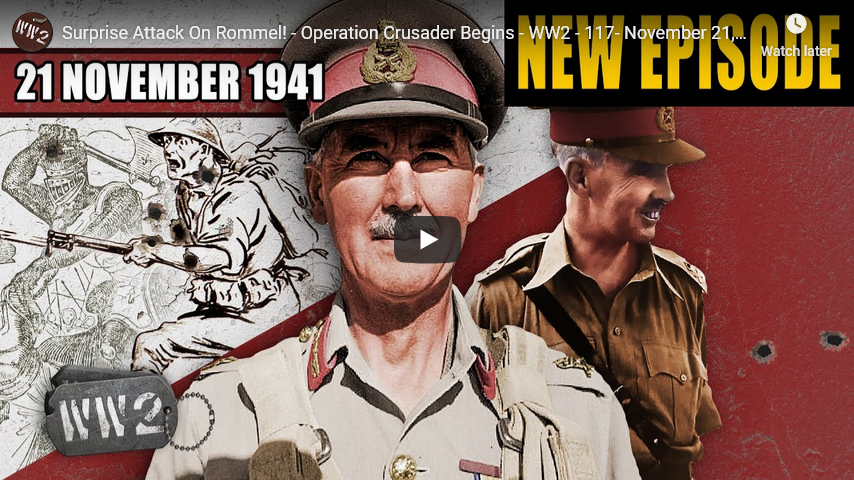
The long planned Allied Offensive in North Africa — Operation Crusader — begins, but the Allies are worrying about how to defend Singapore in case of Japanese aggression. The Germans renew their drive on Moscow, but their number one flying ace perishes, a major PR hit.
Written and Hosted by: Indy Neidell
Director: Astrid Deinhard
Producers: Astrid Deinhard and Spartacus Olsson
Executive Producers: Astrid Deinhard, Indy Neidell, Spartacus Olsson, Bodo Rittenauer
Creative Producer: Maria Kyhle
Post-Production Director: Wieke Kapteijns
Research by: Indy Neidell
Edited by: Miki Cackowski
Sound design: Marek Kamiński
Map animations: Eastory (https://www.youtube.com/c/eastory)
Sources:
Narodowe Archiwum Cyfrowe
Bundesarchiv
Australian War Memorial
Yad Vashem 143BO2
IWM E 6661, K 1261, A 3898, A 10499, FE 487, TR153, E 2384E
Soundtracks from the Epidemic Sound:
Johannes Bornlof – “Death And Glory 2”
Johan Hynynen – “Dark Beginning”
Farrell Wooten – “Blunt Object”
Reynard Seidel – “Deflection”
Johannes Bornlof – “Last Man Standing 3”
Johannes Bornlof – “The Inspector 4”
Philip Ayers – “Under the Dome”
Max Anson – “Ancient Saga”
Johannes Bornlof – “Deviation In Time”
Jon Bjork – “Disposal”
A TimeGhost chronological documentary produced by OnLion Entertainment GmbH.
From the comments:
World War Two
3 days ago
On December 7th we will cover the Japanese attack on Pearl Harbor in real time, minute by minute, as it happens … for five solid hours starting 0610 local Hawaiian time right here on this channel. Don’t miss it!
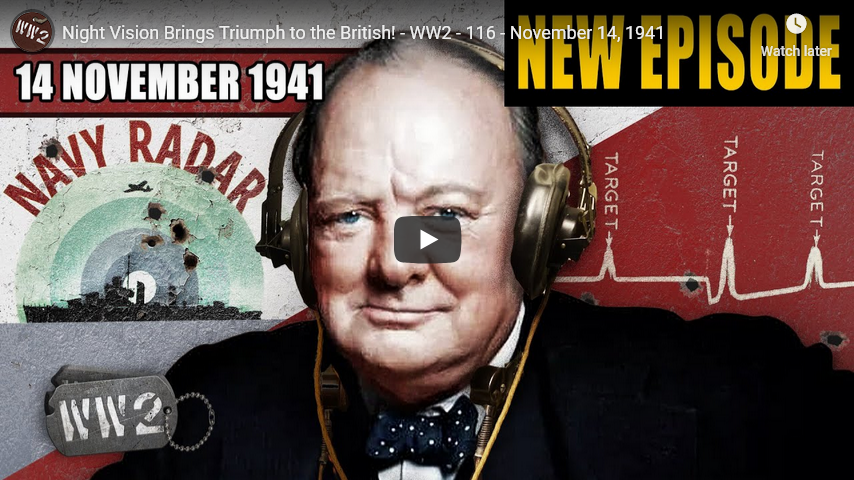
The British sink an entire convoy of supplies heading for Rommel in North Africa by using radar at night, something their opponents lack. In North Africa itself, the Allies are gearing up for a major offensive to begin in a few days. Meanwhile, the Germans are gearing up for a renewed drive on Moscow even as Georgy Zhukov launches small attacks there designed to spoil the larger German plans.
Written and Hosted by: Indy Neidell
Director: Astrid Deinhard
Producers: Astrid Deinhard and Spartacus Olsson
Executive Producers: Astrid Deinhard, Indy Neidell, Spartacus Olsson, Bodo Rittenauer
Creative Producer: Maria Kyhle
Post-Production Director: Wieke Kapteijns
Research by: Indy Neidell
Edited by: Karolina Dołęga
Sound design: Marek Kamiński
Map animations: Eastory (https://www.youtube.com/c/eastory)
Visual Sources:
– Bundesarchiv
– Imperial War Museums: A 8158, FL 4822, A7266, G40, A 6329, A 6333, E 6724, WPN 298, IB2095, CM1725,
– Mil.ru
– Portrait of Alfred Godwin-Austen courtesy of Berserker276 from Wikimedia Commons
– Icons from Noun Project: boy by Mauro Lucchesi, Nick Novell, Calendar by Lorena Salagre, horse by Luis Prado, Gentleman by Samy Menai, man face by Nick Novell, Russian Russian soldier by Wonmo Kang
Soundtracks from Epidemic Sound:
– “March Of The Brave 10” – Rannar Sillard – Test
– “Last Point of Safe Return” – Fabien Tell
– “Weapon of Choice” – Fabien Tell
– “Please Hear Me Out” – Philip Ayers
– “Potential Redemption” – Max Anson
– “nBreak Free” – Fabien Tell
– “Moving to Disturbia” – Experia
– “The End Of The World 2” – Håkan Eriksson
– “Epic Adventure Theme 4” – Håkan Eriksson
A TimeGhost chronological documentary produced by OnLion Entertainment GmbH.
From the comments:
World War Two
2 days ago
Mark December 7th in your calendars, for that day we have five hours of material — ten half-hour episodes — coming out to tell you the story of Pearl Harbor minute by minute in real time, starting 0610 local Hawaiian time.
And in addition to specials like that and our regular week by week coverage here on YouTube, we also cover the war day by day on Instagram, filling in things we don’t have time to cover here. It’s a perfect complement to this. Check it out at: https://www.instagram.com/world_war_two_realtime/
Comments Off on Night Vision Brings Triumph to the British! – WW2 – 116 – November 14, 1941
Don’t miss the special announcement of our new exciting collaboration at the end of this episode!
Register for free at World of Warships here: https://wo.ws/PearlHarbor and receive a special in-game package worth €25, including the ships USS St. Louis, Japanese Cruise Tenryū – and more bonuses.
In this episode:
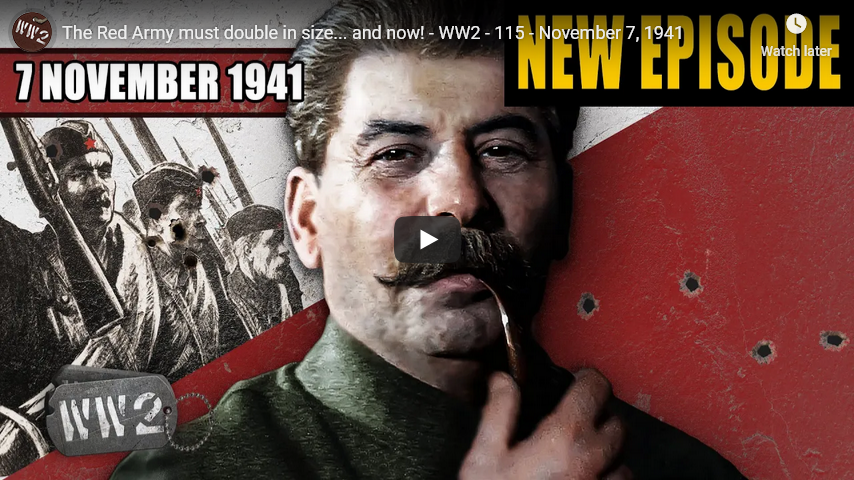
There is a lull now on the Eastern Front, and Adolf Hitler uses the time to plan another drive on Moscow and points beyond, but he’ll be facing a larger Red Army, as reinforcements and recruits hope to nearly double its size in a matter of weeks. The British are counting down the days to their upcoming North African offensive, and the Japanese are sending out orders that will change the world dramatically in a single morning.
Written and Hosted by: Indy Neidell
Director: Astrid Deinhard
Producers: Astrid Deinhard and Spartacus Olsson
Executive Producers: Astrid Deinhard, Indy Neidell, Spartacus Olsson, Bodo Rittenauer
Creative Producer: Maria Kyhle
Post-Production Director: Wieke Kapteijns
Research by: Indy Neidell
Edited by: Miki Cackowski
Sound design: Marek Kamiński
Map animations: Eastory (https://www.youtube.com/c/eastory)
Sources:
Bundesarchiv
Arkiv i Nordland
Narodowe Archiwum Cyfrowe
IWM C 4748, E 6661, WPN 298, E 6724, MH 9292, E 3469E, E 7008, E 759C
Picture of Alfred Godwin-Austin, courtesy of Berserker276 https://commons.wikimedia.org/wiki/Fi…
from the Noun Project: company soldiers by Andrei Yushchenko, Bell by wahyakup
Soundtracks from the Epidemic Sound:
Reynard Seidel – “Deflection”
Johannes Bornlof – “Deviation In Time”
Rannar Sillard – “March Of The Brave 4”
Bonnie Grace – “The Dominion”
Johan Hynynen – “Dark Beginning”
Johannes Bornlof – “The Inspector 4”
Fabien Tell – “Last Point of Safe Return”
Hakan Eriksson – “Epic Adventure Theme 3”
A TimeGhost chronological documentary produced by OnLion Entertainment GmbH.
From the comments:
merdiolu81
22 hours ago (edited)
Meanwhile, on 30 October, Stalin had raised a casual question. “How are we going to do the military parade?” That was the great, traditional 7 November Red Square parade, the celebration of the 1917 “October” Revolution, which had taken place on 24-5 October, Old Style — 6-7 November, New Style. General Pavel Artem’ev, who had been commander of the Moscow Military District and had taken command of the Moscow defence zone as the critical phase began, on 12 October, said it could not happen. Yes, it would, said Stalin. If there was a German air raid, the dead and wounded should be removed quickly, he added. It would happen. The risk was considerable. The potential political response was devastatingly positive, and worth the risk. The “Boss” had his faults (aside being a brutal tyrant) , but this was the decision of a leader. The parade would take place, and the troops, guns and armoured vehicles would then proceed straight to the front. It was a stroke of genius. The military effect would be compounded by the media and political effect. As always, everything was kept secret until the last moment. The officers involved did not receive their final briefing until 02.00. Stalin liked surprises, as most dictators do.
On 7 November, at 08.00 hours, just after dawn, under a steely, overcast Russian sky, with rimy air on the brink of freezing and snow beginning to fall, the troops marched south-east down the “square”, towards St Basil’s Cathedral and the Moskva river, beyond. Red Square, which owes its name to the old Slavic word for “beautiful”, and not to communism at all, is not really a square, either. It is a wide cobbled boulevard, running past the north-east wall of the red-brick, triangular Renaissance fortress. St Basil’s Cathedral is the onion-domed fantasy built for Ivan the Terrible. He was so delighted with it that he had the architect’s eyes put out, so that he could not build for anybody else anything so whimsically fantastic and beautiful. Stalin admired Ivan. The Germans were coming from the north-north-west, so, once the troops, guns and armoured vehicles had passed Lenin’s Mausoleum and reached St Basil’s, they would turn smartly about and head in the opposite direction, up Gor’kiy Street, and then north-west, to face the Germans.
The stars of the show were the new T-34 and KV tanks. But one of the heavy KV tanks screeched to a halt and then turned the wrong way. Another followed. The tanks were all armed, ready for battle, and if anybody wanted to take out the Politburo standing on Lenin’s Mausoleum, that would have been an ideal opportunity. Given the paranoia which prevailed in Moscow at the time, overreaction might have been the order of the day. Artem’ev demanded to know what had happened. The first tank, it turned out, had suffered a mechanical problem, and its commander did not want to cause any embarrassment on the big parade, so he got out of the way. Following the standard operating procedures the newly trained crews had been taught, the second tank went to its aid. This was starting to look like a professional army. The boss classes gathered on the Mausoleum found it amusing, and no one was reprimanded. The big parade was an iconic image of the war, and a stroke of public-relations genius. And, that night, earlier than usual, the Russian winter snow really began to fall.
Absolute War, Soviet Russia in the Second World War – Chris Bellamy
Comments Off on The Red Army must double in size… and now! – WW2 – 115 – November 7, 1941
The Germans draw ever closer to Moscow, but Soviet reinforcements have begun to arrive from Siberia and the city’s defenses have grown stronger. Meanwhile in the south, the Germans are sweeping into the Crimea and looking hungrily at the Caucasus.
Written and Hosted by: Indy Neidell
Director: Astrid Deinhard
Producers: Astrid Deinhard and Spartacus Olsson
Executive Producers: Astrid Deinhard, Indy Neidell, Spartacus Olsson, Bodo Rittenauer
Creative Producer: Maria Kyhle
Post-Production Director: Wieke Kapteijns
Research by: Indy Neidell
Edited by: Miki Cackowski
Sound design: Marek Kamiński
Map animations: Eastory (https://www.youtube.com/c/eastory)
Sources:
Mil.ru
Bundesarchiv
Narodowe Archiwum Cyfrowe
Yad Vashem 90FO3
from the Noun Project: Skull by Muhamad Ulum, Horse by RIZCA, Injury by Adriano Emerick, Oil Tank by Mangsaabguru
Soundtracks from the Epidemic Sound:
Johannes Bornlof – “The Inspector 4”
Reynard Seidel – “Deflection”
Johannes Bornlof – “Death And Glory 3”
Johan Hynynen – “Dark Beginning”
Hakan Eriksson – “Epic Adventure Theme 4”
Gunnar Johnsen – “Not Safe Yet”
Andreas Jamsheree – “Guilty Shadows 4”
Moscow panics as the Germans edge closer and take prisoners by the hundreds of thousands, even as the temperature drops far below freezing. At home in Germany, Josef Goebbels has a problem – he’s promised victory too soon and too often. And in Japan, a government falls.
A TimeGhost chronological documentary produced by OnLion Entertainment GmbH.
From the comments:
World War Two
2 days ago
Japan’s immediate future seems decided with a new government that certainly has no issue with the war in China or with extending that war to the south, meanwhile Moscow panics as the Germans approach. What does all this mean for the men and women in the occupied territory? What does it mean for those at home?
To learn more about that check out our sub-series “War Against Humanity” and “On the Homefront”:
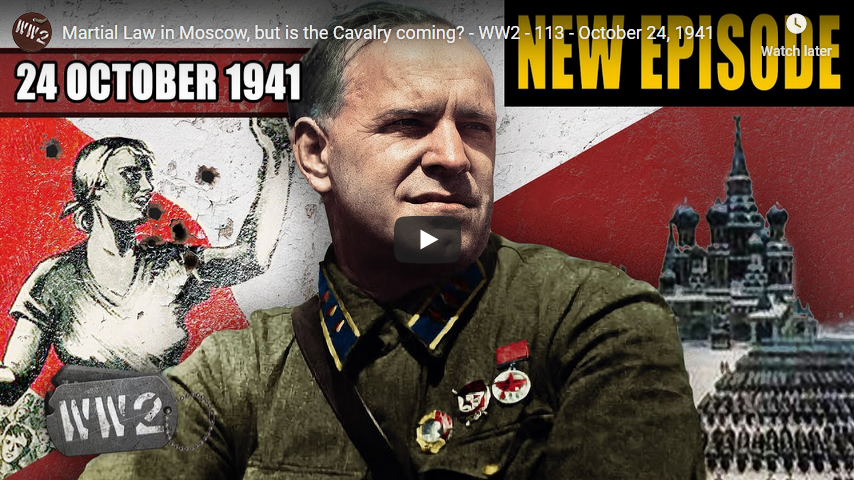
The road to Moscow does indeed lay open before the Germans, but for how long? And can they exploit such an opportunity — since the panzers are busy encircling hundreds of thousands of Soviet soldiers near Vyazema? Georgy Zhukov arrives in Moscow to take charge of the Soviet defenses and try to shut the door.
Written and Hosted by: Indy Neidell
Director: Astrid Deinhard
Producers: Astrid Deinhard and Spartacus Olsson
Executive Producers: Astrid Deinhard, Indy Neidell, Spartacus Olsson, Bodo Rittenauer
Creative Producer: Maria Kyhle
Post-Production Director: Wieke Kapteijns
Research by: Indy Neidell
Edited by: Monika Worona
Sound design: Marek Kamiński
Map animations: Eastory (https://www.youtube.com/c/eastory)
Colorizations by:
Carlos Ortega Pereira
Mikołaj Uchman
Julius Jääskeläinen
Daniel Weiss
Sources:
Archive.org
United States Holocaust Memorial Museum
Mil
Bundesarchiv
Adolf Hitler’s renewed drive on Moscow, the Soviet capital, begins this week, even as the Japanese drive on Changsha ends. But major news this week is the colossal amount of equipment, arms, and ammunition that Britain and the neutral USA plan to ship to the beleaguered Soviet Union.
Sources:
Bundesarchiv
Narodowe Archiwum Cyfrowe
RIA Novosti archive, image #585208
Yad Vashem 3725/4
Picture of Lord Beaverbrook, courtesy Yousuf Karsh, Dutch National Archives
Graphics of Hawker Hurricane, courtesy Martin Čížek https://en.wikipedia.org/wiki/File:Hu…
Graphic of P-39Q Airacobra, courtesy Martin Čížek https://commons.wikimedia.org/wiki/Fi…
From the Noun Project: Skull by Muhamad Ulum, Radar by Econceptive, Mining by Pham Duy Phuong Hung, golds by iconsphere, Diamond by IconMark, puncture by supalerk laipawat, tire by Juan León, wool ball by IconMark, Boots by Atif Arshad, Oil by TTHNga, Needle by artworkbean, Gloves by Berkah Icon, Knife by Vladimir Belochkin, saw by Stepan Voevodin, forceps by IcoLabs, Chest X-ray by Turkkub, pills by Komkrit Noenpoempisut, antibiotics by UNiCORN, Roll by rivercon
Soundtracks from the Epidemic Sound:
Johan Hynynen – “Dark Beginning”
Johannes Bornlof – “Death And Glory 3”
Jon Bjork – “For the Many”
Johannes Bornlof – “Last Man Standing 3”
Reynard Seidel – “Deflection”
Johannes Bornlof – “The Inspector 4”
Bonnie Grace – “The Dominion”
Johannes Bornlof – “Deviation In Time”
Gunnar Johnsen – “Not Safe Yet”
Rannar Sillard – “March Of The Brave 10”
As Barbarossa unfolds and the Germans take ever more Soviet territory, they have ever fewer planes with which to fly over it. What does this mean for the forces on the ground? What does this mean for their other theaters of war?
Sources:
Bundesarchiv
Stuka by Kaboldy https://commons.wikimedia.org/wiki/Fi…
from the Noun Project: Bomb by A184, explosion by Nico Tzogalis, Deteriorated building by Tokka Elkholy, Skull by Muhamad Ulum, Air Crash by Lee Mette
Soundtracks from the Epidemic Sound:
Rannar Sillard – “March Of The Brave 4”
Max Anson – “Maze Heist”
Philip Ayers – “Trapped in a Maze”
Johan Hynynen – “Dark Beginning”
Fabien Tell – “Last Point of Safe Return”
[In an NPR broadcast] McDonald’s is positively portrayed as being an excellent, almost heroic, force for good. McDonald’s manner of doing business is celebrated as changing social norms for the better – for making the world (or at least Russia) not only a more consumer-friendly place, but also a more pleasant, a more polite, a more respectful, and a (yes) more happy place.
Listeners are reminded at the start of the clip that Americans smile a lot, including at strangers. Russians – and, especially, Russians under Soviet domination – did not smile very much. Then McDonald’s opened in Moscow in 1990. McDonald’s trains its workers to smile at customers, and to be polite and friendly. We then learn – from one of the Russians who worked at that McDonald’s in Moscow – that that restaurant became a place of pleasant refuge for Muscovites. The simple, smiling friendliness and politeness that Americans take for granted was, in Russia, actively sought after by many Russians and embraced by their choosing to dine at McDonald’s.
Commerce – voluntary exchange – is essential for what Deirdre McCloskey calls “market-tested betterment.” This betterment, however – and Deirdre would agree – is manifested not only in new and better material products but also in the ways in which businesses treat consumers. In market economies consumers are valuable to businesses; in these economies consumers are treated by businesses as respected guests. In contrast, in non-market economies – in economies in which prices and profits are prevented from moving in market-clearing directions – consumers are treated by ‘businesses’ as repellant pests.
The political factions that oppose the rise of Bolshevism in post-revolutionary Russia come together for a conference this week 100 years ago. But apart from the Moscow State Conference, some people in the military actually aim for a military dictatorship to restore order in Russia and continue the war. At the same time the 2nd Battle of Verdun comes to an end with a French victory and revolutionary fever also spreads across the Black Sea Fleet.
Comments Off on The Moscow State Conference – Black Sea Revolutionaries I THE GREAT WAR Week 162
In The Guardian, Alec Luhn reports on the rise of craft brewing in the heart of vodka-swilling Russia:
It is a drizzly Monday night, but Craft rePUBlic is boisterous with the chatter of brewers and beer aficionados. Those just walking in are greeted with a half pint of Red Nelson, a saison beer made with hibiscus tea and orange peel by local brewer Alexei Sazonov, who is celebrating his birthday at the craft beer bar.
Sazonov works at Bottle Share, one of a growing number of microbreweries driving what has been dubbed the “craft revolution” here, but he created Red Nelson at home under his nickname, Big Hedgehog. Sazonov says of the major Russian beer brands, whose bland lagers dominate store shelves and taps: “They boil it quickly, ferment it quickly and sell it quickly. A microbrewer brews beer he wants to drink himself.”
Russia, of course, is known for vodka rather than beer, and a popular saying holds that “beer without vodka is throwing money to the wind”. According to the latest World Health Organisation data from 2010, 51% of alcohol consumed in Russia was spirits and only 38% was beer. This vodka culture has had deadly consequences for Russian men, whose average life expectancy of just 64 years lags behind that in European countries due mainly to heavy drinking and tobacco use.
Now a new generation of “beer geeks”, as they dub themselves, is working to change Russians’ approach to beer – and to drinking in general. With a focus on savouring the taste rather than drinking to get drunk, at least two dozen craft bars have opened in Moscow since the summer of 2014, serving Russian and foreign microbrews. They’re getting so numerous that the cultural magazine Afisha declared in August that it was “refusing to write reviews of the craft beer bars that are opening every week”.
Few expect beer to displace vodka as the national drink, especially after the government reduced the minimum price of the spirit in 2015 amid economic troubles. But there’s a long tradition of homebrewing in Russia, and the growth potential of craft beer is huge thanks to its relative affordablity; local craft brews typically sell for between 200 and 300 roubles (£2-3) a pint. Moreover, it’s easy to start a craft bar: no liquor licence is required if an establishment serves only beer, and startup costs are minimal, since a large staff, kitchen and lavish interiors aren’t typically necessary. As a result, craft bars are spreading from Moscow and St Petersburg to the regions.
Comments Off on The craft beer movement infiltrates the land of vodka