Train of Thought
Published 5 May 2023In today’s video, we take a look at the American Orient Express, an attempt made by several businesses to replicate the charm and appeal of the real deal that just kept running into bad luck.
(more…)
August 5, 2023
The rotten luck of the American Orient Express
June 17, 2023
China’s long-term revenge for the Opium Wars
In Quillette, Aaron Sarin discusses what he calls the “Reverse Opium War” with Chinese drugs flooding the US street drug culture:

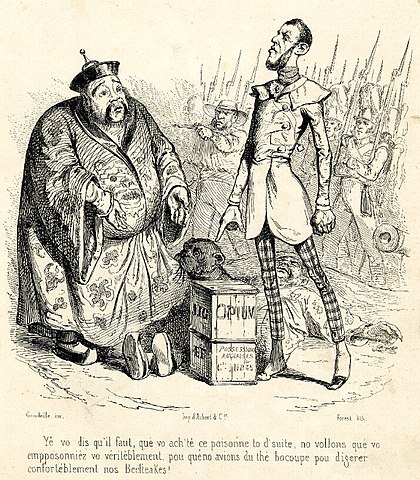
Jean-Jacques Grandville cartoon originally published in Charivari in 1840. “I tell you to immediately buy the gift here. We want you to poison yourself completely, because we need a lot of tea in order to digest our beefsteaks.”
Image and translated caption from Wikimedia Commons.
An epidemic is stalking American cities. Every day, men and women die on sidewalks, in bus shelters, on park benches. Some die sprawled in crowded plazas at midday; others die slumped in the corners of lonely gas station bathrooms. Internally, however, the circumstances are the same. They all end their lives swimming in the warm amniotic dream of a lethally dangerous opioid. When it comes, the moment of death is imperceptible: coaxed by the drug further and further from shore, the user simply floats out too far, passing some unmarked point of no return. The heartbeat weakens, the breathing slows and shallows. As soft an end as anyone might wish for.
This is the fentanyl crisis. It may seem strange to connect a very modern and very American phenomenon to a brace of wars waged 200 years ago by the British Empire on the last of the Chinese dynasties. But so the rhetoric runs: we are witnessing a Reverse Opium War; a belated Sinic revenge.
The Communist Party teaches schoolchildren that China was once a glorious superpower, until it was brought low by that subtlest and most devious of British weapons: Lachryma papaveris (poppy tears). Opium sapped the nation’s strength, and when the Chinese authorities banned it, then Britain went to war — twice.
Those wars crippled the Qing and heralded a “century of humiliation” for China — multiple military defeats and lopsided treaties, the Anglo-French looting and burning of the Emperor’s Summer Palace, the Japanese Rape of Nanking and lethal human experimentation by Unit 731 — ending only with the liberating forces of Marxism-Leninism in 1949. Now some commentators are telling us that history has inverted, that karma has kicked in.
Before examining this idea, we should remind ourselves of the American predicament. Ten years ago, fentanyl began its steady flow from China to the United States. Within just three years the drug had surpassed heroin to become the most frequent cause of American overdose deaths. Fentanyl is many times more powerful than heroin, and so there should be no surprise that lethality has spiked since the great Chinese flow began: in 2012, heroin topped the list with 6,155 deaths; by 2016, fentanyl was proving three times as deadly, with 18,335 deaths. The opioid’s influence seeps into all corners of the narcotics market, due to dealers hiding it in cocaine, heroin, and ecstasy. And it leaks across social strata, killing the homeless but also the rock star Prince, who passed away in an elevator at his Paisley Park estate after ingesting fentanyl disguised as Vicodin.
Under American pressure, the Chinese authorities agreed to regulate fentanyl analogs and two fentanyl precursor chemicals, but it soon turned out that shipments were being rerouted via Mexico. With this new arrangement, the crisis only deepened: between 2019 and 2021, the opioid killed 200 Americans a day. Last year alone, the DEA seized quantities of the drug equivalent to 410 million lethal doses. That’s enough to kill everyone in the US. Even a pandemic couldn’t stem the flow for long: in fact, Wuhan is one of the world’s most reliable suppliers of fentanyl precursors (a role it played both before and after starring at the eye of the COVID storm).
The booming fentanyl trade does not appear to rely on traditional criminal organisations, in the way that East Asian methamphetamine trafficking depends on the Triads. Instead, it turns out to be small family-based groups and legitimate businesses who manufacture and move the drug. Usually located on China’s south-eastern seaboard — Zhejiang, Fujian, Guangdong — these groups use the cover of the vast Chinese chemical industry to channel ingredients into the manufacture of fentanyl-class drugs and their precursors.
May 17, 2023
Texas Chili & The Chili Queens of San Antonio
Tasting History with Max Miller
Published 16 May 2023
(more…)
April 27, 2023
M1908 Mondragon Semiauto Rifle
Forgotten Weapons
Published 24 Nov 2014The M1908 Mondragon is widely acknowledged to have been the first self-loading rifle adopted as a standard infantry arm by a national military force. There are a couple of earlier designs used by military forces, but the Mondragon was the first really mass-produced example and deserves its place in firearms history.
Designed by Mexican general Manuel Mondragon (who had a number of other arms development successes under his belt by this time), the rifles were manufactured by SIG in Switzerland. They are very high quality guns, if a bit clunky in their handling.
The design used a long-action gas piston and a rotating bolt to lock. Interestingly, the bolt had two full sets of locking lugs; one at the front and one at the rear as well as two set of cams for the operating rod and bolt handle to rotate the bolt with. The standard rifle used a 10-round internal magazine fed by stripper clips, but they were also adapted for larger detachable magazines and drums.
Unfortunately, the rifle required relatively high-quality ammunition to function reliably, and Mexico’s domestic production was not up to par. This led to the rifles having many problems in Mexican service, and Mexico refused to pay for them after the first thousand of their 4,000-unit order arrived. The remaining guns were kept by SIG, and ultimately sold to Germany for use as aircraft observer weapons.
(more…)
April 10, 2023
US Army and Marine Corps deployments other than with the American Expeditionary Forces (AEF)
Another excerpt from John Sayen’s Battalion: An Organizational Study of United States Infantry currently being serialized on Bruce Gudmundsson’s Tactical Notebook shows where US infantry units (US Army and USMC) were deployed aside from those assigned to Pershing’s AEF on the Western Front in France:
Apart from the war in Europe, the principal military concern of the Wilson administration during 1917-18 was the protection of resources and installations considered vital to the war effort. The threat of German sabotage in the United States was taken very seriously. In addition, Mexico was still unstable politically and sporadic border clashes continued to occur into 1919. Mexican oil was also regarded as an essential resource and the troops stationed on the Mexican border were prepared to invade in order to keep it flowing. However, all the National Guard, National Army, and even the Regular Army regiments raised for wartime only were reserved for duty with the AEF. (The National Army 332nd and 339th Regiments did deploy to Italy and North Russia, respectively, but both remained under AEF command.) This left non-AEF assignments in the hands of the pre-war Regular Army regiments.
Out of 38 Regular infantry regiments available in 1917, 25 were on guard duty within the Continental United States or on the Mexican border and 13 garrisoned U.S. possessions overseas. Local defense forces raised in Hawaii and the Philippines eventually freed the pre-war regiments stationed in those places for duty elsewhere. By the end of the war the 15th Infantry in China, the 33rd and 65th (Puerto Rican) Infantry in the Canal Zone, and the 27th and 31st Infantry (both under the AEF tables) in Siberia were the only non-AEF regiments still overseas. Inside the United States state militia (non-National Guard) units and 48 newly raised battalions of “United States Guards” (recruited from men physically disqualified for overseas service) had freed 20 regiments from stateside guard duties, but not in time for any of them to fight in France.
Only twelve pre-war regiments actually saw combat in the AEF. Nine of them served with the early-arriving 1st, 2nd, and 3rd AEF Divisions. The other three were with the late arriving 5th and 7th Divisions. One more reached France with the 8th Division, but only days ahead of the Armistice. By this time, the Regular Army regiments had long ago been stripped of most of their pre-war men to provide cadre for new units. They were refilled with so many draftees that their makeup scarcely differed from those of the National Army.*
The situation with the Marines was similar to that of the Regular Army. Most Marine regiments had to perform security and colonial policing duties that kept them away from the “real” war in France. Also like the Army, the Marines made Herculean efforts to accommodate a flood of recruits, acquiring training bases at Quantico Virginia and Parris Island South Carolina, as their existing facilities became too crowded. The Second Regiment (First Provisional Brigade) continued to police Haiti while the Third and Fourth Regiments (Second Provisional Brigade) did the same for the Dominican Republic. The First Regiment remained at Philadelphia as the core of the Advance Base Force (ABF) but its role soon became little more than that of a caretaker of ABF equipment.
Although there was little danger from the German High Seas Fleet ABF units might still be needed in the Caribbean to help secure the Panama Canal and a few other critical points against potential attacks by German surface raiders or heavily armed “U-cruisers.” Political unrest was endangering both the Cuban sugar crop and Mexican oil. To address such concerns, the Marines raised the Seventh, Eighth, and Ninth Regiments as infantry units in August, October, and November 1917, respectively. The Seventh, with eight companies went to Guantanamo, Cuba, to protect American sugar interests. The Ninth Regiment (nine companies) and the headquarters of the Third Provisional Brigade followed. The Eighth Regiment with 10 companies, meanwhile, went to Fort Crockett near Galveston, Texas to be available to seize the Mexican oil fields with an amphibious landing, should the situation in Mexico get out of hand.
Three other rifle companies (possibly the ones missing from the Seventh and Ninth Regiments) occupied the Virgin Islands against possible raids by German submarines. In August 1918, the Seventh and Ninth Regiments expanded to 10 companies each. The situation in Cuba having subsided, the Marine garrison there was reduced to just the Seventh Regiment. The Ninth Regiment and the Third Brigade headquarters joined the Eighth at Fort Crockett.**
* Order of Battle of the United States Land Forces in the World War op cit pp. 310-314 and 1372-1379. A battalion of United States Guards was allowed 31 officers and 600 men. These units were recruited mainly from draftees physically disqualified for overseas service. The 27th and 31st Infantry when sent to Siberia were configured as AEF regiments, though they were never part of the AEF. Large numbers of men had to be drafted out of the 8th Division to build these two regiments up to AEF strength. This seriously disrupted the 8th Division’s organization.
** Order of Battle of the United States Land Forces in the World War op cit pp. 1372-78; Truman R. Strobridge, A Brief History of the Ninth Marines (Washington DC, Historical Division HQ US Marine Corps; revised version 1967) pp. 1-2; James S. Santelli, A Brief History of the Eighth Marines (Washington DC, Historical Division HQ US Marine Corps; 1976) pp. 1-3; and James S. Santelli, A Brief History of the Seventh Marines (Washington DC, Historical Division HQ US Marine Corps; 1980) pp. 1-5.
March 4, 2023
Corruption? In Arizona? It’s more disturbing than you think
Elizabeth Nickson digs into the allegations of massive corruption in the state of Arizona:

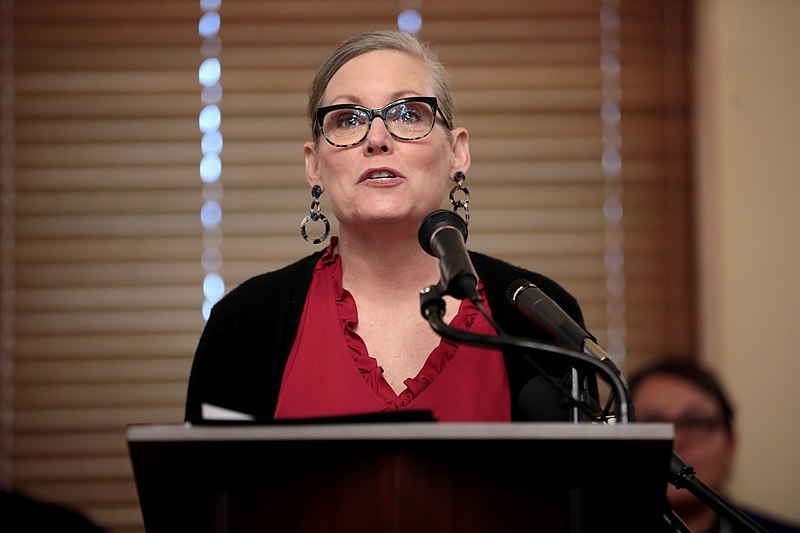
Governor Katie Hobbs speaking with attendees at a Statehood Day ceremony in the Old Senate Chambers at the Arizona State Capitol building in Phoenix, Arizona on 14 February, 2023.
Photo by Gage Skidmore via Wikimedia Commons.
One always likes a unifying theory, particularly one that explicates a thorny mystery rigorously ignored by the super-culture, by which I mean the world that the educated and financially secure occupy.
For instance: why was the preponderance of evidence of election fraud ignored by the courts? How did corruption in city and county governments take hold? Why are desperate people flooding the borders unchecked? Why is human and child sex trafficking so prevalent and not stopped? Why are we permitting our fellow citizens to become human wrecks in open-air drug markets? Why are our biggest cities degrading? Why, in so many cities, is middle class housing out of reach for the middle class?
The answer may be because a significant number of elected and appointed officials have been bribed by cartels and other criminal enterprises like the CCP or Asian gangs, like the ones operating in Vancouver, Seattle and San Francisco. And they are bribed through single family housing, bidding up and up and up the price of real estate.
Late last week, an extraordinary hearing took place in the Arizona Senate, whiphanded by Liz Harris, the chair of the committee investigating election fraud in Arizona. Only Harris expected the last presentation, and it was given by a woman we have all met in the nether worlds of finance when we are re-mortgaging, insuring, reinsuring, or investing in a local enterprise.
She is competent, reductionist, modest, and honest to a fault. She knows the paperwork she slides in front of you for signature, willing to describe every phrase in exhaustive detail.
One of those invisible people upon whom the entire system relies.
Jacqueline Breger was a single mother who owns her own insurance company, has multiple degrees, in accounting, an MBA, and various other necessary finance-industry certifications. She works with her husband1, an investigative attorney named John Thaler.
The story she told had half of America transfixed. Her testimony was based on that of a whistleblower from the Sinaloa cartel given during an application for witness protection, and the subsequent acquisition of 120,000 court documents that prove the case.
Nobody could believe it. Even those who would benefit by it if it were true, didn’t believe it. In the dozen or so interviews that followed the testimony, questions were barked at her and her employer with no small measure of hostility. Rick Santelli of CNBC looked as if all his hair was standing on end.
It starts this way:
In 2006, members of the Sinaloan cartel were arrested, tried and convicted for money laundering through single family homes in Illinois, Iowa and Indiana.
In 2014, Berger’s partner, John Thaler was asked to review the Sinaloan cases in Illinois, Indiana and Iowa and investigate whether the cartel had moved its enterprise to Arizona. Currently, the couple are working with several States Attorneys, the Attorneys General of New Mexico and California, and members of the FBI.
So this is a theory that requires attention.
1. Thaler and Berger are married. Thaler’s ex-wife was the Sinaloan cartel member who requested witsec, and decanted the evidence which triggered the acquisition of the thousands of forged and fake documents. Much of the story is focused on the domestic drama, as if domestic drama were not a part of everyone’s life at one time or another. I am more interested in discovering the truth of the matter.
January 8, 2023
Caesar Salad and Satan’s Playground
The History Guy: History Deserves to Be Remembered
Published 7 Sep 2022The rare example of a food fad that has maintained its popularity, the tangy dressing on romaine lettuce salad has a history as rich as a coddled egg, involving multiple nations, a bevy of movie stars, an infamous American divorcee, a disputed origin story, and, prominently, alcohol. And, perhaps surprising to many, is unrelated to the notorious Roman dictator.
(more…)
November 17, 2022
A History of Tacos
Tasting History with Max Miller
Published 5 Jul 2022
(more…)
September 7, 2022
The Original Caesar Salad from Mexico
Tasting History with Max Miller
Published 6 Sep 2022
(more…)
July 13, 2022
The Irish Fighting for Britain, Mexico’s Role in the War, and Chuikov in Uranus – WW2 – OOTF 27
World War Two
Published 12 Jul 2022How many Irishmen are fighting for Britain and why? And what did Chuikov do during Operation Uranus? And what role has Mexico played in the fighting so far? Find out the answers to these fascinating questions in our latest edition of Out of the Foxholes!
(more…)
December 28, 2021
The Bubblegum History … of Chewing Gum
TimeGhost History
Published 27 Dec 2021Ancient Finns, angry Ottomans, a one-legged Mexican general, and scouring soap — that’s the story of modern chewing gum in a nutshell!
Hosted by: Indy Neidell and Spartacus Olsson
Written by: Indy Neidell
Director: Astrid Deinhard
Producers: Astrid Deinhard and Spartacus Olsson
Executive Producers: Astrid Deinhard, Indy Neidell, Spartacus Olsson, Bodo Rittenauer
Creative Producer: Maria Kyhle
Post-Production Director: Wieke Kapteijns
Edited by: Karolina Dołęga
Sound design: Marek KamińskiSources:
– Birch Bark photo courtesy of Jerzy Opioła https://commons.wikimedia.org/wiki/Fi…
– Mastic tears photo courtesy of פארוק https://en.wikipedia.org/wiki/Mastic_…
– Mexican Cession map courtesy of Kballen https://commons.wikimedia.org/wiki/Fi…
– Peter Gabriel, Chateau Neuf, Oslo, Norway courtesty of Helge Øverås https://en.wikipedia.org/wiki/File:Pe…
– Promotional Chiclets courtesy of Coolshans https://commons.wikimedia.org/wiki/Fi…Soundtracks from Epidemic Sound:
– “Ancient Saga” – Max Anson
– “Master of the Hurricane” – Rockin’ For Decades
– “Home on the Prairie” – Sight of Wonders
– “Cocktail Hour” – The Fly Guy FiveArchive by Screenocean/Reuters https://www.screenocean.com.
A TimeGhost chronological documentary produced by OnLion Entertainment GmbH.
October 16, 2021
City Minutes: Indigenous America
Overly Sarcastic Productions
Published 15 Oct 2021As we look at four pre-Columbian American cities, I don’t know whether to be more impressed with the the architecture or the landscaping. Probably both.
More Indigenous Myths & History:
The Five Suns (https://youtu.be/dfupAlon_8k)
Quetzalcoatl (https://youtu.be/451jzIesWoU)
Huitzilopotchli (https://youtu.be/Zj-jDOjBets)
El-Dorado (https://youtu.be/UHzkGueRz3g)
Pele (https://youtu.be/q1z19p48lZU)
Hawaii (https://youtu.be/xYouQESFE2A)Teotihuacan shirt: https://www.redbubble.com/shop/ap/903…
Timestamps:
0:00 – 1:03 — Teotihuacan
1:03 – 2:04 — Tikal
2:04 – 3:00 — Tenochtitlan
3:00 – 4:08 — Cusco
4:08 – 5:20 — ConclusionSOURCES & Further Reading: The Great Cities in History by John Julius Norwich, The Great Courses lectures “The Great City of Teotihuacan” and “Tikal – Aspiring Capital of the Maya World” and “The Aztec Capital of Tenochtitlan” from lecture series Maya to Aztec: Ancient Mesoamerica Revealed by Edwin Barnhart, and “Machu Picchu and the Sacred Valley” and “The Inca – From Raiders to Empire” from lecture series The Lost Worlds of South America by Edwin Barnhart.
Our content is intended for teenage audiences and up.
PATREON: https://www.Patreon.com/OSP
PODCAST: https://overlysarcasticpodcast.transi…
DISCORD: https://discord.gg/osp
MERCH LINKS: http://rdbl.co/osp
OUR WEBSITE: https://www.OverlySarcasticProductions.com
Find us on Twitter https://www.Twitter.com/OSPYouTube
Find us on Reddit https://www.Reddit.com/r/OSP/
July 6, 2021
History Summarized: The Wild West
Overly Sarcastic Productions
Published 7 Sep 2018This video was commissioned by Patron Matthew Ritter. Thanks Matthew! If you would like to support the channel and earn special rewards, check out our Patreon page: www.patreon.com/OSP
Articles referenced — Because Gun Control and Black Cowboys sound incredulous on paper so I can see why you wouldn’t believe me but it’s real and there’s tons of proof:
Gun Control in the West: https://www.smithsonianmag.com/histor…
Black Cowboys: https://www.smithsonianmag.com/histor…MERCH LINKS:
Shirts – https://overlysarcasticproducts.threa…
All the other stuff – http://www.cafepress.com/OverlySarcas…Find us on Twitter @OSPYouTube!
Another article covering gun control in the “Wild West” says:
… enforcement of the anti carry ordinances in Tombstone and Dodge City and other frontier towns like Deadwood, South Dakota that had them were highly selective. In Tombstone, those friendly with the Earps and their buddies got a pass. In Dodge City those friendly with the powers that be and or the Dodge City Gang — which included Wyatt when there — got a pass too on the side of Dodge with the carry ban. That “side” is a rarely mentioned fact. […] The famous sign reading “The Carrying of Firearms Strictly Prohibited” so often used to promote similar laws today was at the entrance to the North incorporated portion where the “decent” Dodge permanent residents sought to exclude riffraff like the drovers and maintain a somewhat puritan lifestyle. Women were not allowed in saloons and singing or dancing was against the law.
The cowboys and other undesirables were supposed to stay below the Deadline according to Wyatt Earp in the book The Old West in Fact and Film: History Versus Hollywood: “Below the deadline, as far as the marshals force was concerned, almost anything went, and a man could get away with gunplay if he wasn’t too careless about lead. North of the railroad, gun toting was justification for shooting on site, if an officer was so inclined, and meant certain arrest.”
Sounds like cut no slack enforcement, but there are simply too many accounts of gun carry on the North side to believe Earp’s account was anything other than his famed self promoting hyperbole. One example is the 1879 gunfight in the Long Branch Saloon between gamblers Frank Loving and Levi Richardson. Loving killed Richardson and a magistrate ruled the killing justifiable self defense. Even so, why was he not charged with illegal gun carry? Possibly because Dodge’s no carry laws and others like it else- where were not put on the books purely for public safety reasons as anti-Second Amendment activists claim …
February 13, 2021
MORE cultural appropriation foods!
J.J. McCullough
Published 14 Nov 2020How much famous food is just copied from some other country? Thanks to Jack Rackham for the shogun animation!
https://www.youtube.com/channel/UCaQz…FOLLOW ME:
🇨🇦Support me on Patreon! https://www.patreon.com/jjmccullough
🤖Join my Discord! https://discord.gg/3X64ww7
🇺🇸Follow me on Instagram! https://www.instagram.com/jjmccullough/
🇨🇦Read my latest Washington Post columns: https://www.washingtonpost.com/people…
🇨🇦Visit my Canada Website http://thecanadaguide.comHASHTAGS: #food #cooking #history
January 8, 2021
QotD: Culinary appropriation
Cultural appropriation is good. When ideas from different cultures are imperfectly absorbed, new ideas ensue. Exchange promotes change. I detest empires, but, in deference to truth, praise them as culturally creative arenas in which new ways of life, thought, art, language, worship, work, government and food take shape, as people swap and circulate biota, behaviour and brilliance.
Some of the resulting dishes are deplorable. I could live happily in a world without chop suey, chilli con carne, or coronation chicken. I’m not going to try a recipe described in Eater magazine as “huevos Kathmandu that paired green chutney and spiced chickpeas with fried eggs”.
Tex-mex cuisine is Montezuma’s most effective revenge. Rijstafel conquered the Netherlands more thoroughly than the Dutch ever subjected the East, and now rivals the drearier Hutspot as Holland’s national dish. Yet Dutch food still lags behind grandes cuisines.
Vindaloo is the epitome of culinary appropriation: a Bengali dish with ingredients from the Americas — potatoes and chillies — and a corruption of a Portuguese name: vinho d’alho, or garlic wine. It has become so British that “Vindaloo nah-nah” was the chorus of a chant popular among English football fans at a World Cup tournament (perhaps they confused it with Waterloo). I still dislike it.
Usually, however, culturally exchanged foods produce admirable dishes. Chocolate, tomato and avocado are among the few English words derived from Nahuatl. The Aztecs never used the items they designate in pain au chocolat, or tricolore, or avocado toast. But the responsible cultural appropriators deserve praise, not blame.
Satay would be unthinkable if Malays hadn’t incorporated peanuts that Portuguese pinched from Brazil. The basics of cajun cuisine reached Louisiana with “Acadian” migrants from French Canada — but cultural appropriation made it what it is today. Black chefs in the same region would be at a loss without African-born yams.
Curries would be historical curiosities if Indians hadn’t appropriated chillies from Mexico. Is Sichuanese cuisine imaginable without American peppers or sweet potatoes. Tempura would be unavailable if Japanese chefs hadn’t annexed and improved Portuguese techniques of frying. Culinary historians bicker over whether Jewish or Italian immigrants developed fish and chips. But almost everyone agrees that the British could never have done it on their own.
Felipe Fernández-Armesto, “Bad taste of PC foodies”, The Critic, 2020-09-19.