
Tasting History with Max Miller
Published 6 Sep 2022
(more…)
September 7, 2022
The Original Caesar Salad from Mexico
Comments Off on The Original Caesar Salad from Mexico
July 13, 2022
The Irish Fighting for Britain, Mexico’s Role in the War, and Chuikov in Uranus – WW2 – OOTF 27
World War Two
Published 12 Jul 2022How many Irishmen are fighting for Britain and why? And what did Chuikov do during Operation Uranus? And what role has Mexico played in the fighting so far? Find out the answers to these fascinating questions in our latest edition of Out of the Foxholes!
(more…)
December 28, 2021
The Bubblegum History … of Chewing Gum
TimeGhost History
Published 27 Dec 2021Ancient Finns, angry Ottomans, a one-legged Mexican general, and scouring soap — that’s the story of modern chewing gum in a nutshell!
Hosted by: Indy Neidell and Spartacus Olsson
Written by: Indy Neidell
Director: Astrid Deinhard
Producers: Astrid Deinhard and Spartacus Olsson
Executive Producers: Astrid Deinhard, Indy Neidell, Spartacus Olsson, Bodo Rittenauer
Creative Producer: Maria Kyhle
Post-Production Director: Wieke Kapteijns
Edited by: Karolina Dołęga
Sound design: Marek KamińskiSources:
– Birch Bark photo courtesy of Jerzy Opioła https://commons.wikimedia.org/wiki/Fi…
– Mastic tears photo courtesy of פארוק https://en.wikipedia.org/wiki/Mastic_…
– Mexican Cession map courtesy of Kballen https://commons.wikimedia.org/wiki/Fi…
– Peter Gabriel, Chateau Neuf, Oslo, Norway courtesty of Helge Øverås https://en.wikipedia.org/wiki/File:Pe…
– Promotional Chiclets courtesy of Coolshans https://commons.wikimedia.org/wiki/Fi…Soundtracks from Epidemic Sound:
– “Ancient Saga” – Max Anson
– “Master of the Hurricane” – Rockin’ For Decades
– “Home on the Prairie” – Sight of Wonders
– “Cocktail Hour” – The Fly Guy FiveArchive by Screenocean/Reuters https://www.screenocean.com.
A TimeGhost chronological documentary produced by OnLion Entertainment GmbH.

Comments Off on The Bubblegum History … of Chewing Gum
October 16, 2021
City Minutes: Indigenous America
Overly Sarcastic Productions
Published 15 Oct 2021As we look at four pre-Columbian American cities, I don’t know whether to be more impressed with the the architecture or the landscaping. Probably both.
More Indigenous Myths & History:
The Five Suns (https://youtu.be/dfupAlon_8k)
Quetzalcoatl (https://youtu.be/451jzIesWoU)
Huitzilopotchli (https://youtu.be/Zj-jDOjBets)
El-Dorado (https://youtu.be/UHzkGueRz3g)
Pele (https://youtu.be/q1z19p48lZU)
Hawaii (https://youtu.be/xYouQESFE2A)Teotihuacan shirt: https://www.redbubble.com/shop/ap/903…
Timestamps:
0:00 – 1:03 — Teotihuacan
1:03 – 2:04 — Tikal
2:04 – 3:00 — Tenochtitlan
3:00 – 4:08 — Cusco
4:08 – 5:20 — ConclusionSOURCES & Further Reading: The Great Cities in History by John Julius Norwich, The Great Courses lectures “The Great City of Teotihuacan” and “Tikal – Aspiring Capital of the Maya World” and “The Aztec Capital of Tenochtitlan” from lecture series Maya to Aztec: Ancient Mesoamerica Revealed by Edwin Barnhart, and “Machu Picchu and the Sacred Valley” and “The Inca – From Raiders to Empire” from lecture series The Lost Worlds of South America by Edwin Barnhart.
Our content is intended for teenage audiences and up.
PATREON: https://www.Patreon.com/OSP
PODCAST: https://overlysarcasticpodcast.transi…
DISCORD: https://discord.gg/osp
MERCH LINKS: http://rdbl.co/osp
OUR WEBSITE: https://www.OverlySarcasticProductions.com
Find us on Twitter https://www.Twitter.com/OSPYouTube
Find us on Reddit https://www.Reddit.com/r/OSP/

Comments Off on City Minutes: Indigenous America
July 6, 2021
History Summarized: The Wild West
Overly Sarcastic Productions
Published 7 Sep 2018This video was commissioned by Patron Matthew Ritter. Thanks Matthew! If you would like to support the channel and earn special rewards, check out our Patreon page: www.patreon.com/OSP
Articles referenced — Because Gun Control and Black Cowboys sound incredulous on paper so I can see why you wouldn’t believe me but it’s real and there’s tons of proof:
Gun Control in the West: https://www.smithsonianmag.com/histor…
Black Cowboys: https://www.smithsonianmag.com/histor…MERCH LINKS:
Shirts – https://overlysarcasticproducts.threa…
All the other stuff – http://www.cafepress.com/OverlySarcas…Find us on Twitter @OSPYouTube!
Another article covering gun control in the “Wild West” says:
… enforcement of the anti carry ordinances in Tombstone and Dodge City and other frontier towns like Deadwood, South Dakota that had them were highly selective. In Tombstone, those friendly with the Earps and their buddies got a pass. In Dodge City those friendly with the powers that be and or the Dodge City Gang — which included Wyatt when there — got a pass too on the side of Dodge with the carry ban. That “side” is a rarely mentioned fact. […] The famous sign reading “The Carrying of Firearms Strictly Prohibited” so often used to promote similar laws today was at the entrance to the North incorporated portion where the “decent” Dodge permanent residents sought to exclude riffraff like the drovers and maintain a somewhat puritan lifestyle. Women were not allowed in saloons and singing or dancing was against the law.
The cowboys and other undesirables were supposed to stay below the Deadline according to Wyatt Earp in the book The Old West in Fact and Film: History Versus Hollywood: “Below the deadline, as far as the marshals force was concerned, almost anything went, and a man could get away with gunplay if he wasn’t too careless about lead. North of the railroad, gun toting was justification for shooting on site, if an officer was so inclined, and meant certain arrest.”
Sounds like cut no slack enforcement, but there are simply too many accounts of gun carry on the North side to believe Earp’s account was anything other than his famed self promoting hyperbole. One example is the 1879 gunfight in the Long Branch Saloon between gamblers Frank Loving and Levi Richardson. Loving killed Richardson and a magistrate ruled the killing justifiable self defense. Even so, why was he not charged with illegal gun carry? Possibly because Dodge’s no carry laws and others like it else- where were not put on the books purely for public safety reasons as anti-Second Amendment activists claim …

Comments Off on History Summarized: The Wild West
February 13, 2021
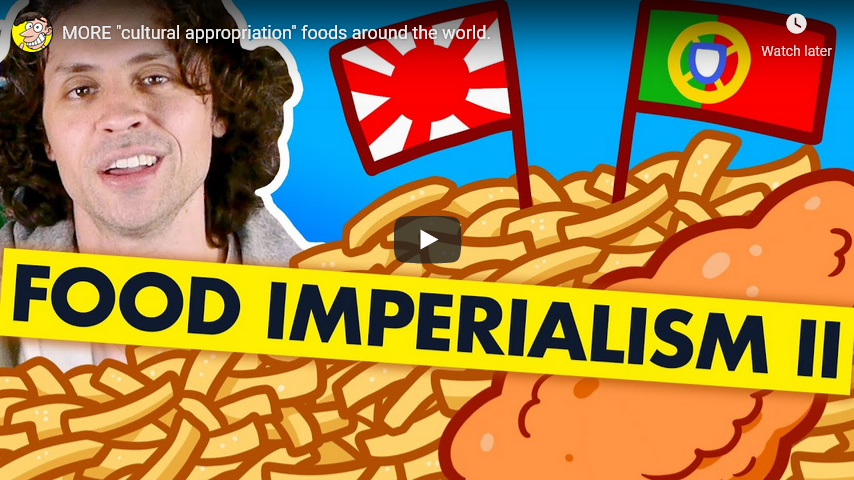
MORE cultural appropriation foods!
J.J. McCullough
Published 14 Nov 2020How much famous food is just copied from some other country? Thanks to Jack Rackham for the shogun animation!
https://www.youtube.com/channel/UCaQz…FOLLOW ME:
🇨🇦Support me on Patreon! https://www.patreon.com/jjmccullough
🤖Join my Discord! https://discord.gg/3X64ww7
🇺🇸Follow me on Instagram! https://www.instagram.com/jjmccullough/
🇨🇦Read my latest Washington Post columns: https://www.washingtonpost.com/people…
🇨🇦Visit my Canada Website http://thecanadaguide.comHASHTAGS: #food #cooking #history
January 8, 2021
QotD: Culinary appropriation
Cultural appropriation is good. When ideas from different cultures are imperfectly absorbed, new ideas ensue. Exchange promotes change. I detest empires, but, in deference to truth, praise them as culturally creative arenas in which new ways of life, thought, art, language, worship, work, government and food take shape, as people swap and circulate biota, behaviour and brilliance.
Some of the resulting dishes are deplorable. I could live happily in a world without chop suey, chilli con carne, or coronation chicken. I’m not going to try a recipe described in Eater magazine as “huevos Kathmandu that paired green chutney and spiced chickpeas with fried eggs”.
Tex-mex cuisine is Montezuma’s most effective revenge. Rijstafel conquered the Netherlands more thoroughly than the Dutch ever subjected the East, and now rivals the drearier Hutspot as Holland’s national dish. Yet Dutch food still lags behind grandes cuisines.
Vindaloo is the epitome of culinary appropriation: a Bengali dish with ingredients from the Americas — potatoes and chillies — and a corruption of a Portuguese name: vinho d’alho, or garlic wine. It has become so British that “Vindaloo nah-nah” was the chorus of a chant popular among English football fans at a World Cup tournament (perhaps they confused it with Waterloo). I still dislike it.
Usually, however, culturally exchanged foods produce admirable dishes. Chocolate, tomato and avocado are among the few English words derived from Nahuatl. The Aztecs never used the items they designate in pain au chocolat, or tricolore, or avocado toast. But the responsible cultural appropriators deserve praise, not blame.
Satay would be unthinkable if Malays hadn’t incorporated peanuts that Portuguese pinched from Brazil. The basics of cajun cuisine reached Louisiana with “Acadian” migrants from French Canada — but cultural appropriation made it what it is today. Black chefs in the same region would be at a loss without African-born yams.
Curries would be historical curiosities if Indians hadn’t appropriated chillies from Mexico. Is Sichuanese cuisine imaginable without American peppers or sweet potatoes. Tempura would be unavailable if Japanese chefs hadn’t annexed and improved Portuguese techniques of frying. Culinary historians bicker over whether Jewish or Italian immigrants developed fish and chips. But almost everyone agrees that the British could never have done it on their own.
Felipe Fernández-Armesto, “Bad taste of PC foodies”, The Critic, 2020-09-19.
Comments Off on QotD: Culinary appropriation
July 21, 2020
QotD: Burritos
This last item is probably why the Burrito (AKA “Tomorrow’s Turd Today”) remains popular with liberal medheads hooked on keeping human ethnic pets on their progressive political plantations. After all, if you can only afford to eat or to feed people once a day, the Burrito is your huckleberry. And if you can also reduce food scraps that would otherwise go straight to the landfill into human waste, you also have a food object that “walks lightly on the planet.”
Gerard VanderLeun, “GRINGO DE MAYO!: A Counter-Celebration for May 7”, American Digest, 2018-05-04.
Comments Off on QotD: Burritos
April 19, 2020
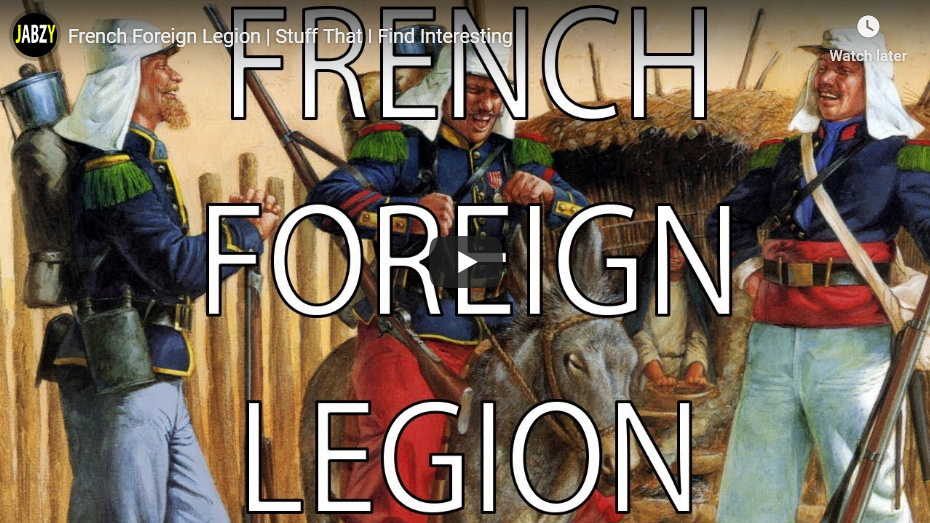
French Foreign Legion | Stuff That I Find Interesting
Jabzy
Published 14 Oct 2017
Comments Off on French Foreign Legion | Stuff That I Find Interesting
February 28, 2020
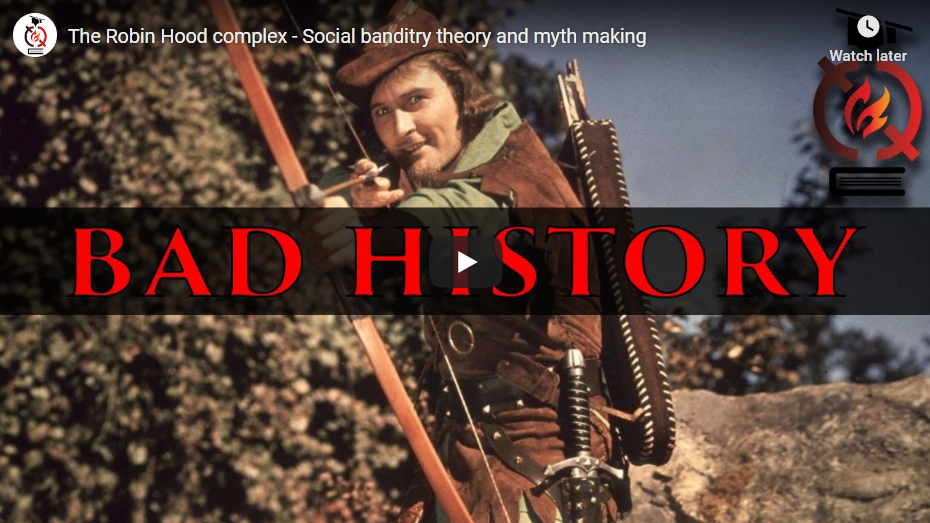
The Robin Hood complex – Social banditry theory and myth making
The Cynical Historian
Published 15 Dec 2016There’s one historical theory that people keep deluding themselves with, and it’s about time I pointed it out. Social banditry, or the “Robin Hood theory” is problematic at best and cultural misanthropy at worst.
Social bandit or social crime is a term invented by the Marxist historian Eric Hobsbawm in his 1959 book Primitive Rebels, a study of popular forms of resistance that also incorporate behavior characterized by law as illegal. He further expanded the field in the 1969 study Bandits. Social banditry is a widespread phenomenon that has occurred in many societies throughout recorded history, and forms of social banditry still exist, as evidenced by piracy and organized crime syndicates. Later social scientists have also discussed the term’s applicability to more modern forms of crime, like street gangs and the economy associated with the trade in illegal drugs.
————————————————————
References:
Boessenecker, John. “California Bandidos.” Southern California Quarterly 80, i4 (Dec. 1, 1998), 419-434.Hall-Patton, Joseph. Pacifying Paradise: Violence and Vigilantism in San Luis Obispo. San Luis Obispo: California Polytechnic – San Luis Obispo thesis, 2016. http://www.digitalcommons.calpoly.edu…
Hobsbawm, Eric. Primitive Rebels: Studies in Archaic Forms of Social Movement in the 19th and 20th Centuries. New York: WW Norton & Company, 1965. https://amzn.to/2L6TDY0
Hobsbawm, Eric. Bandits. Rev. ed. New York: The New Press, 2000. https://amzn.to/2L4RagK
Rediker, Marcus. Outlaws of the Atlantic: Sailor, Pirates, and Motley Crews in the Age of Sail. Boston, Mass.: Beacon Press, 2014. https://amzn.to/2OasYf4
Linebaugh, Peter and Marcus Rediker. The Many-Headed Hydra: Sailors, Slaves, Commoners, and the Hidden History of the Revolutionary Atlantic. Boston, Mass.: Beacon Press, 2000. https://amzn.to/2JKq8tN
https://en.wikipedia.org/wiki/Social_…
https://en.wikipedia.org/wiki/Zorro
https://en.wikipedia.org/wiki/Pancho_…
https://en.wikipedia.org/wiki/Joaquin…
https://en.wikipedia.org/wiki/Salomon…
https://en.wikipedia.org/wiki/Black_B…
————————————————————
Patreon:
https://www.patreon.com/CynicalHistorianLET’S CONNECT:
https://twitter.com/Cynical_History
—————————————–
Hashtags: #History #SocialBanditry #PrimitiveRebellion #RobinHood #BillyTheKid
Comments Off on The Robin Hood complex – Social banditry theory and myth making
December 5, 2019
Fallen flag – the Denver & Rio Grande Western
The origins of the Denver & Rio Grande Western by Mark Hemphill for Trains magazine:
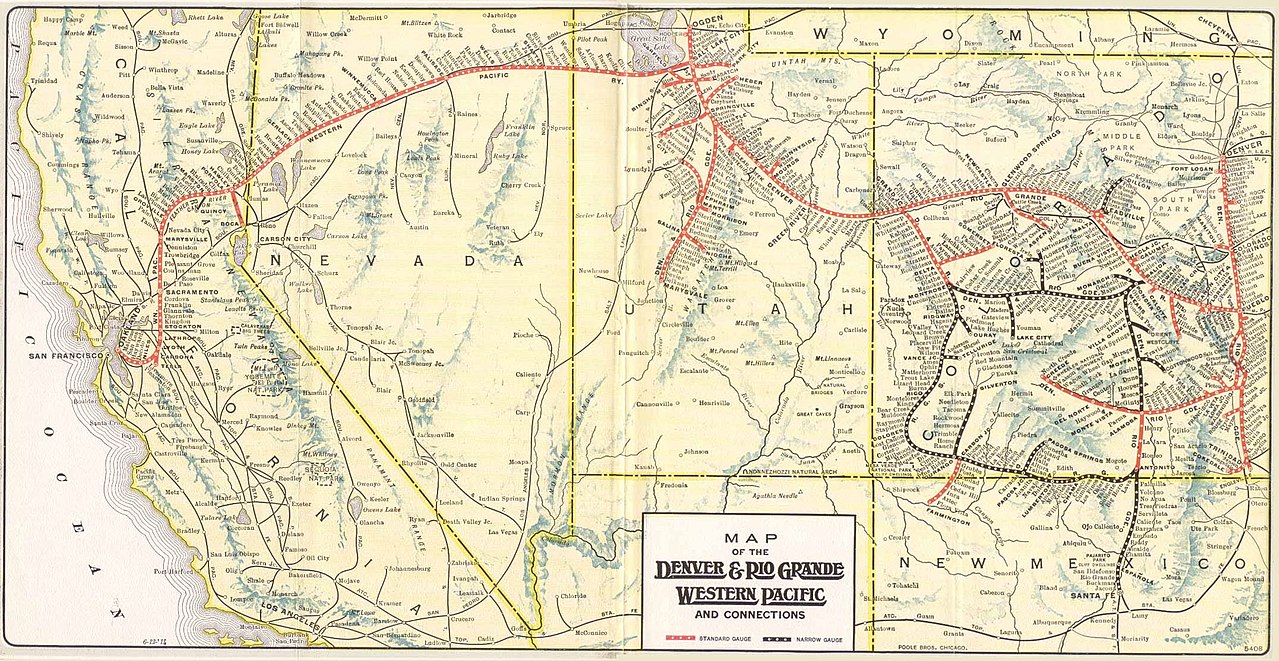
1914 route map of the Denver & Rio Grande Western and Western Pacific railroads.
Map via Wikimedia Commons
In the American tradition, a railroad is conceived by noble men for noble purposes: to develop a nation, or to connect small villages to the big city. The Denver & Rio Grande of 1870 was not that railroad. Much later, however, it came to serve an admirable public purpose, earn the appreciation of its shippers and passengers, and return a substantial profit.
The Rio Grande was conceived by former Union Brig. Gen. William Jackson Palmer. As surveyor of the Kansas Pacific (later in Union Pacific’s realm), Palmer saw the profit possibilities if you got there first and tied up the real estate. Palmer, apparently connecting dots on a map to appeal to British and Dutch investors, proposed the Denver & Rio Grande Railway to run south from Denver via El Paso, Texas, to Mexico City. There was no trade, nor prospect for such, between the two end points, but the proposal did attract sufficient capital to finish the first 75 miles to Colorado Springs in 1871.
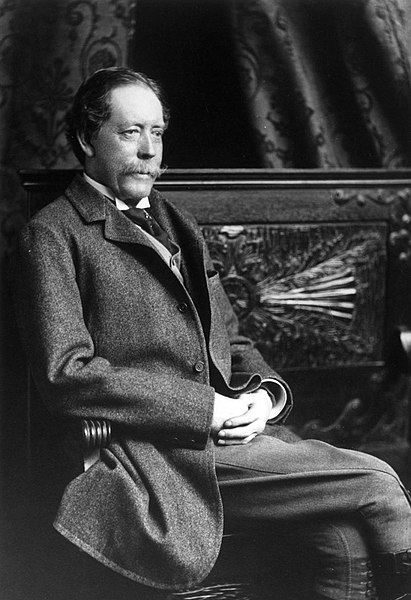
William Jackson Palmer 1836-1909, founder of Colorado Springs, Colorado, builder of several railroads including the D&RGW.
Photograph circa 1870, photographer unknown, via Wikimedia Commons.Narrow-gauge origins
Palmer chose 3-foot gauge to save money, assessing that the real value lay in the real estate, not in railroad operation. At each new terminal, Palmer’s men corralled the land, then located the depot, profiting through a side company on land sales. Construction continued fitfully to Trinidad, Colo., 210 miles from Denver, by 1878. Above Trinidad, on the ascent to Raton Pass, Palmer’s engineers collided with the Santa Fe’s, who were building toward California. Realizing that a roundabout narrow-gauge competing with a point-to-point standard-gauge would serve neither the fare box nor the next prospectus, Palmer changed course, making D&RG a supply line to the gold and silver bonanzas blossoming all over Colorado and Utah. Thus the Rio Grande would look west, not south, and would plumb so many canyons in search of mineral wealth that it was a surprise to find one without its rails.Turning west at Pueblo, Colo., and outfighting the Santa Fe for the Royal Gorge of the Arkansas River — where there truly was room for only one track — D&RG entered Leadville, Colorado’s first world-class mining bonanza, in 1880. Three years later, it completed a Denver–Salt Lake City main line west from Salida, Colo., via Marshall Pass and the Black Canyon of the Gunnison River. The last-spike ceremony in the desert west of Green River, Utah, was low-key, lest anyone closely examine this rough, circuitous, and glacially slow “transcontinental.” Almost as an afterthought, D&RG added a third, standard-gauge rail from Denver to Pueblo, acknowledgment that once paralleled by a standard-gauge competitor, narrow-gauge was a death sentence.
New owners, new purpose
Palmer then began to exit. The company went bust, twice, in rapid succession. The new investors repurposed the railroad again. Instead of transient gold and silver, the new salvation would be coal. Thick bituminous seams in the Walsenburg-Trinidad field fed beehive coke ovens of a new steel mill near Pueblo and heated much of eastern Colorado and western Kansas and Nebraska.
Comments Off on Fallen flag – the Denver & Rio Grande Western
October 2, 2019
“When the next American Civil War starts…”
David Warren goes all soothsayery and predicts the course and outcome of a potential Red-versus-Blue armed conflict arising from the current Red-versus-Blue verbal conflict:
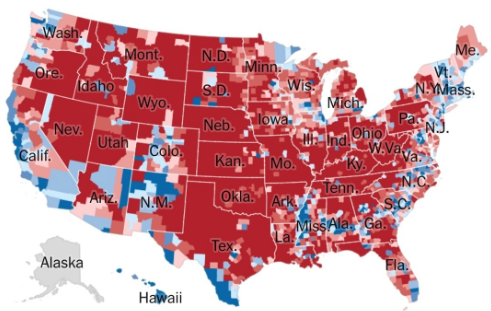
When the next American Civil War starts, I imagine it will look something like Hong Kong: a big melee spreading through all public spaces (I note that USA is bigger than Hong Kong). But there will be fairly limited casualties, at first, each of which will become the subject of unrestrained media outrage, until the media collapse under physical reprisals. Later, the better and better armed demonstrators, on both sides, will tactically “evolve.” The surveillance state itself will begin to disintegrate, and with it any hope of restoring public order, through agencies such as police, courts, and prisons. Things like border surveillance will be abandoned, with immediate consequences, but as the attraction of going to the States diminishes, no one will mind. More noticeably, the economy will break down. Because the American military was designed chiefly to defend against foreign powers, on a very large scale — and the threat will instead be domestic and scattered — the Army will be (at first) effectively neutralized. Isolated firefights between Democrat and Republican soldiers will escalate to firefights between ships and aeroplanes, but these will end fairly quickly as a Pentagon dictatorship seizes control. Within a year, I expect, though only a small part of their arsenal will prove useful, bullet-enforced curfews will restore relative peace to the streets. I don’t expect the death toll to be more than a few hundred thousand, at least from direct conflict as the guns come out. Interruptions of food supply, and the spread of disease, will cost much more — but possibly less (proportionately) than in the last Civil War, in which both sides were better organized.
That it will have spread to Canada, I cannot doubt, developing from the refugee crisis across “the world’s longest undefended border,” as snowflakes of all descriptions, by their millions, run for their lives, then resume their clashes up here. Mexico would also suffer from this “white flight,” except, the chaos from Mexican cartels’ energetic efforts to reclaim significant parts of Texas, California, and the Southwest, would have the paradoxical effect of ending the outbound refugee traffic there. For the most part, other foreign countries would avoid direct engagement. Instead, Islamist and Socialist regimes around the world would be busy consolidating their own local positions, sparking numerous “little wars” by their attempts at regional expansion. Each would be settled as the larger and more ruthless power won.
Still, I shouldn’t expect the anarchy to continue. Tyranny quickly fills a vacuum of authority (moral as well as material), and answers to the growing demand for safety. Nothing, of course, will be learnt from the adventure, and I should think that within a decade or less, resistance to the new President-for-Life will have all but evaporated.
Comments Off on “When the next American Civil War starts…”
September 29, 2019
History Summarized: Mexico
Overly Sarcastic Productions
Published 27 Sep 2019Go to https://NordVPN.com/overlysarcastic and use code OVERLYSARCASTIC to get 70% off a 3-year plan and an extra month for free. Protect yourself online today!
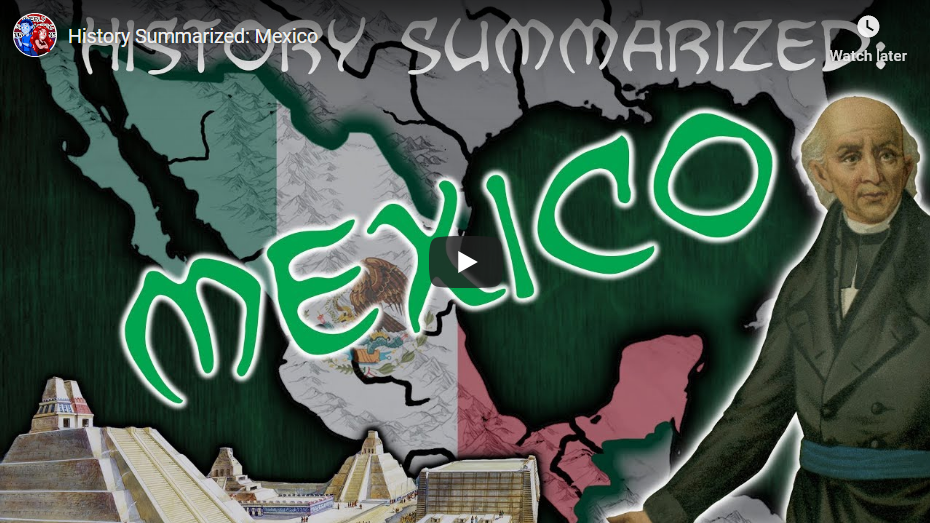
This video is quite serendipitous in timing — by complete coincidence, this is going live on September 27, the day of Mexico’s true political independence under the First Mexican Empire. This is the 11 year sequel to the more traditional Mexican Independence celebrations of September 16th, which marks Miguel Hidalgo’s proclamation of the “Cry of Dolores” and the start of the Mexican War of Independence. No joke, I only realized this when I was partway through researching the video. I do so much ancient history I’m not used to events having dates we can track to the day.
ANYWAY enjoy this look at Mexican History, here broken into three main acts, the Aztec Empire, the Colony of New Spain, and the Independent nation of Mexico.
“Santianna” By The Longest Johns: https://thelongestjohns.bandcamp.com/…
PATREON: https://www.Patreon.com/OSP
DISCORD: https://discord.gg/sS5K4R3
Comments Off on History Summarized: Mexico
August 20, 2019
The Founding of Mexico – Aztec Myths – Extra Mythology
Extra Credits
Published on 19 Aug 2019Join the Patreon community! http://bit.ly/EMPatreon
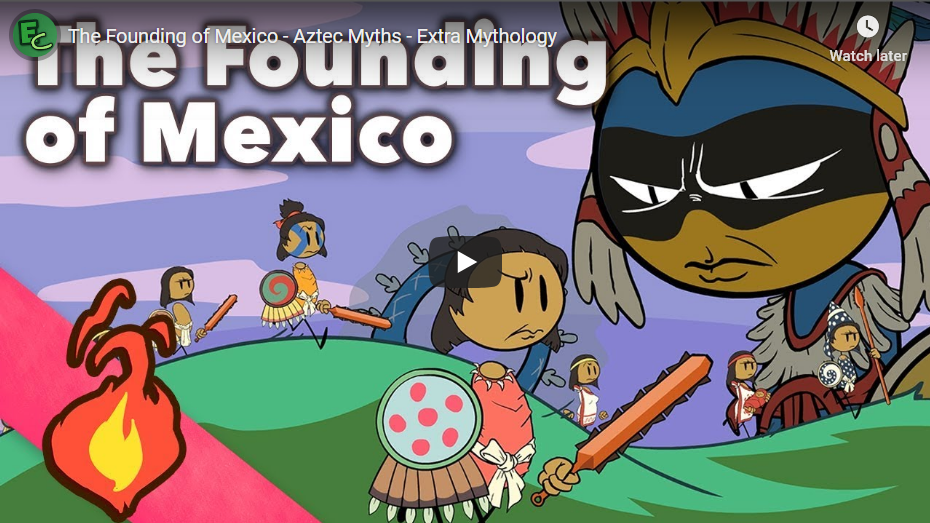
Huitzilopochtli, god of bloody victory, had promised the Mexica people a city. Before they would eventually settle down at Tenochtitlan, they wandered from place to place, inadvertently causing destruction on the orders of the violent god.
From the comments:
Extra Credits
2 days ago
A procession leads a woman up the steps of a great pyramid. The woman is to be the queen of the Mexica, a new tribe of migrants that have come from a faraway place. However, no wedding will take place. The Mexica’s patron god, Huitzilopochtli, has other intentions.
Comments Off on The Founding of Mexico – Aztec Myths – Extra Mythology
May 14, 2019
QotD: Karl Marx, noted racist
For those who see Marx as their hero, there are a few historical tidbits they might find interesting. Nathaniel Weyl, himself a former communist, dug them up for his 1979 book, Karl Marx: Racist. For example, Marx didn’t think much of Mexicans. When the United States annexed California after the Mexican War, Marx sarcastically asked, “Is it a misfortune that magnificent California was seized from the lazy Mexicans who did not know what to do with it?” Engels shared Marx’s contempt for Mexicans, explaining: “In America we have witnessed the conquest of Mexico and have rejoiced at it. It is to the interest of its own development that Mexico will be placed under the tutelage of the United States.”
Marx had a racial vision that might be interesting to his modern-day black supporters. In a letter to Engels, in reference to his socialist political competitor Ferdinand Lassalle, Marx wrote: “It is now completely clear to me that he, as is proved by his cranial formation and his hair, descends from the Negroes who had joined Moses’ exodus from Egypt, assuming that his mother or grandmother on the paternal side had not interbred with a nigger. Now this union of Judaism and Germanism with a basic Negro substance must produce a peculiar product. The obtrusiveness of the fellow is also nigger-like.” Engels shared Marx’s racial philosophy. In 1887, Paul Lafargue, who was Marx’s son-in-law, was a candidate for a council seat in a Paris district that contained a zoo. Engels claimed that Lafargue had “one-eighth or one-twelfth nigger blood.” In a letter to Lafargue’s wife, Engels wrote, “Being in his quality as a nigger, a degree nearer to the rest of the animal kingdom than the rest of us, he is undoubtedly the most appropriate representative of that district.”
Marx was also an anti-Semite, as seen in his essay titled “On the Jewish Question,” which was published in 1844. Marx asked: “What is the worldly religion of the Jew? Huckstering. What is his worldly God? Money. … Money is the jealous god of Israel, in face of which no other god may exist. Money degrades all the gods of man — and turns them into commodities. … The bill of exchange is the real god of the Jew. His god is only an illusory bill of exchange. … The chimerical nationality of the Jew is the nationality of the merchant, of the man of money in general.”
Walter E. Williams, “What Do Leftists Celebrate?”, Townhall.com, 2017-05-10.
Comments Off on QotD: Karl Marx, noted racist


