Quotulatiousness

June 22, 2025

Delaying Mark Carney’s next book

Filed under: Books, Business, Cancon, Politics, USA — Tags: , , , — Nicholas @ 03:00

In the latest SHuSH newsletter, Ken Whyte outlines the various oddities of Mark Carney’s next book to market:

Three years ago, long before he declared himself a politician, Mark Carney published Value(s), his attempt at solving some of the world’s biggest problems: income inequality, climate change, systemic racism, etc. The book was reasonably well received. It sold well. A sequel was in order.

Announced last year, The Hinge: Time to Build an Even Better Canada was ostensibly Carney’s attempt to address Canada’s biggest issues, and perhaps to position himself as our future leader. The book was set for release in May 2025. Events interceded and Carney was elected prime minister on a far tighter timeline than anyone, including his publisher, could have imagined. Publication of The Hinge was delayed. An anonymous source told the Toronto Star Carney was too busy politicking to finish the final edits on the book. I heard the delay had more to do with campaign finance rules that would consider a book publicized or released in election season as political advertising. Anyway, a new release date was set for July 1. Amazon now has The Hinge coming next January.

Carney’s political opponents have been enjoying the delay. Critics both left and right have attributed it to the difficulty of squaring positions taken by Carney a year or two ago with positions he espoused during the campaign and, more recently, as prime minister.

I don’t doubt that Carney’s politics have moved over the last six months. And I wouldn’t be surprised if his second book is being rewritten in whole or in part. I don’t have a problem with that. Much has happened, both in Canada and south of the border. We’ve all been reconsidering our positions.

My problem with Carney’s conduct is not that he’s revising his manuscript, if he is, but that he’s not revising his publishing contract.

The Hinge is set to be published by Signal. Signal is a division of McClelland & Stewart. M&S is a division of Penguin Random House Canada. PRHC is a division of Penguin Random House LLC, corporate headquarters at 1745 Broadway, 3rd Floor, New York, New York, 10019.

Penguin Random House LLC is owned by Bertelsmann, a media conglomerate in Gütersloh, Germany, but legally and operationally, it is a US company. Its executive leadership, including CEO Nihar Malaviya, works out of the above address. Strategy and publishing priorities are set in New York, and profits in PRH’s many far-flung international divisions flow to New York. So the prime minister of Canada is publishing his book with the Canadian branch plant of a US company.

Other recent prime ministers have done the same. Justin Trudeau published Common Ground with HarperCollins. Steven Harper published Right Here, Right Now with Signal, and his forthcoming memoir sits there, too. Jean Chretien released My Stories, My Time with Random House Canada. Most of our politicians have published with branch plants of American firms.

I should add that many of our best writers publish at these same branch plants, if not directly with US publishers. (Even middling scribblers like me have published directly in the US.)

But, again, the world has changed. To quote no less an authority than Mark Carney, Canada’s old relationship with the US, “based on deepening integration of our economies and tight security and military cooperation, is over”. We need to “fundamentally reimagine our economy”, “retool” our industry, and enhance our self-sufficiency.

He sees our cultural relationship with the US as part of this project. From the Liberal platform: “In this time of crisis, protecting Canada means protecting our culture, our journalism, our perspectives. The Americans have threatened our sovereignty and issued inflammatory statements about our economy; we need to be able to tell a story that fights back.”

Right under the cultural section of the platform was a “Buy Canadian” plank. “At a time when our economy is under threat, consumers want to do their part as patriotic Canadians, buying things that are truly made here.” Team Carney promised to make it easier to determine what is and isn’t a Canadian product and prioritize made-in-Canada suppliers in every sector of the economy, limiting bidders from foreign suppliers, and so on.

So it’s “eLbOwS uP!” for the voters, but carry on publishing your next book through a US-owned subsidiary, eh? You have to admit they wear their hypocrisy proudly.

June 18, 2025

Fixing the CAF will require a lot more than just money

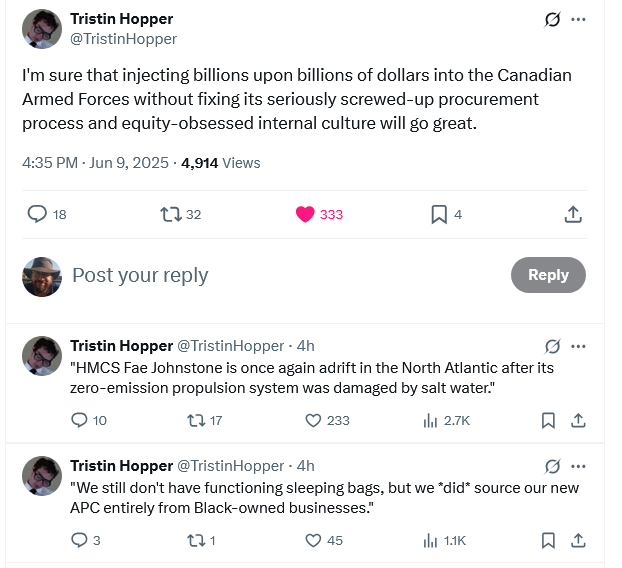
The Canadian Armed Forces are in a dire state. I could literally have written that in any year since I started blogging in 2004 … with brief, unsustained funding boosts for unplanned military commitments here and there that actually made the overall situation worse rather than better. Canada’s military procurement system seems incapable of doing anything quickly … or inexpensively, so pouring billions more into a broken process won’t work out well. There used to be a meme about being able to get whatever you wanted — “good, fast, cheap … pick two”. The CAF can’t even get one of those options.

We’ve had surprising numbers of media folks paying attention to the crippling recruiting crisis, as even on current funding, the CAF is short thousand and thousands of soldiers, sailors, and aircrew. Sadly, but predictably, most of that media attention looks at the shortfall of new recruits being trained for those jobs, which is true but incomplete. The biggest problem on the intake side of the CAF is the bureaucratic inability to bring in new recruits in anything remotely like a timely fashion. The last time I saw annual numbers, the CAF had huge numbers of volunteers coming in the door at recruiting centres, but getting the paperwork done and getting those volunteers into uniform and on to job training was an ongoing disaster area. More than seventy thousand would-be recruits applied to join the CAF and the system managed to process less than five thousand of those applicants and get them started on their military careers.

At a time that we’re losing highly trained technicians in all branches to overwork, underpay, and vocational burn-out, we somehow lack the competence to take in more than one in twenty applicants? That is insane.

In the National Post, Michel Maisonneuve says much the same as I just did, but rather more coherently:

I’m told the Treasury Board has already approved the new funds, making this more than just political spin. Much of the money appears to be going where it’s most needed. Pay and benefit increases for serving members should help with retention, and bonuses for re-enlistment are reportedly being considered. Recruiting and civilian staffing will also get a boost, though I question adding more to an already bloated public service. Reserves and cadet programs weren’t mentioned but they also need attention.

Equipment upgrades are just as urgent. A new procurement agency is planned, overseen by a secretary of state — hopefully with members in uniform involved. In the meantime, accelerating existing projects is a good way to ensure the money flows quickly. Restocking ammunition is a priority. Buying Canadian and diversifying suppliers makes sense. The Business Council of Canada has signalled its support for a national defence industrial strategy. That’s encouraging, but none of it will matter without follow-through.

Infrastructure is also in dire shape. Bases, housing, training facilities and armouries are in disrepair. Rebuilding these will not only help operations but also improve recruitment and retention. So will improved training, including more sea days, flying hours and field operations.

All of this looks promising on paper, but if the Department of National Defence can’t spend funds effectively, it won’t matter. Around $1 billion a year typically lapses due to missing project staff and excessive bureaucracy. As one colleague warned, “implementation (of the program) … must occur as a whole-of-government activity, with trust-based partnerships across industry and academe, or else it will fail.”

The defence budget also remains discretionary. Unlike health transfers or old age security, which are legally entrenched, defence funding can be cut at will. That creates instability for military suppliers and risks turning long-term procurement into a political football. The new funds must be protected from short-term fiscal pressure and partisan meddling.

One more concern: culture. If Canada is serious about rebuilding its military, we must move past performative diversity policies and return to a warrior ethos. That means recruiting the best men and women based on merit, instilling discipline and honour, and giving them the tools to fight and, if necessary, make the ultimate sacrifice. The military must reflect Canadian values, but it is not a place for social experimentation or reduced standards.

They finally did retire the Sea King, long after almost everyone else did. All CAF equipment is expected to have far longer working lives than any of our allies’ equipment.

June 16, 2025

Why Orwell’s choristers wouldn’t solve the CBC problem

Filed under: Britain, Bureaucracy, Cancon, Government — Tags: , , — Nicholas @ 03:00

Peter Stockland was looking for a George Orwell quote in the four-volume Essays, Journalism and Letters collection, but instead he found something that painfully briefly gave him hope on how to resolve the eternal CBC problem:

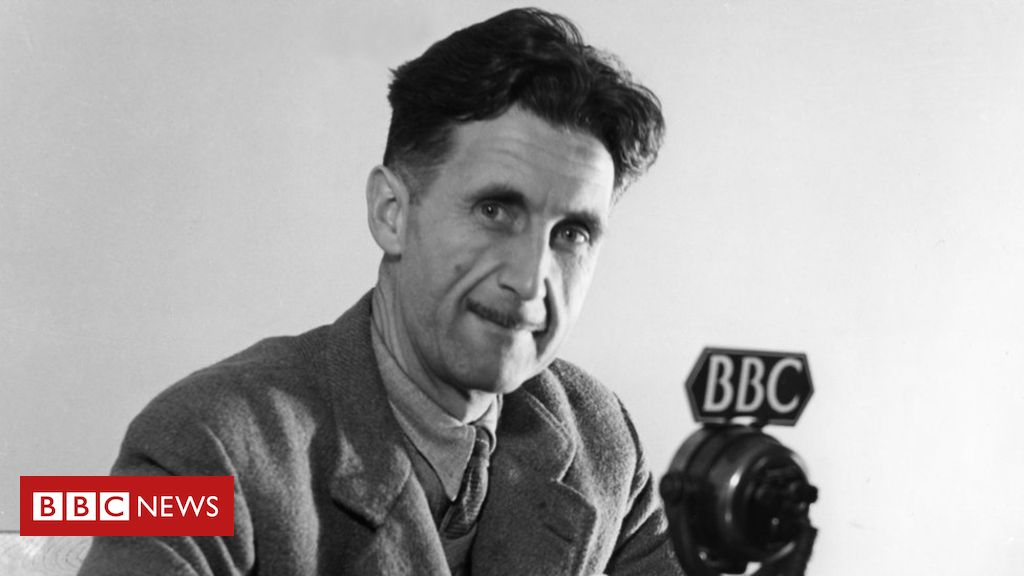
Orwell had been employed by the BBC for about nine months at the time. He writes of the Beeb’s “atmosphere (being) somewhere halfway between a girls’ school and a lunatic asylum (where) all we are doing is useless, or slightly worse than useless”. But that didn’t prevent him observing the following and writing it down for potential reference:

    The only time one hears people singing in the BBC is in the early morning, between 6 and 8. That is the time when the charwomen are at work. A huge army of them arrives all at the same time. They sit in the reception hall waiting for their brooms to be issued to them and making as much noise as a parrot house, and then they have wonderful choruses, all singing together as they sweep the passages. The place has quite a different atmosphere at this time from what it has later in the day.

There’s no overt opining. No proselytizing. No being a loud mouthed schnook. No. Instead, there’s quiet observing. Passerby paying attention. After the fact drafting of an attempt at understanding. All of it brings us journalistically face to face with the vitality – the potential for beauty – of ordinary, practical work using the tools available. It stands in stark contrast to the “useless or slightly worse than useless” abstractionism going on among the great, the good, and the self-important in the BBC bureaucracy.

When I first read the diary entry, it stirred me with eureka-like enthusiasm. That’s it! That’s the solution! We can finally let go of the never-never-land fantasy of abolishing the CBC/Radio Canada. Parliament can instead issue an immediate edict for Mother Corp to hire a “huge army” of cleaning persons, issue them brooms, and unleash them to sing their hearts out. They would soon sweep away the journalistic detritus and parrot droppings in the Corpse’s downtown Toronto and Montreal buildings. A little bit of hallway husbandry married to some glorious working class song: That would fix the GD CBC.

Alas, I was quickly shaken by remembering: This is Canada. Bureaucratism is the irreversible necrosis of the national spirit.

Within months – weeks? – there would be a follow up Clean Canada Choristers Control Act. A federal agency with a $50 million annual starter budget would police against misinformation being sung by the cleaners. It would deploy a gender equitable intersectional analysis to prevent settler colonial bias affecting distribution of bass, tenor, alto and soprano voices. Above all, it would regulate the size and status of the brooms to prevent any unionized chorister feeling unsafe or excluded.

I exaggerate? Not so much. Consider this week’s confirmation that Prime Minister Mark Carney’s urgency to “fast track” projects deemed of “national interest” is about to spawn its own Major Federal Projects Office – a bureaucracy to reduce the bureaucracy of getting down to work and building Canadian things that Canadians need.

You might think some journalist somewhere might ask, like, you know, “Why can’t they just reduce the bureaucracy instead of, like, you know, creating another one with more bureaucrats? Kind of, you know, play DOGE Ball North: ‘You! Bureaucrats! You’ve been tagged! You’re out!!'”

But no. Remember, as I was obliged to, this is Canada. Those kinds of questions aren’t asked even by journalists who should be asking them because … those kinds of thoughts are no longer thunk here. (I don’t think they’re actually illegal. Yet.)

June 15, 2025

Militarizing the Canadian Coast Guard (or not?)

Filed under: Cancon, Government, Military — Tags: , , , — Nicholas @ 03:00

Noah tries to get some solid information on the recent announcement by the Prime Minister that as part of changes to bring Canada into line with our decade-old NATO commitments, the Canadian Coast Guard would be moved from the civilian oversight of the Ministry of Fisheries and Oceans to the military oversight of the Ministry of National Defence. Oddly, the government seems to have been caught rather flat-footed by the PM’s announcement:

When Monday came I was invited to take part in a Media Briefing before [the PM] took questions. My immediate goal was to bring this topic up and get some sort of official words on what these plans were, especially after it wasn’t mentioned in [Carney’s] speech beforehand.

[…]

What we were told was that no such move was taking place, nor plans to arm the Coast Guard and that the current plan was to focus on augmenting their capabilities through new sensors and further collaboration with the RCN.

It was a definitive statement, one that we all agreed was cut and dry. I even reached out to other journalists before adding it to the livethread to make sure we were on [the same] page.

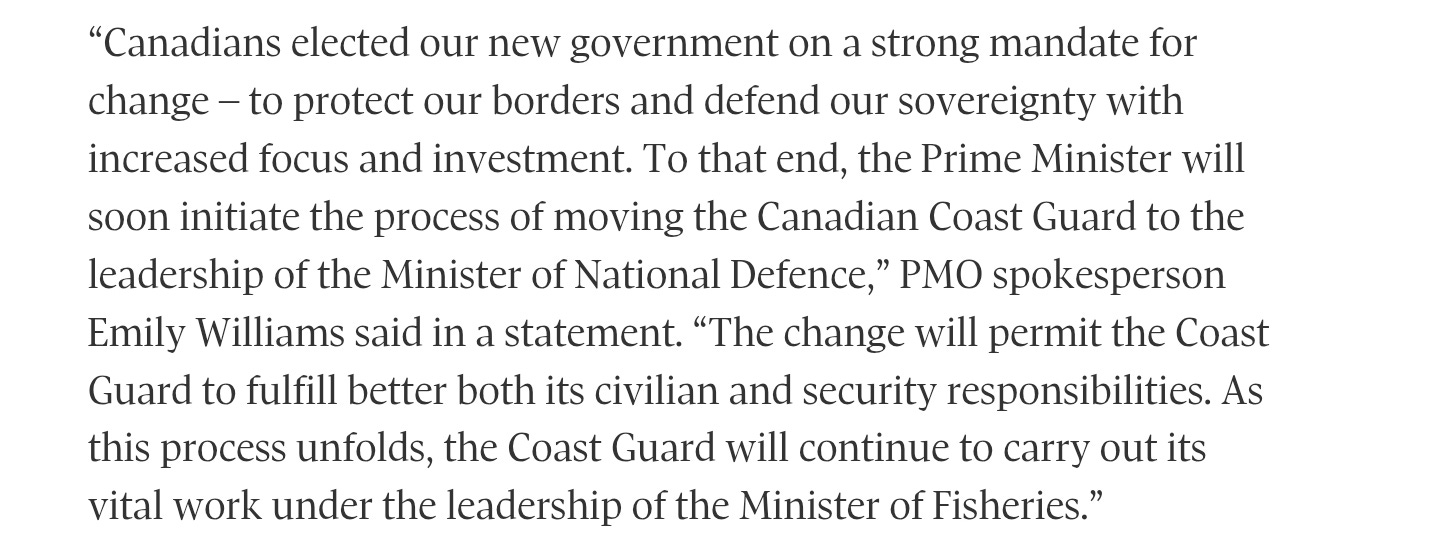
So imagine my surprise when Steven at the G&M came out blazing with a straight no, the plan is to move them. He even came backed up with a statement from the PMO, and credit to Steven, he was quick on this:

Credit to Steven Chase at the Globe & Mail

So as you can imagine my new goal was to figure out what exactly the hell was happening to the Coast Guard, with multiple competing statements on the subject. I made it my mission to have a definitive answer.

So it was back to asking, and emailing, everyone, from the DND to the PMO, CCG to the DFO. I got in contact, I dug into sources, even went as far as to ask people in industry if they had heard anything.

What I got for the first few days was chaos. Multiple statements saying that info wasn’t available, more time was needed. I got outright denial from the DND, only to be told they would email me back with info (they never did)

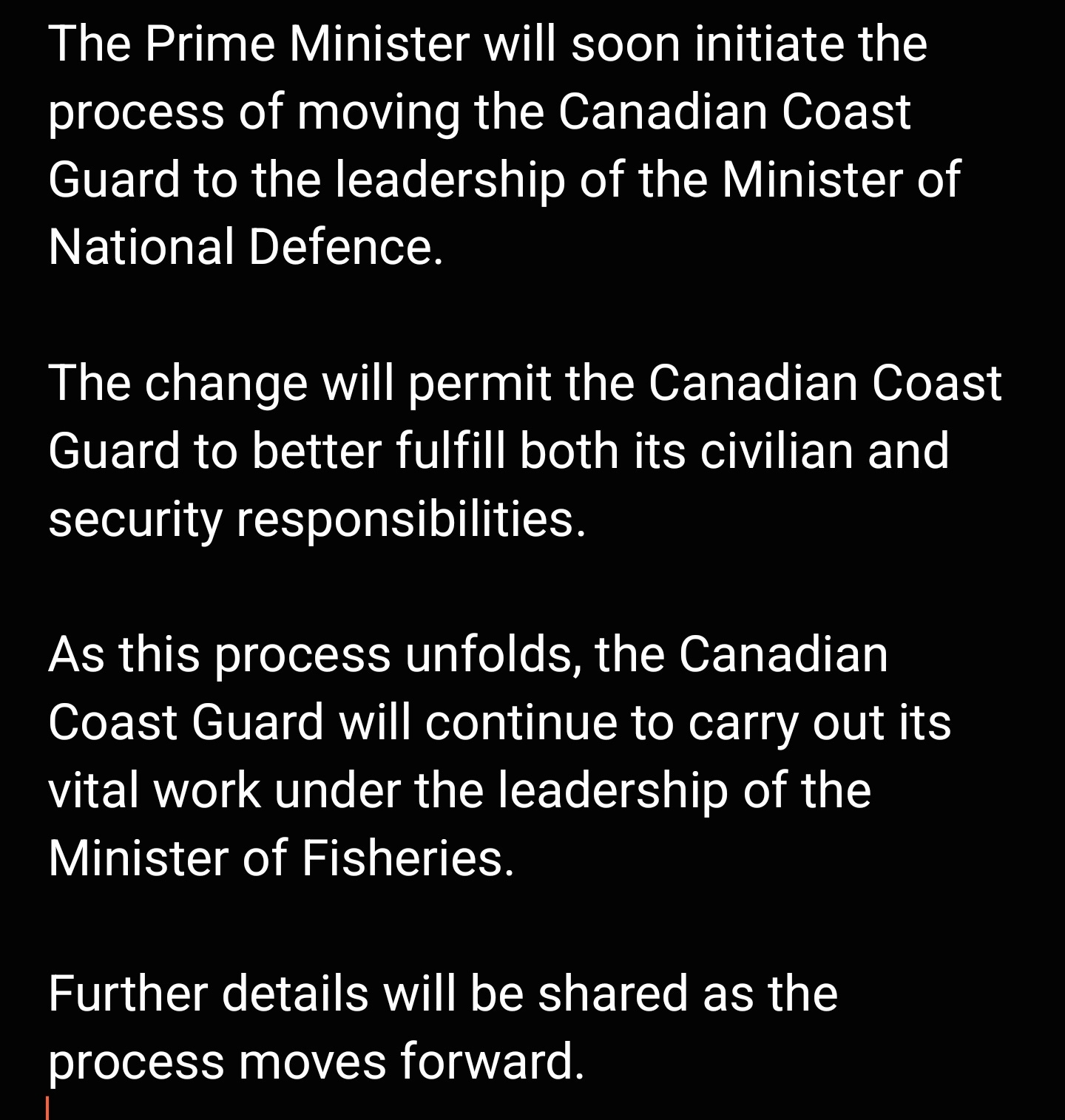
The PMO also told me info would be available when they had it. Evidently as of the time of this writing they have not responded. The only one to stay in contact and provide an answer to my question:

So as far as I was concerned this was a deal closer. The Coast Guard will be moving under the leadership of the Minister of National Defence. What will this look like? We don’t know. I had hit a dead end at this point, where sadly my reach was no longer wide enough for info.

Thankfully, there were others also keen on this, and wanting to get to the bottom of this, and they got farther than me. I will highly recommend my boy Stuart’s article on this as he got farther than me.

What has become evidently clear is:

  1. The Coast Guard is moving
  2. The idea is facing stiff resistance

This isn’t a shock at all. The DFO folks I talked to felt very caught off guard by everything, and the general reaction I have talking around was that this was a bit unexpected.

If accurate, then it is clear that this is the choice of the Prime Minister. He is the one who wants this, and so is making the final push. That isn’t to say he is the only one, but this has his backing and he will push that through.

June 10, 2025

Mark Carney’s big defence spending announcement

Filed under: Cancon, Government, Military — Tags: , , , , , — Nicholas @ 05:00

On Monday Morning, Prime Minister Mark Carney was in Toronto to make a major announcement on Canada’s military spending. After being one of the worst freeloaders in the western alliance, Canada was spending far less on the Canadian Armed Forces than the 2% of GDP we’d promised our NATO partners several years ago. Of course, at the same time that Canada seems to be finally getting serious about defence priorities, the rest of our allies are talking seriously about raising the agreed-upon target to 5%:

Chris Lambie in the National Post says it’s a C$9 billion bump in direct military spending in this (unbudgeted) year:

Canada’s plan to add more than $9 billion to defence spending this year was praised by military watchers Monday, but they cautioned that the country is shooting at a moving target.

Prime Minister Mark Carney announced the country would meet its commitment in this fiscal year of hitting the two per cent of gross domestic product mark that was agreed upon by NATO countries more than a decade back.

“It’s very encouraging that the prime minister has come out this early in his mandate and made such a strong commitment to defence,” said Vincent Rigby, a former top intelligence adviser to former prime minister Justin Trudeau, who spent 14 years with Canada’s Department of National Defence.

“You’ve gone from the former prime minister talking about the two per cent as a crass mathematical calculation to the current prime minister saying, no, this is actually a serious commitment. We committed to it 10 years ago and even before that. And we have to do it because we owe it to our allies. But we also owe it to the Canadian people. He made it quite clear this is about protecting Canada, protecting our national interests and protecting our values.”

New spending could do a lot to improve crumbling military infrastructure, said Michel Maisonneuve, a retired Canadian Army lieutenant-general who has served as assistant deputy chief of defence staff, and chief of staff of NATO’s Allied Command.

“The housing on bases is horrible,” Maisonneuve said.

He’s keen on Carney’s plan to participate in the $234-billion ReArm Europe program.

“This will bolster our ability to produce stuff for ourselves” while also helping the Europeans to do the same, Maisonneuve said.

“All the tree huggers are going to hate that, but that’s where we are today in the world.”

Carney’s cash injection includes $2.6 billion to recruit and retain military personnel. The military is short about 13,000 people. It aims to boost the regular force to 71,500 and the reserves to 30,000 by the end of this decade.

“There is no way we can protect Canada and Canadians with the strength that we have now,” Maisonneuve said.

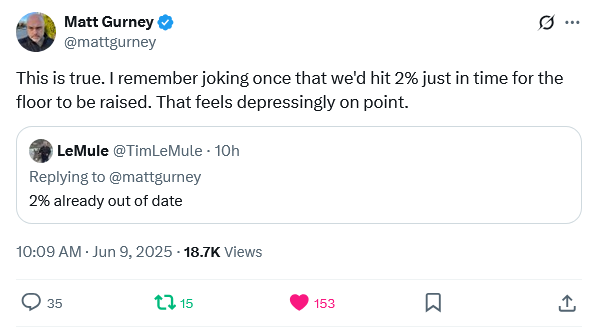
Later in the day, Matt Gurney made some preliminary comments on the social media site formerly known as Twitter (I imagine he’ll have more to say in an upcoming Line post):

I’ve had a chance to actually look at some of the details of what was announced today for Canada’s defence. Overall, I am very supportive of everything that’s been announced.

There are some caveats. Or at least notes.

1. The new spending is mostly aimed at flushing out existing capabilities, not adding new ones.

That’s fine! We need to do that, definitely. I just don’t know if the public understands how much money we could sink into the military without actually adding any new capabilities. All we would do is backfill capabilities that we currently claim to have that don’t really exist.

2. Billions of additional dollars are going toward very basic things. More money to retain existing personnel. Apparently more money to build out recruitment. Spending more money to bring equipment and facilities up to state of proper repair.

Same as above. All good! Needed. Smart.

3. Some of what’s being announced today is entirely a matter of how we’re budgeting stuff. Certain existing expenditures are being redesignated as defence expenditures.

That’s okay! Some of our allies count things toward their defence total that we don’t. Everybody cooks the books a little bit, and I have no objection to this.

4. Everything being announced today should have been done years ago.

The only note I really have to add here is how the longer [Mark Carney] is Prime Minister, the harder it gets to explain away some of the shocking inactivity of his immediate predecessor.

5. None of this is going to be enough.

Remember, all we’re doing here is building out existing capabilities so that they are actually real things, not just things that exist on paper. That’s good. But the actual work of recapitalizing, expanding and adapting the military for 21st-century conflict hasn’t really begun yet. Everything announced today is a necessary start to getting that done. But the hard work is still to come.

And so are the really eye-watering numbers.

Of course, there are definite downsides to just opening up the spending taps the way things currently are set up:

He’s not wrong.

June 9, 2025

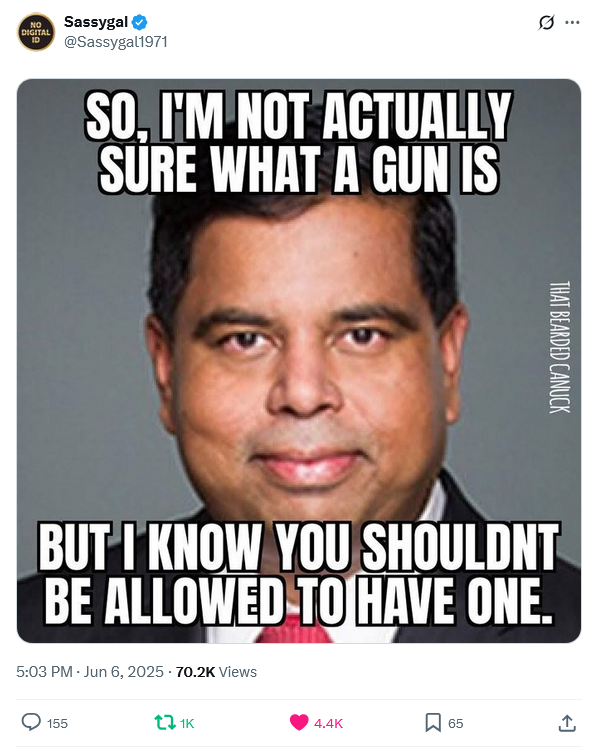
The federal Minister of Public Safety admits he knows literally nothing about Canadian gun laws

Filed under: Bureaucracy, Cancon, Government, Media, Politics, Weapons — Tags: , , , , , — Nicholas @ 03:00

Prime Minister Mark Carney’s cabinet may actually be worse than any line-up of ministers under Justin Trudeau, with the Minister of Public Safety as a poster child for ignorance and apathy:

[…] Then we have the Minister of Public Safety, Gary Anandasangaree — a Trudeau–Carney loyalist freshly installed under the new Liberal minority regime — who made headlines not for bold leadership, but for a shocking display of ignorance on the very file he’s been assigned to oversee: firearms policy.

During a session of debate on the current spending bill, Conservative MP Andrew Lawton posed a basic question:

    “Do you know what an RPAL is?”

An RPAL, or Restricted Possession and Acquisition Licence, is a standard certification required by law for any Canadian who wants to own restricted firearms, such as handguns or certain rifles. It’s a core element of Canada’s legal firearms framework.

The Minister’s response?

    “I do not.”

Lawton followed up with another foundational question:

    “Do you know what the CFSC is?”

The CFSC, or Canadian Firearms Safety Course, is a mandatory course required for all individuals seeking to obtain a firearms license in Canada — including the RPAL. It’s the very first step every legal gun owner in the country must complete. This is basic civics for anyone involved in firearms policy.

Anandasangaree replied again:

    “I do not know.”

This wasn’t a “gotcha” moment. It was a revealing moment. The Minister of Public Safety, the individual charged with implementing gun bans, overseeing buyback programs, and crafting firearms legislation, has no familiarity with the fundamental licensing and safety processes every Canadian gun owner must follow.

In any other profession, this level of unpreparedness would be disqualifying. If a surgeon couldn’t name a scalpel, he’d be pulled from the operating room. But in Ottawa? It qualifies you to oversee a multi-hundred-million-dollar national gun seizure operation.

And that brings us to the next moment of absurdity.

Lawton asked the minister how much money had already been spent on the federal firearms buyback program, the centerpiece of the Liberal government’s Bill C-21, which targets legally acquired firearms now deemed prohibited.

Anandasangaree’s answer?

    “About $20 million.”

But that doesn’t match the government’s own published data. In a report tabled by Public Safety Canada in September 2023, it was disclosed that $67.2 million had already been spent on the buyback as of that date. The majority of that spending was attributed to “program design and administration” — before a single firearm had even been collected.

So what happened? Did the government refund tens of millions of dollars? Were contracts cancelled? Of course not.

They just reframed the accounting — separating so-called “preparatory costs” and implying they don’t count as part of the buyback, even though they exist entirely to implement it.

It’s not transparency. It’s political bookkeeping — a deliberate attempt to make a costly, unpopular program appear manageable.

And it didn’t end there. When Lawton asked for the number of firearms that had actually been collected under the buyback, the response was yet another dodge. The Minister and his department couldn’t provide a number.

That’s right: after spending over $67 million, the federal government can’t even say how many guns have been retrieved. Yet they’re moving full steam ahead, with the support of a minister who doesn’t understand the system he’s responsible for.

This isn’t policymaking. It’s blind ideology strapped to a blank cheque. And the people paying the price are law-abiding citizens — not criminals, not gangs, and not smugglers.

At this rate, I can’t imagine how he’ll still be in cabinet by the end of summer.

June 4, 2025

“Asshole Britain”

Filed under: Britain, Cancon, Media, Politics, USA — Tags: , , , , — Nicholas @ 05:00

In The Line, Greg Quinn indulges in a bit of struggle sessioning about his earlier disagreements with the editors of The Line about Britain and Canada (protip: don’t search for images to go along with that particular headline, especially if you have “safe search” filters turned off):

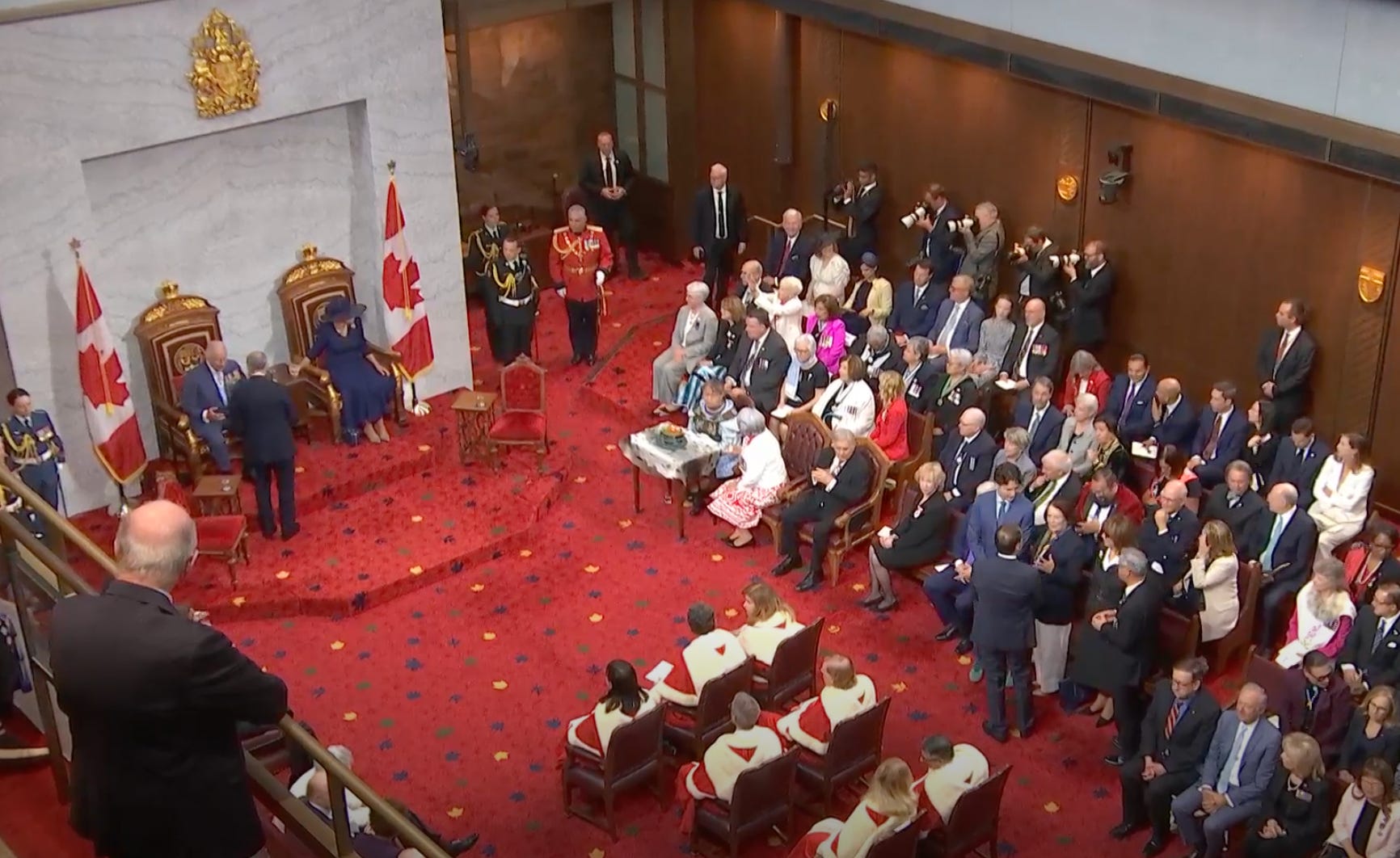
Yeah, let’s go with an inoffensive photo of His Royal Majesty and his Canadian First Minister chatting in the Senate chamber, rather than anything remotely to do with the headline of this post.
Photo by Paul Wells from his Substack

On February 12th of this year, I wrote in The Line about how my country, the United Kingdom, had “ghosted” Canada by refusing to come out strongly in reaction to U.S. President Donald Trump’s egregious attacks on the country and his calls for it to become the 51st state. In writing that piece, I didn’t beat around the bush — I called the U.K.’s actions what they were at the time: cowardice and sycophancy.

Since February, there have been a few (many?!) developments in Canada’s — and the world’s — relationship with President Trump.

Not least among these are Matt Gurney and Jen Gerson’s depiction (or technically, implication) of the U.K. as “Asshole Britain”. As other regular Line readers will know, “Asshole Canada” or “Maximum Canada” is an idea the editors floated here some months ago, where they asserted that Canada should abandon its typical desire to be seen as a global do-gooder and simply assert its national interests, vigorously and unapologetically, and if other countries, even allies, object, well, to hell with them. Editor Gurney, in a recent podcast, cited the just-concluded visit of His Majesty the King to Canada to deliver the Throne Speech — the first time a monarch has done so since 1977 — as an example of that. Prime Minister Mark Carney issued the invite to the King despite obvious discomfort with the idea among senior officials in my government.

Carney didn’t care. The King is the sovereign of Canada, too, and Carney didn’t let British discomfort deter him.

I have to say that HM the King’s speech was a blinder and (in its own royal diplomatic way) left no doubt as to where His Majesty’s sympathies lie and how he supports Canada’s sovereignty and independence. Whether you are a royalist or a republican, the fact that HM the King made the trip and read the speech should be welcomed. And I entirely agree with the editors here — Canadians should and must ignore the comments from the U.K. Who cares? HM the King was acting in his capacity as Canada‘s monarch — the views of anyone in the U.K. (government or otherwise) are irrelevant.

I wish I could condemn Jen and Matt for their (again, implied) characterization of the U.K. — Britain has needed no urging to unapologetically assert its own interests in this revived era of Trump. But I can’t. They are absolutely correct. And every day that passes, I’m sorry to say that the U.K. becomes more and more “Asshole Britain” when it comes to its relationship with Canada and the U.S.

The reasons remain much the same as I identified before: cowardice and sycophancy. To that, I’d now like to add venality. We think we have a special relationship with the U.S., as demonstrated by our recent trade agreement — except the impact of that agreement is open to some question. We seem to be afraid of saying anything that might upset President Trump, in case he reacts. Although we fail to understand that upsetting the President does not follow a rational process. He could (and does) get upset and react extremely easily at the simplest and most unexpected of things.

The President continues to make unacceptable claims against Canada, including reiterating his call for it to become the 51st state shortly after the King’s visit concluded. His latest iteration of this includes claims that Canada could save U.S.$61 billion it “should” be charged for the so-called Golden Dome (what is it with adjectives and this President?) if it joins the U.S. This, of course, fails to grasp the simple strategic fact that if you want a defence shield like this over North America, then you’re going to have to use sensors and other infrastructure on Canadian soil. Is he expecting to be provided that land for free?

By continuing to refuse to stand up to President Trump and clearly express our support for Canada, we are submitting to his attempts to divide and rule those of us who remain like-minded. At its worst, we are now venal — selling out to the president.

Instead, we should be standing true to our roots — as defenders of the free market and democracy. We should be leading the way, and we should be building an alliance of those who continue to share our values.

That is what we should be doing. That we aren’t is nothing short of a disgrace.

Update: Fixed broken link to Greg Quinn’s article. Doh!

Arch-statist Mark Carney believes that Canadians “must earn their freedom everyday”

Filed under: Cancon, Government, Media, Politics — Tags: , , , , — Nicholas @ 03:00

At The Intrepid Viking, Roxanne Halverson examines what Prime Minister Mark Carney means when he tosses off comments like “Freedom is something you earn everyday”:

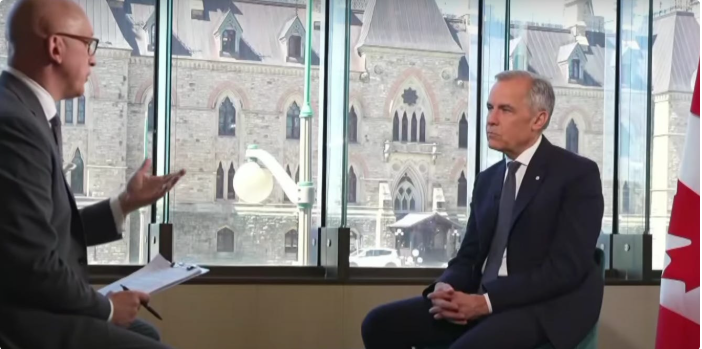
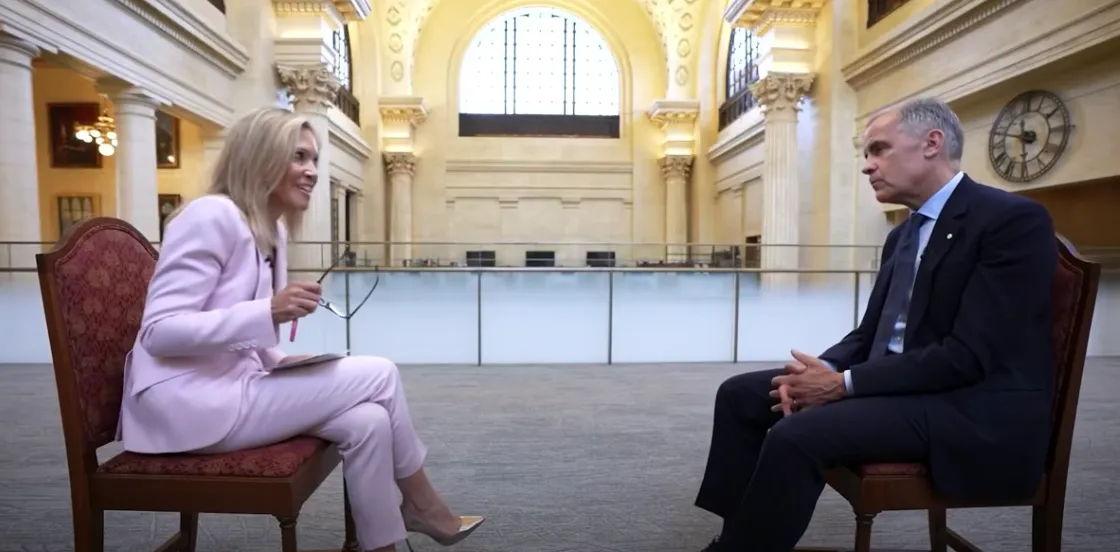
CBC’s David Cochrane interviewing Prime Minister Mark Carney in Ottawa.

It is surprising and disconcerting that so few pundits, commentators or even members of the Conservative Party, and for that matter are, not taking issue with a recent statement from our new Prime Minister in which he asserted, when talking about Canadians, that, “Freedom is something you earn everyday“.

Has anyone asked Mark Carney, this globalist World Economic Forum (WEF) acolyte, who is now Canada’s Prime Minister, what he meant when he made that statement? He made it during an interview with David Cochrane on CBC’s Power and Politics following on King Charles delivering the throne speech. He made the statement while talking about the great “crisis” Canada is and how his government has to get moving on major projects and our economy and solving the housing calamity. Of course he forget to mention that these problems are due to the policies of the previous Liberal government, for whom he was the financial advisor. He also does not explain that why, in the middle of such a crisis, his government has decided to take the summer off and not release of budget of any type, any time soon, but that’s another story.

Now, back to his claim that Canadians “must earn their freedom everyday”. Of course, Cochrane, being one of Carney’s main fanboys at CBC, didn’t probe any deeper to ask him what he meant by that statement. But it is a strange statement coming from the Prime Minister of a country where its constitution essentially says that individual freedom is a God given right. And given that Carney, with his recent visit to Rome to see the new pope, has made it clear that he is a devout practising Catholic, his belief in the Almighty is obviously not an issue. So again, what did he mean by that remark? Strange again, because just six weeks ago, before he was the Prime Minister, Carney posted the following statement on X.

    The Charter of Rights and Freedoms is the embodiment of our principles and our aspirations as Canadians. It must be protected — not wielded for political gain. Forty-three years on, the Charter remains strong — and it’s on all of us to defend it.

This apparently was in response to Conservative Leader Pierre Poilievre’s assertion that he would use the notwithstanding clause to override a judicial ruling against imposing consecutive life sentences on murderers, rather than concurrent sentences.

So given that, it would seem that Mr. Carney believes our rights regarding freedom are enshrined in the Charter. Carney, in his interview with Cochrane also maintained that Canada was still “the true north strong and free”. So then which is it when it comes to freedom from his perspective? Is it enshrined in the Charter, are we the true north “strong and free”, or must freedom be earned, and in what way?

June 3, 2025

Canadian immigration numbers go even higher in 2025

Filed under: Cancon, Government — Tags: , , , , — Nicholas @ 03:00

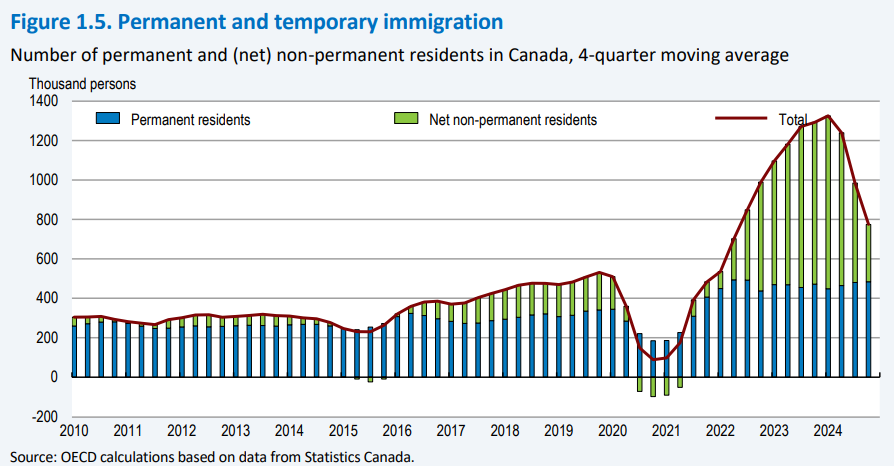
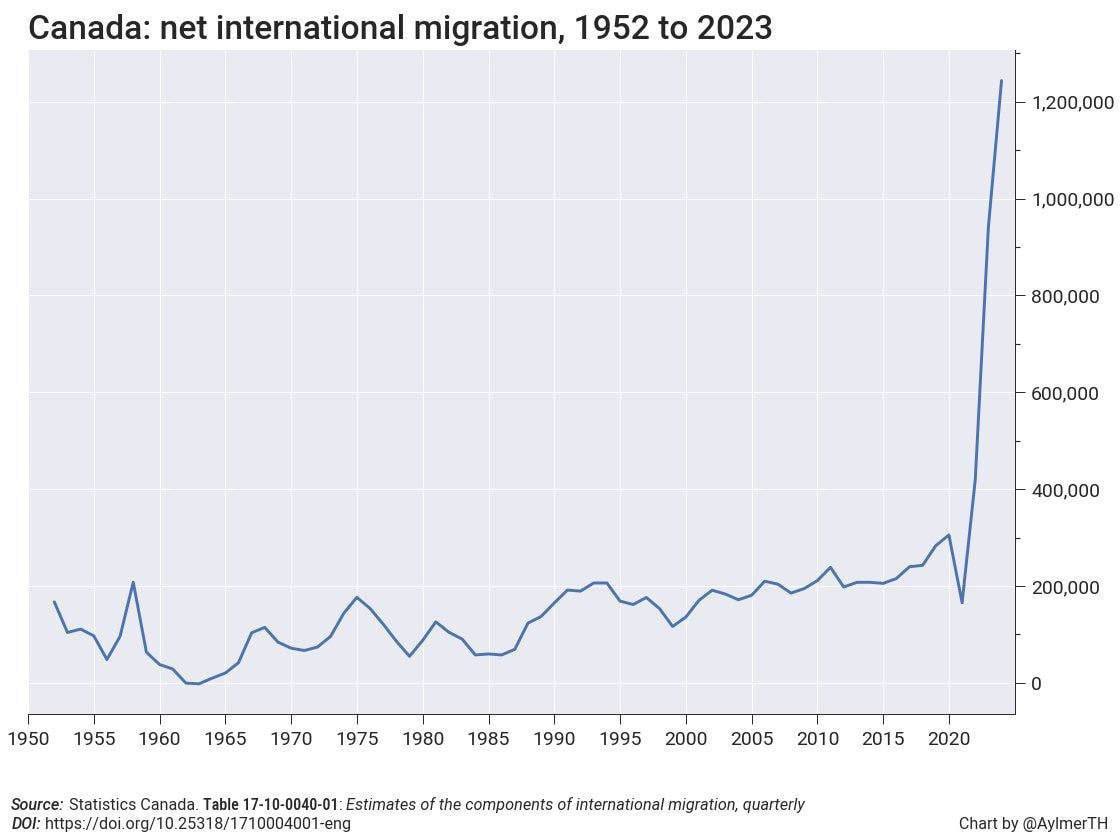
Although the new Liberal government in Ottawa made some slight noises about bringing immigration numbers back down to something closer to sustainable … there’s less than zero evidence that they actually meant it:

Despite all promises to the contrary, all the sudden and supposed interest in nation-building efforts that stretch from Victoria’s Inner Harbour to the Bay of Fundy, all the “Buy Canadian” horseshit lapped up by a portion of the electorate that votes like a long-tailed cat in a room full of rocking chairs, Canada’s once-in-a-generation betrayal of its labour market — and its very present and future — continued at pace to begin 2025.

The numbers are pants-shitting-ly grim.

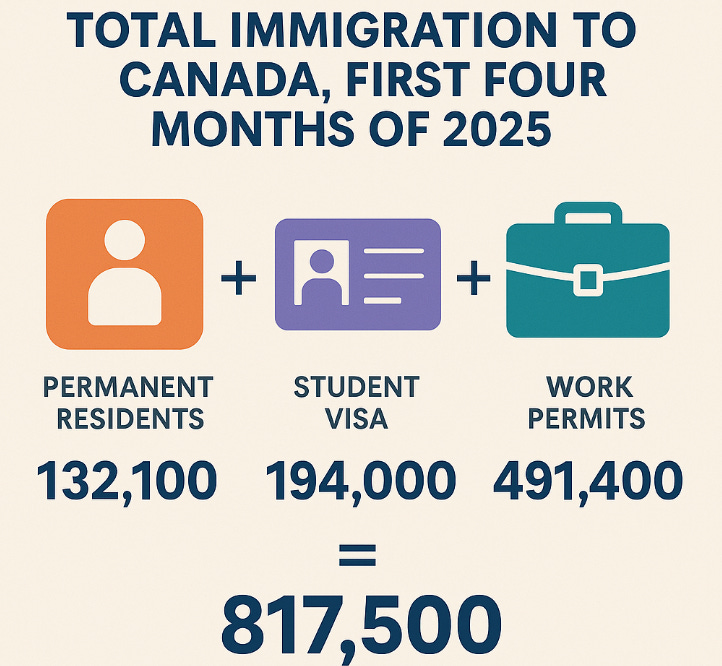
    The latest federal immigration data shows that Canada welcomed more than 817,000 newcomers in the first four months of 2025 when tallying up permanent and non-permanent streams.

    Between January and April 2025, 132,100 people were granted permanent residency, while 194,000 study permits and 491,400 work permits (including extensions) were finalized by Immigration, Refugees and Citizenship Canada. (Juno News)

At a time when 89% of Canadians under 34 have been beaten into believing that “owning a home is only for the rich” (Ipsos poll), along comes the worst summer job market in two decades to match the continued Liberal failure to course-correct on the mass-immigration, replacement-caste grift.

The two are of course inextricably linked.

With even the Bank of Canada speaking uncomfortable truths, that the foreign “student” surge and “temporary” foreign worker bacchanal lead to wage suppression and job displacement for Canadian workers, for 2025’s numbers to continue to blow through any semblance of well-meaning, sustainable targets, is as “bonkers” as it is seditious towards any citizen with an investment in Canada’s future.

The grift, the very lie, that “shortages” drive corporate Canada’s need for a basement-apartment economy has been disproved time and time again.

“All we hear about are labour shortages, [but] we have to begin to recognize that this really is a self-serving narrative mostly coming from corporate Canada,” said Mikal Skuterud, labour economics professor at the University of Waterloo.

May 31, 2025

Depending on how you read the tea leaves, are all the signed treaties now to be ignored?

Filed under: Cancon, Government, History — Tags: , , , , , — Nicholas @ 04:00

In The Free Press Rupa Subramanya discusses King Charles’s land acknowledgement at the start of the Throne Speech earlier this week:

Mark Carney joins our visiting King in the traditional Making of the Small Talk.
Photo by Paul Wells from his Substack

Canadians have a fondness for land acknowledgments, [NR: while some of us think they’re merely virtue signalling on steriods which will end up causing more mischief in the long run] which have now become common at police press conferences, on Air Canada flights, at hockey games, and even at a Taylor Swift concert.

But nothing has caused more commotion than the spectacle of King Charles III opening the 45th legislative session of Parliament on May 27 with a land acknowledgment, when he declared from his throne: “I would like to acknowledge that we are gathered on the unceded territory of the Algonquin Anishinabe people. This land acknowledgment is a recognition of shared history as a nation.”

People will point out that King Charles’s speech was written by Canadian prime minister Mark Carney’s government (true) and that as the monarch he was being respectful to Canadian traditions (fine). But there is something deeply funny about the literal King of England talking about the lands his predecessors brutally conquered centuries ago like they’re still up grabs.

Kicking off Parliament with a speech is a time-honored tradition, but it’s rare for the monarch to deliver it in person, and is normally delivered by the governor general, Canada’s official stand-in for the king. The reason the king was there was to push back against the idea that Canada is for sale.

“There is no better way to assert Canada’s sovereignty than by inviting the sovereign,” said Philippe Lagassé, a constitutional expert at Carleton University in Ottawa, Ontario. “Carney invited the king as part of his renewed emphasis on Canadian nationalism rooted in our institutions and history.” (Unlike the U.S., which broke from Britain in 1776, Canada remained a colony until 1867, when it became a constitutional monarchy with a British-style parliamentary system and the UK monarch as head of state.)

Lagassé added that Carney’s invite to Charles was also likely done to “leverage President Trump’s affection for the king in Canada’s favor.”

Trump may love the monarchy, but Canadians have traditionally been indifferent towards it. But that’s changing, thanks to Trump’s “51st state” rhetoric.

According to a recent poll, 66 percent of Canadians now believe the monarchy helps set the country apart from the United States, up from 54 percent in April 2023. In 2023, 67 percent thought the royal family should have no formal role in Canadian society; today, that number has dropped to 56 percent.

In his speech, King Charles didn’t mention Trump by name, but the subtext was hard to miss: “Canada faces another critical moment. Democracy, pluralism, the rule of law, self-determination, and freedom are values which Canadians hold dear, and ones which the government is determined to protect.”

May 28, 2025

The Throne Speech

Filed under: Cancon, Media, Politics, USA — Tags: , , , , , — Nicholas @ 03:00

On his Substack, Paul Wells reports on the first Throne Speech delivered by the reigning monarch since the 1970s:

Mark Carney joins our visiting King in the traditional Making of the Small Talk.
Photo by Paul Wells from his Substack

We’re like Charlie Brown with Lucy’s football, or I guess, since the new PM is said to prefer British spellings, Charlye Brownne with Lewsey’s Foote Ball. Each generation of Canadian leadership tries to find a new way to make throne speeches exciting. These attempts are forever doomed, because no generation of Canadian leadership is exciting and because the format — a statement of intent from a dignitary who is forbidden to harbour autonomous intent — tends to short-circuit the delivery.

This time the delivery mechanism was the King of Canada, Charles Philip Arthur George, popping over from his secondary residence at Buckingham. His French tops Mary Simon’s, though his Inuktitut is shaky. He did his best to sound excited, or resolute, about the CBSA’s “new powers to examine goods”.

A quarter-century ago the reliably impish John Fraser told me he was preparing a book called Eminent Canadians that would survey recent developments in four Canadian institutions. The institutions he’d selected were the office of the Prime Minister; the Globe and Mail; the Anglican Church; — and here Fraser urged me to guess the fourth. Canadian institution? I dunno, the armed forces? The NHL? “The Crown”, Fraser said with a twinkle. Thus was I prepped for this week’s extended round of you-know-he’s-really-the-king-of-Canada browbeating.

This throne speech was like many before it, though out of deference for the deliverer it was on the short side, 21 pages tucked inside wide margins. In substance it was a paraphrase of Mark Carney’s already-semi-legendary Single Mandate Letter for cabinet ministers. There were sections on redefining Canada’s relationship with the United States; on internal trade; on crimefighting and national defence; and on “spending less and investing more”, which, I mean, we’ll see.

The mandate letter seems to have supplanted the Liberal election platform as the main blueprint for Carney’s action. The two aren’t wildly incompatible, but the mandate letter/throne speech is streamlined and puts stuff in different order.

I saw two surprises big enough to make me write today, but first I want to point to a few elements that are worth noting in the less-surprising stuff. That’s right, I’m trying to be useful, not just smart-assed, so here’s a way to thank me. […]

First, Carney (through His Majesty) makes claims for the “new economic and security relationship with the United States” that seem unrealistic. He expects “transformational benefits for both sovereign nations”. But surely any cross-border negotiation can only be, at best, an exercise in damage control? Any security costs that would be newly borne by Canada would represent a net cost. Trade arrangements short of the substantially free trade we’ve enjoyed for 40 years will also represent a net cost. The point of seeking “one Canadian economy” and taking relations with third countries more seriously is to offset the cost of a degraded Canada-US relationship, no?

Under “more affordable”, the throne speech repeats campaign promises for income-tax cuts and cuts to GST on new homes. The list of tangible financial benefits to individuals doesn’t go much past that. “The Government will protect the programs that are already saving families thousands of dollars every year. These include child care and pharmacare.” “Protect” is an old Ottawa word meaning “not extend”.

The goals for the “one Canadian economy” now include “free trade across the nation”, at both federal and provincial levels of government, “by Canada Day”. Which is 34 days away. The staffing and mandate of another new entity, a single-wicket “Major Federal Project Office”, may end up mattering more to this government’s success and Canada’s prosperity than the name of the PM’s next chief of staff, so put an asterisk next to that.

The government repeats a mysterious claim I’ve found shaky since Carney became a Liberal leadership candidate. It “will take a series of measures to catalyse new investment to create better jobs and higher incomes for Canadians. The scale of the Government’s initiative will match the challenges of our times and the ambitions of Canadians.” The challenges of our times, at least, are large.

So again: if the Canada Infrastructure Bank, the Canada Growth Fund and the Freeland-Sabia investment tax credits are sufficient to catalyse (British spelling) new investment, why duplicate them?

And if they haven’t worked, why keep them?

May 25, 2025

Comparing Japan’s supply management system to the Canadian version

Colby Cosh considers the fate of a Japanese government minister who accidentally told the truth about a subject near and dear to Japanese consumers’ hearts (well, stomachs, actually):

“Japanese Girls at Work in the Rice Fields – Grand Old Fuji-Yama in the Distance, Japan” by Boston Public Library is licensed under CC BY 2.0 .

I’m sure some of you saw Wednesday’s NP headline for an Associated Press wire story: “Japan’s agriculture minister resigns after saying he ‘never had to buy rice’” AP’s Mari Yamaguchi explained this international-news nugget. A cabinet minister in a shaky minority government made a flippant comment indicating that he was light-years out of touch with ordinary people facing high grocery costs in a developed country.

Taku Eto’s political survival thus became impossible within a matter of hours, and his prime minister hastily swapped a congenial young star into the agriculture portfolio. Japan is a constitutional monarchy with a system of parliamentary government more or less like ours, so there’s nothing incomprehensible about any of this to a Canadian …

… but, of course, one almost couldn’t help flashing back to our recent election campaign, wherein the prime minister had half-boasted to a Radio-Canada reporter that he doesn’t buy his own groceries and has no earthly idea how the stuff in his fridge gets there. It struck me at the time that this was a classic mistake for an electoral neophyte like Mark Carney. Fans of the legendary American columnist Michael Kinsley will surely think of it as a “Kinsley gaffe”, i.e., an obviously true statement that is nevertheless bound to get a politician in trouble.

[…]

Eto was talking about rice because the prices for it in Japan have gone through the roof, the clouds and the stratosphere. And rice plays a role in the Japanese culture and diet for which there is no analogue in omnivorous Canada. For precisely that reason, rice is supply-managed there in much the same way our dairy, eggs and poultry are — i.e., through confiscatory tariffs on foreign products, along with a mafia of politically powerful producer cooperatives who operate under supply quotas.

If you read Canadian news, you can recite the effects of this, whether or not you’re capable of finding Japan on a map of Japan. Their supply-management system is, like ours, a major headache for counterparties in trade negotiations. Their farmers, like Canada’s, are dwindling in number and aging out of the business. They are sometimes paid to destroy crops. Farm costs for machinery and supplies are subject to inflation. And sometimes the system for domestic demand forecasting blows a tire.

It’s a constant high-wire act for Japanese governments, who still have official responsibility for the national rice supply under wartime statute. If store-shelf prices get too high, and consumers start to make trouble, the cabinet must consider loosening tariff barriers and releasing rice from the national strategic reserve. The LDP ministry has done both these things in the face of hallucinatory prices, and so the farmers are now just as ticked off as the buying public.

May 22, 2025

Trump, “the American Mussolini”, versus ever-so-democratic Mark Carney

Filed under: Cancon, Government, Media, Politics, USA — Tags: , , , , , — Nicholas @ 03:00

In the National Post, John Robson contrasts the authoritarian dictator at the helm of the American ship of state with our peaceful, democratic, and fully accountable to the voters prime minister:

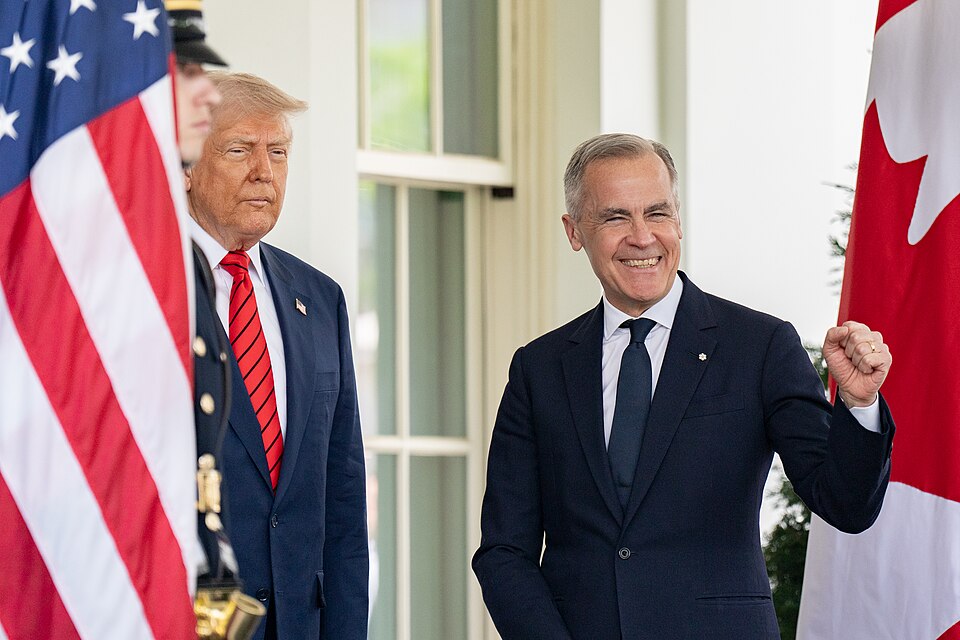
President Donald Trump greets Prime Minister of Canada Mark Carney, Tuesday, May 6, 2025, at the West Wing entrance of the White House.
(Official White House Photo by Gabriel B Kotico)

It was the best of budgets, it was the worst of budgets, it was the age of restraint, it was the age of profligacy, it was the epoch of the legislature, it was the epoch of the executive, it was the season of open debate, it was the season of closed doors, it was the spring of Canada, it was the winter of America. Or possibly the other way around.

The confusion arises because as a patriotic Canadian I keep hearing how U.S. President Donald Trump is an American Mussolini who has abolished the last vestiges of the old Republic, so we should drink rye not bourbon or some other decisive action easily performed while sitting down. Yet the news media mysteriously insist that the Bad Orange Man is having trouble getting his budget through some quaint relic called the United States Congress while Green Mark Carney isn’t bothering to get his spending plans rubber-stamped by some quaint relic called the Canadian Parliament. How can it be?

Tuesday’s the Morning newsletter from the New York Times, which is no MAGA outlet, reads: “Speaker Mike Johnson has a math problem. He wants to pass a megabill before Memorial Day to deliver President Trump’s legislative agenda.” But with only three spare votes in the House, “there are way more than three G.O.P. dissenters, and they don’t agree on what the problem is. Some think the cuts to Medicaid are too large. Others think they’re too small. Some want to purge clean-energy tax breaks. Others want to preserve them because their constituents have used them.”

Likewise The Atlantic, part of the thundering herd of independent liberal American minds, says: “The struggle to pass Donald Trump’s second-term agenda in Congress has never been between Republicans and Democrats … it’s been a battle between the House and Senate GOP, between moderates and hard-liners, and, most salient, between Republicans and reality.”

Egad. What manner of rambunctious folly is this? Open debate within the Maximum Leader’s own party? Dictatorship! By contrast here in decorous Canada can someone remind me which inane or malicious measures from former prime minister Justin Trudeau were ever put at risk by the principled courage, truculence or mere pandering even of his NDP coalition non-partners, let alone the trained seals in red?

Periodically one would bark. But which ever bit? To be sure, as the Canadian Press noted on Sunday, “Prime Minister Mark Carney says the Liberal government will present a federal budget in the fall, allowing time for clarity on some key economic and fiscal issues to emerge”. But if there’s going to be a brawl, it will be inside his office, or head, with his finance minister promising to brush aside Parliament with an “economic statement” before Carney overrode him, saying the government would introduce “a much more comprehensive, effective, ambitious, prudent budget in the fall”.

May 21, 2025

Canadian voters got fooled again

Filed under: Cancon, Media, Politics, USA — Tags: , , , , — Nicholas @ 03:00

Roxanne Halverson on Canadian voter gullibility that Mark Carney and the Liberals took full advantage of in the election campaign:

Offer not applicable in Canada, apparently.

Liberals voters on your elbows up crusade — do you feel foolish, do you feel shamed? Are you ready to admit that you were duped? That you were played like the fiddle in the Devil went down to Georgia. How does it feel to know that you fell for Mark Carney’s fear mongering fabricated crisis that made him Prime Minister. Or is your Trump Derangement Syndrome so severe that you cannot recognize how the Liberals used it and used you to win an election they didn’t deserve to win. It wouldn’t be so bad if only you had to pay the price, but unlike the phony COVID mantra, of we’re all in this together, we really are all in this nightmare together for another possible four years of Liberal rule and corruption, and we’re all going to pay the price. That includes those of us who didn’t get fooled again, but most of us are the same ones who also didn’t get fooled in the last three elections that gave the country the Liberals under Justin Trudeau for a decade of destruction.

Did you see the interview Prime Minister Mark Carney did with Sky News Australia?

You really should watch it. Because in it he admits what those of us who didn’t vote for him knew, and what he, himself also knew. There was never any real threat from Trump to annex Canada. And when pushed on it by the Sky News interviewer Samantha Washington who asks if he inflated the threat as political tool to inflame voters who hated Donald Trump, Carney dances around it saying one minute it wasn’t a threat and the next minute, well he thought it was and so did the Canadian people and well maybe he did use it to kind of stir them up. Essentially he was trying to dodge the fact that he lied and knew all along that Trump wasn’t really going to make Canada the 51st state.

So, let’s begin with the Trump threat — the existential threat to the existence of our country! According to Carney, Trump “wanted to take Canada, he wanted to break it“. But when asked by Washington about that ‘existential threat’, Carney walked it back. In his words, “No the existence is not at stake, it was more of economic crisis, and had a heavy element of national security comes with it, the extent to which we will be cooperating with others, particularly with the United States“.

Now wait a minute, Carney told voters — the elbows uppers — that Canada’s existence was at stake. And now he’s adding in a national security element? I don’t recall Trump ever saying anything about invading Canada or threatening our national security, in fact it was quite the opposite, he said the United States would always protect Canada for any foreign threat. His interest in national security had to do with Canada’s porous border and the fentanyl trade that the Liberals chose to ignore. This response is a typical Carney word salad dancing around answering the question. Something he seems to have in common with his predecessor Justin Trudeau. But at its core, he says, no Canada’s existence was never in danger.

Yet, he repeatedly told crowds at rallies that the US wanted to break us, when it was really just an economic crisis — something Canada has faced many times before, often due to bad Liberal policies.

But that’s what Mark Carney, with the help of his cartel media echo chamber, drummed into the heads of the elbows up crowd during his leadership campaign and during his entire election campaign. Trump was going to come and take our country — “he wants our resources, he wants our land, and he wants our water“.

Now here’s another word salad, walking back the ‘threat’ from Trump. When Washington asked him why he met with Trump when he was still disrespecting Canada by talking about making it the 51st state, even during their meeting in the Oval Office, which he said it, as she described it, “right to your face“. According to Carney this was ‘different’, and then he delivers another word salad because apparently, “Trump was expressing a desire … he had shifted from an expectation to a desire for that to happen. He was also coming from a place where he recognized that that wasn’t going to happen. I made it clear to him in that context.”

May 14, 2025

Carney’s new cabinet – remarkably similar to Trudeau’s cabinets

Prime Minister Mark Carney talked as if he was initiating a new era in Canadian politics, but when it came to nominating his first cabinet, it’s plus ça change, plus c’est la même chose with most of the same cast of incompetents, crooks, lickspittles, and fart-catchers. Justin Trudeau would feel right at home:

Prime Minister Mark Carney promised change, a new way of doing things at speeds never before seen. Yet to help him do this, he is relying on the same old, tired, incompetent ministers who got us into the mess we’re currently in.

The Liberals will trumpet the large number of new faces in Carney’s 28-member cabinet — there are 15 MPs who have never served before.

But the top tier of ministers — the ones sitting in the front row at the swearing-in ceremony on Tuesday — were all former Trudeau acolytes, cabinet ministers now committed to rescuing us from a crisis of their own making.

In the front row was Sean Fraser, our new justice minister and attorney general, and the man who, under former prime minister Justin Trudeau, was responsible for immigration and then housing, two files he spectacularly failed at. If we want to know how bad Fraser was in those jobs, we need only look to Carney’s election platform.

“The last time we faced a housing crisis at such a broad scale was after the Second World War”, read the platform. This crisis “has left younger generations facing rents, down payments and mortgage payments so high that it turned housing into a barrier to opportunity instead of a cornerstone of opportunity”.

What about Fraser’s record at immigration? According to the Liberal platform, the Trudeau government let immigration “grow at a rapid and unsustainable pace”.

In December, when Liberal fortunes were in the toilet, Fraser announced that, for family reasons, he was quitting politics. Strangely, after the party witnessed a reversal in the polls, he announced he was returning.

In Carney’s eyes, Fraser’s blundering on two key files qualifies him to become justice minister. The only thing worse than Fraser as a cabinet minister may be Carney’s judgment.

Also in the front row was Chrystia Freeland, who served as deputy prime minister and finance minister under Trudeau and is now returning to cabinet as minister of transportation and internal trade.

Freeland’s record is best summed up, again, by the Liberal platform: “Business investment in Canada has dropped from 14 per cent of GDP in 2014 to 11 per cent in 2024, undermining long-term economic growth”.

Meanwhile, long-time Trudeau lieutenant Mélanie Joly, whose reign at foreign affairs was about as successful as Fraser was at housing and immigration, moves to industry.

Well, if we’re stuck with Carney’s retreads, at least we can laugh about ’em. Through the tears:

Noah has some faint praise for the new minister of National Defence and the new Secretary of State for Defence Procurement:

Welp it’s official. Bill Blair is out.

I cant say that it’s overly shocking. I don’t think anyone truly expected Blair to be MND by the end of today. While I will give Blair some credit for holding the fort, most of you already know I wasn’t his biggest fan.

He was a great placeholder who was able to smoothly roll out the plans left to him. He also did have several good public showings, such as his efforts in Korea last year. I will give credit where it is due.

However, he was also uninspiring, too passive in his role, and while I have no doubt he took it seriously, was never going to be a great long-term option. He had long overstayed his welcome […] Now he’s out completely from cabinet and in his place we have not one but two new ministers on the defence profile!

David McGuinty, best known for his eight-year stint as Chair of the National Security and Intelligence Committee has taken the reigns as the new Minister of National Defence While Kelowna MP and veteran Stephen Fuhr will take on a new role as Secretary of State for Defence Procurement.

In this role Fuhr will work under McGuinty specifically to tackle the file of Defence Procurement ahead of the establishment of the DPA. He is one of eight new secretaries of state that will operate on a “junior” level in cabinet.

Now McGuinty wouldn’t have been my first pick. I will openly admit that, but it is hard [not] to argue that he is the most prepared for the role, and likely the best we have available.

McGuinty previously held the NSICOP chair from 2017 all the way until December when he was appointed Minister of Public Safety. He has a background in International Development before becoming a parliamentarian, including stints with UNICEF.

He isn’t coming into this without a background on the current security climate we’re facing. He certainly can’t be said to be ill-prepared to take the role at a time when CAF and the DND are at one of their most pivotal moments in restructuring.

« Newer Posts — Older Posts »

Powered by WordPress