Quotulatiousness

November 18, 2025

Canada’s divide isn’t left versus right, it’s old versus young

Older Canadians seem to be taking joy in sticking up their elbows and robbing younger Canadians of opportunities, jobs, and hope. It’s quite literally un-Canadian, but the Boomers have always been a generation apart and this is merely the latest manifestation of their self-centred worldview. Alexander Brown wonders if this divide can be fixed before the country itself is ruined:

“eLbOwS uP!”

“Talk to your parents,” the host of an event for Pierre Poilievre joked on Saturday in Vancouver — an event I happened to attend. “But be patient. Be kind.” And he’s right.

The cross-talk, the rock’em sock’em robots, the continued slap-fight between warring consultant tribes, it isn’t getting us anywhere, clearly. When the present iteration of the party of the status quo wedges a nation against itself, and denies a reform election after a decade of haphazard redistribution, non-growth, and abject decline, you get a traditional voter-demographic breakdown flipped entirely on its head.

The party of seemingly endless opposition dominated with youth, held strong with the 35-54s, but found itself walloped 52% to 34% among those aged 55+. Since then, those 55+ numbers have only widened, as the “safe” choice, that more stately actor (when he’s not radicalizing those who don’t know any better with claims of false invasion) can do little wrong, even coming out of “middling” budget heading to a vote Monday, and with a nation remaining pessimistic about its future prospects.

If the Liberals are voted down Monday, they would likely relish that opportunity to seize on a majority. The spin is already built in.

    The Conservatives don’t want to stand up against Trump!

    At a time like this, when we should be coming together, it’s un-Canadian …

    We’re supposed to be one Team Canada right now (offer void in British Columbia, Ontario, and Quebec), we can’t afford Pierre Poilievre’s divisive Trumpiness.

On and on. Yada and yada.

Nowhere in that comms exercise, drummed up by those who spend more time in America or the Arab Emirates, or meeting with Chinese proxies than they’d publicly care to admit, would there be a defence of younger Canadians, of those still on the launch pad, worried about, say, supposed ‘fixes’ to immigration riddled with creative accounting and more of the same.

Nowhere would they address housing, set to get much, much worse, under both the federal Liberals and targets they’re admitting they won’t come close to hitting, and Ontario’s ‘Conservative’ premier who leads the galaxy in not getting off his ass to get out of the way on starts and lowering punitive development costs.

Nowhere would one find a stout defence against “deconstruction“, or the daily humiliation ritual of flags flying that aren’t our own, or imagined and inflated woke excess meant to sully the memory of our war dead and marginalize normal people.

Following recent debates sparked by Without Diminishment, where we’ve argued a version of “it’s not just the economy, stupid,” when it comes to what’s animating young people and young conservatives — actually talk to them, and half of them are trending towards fascism with how alienated they feel by a lack of upward social mobility, or a society without rules or those willing to enforce them — it’s been easier for some serving in established camps to mischaracterize these conversations as focusing too much on culture, or, ridiculously, “blood and soil nationalism”. But we’re not. If one is dealing in good faith, it’s plain to see we’re trying to talk about both.

Of course, the Liberals survived Monday’s budget vote … for now:

When I saw Elizabeth May stand up and ask Mark Carney what looks like a completely planted question, I assumed the budget would pass and I was correct. Planted questions normally come from government MPs and are a soft way for the government to push their agenda.

This time, it wasn’t a Liberal MP, well at least not a Liberal MP in name and fact. Instead it was Green leader, or deputy leader, or let’s be honest the lonely lady in the corner who is the only Green MP asking the question.

That statement put the Liberals one vote closer to passing their budget and of course May later confirmed ahead of the vote that she would back the budget. This was after saying couldn’t back the budget, might back the budget, would probably back the budget, definitely wouldn’t back the budget and finally would back the budget.

How anyone can take Elizabeth May seriously is beyond me.

How the other votes went…

Ahead of the vote there were lots of questions about how things would go. Would all MPs show up or be able to vote online? Would people abstain? Would MPs vote for the budget without crossing the floor?

In the end, the budget passed 170 to 168 with two NDPers abstaining. That leaves five votes not accounted for and we will figure out.

Here is how the vote went.

Now, some members who were not in their seats did vote electronically. I didn’t see Matt Jeneroux vote electronically and I’m told that he is in British Columbia with is family. Also not voting, Conservative MP Shannon Stubbs.

Conservatives Andrew Scheer and Scott Reid both voted no but only in the time that is allowed for MPs voted electronically to claim tech problems. They were both in the House, so why were didn’t they vote in person?

Regardless, the NDP rushed out to say they voted against the budget but also made sure that it passed with their two abstensions.

As for all this talk of a Christmas election, had the government lost this vote and the PM gone to see the Governor General tomorrow, the earliest election date would have been December 25.

A Christmas election.
Canada’s major projects announcements are an economic “hostage release” program

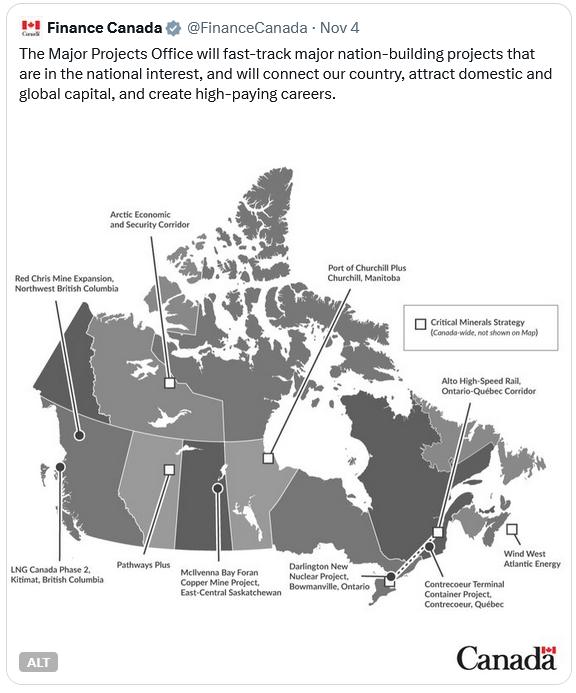
On the social media site formerly known as Twitter, David Knight Legg vents about Dear Leader Carney’s penchant for even-more-Trudeauesque-than-Justin performative governing. Far more emphasis is put on the PR value of an announcement than on the common sense practicality of the thing being announced. And Carney is also starting to re-announce already announced “projects” as if speaking it aloud will magically manifest it into reality:

Canada’s major projects announcements are a national embarrassment — an economic “hostage release” program — that tells the world just how uninvestible Canada has become under the Liberal party.

1970s central planning Liberal govt arrogance is at an all time GDP destroying high.

Try naming another OECD nation (we’re at the bottom now) where the press waits with bated breath for a “dear leader” politician who has never built anything in his life to fly in to grant a bureaucratic benediction on a few projects his bureaucrats will allow past the gate of the caps, taxes, green rules and red tape his govt imposes on everything.

Idea: set up the Major Dumb Redtape office in Calgary instead and get rid of the 10 anti-business rules written into law by the Montreal green alarmist fringe that’s holding Canadian energy, ag, forestry, and manufacturing back while other nations grow …

But PM Carney seems to like his bureaucratic power over what used to be a leading free market economy. Even while our GDP grinds down to the worst in the OECD.

The arrogance is breathtaking.

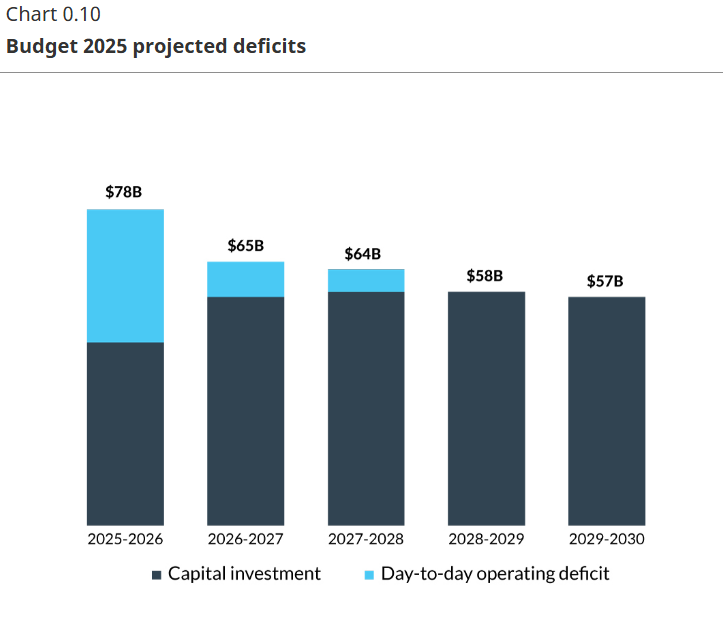
So is the ineptitude. This same central planning genius just punched a record new $78billiom hole through our public finances because he can’t manage basic public service delivery without more crushing debt.

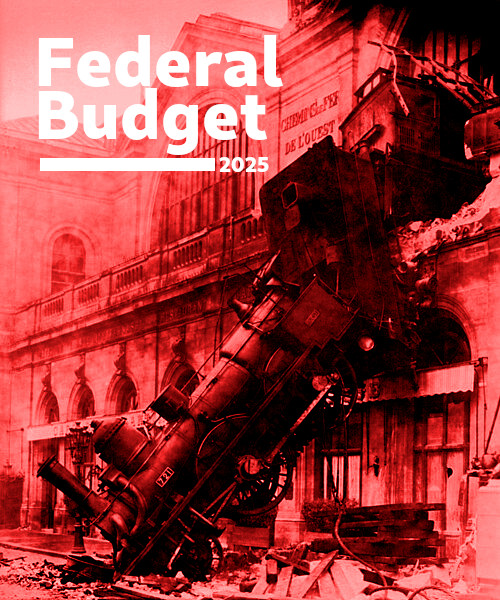
The budget is a train wreck solidifying the final year of a Liberal decade steeply eroding purchasing power, national wealth, personal security and living standards and public services.

The irony is that this has driven Canada to ever-greater 51st state economic dependency. Donald Trump didn’t do that. They did.

But he’s been a too-convenient way to con the elderly with “elbows up” PR.

But should the next generation really be forced to lend this govt another $78bn in addition to the 1 trillion they’ve already taken to fund their failed decade of central planning, green slush funds and EV mandates while real infrastructure projects wait years for the Liberal party to bless them?

It’s not going to last.

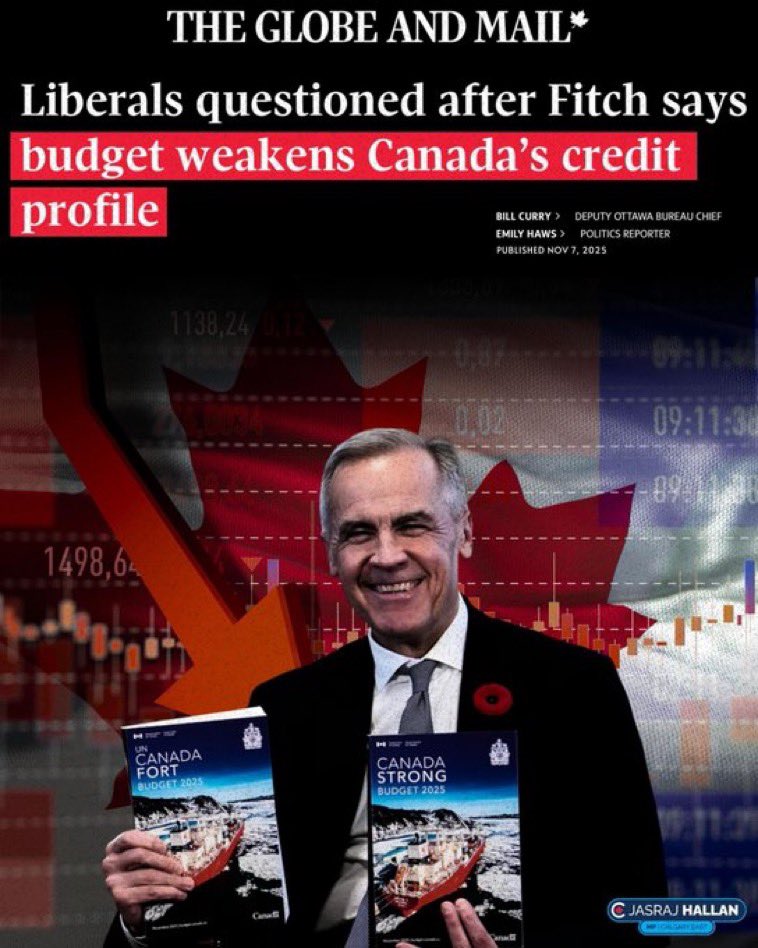
Fitch just questioned the sustainability of all this. Unlike our lacklustre press they aren’t buying “net debt” or “operating/investment” Liberal financial illiteracy.

I had high hopes PM Carney would return fiscal sanity to Canada after openly borrowing Conservative policies to get elected by cutting the carbon and cap gains taxes.

But this budget, this major projects farce and his inability to kill a dozen economy killing rules of his own govt is showing the work how uninvestible Canada has become — and it’s accelerating national economic decline.

2026 is the end of the Liberal lost decade. First recession. Then debt downgrade. Then an election. And Carney can go back offshore to his assets and all the other global investors who like him don’t invest in Canada under Liberal mismanagement.

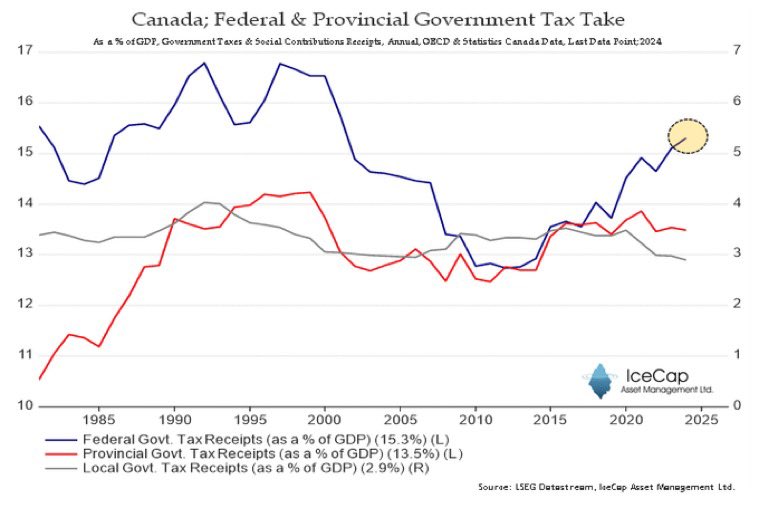
@SteveSaretsky thx for the brilliant line chart as usual.

A day later, after his post got significant attention on the social media site formerly known as Twitter, he posted this follow-up:

This angry post I wrote a day ago got 300,000 views.

Canadians are tired of the fake “major projects” PR by the same people who prevented those projects for a decade with their green taxes and prohibitions.

Announcing the release of 7 hostage projects is a joke. Some of these projects aren’t major and most aren’t new. None needed the govt to do anything but get out of the way from the beginning.

All the several hundred major projects still in purgatory need is for this govt to reverse their anti-job and anti-infrastructure tanker ban, industrial carbon tax, emissions cap, and electricity regs.

Oh — and also clarify by law that in Canada property rights are not overridden by leftist judges and UN wishful thinking.

Then get out of the way so a couple trillion dollars can flow in, major projects can get built and the govt revenue will flow to better public services — and to pay down that debt they just added $78bn to.

November 17, 2025

Yet another example of the Liberal focus on symptoms rather than underlying problems

Filed under: Cancon, Government, Media, Politics — Tags: , , , , , , — Nicholas @ 03:00

The Liberals under both Justin Trudeau and Mark Carney have amply demonstrated that they care far more about appearances than achievements. The immigration crisis is merely the latest example of the government reaching for something that will look good on TV and in the newspapers rather than addressing the root cause of the problem:

Perhaps the most intractable policy disaster handed to Prime Minister Carney by the Trudeau government is the immigration file. The ugliest detail in that file is undoubtedly the astronomic increase in temporary residents (largely foreign workers, international students, and asylum seekers) – a population that expanded from 3.3% in 2018 to 7.5% in 2024. The Carney government’s solution is to limit the inflow of new temporary residents significantly, while at the same time giving permanent residency to many of the ones already on Canadian soil.

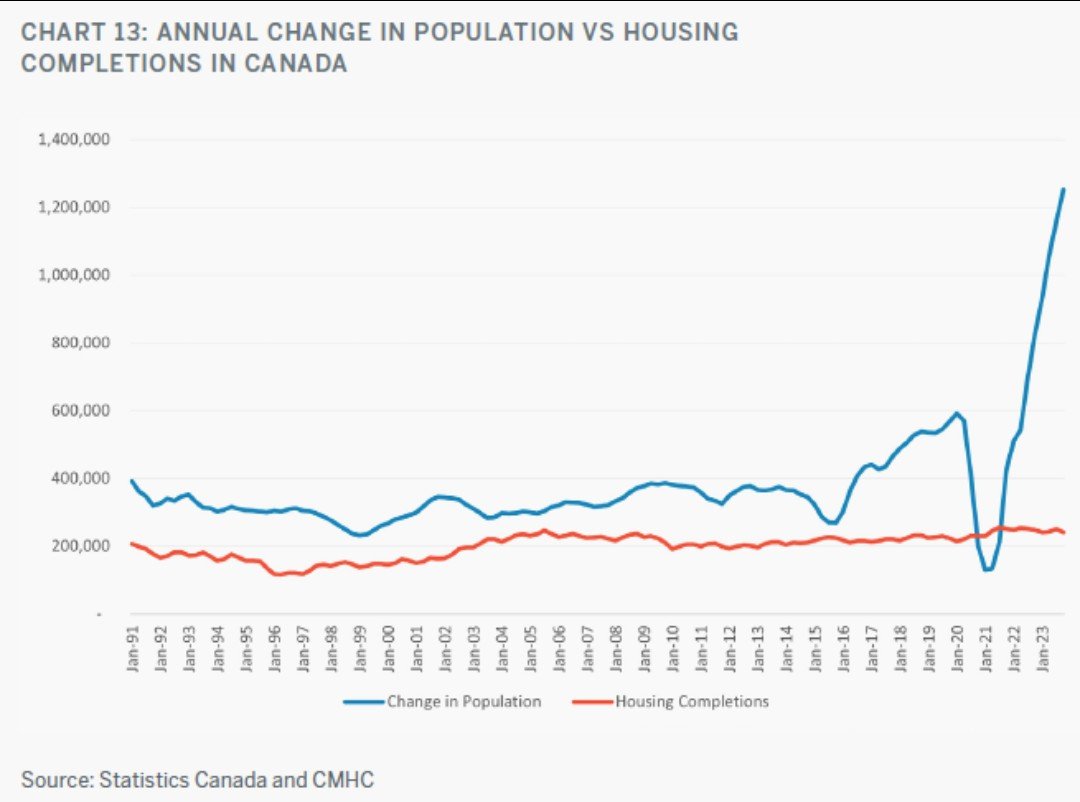
The base problem is far too many people entering the country, driving up demand for housing, overloading healthcare facilities, absorbing more and more government assistance at a time the government is running record deficits, and undercutting young Canadians for entry level jobs while youth unemployment is skyrocketing. But this “solution” will look like firm action as it will be presented by the tame media, so from the point of view of the government, it’s “mission accomplished”.

The Carney government’s first annual Immigration Levels Plan commits to “reducing Canada’s temporary population to less than 5% of the total population by the end of 2027”. To this end, Canada’s annual intake of new temporary residents will be cut from 673,650 in 2025 to 385,000 in 2026, and 370,000 in 2027 and 2028. This cut will hit international students the hardest, with annual new study permits cut in half from over 300,000 to 155,000 in 2026, and 150,000 in 2027 and 2028.

This major cut will ease the strain on Canada’s housing, healthcare, food banks, roads, and social services – a strain that is no longer denied by politicians, and is freely acknowledged across the political aisle. But, as is the case with many policies, the devil is the details. It turns out that one of the ways which the federal government intends to shrink the size of the temporary resident population is by making a large number of them permanent residents.

In the recently released 2025 Annual Report to Parliament on Immigration, Immigration Minister Lena Diab says the Carney government intends to “give priority for permanent residence to temporary residents already living and settled in Canada, further reducing the number of new arrivals”.

How many temporary residents will get permanent residency under this plan is unclear, but we can extrapolate from the data we have.

The Carney government’s Immigration Levels Plan sets the annual permanent resident rate at 380,000 for the next three years – or, a total of 1,140,000. The very last Immigration Levels Plan of the doomed Trudeau government – which committed to transitioning many temporary residents to permanent residency – predicted that temporary residents would account for “more than 40% of overall permanent resident admissions in 2025”.

If the Carney government is heralding the idea of transitioning more temporary residents as a way to slow down the catastrophic population growth Canada has experienced in recent years, we can safely assume that this proportion will be at least a little bit higher than the Trudeau government’s rate. A rate of 50%, say, would mean that 570,000 temporary residents will receive permanent residency over the next three years.

See, Canadians are telling the government that there are too many temporary immigrants, so by waving a magic wand and transforming the bulk of the temporary immigrants into permanent residents, the government can pretend they’ve solved the problem. And the sycophants, fluffers, and cheerleaders in the media will laud them to the skies for their brilliant solution.

November 14, 2025

“Conscription if necessary, but not necessarily conscription” 2 – Electric Boogaloo

Filed under: Cancon, Government, Media, Military, Politics — Tags: , , — Nicholas @ 05:00

Canada has only had two brushes with military conscription — after voluntary enlistments couldn’t keep up with casualties in both the First and Second World Wars — and both caused severe resentment in Quebec. Canadian politicians have generally avoided any hint of anything that could be framed as “conscription” for fear of triggering yet another existential crisis between Quebec and the rest of the country. Prime Minister Mark Carney isn’t a typical Canadian politician, and does not seem to have any of the built-up scar tissue that most others do. This might make him prone to saying and doing things that seem quite ordinary to him, but trigger civil unrest … like forcing civil servants to become soldiers against their will.

I floated the notion that this might be Carney’s five-dimensional chess strategy to reduce the civil service without having to fire everyone, but it’s far more likely that he genuinely doesn’t understand Canadians and our shared history.

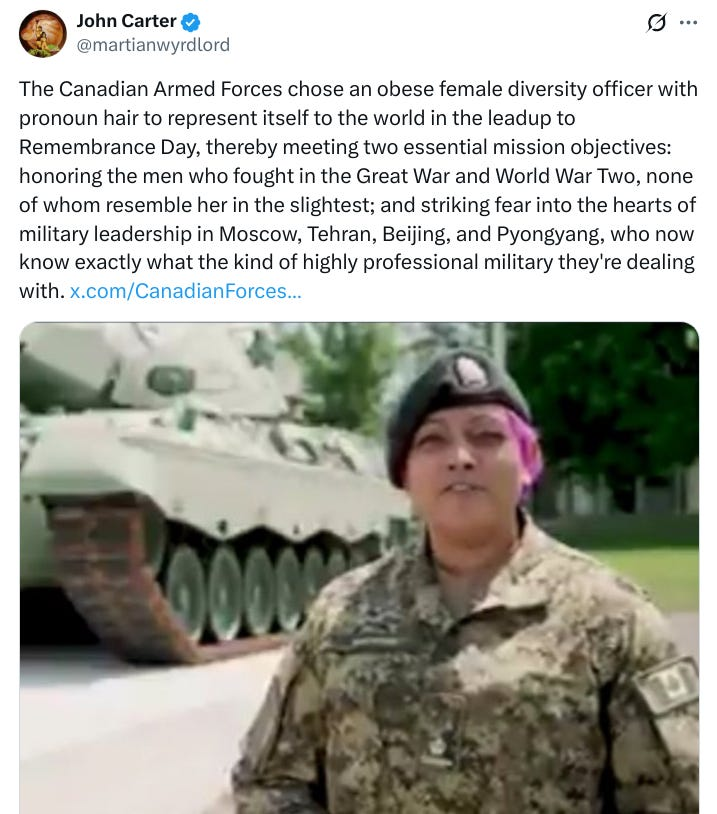
John Carter is … skeptical about the Laurentian Elite being capable of rebuilding the depleted Canadian Armed Forces, as it’s hard to conceal sixty years of open contempt long enough to fake some sincerity:

The Canadian Armed Forces – which refer to themselves as the CAF, pronounced exactly as it’s spelled – recently leaked its intention expand its reserves from the current, anemic 22,000 to 400,000 soldiers. At first I wondered if an extra 0 was added to that number as a typo, but the plan is to grow the Army reserve to 100,000 and the supplementary reserve (which I hadn’t even known existed, and is currently composed of retirees) from a few thousand to 300,000. Further leaked details are that the 300,000-strong supplementary reserve will be created by essentially drafting civilian Federal employees, training them in driving trucks, marksmanship, and drone flying, which really just sounds like the makings of an absolute clown show.

At the same time, Canada’s prime minister Mark Carney has committed to a considerable increase in the CAF’s budget – over $80 billion spread over the next five years, with 2025-26 spending rising to around $62B from the previous average of around $35B – with the goal of reaching the 2% of GDP level that NATO members are expected to (but in practice usually don’t) maintain. As part of this build-up, the CAF is hoping to reach its authorized strength of 71,500 uniformed personnel.

[…]

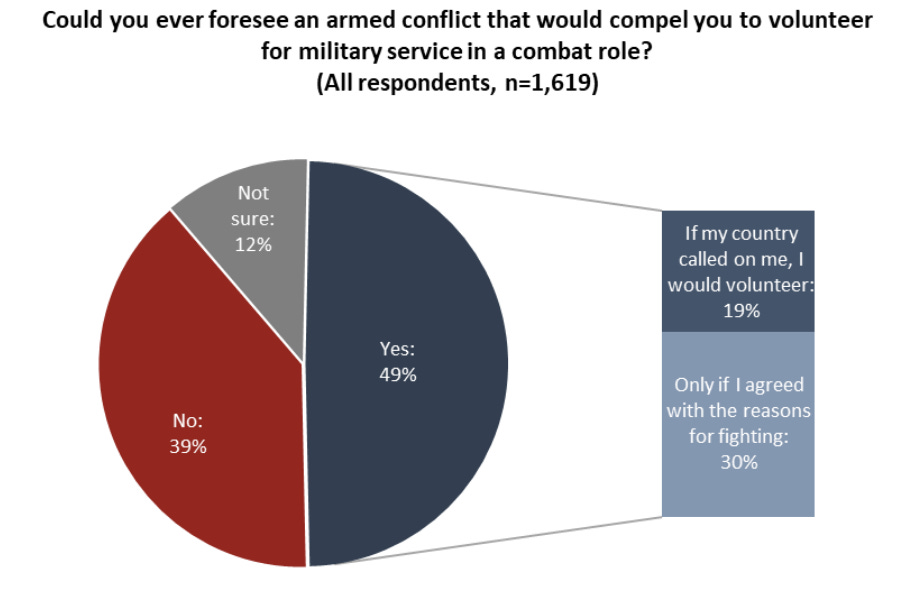
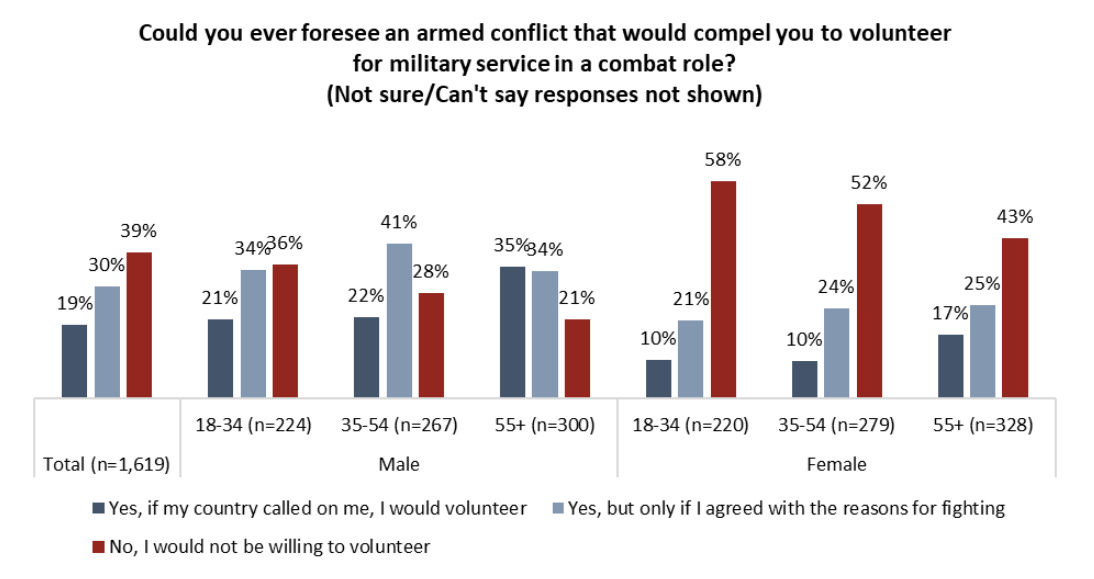
A recent Angus Reid poll indicates that there is very little enthusiasm for military service amongst Canada’s population. Only one in five Canadians would volunteer no matter the reason if their country called them, while 40% would refuse service under any circumstances.

Young men are even less likely to be potentially willing to unconditionally volunteer than old men, while being far more likely to refuse to volunteer under any circumstances (of course, women are almost universally aghast at the idea of serving). Contrast this to World War 2, when about 1/3 of fighting-aged men volunteered.

Governments that find it impossible to motivate their young men to volunteer for military service, but need their warm bodies in uniform anyhow, have historically resorted to conscription. Since they are manifestly not interested at the moment, the political class has begun floating trial balloons about mandatory military service in its media.

[…]

Just because conscription would be unpopular doesn’t mean that the government won’t reach for it, of course. More or less by definition, conscription has never been popular. It is, however, very far from ideal. Conscripts don’t tend to make the most enthusiastic troops. Their morale tends to be low, their enthusiasm non-existent, and their propensities to shirk their duties, avoid danger, surrender, and mutiny are all much higher than those of the committed volunteer.

[…]

The Canadian government has worked hard to systemically alienated the native population. Official state ideology is that Canada is a post-national multicultural state with no core identity built on stolen native land by genocidal settler-colonialists. As such, there’s nothing to defend. There’s no there, there: no identity to identify with, no boundaries of culture to justify the borders of political geography, no in-group to defend against an outgroup. No nationalism without a nation; no patriotism without patria.

Reinvigorating Canadians’ willingness to serve their country and rebuilding Canada’s military into a force that can win wars would both require the Canadian political class to repudiate the ideological territory of globalism, feminism, multiculturalism, mass immigration, and gender-bothering that they have made themselves synonymous with. However, they can’t reverse course without discrediting themselves, and so, they won’t. Fixing the recruitment crisis is therefore a coup-complete problem: it cannot be accomplished absent wholesale replacement of Ottawa’s political class. We only need to look south of the border for demonstration of this. Until 2025, the American military was suffering from precisely the same recruiting woes as afflict Canada and Great Britain, due entirely to a collapse in interest amongst America’s traditional warrior class: white rural Southern men.

The ascendant Trump replaced the shapeless blob Lloyd Austin as the Secretary of Defense with the young, energetic, crusader-tattooed Pete Hegseth as the Secretary of War (and that difference in terminology matters). Recruitment rebounded immediately, with the US Army alone exceeding its 2025 goals by 61,000, four months ahead of schedule. Including reserves, the US military as whole recruited about 325,000 new personnel in 2025, with each branch either hitting or exceeding its recruitment targets (which were also 10-20% higher than in 2024). Adjusting for population ratios, this would be the equivalent of the CAF recruiting 32,500 personnel in one year.

Of course, as we’ve noted here before, the CAF doesn’t have the same kind of recruiting problem that the American services faced (please pardon the self-quote here):

We’ve had surprising numbers of media folks paying attention to the crippling recruiting crisis, as even on current funding, the CAF is short thousand and thousands of soldiers, sailors, and aircrew. Sadly, but predictably, most of that media attention looks at the shortfall of new recruits being trained for those jobs, which is true but incomplete. The biggest problem on the intake side of the CAF is the bureaucratic inability to bring in new recruits in anything remotely like a timely fashion. The last time I saw annual numbers, the CAF had huge numbers of volunteers coming in the door at recruiting centres, but getting the paperwork done and getting those volunteers into uniform and on to job training was an ongoing disaster area. More than seventy thousand would-be recruits applied to join the CAF and the system managed to process less than five thousand of those applicants and get them started on their military careers.

At a time that we’re losing highly trained technicians in all branches to overwork, underpay, and vocational burn-out, we somehow lack the competence to take in more than one in twenty applicants? That is insane.

November 6, 2025

Reactions to Tuesday’s budget announcement

Mark Carney’s government finally got around to releasing their 2025 budget and lots of folks have thoughts and concerns about what is in it and what isn’t in it. After all, it could be the best possible budget, but it would still not satisfy all concerns … and nobody is pretending that this is anything close to “best possible” territory. Sylvain Charlebois says that the budget ignores the food insecurity issues and grocery prices for ordinary Canadians:

Graphic stolen from Small Dead Animals.

For a government that often talks about food affordability and insecurity, Budget 2025 offers surprisingly little that directly addresses either. There’s no bold food strategy, no affordability roadmap, and no new incentives for domestic food production. Yet, in between the lines, Ottawa has quietly set the stage for some indirect relief — not through grocery subsidies or consumer-facing policies, but through infrastructure, trade, and administrative reforms that could make the food system work a little more efficiently.

The largest signal comes from the government’s $115 billion infrastructure plan, one of its so-called “generational investments”. The new Trade Diversification Corridors Fund aims to modernize ports, railways, and airports — all chronic weak points in Canada’s food supply chain. When bottlenecks ease, goods move faster, and perishable products arrive fresher and cheaper. While no one in Ottawa framed this as a food-price measure, logistics efficiency has long been one of the most effective — and least visible — forms of price control.

[…]

Still, the absence of a broader vision for food affordability stands out. After years of grocery price volatility and public debate about “greedflation”, Canadians might have expected a more direct focus on food resilience — investments in innovation, local processing, or retail transparency. Instead, the government seems to have opted for a quieter, systemic approach: strengthen the arteries of trade and logistics, and trust that efficiency will trickle down to the dinner table.

The budget forecasts a $78.3 billion deficit for the 2025-26 fiscal year, which is significantly higher than notorious spendthrift Justin Trudeau’s last budget number. This adds to an already staggering $1.27 trillion debt load, which is nearly double what it was just before the pandemic. In the lead-up to the budget release Mark Carney had hinted at major sacrifices to be made, and while there wasn’t a lot in the document directly corresponding to sacrifice, the need to service that long-term debt will do the job quite adequately.

In the National Post, John Robson says that the budget is “elbows up, IQs down”:

Since I was last propelled years ago into the purgatory known as “the lockup”, where journalists spend budget day, have either process or contents improved? No. Instead they now insert a false stolen-land “acknowledgement” before even getting to the same old same old labeled bold and new. Which is especially troubling at this supposedly critical juncture.

The document is the familiar brick, 406 paper pages and 493 digitally with no explanation for the discrepancy and no excuse for the length. (Or for being called “Canada Strong” with an inexplicable picture of a ship.) Especially as the Finance Minister gabbled “This is a budget that talks to everyday Canadians,” and its purpose is to state plainly how much the government intends to spend, where it hopes to get the money and how far short it already knows it will fall, you shouldn’t have to wade through 248 pages of sludge to find out.

As P.J. O’Rourke said, “beyond a certain point, complexity is fraud”. Though we “privileged” insiders search “Summary Statement of Transactions” and voila, submerged on p. 249 (all references digital) is a $78.3 billion deficit next year if all goes well, and the national debt increasing $80.5 billion so it already didn’t.

Much commentary, and special-interest attention, focuses on trivial fiddles. But what matters is that Leviathan is in hock up to its horns, with interest payments projected at $55.6 billion next year, soaring to $76.1 billion by 2029-30. If the Lord is willing and the creek don’t rise, both forlorn hopes. NDP MP Leah Gazan, who would jail you for “downplaying” residential schools, snarled about not supporting an “austerity budget” but she won’t get the chance.

Some may bleat that times are tough. Indeed the finance minister’s campaign-speech “Foreword, Budget” gasses “The world is changing, profoundly and in real time; we are no longer living in an era of calm, but of significant change”.

The projected deficits are clearly hallucinatory, as the Liberals never seem to get deficit spending to go down, running deficits every year since 2015:

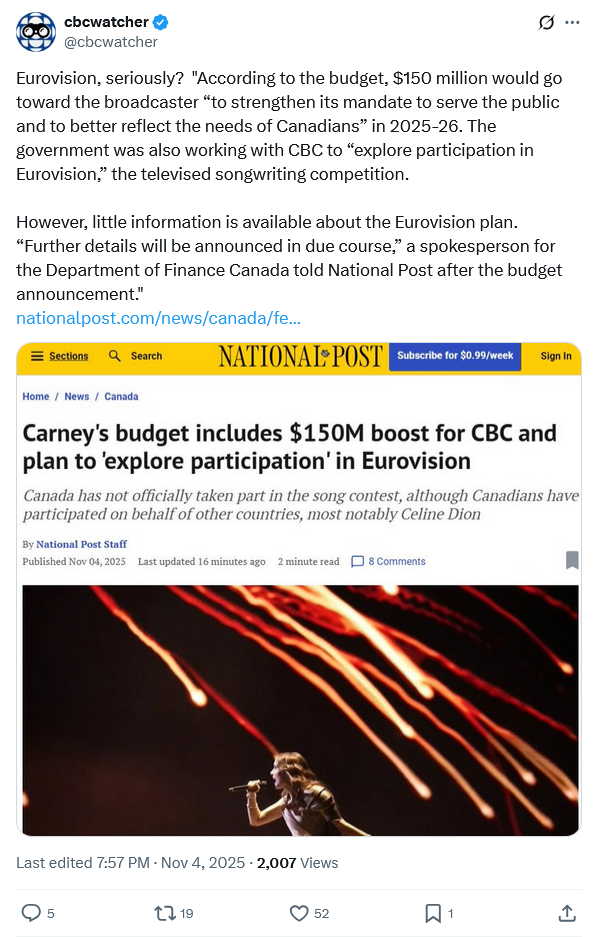
However, on the ludicrous side, the feds want to spend money to “investigate” Canada taking part in the freaking Eurovision contest:

On the slightly less ludicrous side, Noah considers the military aspects of the budget:

Budget 2025 outlines the government’s generational investment to quote, “defend Canada’s people and values, secure its sovereignty, and position the nation as a strong, reliable partner to its allies“. This starts by initiating a process of rebuilding, rearming, and reinvesting in the DND, CCG, and CAF to provide everyone with the necessary tools and equipment to protect sovereignty and bolster security.

Budget 2025 starts by outlining the government’s previous commitment to accelerate investments to meet NATO’s 2 per cent defence-spending target this year, which is five years ahead of schedule.

Budget 2025 goes a step further by setting Canada on a path to meet NATO’s 5 per cent Defence Investment Pledge by 2035. This will be broken down into two categories, 3.5 per cent of GDP by 2035 in core military needs, including supporting the CAF, modernising equipment and technology, and building up defence industries, and 1.5 per cent on security-related infrastructure and investments.

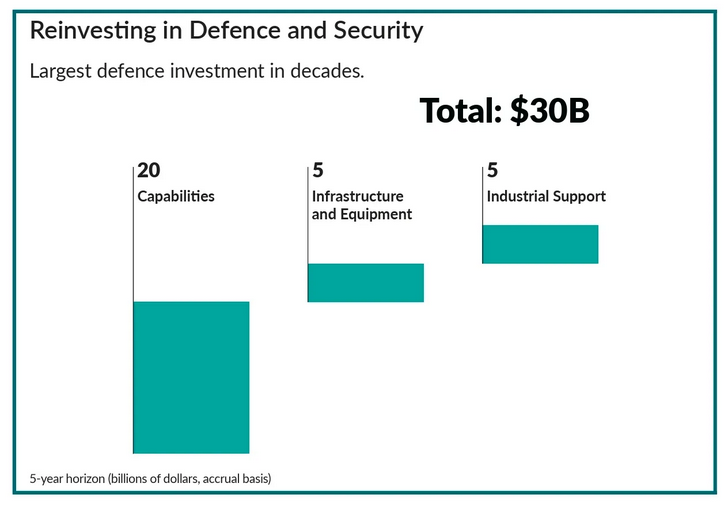
This reinvestment in defence and security is the largest in decades, totaling $30 billion over a five-year horizon on an accrual basis. This funding is allocated across three main pillars: $20 billion for capabilities, $5 billion for infrastructure and equipment, and $5 billion for industrial support.

On a cash basis, Budget 2025 proposes to provide $81.8 billion over five years, starting in 2025-26, to rebuild, rearm, and reinvest in the CAF. This figure includes over $9 billion in 2025-26 that was previously announced in June 2025. This is the funding previously set out for Canada to reach the 2 per cent NATO target.

Key investments from this $81.8 billion fund include $20.4 billion over five years to recruit and retain a strong fighting force, which incorporates the previously announced updates to pay and support for CAF health care.

An additional $19.0 billion over five years is allocated to repair and sustain CAF capabilities and invest in defence infrastructure, including the expansion of ammunition and training infrastructure. Upgrades to digital infrastructure for the Department of National Defence, CAF, and the Communications Security Establishment, particularly for cyber defence, are funded with $10.5 billion over five years.

Finally, $17.9 billion over five years is designated to expand Canada’s military capabilities, with investments in logistics, utility, and armoured vehicles, as well as counter-drone, long-range precision strike capabilities, and domestic ammunition production.

This is a serious chunk of change, although sadly, and as you will see, we don’t get a major breakdown of what this looks like. What we are left with are general piles of money, which isn’t always a bad thing. It’s also expected. The budget is set for a timeline before many critical capabilities will be delivered, so they won’t be included. Almost everything comes after 2030.

October 27, 2025

Trump versus Carney (and Ford, his court jester)

Another week, another set of bleak headlines about the trade relationship (or lack thereof) between Canada and the United States. For some, this is the story of how Trump Derangement Syndrome has consumed all levels of Canadian leadership, while for others it’s proof that you can’t deal with Trump as a rational adult and instead need to consider him an overgrown toddler with a nuclear arsenal at his disposal. Or perhaps it’s a little from column A and a bit from column B:

At the risk of overstating my own influence, it’s like the President of the United States read my piece saying he was acting like a toddler and decided, “oh yeah? I’ll show what ‘acting like a toddler’ means!” and did this, presumably once Bluey was over:

    U.S. President Donald Trump says he is raising tariffs on Canadian goods by 10 per cent, after accusing Canada of airing what he called a “fraudulent” advertisement that misrepresented former president Ronald Reagan’s stance on tariffs.

    In a post published on Truth Social at 4:30 p.m. Saturday, Trump wrote, “I am increasing the Tariff on Canada by 10% over and above what they are paying now.”

    Trump’s post cited his frustration over an advertisement produced by the Ontario government that used clips of Reagan warning about the dangers of protectionism and praising free trade.

    “Canada was caught, red handed, putting up a fraudulent advertisement on Ronald Reagan’s Speech on Tariffs,” he wrote.

    Earlier this week, Trump had cut off trade negotiations with Ottawa, explaining it was due to the “hostile” nature of the ad campaign.

    “Their Advertisement was to be taken down, IMMEDIATELY, but they let it run last night during the World Series, knowing that it was a FRAUD,” Trump further said in the Truth social post.

The good news is, at least Trump is coming right out and admitting that his “national security” tariffs are really about nothing more than his fragile ego, just in time for the Supreme Court to hear arguments about this very issue.

The bad news is, I think it’s exceptionally naive to think SCOTUS is going to save us from this madness.

Not because I think they’ll rule that what he’s doing is legal. That might be a bridge too far for even Justices Thomas and Alito.

But because this proposition rests on the assumption that Trump considers himself bound by Supreme Court rulings and that anyone else is going to exercise their power to ensure these rulings are followed.

Or, if you think Canadian leaders are deep in a TDS binge:

How The New Republic saw Donald Trump during the 2024 election campaign.

Trump Derangement Syndrome (TDS) is a widespread and serious issue. When one is afflicted by it, their capacity to sense-make becomes compromised. Emotions are a difficult thing for humans to control, and TDS-sufferers seem for the most part unaware of how much their negative, emotional feelings concerning Trump have hijacked their reason.

TDS types reveal themselves in so many ways. One specifically, which often goes unnoticed, is a general uncharitableness when it comes to interpreting the words and actions of Trump, or a general unwillingness to look beyond words – either Trump’s words or anyone else’s which have been inserted into Trump discourse. A prime example of this is the anti-tariff ad campaign involving a 1987 speech by former president Ronald Reagan which the Ford government paid $75 million to have broadcast to American audiences – key Republican areas – for the purpose of undermining President Trump’s economic policy.

Firstly, the uncharitable analysis does not allow that Trump has any right, or any good argument, or reason to be upset about Canada’s trade practices, such as supply management. The uncharitable analysis sees Canada as an innocent victim and Trump as a bully who is trying to destroy us and/or take us over.

[…]

Returning to reason and reality. Trump has justification for being upset with Canada over both our trade practices and in the under-handed and unfriendly tactics of Doug Ford and other Canadian leaders. The ad was an insult to Trump. His reaction or over-reaction to the ad, does not change the fact that what Ford did was antagonistic and not in the best interests of productive trade negotiations. The charitable analysis understands this, and does not lose sight of it, no matter how outlandish the things Trump does may be.

On the other side of the uncharitable Trump analysis concerning Ford’s Reagan ad blunder, is circulating the idea that Reagan was anti-tariff. Why is this idea believed? Because of Reagan’s rhetoric. You can find hundreds of clips of Reagan speaking about the dangers of high tariffs, or advocating for free trade. But the uncharitable analysis refuses to go beyond words. They ignore words that don’t support their argument, and act as if the words that do support their argument were the only ones spoken. Further, they act like words are the be all and end all, by not bothering to investigate the actions of those who speak the words, they pretend that word-speakers always do and intend exactly what they say. Reagan’s oratory contained lots of anti-tariff rhetoric, but his actions included lots of pro-tariff policy in an effort to deal with unfair trading partners.

None of this is difficult once you mea culpa from TDS. If you remain under the spell of TDS, you will not be rational or reasonable, and I for one, will not take you seriously. You will look increasingly foolish as time goes on and Trump’s policies turn out not to be the disasters you hysterical twits dreamed they would be. And the group of people like me, who shake their heads and roll their eyes at you, will grow and grow, under the weight of inevitable mass mea culpa. But you will remain shrouded from truth as you descend further into darkness and gloom and hate. It doesn’t have to be this way … just mea culpa FFS!

When announcing something is a substitute for doing something

Filed under: Cancon, Media, Politics — Tags: , , , , — Nicholas @ 03:00

The headline seems to be the most accurate way to describe the habits of the federal Liberals from the start of Justin Trudeau’s first government to Mark Carney’s most recent national media appearance. Peter Menzies describes the bought-and-paid-for national media’s coverage of the big non-event:

It has never been easier, thanks to the internet, for journalists to check if they are being played for fools. But due either to sloth, neglect, habit or servility — pick one — way too many lack the motivation to use a search engine.

Instead, they frequently accept the role of featherheads manipulated by politicians staging one of the oldest scams in the Machiavellian playbook, the recycled “news” announcement. I say “featherheads” (patsies was another option) because, for instance, Prime Minister Mark Carney can book news network time for a full half hour speech that is nothing more than a rehash of everything he’s been saying for the past 10 months and still lead newscasts and make the front pages.

Here, I must pause to credit the Toronto Star. It, like other news organizations, received an embargoed copy of Wednesday’s speech in advance. It read it, saw that it contained no news and did not put a report on its front page. Others such as National Post and the Globe and Mail tried desperately to find a fresh angle within the speech but put it on their front pages anyway. CBC threw everything it had into it and CTV also led with it and tried its best to make it sound like news had happened.

Now, I am a reasonable and fair-minded person, so I would not be reacting were it just this incident that captured my attention. The PM is speaking, everyone gets excited, you review and lock in your story lineup and, ya, I get it. Been there, done that. But this was part of a troubling pattern that has emerged.

For instance, the government’s “plan” to hire 1,000 more Canadian Border Services guards was first announced in the Liberal election platform last spring. It was then, according to Blacklock’s Reporter, re-announced “April 10, April 28, June 3 and August 12”.

That Blacklock’s report was published Oct. 14 and focused on Public Safety Minister Gary Anandasangaree’s insistence he was “not responsible” for the promised hiring that hadn’t happened yet. Two days later, Carney announced that the previously announced and re-announced plan would be announced again in the Nov. 4 budget. And the day after that — Oct. 17 — Anandasangaree announced his ministry would be doing what he said a few days previously wasn’t his responsibility and hiring 1,000 new border guards — over the next five years. A similar pattern of announcement and reannouncements took place regarding the government’s plan to hire 1,000 more RCMP officers, also not immediately but eventually. Then, last week, Finance Minister Francois-Philippe Champagne announced a financial crimes agency would be up and running by next June. This, too, was reported as a new initiative even though the government first committed to that agency in 2021.

While not all news organizations rise to the bait, this widely carried Canadian Press story is an example of how easily the public can be misinformed by reporting that lacks proper context. Re-announcements are presented as “news” despite there being no news other than “politicians repeat what they said before to keep their names in the news”. Media that go along with this pattern of manipulation allow themselves to be accused of defining news as anything the government wishes to present as news, something about which — now that media are subsidized by politicians — they should be more cautious.

The nation needs journalists to tell the whole story or, as Robert Maynard, founder of the Maynard Institute for Journalism Education, put it:

    The first thing about journalism is about accuracy and fairness, but that’s not enough. It has to be about context, it has to be about depth.

October 25, 2025

Foreign interference? In our elections? Say it ain’t so …

Filed under: Cancon, China, Government, India, Media, Politics — Tags: , , , — Nicholas @ 04:00

Oh, but it is, fellow Canadians, and it’s going to continue because our government can’t or won’t lift a finger to stop it:

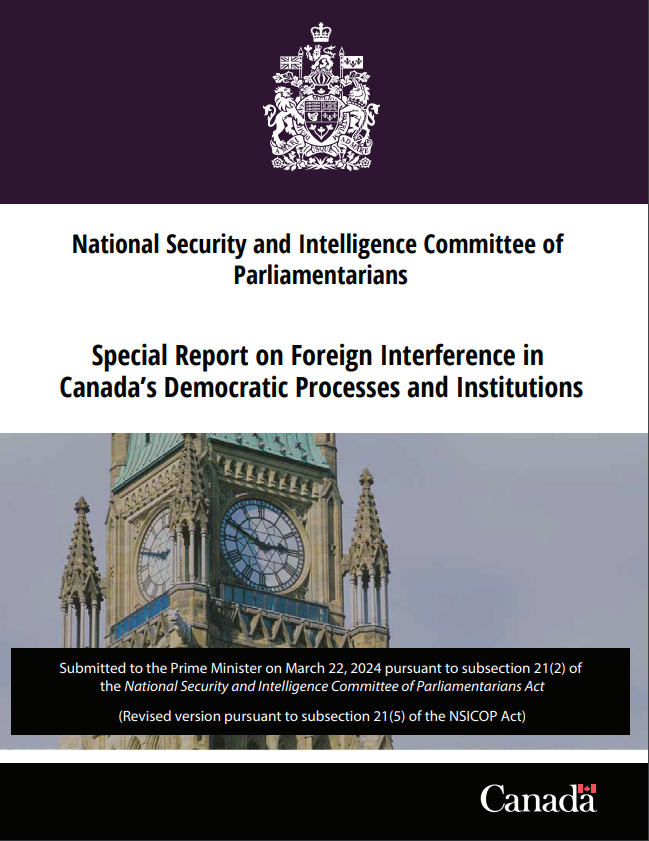
The cover of the NSICOP special report on foreign interference (PDF – https://nsicop-cpsnr.ca/reports/rp-2024-06-03/special-report-foreign-interference.pdf )

[Vancouver-East MP Jenny Kwan]’s recent comments, which correctly noted the incredible hardship that Canadians targeted by foreign regimes endure, typically with no help from an apathetic Canadian government, are important and deserve amplification — we must all hammer home just how vicious a foreign influence campaign can be for those on the receiving end, and how little help they can normally expect from Canadian officials.

But mystifying? I wish.

A recap of the timeline is useful: The Liberals were “actively considering” such a registry as early as 2021. Late the next year, the magnificent Marco Mendicino, living embodiment of Trudeau-era ministerial excellence, was talking about launching a consultation, to see if it was an idea worth pursuing. A few months later, Justin Trudeau himself said that Mendicino would be “moving forward” to study “various proposals” in the coming weeks.

And then, well. You know. Nothing happened. In short order the government had the foreign interference scandal blow up in its face. A public inquiry was eventually called, after a long, drawn out process of increasingly pathetic attempts to dodge the issue. The initial report by Justice Hogue was released in May of 2024, and that month, the House unanimously passed Bill C-70, the Countering Foreign Interference Act. This gave the government the legal tools to establish the registry, a process they said would take about a year. That year ran out five months ago, and at that point … the office wasn’t even operating yet, even just in preparation for eventually going live. The Carney government then said they’d appoint a commissioner by September of this year. This would mark the beginning of the registry’s work.

It’s now late October, with nary a new-fangled commissioner to be found.

The Hill Times article places Kwan’s comments, and the government’s overall lackadaisical effort on this front, in the specific context of the Carney government’s efforts to offset our lopsided reliance on trade with the United States by improving relations with China and India. These are not countries with which we have lately been swapping friendship bracelets, and a foreign influence registry would largely — not exclusively, but largely — be intended to address their interference. “I am constantly worried about [foreign interference], but that doesn’t mean I’m not also worried about affordability issues for Canadians; I can do both,” Kwan is quoted as telling The Hill Times. “The Carney government needs to be able to walk and chew gum at the same time; they need to address both with the level of seriousness and attention they require.”

Later in the article, Dan Stanton, a former senior CSIS official and current national security expert at the University of Ottawa, adds that the Carney government has likely postponed any further announcements on the registry to avoid complicating ongoing talks with the Asian giants.

Well, yeah. That’s pretty clearly an issue. Kwan and Stanton have the government about dead to rights on that one. You can see the proof of that everywhere — Foreign Affairs Minister Anita Anand’s recent trip to India and China, after which she called China a “strategic partner”, is a pretty clear signal. The latest blowup in U.S.-Canada relations, with Trump cancelling all trade negotiations with Canada because (or so he claims) Ontario ran anti-tariff ads on U.S. TV, will only increase the desire in Ottawa to realign our economy toward literally anyone else but the Americans.

International FAFO – Ontario pokes Trump, Trump withdraws from trade talks

Filed under: Cancon, Government, Media, Politics, USA — Tags: , , , , — Nicholas @ 03:00

Canadian politicans seem unable to comprehend that Donald Trump is not a typical American leader — for both good and bad — and Ontario Premier Doug Ford seems to be the last one to figure it out. The Ontario government paid for ads featuring Ronald Reagan making anti-tariff comments to run in the US media and Trump reacted, strongly:

The Ontario government’s anti-U.S. tariff ad will run multiple times during the U.S. broadcast of baseball’s World Series game Friday, less than 24 hours after President Donald Trump “terminated” trade talks with Canada over the commercial.

In an email, Ontario Premier Doug Ford spokesperson Hannah Jensen confirmed information first reported by National Post that the ads will run throughout the World Series.

That means the ads, taken out by Ontario Premier Doug Ford’s government, will be playing to a primetime U.S. audience less than a day after Trump cited them as the reason he was ending trade talks with Canada.

The Toronto Blue Jays are vying for the World Series championship for the first time in over three decades.

The move suggests Ford is not ready to back down on his public campaign against U.S. tariffs on key Ontarian industries including auto manufacturing despite Trump’s ire.

Late Thursday evening, Trump took aim at Ontario’s ads which quote a 1987 speech by Ronald Reagan to fight against U.S. tariffs.

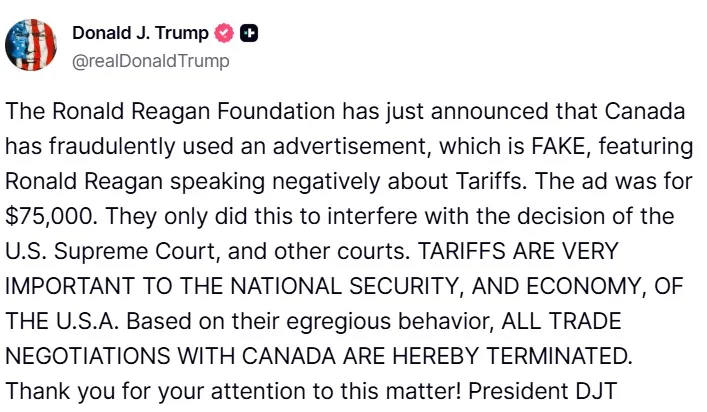
“The Ronald Reagan Foundation has just announced that Canada has fraudulently used an advertisement, which is FAKE, featuring Ronald Reagan speaking negatively about Tariffs. The ad was for $75,000,” Trump wrote on social media.

“They only did this to interfere with the decision of the U.S. Supreme Court, and other courts. TARIFFS ARE VERY IMPORTANT TO THE NATIONAL SECURITY, AND ECONOMY, OF THE U.S.A. Based on their egregious behavior, ALL TRADE NEGOTIATIONS WITH CANADA ARE HEREBY TERMINATED. Thank you for your attention to this matter! President DJT.”

On Friday, Prime Minister Mark Carney said Canada stands ready to resume trade talks with the Trump administration. But he stopped short of opining on if Ontario should cease running the ads.

If there’s a wrong way to deal with Donald Trump, you can be sure that some Canadian politician — often, but not always, Doug Ford — will find it:

Outside of the light conservatism found in the AM Talk radio circuit throughout the GTA, Ontarians didn’t really seem all that fired up when it was discovered that Premier Doug Ford spent $75 million on anti-tariff ads, the most contentious involving an audio clip of former Republican president Ronald Reagan, to be played in American cities targeting Republican audiences. They, for the most part, are also unlikely to appreciate the insult, and the damage it caused, by going directly to Trump’s base with a message that undermines the premise of his economic plan. In Canada, leaders like Ford and Carney, are permitted and even encouraged to talk tough on Trump, because it is well understood that Trump Derangement Syndrome is the leading cause of anxiety amongst Canadian leftists, and sadly, even many so-called conservatives. However, it has always been hollow, toothless, and pointless.

Carney’s elbow’s up nonsense is easily the most embarrassing thing produced by Canada in the last four decades (maybe longer). And Doug Ford is such a clueless dummy, conservative in name only, with NDP levels of TDS, and an incredibly irresponsible propensity to go off half-cocked, with such a careless abundance of volatility. No serious province can survive a leader like this. Ford is what Leftists think Trump is: a dangerous blundering idiot who can’t get anything right. But this thing with the Reagan ad is maybe the worst example in a long list of Ford blundering. Maybe Trump’s anger will blow over, maybe we will somehow come out of this episode embarrassed, yet again, but for the most part, unscathed. We will have to wait and see.

As much as I wish Canada was a force to be reckoned with, as it once was, the best I can muster is that some day in the distant future other countries might stop laughing at us. The sad reality is that generations of abysmal Laurentian elite leadership has destroyed the strength and respectability of Canada. We are a weak insignificant joke of a nation made that way by a grossly feminized ultra-weak leftist leadership class. Ford and Carney with their ineffective provocations directed at Trump in order to appease and win points with the TDS numbskull segment of the Canadian population, does little more than show the nation, and the world, the opportunism and lack of self-awareness indicative of all weak and clueless men of the social justice paradigm in the great feminized north.

To make matters worse, as if the largest and most rapidly expanding national debt in the history of Canada, the general complacency concerning government spending, or the massive affordability crises were not enough, it appears that Ford’s ad team manipulated the content of the Ronald Reagan speech they used in order to make it appear as if Reagan were anti-tariff. The ad stitches together non-consecutive segments of a five minute speech he gave in 1987. Again, the ad in question was part of a $75 million marketing campaign, paid for by Ontario tax-payers, which targeted American audiences.

The Ronald Reagan Presidential Foundation & Institute stated that “The ad misrepresents the presidential radio address, and the Government of Ontario did not seek nor receive permission to use and edit the remarks”.

Nice work, Doug. You can stop any time now …

Update: Fixed broken URL.

October 20, 2025

Carney’s trip to Egypt, without the pesky Canadian media tagging along

Filed under: Cancon, Media, Middle East, Politics, USA — Tags: , , , , , — Nicholas @ 05:00

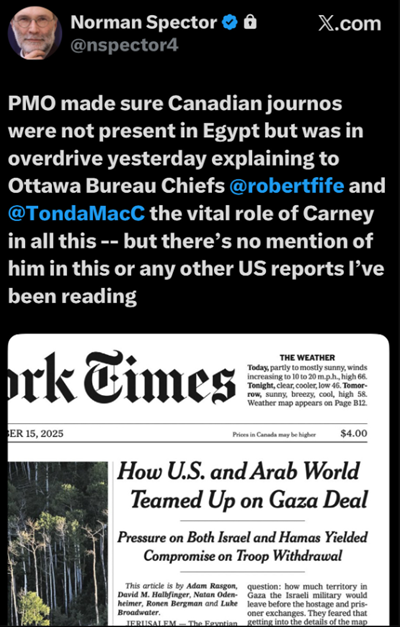
I guess it’s slightly to Prime Minister Mark Carney’s credit that he was able to get a last-second invitation to attend President Trump’s latest international triumph … we all know how Mr. Carney loves him a nice photo op. But it was almost unprecedented that he nipped over to Egypt without taking any of the usual flappers and fart-catchers of the Canadian media along with him:

X-post by former PMO chief of staff Norman Spector, who noticed something was up concerning how the Prime Minister’s team got its message out
Image and caption from The Rewrite by Peter Menzies

Last week, the Parliamentary Press Gallery (PPG) and I had something in common.

We were both dismayed.

They, because they weren’t invited to join Prime Minister Carney on his last-minute trip to Egypt for a photo opp; Me because most of them didn’t seem all that interested in looking into the circumstances of the PM’s hasty departure and instead allowed themselves to be played in the most appallingly obvious manner.

What got the PPG’s knickers twisted was that they weren’t invited to accompany Carney when he departed Ottawa in a rush to get to the Egyptian resort of Sharm El Sheikh, a popular spot on the Red Sea for the world’s glitterati. It took PPG President Mia Rabson a couple of days to issue a statement, but she made it clear the PPG disapproved:

    The Parliamentary Press Gallery was not informed in advance of the Prime Minister’s trip to Egypt to participate in the Middle East Peace Ceremony on Oct. 12-13, […] The Gallery is disappointed and dismayed at the exclusion of Canadian media from the event and expresses in no uncertain terms that this must never happen again.

    It is unprecedented that Canadian media be entirely excluded from a Canadian prime minister’s foreign trip.

The only reporting I could find on this was in Politico, where it was recorded that the PMO had posted this notice: “6:30 p.m. The Prime Minister will depart for Sharm el-Sheikh, Egypt, to attend the signing of a Middle East peace plan. Closed to media.”

What first caused my jaw to drop and to become, like Rabin, disappointed and dismayed, were the stories left unpursued. On the morning of Oct. 12, Canada was not listed as among the countries invited to join in the “peace summit” associated with the ceasefire deal reached between Israel and Hamas. If it had been, the prime minister may not have had to charter a private jet because the usual Royal Canadian Air Force planes and crews were, as City News‘s Glen MacGregor reported, unavailable.

There are two lines of journalistic inquiry there, neither of which appears to have been of interest. The first is: how can Canada’s military be so poorly equipped that there isn’t at all times a fully-equipped aircraft and crew on standby and is this an issue that will be addressed in the future? The second is: how did we wind up getting invited to the peace summit? Comments by US President Donald Trump indicate that we weren’t initially considered important enough to be on site but phoned to ask if we could join the party. (The Line — which doesn’t accept government subsidies — noticed.)

Trump, in remarks to media said: “You have Canada. That’s so great to have, in fact. The president called and he wanted to know if it’s worth — well he knew exactly what it is. He knew the importance. Where’s Canada, by the way? Where are you? He knew the importance of this.”

What was pursued, at least in comments online by journalists, was Trump’s inability to identify Carney by his correct title. (In an exchange that followed, Carney sarcastically thanked Trump for elevating him and, in response, was told “at least I didn’t call you governor”. Ha ha.)

Everyone is free to make their own decisions, but if Canada had to call Trump to ask to be invited, Canadians need to know if that means we are in the president’s debt. Trump, after all, seems like the sort of guy who keeps score.

But it’s what followed that really got creepy. While Canadian reporters were not allowed to accompany the prime minister to Egypt, someone who says he or she was on the plane started phoning around to tell reporters what happened. And they went for it. The Globe and Mail, Toronto Star and Politico all reported unverified statements emanating from a single, unnamed source. The Globe‘s Robert Fife reported that “a senior government official” said that while Carney and others thought they were just in Egypt for a photo opp, during a four hour wait for Trump to arrive from Israel “Mr. Carney had back-and-forth conversations with a group of leaders”.

So, after a bit of ritual humiliation — par for the course with Trump and Carney — the PM got to have unstructured/unfocused chit-chat with other diplomatic rag-tag and bob-tail clinging to the President’s cape. Not a good look, but Canadians must be getting inured to their national leaders being treated as, at best, an afterthought.

October 1, 2025

“Sean Fraser, the current minister of justice and attorney general, has made two major mistakes of late”

If you’re at all interested in Canadian affairs, you should subscribe to The Line … even a free subscription will definitely provide you with some excellent non-propagandistic coverage of what is happening in the dysfunctional dominion. For instance, last weekend’s weekly post from the editors included this segment about Sean Fraser, who is perhaps the worst of Mark Carney’s cabinet (and that takes some doing):

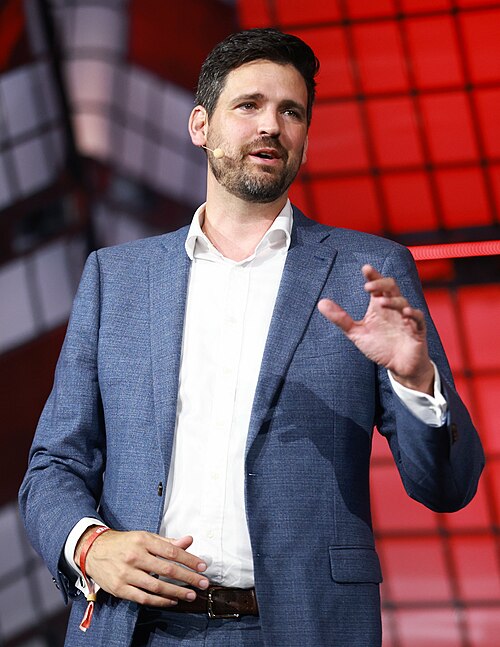
Sean Fraser, as Minister of Immigration, Refugees & Citizenship, during day one of Collision 2023 at Enercare Centre in Toronto, Canada.
Photo by Vaughn Ridley via Wikimedia Commons

We at The Line contend that Sean Fraser, the current minister of justice and attorney general, has made two major mistakes of late.

The first was in deciding not to rescind his decision to spend more time with his friends and family when it became clear that Justin Trudeau was no longer an anchor on his electoral chances. After failing to fix Canada’s housing problem and proving himself integral to blowing apart a pan-partisan consensus on immigration that was once the envy of the world, the man had a real opportunity to leave office on a high note. But, no.

Instead, after hitching his bloated baggage to Mark Carney’s trunk, Fraser decided that Canada needed more of him.

And so, as justice minister, instead of addressing petty stuff like, oh, bail reform, or fixing prisons, or getting crime under control, he turned his attention to … Section 33 of the Charter of Rights and Freedoms. The notwithstanding clause.

You may recall that Quebec’s contentious Bill 21 — which prohibits public-service employees in positions of authority, and teachers, from wearing religious symbols while on the job — is currently before the Supreme Court of Canada. Despite numerous mixed rulings on the law, Quebec moved forward with its stance on secularism by invoking Section 33, which allows parliaments to temporarily override judicial rulings.

Section 33 was placed in the Charter for precisely this kind of situation; one in which the courts and parliament disagree about governance. As we still live in a democracy, and are still nominally governed by representatives we elect, the clause was always a bit of a compromise gesture intended to preserve parliamentary supremacy after granting the courts broad powers to basically reinterpret law according to an expansive and ever-expanding understanding of both their jurisdiction, and of the concept of “rights” writ large.

Section 33, nonetheless, has maintained a heavy odour about it, which has generally limited its application, especially outside Quebec. Among the Sean Fraser set, and the largely Liberal collection of lawyers who will insist that the Supreme Court isn’t remotely political, and how dare we entertain the thought, Section 33 was only ever intended as a symbolic right.

But as the definitely-not-political Supreme Court has edged ever deeper into the territory of override and governance, so too have provincial parliaments responded with a very not-symbolic application of the clause.

We do think there’s some blame to be placed at everyone’s door, here. But we also never really took much issue with Section 33. That’s because, at heart, we at The Line believe in, well, democracy. We believe that the people we elect should be able to decide our laws; and we believe that while the Supreme Court of Canada serves as an important check on Parliamentary power, that power doesn’t and should never override the will of the people.

And that’s basically where we part ways with Fraser and many of his — dare we say it? — Laurentian Consensus ilk. Because the unstated critique of the use of Section 33 is basically always the same: these people dislike the application of the clause because they think politics is icky, and that politicians fundamentally cannot be trusted.

In other words, these people don’t actually want a democracy.

They want a technocracy. One in which the smartest and ablest individuals (as defined by them, of course) are the ones who actually get to set the rules and guardrails for society writ large. One in which parliament really is as theatrical, symbolic and pointless as it often regards itself.

There’s an obvious illogical inconsistency here — Fraser and his colleagues are politicians. We aren’t sure if this desire to go out and limit the ability of he and his fellow parliamentarians to do the best jobs they can for the citizens reflects mere self-loathing, or a particular brand of Liberal blindspot, one that leads them to believe that they alone among politicians are exempt from anything as crass political considerations and/or motivations. Those moral failures are apparently for the other guys. But in any case, we have an elected official making the case that unelected courts should have the ability to override legislators, and that the legislators should have no recourse. However Fraser rationalizes this to himself, it’s where we are.

We think the people who have issues with Section 33 are generally not being honest with themselves in that regard; we also think that their instinctual aversion to politics (or their exemption of themselves from it) tends to make them naive. If you vest all the real power of governance in a “non-partisan” Supreme Court, what you’ll get is not a dispassionate government, but rather a heavily politicized Supreme Court. We need only look at what has happened in the U.S. over the past 30 years to see how that pans out in the long run.

Look, we at The Line don’t like Bill 21. It’s a bad law. It needlessly tramples on minority rights. But there’s a very obvious way to get that law repealed that doesn’t involve flirting with a full-blown constitutional crisis in the midst of, you know, all of the other crises going on right now.

Elect a government that will repeal that law.

That’s what democracies do.

To me, one of the most puzzling things about the Carney government’s recent actions is the overall incoherence of them. They are going ahead with one of the worst policies inherited from the Trudeau years with the “gun buyback” program that the minister responsible has openly admitted is almost completely a sop to voters in Quebec. Okay, that makes cynical sense as the Liberal vote is about as “efficient” as it possibly can be so losing just a few seats in Quebec would make it impossible for the Liberals to get re-elected. Fine. Scummy as hell, but fine. Yet the challenge to Section 33 is guaranteed to piss off far more Quebec voters — and stir up controversy across the country to boot — and you’re going to stage a pitched battle against pretty much all the provinces before the Supreme Court? Are you sure about that?

September 30, 2025

When your prime minister is addicted to photo ops

Filed under: Cancon, Government, Media, Politics — Tags: , , , , , — Nicholas @ 05:00

You might think, from my headline, that I’m referring to former prime minister Justin Trudeau — who really, really did love him some gushing media coverage accompanied by advertising-agency-quality visual effects. But it’s actually our current prime minister who has somehow managed to show even more love for the photogenic backdrop and the appealing props in media coverage:

Twice in four days, Prime Minister Mark Carney scheduled official photo ops in front of environments that weren’t entirely real.

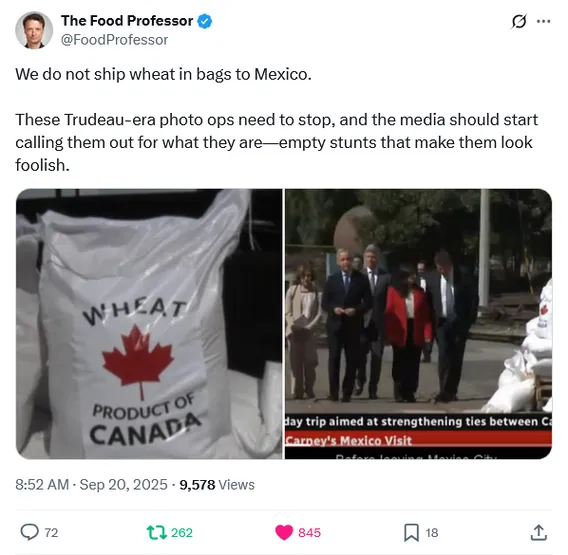
During a Sept. 19 visit to Mexico, Carney led cameras through a railyard stocked with pallets of artfully arranged sacks decorated with a maple leaf and the words “product of Canada”.

The site was the Canadian Pacific Kansas City Ferrovalle train yard, located outside Mexico City.

The yard is indeed equipped to process incoming railcars of Canadian wheat, but that’s all done in bulk. Hopper cars are positioned over large tanks to disgorge their loads, multiple tonnes at a time.

If any sacks ever enter into the equation, it’s long after Canadian producers have exited the process.

“Canadian grain farmers haven’t shipped wheat in sacks for over a century!” read a reaction by Chris Warkentin, Conservative MP for the heavily wheat-growing riding of Grande Prairie, Alta.

Sylvain Charlebois, a food scientist at Dalhousie University, wrote in a column this week that “bagged wheat is a relic of less mechanized economies”.

“We are among the most efficient bulk grain exporters in the world, shipping millions of tonnes through rail networks and ocean vessels designed for efficiency, safety, and traceability,” he wrote.

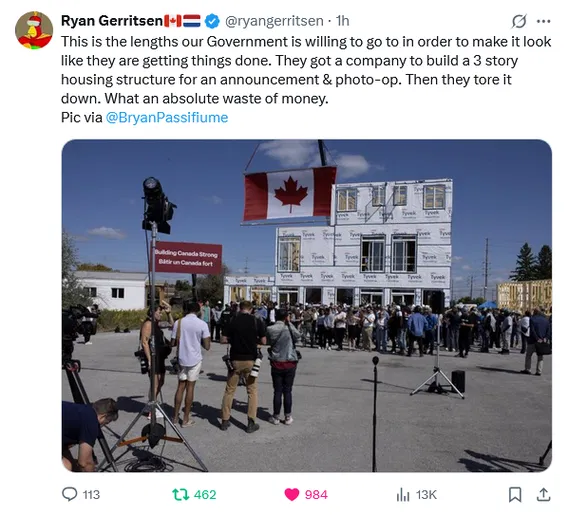
But it was a housing announcement just outside Ottawa where Carney would run into more direct accusations of being deliberately deceptive with his photo backdrop.

On Sept. 14, just before the opening of the fall session of Parliament, Carney stood in front of two under-construction homes in the Ottawa area and announced the official launch of Build Canada Homes, a new federal agency tasked with developing subdivisions of manufactured homes on federal land.

“The two sets of homes behind me were manufactured in two days, assembled on site in one,” Carney said to applause.

“We wanted to keep the townhouses open; we held back the workers from finishing it so you could see how things fit together,” he said, adding that one of the homes was being shipped “to Nunavut”.

Once the press conference was over, both homes were dismantled, and the site returned to what it had been before: A patch of fallow government land located near the Ottawa airport.

The land is a right-of-way for high-voltage power lines, which is why it currently doesn’t contain any development.

At The Rewrite, Peter Menzies congratulates Brian Passifume for being one of the only legacy media reporters to look past the literal Potemkin Village structure Carney had assembled for his photo op:

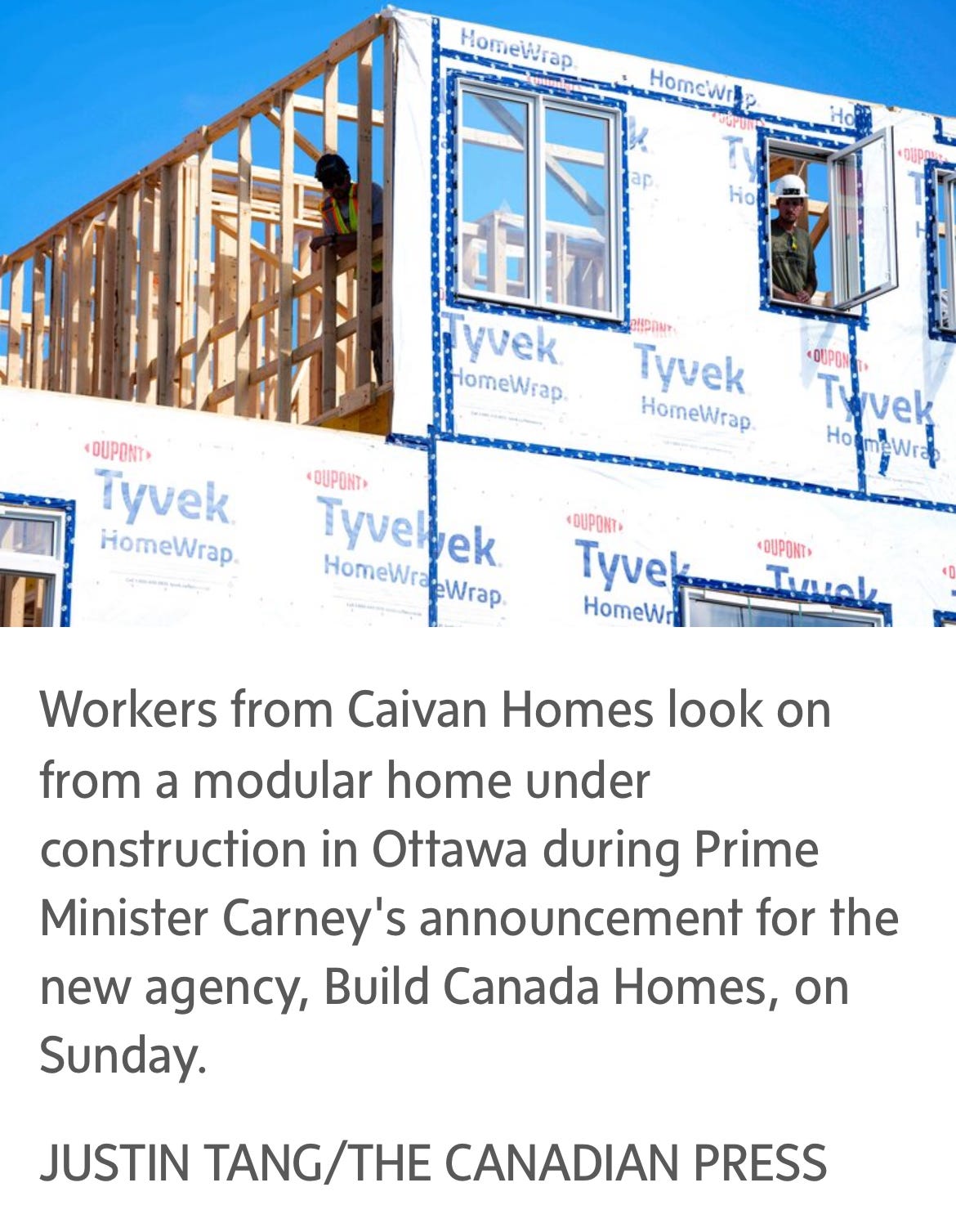
Our Orwellian theme continues but, this time, it’s to credit Brian Passifume of the Toronto Sun for his work digging into how our prime minister and his staff work to create fantasy settings for their announcements. Canadian Press and others were happy to play government propagandist by captioning a photo taken at Prime Minister Mark Carney’s Canada Builds launch by stating “Workers from Caivan Homes look on from a modular home under construction in Ottawa during Prime Minister Carney’s announcement for the new agency.”

Near as I can tell, most other media were happy to play along. Except Passifume who broke from the pack and pointed out the whole scene was, essentially, a movie set.

After one X user pointed out that the entire scene was fake, Passifume jumped in with “Dude I was there, that’s exactly what happened. It was a freshly-graded gravel lot with no utilities or services run. I was discussing this very topic with other reporters covering it — they didn’t even move the crane or remove the lifting apparatus, they just repurposed it to hold a gigantic Canadian flag.”

I expect some in the trade will say “hey, everyone does it” and no doubt that is true. But when people with power and those who crave it misrepresent reality, journalists are obliged to point that out. It doesn’t even have to be aggressive, just “Carney said in front of a set created for the announcement”.

Journalism isn’t actually that complicated. You just have to subscribe to its principles.

September 24, 2025

It won’t work – the minister responsible knows it, but they’re going ahead with it anyway

The “it” in the headline is the federal government’s gun confiscation program, which they claim will reduce crime but they already know it won’t do any such thing. What it will do is take away from literally the most law-abiding, responsible citizens their legally purchased property and leave illegal guns in the hands of criminals … at an ever-increasing estimated cost to the taxpayer. In The Line, Matt Gurney covers the details:

The federal gun confiscation program […] is illogical. It won’t save lives or make the public safer. The federal government doesn’t really even expect it to work, and is only going ahead with it because they’ve been stuck with a dumb proposal the Trudeau government made almost five years ago. If they could do it all over again, they wouldn’t, but they feel like they’ve blocked themselves in and have no choice but to proceed so that they don’t anger part of their electoral coalition, mainly voters in Quebec.

That might sound like a blistering criticism of the program, the kind of thing you’ve read in any number of my columns before. It’s actually what the public safety minister thinks about it. He just didn’t know he was being tape recorded when he said so. In a 20-minute conversation Gary Anandasangaree had with a firearms owner he rents a home to, which was recorded and then leaked, the minister says all of the above things. (He has also confirmed the recording is legitimate.)

Awkward for the minister, clearly, but I actually give him credit. The minister’s comments on tape are a confession, and an admission of defeat. They’re also, hands down, the most honest thing a Liberal government official has said on the gun control file in five years. Given that the minister responsible is freely telling people the program is a bad idea he’s stuck with and that won’t work, a sensible government would probably take this opportunity to walk away from the program.

Unfortunately, that’s not what this PM has chosen. It’s full speed ahead with an idea so bad Anandasangaree wishes he’d never been saddled with it.

Let’s talk about what this program is for a second. And forgive me, there’s quite a bit of history here. During Justin Trudeau’s first term, his only majority, his government had proposed a series of fairly moderate changes to the gun control laws they had inherited from Stephen Harper. As I’ve written often since, the proposals were a mixed bag. Some were okay. Some were bad. But they more or less left the well-functioning Canadian gun control system intact. They nibbled around the edges enough so that they could tell their voters that they had gotten tougher. But they generally didn’t try to fix what wasn’t broken.

But then politics got in the way, as it always does. Trudeau lost his majority in 2019 and became ever-more dependent on voter efficiency and wedge issues. And then in 2020, there was a horrible massacre in Nova Scotia. That catastrophe had nothing to do with our gun control laws; the weapons used were brought in illegally from the United States, as is typical of guns used in gun crime. But the Trudeau government seized on the opportunity — never waste a crisis, right? — to announce that they were “banning” “assault rifles”.

A lot of quotes above. So let me explain. First of all, there really wasn’t much of a ban. Anyone who owned one of the newly banned rifles was allowed to keep them. And as for assault rifles, actual assault rifles — rifle-calibre weapons that use high-capacity detachable magazines and can fire in fully automatic mode — have been banned in Canada for decades. This isn’t a problem that we actually had. And the government tacitly admitted as much when they began fudging the words they used to describe them. In acknowledgement that there were no actual assault weapons to ban, they started talking about assault-style weapons.

“Style” is a tell. You wouldn’t take medicine-style pills, or munch on a food-style snack. Because you’d know better. Trudeau et al knew better. It didn’t stop them. They needed something to announce, and by God, they were going to announce it!

And as we’ve noted several times, the Trudeau government got addicted to the media high of making big showy announcements. So they started doing repeat announcements over a period of time, and thanks to the spinelessness of Canadian legacy media even before Trudeau started directly subsidizing them, the media sugar high got repeated as well. It didn’t take long for the lesson to be learned that making an announcement was cheaper than doing the thing that was announced, and we quickly transitioned to a world where it was the announcement that mattered, not the thing.

At Junk Economics, Bryan Moir sums up the stupidity:

You want blunt? Fine. Here it is:

Listen: politics is kabuki theater and promises are props. Here we have a government rolling out a nationwide confiscation-style buyback and calling it “voluntary” — which is like calling income tax “optional” if you want to be arrested. The minister tells citizens, in public, “it’s voluntary”, then admits in private he’ll criminalize non-compliance, will “bail you out” if it goes that far, and says the whole exercise exists because the party must keep the promise and because the Quebec caucus wants to show muscle. That’s not statesmanship. That’s PR with a warrant.

They lecture you about being “tough on guns” while refusing to be tough on the people who actually bring violence into our streets. The minister himself says if he could do it over he’d target illegal guns and put criminals in jail — not law-abiding owners. Translation: the policy is ideologically driven and politically performative, not strategically intelligent. You don’t cure gang violence — which the cops tell you comes from illegal trafficking and cross-border smuggling — by borrowing billions to buy back legally purchased rifles. That’s like throwing sandbags into a burning house and patting yourself on the back for “doing something”.

And then there’s the logistics and the cost — the ugly part they don’t want on camera. The federal pot is capped at about $742 million and the program is rolled out in fits and starts. Major police forces are already saying “no thanks”, which means the feds must either stand down, contract a patchwork of municipal services, or try to outsource enforcement. Any of those choices blows up the promise in different ways: it becomes toothless, it becomes wildly more expensive, or it becomes a federal-provincial fight that will make the Notwithstanding clause dust-ups look like backyard squabbles. Pick your disaster.

Remember the math: a capped pool of cash plus a growing list of banned models (hundreds, then thousands) equals many owners getting nothing while the bureaucracy eats up the rest on administration, contracts, security, staffing, and political “bribes” (a nicer word for handouts to get agencies to play ball). If the fund runs out — and the minister openly says “it’s capped; when it’s gone, it’s gone” — you’ll have a bunch of people stripped of legal property, out of pocket, and the state triumphant only in optics. That’s confiscation without fair market compensation; it reads like policy designed by accountants and sold by televangelists.

Worst of all: while Ottawa gamely auctions off the idea of virtue, or was that “Canadian values”, real problems pile up. Fire seasons rage, hospitals are full, kids wait for surgeries, food banks are overwhelmed and the cost of living keeps rising— and Mark and Gary are borrowing money to offer coupons for now-illegal guns. If you wanted a textbook case of political misallocation, this is it: symbolic policy delivered with symbolic money so the party can say it kept a promise, while the public pays the bill and crime networks keep smuggling.

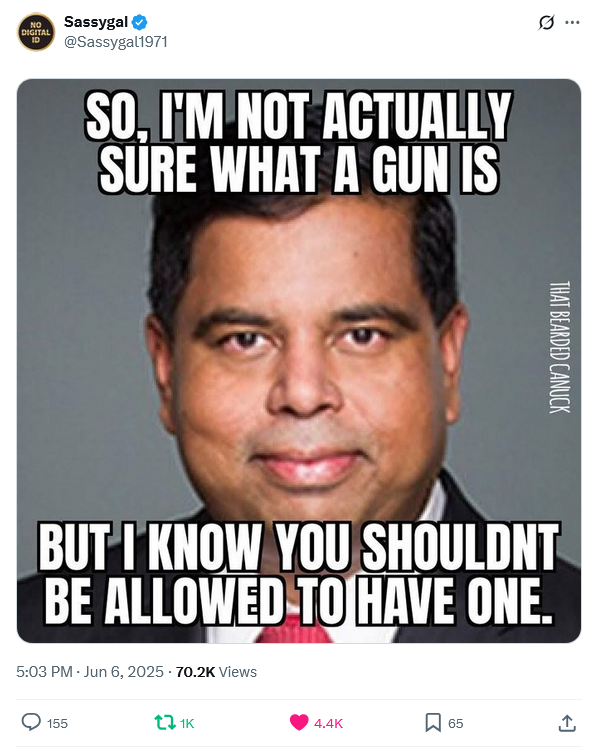
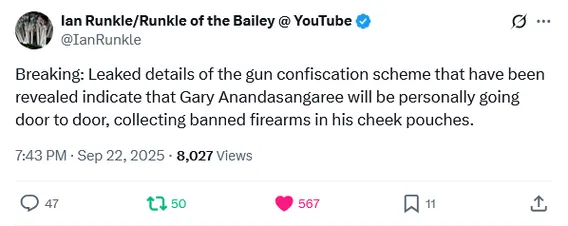
On the gun confiscation program in particular, thank goodness you can always depend on social media to find the funny side of any issue:

September 22, 2025

The Liberals fervently believe that saying something is the same as doing something

One of the most irritating aspects of Justin Trudeau’s long reign of error was his evident joy in making announcements about this or that topic. It got to the point that even the pro-Liberal media started to notice that the same policy would be announced several times over a few months but no actual progress was made (except where they could start setting up a new government program … they’d hire the staff very quickly, but little or nothing would get done beyond that). Mark Carney was supposed to be a clean break from the Trudeau years — even though most of his ministers were Trudeau retreads — but Carney may actually be worse than Trudeau in that he just loves photo ops with pretty props for the cameras. As Dr. Sylvain Charlebois notes, we need a lot fewer photogenic Potemkin Villages in how our federal government operates:

In recent weeks, we have witnessed politicians lean on powerful visuals to make their case on food and trade. But these staged moments rarely serve the public interest. Worse, they often deepen food illiteracy in a country where understanding how our system works is already fragile.

Take Ontario Premier Doug Ford’s stunt. Upset with Diageo’s decision to close its bottling plant in Ontario, he theatrically dumped a bottle of Crown Royal and urged Ontarians to boycott the brand. What he didn’t mention is that the bottle in question was made in Manitoba and bottled in Quebec by unionized Canadian workers — jobs unaffected by the Ontario closure. The Windsor facility mainly serviced the U.S. market, and Diageo’s decision was years in the making. Ironically, the boycott risks punishing Canadian workers who will continue producing Crown Royal for Canadians. And for future investors, the message is chilling: why put capital into Ontario if a government will trash your brand on television for a corporate restructuring decision?

The federal stage brought us another head-scratcher. During a trade visit to Mexico, Prime Minister Mark Carney posed with bags of Canadian wheat stamped with a maple leaf. The problem? Canada doesn’t export wheat in bags. We are among the most efficient bulk grain exporters in the world, shipping millions of tonnes through rail networks and ocean vessels designed for efficiency, safety, and traceability. Bagged wheat is a relic of less mechanized economies. For Canada to present itself this way trivializes our status as a modern agri-food powerhouse. Beyond being misleading, the image suggests to global partners that our system is less advanced than it truly is — a dangerous misrepresentation for a nation that depends on reputation as much as price.

Even I didn’t realize how bad it got until the feds paid contractors to put up a fake building site for Mark Carney to pose in front of, then tore it all down:

September 20, 2025

Feds move to neuter the “notwithstanding clause” to frustrate Alberta

To be honest, I wasn’t a fan of the Charter of Rights and Freedoms when it was forced down our throats in 1982, on the basis that if Pierre Trudeau thought it was a good idea then it must be the opposite. All these years later, although I’m still not a huge fan, I support the provinces who now need to combat Mark Carney’s minority Liberal government’s attempt to use the Supreme Court to limit or eliminate the provinces’ use of the notwithstanding clause:

You might be hearing a lot about the notwithstanding clause these days and wondering what is going on. The fact is, the Carney government is trying to change the constitution via a Supreme Court case on Bill 21 – a heinous bill in my opinion – but not an excuse to scrap or weaken the notwithstanding clause.

We’ve been here before with this debate before and I’m still of the same position, leave the clause alone.

It was in 2018 that Ontario Premier Doug Ford was looking to use the notwithstanding clause to shrink the size of Toronto city council. He should never have had to do this, but a lower court ruled that Ford’s actions were unconstitutional.

Which is really weird because the constitution is clear, municipalities are creations of the province. A provincial government can merge municipal governments, they can even abolish them if they wish.

Eventually, a higher court overturned the very politically driven decision against Ford, but for a time, he seemed to need the notwithstanding clause, otherwise known as section 33 of the Charter of Rights and Freedoms.

I’ll never understand why some claim the notwithstanding clause is against the Charter when it is part of the Charter.

On the social media site formerly known as Twitter, Sean Speer notes the Liberals seem to be taken by surprise at the negative reactions to their plans:

I suspect that non-conservatives are a bit surprised by the magnitude of the reaction to the Carney government’s factum on the notwithstanding clause. That’s mainly because I think liberals and progressives don’t quite understand how much the past decade or two of judicial activism has come to animate Canadian conservatism. Even as a somewhat moderate conservatism, I admit to being radicalized on these issues.

The Carter decision on MAID was a key moment in this evolution. Not necessarily because of the issue per se — though a lot of us oppose it. But mainly because it was such a naked example of judicial lawmaking. The clearest case that it’s just power and politics all the way down.

After having ruled that there was no right to physician-assisted death in the Charter, just over twenty years later the Supreme Court unanimously decided there was indeed such a right.

There had been no constitutional amendment in the meantime. Parliament had considered the issue and carefully and consistently voted against it. And yet nine judges decided that the right should exist and so they created one.

If the judiciary isn’t merely protecting constitutionally-prescribed rights but manufacturing them based on the political preferences of judges themselves—if it’s in effect just politics from the bench — then we might as well have the politicians who we’ve duly elected to be making these decisions for us.

Before Carter I would have said that I was broadly supportive of S.33 as part of our constitutional order but today it’s much bigger part of my core political identity as the only check we have on judicial politicking.

The Carney government’s factum then isn’t just objectionable because it threatens to constrain the notwithstanding clause but precisely because it invites the Supreme Court to once again alter the constitution in its own image.

Brian Peckford, the last surviving signatory to the patriation of the Constitution in 1982:

Tragically, it is not surprising that we see this further emasculation of our 1982 Constitution.

It has been ongoing almost since its inception. Witness the 1985 Court Opinion twisting the meaning of the opening words: “the Supremacy of God”.

And the constant distortions ever since, accelerated during the false covid crisis.

This is The Tyranny of The Judiciary —The Destruction Of Parliamentary Democracy!

How important is Section 32 — the notwithstanding clause?

There would be no Constitution Act 1982 — no Charter of Rights and Freedoms without Section 32.

When PM Trudeau Sr. tried to unilaterally Patriate the Constitution and failed miserably because of the Provinces’ opposition before the Courts, he validated the suspicion most Premiers had about the Federal Government and its intentions during that time. The ability of the Provinces to continue democratically to initiate specific exemptions was crucial to solidify the federal nature of this country.

The Supreme Court was right in Sept 1981 in denying the Federal Government such sweeping powers.

None of the 10 First Ministers who signed the Patriation Agreement intended for this Section to be amended in any other way except by the Amending Formula that was achieved for the first time in our history in that Agreement.

The Federal Justice Minister’s action to ask the court is wrong — totally against the intent of those who authored the Patriation Agreement and defies and denigrates one of major accomplishments of 1982, The Amending Formula, a crucial part of the earlier 1981 Agreement, the foundation document, “The Patriation Agreement”.

The Canadian Press carries this:

    OTTAWA — The federal government’s request to Canada’s top court for limits on the notwithstanding clause isn’t only about Quebec’s secularism law, Justice Minister Sean Fraser said on Thursday.

    In a media statement, Fraser said he hopes the Supreme Court’s eventual decision “will shape how both federal and provincial governments may use the notwithstanding clause for years to come”.

Excuse me, Mr Fraser, this is the job, the solemn responsibility, for Canada’s Elected First Ministers and Their elected Parliaments not the Judiciary. Making law is the job of the elected, interpreting law the role of the Judiciary.

This brazen action of the Federal Government would enlarge the Judiciary power to make law — it deciding the powers of The Governments of this Nation.

Ironic in the extreme it is to ponder that Canada sought for decades to find an amending formula — self criticizing itself for not having a legitimate avenue for Constitutional Change.

Now that it has such an avenue instead of using it, it cowardly asks The Court?

Should not a majority of the Provinces have to agree — that’s what the Supreme Court said in 1981?

Hence, the Supreme Court, consistent with it predecessor views of 1981 should refrain from hearing the matter, and inform the Governments that it is they who have the power through the legitimate constitutional process present in the Constitution to make such significant change ie the powers of the Governments, adhering to Section 38, the Amending Formula.

« Newer PostsOlder Posts »

Powered by WordPress