Quotulatiousness

November 15, 2020

London’s wool and cloth trade fuelled massive growth in the city’s population after 1550

In the latest Age of Invention newsletter, Anton Howes traces the rise and fall of the late Medieval wool trade and its rebirth largely thanks to an influx of Dutch and Flemish clothmakers fleeing the wars in the Low Countries after 1550:

The Coat of Arms of The Worshipful Company of Woolmen — On a red background, a silver woolpack, with the addition of a crest on a wreath of red and silver bearing two gold flaxed distaffs crossed like a saltire and the wheel of a gold spinning wheel.
The Worshipful Company of Woolmen is one of the Livery Companies in the City of London. It is known to have existed in 1180, making it one of the older Livery Companies of the City. It was officially incorporated in 1522. The Company’s original members were concerned with the winding and selling of wool; presently, a connection is retained by the Company’s support of the wool industry. However, the Company is now primarily a charitable institution.
The Company ranks forty-third in the order of precedence of the Livery Companies. Its motto is Lana Spes Nostra, Latin for Wool Is Our Hope.
Wikipedia.

… it was one thing to be able to reach these new southern markets, and another thing to have something to sell in them. For the shift in the markets for wool cloth exports also required major changes in the kinds of cloth produced. In this regard, London may well have been a direct beneficiary of the 1560s-80s troubles in the Low Countries that had caused Antwerp’s fall, because thousands of skilled Flemish and Dutch clothmakers fled to England. In particular, these refugees brought with them techniques for making much lighter cloths than those generally produced by the English — the so-called “new draperies”, which could find a ready market in the much warmer Mediterranean climes than the traditional, heavy woollen broadcloths.

The introduction of the new draperies was no mere change in style, however. They were almost a completely different kind of product, involving different processes and raw materials. The traditional broadcloths were “woollens”. That is, they were made from especially fine, short, and curly wool fibres — the type that English sheep were especially famous for growing — which were then heavily greased in butter or oil in preparation for carding, whereby the fibres were straightened out and any knots removed (because of all the oil, in the Low Countries the cloths were known as the wet, or greased draperies). The oily, carded wool was then spun into yarn, and typically woven into a broad cloth about four metres wide and over thirty metres long. But it was still far from ready. The cloth had to be put in a large vat of warm water, along with some urine and a particular kind of clay, and was then trodden by foot for a few days, or else repeatedly compacted by water-powered machinery. This process, known as fulling, scoured the cloth of all the grease and shrunk it, compacting the fibres so that they began to interlock and enmesh. Any sign of the cloth being woven thus disappeared, leaving a strong, heavy, and felt-like material that was, as one textile historian puts it, “virtually indestructible”. To finish, it was then stretched with hooks on a frame, to remove any wrinkles and even it out, and then pricked with teasels — napped — to raise any loose fibres, which were then shorn off to leave it with a soft, smooth, sometimes almost silky texture. Woollens may have been made of wool, but they were no woolly jumpers. They were the sort of cloth you might use today to make a thick, heavy and luxuriant jacket, which would last for generations.

Yet this was not the sort of cloth that would sell in the much warmer south. The new draperies, introduced to England by the Flemish and Dutch clothworkers in the mid-sixteenth century, used much lower-quality, coarser, and longer wool. Later generally classed as “worsteds”, after the village of Worstead in Norfolk, they were known in the Low Countries as the dry, or light draperies. They needed no oil, and the long fibres could be combed rather than carded. Nor did they need any fulling, tentering, napping, or shearing. Once woven, the cloth was already strong enough that it could immediately be used. The end product was coarser, and much more prone to wear and tear, but it was also much lighter — just a quarter the weight of a high-quality woollen. And the fact that the weave was still visible provided an avenue for design, with beautiful diamond, lozenge, and other kinds of patterns. The new draperies, which included worsteds and various kinds of slightly heavier worsted-woollen hybrids, as well as mixes with other kinds of fibre like silk, linen, Syrian cotton, or goat hair, thus came in a dazzling number of varieties and names: from tammies or stammets, to rasses, bays, says, stuffs, grograms, hounscots, serges, mockadoes, camlets, buffins, shalloons, sagathies, frisadoes, and bombazines. To escape the charge that the new draperies were too flimsy and would not last, some varieties were even marketed as durances, or perpetuanas.

Curiously, however, while the shift from woollens to worsted saved on the costs of oiling, fulling, and finishing, it was significantly more labour-intensive when it came to spinning — even resulting in a sort of technological reversion. Given the lack of fulling, the strength of the thread mattered a lot more for the cloth’s durability, and the yarn had to be much finer if the cloth was to be light. The spinning thus had to be done with much greater care, which made it slower. Spinners typically gave up using spinning wheels, instead reverting to the old method of using a rock and distaff — a technique that has been used since time immemorial. Albeit slower, the rock and distaff gave them more control over the consistency and strength of the ever-thinner yarn. For the old, woollen drapery, processing a pack of wool into cloth in a week would employ an estimated 35 spinners. For the new, lighter worsted drapery it would take 250. As spinning was almost exclusively done by women, the new draperies provided a massive new source of income for households, as well as allowing many spinsters or widows to support themselves on their own. Indeed, an estimated 75% of all women over the age of 14 might have been employed in spinning to produce the amounts of cloth that England exported and consumed. Some historians even speculate that by allowing women to support themselves without marrying, it may have lowered the national fertility rate.

This spinning, of course, was not done in London. It was largely concentrated in Norfolk, Devon, and the West Riding of Yorkshire. But the new draperies provided employment of another, indirect kind. As a product that was saleable in warmer climes it could be exchanged for direct imports of all sorts of different luxuries, from Moroccan sugar, to Greek currants, American tobacco (imported via Spain), and Asian silks and spices (initially largely imported via the eastern Mediterranean). The English merchants who worked these luxury import trades were overwhelmingly based in London, and had often funded the voyages of exploration and embassies to establish the trades in the first place, putting them in a position to obtain monopoly privileges from the Crown so that they could restrict domestic competition and protect their profits. Unsurprisingly, as they imported everything to London, it also made sense for them to export the new draperies from London too.

Thus, despite losing the concentrating influence of nearby Antwerp, London came to be the principal beneficiary of England’s new and growing import trades, allowing it to grow still further. The city began to carve out a role for itself as Europe’s entrepôt, replacing Antwerp, and competing with Amsterdam, as the place in which all the world’s rarities could be bought (and from which they could increasingly be re-exported). Indeed, English merchants were apparently happy to sell wool cloth at below cost-price in markets like Spain or Turkey — anything to buy the luxury wares that they could monopolise back home.
October 22, 2020

When England “Londonized”

Filed under: Britain, Economics, Europe, Health, History — Tags: , , , , — Nicholas @ 05:00

In the latest Age of Invention newsletter, Anton Howes looks at changes in urbanization in England from the Middle Ages onward and the astonishing growth of London in particular:

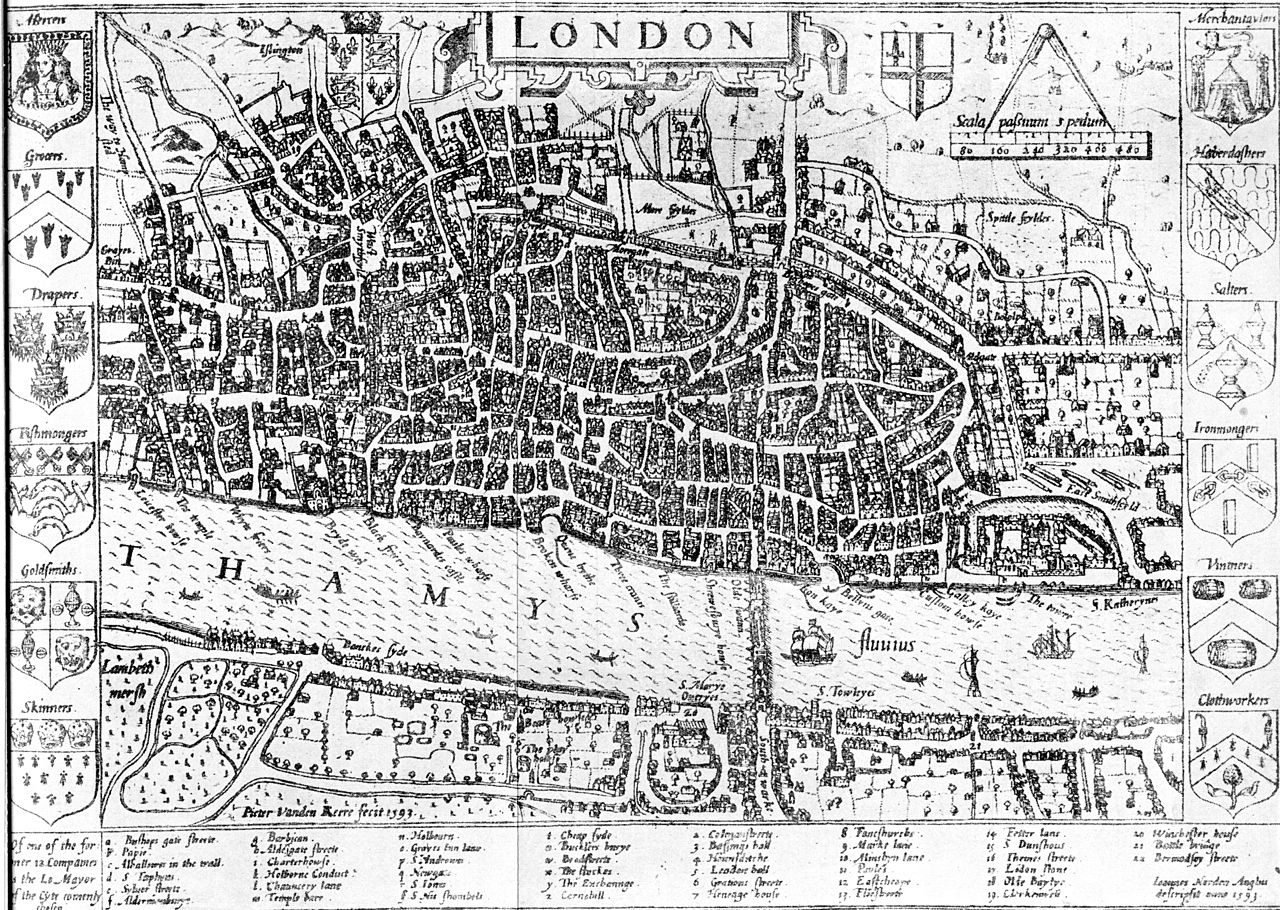
John Norden’s map of London in 1593. There is only one bridge across the Thames, but parts of Southwark on the south bank of the river have been developed.
Wikimedia Commons.

We must thus imagine pre-modern England as a land of tens of thousands of teeny tiny villages, each having no more than a couple of hundred people, which were in turn served by hundreds of slightly larger market towns of no more than a few hundred inhabitants, and with only a handful of regional centres of more than a few thousand people. By the 1550s, the country’s population had still not recovered to its pre-Black Death peak, and still only about 4% of the population lived in cities. London alone accounted for about half of that, with approximately 50-70,000 people (about five times the size of its closest rival, Norwich). So after a couple of centuries of recovery, London was only a little past its medieval peak.

But over the following century and a half, things began to change. At first glance, England’s continued population growth was unremarkable. By 1700, its overall population had finally reached and even surpassed the medieval 5 million barrier, despite the ravages of civil war. This was, perhaps, to be expected, with a little additional agricultural productivity allowing it to surpass the previous record. But the composition of that population had changed radically, largely thanks to the extraordinary growth of London. England’s overall population had not only recovered, but now 16% of them lived in cities of over 5,000 inhabitants — over two thirds of whom lived in London alone. Rather than simply urbanise, England londonised. By 1700, the city was nineteen times the size of second-place Norwich — even though Norwich’s population had more or less tripled.

London had, by 1700, thus risen from obscurity to become one of the largest cities in Europe. At an estimated 575,000 people, it was rivalled in Europe only by Paris and Constantinople, both of which had been massive for centuries. And although by modern standards it was still rather small, it could at least now be comfortably called a city — more or less on par with the populations of modern-day Glasgow or Baltimore or Milwaukee.

During that crucial century and a half then, London almost single-handedly began to urbanise the country. Its eighteenth-century growth was to consolidate its international position, such that by 1800 the city was approaching a million inhabitants, and from the 1820s through to the 1910s was the largest city in the world. In the mid-nineteenth century England also finally overtook Holland in terms of urbanisation rates, as various other cities also came into their own. But this was all just the continuation of the trend. London’s growth from 1550 to 1700 is the phenomenon that I think needs explaining — an achievement made all the more impressive considering how many of its inhabitants were dropping dead.

Throughout that period, urban death rates were so high that it required waves upon waves of newcomers from the countryside to simply keep the population level, let alone increase it. London was ridden with disease, crime, and filth. Not to mention the occasional mass death event. The city lost over 30,000 souls — almost of a fifth of its population — in the plague of 1603 (which was apparently exacerbated by many thousands of people failing to social distance for the coronation of James I), followed by the loss of a fifth again — 41,000 deaths — in the plague of 1625, and another 100,000 deaths — by now almost a quarter of the city’s population — in 1665. And yet, between 1550 and 1700 its population still managed to increase roughly tenfold.

I’ve been hard-pressed to find an earlier, similarly rapid rise to the half-a-million mark that was not just a recovery to a pre-disaster population or simply the result of an empire’s seat of government being moved. Chang’an, Constantinople, Ctesiphon, Agra, Edo, for example — all owed their initial, massive populations to an administrative change (often accompanied by a degree of forcible relocation), and all then grew fairly gradually up to or beyond half a million. As for a very long-term capital like Rome, it seems to have taken about three or four centuries to achieve the increases that London managed in just one and a half (though bear in mind just how rough and ready our estimates of ancient city populations are — our growth guesstimate for Rome is almost entirely based on the fact that the water supply system roughly doubled every century before its supposed peak). The rapidity of London’s rise from obscurity may thus have been unprecedented in human history — and was certainly up there with the fastest growers — though we’ll likely never know for sure.

But how? I can think of a multitude of factors that may have helped it along, but I find that each of them — even when considered altogether — aren’t quite satisfactory.

August 25, 2020

How we used to “dine out” (and someday might be able to again)

Filed under: Books, Britain, Business, Europe, Food, France, History — Tags: , , , , , — Nicholas @ 03:00

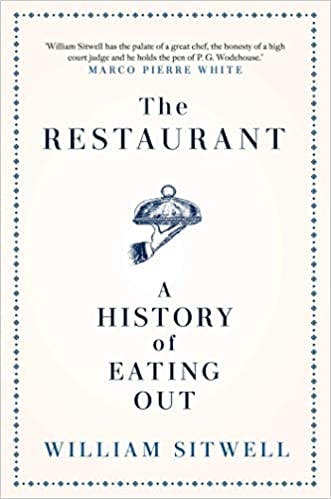
In The Critic, Alexander Larman reviews The Restaurant: A history of eating out by William Sitwell:

The recent enforced lockdown closure was a potential death blow to the entire [restaurant] industry. Which makes William Sitwell’s luxurious book both a celebration and an unintentional requiem for what may be a bygone time.

His central thesis is clear: the history of dining out is also a social history of evolving cultures and tastes. This means that the subjects he writes about range from ancient Pompeii to the growth of the sushi conveyor belt restaurant, encompassing everything from medieval taverns and the French Revolution to the rise of Anglo-Indian cuisine.

It is a broad and impressive spectrum, but perhaps Sitwell has, like some of the less fortunate people he describes, bitten off more than he can chew. His opening chapter about Pompeii is rich in surprising detail (graffiti uncovered outside one tavern when it was excavated ranged from the poetic — “Lovers are like bees in that they lead a honeyed life” — to the crude — “I screwed the barmaid”) and an insightful evocation of the dining culture in Ancient Rome.

He is then, unfortunately, faced with the insurmountable difficulty that the restaurant, as we know it today, did not exist until the late eighteenth century, meaning that his definition of “eating out” has to do some extremely heavy lifting.

There is as much padding in the early chapters as there is around some of his subjects’ waistlines. Much of what he writes is very interesting and often amusing, such as the way in which coffee, first drunk in London around the time of the Restoration, became associated both with health-giving properties and reportedly making men impotent, withered “cock-sparrows”. Yet there are also lengthy sections that have little or nothing to do with restaurants, such as a potted history of the Industrial Revolution.

Nevertheless, when Sitwell finally gets into his stride and begins to write about eateries proper, his authority and enthusiasm are palpable. He describes the dawn of fine dining in Paris in the nineteenth century evocatively. London lagged behind, although gentlemen’s clubs such as the Athenaeum and Reform offered some delights for the wealthy thanks to chefs (French, naturally) such as Alexis Soyer who implemented what one biographer called “the most famous and influential working kitchen in Europe” in 1841, complete with gas-fired stoves, butcher’s rooms and a fireplace devoted to the roasting of game and poultry.

August 23, 2020

QotD: Herbert Hoover and the American tourists

Count up the victims of World War I, and American tourists will be pretty far down the list. But victims they were. When the conflict broke out, thousands of Americans were overseas visiting the cathedrals of Florence or the museums of London. They woke up one morning to find the ships that were supposed to take them back had been conscripted into the war effort, or refused to sail for fear of enemy fire. The banks that were supposed to cash their travelers’ checks were panicking, or devoting all their funds to the war effort, or dealing with a million other things. The hotels that were supposed to house them were closed indefinitely, their employees rushing to enlist out of patriotic fervor. And so thousands of frantic Americans, stuck in a foreign continent with no money and nowhere to stay, showed up at the door of the US Embassy in London and said – help!

The US Consulate in London didn’t know how to solve these problems either. But Herbert Hoover, still high on his decision to pivot to philanthropy and public service, calls them up and asks if he can help. They say yes, definitely. Hoover gets in touch with his rich friends, passes around the collection plate, and organizes a Committee For The Assistance Of American Travelers. Then he gets to work, the way only he can:

    Within 24 hours, Hoover’s committee had its own stationery, and within forty-eight it was operating a booth in the ballroom of the Savoy Hotel as well as three other London locations. Through his business connections, Hoover managed to bypass restrictions on telegraph service and open a transatlantic line to allow Americans to wire money to stranded friends and relatives. In a city suddenly flooded with refugees, he reserved for American travelers some two thousand rooms in hotels or boardinghouses. He issued a press release proclaiming that his Residents’ Committee was assuming charge of all American relief work in the city, and that in doing so it had the blessings of its honorary chairman, Walter Hines Page, the US ambassador to London.

… which is totally false. Hoover is starting to display a pattern that will stick with him his whole life – that of crushing competing charities. He begins a lobbying effort to get the US Embassy to ban all non-Hoover relief work, focusing on the inefficiency of having multiple groups working on the same problem. When the US Assistant Secretary Of War arrives in London to coordinate a response, he is met on the dock by Hoover employees, who demand he consult with Hoover before interfering in the US tourist issue. Eventually the Embassy, equally exasperated by Hoover’s pestering and impressed with his results, agrees to give him official control of the relief effort.

After two months of work, Hoover and his Committee have repatriated all 120,000 US tourists, supporting them in style until it could find them boat tickets. All of its loans and operating costs have been repaid by grateful tourists, and its budget is in the black. The rescued travelers are universal in their praise for Hoover, partly because Hoover has threatened to ruin any of them who get too critical:

    Other complainants were received with less patience, including a hotheaded professor of history from the University of Michigan, who wrote to accuse the Residents’ Committee of mistreatment. Hoover refuted his charges indignantly and comprehensively, copying his response to the president of the university and its board of regents. After a meeting with his employer, the professor returned Hoover an abject retraction and apology.

Scott Alexander, “Book Review: Hoover”, Slate Star Codex, 2020-03-17.

July 18, 2020

“Agglomerationists” today and in the Middle Ages

Filed under: Britain, Economics, Europe, France, History — Tags: , , , , — Nicholas @ 03:00

In his latest Age of Invention newsletter, Anton Howes compares the views of today’s “urbanists” with the “agglomerationists” of the late Medieval period:

John Norden’s map of London in 1593. There is only one bridge across the Thames, but parts of Southwark on the south bank of the river have been developed.
Wikimedia Commons.

The other day, economic historian Tim Leunig tagged me into a comment on twitter with the line “intellectually I think the biggest change since settled agriculture was the idea that most people could live in cities and not produce food”. What’s interesting about that, I think, is the idea that this was not just an economic change, but an intellectual one. In fact, I’ve been increasingly noticing a sort of ideology, if one can call it that, which seemingly took hold in Britain in the late sixteenth century and then became increasingly influential. It was not the sort of ideology that manifested itself in elections, or even in factions, but it was certainly there. It had both vocal adherents and strenuous opponents, the adherents pushing particular policies and justifying them with reference to a common intellectual tradition. Indeed, I can think of many political and economic commentators who are its adherents today, whether or not they explicitly identify as such.

Today, the people who hold this ideology will occasionally refer to themselves as “urbanists”. They are in favour of large cities, large populations, and especially density. They believe strongly in what economists like to call “agglomeration effects” — that is, if you concentrate people more closely together, particularly in cities, then you are likely to see all sorts of benefits from their interactions. More ideas, more trade, more innovation, more growth.

Yet urbanism as a word doesn’t quite capture the full scope of the ideology. The group also heavily overlaps with natalists — people who think we should all have more babies, regardless of whether they happen to live in cities — and a whole host of other groups, from pro-immigration campaigners, to people setting up charter cities, to advocates of cheaper housing, to enthusiasts for mass transit infrastructure like buses, trams, or trains. The overall ideology is thus not just about cities per se — it seems a bit broader than that. Given the assumptions and aims that these groups hold in common, perhaps a more accurate label for their constellation of opinions and interests would be agglomerationism.

So much for today. What is the agglomerationist intellectual tradition? In the sixteenth century, one of the mantras that keeps cropping up is the idea that “the honour and strength of a prince consists in the multitude of the people” — a sentiment attributed to king Solomon. It’s a phrase that keeps cropping up in some shape or form throughout the centuries, and used to justify a whole host of agglomerationist policies. And most interestingly, it’s a phrase that begins cropping up when England was not at all urban, in the mid-sixteenth century — only about 3.5% of the English population lived in cities in 1550, far lower than the rates in the Netherlands, Italy, or Spain, each of which had urbanisation rates of over 10%. Even England’s largest city by far, London, was by European standards quite small. Both Paris and Naples were at least three times as populous (don’t even mention the vast sixteenth-century metropolises of China, or Constantinople).

Given their lack of population or density, English agglomerationists had a number of role models. One was the city of Nuremburg — through manufactures alone, it seemed, a great urban centre had emerged in a barren land. Another was France, which in the early seventeenth century seemed to draw in the riches to support itself through sheer exports. One English ambassador to France in 1609 noted that its “corn and grain alone robs all Spain of their silver and gold”, and warned that it was trying to create still new export industries like silk-making and tapestry weaving. (The English rapidly tried to do the same, though with less success.) France may not have been especially urban either, but Paris was already huge and on the rise, and the country’s massive overall population made it “the greatest united and entire force of any realm or dominion” in Christendom. Today, the population of France and Britain are about the same, but in 1600 France’s was about four times as large. Some 20 millions compared to a paltry 5. If Solomon was right, then England had a lot of catching up to do to even approach France in honour.

July 12, 2020

Reforming the police

Filed under: Australia, Britain, Government, History, Law, USA — Tags: , , — Nicholas @ 05:00

A guest editorial at Catallaxy Files from former Australian senator David Leyonhjelm discusses the original civilian police force, the London Metropolitan Police, and the rules that governed their actions. Contrasting the origins of modern policing, he then discusses the ways police organizations have changed:

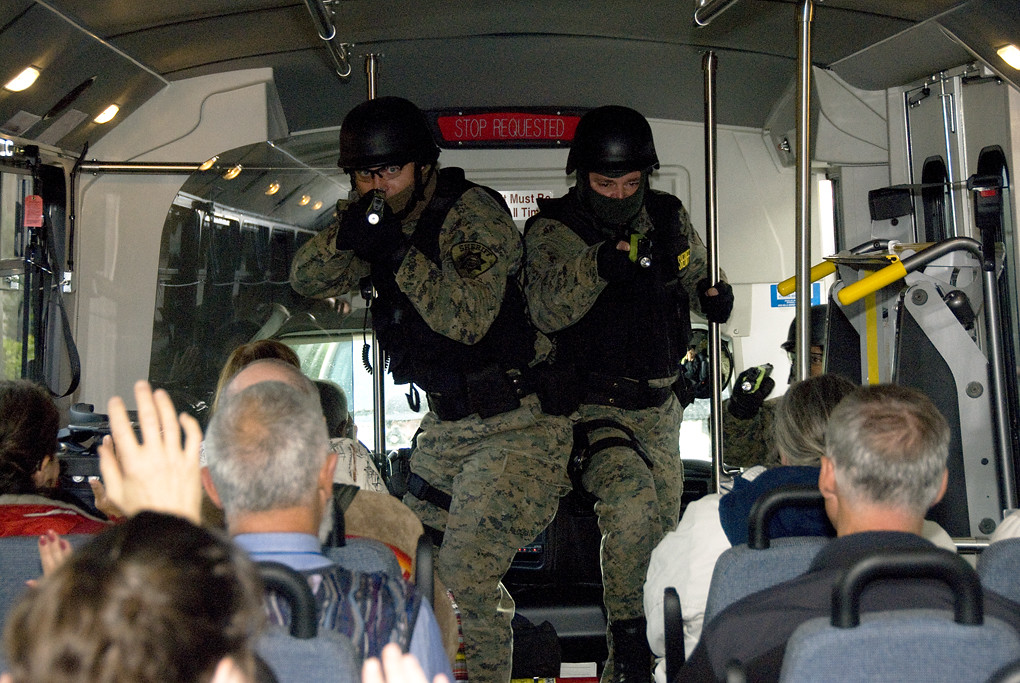
“On the bus” by OregonDOT is licensed under CC BY 2.0

One issue is the steady militarisation of the police. This ranges from references to the public as civilians and assertions that the police place their lives on the line every day, to black uniforms, military assault rifles and equipment such as armoured personnel carriers. This is a bigger concern in America, where a lot of military surplus equipment is sold to police and the emphasis on armed conflict is more pronounced, but the trend is the same here.

When they see themselves as soldiers in a war, it is not surprising that some police have no regard for public welfare. The negligence leading to the death of Miss Dhu in police custody in [Western Australia], and of course the notorious deaths in America, are obvious examples of where that leads.

Peel’s principles also stipulate that police should only use physical force when persuasion, advice and warning are insufficient, to use only the minimum force necessary, and that the cooperation of the public diminishes proportionately with the necessity of the use of physical force and compulsion.

Yet how often do we see police resort to violence when making an arrest? People are tackled, forced to the ground with knees on their back and neck amid blows, kicks and the vindictive use of Tasers, simply to apply handcuffs. Being “non-compliant” or raising verbal objections is enough to prompt this, and some have died as a result.

Moreover, when the victims of such treatment are not convicted or imprisoned, such rough handling amounts to a form of punishment. That is also in conflict with Peel’s Principles, which require the police to avoid usurping the powers of the judiciary by authoritatively judging guilt and punishing the guilty.

Enforcement of the Covid rules, including the authoritarian decrees and fines imposed by state premiers, provide further examples: petty closing of cafes, prosecutions for reading in a park, chasing individuals along a closed beach, stopping fishing from a pier the day after 10,000 have gathered in a demonstration, and even a Police Commissioner who denounces the cruise industry as criminal, are among them. The Australian public are never likely to accept the police as one of them while those sorts of things occur.

Change is necessary. Corrupt and thuggish police must be rooted out and the enforcement of laws that the public does not support, including political and victimless crimes, should never have priority. Moreover, arresting people seldom solves problems that originate in drug use, alcoholism, mental illness and poverty.

The fundamental responsibility of governments is to protect life, liberty and property. If the police were to focus on these while upholding Peel’s Principles, Australians might even come to their aid.

June 4, 2020

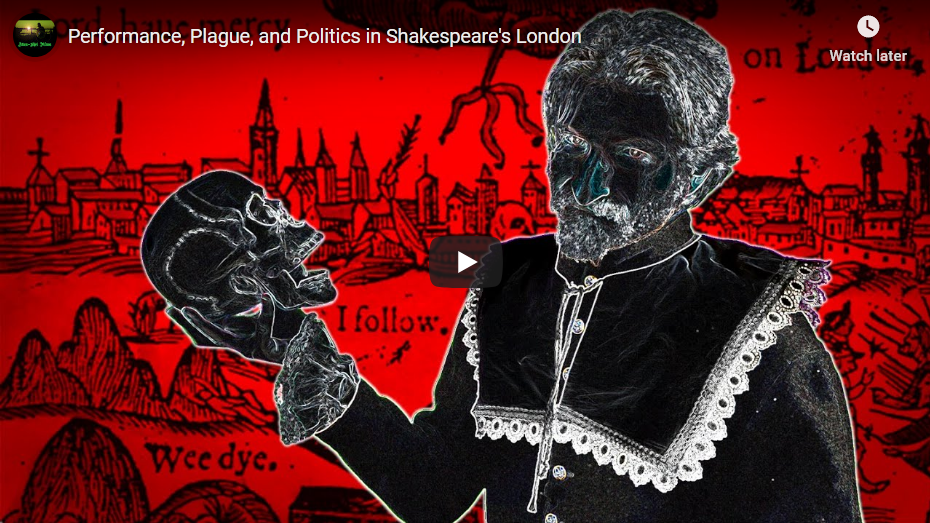
Performance, Plague, and Politics in Shakespeare’s London

Filed under: Britain, Health, History, Humour, Media — Tags: , , , , , , , — Nicholas @ 06:00

Atun-Shei Films
Published 27 Mar 2020

Help us make the first feature film ever made (that we know of) spoken entirely in Original Pronunciation, the accent of Shakespeare: https://igg.me/at/sudburydevil/x/1502…

Did William Shakespeare write King Lear under quarantine? That is the question. In this video I introduce you to the actor’s process in Elizabethan theater; dive deep into first-hand accounts of the bubonic plague epidemics that Shakespeare lived through; explore the politics of late 16th and early 17th century England, onstage and off; and discuss OP, Original Early Modern English Pronunciation, the accent and dialect in which the Bard’s plays were originally performed.

The rest is silence.

Support Atun-Shei Films on Patreon ► https://www.patreon.com/atunsheifilms

#English #Theater #History

Watch our film ALIEN, BABY! free with Prime ► http://a.co/d/3QjqOWv
Reddit ► https://www.reddit.com/r/atunsheifilms
Twitter ► https://twitter.com/atun_shei
Instagram ► https://www.instagram.com/atunsheifilms
Merch ► https://atun-sheifilms.bandcamp.com

From the comments:

Atun-Shei Films
1 month ago
CORRECTION: The Great Vowel Shift was a SEPARATE linguistic trend to the R-dropping in 18th century English. My mistake, sorry!

June 3, 2020

The Wehrmacht‘s License to Kill the Innocent – War Against Humanity 012 – May 1941

Filed under: Europe, Germany, History, Military, WW2 — Tags: , , , , , , , — Nicholas @ 04:00

World War Two
Published 2 Jun 2020

As the Blitzes of Britain slow down considerably, violence in Croatia increases dramatically as the Ustaše government purges the country of Jews and Serbs and the Wehrmacht gets deadly instructions for their invasion of the Soviet Union.

Join us on Patreon: https://www.patreon.com/TimeGhostHistory
Or join The TimeGhost Army directly at: https://timeghost.tv

Follow WW2 day by day on Instagram @World_war_two_realtime https://www.instagram.com/world_war_t…
Between 2 Wars: https://www.youtube.com/playlist?list…
Source list: http://bit.ly/WW2sources

Hosted by: Spartacus Olsson
Written by: Joram Appel and Spartacus Olsson
Director: Astrid Deinhard
Producers: Astrid Deinhard and Spartacus Olsson
Executive Producers: Astrid Deinhard, Indy Neidell, Spartacus Olsson, Bodo Rittenauer
Creative Producer: Joram Appel
Post-Production Director: Wieke Kapteijns
Research by: Joram Appel
Edited by: Mikołaj Cackowski
Sound design: Marek Kamiński
Map animations: Eastory (https://www.youtube.com/c/eastory)

Colorizations by:
Norman Stewart – https://oldtimesincolor.blogspot.com/
Adrien Fillon – https://www.instagram.com/adrien.colo…
Carlos Ortega Pereira – BlauColorizations, https://www.instagram.com/blaucoloriz…
Cassowary Colorizations – https://www.flickr.com/people/cassowa…

Sources:
Bundesarchiv
Narodowe Archiwum Cyfrowe
IWM D 5984, D 1091
USHMM

Bibliography:
Barton, Brian, “A Belfast Blitz Memorial?”. In: History Ireland 24:2 (March/April 2016) 8-9.
Biondich, Mark, “Religion and Nation in Wartime Croatia: Reflections on the Ustaša Policy of Forced Religious Conversions, 1941-1942″. In: The Slavonic and East European Review 83:1 (Jan 2005) 71-116.
Clapson, Mark, “Air Raids in Britain, 1940-45”. In: The Blitz companion: Aerial Warfare, Civilians and the City since 1911 (2019) 37-76.
Gotovich, Aron, Dictionnaire de La Seconde Guerre Mondiale En Belgique (2008).
MacDonald, David B., “From Jasenovac to Srebrenica; Subaltern Genocide and the Serbs”. In: Nicholas Robins, Adam Jones (ed.), Genocides by the Oppressed: Subaltern Genocide in Theory and Practice (2009) 103-121, 106.
Tanner, Marcus, “The Ustashe”. In: Croatia: A Nation Forged in War; Third Edition (2010) 141-167.
Williamson, Murray, and Allan Millett, “Barbarossa 1941”. In: A War To Be Won (2000) 110-142.

Primary Sources:
Barbarossa Decree, 13 May 1941. http://users.clas.ufl.edu/ggiles/barb….
Commissar Order, 6 June 1941. http://users.clas.ufl.edu/ggiles/barb….
William Sansom: Westminster in War, 1947.

Soundtracks from the Epidemic Sound:
Cobby Costa – “From the Past”
Reynard Seidel – “Deflection”
Johan Hynynen – “Dark Beginning”
Gunnar Johnsen – “Not Safe Yet”
Farell Wooten – “Blunt Object”
Peter Sandberg – “Document This 1”
Andreas Jamsheree – “Guilty Shadows 4”
Cobby Costa – “Flight Path”

Archive by Screenocean/Reuters https://www.screenocean.com.

A TimeGhost chronological documentary produced by OnLion Entertainment GmbH.

From the comments:

World War Two
2 hours ago
For many living in newly occupied territories in South-Eastern Europe, May 1941 marked the start of a hellish life under fascist occupation. For many more, May 1941 will be the month in which their fate is sealed. Many hundreds of thousands more will suffer by the decisions made this months. From this episode, and the next ones, it will become very clear that there is no such thing as a “clean Wehrmacht“, and that this is very much a myth. Some parts of the internet still seem to hold on tight to this, but we will counter it time and again, wether it is about occupying forces, Operation Barbarossa or Erwin Rommel.

Cheers,
Joram

Fanatics gonna fanatic … they can’t help it

It’s funny that no matter what the claimed crisis, the answers always go in the same direction, as Kristian Niemietz points out with the demands to turn our still unending lockdown toward “protecting the environment”:

The change, superficially, is to encourage “a safe return to work” allowing more social distancing between pedestrians, but more substantially in order to preserve the cleaner air that has resulted from the lockdown.

The health and safety excuse for the policy change can be largely dismissed. The simple truth of the pandemic and national policy is that if social distancing matters, the centre of London is not safe to return to work. It is too densely populated and almost entirely reliant on mass transit which cannot operate above 10-15% capacity with 2m exclusion rules. With average commutes over 9 miles each way, substitution effects to walking and cycling will be extremely limited and temporary.

It is then hard to see then how the policy’s architects imagine the streets will fill up to the extent urgent measures are needed. Conversely, if social distancing does not matter (and it will cease to matter eventually), then a policy to enable more social distancing outside by widening the pedestrian streetscape is redundant. If it is safe to sit on a crowded train, it is safe to walk on a crowded pavement. It is not hard then to cut through the pandemic packaging to note that the motive for this policy is opportunistic, to accelerate a pedestrianisation plan that is the dream of many an urban planner.

Many will see this as self-evidently a good thing. Removing vehicle traffic from densely populated narrow streets will reduce air pollution, congestion and road traffic accidents. As a policy it will have more supporters than opponents; very few people drive into the centre of London to commute and there is very little capacity for parking. London’s leaders are not wrong to think that this is the future, the question is really one of timing and how they go about it, which is far more difficult and does not have anything to do with managing a coronavirus.

What the pandemic allows is the ability to use emergency powers for something that is not an emergency. This matters, in normal times it took several years to close one dangerous junction at Bank to most traffic, and this under a hail of protests from local businesses and taxi drivers. The same result can now be achieved in a few weeks across many streets. The democratic checks and balances that differentiate the UK from authoritarian states can be ditched and London officialdom granted extraordinary powers to do as they please. If the protestors don’t like it this time, they should note the right to protest has also been suspended, at least for now.

May 21, 2020

The Great Exhibition of 1851 also served (for some) as the 19th century equivalent of the “Missile Gap” controversy

In the latest edition of his Age of Invention newsletter, Anton Howes discusses the changing role of the British government and how the Great Exhibition was also useful as subtle domestic propaganda for a more active role for government in the British economy:

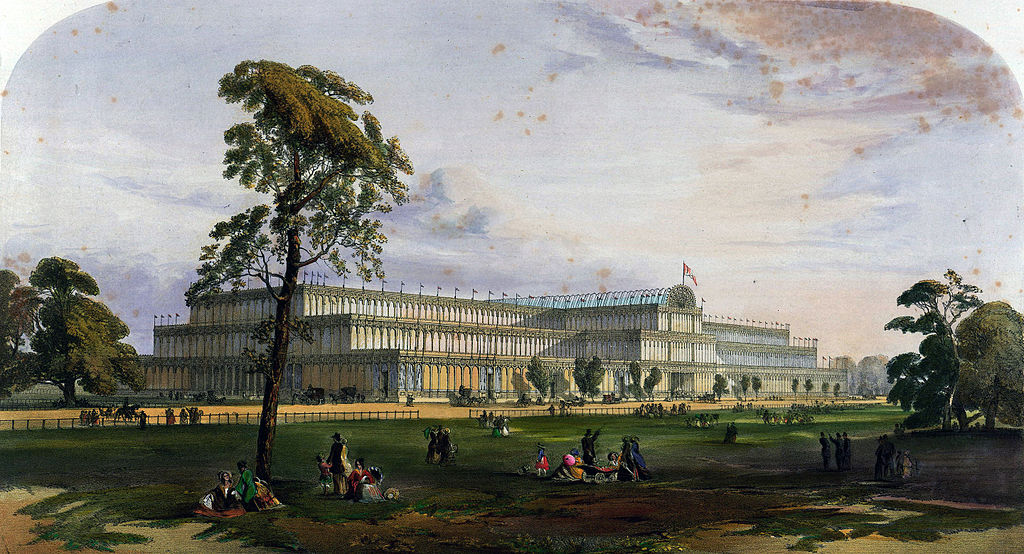
The Crystal Palace from the northeast during the Great Exhibition of 1851, image from the 1852 book Dickinsons’ comprehensive pictures of the Great Exhibition of 1851
Wikimedia Commons.

… a whole new opportunity for reform was provided by the Great Exhibition of 1851. As I explained in the previous newsletter, an international exhibition of industry functioned as an audit of the world’s industries. It, and its successors, the world’s fairs, gave some indication of how Britain stood relative to rival nations, especially France, Prussia, and the United States. And whereas some people saw the Great Exhibition as a clear mark of Britain’s superiority, for would-be reformers it was a chance to expose worrying weaknesses. Thus, Henry Cole and the other original organisers of the exhibition at the Society of Arts exacerbated fears of Britain’s impending decline, giving them an excuse to create the systems they desired.

They identified two areas of worry: science and design. Britain of course had many eminent scientists and artists — some of the best in the world — but other countries seemed to have become better at diffusing scientific training and superior taste throughout the workforce as a whole. Design skills were an issue because France appeared to be catching up with Britain when it came to the mechanisation of industry; if it caught up on machinery while maintaining its lead in fashion, then Britain would not be able to compete. And scientific training appeared more useful than ever, with the latest scientific advances “influencing production to an extent never before dreamt of”. Visitors to the Great Exhibition had marvelled at the recent inventions of artificial dyes, a method of processing beetroot sugar, and the latest improvements to photography and the electric telegraph. Thus, for Britain to maintain its lead, it would need to improve the education of its workers.

The reformers’ scare tactics worked. The aftermath of the Great Exhibition saw the creation of a government Department of Science and Art under the direction of Henry Cole, who in turn oversaw the agglomeration of various museums, design schools, and other cultural institutions to what is now the “Museum Mile” in South Kensington. (Curiously, the area was originally called Brompton, but when Cole opened a museum of design and industry there, he named it the South Kensington Museum. Kensington was a much more aristocratic area nearby, though it had no “south” at the time. The museum evolved, rather complicatedly, into what is now the Victoria & Albert Museum. But unlike so many top-down area re-brands, the name South Kensington stuck.)

And that was just the beginning. Cole and his allies then oversaw a dramatic expansion of the state into education, largely through the use of examinations. Although state-funding for education had initially centred on building new schools, getting any more involved was a highly contentious issue. Most schools were controlled and funded by religious organisations, but were split between the established Anglican church and dissenters. When the government first became involved in schools, it was thus bitterly opposed by many dissenters as they feared that their children might become indoctrinated to Anglicanism. And naturally, the government could not teach dissenting religions. Yet the proposed compromise of teaching no religion at all was unacceptable to both sides. Schools were crucial, the groups believed, to keeping religion alive.

So the utilitarians came up with a workaround. Rather than getting the state too involved directly in managing the schools themselves, it would instead influence the curriculum. By holding examinations, and then paying teachers based on the outcomes of the tests, they could incentivise the teaching of certain subjects and leave the schools free to teach whatever religious beliefs they pleased. Indeed, by diverting more and more time towards teaching particular subjects, the reformers saw it as a secularising blow “against parsonic influence”. The tactic was initially applied to adult education. The Society of Arts would first trial out examinations without payments, to test their viability. Then Cole would have his department take over the examinations, first for drawing, and later for science, using his budget to fund payment-by-results. The effects were dramatic. The Society’s relatively popular examinations in chemistry, for example, rarely had more than a hundred candidates a year. But when the department instituted its payments, it soon drew in thousands. By 1862, when the government wanted to improve the teaching of reading, writing, and arithmetic in schools, they adopted Cole’s suggestion that they also use payment-by-results.

May 19, 2020

Some changes to the working world … when the world gets back to working

Filed under: Britain, Business, Economics — Tags: , , , , , , — Nicholas @ 05:00

Sean Gabb has some thoughts on the post-lockdown return so … well, not normal, but as the economy reaches toward a new working equilibrium:

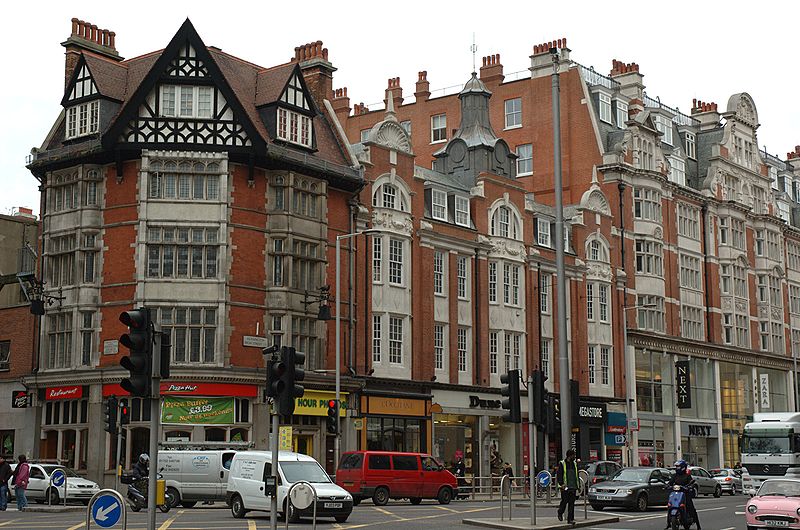
Kensington High Street at the intersection with Kensington Church Street. Kensington, London, England.
Photo by Ghouston via Wikimedia Commons.

The Coronavirus and its aftermath of lingering paranoia are the perfect excuse. Decentralisation and homeworking must be done. They must be done for the duration. They must be continued after that to maintain social distancing. No one will think ill of Barclays and WPP for taking the leap. No one will blame them for taking the leap in a way that involves a few deviations from course and a less than elegant landing. A year from now, these organisations will be making measurably larger profits than they would be otherwise. The mistakes will have been ignored.

And other organisations will follow. Whether the present crash will bring on a depression shaped like a V or an L, there is no doubt that, even if slowly at first, the wheels of commerce will continue turning. But they will be turning on different rails. As with any change of course, there will be winners and losers. I have already discussed how I can expect to be among the winners. I will leave that as said for the other winners — these being anyone who can find a market for doing from home what was previously required by custom and lack of imagination to be done somewhere else. I will instead mention the losers.

Most obvious among these will be anyone involved in commercial property. Landlords will find themselves with many more square feet to fill than prospective tenants want to fill. Rental and freehold values will crumble. Bearing in mind how much debt is carried by commercial landlords, there will be some interesting business failures in the next few years. Then there are the ancillary sectors — property management companies, commercial estate agents, maintenance companies. These employ swarms of architects and surveyors and lawyers and negotiators, of builders, plumbers, electricians, of drivers and cleaners. If the humbler workers will eventually find other markets, many with degrees and professional qualifications can look to a future of straitened circumstances.

The lush residential estates in and about Central London will follow. I think particularly of the aristocratic residential holdings in Kensington. Houses here go for tens of thousands a week to senior bank workers from abroad. If the City and Canary Wharf are emptied out, who needs to live in a place like Kensington? It has poor Underground connections. It is close by places like Grenfell Tower. Its residents keep predators at bay only by heavy investment of their own in security and by suspecting every knock on the door and every sound in the night. Many of the shops and eateries that make its High Street an enjoyable place to be will not reopen. Those that do reopen will be hobbled by continuing formal and informal rules on social distancing.

As a result, restaurants and pubs and coffee bars will begin to disappear. All but a few of these were barely making normal profit before they were closed last month. So few are in liquidation as yet only because so few petitions have been lodged in the courts. Most of them will now be surplus to requirement. The same can be said of hotels. Speaking for myself, I used to visit Cambridge twice a year on examinations business. I was always put up there for a couple of nights. I shall now do from home all that I did in Cambridge. I doubt I am alone. Zoom will destroy business travel. In the same way, bigger televisions plus continued social distancing will finish off the theatres and cinemas — also in decline before last month.

May 12, 2020

Dave Grohl on live music

Filed under: Government, Health, Media — Tags: , , , , , — Nicholas @ 03:00

Writing in The Atlantic, he regrets having to miss a particular event:

Dave Grohl and the Foo Fighters at Rock am Ring, 3 June 2018.
Photo by Andreas Lawen via Wikimedia Commons.

Where were you planning to be on the Fourth of July this year? Backyard barbecue with your crankiest relatives, fighting over who gets to light the illegal fireworks that your derelict cousin smuggled in from South Carolina? Or maybe out on the Chesapeake Bay, arguing about the amount of mayonnaise in the crab cakes while drinking warm National Bohemian beer? Better yet, tubing down the Shenandoah with a soggy hot dog while blasting Grand Funk Railroad’s “We’re an American Band”?

I know exactly where I was supposed to be: FedExField, outside Washington, D.C., with my band Foo Fighters and roughly 80,000 of our closest friends. We were going to be celebrating the 25th anniversary of our debut album. A red, white, and blue keg party for the ages, it was primed to be an explosive affair shared by throngs of my sunburned hometown brothers and sisters, singing along to more than a quarter century of Foo.

Well, things have changed.

Unfortunately, the coronavirus pandemic has reduced today’s live music to unflattering little windows that look like doorbell security footage and sound like Neil Armstrong’s distorted transmissions from the moon, so stuttered and compressed. It’s enough to make Max Headroom seem lifelike. Don’t get me wrong, I can deal with the monotony and limited cuisine of quarantine (my lasagna game is on point!), and I know that those of us who don’t have to work in hospitals or deliver packages are the lucky ones, but still, I’m hungry for a big old plate of sweaty, ear-shredding, live rock and roll, ASAP. The kind that makes your heart race, your body move, and your soul stir with passion.

There is nothing like the energy and atmosphere of live music. It is the most life-affirming experience, to see your favorite performer onstage, in the flesh, rather than as a one-dimensional image glowing in your lap as you spiral down a midnight YouTube wormhole. Even our most beloved superheroes become human in person. Imagine being at Wembley Stadium in 1985 as Freddie Mercury walked onstage for the Live Aid benefit concert. Forever regarded as one of the most triumphant live performances of all time (clocking in at a mere 22 minutes) Freddie and Queen somehow managed to remind us that behind every rock god is someone who puts on their studded arm bracelet, absurdly tight white tank, and stonewashed jeans one pant leg at a time just like the rest of us. But, it wasn’t necessarily Queen’s musical magic that made history that day. It was Freddie’s connection with the audience that transformed that dilapidated soccer stadium into a sonic cathedral. In broad daylight, he majestically made 72,000 people his instrument, joining them in harmonious unison.

May 10, 2020

London’s Metropolitan Police live down to expectations … and then some

Filed under: Britain, Health, Law, Liberty — Tags: , , , , , — Nicholas @ 06:00

Brendan O’Neill observes the latest sweep by the Metropolitan Police, relentlessly cracking down on scofflaws and evil-doers who … were walking peacefully in the sunshine?

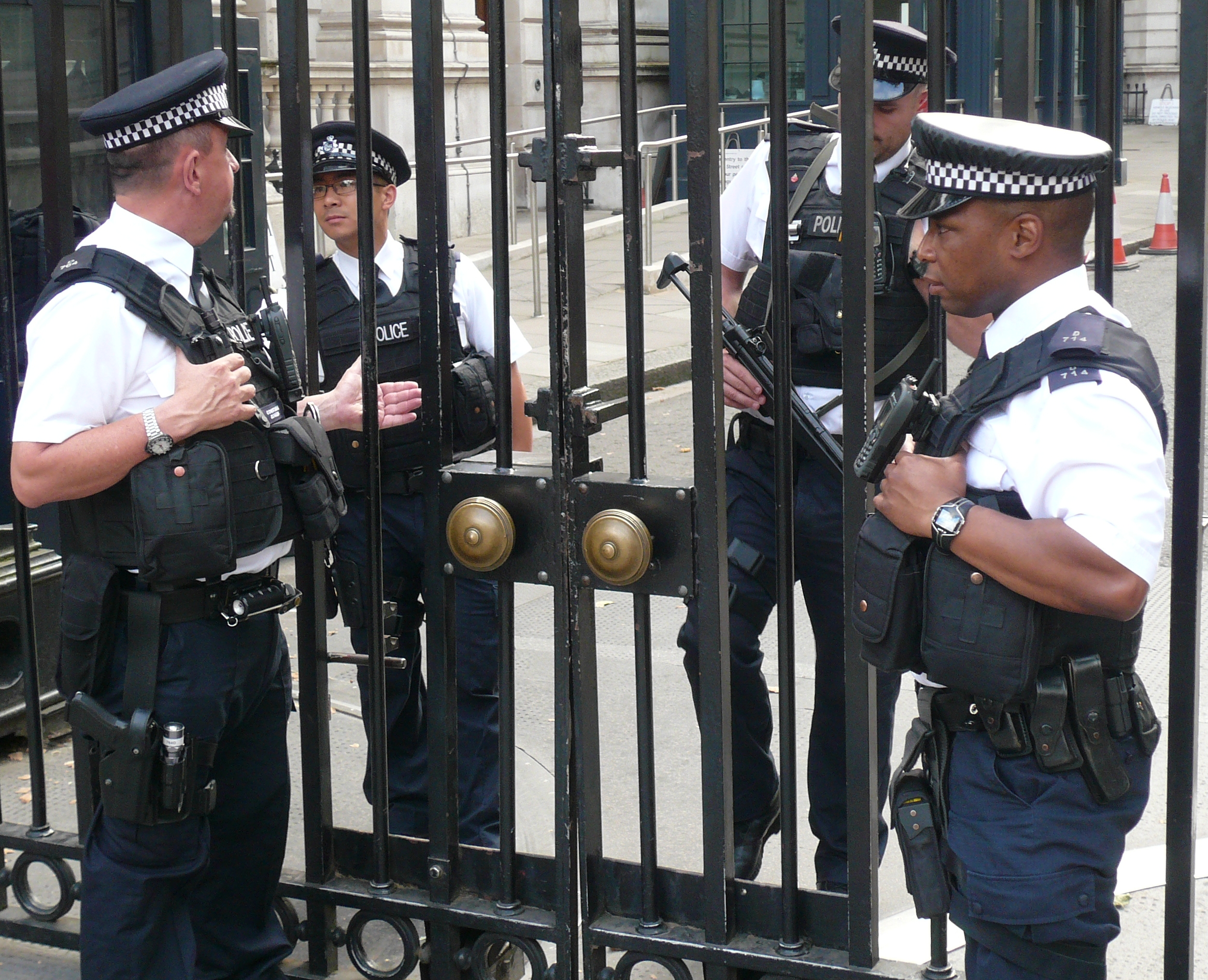
Armed Metropolitan Police near Downing Street in London.
Photo by Stanislav Kozlovskiy via Wikimedia Commons.

You heard them before you saw them. It sounded like a platoon of soldiers. The one in charge was barking orders to “move forward!” and then came the trudge of their boots. Scores of them, making military manoeuvres, marching in a long, thin line through one of Britain’s prettiest parks: St James’s Park in London. This was the Metropolitan Police today, enforcing the lockdown, sweeping through parks and streets and issuing the same warning to everyone they came across, from young lovers to dads playing football with their kids to homeless people with nowhere else to go: “Move on.” It’s one of the most disturbing things I’ve ever seen the police do.

Watching them stream through St James’s Park, looking for all the world like a line of soldiers conquering a small town, you’d think they were on their way to confront some serious organised crime. But of course their targets were sunbathers, those apparently selfish people demeaned in the media and now harassed by the cops. And a dad playing football with his toddler. “Aren’t we allowed to exercise?”, the dad asked. “For one hour”, came the reply. “How long have you been out?” And young lovers and friends. I saw a copper on horseback shouting down at two young men as if they were in the process of committing some awful crime. I guess they were in the eyes of the lockdown fanatics: they were sitting under a tree.

A young Muslim mum sitting down and watching her two kids play with little tennis bats was confused, too. Can’t kids play outside? She was told she couldn’t sit still. She had to walk. “How about walking your kids around the park?”, said the spectacularly patronising cop. They even threw out homeless people. I saw them tell four individual homeless people (ie, not a group of homeless people) to move on. Where to? Must they also walk and walk, forever, and never sit down anywhere? The most despicable thing I saw was a policeman telling an elderly homeless gentleman to move on. Inarticulately, the man explained he had nowhere else to go. I stepped in and explained to the cop that there is no home for him to go to, and he has to be able to sit down somewhere on a hot day. “I don’t make the rules”, came the snivelling, officious reply.

The police’s reputation will have taken a severe beating in London today. Anyone who argued back — as two young women did, patiently explaining that they are from the same household and that they were metres away from everyone else — was patronised or even insulted. “You’re putting other people’s lives at risk”, the women were told, which is completely untrue — being outside and socially distanced on a very warm day carries virtually zero threat of infection. I heard an officer call someone an idiot. Another officer made fun of someone who asked about his right to be outside. It was staggeringly rude and even repugnant behaviour. A politician, or someone, needs to get a grip on these people.

May 3, 2020

The Great Exhibition of 1851

In the latest Age of Invention newsletter, Anton Howes looks at one of the biggest popular events of Queen Victoria’s reign, the Great Exhibition:

The Crystal Palace from the northeast during the Great Exhibition of 1851, image from the 1852 book Dickinsons’ comprehensive pictures of the Great Exhibition of 1851
Wikimedia Commons.

On this day, in 1851, Londoners were finally allowed to enter one of the most spectacular edifices to grace their city. Over the previous months they had watched it spring up in Hyde Park — the largest enclosed structure that had ever been built, and made with three hundred thousand of the largest panes of glass ever produced. Set against the blackened, soot-stained buildings of London, the massive glass edifice gleamed. It soon became known as the Crystal Palace.

Although it no longer exists — it was rebuilt in Sydenham, but the new version burnt down in the 1930s — the fame of the Crystal Palace endures. The same goes for the event that it was originally built for, the Great Exhibition of 1851. But, despite that name-recognition, I’ve found that most people don’t really know what the Great Exhibition was for. Yes, it attracted six million visitors in the space of just a few months — an estimated two million people, almost a tenth of the entire population of Great Britain, most of them returning again and again. But why? I must admit, despite having mentioned the event before in some of my work, I’d never really considered it properly before I started researching the history of the Society of Arts.

The idea of such an exhibition in Britain originated with the Society’s secretary in the 1840s, the civil engineer Francis Whishaw. He had seen the use of industrial exhibitions in France, as a means of catching up with Britain in terms of technology. Every few years since 1798, the French government had held an exhibition of its national industries in Paris. The state paid for everything — a grand temporary building, as well as the expenses of the exhibitors — and the head of state himself awarded medals and cash prizes for the bet works on display. Some of the very best exhibitors were even admitted to the Légion d’honneur, France’s highest order of merit. The benefits to exhibitors were so high that essentially every manufacturer wished to take part. In the days before GDP statistics, the exhibitions were thus an effective means of getting a detailed snapshot of the nation’s manufacturing capabilities. An exhibition served as the nation’s industrial audit.

[…]

Although there had been a few local exhibitions of industry in Britain in the late 1830s and early 1840s, there had been nothing on a national scale to rival the French ones. So Francis Whishaw began the work of getting the Society to organise such an event — a national exhibition of industry for Britain. His initial plan came to nothing, partly as he left the Society to take another job, but in the late 1840s the project was resurrected by a new member of the Society, a civil servant named Henry Cole. In fact, Cole almost entirely took over the Society in the late 1840s, turning it into an exhibition-holding organisation. It held exhibitions devoted to particular living artists, on ancient and medieval art, on inventions, and especially on industrial design — what Cole liked to call “art-manufactures”. And, at the 1849 national exhibition in Paris, he adopted an idea that had already been floated for some years by French officials: an international exhibition, to show the industry of all nations.

This was the crucial step. The idea of an international exhibition of industry appealed to the free trade movement in Britain, which had achieved success in the 1840s with the abolition of the Corn Laws. By displaying the products of other nations, the argument went, British consumers would demand that they be able to buy them more cheaply. And free trade would hopefully bring an end to war, too. Free trade campaigners argued that the productive classes of rival nations competed peacefully, simply by trying to outdo one another in the quality and quantity of what they produced. It was the landed aristocracy, they argued, who let the competition become violent, feeding their pride by causing destruction. Thus, a grand exhibition of the products of all nations — the Great Exhibition — would be a physical manifestation of free trade and international harmony: a “competition of arts, and not of arms”.

The Great Exhibition thus had many roles. It was partly born of national paranoia, about French industrial catch-up, as well as about Britain being the first to hold such an event. It was also about exciting competitive emulation between manufacturers, showing consumers what they did not know they wanted, and achieving world peace and free trade. It certainly spurred on dozens of examples of international cooperation. In fact, just the other day I discovered that the first international chess tournament was held in London to coincide with the exhibition. And it served as an audit of the world’s industries, allowing people to judge who was ahead and who was behind. It thereby gave domestic reformers the ammunition to push for changes in areas where Britain seemed to be falling behind, in areas like education, intellectual property, and design. But more on those another time.

March 17, 2020

When the state renounces enforcing the law, there are two alternatives

Filed under: Britain, Government, Law, USA — Tags: , , , — Nicholas @ 03:00

Yesterday, David Thompson linked to a post by Natalie Solent about how the police in London failed to do anything about a blatant theft at a Boots pharmacy because it was considered a “civil matter”. The accused thief was prosecuted privately by the parent corporation, which is apparently the first time this has happened in England. As Natalie says, this is the “nice” option when the government fails to enforce the law of the land — or enforces it only sporadically and unevenly.

In the latest edition of the Libertarian Enterprise, Eric Oppen provides an example from the US in the post-Civil War era that shows the other option for private law enforcement:

Many of the victims of the kind of small-time crime committed by vagrants and the “homeless” are, themselves, far from rich. Repeated thefts can drive a small, struggling business under, and loss of, for example, a bicycle can represent a catastrophic blow to a poor person’s finances. This doesn’t address the sense of violation felt by those victimized by crime.

The original San Francisco Committees of Vigilance formed because the “forces of law and order” either were not doing their jobs, or were actively in league with the very criminals they were supposed to be suppressing. Many police were incompetent or lazy, while others were often corrupt on a scale that would shock Boss Hogg.

Do-it-yourself justice was far from uncommon in nineteenth-century America, including in the “civilized” East. In upstate New York, after decades of unpunished crime, the Loomis family gang received an epic comeuppance in 1865. Fifteen years earlier, their outraged neighbors had tried staging a raid on the Loomis farm, but uncertainty about who owned the stolen goods they found prevented any Loomis from being convicted. In 1865, many of their neighbors were returned Civil War combat veterans. They had become inured to violence, and they were tired of the Loomis’ thefts, arsons and intimidation. They killed George “Wash” Loomis, the leader of the gang, nearly lynched one of his brothers, and burned down the family’s home. After that, the Loomis family’s power was broken and their reign of crime was pretty much over.

These things happened because there was no other way to deal with these situations. Law enforcement, in those days, was primitive, especially outside of the major cities. Large corporations often had their own private police simply because of this fact.

The “social contract” is supposed to read something like “renounce personally avenging your wrongs, and society will do it for you.” But what can one do, when society is visibly abrogating the contract? Take it to court?

Vigilantism is not unknown even in Canada.

“Tombstone Courthouse State Historic Park” by August Rode is licensed under CC BY-NC-SA 2.0

« Newer PostsOlder Posts »

Powered by WordPress