
During the first lockdown, I often found myself going to bed with two especially charming gentlemen. The first was a boisterous Old Etonian called Bertie, who took understandable pride in his aptitude for theology (and, indeed, won the prize for Scripture Knowledge at his prep school), and whose conversation usually involved reference to his club, the Drones, and the unfortunate incident where he served a night in the cells for knocking off a policeman’s helmet during Boat Race festivities. And the other man – Reginald, though he preferred to be known as Jeeves – was of a more sombre and serious mien. Quieter and more reserved than his companion, he was less free with his opinions and chatter, but what he said revealed a serious and deep intellectual commitment and purpose, albeit one leavened with a degree of good-humoured and entirely understandable exasperation at his charge’s more whimsical and mercurial antics.
Everybody has those books, and authors, that they go to when they are in need of escapism. For me, PG Wodehouse’s Jeeves and Wooster series have always been these tales. Nightly incursions into their pages during the pandemic made the misery and boredom of those long days and weeks considerably more bearable. He wrote 35 short stories and 11 novels featuring the duo, beginning in 1915 with Extricating Young Gussie (although purists prefer to begin with Leave it to Jeeves which appeared the following year and features the most recognisable incarnation of the characters), and ending shortly before his death in 1975 with 1974’s Aunts Aren’t Gentlemen. Undoubtedly, if Wodehouse had somehow lived another five or ten years, there would have been more stories, but his prolific dedication to “the graft” has left us with a truly splendid collection of tales, all revolving around a pre-lapsarian world that was always a fantastical creation, even when Wodehouse began writing. By the time of the last book’s publication, when Britain was immersed in the three-day week and the dying days of the Heath government, the events depicted bore as much relation to readers’ everyday lives as if Wodehouse had been writing about events on Mars.
This was, of course, the point from the beginning. As Evelyn Waugh, a great admirer, famously said, “Mr. Wodehouse’s idyllic world can never stale. He will continue to release future generations from captivity that may be more irksome than our own. He has made a world for us to live in and delight in.” Nobody has ever sat down to read about the adventures of Jeeves, Bertie, Bingo Little, Gussie Fink-Nottle, the terrifying Aunt Agatha and Roderick Spode (to say nothing of his black short-wearing followers) and expected gritty social realism.
Instead, they have come to marvel at the twentieth century’s greatest comic prose stylist’s apparently endless invention, in which matrimony is a predicament to be averted at all costs, where the distaste of one’s gentleman’s gentleman for an ill-considered sartorial faux pas can lead to a (happily temporary) breakdown in amicable relations, and where the sole work undertaken by Bertie is to contribute an article about “What the well-dressed man is wearing” to his aunt’s periodical. Like his prize for scripture knowledge, he remains proud of this modest achievement, and continually refers to it throughout his adventures.
Alexander Larman, “The enduring appeal of Jeeves and Wooster”, The Critic, 2020-10-16.
March 5, 2021
QotD: P.G. Wodehouse’s Jeeves and Wooster
March 1, 2021
Solothurn S18-1000: The Pinnacle of Anti-Tank Rifles
Forgotten Weapons
Published 13 Oct 2017Among all the antitank rifles developed between the World Wars, the highest quality and most sophisticated was the Solothurn S18-1000. It fires the 20x138B cartridge which was also used in the Finnish Lahti L-39 and the German 20mm Flak guns, and it does so using a semiautomatic action and an 8-round box magazine. It is a short-recoil system, with a rotating bolt rather similar to that of the MG-34 machine gun.
The recoil-operated action of the Solothurn helps dampen its recoil more than the Lahti, and is definitely a more comfortable gun to shoot. The Solothurn is equipped with both iron sights and an optical sight (we used the irons in this shooting, because the rubber eye cup on the scope is fairly hard and brittle on this example). Remarkably for its 100+ pound weight, the gun definitely jumps back a few inches when fired unless one has firmly sunk the bipod feet into the earth. However, the recoil force is really more of a push than a sharp impact, and combined with the large surface area of the shoulder pad it is not at all a bad experience.
A number of different countries bought the S18-1000 (and many others bought the smaller S18-100), including the Italians and Hungarians. The only combat account I was able to find was from a Dutch antitank gun team that used one to successfully engage several German armored cars during the invasion of the Netherlands in 1940.
http://www.patreon.com/ForgottenWeapons
Cool Forgotten Weapons merch! http://shop.bbtv.com/collections/forg…
If you enjoy Forgotten Weapons, check out its sister channel, InRangeTV! http://www.youtube.com/InRangeTVShow

February 25, 2021
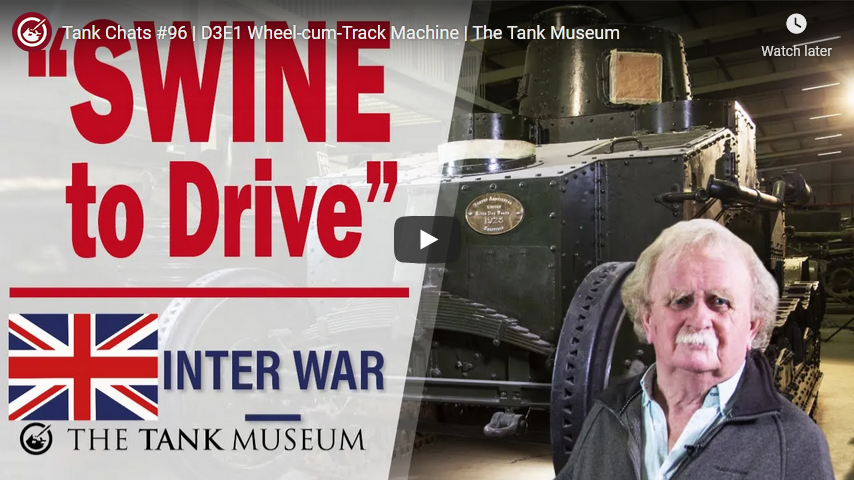
Tank Chats #96 | D3E1 Wheel-cum-Track Machine | The Tank Museum
The Tank Museum
Published 28 Feb 2020David Fletcher looks at the experimental inter-war Vickers D3E1, which was conceived to solve the problem of track wear, with wheels that could be used instead where the ground was suitable. In practice the concept proved too complicated.
Support the work of The Tank Museum on Patreon: ► https://www.patreon.com/tankmuseum
Visit The Tank Museum SHOP: ►tankmuseumshop.org
Twitter: ► https://twitter.com/TankMuseum
Instagram: ► https://www.instagram.com/tankmuseum/
Tiger Tank Blog: ► http://blog.tiger-tank.com/
Tank 100 First World War Centenary Blog: ► http://tank100.com/
#tankmuseum #tanks
February 18, 2021
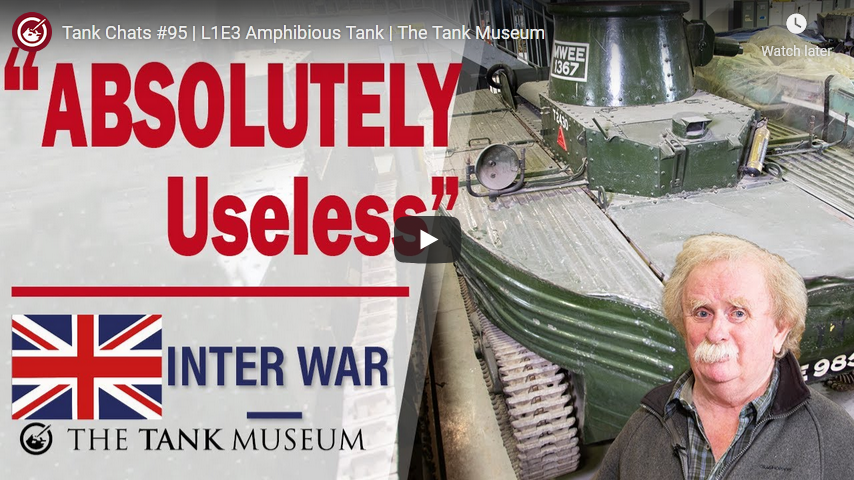
Tank Chats #95 | L1E3 Amphibious Tank | The Tank Museum
The Tank Museum
Published 21 Feb 2020Here David Fletcher examines the Vickers-Carden-Loyd L1E3 Amphibious Tank. Produced in the 1930s, the L1E3 was a pre-WW2 experimental tank which never entered service with the British Army.
Support the work of The Tank Museum on Patreon: ► https://www.patreon.com/tankmuseum
Visit The Tank Museum SHOP: ► tankmuseumshop.org
Twitter: ► https://twitter.com/TankMuseum
Instagram: ► https://www.instagram.com/tankmuseum/
Tiger Tank Blog: ► http://blog.tiger-tank.com/
Tank 100 First World War Centenary Blog: ► http://tank100.com/
#tankmuseum #tanks
February 6, 2021
From an improbable 1930s “death ray” to the radar network that helped defeat the Blitz
In a story from a few years back, Tim Harford outlines how a British Air Ministry prize for developing a “death ray” to use against enemy aircraft eventually helped kick off the discovery of radar:
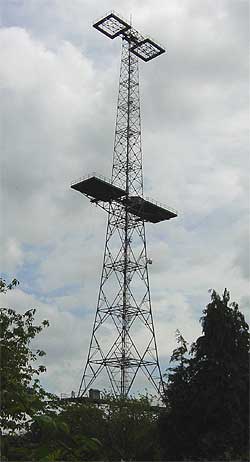
The Chain Home radar tower in Great Baddow Chelmsford.
Photo by Stuart166axe via Wikimedia Commons.
… sometimes inventions need other inventions to unlock their full potential.
For the aviation industry, that story starts with the invention of the death ray, or at least an attempt to design a death ray, back in 1935.
Officials in the British Air Ministry were worried about falling behind Nazi Germany in the technological arms race.
The death ray idea intrigued them: they had been offering a £1,000 prize for anyone who could zap a sheep at a hundred paces. So far, nobody had claimed it.
But should they fund more active research? Was a death ray even possible?
Unofficially, they sounded out Robert Watson Watt, of the Radio Research Station.
And he posed an abstract maths question to his colleague Skip Wilkins.
“Suppose, just suppose,” said Watson Watt to Wilkins, “that you had eight pints of water, 1km [3,000ft] above the ground.
“And suppose that water was at 98F [37C], and you wanted to heat it to 105F.
“How much radio frequency power would you require, from a distance of 5km?”
Skip Wilkins was no fool.
He knew that eight pints was the amount of blood in an adult human, 98F was normal body temperature and 105F was warm enough to kill you, or at least make you pass out, which — if you’re behind the controls of an aeroplane — amounts to much the same thing.
So Wilkins and Watson Watt understood each other, and they quickly agreed the death ray was hopeless: it would take too much power.
But they also saw an opportunity.
Clearly, the ministry had some cash to spend on research. Perhaps Watson Watt and Wilkins could propose some alternative way for them to spend it?
Wilkins pondered. It might be possible, he suggested, to transmit radio waves and detect — from the echoes — the location of oncoming aircraft long before they could be seen.
Watson Watt dashed off a memo to the Air Ministry’s newly formed Committee for the Scientific Survey of Air Defence. Would they be interested in pursuing such an idea? They would indeed.
What Skip Wilkins was describing became known as radar.
January 6, 2021
QotD: George Bernard Shaw’s views on eugenics
The Irishman’s opinions are, however, coming back to mangle and even smash his reputation. A group of students at RADA have called for Shaw’s name to be removed from the drama school’s theatre as part of an anti-racism action plan. This matters, because Shaw provided for the school in his will, and last year the royalties from his work contributed more than £78,000 to RADA. Yet the accusation that the renowned theatre college “celebrates historical figures who embraced racist ideologies” does have a certain merit. Problem is, as has been debated myriad times: do, can, and should we separate an artist’s work from their period, character and ideas? If the ghosts of anachronism and historical assumptions are never to be exorcised, there are an awful lot of people who will fail and fall to the wide-awake litmus test.
Shaw did indeed write, that, “The only fundamental and possible socialism is the socialisation of the selective breeding of man” and, chillingly, “A part of eugenic politics would finally land us in an extensive use of the lethal chamber. A great many people would have to be put out of existence simply because it wastes other people’s time to look after them.” He lectured for the Eugenic Education Society, praised Stalin (naturally) the early Mussolini, and even Hitler as late as 1935. He abandoned most of all this in his old age but never made any formal apology.
He was also an incisive critic of imperialism, mercilessly exposed establishment hypocrisy, opposed war and oppression throughout his career, and cared passionately about actors and writers – the very people at RADA trying to expunge his name from their place of learning. And here’s another challenge and even embarrassment for those who would remove the social engineers from the litany of the great and the good: many of their harshest opponents were not others on the left but, in Edwardian Britain and in the 20s and 30s, conservative Roman Catholic writers led by G.K. Chesterton and Hilaire Belloc.
Michael Coren, “Eugenics and the intellectual left”, The Critic, 2020-09-16.
November 22, 2020
Our World 100 Years Ago – November 1920 I THE GREAT WAR
The Great War
1.25M subscribers
Dissent This
What happened around the world 100 years ago?» SUPPORT THE CHANNEL
Patreon: https://www.patreon.com/thegreatwar» OUR PODCAST
https://realtimehistory.net/podcast – interviews with World War 1 historians and background info for the show.» BUY OUR SOURCES IN OUR AMAZON STORES
https://realtimehistory.net/amazon *
*Buying via this link supports The Great War (Affiliate-Link)» MORE THE GREAT WAR
Website: https://realtimehistory.net
Instagram: https://instagram.com/the_great_war
Twitter: https://twitter.com/WW1_Series
Reddit: https://reddit.com/r/TheGreatWarChannel»CREDITS
Presented by: Jesse Alexander
Written by: Jesse Alexander
Director: Toni Steller & Florian Wittig
Director of Photography: Toni Steller
Sound: Toni Steller
Editing: Toni Steller
Motion Design: Philipp Appelt
Mixing, Mastering & Sound Design: http://above-zero.com
Maps: Daniel Kogosov (https://www.patreon.com/Zalezsky)
Research by: Jesse Alexander
Fact checking: Florian WittigChannel Design: Alexander Clark
Original Logo: David van StepholdContains licensed material by getty images
All rights reserved – Real Time History GmbH 2020
From the comments:
The Great War
2 days ago
Hope the new mic does its job and the audio is alright for all of you. We also got a lot of questions about the contents of Jesse’s bookshelf and the Emergency Lockdown Studio Also Known As Jesses Living Room (ELSAKAJLR™). Think we will film an extra video with Jesse (MTV Cribs?).

November 6, 2020
An American Globalist – Cordell Hull – WW2 Biography Special
World War Two
Published 5 Nov 2020Cordell Hull is the face of American diplomacy in 1941 as it navigates the precarious road to war against Imperial Japan.
Join us on Patreon: https://www.patreon.com/TimeGhostHistory
Or join The TimeGhost Army directly at: https://timeghost.tvFollow WW2 day by day on Instagram @ww2_day_by_day – https://www.instagram.com/ww2_day_by_day
Between 2 Wars: https://www.youtube.com/playlist?list…
Source list: http://bit.ly/WW2sourcesHosted by: Indy Neidell
Written by: Francis van Berkel and James Newman
Director: Astrid Deinhard
Producers: Astrid Deinhard and Spartacus Olsson
Executive Producers: Astrid Deinhard, Indy Neidell, Spartacus Olsson, Bodo Rittenauer
Creative Producer: Maria Kyhle
Post-Production Director: Wieke Kapteijns
Research by: James Newman
Edited by: Miki Cackowski
Sound design: Marek Kamiński
Map animations: Eastory (https://www.youtube.com/c/eastory)Colorizations by:
Norman Stewart – https://oldtimesincolor.blogspot.com/
Mikolaj Uchman
Spartacus OlssonSources:
Naval History & Heritage Command
http://maps.bpl.org
FDR Presidential Library & Museum
Picture of MS St. Louis in Hamburg, United States Holocaust Memorial Museum, courtesy of Herbert and Vera Karliner
from the Noun Project: Skull by Muhamad Ulum, Handshake by priyanka, Pickaxe by Luke Anthony Firth, oil barrel by BomSymbolsSoundtracks from the Epidemic Sound:
Howard Harper-Barnes – “London”
Johannes Bornlof – “The Inspector 4”
Farell Wooten – “Blunt Object”
Philip Ayers – “Trapped in a Maze”
Johannes Bornlof – “Deviation In Time”Archive by Screenocean/Reuters https://www.screenocean.com.
A TimeGhost chronological documentary produced by OnLion Entertainment GmbH.

October 27, 2020
What Happened 100 Years Ago? – October 1920 I THE GREAT WAR
The Great War
Published 26 Oct 2020It’s time for our monthly summary of the events 100 years ago.
» SUPPORT THE CHANNEL
Patreon: https://www.patreon.com/thegreatwar» OUR PODCAST
https://realtimehistory.net/podcast – interviews with World War 1 historians and background info for the show.» BUY OUR SOURCES IN OUR AMAZON STORES
https://realtimehistory.net/amazon *
*Buying via this link supports The Great War (Affiliate-Link)» MORE THE GREAT WAR
Website: https://realtimehistory.net
Instagram: https://instagram.com/the_great_war
Twitter: https://twitter.com/WW1_Series
Reddit: https://reddit.com/r/TheGreatWarChannel»CREDITS
Presented by: Jesse Alexander
Written by: Jesse Alexander
Director: Toni Steller & Florian Wittig
Director of Photography: Toni Steller
Sound: Toni Steller
Editing: Toni Steller
Motion Design: Philipp Appelt
Mixing, Mastering & Sound Design: http://above-zero.com
Maps: Daniel Kogosov (https://www.patreon.com/Zalezsky)
Research by: Jesse Alexander
Fact checking: Florian WittigChannel Design: Alexander Clark
Original Logo: David van StepholdContains licensed material by getty images
All rights reserved – Real Time History GmbH 2020
September 18, 2020
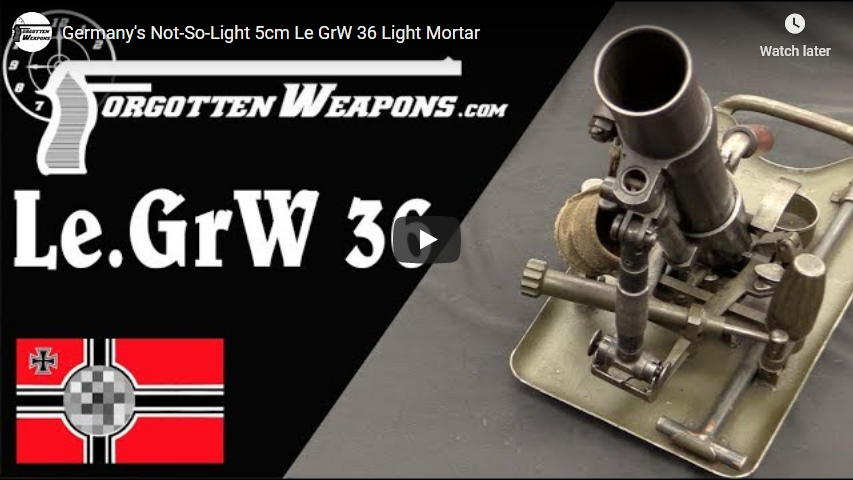
Germany’s Not-So-Light 5cm LeGrW 36 Light Mortar
Forgotten Weapons
Published 2 Sep 2018Sold for $18,400
http://www.patreon.com/ForgottenWeapons
Cool Forgotten Weapons merch! http://shop.bbtv.com/collections/forg…
The 5cm 5CM Leichter Granatwerfer 36 was the standard German light infantry mortar going into World War Two. It was designed by Rheinmetall-Borsig in the mid 1930s and adopted in 1936. It fired a 0.9kg / 2 pound mortar bomb with a range of up to 550 meters. In theory, it occupied the same role as the French Mle 1937 50mm light mortar — except it was far heavier than was practical, and substantially more complex to use. The LeGrW 36 weighed in at a hefty 31 pounds (14kg) – nearly four times as much as its French counterpart.
It was a striker fired design, with a trigger lever and thus did not fire immediately upon a round being loaded. It used adjustments in angle to determine range, with a constant projectile velocity (as opposed to venting a varying amount of propellent gas to adjust range). By the middle of the war, it was being pulled out of front-line use, as its weight and relative complexity made it impractical for its intended role.
If you enjoy Forgotten Weapons, check out its sister channel, InRangeTV! http://www.youtube.com/InRangeTVShow
September 15, 2020
France’s Super-Light 50mm Modele 37 Grenade Launcher
Forgotten Weapons
Published 1 Sep 2018Sold for $1,725
http://www.patreon.com/ForgottenWeapons
Cool Forgotten Weapons merch! http://shop.bbtv.com/collections/forg…
A new very light and portable mortar to replace the V-B rifle grenade was one of the facets of the French plan for rearmament and modernization after World War I. The concept for the weapons that would become the L.Gr. Mle 37 was first requested in 1924 — but like so almost all the other parts of that arms program, it was crippled by delays through the 1920s and 1930s. Only in the late 1930s when war was looking imminent did the program finally move forward.
The design, created by Captain Nahan of the Chatellerault arsenal, was adopted in 1937 and a whopping 21,950 were ordered in January of 1938 — and the order was quickly revised up to 50,000. However, only 2900 had been produced by the time of the armistice in June 1940. Production resumed in 1944, and the launcher did see use in Indochina. In addition, its 50mm grenade was the basis for the postwar French rifle grenades, as used on the MAS-36 LG 48, the MAS-44, and MAS-49 rifles. As fired from the mortar, the projectile weighed about one pound (0.4kg) and had a range of 80 to 460 meters, with an effective rate of fire up to 20 rounds per minute.
If you enjoy Forgotten Weapons, check out its sister channel, InRangeTV! http://www.youtube.com/InRangeTVShow

September 13, 2020
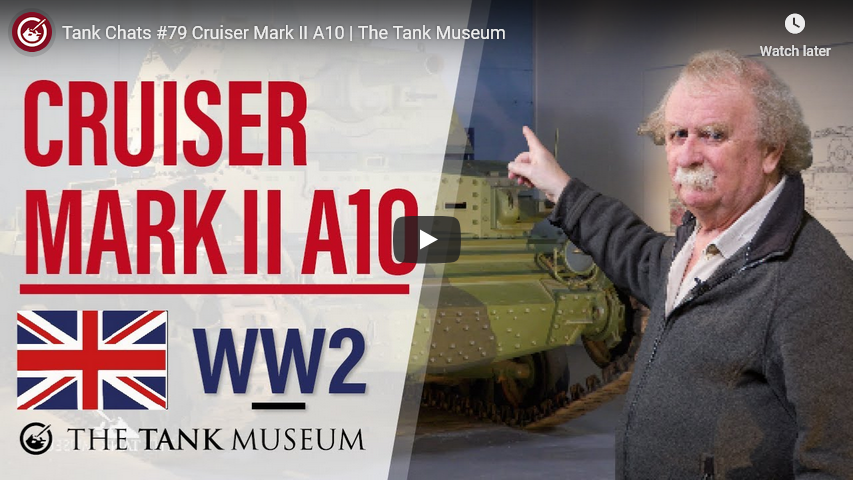
Tank Chats #79 Cruiser Mark II A10 | The Tank Museum
The Tank Museum
Published 29 Jun 2019The Cruiser Mark II A10 was developed alongside the A9 and was intended to be a heavier version of the tank.
Support the work of The Tank Museum on Patreon: ► https://www.patreon.com/tankmuseum
Visit The Tank Museum SHOP: ► https://tankmuseumshop.org/
Twitter: ► https://twitter.com/TankMuseum
Instagram: ► https://www.instagram.com/tankmuseum/
Tiger Tank Blog: ► http://blog.tiger-tank.com/
Tank 100 First World War Centenary Blog: ► http://tank100.com/ #tankmuseum #tanks
September 12, 2020
Shooting the ZB-26: A Jewel of an Interwar Light Machine Gun
Forgotten Weapons
Published 27 Oct 2017Sold for $34,500 (transferrable).
Today we have a chance to do some shooting with a ZB-26, a German-occupation 8mm light machine gun made at Brno in Czechoslovakia. The ZB-26 does not get nearly as much attention as LMGs made by the better known powers during the war, but it is an excellent weapon. In addition to being adopted by the Czech military, the gun was sold to about two dozen other countries and used in significant numbers by the Waffen SS.
As one would expect form its reputation, the ZB was smooth, reliable, and very controllable. For all the reasons discussed in yesterday’s history and disassembly video [here], it is a top notch firearm.
http://www.patreon.com/ForgottenWeapons
Cool Forgotten Weapons merch! http://shop.bbtv.com/collections/forg…
If you enjoy Forgotten Weapons, check out its sister channel, InRangeTV! http://www.youtube.com/InRangeTVShow

September 6, 2020
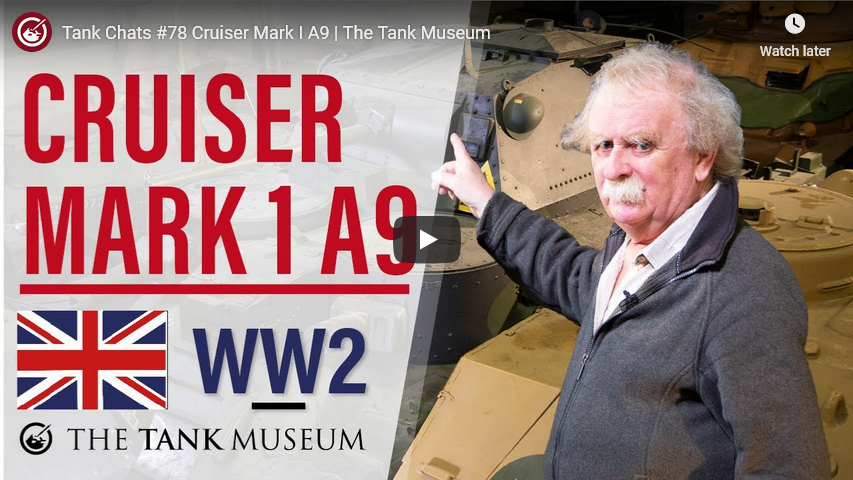
Tank Chats #78 Cruiser Mark I A9 | The Tank Museum
The Tank Museum
Published 21 Jun 2019The Tank Cruiser Mark I A9 is an interwar British tank. Tank Historian David Fletcher talks through the very first cruiser tank to go into service.
Support the work of The Tank Museum on Patreon: ► https://www.patreon.com/tankmuseum
Visit The Tank Museum SHOP: ► https://tankmuseumshop.org/
Twitter: ► https://twitter.com/TankMuseum
Instagram: ► https://www.instagram.com/tankmuseum/
Tiger Tank Blog: ► http://blog.tiger-tank.com/
Tank 100 First World War Centenary Blog: ► http://tank100.com/ #tankmuseum #tanks #tankchats
August 14, 2020
Warsaw, 1920 – “Smash a Bolshevik!”
Arthur Chrenkoff on the important but little-known Russo-Polish conflict a century ago:
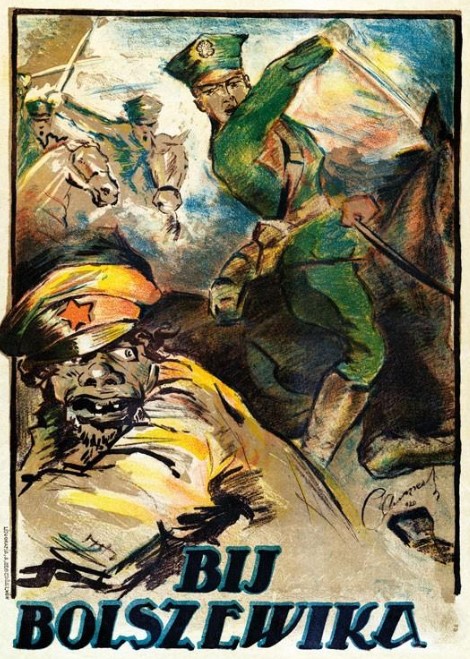
Polish propaganda poster “Smash a Bolshevik”
Image via Daily Chrenk.
The Polish-Russian war of 1919-20 was the last major conflict where massed cavalry played an important role. Unlike the static Western Front a few years earlier (but similarly to the much more mobile Eastern Front) it was a war of maneuver and speed, conducted over vast swathes of territory. While still fought in a pre-armour era, its conduct directly and indirectly inspired the major proponents of the future tank warfare and the doctrine of blitzkrieg, from the young De Gaulle (who was one of the official French Army observers in Poland at the time) through Tukhachevsky in the Soviet Union to Guderian in Germany. Two million troops from both sides took part in the conflict, making it the most significant foreign intervention against the newly installed Bolshevik regime over the course of the Russian Civil War. It might have even succeeded in strangling communism in its cradle; what prevented the cooperation with the counter-revolutionary White forces was their old imperial hostility to independent Poland (coincidentally, the anti-Hitler German opposition of 1944 was likewise unfriendly to the idea).
The basic story of the war is easily enough told. After 123 years of partition between Russia, Prussia and Austria-Hungary, Poland was recreated (or, really, recreated herself) among the chaos of the late 1918, with the collapse of all three of her occupying empires. The new “Versailles” Poland was smaller than in the past, which led the new government to try to restore by force what has been denied to her at the negotiating table (where Poles had no seat in any case). The Russian Revolution (or rather the Bolshevik coup d’etat) and the following civil war provided a perfect opportunity. Throughout 1919, the reconstituted Polish Army under the command of Marshall Jozef Pilsudski fought against and took over the briefly independent Western Ukraine republic and then marched on Kiev, this time in alliance with the forces of also briefly independent Eastern Ukraine republic (it was Pilsudski’s intention to recreate some form of an independent Ukrainian state – minus the predominantly Polish areas – as part of his larger project to create the Miedzymorze (Intermarum) Confederation of both anti-Russian and anti-German states stretching from the Baltic to the Black Sea).
But the Polish Army became overstretched and the Soviet government, now having defeated its major White opponents, found itself willing and able to stand up to and roll back what they saw as the Polish aggression against historically Russian territories. The Red Army, which sporadically skirmished with the Poles over the previous year, now counter-attacked across the whole wide front across what is now Belarus and Ukraine, driving the Polish Army back at an unprecedented pace of 30 kilometres a day. Soviet Marshall Tukhachevsky ordered his troops “To the West! Over the corpse of White Poland lies the road to worldwide conflagration. March on Vilno, Minsk, Warsaw!” and “onward to Berlin over the corpse of Poland!” Pravda newspaper echoed “Through the corpse of the White Poland lies the way to World Inferno. On bayonets we will carry happiness and peace to working humanity”. British Labour Party and French Socialists vowed not to support “reactionary” Poland; German and Czech unions sabotaged the delivery of crucial military supplies to the beleaguered Poland.
On 10 August, Cossack units of Tukhachevsky’s northern Army crossed the Vistula River north of Warsaw in at attempt to envelop the capital. This was a mistake, as the southern Army, under Budyonny, was still stuck around Lwow, three hundred kilometres to the south-east. For weeks preparing in secret, the last Polish reserves punched through the centre, first cutting off the two Soviet fronts from each other and then in a series of counter-enveloping maneuvers routing three Soviet armies. Now it was the Poles’ turn to advance 30 kilometres per day, as the Red Army collapsed and retreated in chaotic circumstances. The Polish counter-strike subsequently became known as “Cud nad Wisla” (Miracle of the Vistula), but it was less of a supernatural intervention and more a combination of several favourable factors: Soviet missteps, good Polish organisation, the growing hostility between Stalin and Trotsky as well as various military commanders, which hampered the cooperation between the Soviet fronts. Last but not least, and this was only revealed in 2004, Polish cryptographers had managed to break the Red Army codes – just as they would later be instrumental in breaking the German Enigma.


