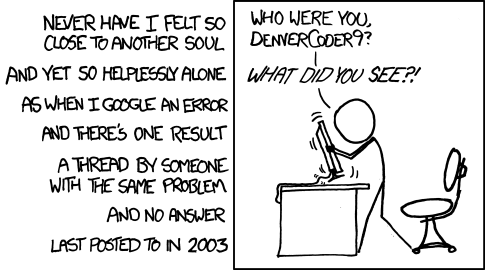
This xkcd installment is amazingly accurate, at least based on my experiences:
Wisdom of the Ancients

Remember to mouse-over the cartoon: you’re missing at least half the humour if you don’t read the mouse-over text of any xkcd cartoon.

This xkcd installment is amazingly accurate, at least based on my experiences:
Wisdom of the Ancients

Remember to mouse-over the cartoon: you’re missing at least half the humour if you don’t read the mouse-over text of any xkcd cartoon.
If so, it was probably a brilliant move:
I think we all know that Google’s pretty good at, um, obeying tax laws to the letter. For example, they’ve paid an entire £8m in UK corporation tax on revenues of some £6bn from 2004 to 2010.
[. . .]
However, this deal to purchase Motorola Mobility might be a coup to beat that hands down. The headline price to purchase the handset-maker and their bundle of patents is $12.5bn but that’s not what the net cost to Google might turn out to be. How about $3.8bn for that? For, along with the company and the patents, Google has also bought a series of tax losses.
For the record, it’s cheap politics to accuse a person or a corporation for paying “only” so much tax. If the politicians have set up the system to allow certain deductions or credits, then you’re insane not to take advantage of them. Like a number of headlines over the last day or so, pointing out that this or that company paid less in taxes than they paid their CEO. If the company paid more than it should, it’s depriving its shareholders of what they are rightfully due, and will likely be facing them in court.
Eric S. Raymond looks at the hard road ahead for Apple without Steve Jobs:
I’ve said before that I think Apple looks just like sustaining incumbents often do just before they undergo catastrophic disruption from below and their market share falls off a cliff. Google’s entire game plan has been aimed squarely at producing disruption from below, and with market share at 40% or above and Android’s brand looking extremely strong it is undeniable that they have executed on that plan extremely well. The near-term threat of an Apple market-share collapse to the 10% range or even lower is, in my judgment, quite significant — and comScore’s latest figures whisper that we may have reached a tipping point this month.
For Apple, the history of technology disruptions from below tells us that there is only one recovery path from this situation. Before the Android army cannibalizes Apple’s business, Apple must cannibalize its own business with a low-cost iPhone that can get down in the muck and compete with cheap Android phones on price. Likewise in tablets, though Apple might have six months’ more grace there.
Of course, this choice would mean that Apple has to take a massive hit to its margins. Which is the perennial problem in heading off a disruption from below before it happens; it is brutally difficult to convince your investors and your own executives that the record quarterlies won’t just keep coming, especially when your own marketing has been so persuasive about the specialness of the company and its leading position in the industry. This is a failure mode that, as Clayton Christensen has documented, routinely crashes large and well-run companies at the apparent peak of their success.
Does Tim Cook have the vision and the will to make this difficult transition happen? Nobody knows. But the odds are against it.
At least, so says Eric S. Raymond:
We’ll see a lot of silly talk about Google getting direct into the handset business while the dust settles, but make no mistake: this purchase is all about Motorola’s patent portfolio. This is Google telling Apple and Microsoft and Oracle “You want to play silly-buggers with junk patents? Bring it on; we’ll countersue you into oblivion.”
Yes, $12 billion is a lot to pay for that privilege. But, unlike the $4.5 billion an Apple/Microsoft-led consortium payed for the Nortel patents not too long ago, that $12 billion buys a lot of other tangible assets that Google can sell off. It wouldn’t surprise me if Google’s expenditure on the deal actually nets out to less – and Motorola’s patents will be much heavier artillery than Nortel’s. Motorola, after all, was making smartphone precursors like the StarTac well before the Danger hiptop or the iPhone; it will have blocking patents.
I don’t think Google is going to get into the handset business in any serious way. It’s not a kind of business they know how to run, and why piss off all their partners in the Android army? Much more likely is that the hardware end of the company will be flogged to the Chinese or Germans and Google will absorb the software engineers. Likely Google’s partners have already been briefed in on this plan, which is why Google is publishing happy-face quotes about the deal from the CEOs of HTC, LG, and Sony Ericsson.
When you read the word “santorum”, what do you think of? A small minority of people apparently believe it refers to an obscure American politician:
The world’s Wikifiddlers are obsessed with santorum. Though they can’t agree on what that is.
For some, it’s a word. For others, it’s not: it’s the result of a campaign to create a word. The distinction — however subtle — has sparked weeks of controversy among the core contributors to Wikipedia, the “free encyclopedia anyone can edit”. If you find this hard to believe, you’ve never been to Wikiland — and you’ve never Googled “Rick Santorum”.
Famously, Rick Santorum — the former Pennsylvania Senator and a Republican candidate for president of the United States — has a Google problem. But he also has a Wikipedia problem. And the two go hand-in-hand.
If nothing else, the whole controversy has added another variant meaning to the term “to be savaged”.
Dark Water Muse does the math for you:
In this piece DWM does not explore other possible ways that a tablet does things differently to a smart phone, net book, laptop or desktop computer. This is not a general review of tablet capabilities. It can be considered an update to DWM’s eReader versus Book piece [Ed: linked to from this post last week] with emphasis on the cost of the use of the tablet as an eReader.
Since DWM is focused on eReading then cost is an influential factor when considering any eReader device.
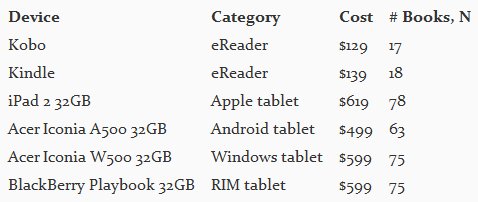
If you trust DWM to do the math and you don’t want to review DWM’s work (included further below in the section entitled “The Math”) then you can read the results in the Table #1: comparison of relative eReading costs below.
If we assume the average book price is $20 and eBooks are discounted by 40% (a gracious discount from DWM’s experience) then we get the following equation for N, the number of eBooks you must purchase and read on your new device to ensure you’re not paying more for the content you could have read as a book:
N = cost of device / $8
Table #1: comparison of relative eReading costs: The following table indicates the number of books N you must read on the corresponding eReader on the market today (prices taken from the web as of May 15, 2011) in order that the cost of the device does not drive up the cost of eBooks you read.
Apparently, even a short summary and a hyperlink are considered to be a violation of copyright in Belgium:
A Belgian appeals court has upheld an earlier ruling that Google infringes on newspapers’ copyright when its services display and link to content from newspaper websites, according to press reports.
The search engine giant is responsible for infringing the copyrights of the papers when it links to the sites or copies sections of stories on its Google News service, the Belgian Court of Appeals said, according to a report in PC World.
Google must not link to material from Belgian newspapers, the court said, according to the report (in French). No translation of the ruling is yet available.
[. . .]
The newspapers argued that they were losing online subscriptions and advertising revenue because Google was posting free snippets of the stories and links to the full article on Google News.
Google’s search engine offers links to the websites it indexes but also to “cached” copies of those pages. The copies are stored on Google’s own servers.
A bit of light fluff for the Easter weekend: Another Dozen Google Easter Eggs.

QR on Demand With Goo.gl
Most Google easter eggs are played strictly for laughs, but this one’s actually useful: When you’re working with Google’s URL shortener, goo.gl, simply add “.qr” to any shortened URL to generate a scannable QR code for the Website in question
This is an interesting site:

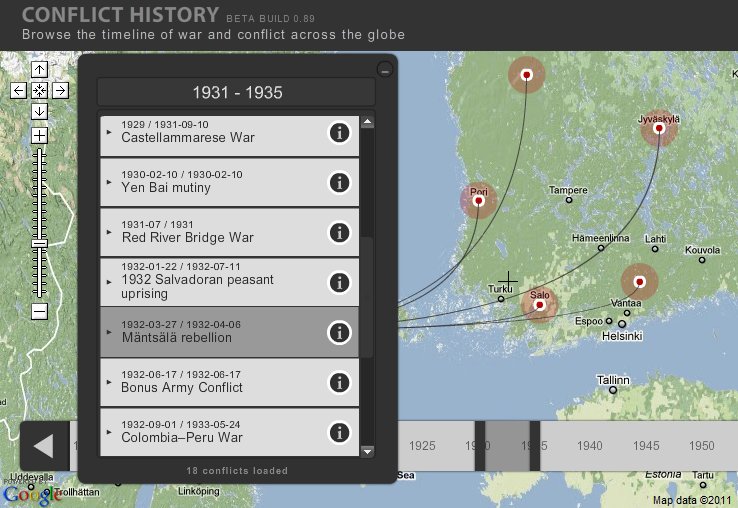
The screencap above shows the significant sites in the Mäntsälä rebellion in Finland in 1932 (no, I’d never heard of it either). Use the slider at the bottom of the screen to choose the time in history, and the map will show you the known conflicts for that period.

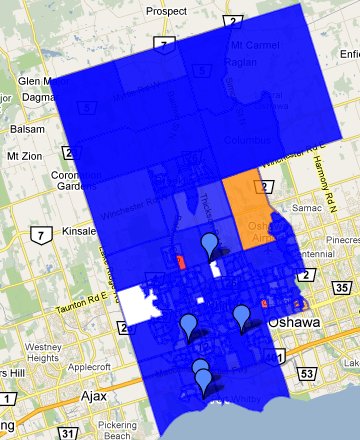
Here’s the riding of Whitby-Oshawa in the 2008 election. Notice all that deep blue colour? As the legend says, the opacity of colour indicates the strength of the party in that area. Up in the Brooklin area, you can barely see the underlying road pattern for all the blueness.


You can find how blue (or red, or whatever) your riding is by using the cyberpresse.ca Interactive map (this is now available in English: the original was in French). It’s another illustration of how to use Google Maps to display geographical data in interesting ways.
This time around, I’ll at least have a Libertarian candidate to vote for: Josh Insang is running for the Libertarian Party. Check the LPC Candidate page to see if you have a Libertarian running in your riding.
Royce McDaniels provides step-by-step instructions for installing the PDF reader plug-in for the Chrome browser:
Hello, everyone, and welcome to today’s How To segment here at The Walrus Says! Today we’re examining another useful feature of the Chrome web browser from Google, namely the ability to display Adobe Portable Document Format (PDF) files directly in the browser rather than via an external application like Google Docs which has been necessary before. The instructions below not only show you how to activate this feature of Chrome, but show you an interesting way to access Chrome functionality not part of the standard configuration menus! (Chrome itself is an Open Source project sponsored by Google; you can get complete information about the browser’s development at The Chromium Project. Enjoy!
I’m still (barely) sticking with Firefox as my primary browser, although it’s becoming a pain to use these days: for example, as I’m typing this line, the letters I type are appearing several seconds after I type ’em. It’s a bit like using an old 300 baud line with a small buffer. If the next major release of Firefox doesn’t fix this problem, then I’ll be switching to Chrome as my primary browser.
Powered by WordPress