Quotulatiousness

January 20, 2022

“The new music market is actually shrinking. All the growth in the market is coming from old songs”

Filed under: Media — Tags: , , , , — Nicholas @ 05:00

As a certified (certifiable?) old pharte, I have to admit I pretty much stopped listening to “new” music on the radio the year my son was born, so I certainly listen to a lot of music from my younger years, but apparently even young people today are also more inclined to listen to music from before they were born:
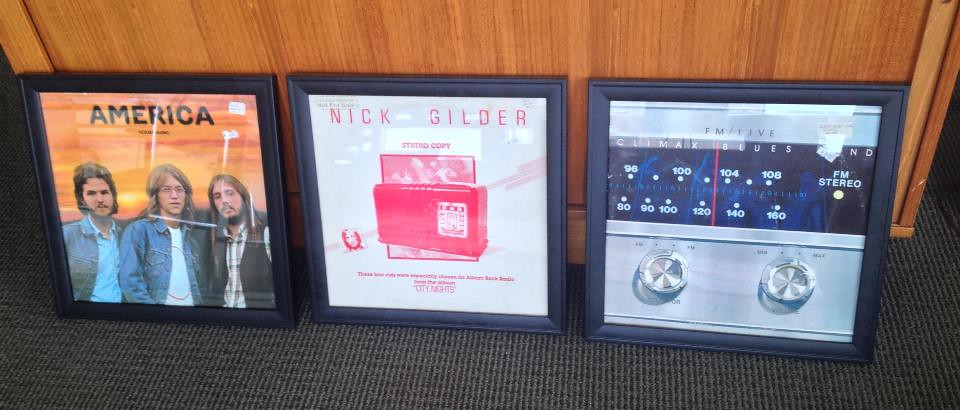
“Framed Vinyl Album Art: America ‘Homecoming’; Nick Gilder (Studio Copy of Singles From ‘City Lights’ Chosen for AOR); Climax Blues Band ‘FM Live’)” by JoeInSouthernCA is licensed under CC BY-ND 2.0

I had a hunch that old songs were taking over music streaming platforms — but even I was shocked when I saw the most recent numbers. According to MRC Data, old songs now represent 70% of the US music market.

Those who make a living from new music — especially that endangered species known as the working musician — have to look on these figures with fear and trembling.

But the news gets worse.

The new music market is actually shrinking. All the growth in the market is coming from old songs.

Just consider these facts: the 200 most popular tracks now account for less than 5% of total streams. It was twice that rate just three years ago. And the mix of songs actually purchased by consumers is even more tilted to older music — the current list of most downloaded tracks on iTunes is filled with the names of bands from the last century, such as Creedence Clearwater and The Police.

I saw it myself last week at a retail store, where the youngster at the cash register was singing along with Sting on “Message in a Bottle” (a hit from 1979) as it blasted on the radio. A few days earlier, I had a similar experience at a local diner, where the entire staff was under thirty but every song more than forty years old. I asked my server: “Why are you playing this old music?” She looked at me in surprise before answering: “Oh, I like these songs.”

The reasons are complex — more than just the appeal of old tunes — but the end result is unmistakable: Never before in history have new tracks attained hit status while generating so little cultural impact. In fact, the audience seems to be embracing en masse the hits of decades past. Success was always short-lived in the music business, but now it hardly makes a ripple on the attention spans of the mass market.

H/T to Althouse for the link.

April 18, 2021

Take a moment to reflect on the plight of those poor, alienated students at Haverford College in Pennsylvania

Filed under: Education, Health, USA — Tags: , , , , , , — Nicholas @ 03:00

In Quillette, Jonathan Kay outlines some of the issues faced by the students of an expensive elite academic institution and how it impacts their mental health:

In December, I wrote a detailed report for Quillette about the race-based social panic that had recently erupted at Haverford College in Pennsylvania. One of the reasons why the meltdown seemed so surreal, I noted, is that this elite school appears to the outside world as picturesque and serene. The average annual cost of attendance is about US$76,000. And most of these students live extremely privileged lives, insulated (physically and otherwise) from what any normal person would regard as suffering. Nor is there much in the way of substantive political discord on campus. According to survey results released in late 2019, 79 percent of Haverford students self-identify as politically liberal, while only 3.5 percent self-identify as conservative. It’s as close to an ideological monoculture as you can find outside of a monastery or cult. On paper, it resembles one of those utopian micro-societies conceived by science-fiction writers or 19th-century social theorists.

The survey results I’m alluding to originate with Haverford’s “Clearness Committee,” an excellent resource for anyone seeking to understand the attitudes of students at hyper-progressive schools. The most recent Clearness survey, completed by more than two-thirds of Haverford students in 2019, contained 133 survey questions pertaining to everything from how much students sleep, to how many friends they have, to how they feel about campus jocks. There is also a substantial section dedicated to the theme of “marginalization.” Amazingly, 43 percent of respondents said they felt personally marginalized on campus because of some aspect of their identity. This included 61 percent of gay students, and more than 90 percent of trans students.

This is an odd-seeming result given the sheer number of LGBT individuals on Haverford’s campus. No fewer than 31 percent of student respondents identified themselves as something other than straight. In regard to gender, almost six percent self-identified as trans or some variant of non-binary. Both of these percentages exceed the overall American average by an order of decimal magnitude. Despite having only about 1,300 students (smaller than many public high schools), Haverford has a resource center for LGBT students, a pro-LGBT hiring policy, an LGBT studies program, dedicated LGBT living arrangements, a health insurance policy that covers hormone replacement therapy, and numerous other resources. Outside of other similarly liberal campuses, it is hard to imagine a more welcoming environment for LGBT youth anywhere on the planet.

It’s also telling that self-reported marginalization rates for Haverford’s gay students are almost identical to those for self-described bisexuals (62 percent) and asexuals (59 percent); and that the rate for students who self-identify under the loose category of “non-binary” (89 percent) is almost identical to the rate for students who, being trans, experience actual gender dysphoria (91 percent). The report authors conclude that there is “a series of immediate crises facing Haverford’s transgender population.” Yet despite the abundant write-in information supplied by surveyed students, no real evidence of these crises appears. What we get instead are vague testimonials about perceived attitudes and atmosphere. (“As a nonbinary person, athletics is inherently exclusive because it is gendered. We need to put that phrase to rest and start talking about the real divisions on campus—such as who feels comfortable going to parties hosted by athletes and who doesn’t.”) Even amidst the melodramatic throes of last year’s student strike, at a time when every imaginable identity-based grievance was described in lengthy student manifestos, no one could point to a single recent incident of real homophobia or transphobia targeting Haverford students.

March 3, 2021

Gen Z is suffering … but not enough?

Filed under: Britain, Health, USA — Tags: , , , , — Nicholas @ 03:00

In Quillette, Freya India considers the plight many of her cohort find themselves in during the ongoing efforts to combat the spread of the Wuhan Coronavirus (aka Covid-19):

“Gen Z” by EpicTop10.com is licensed under CC BY 2.0

My generation is miserable. Gen Z, those of us born after 1997, are the saddest, loneliest, and most mentally fragile age group to date, cursed with rising rates of anxiety, depression, and suicide. How can that be? How can a generation with everything feel so desperately unhappy? By almost every metric, human life is dramatically better today than it ever has been. The number of people living in extreme poverty has fallen from around 90 percent in 1820 to just 10 percent in 2015, while rates of illiteracy, mortality, and battle deaths are also in rapid decline. For the most part, Gen Z are heirs to an immense fortune: a utopian world of instant gratification and technological dynamism. In theory, this should be the age of happiness.

And yet, misery abounds. In the United States, 54 percent of Gen Z report anxiety and nervousness, according to researchers at the American Psychological Association. This is compared with only 40 percent of millennials and a national average of 34 percent. It isn’t just a case of self-report bias either, since the suicide rate for Americans aged between 15 and 24 has risen by over 51 percent in the last decade. For Gen Z women in particular, suicide rates have risen a staggering 87 percent since 2007. In my home country of the UK, one in four girls is clinically depressed by the time they are 14.

There’s no shortage of articles trying to make sense of the mental health epidemic at a time of such global prosperity. Teens and pre-teens today, we’re told, are simply interred beneath the weight of political issues like climate change, immigration, and sexual assault, as well as fatigued by job stress, exam burnout, and the attainment of unrealistic social media standards. The antidote, many suggest, lies in practicing better “self-care,” from daily gratitude journaling to adopting a 38-step skincare routine. And it’s a popular remedy. Since the pandemic began, online searches for “self-care” have risen 250 percent, with schools, universities, and employers turning to compulsory wellness programmes like mindfulness training and meditation sessions to improve mental health.

But, I suspect the problem is more nuanced than this. I don’t doubt that Gen Z is under a lot of strain, but I also think our plight is unique. For the first time in history, much of our misery stems not from too much suffering, but from not suffering enough. Gen Z does face real problems. I have certainly felt beleaguered by the pressures of social media, an oversaturated job market and the impact of coronavirus restrictions on my education. On top of that, there’s the difficulty of simply trying to exist as a fallible human in a political climate which demands infallibility, where nothing feels light-hearted anymore, and everything we say or do in our youth is stained onto the Internet for all time.

So, pressure is no doubt part of it. But previous generations faced egregiously difficult times: world wars, pandemics, economic crises, political rebellions, totalitarian regimes, and conditions of extreme poverty. Not only that, but today there are a wider range of mental health services available than ever before, and Gen Z are more likely than any other generation to seek treatment. So, for our rates of mental illness and suicide to be so high in a time of relative peace, there must exist a more convincing explanation than simply the asperities of life.

What lurks over my generation is not just a sense of misery, but meaninglessness. We exist in a state of lethargy and unfulfillment, tormented not by the tragedy of it all, but the futility. This is a point most articles and public figures today are less willing to discuss. But, to examine this possibility isn’t to say that Gen Z never struggle — but to suggest that at least some of us are caught in a rut of boredom, not burnout.

October 14, 2020

“For Generation Z — roughly speaking, those born between 1995 and 2010 — ‘flattering’ is becoming a new F-word”

Filed under: Britain — Tags: , , , , — Nicholas @ 03:00

Hannah Betts explains why it’s now somewhere between awkward and mortally offensive to use the word “flattering” to or about a member of Gen Z:

Why do we wear clothes? The mundane answer runs “for protection against the elements”, pointing to the succession of Ice Ages to which homo sapiens was subjected, forced to borrow fur from more hirsute species.

Well, up to a point, Lord Copper. The ancient civilisations that grew up in the fertile valleys of the Euphrates, the Nile and the Indus, were more tropical than a Wham! video, and clearly using their outfits to signify status, occupational, sex and gender differentiation.

Some may even have wanted to be regarded as individuals — despite we modern types imagining we invented all that — cutting a dash with a tufted Mesopotamian fringe here, or supple Egyptian weave there.

I raise the question because the issue of why we dress is feeling modish again, and not merely because the great grounding brought about by Covid has made comfort king.

The costumes of both genders had been heading in this direction already — what with normcore, athleezure, and the lemming-like “casualisation”. But, I’m talking about something else here, a resistance to the at-one-time uncontroversial notion of what is “flattering”, a term now considered oppressive by the young.

To quote the Guardian‘s Jess Cartner-Morley, never backward about coming forward in identifying a zeitgeist moment: “For Generation Z — roughly speaking, those born between 1995 and 2010 — ‘flattering’ is becoming a new F-word.

“To compliment a woman on her ‘flattering’ dress is passive-aggressive body-policing, sneaked into our consciousness in a Trojan horse of sisterly helpfulness. It is a euphemism for fat-shaming, a sniper attack slyly targeting our hidden vulnerabilities. ‘Flattering’, in other words, is cancelled.”

January 22, 2020

The general unpleasantness of life in the “groves of academe”

Filed under: Education — Tags: , , , , — Nicholas @ 03:00

David Warren on the state of play on the intellectual and political battlefronts of academia:

University College, University of Toronto, 31 July, 2008.
Photo by “SurlyDuff” via Wikimedia Commons.

As the latest reports from our universities confirm, we live in an age of juvenile anachronism. So far as the past is acknowledged at all, it is to be judged, by the incredibly narrow standards of “social justice,” itself two words of a lie. Anyone who tries to resist this — even tenured professors — will be demoted, fired, or “placed on probation.” As in Soviet universities, this was enough to keep most dissenters secret. There is, after all, at least one mouth to feed, and not everyone is equipped to become a martyr. Among the better academics, some particles of truth can be snuck into lectures, past the inquiring minds of ignorant thugs.

But as technology has now blessed us with portable, and easily concealed recording devices, they must stay constantly on guard. A slight ideological slip could end the most promising career, apart from surrounding the speaker with shrieking Antifa who, if they manage to injure him, will not be prosecuted by campus or municipal sensitivity police.

It’s actually no better for (most of) the students than it is for the professors:

… after family breakdowns and the re-education of a generation of public school teachers, the crop of new students are so dull and docile that, unless they are radicalized, they will sit there aloof, like zombies. There are “conservative” students, whose complacency can serve any mission. Many have “common sense” enough to play along. They are only there to acquire the minimum credentials for paid work on the outside. It is a prison term. Once graduated, they will then adopt the customs and tone in their workplace environment which, except for “professions” like journalism, are unlikely to be radical. The feigned “social justice warrior” is transformed into a feigned enthusiast for capitalism, by self-interest, almost overnight.

September 11, 2019

Environmental virtue signalling – it’s other people who need to change, not me

Filed under: Environment, Politics, USA — Tags: , , , , — Nicholas @ 05:00

Heather Mac Donald notes that, as with so many other things, young people who like to virtue signal about their environmental concerns don’t consider it incumbent on them to change … it’s always other people whose habits must be changed, by force if necessary:

FridaysForFuture Demonstration, 25 January 2018 in Berlin.
Photo by C. Suthorn via Wikimedia Commons.

The claim about youth’s transformative commitment to radical environmental change is — based on informal observation — bunk. The cardinal rule when it comes to environmental virtue-signaling is that people give up what they’re willing to give up. Young people are no different. If being environmentally sound required sacrificing anything that a self-described environmental warrior actually valued, the conversation would quickly change to a different topic. One’s own habits are necessary; it’s everyone else’s that need to change.

This always-unreached threshold for environmental sacrifice is particularly notable on the part of celebrity Greens, with their fortress-like SUVs, multiple residences, and massive carbon footprints — whether it’s the cavalcade of yachts and private jets that brought such luminaries as Leonardo DiCaprio, Mark Zuckerberg, and Katy Perry to Google’s three-day climate-change summit in Sicily this July; environmental crusaders Prince Harry and Meghan Markle jetting off to Elton John’s French estate; or Reliable Sources host Brian Stelter’s “quick day trip” to Los Angeles from New York just ahead of the CNN climate-change debate. A police caravan drives New York City mayor Bill de Blasio 11 miles from his mayoral mansion in Manhattan to his favorite gym in Brooklyn. “Everyone in their own life has to change their own habits to start protecting the earth,” he has intoned, but taking the subway is not one of those changes appropriate for him.

Most young people have not yet reached such a flamboyant level of energy use, but if they could, they undoubtedly would, with as little sense of anachronism as that of Al Gore in his energy-guzzling mansion. These are the consumers who keep football fields of computer servers buzzing round the clock to support their social media habits. If being green meant turning off one’s phone for 22 hours a day or foregoing the latest smartphone upgrade, the reasons why such sacrifices are not required would spout from every Gen Z-er and millennial’s lips. Students from the University of California, Irvine, constantly run their air-conditioners in the apartment complex where I spend summers, regardless of how cool the temperature outside is. They drive with their windows sealed and the car AC on, no matter how fresh the day (this is the new driving norm for almost everyone now). The meteoric rise of food-delivery apps, producing torrents of plastic and paper waste and a constant circulation of cars and electric bikes, has been fueled by young people’s demand for convenience and instant gratification. Cooking is apparently unthinkable. At best, one buys precut and washed food in the inevitable plastic containers. A daily Starbucks habit is deemed consistent with railing against environmentally destructive corporate greed.

New York’s tap water is among the purest in the world. Yet a young neighbor of mine in New York, like progressives throughout the city, receives towering deliveries of bottled water, entailing huge energy outlays to package and transport, not to mention generating flotillas of discarded plastic. The swim team members in my gym turn on their showers in the locker room, then walk away or do nothing other than chat as water gushes down the drain. Uber drivers in college towns report that students regularly call a car to get to class, rather than walk or ride a bike.

May 31, 2019

Addressing the Canadian Forces’ shortfall in recruiting

Filed under: Cancon, Military — Tags: , , , — Nicholas @ 05:00

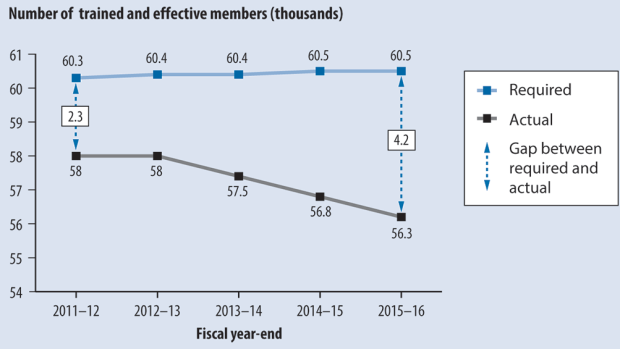
The Canadian Armed Forces have an authorized strength of more than 60,000, but have not been close to that level for several years: as of 2016 there were barely more than 56,000. Recruiting has not kept pace with the demand:

Canada’s armed forces have struggled for years to attract and retain talent. The latest reports only highlight the growing gulf between the number of members required for a fully staffed service, and the lack of actual personnel.

On May 7, Procurement Canada published an expression of interest notice asking the film and television industry to help boost the military’s brand among millennials and young Canadians.

The document ascribes young people’s apparent lack of interest in joining the military to a shift in generational attitudes.

“Millennials rank inward-focused values – happiness, discovery, etc. – higher than collective-focused values – justice, duty, etc.,” the report says.

“Characteristically, they want to contribute to society in a way that is meaningful as viewed in their own standards.”

Membership in the Canadian Armed Forces (CAF) fell from 58,000 to 56,300 between 2011 and 2016, while the forces’ staffing requirements actually grew.

The shortfall in personnel by the end of 2016 measured 4,200 jobs – nearly twice the vacancy gap of four years prior – with no evidence of a reversal of fortunes since.

A fascinating statistic popped up in the coverage that I hadn’t seen before:

The callout also targets celebrity personalities, influencers, podcasts and video games as potential vehicles for pro-military narratives, and stresses the importance of attracting visible minorities “as they account for 51 per cent of all science, technology, engineering and math (STEM) degrees and account for 50 per cent of the doctorate holders in Canada.”

According to the 2016 Census (summarized by Wikipedia), the national average of visible minorities is 22%, so that 22% is disproportionally represented in the graduating classes in STEM programs.

H/T to my friend William for the link.

April 27, 2019

Dating is dead

Filed under: Health, Randomness — Tags: , , , , — Nicholas @ 03:00

Suzanne Venker discusses the state of dating among the love-lorn Millennials and new-to-relationships members of Generation Z:

Remember when it [dating] was viewed as a step toward a committed relationship or even marriage?

Tell that to anyone under 40, and they’ll look at you like you have three heads.

[…]

According to … the Wall Street Journal, Generation Z, most of whom are currently college-age, is “uniquely bad at dating.” The men and women of this generation are less independent, less resilient and more sheltered than previous generations, it says — and these factors make this generation “romantically challenged.”

That may very well be true, but it’s hardly the end of the conversation.

There are numerous factors at play that explain why men and women under 40 can’t sustain love, or why they can’t manage to get married and build a life together. In my next few posts, I will outline those reasons and offer solutions for how parents and educators can help young people correct what I personally consider to be the most pressing issue of our time.

The first and most obvious is that Generation Z, as well as the Millennials who preceded them, have been given zero guidance and encouragement when it comes to building a relationship with the opposite sex. Women in particular have been explicitly and repeatedly told to do just the opposite: postpone marriage as long as possible, while enjoying the supposed benefits of commitment-free sex, and make a career the center of their lives.

Given this cultural script, why wouldn’t we expect dating to die and relationships to fail? We specifically moved women away from this goal. It’s not their fault — it’s the fault of the adults who failed them.

If a woman’s professional life is considered the #1 most important thing, there’s no reason to date in the traditional sense of the word. The purpose of dating is to determine whether or not the other person is a match, potentially for life. Why go through all the rigamarole if marriage isn’t on your radar? Might as well hookup until you’re ready to settle down.

February 25, 2019

Modern parenting – too many helicopters yield lots of snowflakes

Filed under: Britain, Health, Liberty, Media — Tags: , , , , , — Nicholas @ 03:00

It’s a commonplace assertion that children today have less unscheduled, unsupervised opportunities for play and exploration, and parents have been indoctrinated into the belief that the world has become a much more dangerous place and their kids need 24/7 protection from those myriad dangers. “Helicopter” parenting is a rational response to this indoctrination, but it comes with costs to the growth and maturity of the next generation. More than a decade ago, I posted this graphic showing how each generation has been more protective of their own children than their parents had been for them:

The problem has been getting worse over time, as Rob Creasy and Fiona Corby describe:

Children growing up in the UK are said to be some of the unhappiest in the industrialised world. The UK now has the highest rates of self harm in Europe. And the NSPCC’s ChildLine Annual Review lists it as one of the top reasons why children contact the charity.

Children’s mental health has becomes one of British society’s most pressing issues. A recent report from the Prince’s Trust highlights how increasing numbers of children and young people are unhappy with their lives, sometimes with tragic consequences.

This is a generation of young people that has been labelled as “snowflakes” – unable to handle stress and more prone to taking offence. They are also said to have less psychological resilience than previous generations. And are thought to be too emotionally vulnerable to cope with views that challenge their own.

[…]

Children’s lives are being stifled. No longer are children able to spend time with friends unsupervised, explore their community or hang around in groups without being viewed with suspicion. Very little unsupervised play and activity occurs for children in public spaces or even in homes – and a children’s spare time is often eaten up by homework or organised activity.

This is further impacted by the way children are taught in schools and how pressure to succeed has led to a taming of education. But if children are never challenged, if they don’t ever experience adversity, or face risks then it is not surprising they will lack resilience.

February 7, 2019

QotD: Generation Z begins to hit adulthood

Filed under: Media, Quotations, USA — Tags: , , , — Nicholas @ 01:00

Those born after 1998 are currently (and quite unimaginatively) being called Generation Z. And, by Pew’s math, the eldest members of this nascent generation are turning 18 this year [2017].

Welcome to adulthood, Gen Z!

As one of the oldest members of your immediate ancestors in American youth, I’d like to officially transfer the think-piece mantle your way. As millennials’ misadventures in youthful entitlement and narcissism dwindle, may your place as a scapegoat for societal fears about sex, technology, and general change shine bright. May Gen X prove as much a collective nemesis for you as boomers have so generously done for my generation. And, perhaps most importantly, may you please be patient in a few years when you’re trying to explain to us how to upload a hologram snap to Mind Twitter.

Also, for what it’s worth, millennials may have spawned Facebook, but don’t blame us if Americans are more politically polarized these days. According to another recent generational study, it’s the oldest Americans who have grown the most polarized within their own generation in recent decades. While many people attribute political polarization to social media or the internet more broadly, the study’s authors found that, between 1996 and 2012, the increase in polarization was “largest among the groups least likely to use the internet and social media.” On a nine-point measure of different sorts of polarization, the gap grew by 0.38 index points for respondents ages 75 and older, but just 0.05 index points for adults ages 39 and below.

Lastly, don’t get too comfortable, kids — your generational predecessors are already arriving. Going by Pew’s parameters, the typical generation spans about 17 years … which means that the last of Gen Z babies were likely born in 2016. A new generation starts being born this year.

Welcome to the world, post-Gen Z generation! What a weird, absurdist time to be starting your lives. May we course correct a bit here before you hit adulthood. (Alternately, tell your kids to give President Ivanka’s reanimated corpse and V.P. Chelsea Clinton’s cryogenically frozen head my love, and sorry about the Kardashians. That one really is our fault.)

Elizabeth Nolan Brown, “Welcome to Adulthood, Gen Z: The post-millennial generation starts turning 18 this year, while the eldest members of the post-Gen Z cohort are starting to be born.”, Reason, 2017-03-22.

February 1, 2019

Severian explains why he quit teaching

Filed under: Education — Tags: , , , , , — Nicholas @ 03:00

Spoiler: it wasn’t fun anymore. As to why it wasn’t fun, it was (say it together with me) the youth of today:

It’s not that kids today are mal-educated, woefully ignorant, and wouldn’t know serious academic work if it bit them on the ass. Those are all true, of course, but that’s the way it has always been — I have no doubt Plato said the same thing about Aristotle (and Socrates no doubt said it about Plato). In my experience, the rueful phrase “back when I was in college” first escapes your lips approximately 36 hours into graduate school.

It’s not the quantity of ignorance, then, but the quality. Generation Snowflake really are New Soviet Men. If you’ve read about life under Stalin, especially, you’ll know what I’m talking about — at once invincibly self-righteous and cringingly subservient, modern students come across like junior volunteer commissars. If they don’t already know it, it’s by definition not worth knowing… and you’re an asshole — to be avoided, undermined, ignored, or (very, very grudgingly) tolerated, as the situation dictates — for trying to make them “learn” something new.

They’re not sociopaths, exactly, but that’s close enough to what they are that we’ll go with it. For instance: They have no problem asking you to move due dates, even for big things like midterm exams, if it inconveniences them. And just them — the rest of the class should still have to take the exam on Friday; it’s just that she, Suzy Snowflake, has a big sorority function that weekend that she really needs to prepare for, so she should be allowed to take it Monday. Nor do they have a problem with lying on spec, just to see if you’ll bite. Tell Suzy no, she still has to take the exam on Friday like everyone else, and there’s a decent chance you’ll be getting a “dead Grandma” email from her over the weekend — my Grandma died suddenly this Friday, I had to go home for the funeral, I’m so broken up, I’m free to take the makeup exam on Monday.

No, I’m not joking, and yes, you can check Suzy Snowflake’s social media and find pictures of her downing shots at the big sorority do Saturday night. And yes, she knows those pictures are out there; Generation Snowflake regards the concept of “online privacy” like your cat thinks about calculus. It’s just that hey, maybe you won’t check. Worth a shot, right? If anyone should be upset it’s her, for making her feel bad by doubting her story. She’ll saunter into class on Monday like nothing happened…. because to her, nothing did. She threw a Hail Mary, it got intercepted, oh well, what’s new in the Netflix queue?

Faced with that, any attempt at education is like King Canute ordering back the tides. It’s excruciatingly pointless, and that’s why I quit. Life’s too short to spend raging against the inevitable.

April 13, 2018

The free speech views of “Gen Z”

Filed under: Education, Liberty, Politics, USA — Tags: , , , — Nicholas @ 06:00

Sean Stevens and Jonathan Haidt argue that despite many nay-sayers, there really is a freedom of speech crisis on university campuses:

In our first post responding to the skeptics, we showed that the skeptics support their skepticism primarily by relying on data about the Millennial generation (those born 1982-1994). The skeptics are correct that Millennials are not much different than previous generations when asked about free speech issues. We also argued that this debate has nothing to do with Millennials; it is about CURRENT college students, who are not Millennials. By the fall of 2015, most college students (especially at elite four year schools) were members of iGen, the “Internet generation” (sometimes called “Gen Z”), which begins around birth year 1995, and which first arrived at college around 2013.

We noted that the new attitudes about speech — including the idea that speech can be violence (even when it includes no threat), and corresponding requests for safe spaces and trigger warnings — only began to appear on select campuses around 2013 or 2014, and we noted that these ideas only became widely known after the wave of student protests that began at the tail end of 2015. Therefore, we pointed out, it is unlikely that nationally representative samples, drawing on students in America’s 4,700 institutions of higher education, could have picked up any changes before 2015, when colleges were still full of Millennials who had never heard of trigger warnings and microaggressions. We proposed that the best way to evaluate whether or not things have changed on campus is to examine data collected on current college students in 2016 or later, and compare it to data on current college students from 2014 and before.

When we performed such comparisons, we found some evidence that in fact things are changing. There is not yet much data available to make direct comparisons, but the GSS does show a change for the little bit of iGen data that it has (see figure 1 in post 1), and the larger Knight study showed a change just from 2016 to 2017. In this post we do a much deeper dive. We present far more data on current college students and we assess whether the campus climate has changed in the last few years with regard to speaking up and sharing one’s views.

The key question is this: are students and professors today more reluctant than they were a few years ago to share their views or to question dominant views? If so, then there is a climate or culture problem on campuses where that change has occurred. We note that the overall climate can change rapidly even if there has been no change in average attitudes about speech. All that needs to happen is that a small group of students begins imposing social costs on those who say things they don’t like, while at the same time college administrators do nothing to stop them. (For a fuller explanation, see this essay by Lee Jussim, or this one by Nassim Taleb, whose title explains the key point: The most intolerant wins: The dictatorship of the small minority.) If college students are more likely to report the feeling of “walking on eggshells” in the years after 2015 than they did in the years before 2015, then there has been a change in the campus culture, even if the average student’s support for free speech has not changed.

August 5, 2017

“… theirs is a generation shaped by the smartphone and by the concomitant rise of social media. I call them iGen”

Filed under: Technology, USA — Tags: , , , , , , , — Nicholas @ 04:00

In The Atlantic, “Gen Xer” Jean Twenge is worried about the ways the new generation differ from their Millennial predecessors:

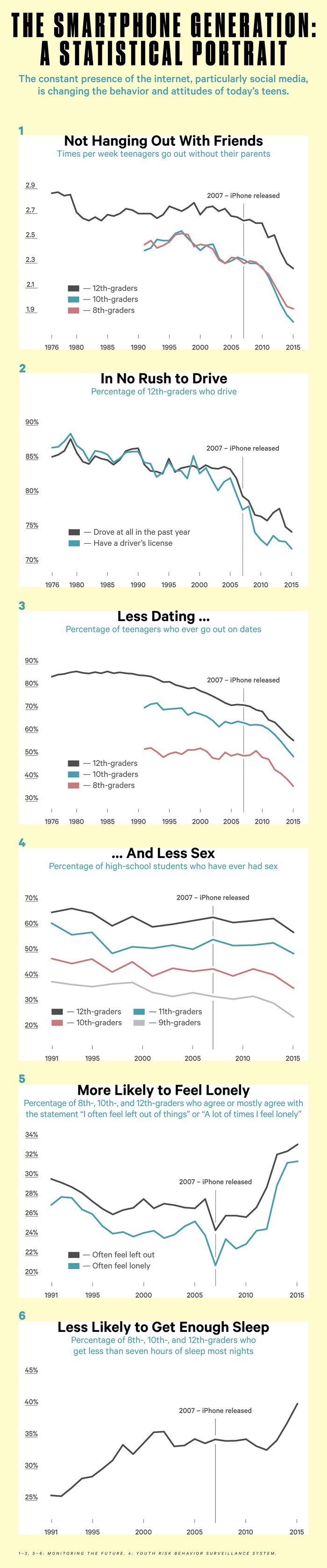
Click to see full-size image

I’ve been researching generational differences for 25 years, starting when I was a 22-year-old doctoral student in psychology. Typically, the characteristics that come to define a generation appear gradually, and along a continuum. Beliefs and behaviors that were already rising simply continue to do so. Millennials, for instance, are a highly individualistic generation, but individualism had been increasing since the Baby Boomers turned on, tuned in, and dropped out. I had grown accustomed to line graphs of trends that looked like modest hills and valleys. Then I began studying Athena’s generation.

Around 2012, I noticed abrupt shifts in teen behaviors and emotional states. The gentle slopes of the line graphs became steep mountains and sheer cliffs, and many of the distinctive characteristics of the Millennial generation began to disappear. In all my analyses of generational data — some reaching back to the 1930s — I had never seen anything like it.

At first I presumed these might be blips, but the trends persisted, across several years and a series of national surveys. The changes weren’t just in degree, but in kind. The biggest difference between the Millennials and their predecessors was in how they viewed the world; teens today differ from the Millennials not just in their views but in how they spend their time. The experiences they have every day are radically different from those of the generation that came of age just a few years before them.

What happened in 2012 to cause such dramatic shifts in behavior? It was after the Great Recession, which officially lasted from 2007 to 2009 and had a starker effect on Millennials trying to find a place in a sputtering economy. But it was exactly the moment when the proportion of Americans who owned a smartphone surpassed 50 percent.

The more I pored over yearly surveys of teen attitudes and behaviors, and the more I talked with young people like Athena, the clearer it became that theirs is a generation shaped by the smartphone and by the concomitant rise of social media. I call them iGen. Born between 1995 and 2012, members of this generation are growing up with smartphones, have an Instagram account before they start high school, and do not remember a time before the internet. The Millennials grew up with the web as well, but it wasn’t ever-present in their lives, at hand at all times, day and night. iGen’s oldest members were early adolescents when the iPhone was introduced, in 2007, and high-school students when the iPad entered the scene, in 2010. A 2017 survey of more than 5,000 American teens found that three out of four owned an iPhone.

The advent of the smartphone and its cousin the tablet was followed quickly by hand-wringing about the deleterious effects of “screen time.” But the impact of these devices has not been fully appreciated, and goes far beyond the usual concerns about curtailed attention spans. The arrival of the smartphone has radically changed every aspect of teenagers’ lives, from the nature of their social interactions to their mental health. These changes have affected young people in every corner of the nation and in every type of household. The trends appear among teens poor and rich; of every ethnic background; in cities, suburbs, and small towns. Where there are cell towers, there are teens living their lives on their smartphone.

It could be that the widespread use of available technology to “virtualize” adolescence is at least to a degree a reaction to helicopter parenting.

H/T to Kate at Small Dead Animals for the link.

« Newer Posts

Powered by WordPress