Quotulatiousness

June 24, 2024

Justin Trudeau’s Ominous Online Harms Act: Minority Report Comes to Canada: Conor Friedersdorf

Quillette
Published Jun 19, 2024

Jonathan Kay talks to Atlantic Magazine staff writer Conor Friedersdorf about a censorious government bill that would allow officials to investigate Canadians for things they haven’t done yet.

https://quillette.com/2024/06/19/just…

——

Quillette is an Australian-based online magazine that focuses on long-form analysis and cultural commentary. It is politically non-partisan, but relies on reason, science, and humanism as its guiding values.

Quillette was founded in 2015 by Australian writer Claire Lehmann. It is a platform for free thought and a space for open discussion and debate on a wide range of topics, including politics, culture, science, and technology.

Quillette has gained attention for publishing articles and essays that challenge modern heterodoxy on a variety of topics, including gender and sexuality, race and identity politics, and free speech and censorship.
(more…)

June 15, 2024

In Germany, it can be dangerous to “participat[e] in the wrong discussions before the wrong kind of people and assembl[e] one’s (wholly accurate) data from the wrong sources”

Filed under: Germany, Health, Media, Politics — Tags: , , , , — Nicholas @ 05:00

German government control over what people can say online seems like something Justin Trudeau would love to have (and, in fact, is working toward) here in Canada:

Almost two years ago, on 26 July 2022, a German Twitter user known only as MicLiberal posted a thread that culminated in his criminal trial this week. His is but the latest in a long line of such prosecutions – the tactic our rulers increasingly favour to intimidate and harass those who use their freedom of expression in inconvenient ways.

MicLiberal committed his alleged offence as Germany was still awakening from months of hypervaccination insanity. Science authorities and politicians had spent the winter decrying the “tyranny of the unvaccinated“, demanding that “we have to take care of the unvaccinated, and … make vaccination compulsory“, firing people who protested institutional vaccine mandates on social media and denouncing the unvaccinated for ongoing virus restrictions and Covid deaths. Our neighbour, Austria, even went so far as to impose a specific lockdown on those who refused the Covid vaccines. Culturally and politically, those were the darkest months I have ever lived through; they changed my life forever and I will never forget them.

MicLiberal’s thread aimed only to memorialise some of the crazy things the vaccinators had said. It opened with this tweet:

    We were complicit!

    We marginalised, defamed, discredited, insulted and cancelled people. On behalf of science!

    By popular demand, this brief thread with statements that should not be forgotten:

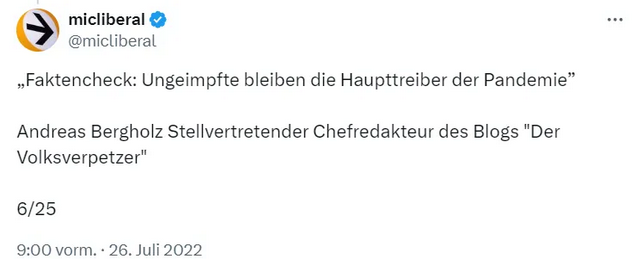
There ensued nothing but a series of citations, most of them wholly typical samples of vintage 2021/22 vaccinator rhetoric, much of it not even that remarkable. For example, MicLiberal included this statement from Andreas Berholz, deputy editor-in-chief of the widely read blog Der Volksverpetzer:

    Fact-check: The unvaccinated remain the main drivers of the pandemic.

[…]

You might be wondering what crime MicLiberal can possibly have committed by drawing attention to these already-public statements. The most honest answer is that his thread achieved millions of views in a matter of days, and at a very awkward moment – precisely when everyone was beginning to regret all the illiberal and wildly intemperate things they had said in the depths of the virus craze. He had embarrassed some very vain and powerful people with their own incredibly stupid words, and today many are of the opinion that that ought to be a crime in and of itself.

Alas, things have not yet deteriorated that far. Thus the police and prosecutors were left to scour our dense thicket of laws for a more plausible offence. They decided that their best chance lay with a novel provision of the German Criminal Code (Paragraph 126a). This provision makes it a crime to “disseminate the personal data of another person in a matter that is … intended to expose this person … to the risk of a criminal offence directed against them“. On 28 July, two days after MicLiberal posted his 25 tweets, Cologne police filed a criminal complaint against him, and afterwards the Cologne prosecutor’s office brought charges, arguing that MicLiberal had suggested that the people he cited were “perpetrators” and therefore associated them with “fascism”. The district court declined to approve the charges, but the prosecutors appealed to the regional court, where the judges saw things differently. They believed that a prosecution was warranted because of the “heated social debate” surrounding Covid measures, and because MicLiberal’s audience was composed of “homogeneous” like-minded people, who (in the summary of the Berliner Zeitung) “could either form groups or encourage individual members to commit acts of violence”. MicLiberal had furthermore assembled his citations from a website that the judges deemed guilty of an “anti-government orientation”.

We must take a moment to ponder this truly amazing argumentation, which would seem to criminalise such things as participating in the wrong discussions before the wrong kind of people and assembling one’s (wholly accurate) data from the wrong sources. In each of these cases, of course, it is the prosecutors and the judges eager to apply Paragraph 126a to their political opponents who get to decide what is “wrong”.

The good news in all of this is that the court acquitted him of these creative charges, but the prosecution has given notice that they intend to appeal.

May 2, 2024

Gad Saad’s latest “affront to human dignity” kerfuffle

Filed under: Books, Cancon, Media — Tags: , , , , — Nicholas @ 03:00

Gad Saad managed to do more than just ruffle the feathers of the Québécois last year by calling the Quebec accent “an affront to human dignity”:

In my 30-year career as a professor and public intellectual, I have never shied away from tackling sacred cows. As a free speech absolutist, I firmly believe that short of the usual caveats (e.g., direct incitement to violence, defamation), free speech is a deontological principle that is inviolable. As a Jewish person, I support arguably the most offensive speech possible, namely the denial of the Holocaust. Such is the price that we must pay to live in a truly free society.

As I explain in my 2020 book, The Parasitic Mind: How Infectious Ideas Are Killing Common Sense, the operative zeitgeist in the West is that one’s speech should be tempered in order to minimize the prospect of hurt feelings. This is a terrible reflex in that it forces people to engage in arguably the most pervasive form of censorship, self-censorship. The reality though is that truth must be anti-fragile to mockery, derision, satire, criticism and scrutiny. If it cannot withstand such stressors, it is undoubtedly false. Or as the philosopher Peter Sloterdijk remarked in Critique of Cynical Reason (p. 288): “How much truth is contained in something can be best determined by making it thoroughly laughable and then watching to see how much joking around it can take. For truth is a matter that can stand mockery, that is freshened by any ironic gesture directed at it. Whatever cannot stand satire is false.”

This brings me to a bewildering episode that I faced last summer. The cancel mob came for me albeit in a truly unexpected manner. On July 25, I appeared on Joe Rogan’s podcast for the ninth time to promote the release on that day of my latest book, titled The Saad Truth About Happiness: 8 Secrets for Leading the Good Life (paperback edition to be released on May 14, 2024). My conversations with Joe are always fun, informative and far-ranging. At one point during our chat, we were jocularly discussing various accents that I found to be auditorily unappealing. I remarked that my family and I had just returned from Portugal, and accordingly I had found the Portuguese accent to be less than attractive. I then qualified Hebrew as “violently ugly”. But it was the third accent that unleashed the tsunami of rage, insults, threats and calls to have me fired from my 30-year professorship. I jokingly said that the French-Canadian accent was an “affront to human dignity”. The sentence in question has become a trademark hyperbolic humorous phrase that I use when expressing an over-the-top esthetic opinion. It is a running gag that has appeared on numerous occasions on my X (formerly Twitter) feed. I have referred to The Beatles, musicals, Lionel Messi haters, fans of Cristiano Ronaldo, and the song “Ironic” by Alanis Morissette as an affront to human dignity/decency. If my wife burns our dinner, I might joke with her that the dish is an affront to human dignity.

In the past, I have triggered the ire of many ideological groups including Islamists, trans activists and vegans. But nothing compared to the unbridled hate that I received from some of my fellow Quebecers, which was largely set off by an article written by Marc Cassivi in La Presse regarding my apparent “linguistic genocide”. My stellar 30-year record as an academic and international bestselling author had never managed to capture the attention of French-Canadian society but once I dared to joke about the local accent, I had committed a linguistic capital crime. And it was time for me to pay!

April 30, 2024

The CDU’s “five-point plan to protect German democracy from … the free and open internet”

Filed under: Germany, Law, Liberty, Media, Politics — Tags: , , , , , — Nicholas @ 04:00

German mainstream politicians are struggling to keep extreme right populist anti-democratic voices from being heard by innocent and trusting German voters, so the leader of the CDU in Thuringia has a master plan:

The duel between our leading Thuringian politicians was all but unwatchable, as indeed almost all political debates turn out to be. While [AfD leader Björn] Höcke could’ve acquitted himself better, [CDU leader Mario] Voigt’s performance was flat, uninspired and profoundly banal. Among other things, the man suffers from a peculiar rodentine aspect; he bites his way stiffly through bland preformulated arguments like a squirrel chewing a stale nut or a beaver gnawing through saplings. After the event, the CDU took to the press to declare victory, but polls showed that viewers found Höcke on balance more persuasive, which is of course the real reason that everybody told Voigt to avoid the confrontation. Voigt is intensely democratic and therefore extremely right about everything, but somehow – and this is very awkward to discuss – his being eminently righteous and correct in all things does not manifest in an ability to defeat the very wrong and evil arguments of his opponents. It’s very weird how that works, perhaps somebody should look into it.

Stung by this failure, Voigt has set off to find other means of defending democracy. This week, in the Thüringen state parliament, he gave an amazing speech outlining a five-point plan to protect German democracy from that other great menace, the free and open internet:

    So how do we protect democracy in the area of social media? There are five approaches:

    Ideally, we should agree to ban bots and to make the use of fake profiles a criminal offence.

    There is also the matter of requiring people to use their real names, because freedom of expression should not be hidden behind pseudonyms.

    Then there’s the question of whether we should create revocable social media licences for every user, so that dangerous people have no place online.

    We need to consider how we can regulate algorithms so that we can revitalise the diversity of opinions in social networks.

    And we also have to improve media skills.

For all that Björn Höcke is supposed to be a “populist authoritarian” opposed to representative government, I’ve never heard him say anything this crazy. Voigt, meanwhile, is a leading politician for the officially “democratic” Christian Democratic Union (you know they are democratic because the word is in their name), and he’s actually dreaming of requiring Germans to obtain state-issued licenses for permission to post their thoughts to the internet.

Because Voigt’s regulatory regime would entirely abolish online “freedom of expression”, it is unclear how banning bots and pseudonymity could ever defend it. Generally speaking, for a thing to be defended, it must first exist. Equally curious is Voigt’s belief that any “diversity of opinion” will survive his social media license scheme to benefit from the regulation of social media algorithms.

April 20, 2024

How much of your language do you have to destroy to avoid the taint of historical fascist usage?

Filed under: Germany, History, Law, Liberty, Media, Politics — Tags: , , , , — Nicholas @ 05:00

For understandable reasons, German governments since the end of World War 2 have been twitchy about any symbols, songs, words and phrases that were used by Hitler’s various fascist organizations … to the point of making many things illegal. eugyppius outlines one particular case where the use of a simple German phrase by an AfD politician has landed him in court, facing a possible three-year prison sentence even though he denies that he knew the phrase had such connotations:

Today, the leader of the Alternative für Deutschland faction in the Thuringian state parliament, Björn Höcke, appeared before the district court in Halle for the first day of his long-awaited speech trial. He stands accused of having used a forbidden Nazi slogan favoured by the Sturmabteilung at a political rally in Merseburg on 29 May 2021. Höcke pleads that he used the three-word phrase in a moment of spontaneous elaboration at the end of his speech, without knowing its National Socialist associations. Out of an abundance of caution, I won’t quote the phrase here, even in translation, but I’ll provide it in context below; it begins with the words “Everything for” (“Alles für“) and concludes with the name of the Federal Republic. As slogans go, it is so seemingly banal that before the trial many Germans would have been surprised to know it had any Nazi associations at all.

For the moment, not much has happened. Höcke’s lawyers filed a variety of requests, among them that the Federal Constitutional Court answer a question surrounding the court’s jurisdiction. In consequence, it’s unclear whether the trial will continue as scheduled next week or whether it will have to be substantially delayed. The state prosecutor’s position is that Höcke’s background as a history teacher makes his claims of ignorance implausible. The prosecutors’ office have also added an additional charge for Höcke’s defiance at a rally in Gera last December, where he shouted the first two words of the slogan at the crowd, and invited them to supply the last one. I fear that this was a grave mistake, because as we will see, the original case against Höcke is laughably weak.

If found guilty, Höcke could be fined or sentenced to prison for up to three years. It is also conceivable that his right to vote and run for office could be suspended. Whatever you think of Höcke or his politics, the political dimensions of this trial are undeniable, as it is occurring mere months ahead of the Thuringian state elections, and as Alternative für Deutschland commands a solid plurality of polling numbers in that state.

[…]

That Höcke deliberately used the SA slogan as a subtle enticement to the extreme right is more than doubtful; that he also did so in hopes that he would be prosecuted and profit politically from his victimisation is so ridiculous, I can’t imagine that even Hillje really believes this. This obnoxious thesis nevertheless recurs whenever the German press report on the harassment of AfD politicians; it is somehow their fault, because they are held to benefit from it.

Der Spiegel, always a source of unintentional amusement, ran a headline today mocking Höcke as a “history teacher with no knowledge of history“. “He claims not to know it was an SA slogan”, they report, “but there are doubts about this”. Alas, the very same news magazine last September accidentally used the forbidden phrase to headline an approving article on Olaf Scholz’s proposed “Germany Pact”. They rapidly changed the headline, appending this brief and embarrassing correction to the bottom:

    An earlier version of the article was headed with a line that was used by the SA as a slogan. This was not intended by the author and editors and has now been changed.

April 19, 2024

Humza Yousuf, the “Thug King of Scotland”

Filed under: Britain, Media, Politics — Tags: , , , , — Nicholas @ 05:00

I don’t know what Scotland did to deserve Humza Yousuf as their first minister, but it must have been really bad:

Not what you were hoping for.

Assuming he doesn’t get removed by a leadership coup before voters sink the leaking Tory battleship, Sunak will be gone by January of 2025 at the latest. That just leaves Humza Yousuf, characterized by Morgoth as The Thug King of Scotland: a post-ideological, apolitical opportunist interested purely in power for its own sake and quite happy to use the absurd public morality of the despised rubes that he rules over to keep the wretches in their place.

And boy, does he despise them.

Yousuf first came to the Internet’s attention in 2020, when he was filmed ranting in the Scottish parliament about how disgustingly racist it was that most of the high public offices in a country with an overwhelmingly White population were occupied by presumptively racist White cavebeasts:

    The Lord President is white, the Lord Justice Clerk is white, every High Court judge is white, the Lord Advocate is white, the Solicitor General is white, the chief constable is white, every deputy chief constable is white, every assistant chief constable is white, the head of the Law Society is white, the head of the Faculty of Advocates is white and every prison governor is white.

    That is not the case only in justice. The chief medical officer is white, the chief nursing officer is white, the chief veterinary officer is white, the chief social work adviser is whiteand almost every trade union in the country is headed by white people. In the Scottish Government, every director general is white. Every chair of every public body is white. That is not good enough.

If you haven’t watched the video, you should. You need to hear the contempt dripping off of his tongue, the way he spits out the awful word “White” like bitter venom.

In the immediate aftermath of this angry foreigner’s tirade, a sane country would have immediately marched their ill-mannered guest out of parliament, stripped him of office and citizenship, thrown him on a rusty fishing vessel, hauled him up north of the Orkneys, tossed him into the North Sea wearing nothing but a life preserver, and sent him on his way with a cheery wave and a reminder to mind the orcas.

Instead, they gave him the keys to the kingdom.

But while the infamous White Speech might not have prevented his elevation to the highest office in the land – indeed, given the derangement of our elites, if anything it smoothed his ascent – it has come back to haunt him. Thin-skinned and insecure as he is, Yousuf’s first priority on taking office was to ram through a new hate speech law with which to prevent the contemptible White worms from critiquing him or his noble tribe of vape-shop owners, cabbies, and grooming gang pimps. The law was ridiculously broad and invasive: one could be reported for the criminal offence of hate speech merely for making a remark in the privacy of one’s home, around the dinner table, with no one present but one’s kith and kin.

The day that the bill was finally forced through the Scottish parliament, and predictably enough for anyone who glanced at the law and had a passing understanding of the Scottish national character, the Scottish people responded by DDoSing the police with a deluge of hate crime reports, a very large number of which were reporting Yousuf’s rant as a hate crime … which, apparently, under the strict interpretation of the new law, it certainly was, with the only thing standing between Yousuf and indictment under his own half-baked law being that his ill-considered harangue took place prior to the law being passed. Which hasn’t stopped the Scots from taking the piss and continuing to report him.

It turns out that the Scots really do not like a ban on bantz, not one bit, and respond to demands that they cease the bantz by cranking up the bantz. Yousuf, being a humourless Pakistani who is confused and angered by this entirely foreseeable reaction, has risen to the occasion with all the grace, poise, and wit you would expect. In an attempt to stem the savage tide of mockery, Yousuf has tried claiming that reporting his hate speech is hate speech (lulz); has ordered Scottish police to read verbatim a prewritten transcript defending him each time his hate speech is thrown back at him (because that doesn’t look ridiculous); and faked a hate crime against himself by having his house sprayed with graffiti (did anyone fall for this?).

The next Scottish general election is two years away. Whether Humza survives the interim as First Minister, and if so whether he is able to guide the “Scottish” “National” Party to victory, remains to be seen. I don’t fancy his chances. He is a cunning and ruthless brute, to be sure. But he is also clumsy, clueless, and very stupid. Yousuf’s popularity has already plummeted. I’m sure he can find ways to plummet further. I believe in you, Yousuf. You can do it!

Yet another unintended consequence of the Online Harms Act – easier deportation of non-citizens

In The Line, Kevin Wiener explains another of the hidden “gems” of the Trudeau government’s ill-considered and repressive Online Harms Act that at least will please a few anti-immigration activists:

According to the Trudeau government and its defenders, the Online Harms Act is nothing to worry about. This is supposed to be a bill that will protect equity-seeking groups like racial minorities — yet one little-discussed provision will make millions of permanent residents open to deportation for even the most minor criminal offences, as long as a prosecutor can show that the crime was hate-motivated.

The resulting power to turn any crime into a deportable offence will make non-citizens — many of whom are racial and religious minorities — even more vulnerable in the criminal justice system compared to citizens.

The main focus of the Online Harms Act is regulating online platforms, but it also makes major changes to the way the criminal justice system deals with hate-motivated crimes. Under current law, if a crime is motivated by hate based on a protected characteristic, that’s considered an aggravating factor at sentencing. That means the judge can impose a higher sentence than they normally would, although they can never exceed the maximum sentence for the underlying crime. For many minor crimes, that maximum sentence is two years less a day.

The Online Harms Act uses a totally different approach to hate crimes. Rather than just being a sentencing factor, the Act would create a brand-new hate crime offence. Committing any crime, if motivated by hatred, would make someone guilty of a second crime, with a maximum sentence of life imprisonment. To counter public concern, the Trudeau government has recently sent one of its senior advisors, Supriya Dwivedi, to argue that critics of this provision are “engaging in bad faith tactics”, going so far as to make the absolutely false statement that the bill won’t allow an increased sentence unless the underlying crime already had that sentence.

That is an accurate description of the current sentencing regime, but the text and clear purpose of the new bill is to let judges go further: a serious aggravated assault that might normally attract the maximum 14-year sentence can lead to life imprisonment if the attack was hate-motivated.

Further, Dwivedi’s defence of the bill ignores that maximum sentences play an important role in Canada’s immigration policy. If someone is neither a citizen nor a permanent resident, they can only be deported if they commit a more serious (called an “indictable”) offence, or two separate less serious (or “summary”) offences.

The new hate crime provision would be an indictable offence.

April 8, 2024

“At the time of writing, the Scottish first minister Humza Yousaf edges J. K. Rowling in the battle for the inaugural title of Scotland’s Most Hateful Person”

Filed under: Britain, Law, Liberty, Politics — Tags: , , , , , — Nicholas @ 05:00

At Oxford Sour, Christopher Gage updates us on the mental gymnastics required to navigate Scotland’s new hate crime law:

To the surprise of many terminally online folks, J.K. Rowling is not the top offender under Scotland’s new hate crime law. That “honour” goes to Scotland’s current first minister, Humza Yousaf for a speech delivered several years ago.

One-third of the Scottish police are yet to receive any training on this sweeping new law. Amongst the rank-and-file, the spectre of threatening and abusive material seeping out of public performances such as plays creeps like sarin gas. Such forbidden filth threatens to mutate ordinary Scots into far-right zombies, parroting Andrew Tate’s pitiful jock philosophy.

Police have absorbed over 4,000 reports of hate crimes in the first 48 hours. Mercifully, many Scots are still evidently well-versed in the timeless Scottish art of taking the piss. At the time of writing, the Scottish first minister Humza Yousaf edges J. K. Rowling in the battle for the inaugural title of Scotland’s Most Hateful Person. Second prize, I believe, is a set of steak knives.

Not to worry, those coppers recently announced a new “proportional response strategy”. Police will no longer investigate crimes such as smashed windows, or run-of-the-mill thefts. This “new approach” to policing, which contravenes the very definition of policing, saves the rozzers 24,000 fewer investigations and 130,000 man-hours per year. That leaves plenty of time to investigate those unenlightened beings poxed with the false belief that women don’t have cocks.

Nobody has any idea what is going on. On the first day of the Scottish Unenlightenment, a Scottish National Party minister said J. K. Rowling’s gender-critical tweets could bring the coppers to her door.

On Twitter, J. K. Rowling had reeled off a string of photographs of trans people. She then called those biological men “men”.

Siobhian Brown, the SNP’s community safety minister, had claimed referring to a trans woman as a “he” would not break the new law. Later on, she said the police would decide whether such misgendering would count as a hate crime.

“It could be reported, and it could be investigated. Whether or not the police would think it was criminal is up to Police Scotland for that”, said Brown.

You could taste the acrid, small-town glee steaming from the repressive and literal minded. Rajan Barot, a former fraud prosecutor for the Crown Prosecution Service, warned Rowling that her Twitter posts, many of which state that biological men are not and cannot become women, would most likely contravene the new law and advised her to delete them.

Police later confirmed the very rich and very visible author would not face prosecution for her stubborn grasp of biological reality — at least whilst the universe watched on in a state of unadulterated fremdschämen.

April 7, 2024

QotD: Censorship works, but not the way the censors think it does

Filed under: Government, Media, Politics, Quotations — Tags: , — Nicholas @ 01:00

Preference Falsification — If people are afraid to say what they really think, they will instead lie. Therefore, punishing speech — whether by taking offence or by threatening censorship — is ultimately a request to be deceived.

Gurwinder Bhogal, “33 concepts to survive the year”, UnHerd, 2024-01-01.

March 23, 2024

“At least they didn’t arrest the dog”

Filed under: Britain, Government, Law, Liberty, Politics — Tags: , , , — Nicholas @ 04:00

Andrew Doyle revisits the Nazi pug story as new Scottish blasphemy hate speech laws are about to come into force at the beginning of April:

If you’re deluded enough to suppose that human history works in a progressive linear fashion, the example of Scotland should swiftly change your mind. Once the home of the Enlightenment, the country has now veered into authoritarianism under the control of the SNP. The party’s new hate crime law will come into force on April Fools’ Day, and no-one in government is seemingly able to give examples of “crimes” that would be covered by this legislation that aren’t already criminal. When specifically asked on the BBC’s Newsnight whether “misgendering” would result in prosecution, SNP backbench Fulton MacGregor could only mutter: “Well, it depends on the circumstances”. How reassuring.

For all MacGregor’s “faith” that the law would be “properly” implemented, nonbelievers are right to be cautious. Vaguely worded legislation is bound to be exploited, and has been many times in the past. This is particularly the case when it comes to “hate speech”, a concept for which no adequate definition has ever been achieved. The best the Irish government could muster for their forthcoming hate crime bill is that hatred “means hatred”. In these times of slippery authoritarian wordplay, that’s about as specific as we can expect.

The Scottish police have claimed that they will not “target” comedians and actors under the new legislation, and yet at the same time have sworn to investigate every complaint. Thankfully, activists never make spurious complaints against their ideological opponents in the hope of seeing them silenced. Oh wait. They do. All the time.

[…]

So for all of the claims that our concerns about the new hate crime law are unfounded, and that the police would never prosecute anyone for a gag, we should remember that they already have. This legislation will simply make it easier for activists within and without the police force to weaponise the law against those deemed to be subversive. On the day of Meechan’s arrest, one police officer affirmed that he must be “an actual Nazi trying to inspire people to become Nazis”. The judge eventually agreed, in spite of the fact that after two years of investigation the police had uncovered no evidence of far-right sympathies.

Of course those who wish to criminalise dissent will not stop at comedians. They’ll also be keen to crack down on anyone who knows the difference between men and women and is willing to declare this esoteric knowledge out loud. Although it has become a cliché to cite George Orwell’s Nineteen Eighty-Four in such circumstances, that is only because it is so apposite: “The Party told you to reject the evidence of your eyes and ears. It was their final, most essential command”.

I do not sincerely believe that the police will turn up at our Comedy Unleashed show next Monday. It seems unfathomable that we might see a kind of re-enactment of the closing scenes of The Blues Brothers, with police officers standing in the shadows of the club to monitor the show for heterodox content. But then, I would never have anticipated that in a free country someone who made a video mocking Nazis would end up with a criminal record. Of course our show will be offensive to those who choose to be offended. Such is the nature of comedy. The only way to avoid such a situation would be for the acts to stand on stage in total silence. And even then, someone might find this offensive to mutes.

March 22, 2024

Four years later

Kulak hits the highlights of the last four years in government overstretch, civil liberties shrinkage, the rise of tyrants local and national, and the palpably still-growing anger of the victims:

4 years ago, at this exact moment, we were in the “two weeks” that were supposed to flatten the Curve of Covid.

4 years ago you were still a “conspiracy theorist” if you thought it would be anything more than a minor inconvenience that would last less than a month.

Of course if you predicted that this would not last 2 weeks, but over 2 years; that within 2 months anti-lockdown protests would end in storming of state houses and false-flag FBI manufactured kidnapping attempts of Governors; that within 3 riots would burn a dozens of American cities; that the election would be inconclusive; that matters would go before the US Supreme Court, again; that a riot/mass entrapment would take place within the halls of congress … And then that this was just the Beginning …

That Big-Pharma would rush a vaccine which may well have been more dangerous that the virus; that Australia and various countries would build concentration camps for unvaccinated; that nearly all employers would be pressured or mandated to FORCE this vaccine on their employees; that vaccine passports would be implemented to track your biological status; that Canada and several other countries would implement travel restrictions on the unvaccinated and collude with their neighbors to prevent their population escaping; and then that, nearly 2 years from 2weeks to slow the spread, Canadians!? would mount one of the most logistically complex protests in human history, in the dead of winter, besieging Ottawa and blockading the US border to all trade in an apocalyptic showdown to break free of lockdowns …

Well … not even Alex Jones predicted all of that, though he got a remarkable amount of it.

Indeed the reverence with which Jones is now treated, a Cassandra-like oracle who predicts the future with seemingly (and memeably) 100% clairvoyance only to doomed to disbelief. That alone would have been unpredictable, or unbelievable in those waning days of the long 2019, those first 2-3 months when you could imagine 2020 would MERELY be an Trumpianly heated election cycle like 2016, and not a moment Fukuyama’s veil threatened to tear and History pour back into the world.

Oh, and also the bloodiest European war since the death of Stalin broke out.

March 19, 2024

Canada’s new international role: the object lesson in failure and tyranny

Tristin Hopper rounds up some of the foreign impressions of Canada’s descent into the west’s object lesson in what not to do in almost every area:

In just the last week, there have been two separate columns in British newspapers framing Canada as a model of what not to do.

Both were inspired by the tabling of Bill 63, the Liberals’ Online Harms Bill. The Spectator said that it effectively engendered the founding of a Canadian “thought police”. The Telegraph cited it as evidence that “Canada’s descent into tyranny is almost complete”.

This didn’t used to happen. It wasn’t too long ago that Canadian politics were famously inaccessible to the wider world. For Canada’s 2008 federal election, The Spectator covered it with a blog post that mostly mused on how nobody cared. “It’s curious that Canada receives almost no foreign coverage, even in Britain where there are, after all, plenty of people with Canadian relatives or connections,” it read.

But now – on topics ranging from assisted suicide to housing affordability to internet regulation – it’s not infrequent that Canada will be cited in foreign parliaments and in foreign media as the very model of a worst-case scenario.

It was just six months ago that The Telegraph scored a viral hit with a mini-documentary framing the political situation in Canada as a “warning to the West”.

“Under Justin Trudeau, Canada has sought to position itself as the global bastion of progressive politics,” reads a synopsis for the film Canada’s Woke Nightmare, which has garnered more than five million views.

The documentary notes that Canada is now at the absolute global vanguard of progressive issues including harm reduction, assisted suicide and gender ideology.

[…]

If the Online Harms Act is suddenly garnering headlines across the rest of the Anglosphere, it’s not because Canadian politics are inherently interesting to the wider world. Rather, it’s because Bill C-63 – just like any number of Trudeau policies before it – is proposing to do things that no other Western democracy has yet proposed.

While plenty of Canada’s peer countries have hate speech controls, Bill C-63 was able to raise even European eyebrows with life sentences for “advocating genocide”, and a provision for police to mandate house arrest merely on suspicion that a Canadian was likely to commit a hate crime.

The Wall Street Journal, for one, profiled the bill as a real-life example of the 2002 film Minority Report, which depicts a dystopian future in which citizens are jailed for “pre-crime”.

Or in the critical words of The Spectator, “this legislation authorises house arrest and electronic tagging for a person considered likely to commit a future crime … if that’s not establishing a thought police, I don’t know what is”.

March 16, 2024

The “TikTok ban” isn’t really about banning TikTok

Filed under: China, Government, Media, Technology, USA — Tags: , , , , — Nicholas @ 04:00

Matt Taibbi explains why the movement to ban TikTok is so dangerous to Americans’ civil liberties:

As discussed on the new America This Week, passage of the TikTok ban represents a perfect storm of unpleasant political developments, putting congress back fully in line with the national security establishment on speech. After years of public championing of the First Amendment, congressional Republicans have suddenly and dramatically been brought back into the fold. Meanwhile Democrats, who stand to lose a lot from the bill politically — it’s opposed by 73% of TikTok users, precisely the young voters whose defections since October put Joe Biden’s campaign into a tailspin — are spinning passage of the legislation to its base by suggesting it’s not really happening.

“This is not an attempt to ban TikTok, it’s an attempt to make TikTok better,” is how Nancy Pelosi put it. Congress, the theory goes, will force TikTok to divest, some kindly Wall Street consortium will gobble it up (“It’s a great business and I’m going to put together a group to buy TikTok,” Steve Mnuchin told CNBC), and life will go on. All good, right?

Not exactly. The bill passed in the House that’s likely to win the Senate and be swiftly signed into law by the White House’s dynamic Biden hologram is at best tangentially about TikTok.

You’ll find the real issue in the fine print. There, the “technical assistance” the drafters of the bill reportedly received from the White House shines through, Look particularly at the first highlighted portion, and sections (i) and (ii) of (3)B:

As written, any “website, desktop application, mobile application, or augmented or immersive technology application” that is “determined by the President to present a significant threat to the National Security of the United States” is covered.

[…]

As Newsweek reported, the bill was fast-tracked after a secret “intelligence community briefing” of Congress led by the FBI, Department of Justice, and the Office of the Director of National Intelligence (ODNI). The magazine noted that if everything goes as planned, the bill will give Biden the authority to shut down an app used by 150 million Americans just in time for the November elections.

Say you’re a Democrat, however, and that scenario doesn’t worry you. As America This Week co-host Walter Kirn notes, the bill would give a potential future President Donald Trump “unprecedented powers to censor and control the internet“. If that still doesn’t bother you, you’re either not worried about the election, or you’ve been overstating your fear of “dictatorial” Trump.

We have two decades of data showing how national security measures in the 9-11 era evolve. In 2004 the George W. Bush administration defined “enemy combatant” as “an individual who was part of or supporting Taliban or al Qaeda forces, or associated forces that are engaged in hostilities against the United States”. Yet in oral arguments of Rosul et al v Bush later that year, the government conceded an enemy combatant could be a “little old lady in Switzerland” who “wrote a check” to what she thought was an orphanage.

March 14, 2024

Oddly, Jen Gerson finds her fears about the Online Harms Act unassuaged

There was a point during the last Line podcast where Jen Gerson used the word “assuaged”, and then realized that although she knows what it means and when it’s appropriate to use it, she didn’t know how to say it out loud (a problem I’ve encountered many times in my life, having read widely but not listened to lectures on the various topics I’ve read about). I reference that in the headline, as she recounts going through a belated “technical briefing” on the already tabled bill:

Let’s start by noting that it’s a little bit odd for a government to hold a technical briefing for a bit of legislation more than a week after that legislation has been tabled. Usually presentations of this kind are held for media, MPs, and various stakeholders as or just before a complicated issue or bill is about to be announced to the public.

For the federal government to hold a briefing on the Online Harms Act on March 6 — as it did — raises questions. Questions like “Why?” Questions like “Is this really a ‘technical briefing’ or is this an attempt to assuage concerns about what is actually written in the bill?” And, most importantly, questions like “Am I so assuaged?”

I think, dear readers, that I am not.

Let me explain by appending a caveat about the Online Harms Act, or Bill C-63, which was tabled about two weeks ago. About 75 per cent of what’s in this bill is either good, or benign but potentially useless, and is genuinely focused on mitigating real online harms like child porn and revenge porn. I might nitpick some of those parts if it weren’t for the rest of it. The rest of it consists of “will result in the most significant expansion of Canada’s hate speech laws and create one of North America’s most rigid regulatory environments for media and social media companies”, as law firm Norton Rose Fulbright put it.

In C-63, and its attempts to explain this bill, this government has consistently muddied the waters that delineate between hate crimes and hate speech, and has demonstrated a deep unwillingness to deal with the philosophical problem of defining hate speech in a way that is clear, consistent, and fairly and evenly applied. More specifically, the bill’s attempts to increase the penalties for “advocating genocide” to life imprisonment; the use of peace bonds for pre-crime hate speech; and the re-introduction of Section 13, to be administered by the already questionable Human Rights Tribunal apparatus. All of these present such punitive measures that they would have a chilling effect on speech that is fundamentally incompatible with the freedoms we expect in a Western liberal democracy.

There’s no nice way to put this. These measures reveal deeply authoritarian instincts toward speech and regulation, all the more pernicious as they’re being introduced by people who are absolutely convinced of their own righteous good intentions.

And that brings us back to the aforementioned technical briefing, which attempted to address each of these concerns in turn. I should note that I don’t believe I was invited directly to this briefing — and as I’m not in the Parliamentary Press Gallery, this is not surprising or unusual. I was, however, provided a copy of the briefing in its entirety, and I was told that I was free to quote from it, provided I did not name the Department of Justice official speaking.

To that end, I’d like to provide some excerpts and paraphrases from this briefing, followed by my own observations on what was being presented to an audience of, broadly speaking, laymen. I’ve also run these observations by criminal lawyers to ensure my understanding of the law is sound. If I am in error in any point, I welcome any correction.

March 13, 2024

The true “Online Harms” are coming from inside the bill

Even the state media lapdog CBC admits that the Trudeau government’s proposed Online Harms Act is an incredibly authoritarian piece of legislation:

Justice Minister Arif Virani is defending his government’s Online Harms Bill after celebrated Canadian writer Margaret Atwood shared views comparing the new legislation to George Orwell’s dystopian novel Nineteen Eighty-Four.

The award-winning author took to social media late last week to share an article from the British magazine The Spectator titled, “Trudeau’s Orwellian online harms bill”.

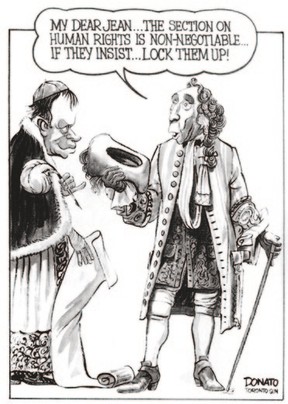
“If this account of the bill is true, it’s Lettres de Cachet all over again,” Atwood wrote on X, referring to letters once sent out by the King of France authorizing imprisonment without trial.

The federal government introduced late last month its long-awaited Online Harms Bill, which proposes to police seven categories of harmful content online, including content used to bully a child, content that sexualizes children or victims of sexual violence, content that incites violence or terrorism, and hate speech.

As part of proposed amendments, “hate speech” would be defined based on Supreme Court of Canada decisions.

“The possibilities for revenge false accusations + thoughtcrime stuff are sooo inviting!” Atwood wrote.

In Orwell’s cautionary novel about a totalitarian society, thoughtcrime is the illegal act of disagreeing with the government’s political ideology in one’s unspoken thoughts.

Atwood famously tackled authoritarian regimes in her novel The Handmaid’s Tale, in which a religious patriarchal society forces women to bear children and those who speak freely are severely punished.

« Newer PostsOlder Posts »

Powered by WordPress