Quotulatiousness

November 10, 2018

Hitler’s Beer Hall Disaster I BETWEEN 2 WARS I 1923 Part 1 of 2

Filed under: Germany, History, Military — Tags: , , , , , , — Nicholas @ 10:34

TimeGhost History
Published on 10 Nov 2018

When Germany spirals into hyperinflation and the French occupy the Ruhr, Adolf Hitler and Erich Ludendorff make a grab for power.

Join us on Patreon: https://www.patreon.com/TimeGhostHistory

Hosted by: Indy Neidell
Written and directed by: Spartacus Olsson
Writing and Research Contributed by: Rune V. Hartvig
Produced by: Astrid Deinhard
Executive Producers: Bodo Rittenauer, Astrid Deinhard, Indy Neidell, Spartacus Olsson

Archive by Screenocean/Reuter https://www.screenocean.com

A TimeGhost chronological documentary produced by OnLion Entertainment GmbH

And from the comments:

We jump ahead briefly to 1923 as this week is the anniversary of the Hitlerputsch and the Georg Elser Bomb in 1939. We will return to part 4 of 1920 in shortly. Many thanks to Rune V. Hartvig for contributing to the writing of this episode.

READ BEFORE YOU COMMENT: This episode was recorded before we had our studio, therefore our the sound is not great. Also READ OUR RULES:

RULES OF CONDUCT
STAY CIVIL AND POLITE we will delete any comments with personal insults, or attacks.
AVOID PARTISAN POLITICS AS FAR AS YOU CAN we reserve the right to cut off vitriolic debates.
HATE SPEECH IN ANY DIRECTION will lead to a ban.
RACISM, XENOPHOBIA, OR SLAMMING OF MINORITIES will lead to an immediate ban.
PARTISAN REVISIONISM, ESPECIALLY HOLOCAUST AND HOLODOMOR DENIAL will lead to an immediate ban.

Thanks for reading, and now…. let’s make history!

November 8, 2018

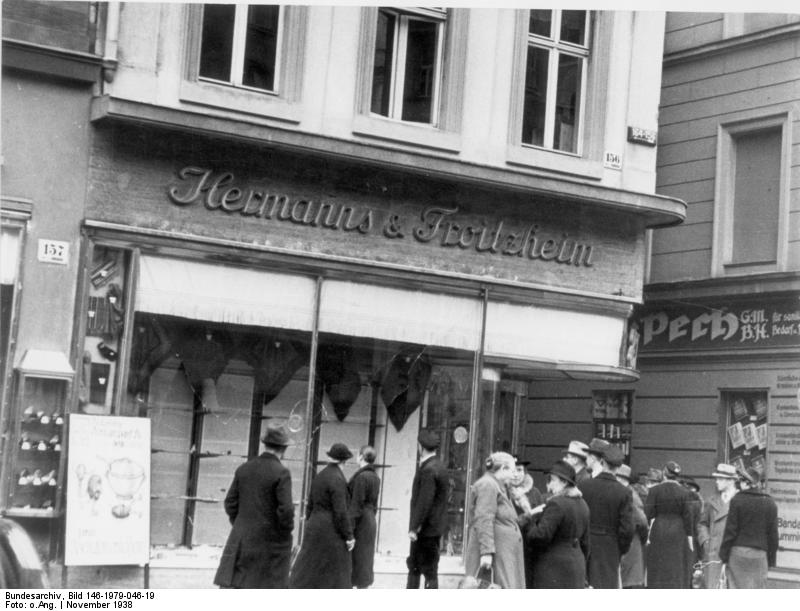
80 years on from Kristallnacht

Filed under: Germany, History, Religion — Tags: , , , , , , — Nicholas @ 03:00

Jerrold Sobel reminds us that 80 years ago today, the Nazis got their desired pretext to launch a domestic terror campaign against the Jews:

Destroyed shopfront of a Jewish business in Magdeburg, November 9, 1938.
Photo Bundesarchiv Bild 146-1979-046-19, via Wikimedia Commons.

Hitler came into power in 1933 with a plan to expand Germany’s rule and to completely annihilate world Jewry. During this time between his ascension and 1938, progressively strident anti-Semitic laws known as the Nuremberg Laws were enacted in which governmental policies regulated every aspect of Jewish life.

As conditions increasingly worsened for Jews, a Polish Jewish student, Herschel Grynszpan, whose family was being deported after a lifetime living in Germany, acted out against the Nazis and assassinated a German diplomat, Ernst vom Rath, on November 7, 1938. Hitler could not have been happier: it was the pretext he had been seeking to up the ante of anti-Semitism from “law-based” to mob violence.

By November 9, rioting was already in full swing in all quarters of the Reich, which by this time included Austria. Minister of propaganda Josef Goebbels encouraged Hitler to allow further punishment of the Jews through more “spontaneous demonstrations” of violence. According to Goebbels’s diary, Hitler responded: “[D]emonstrations should be allowed to continue. The police should not be withdrawn. For once the Jews should get the feel of popular anger.”

And did they ever. On the nights of November 9 and 10, 1938, unspeakable assaults upon Jewish women and men took place in Germany and Austria. When the majority of the mayhem finally ended on November 11, 30,000 Jewish men had been arrested and taken to concentration camps. Although figures vary, at least 100 fatalities were initially reported, the number growing into the hundreds due to subsequent mistreatment of those arrested.

Over 1,400 synagogues were burnt to the ground, and more than 7,500 businesses were likewise looted and torched. Jewish hospitals, homes, and schools fared no better. Those two nights of havoc would ignominiously become known as Kristallnacht: the night of the broken glass.

Soon, the world came to know the depredations wrought upon the Jewish people those nights. It was just the beginning, a precursor to the greatest ethnic mass murder of a people in the history of the world: the Holocaust.

October 16, 2018

Modernism and the “so-called international style … is the blight of Germany (and of almost everywhere else where it has been tried)”

Filed under: Architecture, Europe, History — Tags: , , , , , — Nicholas @ 05:00

Theodore Dalrymple on the awful concrete-and-glass monoliths of modern architecture, especially those designs by Le Corbusier, Mies van der Rohe, and Gropius:

The modernism and so-called international style that is the blight of Germany (and of almost everywhere else where it has been tried, which is almost everywhere in the world), and which the author of the article appears to think is apolitical, was hardly without its intellectual, ideological, and political foundations.

And what hideous intellectual, ideological, and political foundations they were! The great figures of modernism — great, that is, in the scope and degree of their baleful influence, not great in artistic or aesthetic merit — were from the first totalitarian in spirit. They were toadies to the rich and bullies to the poor; they were communists and fascists (not in the merely metaphorical sense, either), and by a mixture of ardent self-promotion, bureaucratic scheming, and intellectual terrorism managed to gain virtual control of the world’s schools of architecture. Just try saying in a French architectural school what is perfectly obvious, that Le Corbusier was not a genius except in self-advertisement, that his fascist ideas were repugnant, that he regarded humans in his cities much as we all regard bedbugs in beds, that during the Occupation he suggested deporting millions of people from Paris because he thought they had no business to be there, that his designs were incompetent, and that his constructions were instinct with and the very embodiment of his odious ideas, and see how far you get up the academic ladder! (How, incidentally, were the world’s most beautiful cities and buildings erected without the aid of architectural schools?) Anyone interested in the ideological foundations, as well as effects, of architectural modernism should read James Stevens Curl’s recently published Making Dystopia: The Strange Rise and Survival of Architectural Barbarism (Oxford), a magisterial and to me unanswerable account of one of the greatest aesthetic disasters to have befallen Europe in all its history. A single modernist building in a townscape is like a dead mouse in a bowl of soup, that is to say you cannot very well ignore it however splendid its surroundings may otherwise be.

Ah, you might protest, we have moved on from Mies van der Rohe et al., and so we have. (By the way, Professor Curl is very amusing on the opportunistic evolution of Mies van der Rohe’s name, as well as his equally opportunistic passage from being pro-Nazi to purely careerist refugee from Nazism.) Nonetheless two things need to be said about this supposed moving on from modernism to postmodernism and other isms: first that the damage, reparable only by demolition on a vast and inconceivable scale, has been done, and second that change is not by itself necessarily for the better. The capacity of eminent architects to spend vast sums of money to build aesthetic monstrosities fit to make Vitruvius weep is illustrated by the Whitney Museum in New York and the Philharmonie in Paris, the latter in particular of truly astonishing hideousness, that would have been almost comical had it not absorbed and wasted so much money, in the process becoming for many generations of the future as pleasing an aesthetic experience as a foreign body in the eye.

Philharmonie at the Parc de la Villette, Paris.
Photo by Zairon via Wikimedia Commons.

The mystery is how and why the patrons, those who choose the designs, stand for it. The key, I suppose, is to be found in Hans Christian Andersen — the Emperor’s New Clothes. The patrons are afraid to be thought by the architects not to understand: an accusation that Le Corbusier leveled decades ago at all those who did not approve of his plans to destroy old cities and cover the world with an ocean of raw concrete and a forest of almost identical towers. In other words, it is intellectual and moral cowardice that makes the world go round.

October 7, 2018

QotD: Hitler’s over-arching “grand strategy”

Filed under: Books, Europe, History, Politics, Quotations — Tags: , , , , — Nicholas @ 01:00

… on the internal evidence of Mein Kampf, it is difficult to believe that any real change has taken place in Hitler’s aims and opinions. When one compares his utterances of a year or so ago with those made fifteen years earlier, a thing that strikes one is the rigidity of his mind, the way in which his world-view doesn’t develop. It is the fixed vision of a monomaniac and not likely to be much affected by the temporary manoeuvres of power politics. Probably, in Hitler’s own mind, the Russo-German Pact represents no more than an alteration of time-table. The plan laid down in Mein Kampf was to smash Russia first, with the implied intention of smashing England afterwards. Now, as it has turned out, England has got to be dealt with first, because Russia was the more easily bribed of the two. But Russia’s turn will come when England is out of the picture — that, no doubt, is how Hitler sees it. Whether it will turn out that way is of course a different question.

Suppose that Hitler’s programme could be put into effect. What he envisages, a hundred years hence, is a continuous state of 250 million Germans with plenty of “living room” (i.e. stretching to Afghanistan or thereabouts), a horrible brainless empire in which, essentially, nothing ever happens except the training of young men for war and the endless breeding of fresh cannon-fodder. How was it that he was able to put this monstrous vision across? It is easy to say that at one stage of his career he was financed by the heavy industrialists, who saw in him the man who would smash the Socialists and Communists. They would not have backed him, however, if he had not talked a great movement into existence already. Again, the situation in Germany, with its seven million unemployed, was obviously favourable for demagogues. But Hitler could not have succeeded against his many rivals if it had not been for the attraction of his own personality, which one can feel even in the clumsy writing of Mein Kampf, and which is no doubt overwhelming when one hears his speeches …. The fact is that there is something deeply appealing about him. One feels it again when one sees his photographs — and I recommend especially the photograph at the beginning of Hurst and Blackett’s edition, which shows Hitler in his early Brownshirt days. It is a pathetic, dog-like face, the face of a man suffering under intolerable wrongs. In a rather more manly way it reproduces the expression of innumerable pictures of Christ crucified, and there is little doubt that that is how Hitler sees himself. The initial, personal cause of his grievance against the universe can only be guessed at; but at any rate the grievance is here. He is the martyr, the victim, Prometheus chained to the rock, the self-sacrificing hero who fights single-handed against impossible odds. If he were killing a mouse he would know how to make it seem like a dragon. One feels, as with Napoleon, that he is fighting against destiny, that he can’t win, and yet that he somehow deserves to. The attraction of such a pose is of course enormous; half the films that one sees turn upon some such theme.

George Orwell, “Review of Mein Kampf” by Adolf Hitler”, 1940.

September 17, 2018

“Nazis on Drugs” – Wehrmacht & Meth – Wunderwaffe?

Filed under: Germany, Health, History, Military, WW2 — Tags: , , , — Nicholas @ 02:00

Military History not Visualized
Published on 17 Aug 2018

There some over-blown claims out there that the “Blitzkriege” were mainly achieved due to the use of Meth (Pervitin) and that historians had ignored this issue. Is it true or false? In this video we take a look at Pervitin, the Wehrmacht, the early German victories aka “Blitzkriege” and various aspects. Was Pervitin a Wunderwaffe? Was the Wehrmacht on Meth? How long was it used? And some aspects.

September 16, 2018

QotD: Austria’s share of the Nazi legacy

Filed under: Europe, History, Quotations, WW2 — Tags: , , — Nicholas @ 01:00

This ambiguity, or (to put it less kindly) dishonesty, if it really exists, replicates in symbolic fashion the attitude of Austria to its historical record in the 1930s and 40s. Officially, Austria was a victim of Nazi aggression; in reality, it was an enthusiastic participant in Nazi crimes. But whatever crimes Austrians as individuals committed during the war, they committed them as Germans, not as Austrians. They were responding only to force majeure; the Austrian state was not implicated.

Suspicion of Austria runs deep, and with good reason. Everyone thinks (though it cannot be proved or disproved) that Kurt Waldheim, the former Secretary-General of the United Nations, was elected president of the country not in spite of his Nazi past, but because of it. The Austrians claim that they insisted on voting for him because they resented the hypocritical reaction of the outside world to his candidature – surely, they said, powers with the combined intelligence resources of the United States, the Soviet Union, Britain and France must have known of his Nazi past when they accepted him as Secretary-General, so why should the Austrians themselves not accept him as President? Once again the Austrians were able to conceive of themselves as the injured party in the whole business.

Even the Austrian prohibition of Holocaust denial, under which the British Nazi-supporting historian David Irving was (in my view wrongfully) imprisoned until he recanted, or at least pretended to recant, is ambiguous. On the one hand, of course, it is a recognition of the moral monstrosity of what the Nazis did, and of the Austrians’ special responsibility for it; but on the other, it implies a deep mistrust of the Austrian people, who (it must have been feared by those who framed the law) might recant their anti-Nazism if they could.

Of course, there have been Austrians who were deeply disgusted by their countrymen. The greatest Austrian writer of the post-war period, Thomas Bernhard, inserted a famous clause in his will that repays reflection. He ordered that, for the duration of his legal copyright after his death, nothing he had ever written, including his plays, should ever be published or performed:

    within the borders of the Austrian state, however that state
    describes itself. I categorically emphasize that I want to have
    nothing to do with the Austrian state and I safeguard myself
    concerning my person and my work not only against every
    interference but also against every approach by this Austrian
    state to my person and my work for all time to come.

‘For all time to come:’ that is a pretty strong injunction, implying as it does that the Austrian soul, or whatever you want to call it, is so tainted by its original sin, or sins, that it is irrecoverably and irremediably evil.

Theodore Dalrymple, “Austria and Evil”, New English Review, 2008-05.

September 5, 2018

QotD: Why did appeasing the Fascist dictators seem such a sensible policy?

Filed under: Europe, History, Quotations — Tags: , , , , , — Nicholas @ 01:00

It is a familiar student essay question, whether the revolution could have been averted, but for the world war and resultant loss of up to three million Russian lives. It seems more useful merely to suggest that, in the political and ideological climate of the early 20th century, the collectivist experiment was bound to be attempted somewhere, and Russia or China were obvious testbeds. The consequences for millions of Russian peasants, together with the ferocity of Soviet oppression, were successfully concealed from most western eyes for half a century. The 1789 French revolution killed only a few thousand aristocrats and transferred land to peasants, who thus became ardent upholders of property rights. The Russian version required liquidation of the entire governing class and transfer of land to collective ownership, an incomparably more radical proceeding. Douglas Smith’s 2012 book Former People gives a harrowing account of the fate of the Tsarist aristocracy.

In the West, the gullibility of the Webbs, Bernard Shaw and the rest of the ‘true believers’ was fed by a desperation to suppose the Soviet example viable. ‘Looking around us at our own hells,’ wrote the historian Philip Toynbee, who became a communist at Cambridge, ‘we had to invent an earthly paradise somewhere else’. As late as 1945, the leftist publisher Victor Gollancz brought posterity’s contempt upon himself by declining to publish Animal Farm, George Orwell’s great satire on Bolshevism.

For a counter-revolutionary contemporary perspective, it is impossible to understand the 1930s appeasement of the dictators without grasping the traumatic impact of events in Russia on the propertied classes everywhere. The Winter Palace was stormed only 16 years before Hitler came to power. For at least two decades, Europe’s ‘haves’ were far more frightened of Bolshevism than of fascism.

The ‘clubland hero’ novels of John Buchan and Sapper offer embarrassing glimpses of the British bourgeois view of Lenin’s people and their followers in the decades following the revolution. A belief took hold in polite circles that the bloodiest revolutionaries were not merely communists but also Jews, which meant they were doubly damned in St James’s clubs.

Max Hastings, “The centenary of the Russian revolution should be mourned, not celebrated”, The Spectator, 2016-12-10.

August 25, 2018

Why was Italy so Ineffective in WWII? | Animated History

Filed under: Economics, Europe, History, Italy, Military, Technology, WW2 — Tags: , , , , , — Nicholas @ 02:00

The Armchair Historian
Published on 27 Jul 2018

Potential History’s Video: https://youtu.be/QB2GINNs3Aw

Our Patreon: https://www.patreon.com/armchairhistory

Our Twitter: https://twitter.com/ArmchairHist

Sources:
The Rise and Fall of the Third Reich, William L. Shirer
Fascist Italy’s Military Struggles from Africa and Western Europe to the Mediterranean and Soviet Union 1935-45, Frank Joseph
Hitler’s Italian Allies: Royal Armed Forces, Fascist Regime, and the War of 1940-1943, MacGregor Knox

August 10, 2018

“The banality of evil”

Filed under: Books, History — Tags: , , , — Nicholas @ 03:00

Anthony Daniels in the most recent issue of Quadrant:

“The banality of evil” is a phrase that suddenly entered the English language, probably for ever, in 1963, on the publication of Hannah Arendt’s book about Adolf Eichmann’s trial in Jerusalem, Eichmann in Jerusalem: A Report on the Banality of Evil.

It hardly matters that Hannah Arendt, after much arduous study and conscientious effort, got Eichmann entirely wrong, and had the wool pulled comprehensively over her eyes by the man she thought an utter mediocrity. Surely scum like him were no match for a much-garlanded political philosopher? But far from having been a faceless bureaucrat as she portrayed him, or mere pen-pusher who somehow, as if by accident, wandered into the organisation of genocide, Eichmann was an ardent and committed Nazi, an idealist of evil so to speak, who knew exactly what he was doing and regretted only that he had been unable to do more and finish the job. Bettina Stangneth’s book Eichmann Before Jerusalem should have put paid once and for all to the notion of Eichmann as a kind of sleep-walking little man, the post office clerk of extermination. But image often triumphs over reality, and in any case, the banality of evil could well survive as a concept, even if it had been grotesquely misapplied on its first outing.

Recently, I seem to be surrounded by the banality of evil: in books, I mean, not in real life (assuming that books are not part of real life, that is). For example, I just picked up a book by the well-known French forensic psychiatrist Daniel Zagury, titled La Barbarie des hommes ordinaires: Ces criminels qui pourraient être nous (The Barbarity of Ordinary Men: These Criminals Who Could Be Us). The very title, of course, makes reference to Arendt’s famous phase, and I had not gone many pages into it when her name cropped up: because Zagury is writing about men (mainly men in contrast to women) who commit appalling violent crimes without being obviously mad, he makes reference to Arendt and her banality of evil. The banality lies in the absence of all thought or reflection, of foresight or imagination. The most atrocious acts occasion no more mental trouble than, say, that entailed in the making of a sandwich.

Before I took up Zagury, I had just read Behind the Shock Machine, a book by the Australian psychologist and writer Gina Perry, about the famous, or infamous, experiments carried out by Stanley Milgram in the early 1960s at Yale on man’s obedience to authority. These experiments, as written up by Milgram in his book Obedience to Authority, have more or less entered common consciousness, at least that of intellectuals, as proving that there is in most of us an inner Eichmann, if not quite struggling to get out, at least prepared to obey the most frightful orders if authority gives them.

Milgram published his book in 1974, which was twelve years after the conclusion of his experiments and eleven years after the publication of Arendt’s book. He was, I surmise, much influenced by Arendt’s masterfully summarising — or one might say misleading — phrase, for the truth behind which he retrospectively tried to supply some psychological evidence. Gina Perry, by examining the records of his experiments in detail, found that Milgram had misrepresented his results, exaggerating his subjects’ willingness to comply with orders in his eagerness to show man’s tendency to obey, a tendency which demonstrates that the Holocaust could happen again — by implication anywhere.

July 29, 2018

QotD: The third Great Awakening

Filed under: Politics, Quotations, Religion, USA — Tags: , , , — Nicholas @ 01:00

We are now — in the Me Decade — seeing the upward roll (and not yet the crest, by any means) of the third great religious wave in American history, one that historians will very likely term the Third Great Awakening. Like the others it has begun in a flood of ecstasy, achieved through LSD and other psychedelics, orgy, dancing (the New Sufi and the Hare Krishna), meditation, and psychic frenzy (the marathon encounter). This third wave has built up from more diverse and exotic sources than the first two, from therapeutic movements as well as overtly religious movements, from hippies and students of “psi phenomena” and Flying Saucerites as well as charismatic Christians. But other than that, what will historians say about it?

The historian Perry Miller credited the First Great Awakening with helping to pave the way for the American Revolution through its assault on the colonies’ religious establishment and, thereby, on British colonial authority generally. The sociologist Thomas O’Dea credited the Second Great Awakening with creating the atmosphere of Christian asceticism (known as “bleak” on the East Coast) that swept through the Midwest and the West during the nineteenth century and helped make it possible to build communities in the face of great hardship. And the Third Great Awakening? Journalists (historians have not yet tackled the subject) have shown a morbid tendency to regard the various movements in this wave as “fascist.” The hippie movement was often attacked as “fascist” in the late 1960s. Over the past several years a barrage of articles has attacked Scientology, the est movement, and “the Moonies” (followers of the Reverend Sun Myung Moon) along the same lines.

Frankly, this tells us nothing except that journalists bring the same conventional Grim Slide concepts to every subject. The word fascism derives from the old Roman symbol of power and authority, the fasces, a bundle of sticks bound together by thongs (with an ax head protruding from one end). One by one the sticks would be easy to break. Bound together they are invincible Fascist ideology called for binding all classes, all levels, all elements of an entire nation together into a single organization with a single will.

The various movements of the current religious wave attempt very nearly the opposite. They begin with … “Let’s talk about Me.” They begin with the most delicious look inward; with considerable narcissism, in short. When the believers bind together into religions, it is always with a sense of splitting off from the rest of society. We, the enlightened (lit by the sparks at the apexes of our souls), hereby separate ourselves from the lost souls around us. Like all religions before them, they proselytize — but always on promising the opposite of nationalism: a City of Light that is above it all. There is no ecumenical spirit within this Third Great Awakening. If anything, there is a spirit of schism. The contempt the various seers have for one another is breathtaking. One has only to ask, say, Oscar Ichazo of Arica about Carlos Castaneda or Werner Erhard of est to learn that Castaneda is a fake and Erhard is a shallow sloganeer. It’s exhilarating! — to watch the faithful split off from one another to seek ever more perfect and refined crucibles in which to fan the Divine spark … and to talk about Me.

Whatever the Third Great Awakening amounts to, for better or for worse, will have to do with this unprecedented post-World War II American development: the luxury, enjoyed by so many millions of middling folk, of dwelling upon the self. At first glance, Shirley Polykoff’s slogan — “If I’ve only one life, let me live it as a blonde!” — seems like merely another example of a superficial and irritating rhetorical trope (antanaclasis) that now happens to be fashionable among advertising copywriters. But in fact the notion of “If I’ve only one life” challenges one of those assumptions of society that are so deep-rooted and ancient, they have no name — they are simply lived by. In this case: man’s age-old belief in serial immortality.

Tom Wolfe, “The ‘Me’ Decade and the Third Great Awakening”, New York Magazine, 1976-08-23.

July 2, 2018

Mark Steyn on 49th Parallel

Filed under: Cancon, Germany, History, Military, WW2 — Tags: , , , , — Nicholas @ 05:00

His annual Canada Day post this year featured a World War 2 British film about Canada intended for Americans:

The film stars, in order of billing, Leslie Howard, Laurence Olivier, Raymond Massey, Anton Walbrook, Eric Portman “and the music of Ralph Vaughan Williams”, which gets an above-the-title credit – as well it should. Vaughan Williams’ score is an integral part of the picture and, if not especially Canadian (save for a very short evocation of Calixa Lavallée’s “O Canada” right at the beginning), accompanies the country’s physical landscape beautifully, particularly in the opening travelogue, mostly shot by Freddie Young leaning out of a plane with a hand-held camera and edited back in England by David Lean. (Lean and Young, of course, subsequently worked together on Lawrence of Arabia, Doctor Zhivago and Ryan’s Daughter.) And, if you’re thinking that (with one exception) none of these participants seems terribly Canuck, well, if it’s any consolation, the English also get to play all the Nazis, too. The Canadians are largely relegated to small roles and extras – like the real seamen who play the survivors of the Canadian ship torpedoed in the Gulf of St Lawrence at the opening of the picture. “So,” pronounces the German U-boat commander, “the curtain rises on Canada.”

U-37 decides to flee to Hudson’s Bay to evade the RCAF and RCN patrols looking for it. Six Germans are put ashore to scout for supplies. But, even as they set foot on land, they hear the swoop of planes and look back to see Canadian bombers destroying their submarine. In order to lend verisimilitude to the scene, Michael Powell destroyed a real – or real-ish – sub, built for him in Halifax, Nova Scotia. The RCAF gave him two thousand-pound bombs to make it look good, and he put them on “U-37” and was cunning enough to neglect to tell the actors, lest it made them nervous. The sub was then towed to the Strait of Belle Isle between Labrador and Newfoundland to be blown sky high. That was Powell’s only mistake. Notwithstanding that he named the film after Canada’s southern border, the director’s grip on the country’s eastern border was a little hazier. He had forgotten that Newfoundland was not (yet) in Canada but was a British possession in its own right. So HM Customs impounded “U-37” and Powell had to go directly to the Governor to get it back.

Other than that, he and Pressburger didn’t put a foot wrong. The location footage was impressive in its day, and still striking in ours; Pressburger’s script is subtle and humane; and the episodic structure allows for plenty of variety. Following the loss of U-37, the six Germans are now beached in northern Canada and have to figure out a way to get to safe, neutral America. They make their way to a Hudson’s Bay trading post, where the factor (played by the great Scots actor Finlay Currie) is welcoming back an old friend who’s spent the last eleven months hunting in the wilds and so has no idea Canada is at war. Johnny is a French-Canadian trapper played by – who else? – Laurence Olivier. We first meet him in the bath tub singing “Alouette”, and, as often with Olivier, the attention to detail on the accent is so good that it becomes oddly intrusive: “Diss is one big country, but verra few pipple. Ever-wan know ever-body. You can’t make goosestep trew it widdout da police fine out,” he tells the senior German officer (Eric Portman).

The window shot Michael Powell uses to get the Nazis into the factor’s small cabin is cool and clinical and all the more chilling for it. The six Germans enter and announce that they’re now in control. When you’ve just come in off the tundra after eleven months and you want to have a soak in the tub and unwind, the Master Race showing up is a bit of a downer. “Okay, you are German. Why yell about it? I am Canadian,” says the Frenchie. “He is Canadian” – he points to the Scots factor – “and he is Canadian” – and to the smiling eskimo lad: French, English and Inuit all with the same unhyphenated label “Canadian”. That’s a lot simpler than the fractious diversity at Parliament Hill earlier today.

The Nazi lieutenant attempts to beguile his captives with a copy of Mein Kampf, but Trapper Johnny isn’t interested. “What’s the matter with Negroes?” he asks.

“They’re semi-apes,” explains the German. “One step above the Jews.” This is something of a remote concern at a Hudson’s Bay trading post. The Nazis seems as enraged by their prisoners’ geniality as by anything else. As they depart, one tears a portrait of the King and Queen off the wall and carves a swastika into the space.

Pressburger’s plot follows as you’d expect: There are six Germans, and soon there will be five, and then four, three, two… From Hudson’s Bay, they commandeer a seaplane that crashes near a Hutterite community in Manitoba, where a young pre-Mary Poppins Glynis Johns is sweetly trusting of them. They make their way to Indian Day in Banff National Park, for a rather Hitchcockian scene, and thence to a camp in the Rockies, where an arty pacifist (Leslie Howard) is discoursing on Thomas Mann. The tone is set by Olivier’s Frenchie coming in from the bush: He may not be interested in war, and nor is Glynis Johns or Leslie Howard. But war is interested in them. This was the purpose of the film, as the British Ministry of Information saw it: That’s why they wanted it set in Canada, rather than in, say, England, across the Channel from Occupied Europe. These trappers, Hutterites, and pacifists didn’t come looking for trouble. But, even five thousand miles from the fighting, trouble came looking for them – in big, empty, peaceable Canada. And the implicit message to America was: In the end, it will come for you, too. There is no 49th Parallel. Whichever side of it you’re on, it’s the same side.

June 23, 2018

“An extraordinary thing happened in internet culture this week: Godwin repealed Godwin’s Law”

Filed under: Liberty, Media, Politics, Technology, USA — Tags: , , , , , — Nicholas @ 05:00

Mike Godwin obliterates his own legacy:

An extraordinary thing happened in internet culture this week: Godwin repealed Godwin’s Law. Godwin’s Law is the idea that the longer an internet discussion thread drags on, the more likely it is that one of the discussants will mention Hitler. Rashly and inappropriately. They’ll compare their opponent to Der Fuhrer or say, ‘This is how Nazism started!!!!’. Reductio ad Hitlerum, as some call it. The law was invented by Professor Mike Godwin, an American attorney. And this week he scrapped it. To the delight of virtual leftists and Trump-bashers who are chomping at the bit to say ‘TRUMP IS LITERALLY A NAZI’, Godwin tweeted in relation to the Trump administration and its child-migrant policy: ‘By all means, compare these shitheads to Nazis. Again and again. I’m with you.’

The response was one of glee. ‘Godwin has officially suspended Godwin’s Law’, tweeters crowed. The ‘actual, literal creator of Godwin’s Law’ has okayed Hitler comparisons, they whooped. They could now crack on with their hysterical likening of Trump to Hitler, and everything he does to what happened in 1930s Europe, without having to worry about someone shouting, ‘Godwin’s Law!’ at them. It so perfectly sums up the arrogance of the Twitterati and opinion-forming set: for years they mocked the Hitler-obsessed ‘below the line’ (BTL) commenters on their Tumblr blogs or Guardian columns, and even instituted an internet law to paint them as vulgar idiots, and now they themselves embrace mad Hitler blather and have scrapped the law that said such online talk was wrong. One online law for thee, another for me.

They can dress up their adoption of the Reductio ad Hitlerum worldview as a legitimate political position as much as they like. They can carry on saying, ‘Ah, but Trump’s policies really are like Hitler’s, which means my Nazi comparisons carry more weight than those of the non-Oxford-educated blowhard I had to block on Twitter because he kept saying “Hillary is Hitler”’. But they’re not fooling anyone. Except themselves. The rest of us know they are now just like the BTL people they once slagged off: confused, angry, rash and willing to exploit the greatest crime in history if it helps them to register and advertise their emotional fury with political developments. They are BTL people now, though they’re above the line, still all over the media, busily making it acceptable to talk shit about the Holocaust in public.

This week, with the controversy over Trump’s separation of families arriving illegally from Mexico, has represented a turning point in their popularisation of the Hitler comparisons they once chided. They refer to the places in which the children of illegal migrants are being housed as ‘concentration camps’. The former director of the CIA, Michael Hayden, tweeted a photo of Auschwitz with the words, ‘Other governments have separated mothers and children’. Pre-empting the suspension of Godwin’s Law, a writer for the New Statesman said: ‘Stop talking about Godwin’s Law – real Nazis are back.’ Twitter buzzes with Trump-as-Hitler talk. ‘This is how the Holocaust started’, they all say.

I’m not a Trump fan … for the first few months of his administration (and during the election campaign), I labelled him as Il Donalduce, but I mostly meant that as a visual reference: watch any of Mussolini’s speeches and you’ll see some resonances with how Donald Trump speaks. The Hitler equivalence is wish-fulfilment by those who oppose him … it’s not an accurate or useful way to portray him, unless your goal is to make Adolf Hitler seem less demonic. I literally do not understand why anyone in pursuit of a modern political goal would try to make Hitler’s crimes seem more acceptable in an attempt to blacken the reputation of a living politician, unless you are clinically insane.

As a libertarian, Trump is far, far from my ideal of the “leader of the free world” (as the western media tends to portray the US president), but he’s not even close to the evil genius that created the “Thousand-year Reich“, and any attempt to portray him that way is historically illiterate and politically tone-deaf.

June 17, 2018

The German People Oppose the Right Wing Extremists I BETWEEN 2 WARS I 1920 Part 2 of 4

Filed under: Europe, Germany, History, Politics — Tags: , , , , — Nicholas @ 04:00

TimeGhost History
Published on 16 Jun 2018

Germany is usually associated with the rise of right wing extremism in the interwar years, but in 1920 almost the entire German citizenry unites to stop the reactionary forces from destroying their brand new democracy during the Lüttwitz Kapp Putsch. Meanwhile in Munich Adolf Hitler makes his next move to create the Nazi movement, while Lenin prepares the International socialist revolution in Russia.

NSDAP 25 point program: https://en.wikipedia.org/wiki/National_Socialist_Program

Comintern Twenty-one Conditions: https://en.wikipedia.org/wiki/Twenty-one_Conditions

Join us on Patreon: https://www.patreon.com/TimeGhostHistory

Hosted by: Indy Neidell
Written and directed by: Spartacus Olsson
Produced by: Astrid Deinhard
Executive Producers: Bodo Rittenauer, Astrid Deinhard, Indy Neidell, Spartacus Olsson

A TimeGhost chronological documentary produced by OnLion Entertainment GmbH

I’ve also created a group on MeWe for fans of TimeGhost – http://mewe.com/join/fans_of_timeghost.

May 29, 2018

QotD: Gandhi on the Holocaust

Filed under: Europe, Germany, History, India, Quotations — Tags: , , , — Nicholas @ 01:00

I am aware that for many not privileged to have visited the former British Raj, the names Gujarat, Rajasthan, and Deccan are simply words. But other names, such as Germany, Poland, Czechoslovakia, somehow have a harder profile. The term “Jew,” also, has a reasonably hard profile, and I feel all Jews sitting emotionally at the movie Gandhi should be apprised of the advice that the Mahatma offered their coreligionists when faced with the Nazi peril: they should commit collective suicide. If only the Jews of Germany had the good sense to offer their throats willingly to the Nazi butchers’ knives and throw themselves into the sea from cliffs they would arouse world public opinion, Gandhi was convinced, and their moral triumph would be remembered for “ages to come.” If they would only pray for Hitler (as their throats were cut, presumably), they would leave a “rich heritage to mankind.” Although Gandhi had known Jews from his earliest days in South Africa — where his three staunchest white supporters were Jews, every one — he disapproved of how rarely they loved their enemies. And he never repented of his recommendation of collective suicide. Even after the war, when the full extent of the Holocaust was revealed, Gandhi told Louis Fischer, one of his biographers, that the Jews died anyway, didn’t they? They might as well have died significantly.

Richard Grenier, “The Gandhi Nobody Knows”, Commentary, 1983-03-01.

May 10, 2018

Enter ADOLF HITLER stage left I BETWEEN 2 WARS I 1919 Part 4 of 4

Filed under: Germany, History — Tags: , , , , , — Nicholas @ 04:00

TimeGhost History
Published on 8 May 2018

The fledgling democracy in Germany struggles to survive as the German Revolution escalates into a downright civil war. In one of the German States Bavaria, Adolf Hitler appears on the stage within the context of the Bavarian Soviet Revolution.

Click here for the rest of the Between 2 Wars series: http://goo.gl/enXJWf

Join the TimeGhost Army at https://timeghost.tv
or on Patreon: https://www.patreon.com/TimeGhostHistory

Hosted by: Indy Neidell
Written by Spartacus Olsson and Indy Neidell
Directed by: Spartacus Olsson
Produced by: Astrid Deinhard
Executive Producers: Bodo Rittenauer, Astrid Deinhard, Indy Neidell, Spartacus Olsson

A TimeGhost chronological documentary produced by OnLion Entertainment GmbH


CORRECTION: Article 48 of the Weimar Constitution gave the PRESIDENT of the German Reich the power to suspend civil rights and take armed action, nothing else… our apologies. In this episode we meet Adolf Hitler for the first time. Now some might be surprised about how we portray Hitler and his political views in 1919 and this needs some commentary. Before you go off in any specific direction about Hitler and Naziism, you should therefore read our commentary here https://community.timeghost.tv/t/enter-adolf-hitler-from-the-left-between-2-wars-1919-part-4-of-4/262/3:

Commentary regarding our portrayal of Hitler:

Those of you who follow our work since a longer time will know that we are loath to tell a skewed or biased version of the events we portray. Our aim with how we tell Hitler’s story is neither to exonerate him, nor to vilify him; the facts speak for themselves and we are convinced that we neither need to add, nor subtract emphasis to the story of Hitler and the Nazis.

In many other works covering Hitler you will see a tendency to hang the events of this epoch on the leaders that rose to power in the period. While it is unquestionable that the impact of those leaders was far reaching and instrumental in how the events evolved, it should not be forgotten that these men (and a few women) were not created in a bubble. As postulated in the main historiographical theory dealing with the impact of leadership, Zeitgeist Theory (from where we take or brand name btw.) it is easily seen at that it was not the characters that created the times, but the times that created the characters who then steered the events as they evolved.

This is an uncomfortable position to take, because it leads to the next conclusion: Germany, Japan and Italy did also not exist inside bubbles. This in turn leads us to have to look at the entire picture of the world to understand the events that followed. Inevitably this will not lead to a black and white picture of good guys vs. bad guys. Instead we face a complex situation where many cogwheels interact to bring about the situation that eventually leads to war.

To be clear: once again we are not seeking to exonerate, or vilify anyone. What with the extensive crimes against humanity perpetrated by the Axis powers before and during the war, there is always the risk of comparing apples and oranges when you dive into this area. To avoid that conundrum, the war crimes perpetrated by the Allies are often brushed aside, or simply justified as an unfortunate part of war. Again to be clear: while the firebombing of Dresden, Hamburg, Tokyo, Osaka and many other cities does constitute war crimes, it does not exonerate the murder of tens of millions of people by the Nazis. Furthermore the sheer difference in numbers and method speak for themselves (if you must look at a comparison of who was worse than the other).

Our interest will always be to tell the story as accurately as we can and let the story itself provide judgement. At no point will we waiver from telling a part of the story just because it makes one side or the other look better or worse. Also, we will not get involved in the moral arguments surrounding this, such as that certain acts were justified because they led to victory, or were the lesser evil. It is not our job to make that kind of moral judgement – that is up to the philosophers of the world and we’re mere tellers of history.

Regarding Hitler’s political views in 1919:

The fact that Hitler had liberal sympathies in 1919, should not be misunderstood as a foundation for an argument that Naziism was a left wing ideology. While Hitler and Drexler did incorporate social welfare concepts and anti-capitalist ideas into their agenda, the national socialist doctrine is clearly a derivative of conservatism, not progressivism.

Contrary to communism that focuses on class and internationalism, Naziism focuses on race and nationalism. Naziism espouses traditional social conservative views regarding gender roles, division of labour, social values, and foreign relations. Communism claims to be egalitarian while Naziism espouses an elitist world view. Communism seeks to create a completely new economic system based on overthrowing traditional trade and profit ideas, Naziism espouses economic protectionism and state regulated capitalism. In one aspect the two ideologies do share a common denominator, namely in the repression of the financial transfer economy (money lending, property speculation and so on). This last bit has often been misrepresented as proof that Naziism is a left-wing ideology, but that would be a fallacious conclusion as this is not at the centre of the ideology, but rather an artifact of the somewhat contradictory antisemitic ideas of Naziism.

Last but not least the main unique feature of Naziism that differentiates it from Fascism is the outspoken antisemitism at the heart of the ideology. Absurdly Hitler came to equate Jews with robber capitalists AND communism. As strange as that is, it’s a way of thinking that was not only prevalent with Hitler, but also with other political thinkers like Charles Maurras, a Frenchman who formulated an early form of Naziism already in the late 1880s and 1890s (yes we will cover him). The basis of this is their belief in a world conspiracy led by the Jews that was aimed at the overthrow of what they perceived as ‘their race.’ Based on that, robber capitalism and Bolshevik Communism were seen as instruments in this imaginary war of the races. The idea was also promoted within the context of the Russian Revolution, where for instance the fabricated Protocols of The Elders of Zion, aimed to show that the ‘Jewish conspiracy’ was a driving force behind the revolution.

« Newer PostsOlder Posts »

Powered by WordPress