Quotulatiousness

April 27, 2014

Soaring English house prices due to “discriminatory zoning, keeping the urban unwashed out of the home counties”

Filed under: Britain, Bureaucracy — Tags: , , — Nicholas @ 10:19

This wasn’t in the Torygraph, it was actually reported in the Guardian:

More of Surrey is now devoted to golf courses than housing, according to provocative new research that claims to dispel many of the myths associated with Britain’s housing boom.

A study by the Centre for Economic Performance at LSE suggests soaring house prices are not caused by an influx of foreign buyers but are down to restrictive planning policies that have ensured the country’s green belt is a form of “discriminatory zoning, keeping the urban unwashed out of the home counties”.

Paul Cheshire, professor emeritus of economic geography at LSE and a researcher at the Spatial Economics Research Centre, has produced data showing that restrictive planning laws have turned houses in the south-east into valuable assets in an almost equivalent way to artworks. He points out that twice as many houses were built in Doncaster and Barnsley in the five years to 2013 than in Oxford and Cambridge.

As a result of the policy that specifically safeguards green belts, Cheshire claims houses have not been built where they are most needed or most wanted – “in the leafier and prosperous bits of ex-urban England”.

[…]

“We have a longstanding and endemic crisis of housing supply and it is caused primarily by policies that intentionally constrain the supply of housing land,” Cheshire claims. “It is not surprising to find that house prices increased by a factor of 3.36 from the start of 1998 to late 2013 in Britain as a whole and by a factor of 4.24 over the same period in London.”

Once inflation is discounted, house prices have gone up fivefold since 1955. But the price of the land for houses has increased in real terms by 15-fold over the same period.

As a result, houses are becoming like investment assets, creating incentives to hold on to them in expectation of future price rises.

April 25, 2014

England’s mixed-up, renamed, lost, and forgotten counties

Filed under: Britain, Government, History — Tags: , , — Nicholas @ 08:16

I was born in Yorkshire. If anyone ever asked, that’s what I’d say. But there’s Yorkshire and then there’s “Yorkshire”. At some point shortly after my family emigrated to Canada, they moved my hometown out of Yorkshire and into a new county-like entity. Then they moved the boundaries again. And again. And again. I’ve long since lost track of which county Middlesbrough is officially located in … I think it was now part of Durham (which is nice, because I currently live in a different county-like entity also called Durham). As this BBC News Magazine post illustrates, the counties of England are very confusing and in some cases bear almost no relationship to the historical counties most of us still think of as being “the real counties”:

Middlesex dates back to the 8th Century but Middlesex County Council was abolished in 1965. Middlesex County Cricket Club and Middlesex University live on. So too does the historic county of Middlesex even though most of its inhabitants now live in the ceremonial county of Greater London.

Still following?

England’s counties are the source of much regional pride, not least on cricket pavilions. To identify as a Yorkshirewoman or a Devonian or a Northumbrian is to invite certain expectations about the forthrightness of one’s views or one’s tolerance for cider and clog-dancing.

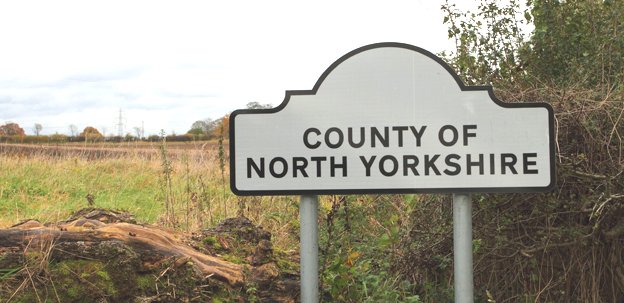
County boundary sign for North Yorkshire

But successive waves of local government reform have left many people deeply unclear as to which county they live in – the answer to which depends on exactly what you mean by the word “county”.

Now, in an effort to support the “tapestry” of ancient place names, the government has changed its rules allowing councils to put up boundary signs marking traditional English counties – including the likes of Cumberland and Huntingdonshire, names which no longer have any connection to local authorities.

If you’re attempting to keep score at home, here are the different kinds of “county” you need to track for historical purposes:

First there are the historic counties, which date as far back as the mid-Saxon period. Some, like Westmorland, no longer exist in an administrative sense. But especially in places like Yorkshire, Durham and Cornwall, they are important expressions of geographic and cultural identity.

Then there are administrative counties and unitary authority areas created by the 1972 Local Government Act. These include non-metropolitan county councils like Oxfordshire and Surrey (where some services are also provided by districts). Others, like Northumberland, are single-tier unitary councils. Some areas like Berkshire have no county council and the districts are the sole local authorities.

And finally there are the ceremonial counties, established by the 1997 Lieutenancies Act, each of which has a Lord Lieutenant. Bedfordshire and Cheshire, for instance, do not exist as councils but do as ceremonial counties. In metropolitan counties like Merseyside, Tyne and Wear and Greater Manchester, county councils were scrapped in the 1980s, but some services including transport and the police are run jointly by groups of councillors within the old boundaries.

If you’ve followed that, well done. Catherine Staite, director of the Institute of Local Government at Birmingham University, says there was no consistency to the way these overlapping boundaries were drawn. “We’ve ended up with a patchwork of arrangements for which there is no logic.”

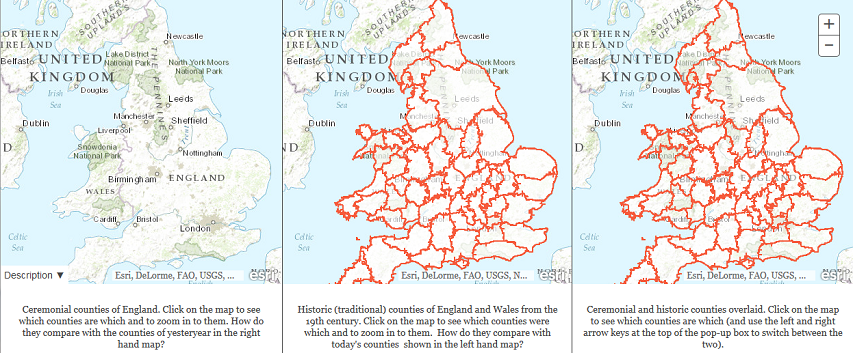
There is a new website to attempt to resolve the confusion, but I’m not sure it will do much:

English county maps

April 20, 2014

Those dismal, uncaring economists

Filed under: Economics, Religion — Tags: , , , — Nicholas @ 10:39

Tim Harford found a recent assertion by a clergyman to be troubling:

‘Some research on students suggests economics either attracts or creates sociopaths’

Justin Welby, the Archbishop of Canterbury, recently bemoaned the way that “we are all reduced to being Homo financiarius or Homo economicus, mere economic units … for whom any gain is someone else’s loss in a zero-sum world.”

The remarks were reported on the 1st of April, but I checked, and the Archbishop seems serious. He set out two ways to see the world: the way a Christian sees it, full of abundance and grace; and the way he claims Milton Friedman saw it, as a zero-sum game.

Whatever the faults one might find in Friedman’s thinking, seeing the world as a zero-sum game was not one of them. So what do we learn from this, other than that the Archbishop of Canterbury was careless in his choice of straw man? The Archbishop does raise a troubling idea. Perhaps studying economics is morally corrosive and may simply make you a meaner, narrower human being.

However, the Archbishop appears to have been misinformed:

Economists did actually give more to charity in Frank’s survey. They were richer, and while they gave less as a percentage of their income they did give more in cash terms.

What about those hypothetical questions about envelopes full of cash? Were economics students selfish or merely truthful? Anthony Yezer and Robert Goldfarb (economists) and Paul Poppen (a psychologist) conducted an experiment to find out, surreptitiously dropping addressed envelopes with cash in classrooms to see if economics students really were less likely to return the money. Yezer and colleagues found quite the opposite: the economics students were substantially more likely to return the cash. Not quite so selfish after all.

Most importantly, classroom experiments with collective goods or the prisoner’s dilemma don’t capture much of economic life. The prisoner’s dilemma is a special case, and a counter-intuitive one. It is not surprising that economics students behave differently, nor does it tell us much about how they behave in reality. If there is a single foundational principle in economics it is that when you give people the chance to trade with each other, both of them tend to become better off. Maybe that’s naive but it’s all about “abundance” and is the precise opposite of a zero-sum mentality.

In fact, some of the more persuasive criticisms of economics are that it is too optimistic about abundance and peaceful gains from trade. From this perspective, economists should give more attention to the risks of crime and violence and to the prospect of inviolable environmental limits to economic growth. Perhaps economists don’t realise that some situations really are zero-sum games.

If Scotland chooses separation, should it take Northern Ireland too?

Filed under: Britain, History — Tags: , , , — Nicholas @ 00:01

Patrick West believes that Scotland should include Northern Ireland in its new country if the separation vote succeeds:

[A union] between England and Wales could, possibly [succeed]. Despite the wishes of Welsh (and indeed English) nationalists, the two countries are physically and economically linked – just have a look at the commercial relationship between Bristol and Cardiff or Liverpool and north Wales. But Northern Ireland would resemble a very odd third partner in this hypothetical, slimmed-down UK, cut off by the sea and by culture (there are no peace walls in England and only Southport has annual Orange Order parades).

So, I have a better suggestion: if Scotland declares independence, shouldn’t Northern Ireland go with it? No, let me rephrase that: if Scotland becomes independent, it has a moral obligation to take Northern Ireland with it. Ulster is, after all, far more of a Scottish colony than an English one, demographically speaking. From the reign of King James VI of Scotland (who also became James I of England in 1603), Ulster was disproportionately colonised by Scots (many of whom later left for America to become ‘Scotch-Irish’), which explains why Presbyterianism was always a more popular denomination in Ulster than the Church of Ireland. The Scottish legacy is also reflected in efforts in recent decades among Protestants to cement an ‘Ulster-Scots’ culture and language. While you will see the Scottish saltire at Orange Order marches, you won’t see an empty-handed Cross of St George.

The two lands are united in their love of and hatred of Glasgow’s two football teams and by simmering sectarianism. The Scottish National Party (SNP) was very keen to jump on the Braveheart bandwagon. Why not go even further back in time? Parts of Ulster and Scotland were once united in the sixth and seventh century in the kingdom of Dalriada. The revival of this ancient kingdom, should Scotland vote ‘Yes’, would make much more sense than Northern Ireland’s continued bondage to England. After all, most English people are notoriously ignorant about Ulster. During the Troubles, the English regarded the province with a mixture of irritation and indifference, which is why the IRA in the 1970s knew that England would only take notice if there were bombs on the mainland. ‘They’re both as bad as each other’ and ‘fancy fighting about religion’ were the two common reactions. To the English, the Northern Irish are a foreign people, which is why they found the grating, mangled accents of John Cole and Ian Paisley so amusing – so otherish, so strange.

There has been little love in the opposite direction. To Irish republicans, England was always the occupier, and most Ulster Catholics had good reason to come to dislike the English after 1969. It was with English accents that they heard their houses raided, their husbands and brothers interned and shot. Meanwhile, Ulster Protestants have always – with fair reason – suspected that London wanted to rid itself of the Six Counties, hence the actions of 1974 and 1985 (even 1912), when ‘loyalists’ rebelled against a perceived perfidious London government.

March 10, 2014

Imagine a steel-capped Hush Puppy crushing a state-funded artist’s face, forever

Filed under: Britain, Media, Politics — Tags: , , — Nicholas @ 09:32

To the barricades, comrades! We must save the artists from the pitiless destruction of the inevitable UKIP government repression:

A vision of life under The Ukip’s steel-capped Hush Puppies
How will the artist fare when The Ukip take over? The messages from HQ are far from clear

The inevitable victory of the Scottish independence campaign and the subsequent collapse of the Labour vote in the sorry remnants of the UK will see the next election won by a coalition of The Ukip and The Conservative party. Then the Bullingdon boys’ lack of appeal to the common man will eventually leave the country entirely crushed by The Ukip’s steel-capped Hush Puppy, as a pipe and cardigan version of The Golden Dawn gradually reshapes society in its own image, smothering dissent under an enormous tartan travel rug of hate.

But whether one is a supporter of The Ukip’s position on immigration or not, at least it is easy to grasp. The Ukip dislikes immigration even more than it loves smoking in pubs. But I was born here so I’m all right. What concerns me, as a professional creative, is the apparent incoherence of the anti-immigration party’s arts policy, as this will have a direct effect on my own quality of life, financial future and access to touring theatre productions should I chose to leave London and live in a region.

H/T to Perry de Havilland for the link.

February 13, 2014

Flooding in Britain – call for the Witchfinder Floodfinder General!

Filed under: Britain, Environment, Media — Tags: , , , , — Nicholas @ 12:13

Rob Lyons asks who is to blame for the current flooding in Britain. The answer may be … nobody:

Floods in the UK are getting worse. There’s not much we can do it about it. It’s caused by climate change, which in turn is caused by human beings. It’s payback time.

There you go. In one paragraph, I’ve saved you having to read British newspapers or watch British TV news for the next few days. Of course, the recent flooding is a nightmare for those affected. It’s also a dream for lazy TV news editors who want to plonk their reporters in front of some interesting backdrop offering trite statements about a human-interest story. But the discussion about the causes of the floods and whether we can – or should – do anything about them is rather more worrying than TV’s dumbed-down ‘news values’.

[…]

A briefing published by the UK Met Office earlier this month highlights just how unusual the weather is at present. ‘Although no individual storm can be regarded as exceptional, the clustering and persistence of the storms is highly unusual. December and January were exceptionally wet. For England and Wales this was one of, if not the most, exceptional periods of winter rainfall in at least 248 years. The two-month total (December + January) of 372.2mm for the south-east and central southern England region is the wettest any two-month period in the series from 1910.’ It’s the conveyor belt of stormy weather, rather than any particular individual event, which is causing the problems. The ground is already soaked and rivers are already high; further rainfall has nowhere to go but out on to the flood plains.

However, a quick look at the Met Office briefing shows that while rainfall in southern England in January was very exceptional, it is hard to glean any particular overall pattern – other than that rainfall is very variable.

January rainfall, southern England, 1910-2014. Source: Met Office

January rainfall, southern England, 1910-2014. Source: Met Office

Indeed, just two years ago, Britain was in drought. Consecutive winters of below-average rainfall had left water companies enforcing restrictions on supply. Then the heavens opened, and it seems to have barely stopped raining since. So how on earth did the head of the Met Office, Dame Julia Slingo, conclude that while there was ‘no definitive answer’ to what caused the storms, ‘all the evidence suggests there is a link to climate change’? Indeed, Slingo is not alone in her assessment. The prime minister, David Cameron, said in January that he ‘suspected’ climate change was behind the floods. Labour leader Ed Miliband declared that climate change was sure to bring ‘more flooding, more storms’. Yet less than a year ago, scientists were assuring us that climate change would lead to more droughts in the future in the UK.

December 27, 2013

QotD: The Church of England

Filed under: Britain, Humour, Quotations, Religion — Tags: , , — Nicholas @ 08:47

“Getting the PM to choose the right bishop is like a conjuror getting a member of the audience to choose a card. With the Church of England the choice is usually between a knave and a queen.”

“The bench of bishops should have a proper balance between those who believe in God and those who don’t.”

“Bishops tend to live a long time, perhaps because the Almighty is not all that keen for them to join him.”

“The plans for a new church in South London had places for dispensing orange juice, family planning, and organizing demos, but nowhere to celebrate Holy Communion.”

“Theology is a device for helping agnostics to stay within the Church of England.”

“The Queen is inseparable from the Church of England. God is an optional extra.”

Jonathan Lynn, “Yes Minister Series: Quotes from the dialogue”, JonathanLynn.com

December 5, 2013

The Hundred Years War

Filed under: Books, Europe, France, History, Military, Weapons — Tags: , , — Nicholas @ 08:46

In History Today, George Goodwin reviews A Great and Glorious Adventure: A Military History of the Hundred Years War by Gordon Corrigan:

As Corrigan explains, the Hundred Years War extended over a longer period (1337-1453) than its name suggests, but then it was not a continuous war either. Instead its series of intermittent campaigns featuring major battles and sieges was interspersed with periods of lower tempo siege warfare and long stretches of peace. The war was initially sparked by Philip VI of France’s formal declaration that Edward III’s territories in France (most notably Aquitaine) had been confiscated because the young English king had refused to act as his vassal and to hand over Robert of Artois, Philip’s mortal enemy. The war escalated after the Declaration of Ghent in 1340, when Edward proclaimed himself king of France on the basis that, through his mother, he had a superior claim to the throne than Philip, as she was the daughter of Philip IV, while Philip VI was merely his nephew. France, however, had never allowed for kingship to descend through the female line.

Corrigan’s dramatic description of the Battle of Sluys in 1340 gets the book going. Though fought between opposing navies, Sluys was essentially a land battle that took place on a flotilla of French ships chained across the mouth of an estuary, with the victorious English army moving from vessel to vessel and pushing their French opponents overboard. Corrigan accounts for England’s victory being due to superior tactics and the far greater effectiveness of the longbow in comparison to the French crossbow. This was down to both to the nature of the weaponry and the superior skill of the Anglo-Welsh archers. They proved decisive time and time again at the great set-piece battles of Crecy, Poitiers, Agincourt and Verneuil.

December 2, 2013

Sea level changes during recorded history

Filed under: Environment, Europe, History — Tags: , , , , , — Nicholas @ 10:50

Some interesting points in this guest post by Robert W. Endlich:

Sea level changes over relatively recent geologic and human history demonstrate that alarmist claims do not withstand scrutiny. Sea levels rose significantly after the last ice age, fell during the Little Ice Age, and have been rising again since the LIA ended around 1850. In fact, Roman Empire and Medieval port cities are now miles from the Mediterranean, because sea levels actually fell during the Little Ice Age.

[…]

Those rising oceans created new ports for Greek and Roman naval and trade vessels. But today many of those structures and ruins are inland, out in the open, making them popular tourist destinations. How did that happen? The Little Ice Age once again turned substantial ocean water into ice, lowering sea levels, and leaving former ports stranded. Not enough ice has melted since 1850 to make them harbors again.

The ancient city of Ephesus was an important port city and commercial hub from the Bronze Age to the Minoan Warm period, and continuing through the Roman Empire. An historic map shows its location right on the sea. But today, in modern-day Turkey, Ephesus is 5 km from the Mediterranean. Some historians erroneously claim “river silting” caused the change, but the real “culprit” was sea level change.

Ruins of the old Roman port Ostia Antica, are extremely well preserved – with intact frescoes, maps and plans. Maps from the time show the port located at the mouth of the Tiber River, where it emptied into the Tyrrhenian Sea. The Battle of Ostia in 849, depicted in a painting attributed to Raphael, shows sea level high enough for warships to assemble at the mouth of the Tiber. However, today this modern-day tourist destination is two miles up-river from the mouth of the Tiber. Sea level was significantly higher in the Roman Warm Period than today.

An important turning point in British history occurred in 1066, when William the Conqueror defeated King Harold II at the Battle of Hastings. Less well-known is that, when William landed, he occupied an old Roman fort now known as Pevensey Castle, which at the time was located on a small island in a harbor on England’s south coast. A draw bridge connected it to the mainland. Pevensey is infamous because unfortunate prisoners were thrown into this “Sea Gate,” so that their bodies would be washed away by the tide. Pevensey Castle is now a mile from the coast – further proof of a much higher sea level fewer than 1000 years ago.

November 28, 2013

The equine Range Rovers race

Filed under: Britain, Sports — Tags: , — Nicholas @ 09:02

Published on 24 Nov 2013

Five Clydesdale shire horses have taken part in a charity race at Exeter racecourse.

The horses thundered down the home straight with the aim of promoting the breed, which has been given “at risk” status.

The horses took part in the Devon Air Ambulance charity race 35 minutes before before the day’s main racing and were ridden by professional jockeys.

The two furlong race was won by Tom Parker, ridden by Michael Nolan.

October 30, 2013

Dr. Richard Holmes – Agincourt 1415

Filed under: Europe, France, History, Weapons — Tags: , — Nicholas @ 10:46

Published on 3 Oct 2012

Dr Richard Holmes’ TV Documentary series from 1996 entitled War Walks. This episode concerns the legendary Battle of Agincourt. Unfortunately, Richard Holmes — my favourite military historian — died of Pneumonia only last year (2011).

October 9, 2013

England performs poorly in literacy and numeracy survey

Filed under: Australia, Britain, Cancon, Education, USA — Tags: , — Nicholas @ 07:50

In the Guardian, Randeep Ramesh reports on a recent OECD ranking of literacy and numeracy which shows England in a poor light:

England is the only country in the developed world where the generation approaching retirement is more literate and numerate than the youngest adults, according to the first skills survey by the Organisation for Economic Co-operation and Development.

In a stark assessment of the success and failure of the 720-million-strong adult workforce across the wealthier economies, the economic thinktank warns that in England, adults aged 55 to 65 perform better than 16- to 24-year-olds at foundation levels of literacy and numeracy. The survey did not include people from Scotland or Wales.

The OECD study also finds that a quarter of adults in England have the maths skills of a 10-year-old. About 8.5 million adults, 24.1% of the population, have such basic levels of numeracy that they can manage only one-step tasks in arithmetic, sorting numbers or reading graphs. This is worse than the average in the developed world, where an average of 19% of people were found to have a similarly poor skill base.

When the results within age groups are compared across participating countries, older adults in England score higher in literacy and numeracy than the average among their peers, while younger adults show some of the lowest scores for their age group.

As with any sort of survey of this kind, it helps to know how they went about assessing skills in various countries and how similar countries rank:

Literacy for people aged 16-24

6 Australia
15 Canada
17 Ireland
19 England/N Ireland
20 United States

Literacy for all adults

5 Australia
10 Canada
14 England/N Ireland
16 United States
19 Ireland

Numeracy for people aged 16-24

14 Australia
16 Canada
18 Northern Ireland
20 Ireland
24 United States

Numeracy for all adults

13 Australia
14 Canada
16 England/N Ireland
19 Ireland
20 United States

If there’s reason for English authorities to be concerned with their middle-of-the-Anglosphere ranking, there’s even more reason for American educators to take note.

H/T to Tyler Cowen for the link.

February 6, 2013

English accents, circa 1483

Filed under: Britain, History — Tags: , , , — Nicholas @ 00:02

I’m afraid the coverage of the discovery and identification of the remains of Richard III have done bad things to the newspapers. We’re starting to see articles like this posted:

King Richard III was ‘a brummie’
King Richard III would have spoken with a Birmingham accent, according to a language expert.

Dr Philip Shaw, from the University of Leicester’s School of English, used two letters penned by the last king of the Plantagenet line more than 500 years ago to try to piece together what the monarch would have sounded like.

He studied the king’s use of grammar and spelling in postscripts on the letters.

The university has now released a recording of Dr Shaw mimicking King Richard reading extracts from those letters.

Despite being the patriarch of the House of York, the king’s accent “could probably associate more or less with the West Midlands” than from Yorkshire or the North of England, said Dr Shaw.

Wow. This must have been a long, painstaking effort to pin down the linguistic “tics” that help indicate a person’s natural speaking habits. What were the key elements that indicated Good King Richard was a “Brummie”?

“… there is also at least one spelling he employs that may suggest a West Midlands accent.”

That’s it? One spelling variation that “suggests” he would pronounce that one word in a similar manner to the modern Birmingham style? Gah!

January 27, 2013

In Britain, ignorance of the law is a valid excuse (under certain circumstances)

Filed under: Britain, Law, Religion — Tags: , , , , , — Nicholas @ 11:25

Words fail me:

The failure of an Islamic faith school in the UK to provide a pupil with any knowledge about sexual relations, other than to teach him that women were “no more worthy than a lollipop dropped on the ground”, led to the trial of an 18-year-old who was charged with raping a 13-year-old girl.

But, according to this report, instead of being jailed, the “naïve” Birmingham teenager, Adil Rashid, was handed a suspended sentence in Nottingham Crown Court by Judge Michael Stokes, who said:

    Although chronologically 18, it is quite clear from the reports that you are very naive and immature when it comes to sexual matters.

The judge added that because Rashid was “passive” and “lacking assertiveness”, sending him to jail might cause him “more damage than good”.

Rashid admitted having sex with the girl, saying he had been “tempted by her” after they met online.

After they had had sex, Rashid returned home and went straight to a mosque to pray. He was arrested the following week after the girl confessed what had happened to a school friend, who informed one of her teachers.

He told police he knew the girl was 13 but said he was initially reluctant to have sex before relenting after being seduced.

Earlier the court heard how Rashid had “little experience of women”due to his education at an Islamic school in the UK, which cannot be named for legal reasons.

After his arrest, he told a psychologist that he did not know having sex with a 13-year-old was against the law. The court heard he found it was illegal only when he was informed by a family member.

January 22, 2013

The obscure, unremembered — but bloodiest — battle in England

Filed under: Britain, History — Tags: , , , , , — Nicholas @ 09:42

Unless you paid very close attention to British history, you may not even have heard of the bloodiest battle in England:

Consider, for example, Towton — the bloodiest battle on English soil, in which most of our nobility and their retainers took part and in which 28,000 people are said to have died. Since the population of the time was not much more than three million, that’s the equivalent of a battle today costing the lives of half a million.

If you were on the wrong side, that was it: curtains. Even if you survived the fighting you faced the greater horror of being ‘attainted’. This meant being hanged, drawn and quartered, while your goods were confiscated and your heirs disinherited in perpetuity. Such was the fate of 60 Lancastrian knights and gentlemen (including 25 MPs — so it wasn’t all bad…) after Towton.

As with the Norman Conquest and the first world war, the war’s victims numbered disproportionately among the English upper classes. ‘Out of 70 adult peers during this period, over 50 are known to have fought in battles they had to win if they wanted to stay alive,’ notes Desmond Seward, in his superb The Wars Of The Roses. Entire noble families were exterminated. In one campaign alone — 1460 to 1461 — 12 noblemen were killed and six beheaded, over a third of the English peerage.

And there was no way of opting out. If you were one of the 50 or 60 great families, you were too prominent politically and socially, and your private army was too valuable, to permit your remaining neutral. This, in turn, meant that your myriad kinsmen, retainers, and hangers-on had to follow you into battle, whether they liked it or not. As a government spokesman told the House of Commons in 1475, ‘None [of us] hath escaped.’

Update: Colby Cosh sent along a link to this Economist article from 2010:

Towton is a nondescript village in northern England, between the cities of York and Leeds. Many Britons have never heard of it: school history tends to skip the 400-or-so years between 1066 and the start of the Tudor era. Visitors have to look hard to spot the small roadside cross that marks the site of perhaps the bloodiest battle ever fought in England. Yet the clash was a turning point in the Wars of the Roses. And, almost 550 years later, the site is changing our understanding of medieval battle.

In Shakespeare’s cycle of eight plays, the story of the Wars of the Roses is told as an epic drama. In reality it was a messy series of civil wars — an on-again, off-again conflict pitting supporters of the ruling Lancastrian monarchy against backers of the house of York. According to Helen Castor, a historian at Sidney Sussex College, Cambridge, the wars arose from the slow breakdown of English government under Henry VI, a man who was prone to bouts of mental illness and “curiously incapable” even when well. As decision-making under Henry drifted, factions formed and enmities deepened. These spiralling conflicts eventually drove Richard Plantagenet, Duke of York, to assert his own claim to the throne. York was named Henry’s heir, but he was killed in December 1460. His 18-year-old son, Edward, proclaimed himself king just before the battle of Towton.

That set the stage for a vicious fight. Edward had his father and brother to avenge. After killing him, Lancastrian forces had impaled York’s head on a lance and adorned it with a paper crown. Following years of skirmishes others had scores to settle, too. In previous encounters, efforts had been made to spare rank-and-file soldiers. At Towton, orders went out that no quarter be given. This was to be winner-takes-all, a brutal fight to the death.

The result was a crushing victory for the Yorkists and for the young king. Edward IV went on to rule, with a brief interruption, until his death 22 years later — a death that triggered the final stage of the conflict and the rise of a new dynasty under Henry Tudor. The recorded death toll at Towton may well have been inflated to burnish the legend of Edward’s ascent to the crown. Yet there can be little doubt it was an unusually large confrontation.

The archaeological details of the battlefield excavations are quite interesting. Gruesome, but interesting.

« Newer PostsOlder Posts »

Powered by WordPress