Quotulatiousness

January 18, 2011

Singapore diplomats caught speaking very undiplomatically

Filed under: Asia, China, India, Japan — Tags: , , , , — Nicholas @ 08:15

Sometimes, the information in the various WikiLeaks releases shocks and surprises. Other times, it merely confirms common beliefs:

Singaporean officials are putting up a brave face after highly embarrassing Wikileaks’ disclosures. They have rubbished the leaked cables as “cocktail talk” and accused the media of blowing the casual remarks out of context. Singapore-specific cables have shown that diplomats and officials of this tiny but prosperous city state have scant regard for leaders of neighboring countries and have insulted their neighbors with disparaging remarks.

[. . .]

Tommy Koh, a senior diplomat of Singapore, took pot shots at Japan and said that Japan was “the big fat loser” in the larger strategic matrix as China’s relations with ASEAN nations continued to improve. This is not insulting had Koh stopped at that only. However, the Singaporean diplomat blabbed on and blamed Japan’s “stupidity, bad leadership, and lack of vision.” Koh dragged in the Indians as well and called India “stupid” for being “half-in, half-out” of ASEAN.

Another leaked cable quotes Peter Ho, Singapore’s former Minister of Foreign Affairs and Permanent Secretary, telling a U.S. official in March 2008 that Malaysian Prime Minister Najib Razak was an “opportunist”. Another Singapore diplomat remarked senior colleague in Singapore’s foreign ministry, Bilahari Kausikan, told US Deputy Secretary of Defence for South that ousted Thailand leader Thaksin Shinawatra was ‘corrupt’, along with “everyone else, including the opposition.”

The art of diplomacy is saying in public what your government wants everyone to believe, while saying to your government what is really happening.

December 14, 2010

Christopher Hitchens on the real Henry Kissinger

Filed under: History, Media, Politics, USA — Tags: , , , , — Nicholas @ 09:14

I must admit that I never understood the adulation Henry Kissinger has attracted. I started paying attention to politics in the early 1970s, and Kissinger was one of the main players on the world political stage at that point. His connection to the deeply repugnant Richard Nixon should have been enough to keep him out of the limelight after his boss was forced out of the presidency. Yet he somehow managed not only to stay in the public eye, but to increase his popularity.

Christopher Hitchens thinks that the latest revelations from that era will finally bring Kissinger the odium he so richly deserves:

Henry Kissinger should have the door shut in his face by every decent person and should be shamed, ostracized and excluded. No more dinners in his honour; no more respectful audiences for his absurdly overpriced public appearances; no more smirking photographs with hostesses and celebrities; no more soliciting of his worthless opinions by sycophantic editors and producers. One could have demanded this at almost any time during the years since his role as the only unindicted conspirator in the Nixon/Watergate gang, and since the exposure of his war crimes and crimes against humanity in Indochina, Chile, Argentina, Cyprus, East Timor and several other places. But the latest revelations from the Nixon Library might perhaps turn the scale at last.

Chatting eagerly with his famously racist and foul-mouthed boss in March 1973, following an appeal from Golda Meir to press Moscow to allow the emigration of Soviet Jewry, Kissinger is heard on the tapes to say:

“The emigration of Jews from the Soviet Union is not an objective of American foreign policy. And if they put Jews into gas chambers in the Soviet Union, it is not an American concern. Maybe a humanitarian concern.”

(One has to love that uneasy afterthought….)

In the past, Kissinger has defended his role as enabler to Nixon’s psychopathic bigotry, saying that he acted as a restraining influence on his boss by playing along and making soothing remarks. This can now go straight into the lavatory pan, along with his other hysterical lies. Obsessed as he was with the Jews, Nixon never came close to saying that he’d be indifferent to a replay of Auschwitz. For this, Kissinger deserves sole recognition.

It’s hard to know how to classify this observation in the taxonomy of obscenity. Should it be counted as tactical Holocaust pre-denial? That would be too mild. It’s actually a bit more like advance permission for another Holocaust. Which is why I wonder how long the official spokesmen of American Jewry are going to keep so quiet. Nothing remotely as revolting as this was ever uttered by Jesse Jackson or even Mel Gibson, to name only two famous targets of the wrath of the Anti-Defamation League. Where is the outrage? Is Kissinger — normally beseeched for comments on subjects about which he knows little or nothing — going to be able to sit out requests from the media that he clarify this statement? Does he get to keep his op-ed perch in reputable newspapers with nothing said? Will the publishers of his mendacious and purloined memoirs continue to give him expensive lunches as if nothing has happened?

December 10, 2010

The Economist: “America … should learn from its mistakes in the past decade and stick to its own rules”

Filed under: Bureaucracy, Law, USA — Tags: , , , , , — Nicholas @ 08:23

A very good column in The Economist seems to cover the issues quite well:

BIG crimes deserve tough responses. In any country the theft and publication of 250,000 secret government documents would deserve punishment. If the leak costs lives, let alone the careers and trust that have already perished amid the WikiLeaks disclosures, the case for action is even stronger.

[. . .]

For the American government, prosecution, not persecution, offers the best chance of limiting the damage and deterring future thefts. The blustering calls for the assassination of Julian Assange, the WikiLeaks founder now in custody in London awaiting extradition to Sweden on faintly mysterious charges of sexual assault, look both weak and repellent. If Mr Assange has broken American law, it is there that he should stand trial, just like Bradley Manning, the alleged source of the stolen documents. If not, it may be some consolation that the cables so far reveal a largely flattering picture of America’s diplomats: conscientious, cool-headed, well-informed, perceptive and on occasion eloquent.

[. . .]

If America sticks to those standards now it will display a strength and sanity that contrasts with the shrill absolutism and cyber-vandalism of the WikiLeaks partisans. Calling Mr Assange a terrorist, for example, is deeply counterproductive. His cyber-troops do not fly planes into buildings, throw acid at schoolgirls or murder apostates. Indeed, the few genuine similarities between WikiLeaks and the Taliban — its elusiveness and its wide base of support — argue against ill-judged attacks that merely broaden that support. After a week of clumsy American-inspired attempts to shut WikiLeaks down, it is now hosted on more than 700 servers around the world.

The big danger is that America is provoked into bending or breaking its own rules, straining alliances, eroding credibility and — because it will not be able to muzzle WikiLeaks — ultimately seeming impotent. In recent years America has promoted the internet as a menace to foreign censorship. That sounds tinny now. So did its joy of hosting next year’s World Press Freedom Day this week. Chinese and Russian glee at American discomfort are a sure sign of such missteps.

H/T to John Perry Barlow for the link.

Update: This certainly matches what I expected Julian Assange’s personality to be like:

Defectors include Daniel Domscheit-Berg, otherwise known as Daniel Schmitt, who made a high-profile exit from WikiLeaks in September, and Herbert Snorrason, an Icelandic student. Both resigned in September. Snorrason is quoted as telling Assange, in an online chat log acquired by WiReD:

And you’re not even fulfilling your role as a leader right now. A leader communicates and cultivates trust in himself. You are doing the exact opposite. You behave like some kind of emperor or slave trader.

Snorrason’s departure was fomented by this declaration from Assange:

I am the heart and soul of this organization, its founder, philosopher, spokesperson, original coder, organizer, financier and all the rest. If you have a problem with me, piss off.

And he did.

December 9, 2010

Bruce Schneier on the WikiLeaks situation

Filed under: Bureaucracy, Media, USA — Tags: , , , , — Nicholas @ 07:48

Bruce Schneier has some useful observations about the ongoing WikiLeaks document release:

4. This has little to do with WikiLeaks. WikiLeaks is just a website. The real story is that “least trusted person” who decided to violate his security clearance and make these cables public. In the 1970s he would have mailed them to a newspaper. Today he uses WikiLeaks. Tomorrow he will have his choice of a dozen similar websites. If WikiLeaks didn’t exist, he could have put them up on BitTorrent.

5. I think the government is learning what the music and movie industries were forced to learn years ago: it’s easy to copy and distribute digital files. That’s what’s different between the 1970s and today. Amassing and releasing that many documents was hard in the paper and photocopier era; it’s trivial in the Internet era. And just as the music and movie industries are going to have to change their business models for the Internet era, governments are going to have to change their secrecy models. I don’t know what those new models will be, but they will be different.

December 7, 2010

Chinese official acknowledged that official data is unreliable

Filed under: Bureaucracy, China, Economics, Railways — Tags: , , , , — Nicholas @ 07:32

I’ve been saying this for years now: China’s official GDP and associated economic numbers are just not reliable:

A senior Chinese official said in 2007 that much of the country’s local economic data are unreliable, according to a leaked diplomatic cable published by the WikiLeaks website.

The official, Li Keqiang, was at the time Communist Party secretary of the northeastern province of Liaoning, and has since been promoted to vice premier. Since landing that position, he has overseen many of the central government’s efforts to improve the quality of its economic statistics, which continue to face many questions over their accuracy and consistency.

[. . .]

China’s Foreign Ministry has said it will not comment on the content of the diplomatic cables published by WikiLeaks. The leaked cable reports comments Mr. Li made in a dinner in Beijing with then-U.S. Ambassador Clark Randt on March 12, 2007. His remarks focused on the challenges of administering the province of Liaoning, which because of its legacy of failed state-owned enterprises was burdened with a large number of unemployed workers.

“When evaluating Liaoning’s economy, he focuses on three figures: 1) electricity consumption, which was up 10% in Liaoning last year; 2) volume of rail cargo, which is fairly accurate because fees are charged for each unit of weight; and 3) amount of loans disbursed, which also tends to be accurate given the interest fees charged,” the cable says.

“By looking at these three figures, Li said he can measure with relative accuracy the speed of economic growth. All other figures, especially GDP statistics, are ‘for reference only,’ he said smiling,” the cable reads. “GDP figures are ‘man-made’ and therefore unreliable,” the cable paraphrases Mr. Li as saying.

As I said back in February, the reason for the made up numbers is inherent in the Chinese system:

In this way, the PLA stopped being just the customer/end user. They cut out the middleman and absorbed the entire supply chain. The PLA became a significant economic player in the Chinese industrial economy . . . and this is still true today. The generals aren’t formally in charge, but they own the companies that do military production.

So what? So let’s look at how a civilian corporation’s incentives differ from one owned directly by the army. In a civilian corporation, the CEO runs the business with an eye to generating the largest profit possible while staying (for the most part) within the law. A CEO who deviates from this to ride a favourite hobby horse will eventually face the wrath of the stockholders who want that maximized profit. There are natural limits on how much freedom to invest in uneconomic activity any CEO will be given. Sensible stockholders don’t try to micromanage the firm, but do raise questions if too much of the company’s efforts are devoted to things clearly not related to the company’s long term benefit. Company accounts can be rigged, for a time, to show misleading results, but eventually (Enron, Worldcom, etc.) the truth will out.

A Chinese firm that’s owned by the army? Profit may be nice, but the “CEO” reports to a different master: the guys with the guns. The company accounts will show exactly what the guys with the guns want them to show . . . and the oversight and auditing committee members carry submachine guns. You’re told that your target is 10% growth? Don’t you think that the reported result will be at least 10%? Because your life may depend on the reported results being acceptable.

As my former virtual landlord says, this is one of my hobbyhorses:

December 6, 2010

A qualified list of terror targets in Canada

Filed under: Cancon, Economics, Military, USA — Tags: , , , — Nicholas @ 12:25

Norman Spector goes where US federal government employees are forbidden to go:

In February of last year, U.S. diplomatic posts were given one month by Washington to compile and forward an inventory of critical infrastructure and key resources in their respective reporting areas “whose loss could critically impact the public health, economic security, and/or national and homeland security of the United States.” The U.S. embassy in Ottawa — and the string of American consulates across Canada — were included in this “action request.”

[. . .]

Not surprisingly given that we share a continent, the U.S. compilation of critical infrastructure and key resources in foreign countries includes many sites and undertakings in Canada, from Nova Scotia to British Columbia. Dams; undersea cables; oil and gas pipelines; border crossings, including bridges; nuclear power plants; defence production factories; mines; and, last but not least, pharmaceutical and vaccine production plants.

While, there has been considerable sympathy to date for WikiLeaks and for Mr. Assange, I suspect that some of this might erode once Canadians get a look at this latest cable, which is now widely available, and which sets out the juiciest targets in Canada for those looking to do harm to the United States. Moreover, once Canadians have had a chance to examine the list of sites it includes, I doubt that many of our compatriots will conclude that its compilation by U.S. diplomats serving in this country amounts to anything remotely connected to what we understand to constitute espionage:

Canada: Hibernia Atlantic undersea cable landing Halifax, Nova Scotia, Canada
James Bay Power Project, Quebec: monumental hydroelectric power development
Mica Dam, British Columbia: Failure would impact the Columbia River Basin.
Hydro Quebec, Quebec: Critical irreplaceable source of power to portions of Northeast
U. S. Robert Moses/Robert H. Saunders Power, Ontario: Part of the St. Lawrence Power Project, between Barnhart Island, New York, and Cornwall, Ontario
Seven Mile Dam, British Columbia: Concrete gravity dam between two other hydropower dams along the Pend d’Oreille River
Pickering Nuclear Power Plant, Ontario, Canada
Chalk River Nuclear Facility, Ontario: Largest supplier of medical radioisotopes in the world
Hydrofluoric Acid Production Facility, Allied Signal, Amherstburg, Ontario
Enbridge Pipeline Alliance Pipeline: Natural gas transmission from Canada
Maritime and Northeast Pipeline: Natural gas transmission from Canada
Transcanada Gas: Natural gas transmission from Canada
Alexandria Bay POE, Ontario: Northern border crossing
Ambassador Bridge POE, Ontario: Northern border crossing
Blaine POE, British Columbia: Northern border crossing
Blaine Washington Rail Crossing, British Columbia
Blue Water Bridge POE, Ontario: Northern border crossing
Champlain POE, Quebec: Northern border crossing
CPR Tunnel Rail Crossing, Ontario (Michigan Central Rail Crossing)
International Bridge Rail Crossing, Ontario International Railway Bridge Rail Crossing
Lewiston-Queenstown POE, Ontario: Northern border crossing
Peace Bridge POE, Ontario: Northern border crossing
Pembina POE, Manitoba: Northern border crossing
North Portal Rail Crossing, Saskatchewan
St. Claire Tunnel Rail Crossing, Ontario
Waneta Dam, British Columbia: Earthfill/concrete hydropower dam
Darlington Nuclear Power Plant, Ontario, Canada.
E-ONE Moli Energy, Maple Ridge, Canada: Critical to production of various military application electronics
General Dynamics Land Systems – Canada, London Ontario, Canada: Critical to the production of the Stryker/USMC LAV Vehicle Integration
Raytheon Systems Canada Ltd. ELCAN Optical Technologies Division, Midland, Ontario, Canada: Critical to the production of the AGM-130 Missile
Thales Optronique Canada, Inc., Montreal, Quebec: Critical optical systems for ground combat vehicles
Germanium Mine Graphite Mine Iron Ore Mine Nickel Mine Niobec Mine, Quebec, Canada
Niobium Cangene, Winnipeg, Manitoba: Plasma
Sanofi Pasteur Ltd., Toronto, Canada: Polio virus vaccine
GlaxoSmithKile Biologicals, North America, Quebec, Canada: Pre-pandemic influenza vaccines.

As Colby Cosh notes on Twitter, “That scary list of Cdn targets in the Wikileaks cable on security installations? You could have written it after a morning in the library.”

November 29, 2010

Oh noes! WikiLeaks show “undiplomatic” side of US diplomacy

The latest release of WikiLeaks’ cache of US government documents shows the undiplomatic side of things:

The documents obtained by the whistle-blowing website WikiLeaks, some of which describe allies and adversaries in starkly blunt terms, could undermine the Obama administration’s efforts to improve ties that have frayed with some key countries in Europe, the Middle East and elsewhere.

As reported by The New York Times and other media, the cables at times deride or mock foreign officials, calling Italian Prime Minister Silvio Berlusconi a “feckless” partier and describe Afghan President Hamid Karzai as “weak” and “easily swayed.”

Below are highlights of the embarrassing comments from the new WikiLeaks documents.

— One July 2009 cable from the State Department’s intelligence bureau, posted by The New York Times, contains instructions to U.S. diplomats for collecting intelligence on the United Nations.

The directive, from U.S. Secretary of State Hillary Clinton, urges diplomats to collect biographical information on U.N. personnel, including such personal data as telephone, cellphone, pager and fax numbers and e-mail addresses; credit card account numbers; frequent flyer account numbers, work schedules, and Internet and intranet “handles” (or nicknames).

Here we go: a perfect example of government duplication of effort. Everyone knows it’s cheaper to buy this information from Facebook!

Other “worldshaking” revelations include:

The newspaper says one 2008 cable characterizes the relationship between Dmitry Medvedev, Russia’s president, and its Prime Minister Vladimir Putin as a partnership in which Medvedev, who has the grander title, “plays Robin to Putin’s Batman.”

It also says a cable describes Italy’s Berlusconi as “feckless, vain and ineffective as a modern European leader.” One cable from Rome to Washington describes Berlusconi as “physically and politically weak” and asserts that his “frequent late nights and penchant for partying hard mean he does not get sufficient rest.”

In other words, pretty much common knowledge.

Update: William A. Jacobson thinks this is the Jimmy Carter moment for Barack Obama:

The U.S. Embassy takeover in Tehran on November 4, 1979, was the start of 444 days which came to define Jimmy Carter. The U.S. government was revealed to be powerless and the President weak. Those among us who were alive and conscious during those days have embedded the feelings of helplessness.

There have been many comparisons of Barack Obama to Jimmy Carter, focused on the economy. But the continuing leak of documents by Wikileaks has become for Obama what the Iranian hostage crisis was to Carter.

November 12, 2010

Another G20 meeting, another blow against free speech

Filed under: Cancon, Law, Liberty — Tags: , , , — Nicholas @ 09:45

If you followed the progress of the last G20 meeting in Toronto, you’ll recall the street theatre it gave rise to. The politicians meeting behind barricades, barbed wire, and thousands of police and soldiers weren’t the story — the story was the protest. In turns, it was peaceful, randomly vandalistic, and then violently suppressed. I was generally against the whole thing, both the G20 itself and the protests that were generated by its presence.

Christopher Hume has been attending the Canadian Civil Liberties Association public meetings about the events of that weekend:

In anticipation of the violence that has become de rigueur at such gatherings, South Korea has mobilized 50,000 police officers and put its armed forces on the highest security alert.

Sound familiar? It should. We did exactly the same thing — and in the process revealed ourselves to be oafs. And not just oafs, but nasty oafs.

Just how nasty is being documented by the Canadian Civil Liberties Association. It’s holding public meetings this week in Toronto and Montreal to hear from victims of police violence at the G20. Their stories were at once riveting and tedious. Riveting because the pain is so obviously real; tedious because they’re all the same.

The fact is that G20 summits have no place in the city. The gatherings, which come with full imperial trappings, are a contemporary version of the Field of the Cloth of Gold. That was the legendary meeting in 1520 between King Henry VIII of England and King Francis I of France. As the name implies, it was a diplomatic extravaganza where fountains flowed with wine, where palaces were constructed — and where nothing was accomplished.

[. . .]

A city is its infrastructure. That infrastructure is what we inhabit, and what enables us to inhabit the city. But because of security concerns, G20 organizers and their uniformed henchmen feel they must shut down that infrastructure, and with it, the city.

The tales of police callousness and brutality being heard at the CCLA are a disturbing reminder of the lengths to which the state will go to ensure its safety even at the cost of ours. It’s like the old line from the Vietnam War about having to destroy a village in order to save it. In this case, Torontonians, and by extension all Canadians, had their right to security suspended so as not to compromise the participants’ security — or, more to the point perhaps, not to inconvenience these terribly important people.

Earlier posts on the G20 idiocy here.

July 13, 2010

Lacrosse team caught in international issue over passports

Filed under: Britain, Bureaucracy, Law, USA — Tags: , , , , , — Nicholas @ 07:24

This is a confusing situation, as Aboriginal tribes/nations are sometimes considered separate political entities from the country within which they live and other times are not. The Iroquois nation apparently has been issuing their own passports, but now the British and US governments don’t want to honour them as they have in the recent past:

The Iroquois team, known as the Nationals, represents the six Indian nations that comprise the Iroquois Confederacy, which the Federation of International Lacrosse considers to be a full member nation, just like the United States or Canada. The Nationals enter this year’s tournament ranked fourth in the world.

The Nationals’ 50-person delegation had planned to travel to Manchester, England, on Sunday on their own tribal passports, as they have done for previous international competitions, team officials said.

But on Friday, the British consulate informed the team that it would only issue visas to the team upon receiving written assurance from the United States government that the Iroquois had been granted clearance to travel on their own documents and would be allowed back into the United States. Neither the State Department nor the Department of Homeland Security would offer any such promise.

If the US government has allowed the use of Iroquois travel documents before, why are they now pretending they’ve never encountered them before? Is it a formal change in policy or just a bureaucrat flexing his or her ability to cause inconvenience and delay on a whim?

Update, 14 July: The New York Times reports that the team has been allowed to travel on their Iroquois passports:

The State Department’s blessing ends a five-day standoff between the Iroquois team and the federal government over whether the players could travel on their own documents instead of United States passports, as they have done in past international competitions.

Representative Louise M. Slaughter, Democrat of New York, said in a statement that Secretary of State Hillary Clinton personally intervened in the case on Wednesday morning and that the team would be able to depart on Wednesday afternoon.

“I am extremely grateful to Secretary of State Clinton, who responded to this glitch promptly and efficiently,” Ms. Slaughter said. “Going forward, we must find a way to balance homeland security concerns with some common sense and a border policy that does not create unintended consequences.”

Part of the reason appears to have been technical: “The Iroquois passports are partly hand-written and do not include any of the security features that make United States passports resistant to counterfeiting.”

June 28, 2010

Running with the nihilists

Filed under: Media, Politics — Tags: , , , , , , , — Nicholas @ 12:13

Tony Keller walked with the main union-led protest marchers on Saturday, pointing out that there was no single, unifying principle — it was a “grievance smorgasbord, an all-you-can-eat buffet of complaints, and apparently anyone protesting anything — anything — was invited”. What interested him the most, however, were the “hobbits”:

Standing in front of Cafe Lettieri, which was still open and doing a booming business even as protesters were packed so tightly outside that they pressed up against its windows, I heard someone to my right say, “Black Bloc, meet up on Queen!”

I turned to see six hobbits in black hoodies shuffling past me. It was on. Whatever “it” was going to be.

[. . .]

And then the non-peaceful part of our program started. The crowd suddenly began to surge away from the police lines at Spadina and Richmond, and back onto Queen Street. We were now heading east, violently following the route the non-violent march had just taken. A mass of maybe 100 people in black hoodies and balaclavas was moving at almost a run, accompanied by several hundred journalists and riot tourists. Occasionally someone would dart out from the group to smash a window or spray paint a slogan: “Against Police Against Prisons,” “F– the Police,” “F- Corporate Rule.”

[. . .]

The hoodie people weren’t just small in number, they were also small in stature. A lot of skinny white boys. And white women. (Some skinny, some really not). They looked like the kind of people who spend a lot of time playing video games in their parents’ basements. Or the graduating class of an art college. They were not marauding toughs. More like marauding geeks. Geeks marauding in a spontaneous yet carefully choreographed manner.

There’s a point in most peoples’ lives when getting out and protesting seems like such a good idea. And then you graduate and get a job . . .

Monty’s salute to President Obama at the G20 talks

Filed under: Economics, Government, Humour, USA — Tags: , , , , , , — Nicholas @ 12:08

Monty, in his daily “Financial Briefing” post, has his own G20 protest:

The meeting of the G-20 is the big news, but “big news” in this case means no news, really. The whole point of the conference appears to provide world leaders with an opportunity to frown and look concerned. What other purpose it serves I don’t know. The peaceful hippies seem to be enjoying themselves, though. Toronto cops arrested about 500 yammering idiots, but failed to heed Mayor Daley’s advice to lump them up a little bit before letting them go. (That would be Richard J. Daley, who viewed beating up hippies as vigorous and healthy outdoor exercise, not his pissant kid Richard M. Daley.)

But hey, on the bright side: everyone agreed to “cut debt”! Yay! It’s just that easy, apparently! Monty, a financial-industry gadfly and obscure vulgarian from some trailer park in Jesusland, heckled the gathered august personages by shouting “You incompetent, moronic, cheating, lying, prevaricating, thieving, low-down, whiffle-headed, asshole spendthrift fucksticks!”. He was forcibly removed by security. When reached later for comment from his jail-cell, Monty said that his remarks “[W]ere delivered in the heat of the moment, but do accurately reflect my beliefs.” He also invited President Barack Obama to come to his cell and kiss his ass. President Obama could not be reached for comment.

The arrest count reportedly went over 900, but the most frequent allegations of police brutality were from some of the media people who were arrested. Jesse Rosenfeld, a Guardian reporter, was observed being punched by police while they were handcuffing him. The National Post had two of their photographers arrested, while all the newspapers seemed to have encountered police discouragement to them filming or photographing events after the violence broke out.

The Toronto Star notes that search warrants are for pussies, not real police officers:

John Booth said the officers, who entered through an unlocked door, sidestepped repeated requests to show him a warrant. He said they alternately promised to produce it later, claimed to have showed it to someone else, or simply said no.

“At first I actually said, ‘This isn’t a joke, right?’ Because I honestly couldn’t even understand where this was coming from,” he said. “They understood, as the interaction went on, that it was looking less and less likely that I had anything to do with what they were talking about. They were inadvertently discovering — ‘Oh, okay, thanks for telling us that there’s two apartments,’ like that was so enlightening. Yeah, well, you should’ve known that before you came into my house.”

The Booths say they will not sue. But they have filed a complaint to the province’s police review office in an attempt to hold the planners of the raid accountable; John Booth said he does not blame the junior officers who conducted it.

June 27, 2010

The stars were aligned for ugliness

Filed under: Cancon, Media, Politics — Tags: , , , , , , , — Nicholas @ 09:39

Peter Kuitenbrouwer enumerates the reasons why the violence this weekend was pretty much inevitable:

Prime Minister Stephen Harper has something to answer for tonight. It is hard for this writer to escape the feeling that this summit was designed with every possible star aligned for ugliness to occur. The summit is held on a summer weekend, after university and high school exams are over; all the students are out and free and have time on their hands. Summer weather is perfect for a march. The summit takes place in the heart of Toronto: everybody in Canada has a friend in Toronto where they can stay during a protest.

And can we not say that assembling the greatest number of police in one spot in the history of Canada, and spending more on fences and security than Canada has ever spent before, has a provocative effect?

Why didn’t they keep both summits in Huntsville? Or, as several people have pointed out, at a remote Canadian Forces base where air transport and physical security are already in place?

Update: Jonathan Kay thinks the media and the echo chamber of Twitter, Facebook, blogs, and instant messaging combine to make a few incidents appear far bigger and more scary than they really are:

This is one of those stories the social media has gotten wrong: a million tweeters all tweeting up the same three burning police cruisers and few dozen wrecked storefronts. The number of protestors wasn’t even that big (even if the media insists on calling the protests “massive.”) The estimate I’ve seen thrown around is about 10,000. To put that figure in perspective, the number of protestors who swarmed Quebec City at the Summit of the Americas in 2001 was approximately 100,000 — tens times as large.

[. . .]

As I approached the intersection of Queen and Spadina, I could see a rowdy crowd of several thousand gathered. There were a few earnest placards in evidence (“Mother earth convenes the G-6billion. Fuck the G20″). But mostly, it was just excited-looking teenagers surrounding the cop car, like hyenas around their kill. In that moment, it looked like things were about to get truly ugly. I began eying the stores lining Queen, trying to predict which one would get trashed first.

But then came the sirens, and the atmosphere changed very quickly. From down Queen Street, headed eastbound, a speeding convoy of unmarked white busses stopped outside the Silver Snail comic store, and out poured police in full riot gear — helmets, batons, body armor. From an accompanying black suburban came a few even more serious-looking fellows, including at least one with a military-style assault rifle. They never said a word, never issued a threat, never fired any of their crowd-control weapons. They just advanced, in a line, several officers deep, toward the heart of Spadina and Queen. There wasn’t any violence — at least none that I saw. The worst I witnessed was a single protestor who threw a bottle from amidst the anonymity of the crowd, which gained a few oohs and ahs after it fell harmlessly on the concrete.

QotD: Toronto Saturday Night, G20 edition

Filed under: Cancon, Media, Politics, Quotations — Tags: , , , — Nicholas @ 09:16

You can walk a block or two from the action and Toronto is seen carrying on as normal. It’s not quite dangerous, but it’s not quite safe. The crowds are a mix of the indignant, the earnest and the opportunistic. Some obviously carry bad intentions. A lot seem simply bored. When the lights went out in 2003 and order unravelled slightly, Toronto turned into a party. Tonight, again, people are out in the streets, but the mood is simply dumb.

Aaron Wherry, “Toronto, tonight”, Macleans, 2010-06-26

June 26, 2010

The smell of burning police cars

Filed under: Cancon, Media, Politics — Tags: , , , , , , — Nicholas @ 21:34

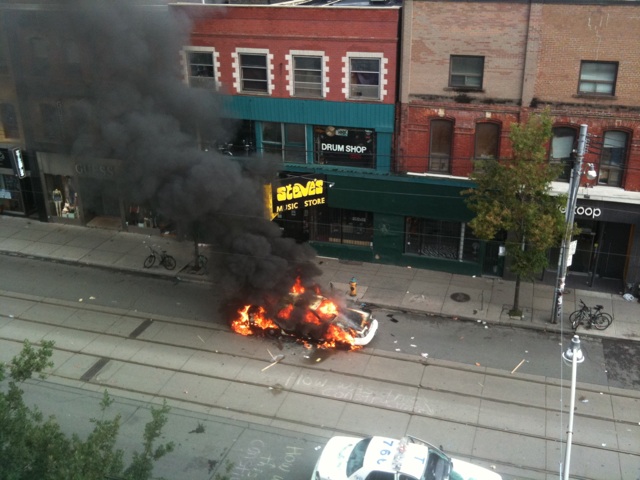
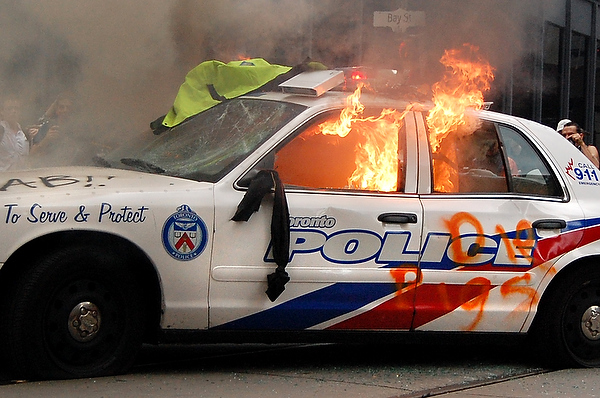
Just when you think the anarchists have decided to let the government look like fools, they pull stuff like this, allowing the security forces to justify the billion+ they’ve spent on the G8/G20 summit meetings:

Pic from Eric Squair.

Pic from Pete Forde. The second police car in this photo also gets the warm treatment from the anarchists.

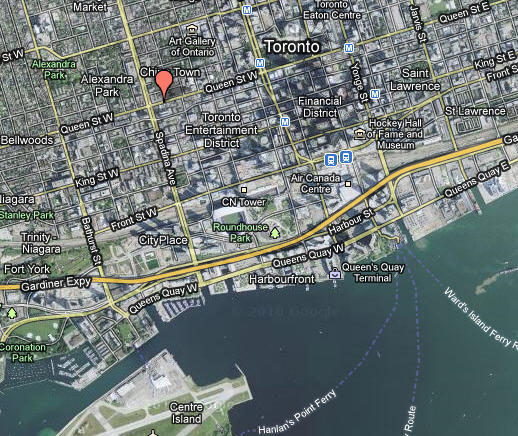
For those not familiar with Toronto, this is approximately here:

Update: Michael Coren has a suggestion to get the police more involved in deterring the rioters:

An idea. Tell the cops that these anarchist criminals are actually confused, gentle Polish visitors trying to find help at an airport. Not only will deadly force ensue but the police will lie about it all after the fact.

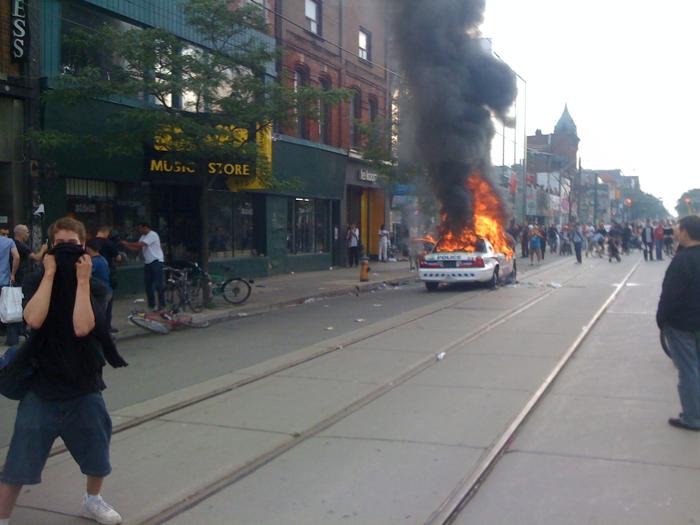
Update, the second: Another burning police car, further east at (I assume) Queen King St. and Bay St.

Pic by Marissa Nelson.

Update, the third: In spite of all the images available of burning or burnt-out police vehicles, the three above were the only ones. Rarely have so many twittered so much about so few . . .

G20 arrests not considered “major enough” to release details

Filed under: Cancon, Law, Media — Tags: , , , , , , , — Nicholas @ 12:25

Siri Agrell notes the inconsistency of Toronto police over the (32 at time of writing) arrests made around the G20 area:

When asked for details of the arrest of a deaf man at Friday night’s demonstration, Burrows [of the Integrated Security Unit] said he had neither a name or the charges.

“Very rarely do we ever release information unless it’s a major arrest, major charges, big investigation or something like that,” he said. “That’s our standard practice. This guy was arrested last night, there’s nothing major about it. we’d never put a release out about that.”

And yet, the police regularly release information about minor incidents, ranging from lost property to suspicious behaviour. Surely, the arrest of Toronto citizens exercising their right to protest during a major international event warrents some transparency?

Yet another example of the police taking advantage of the situation to expand their practical reach?

So teenagers sending sext messages, a lost urn and some guy trying to pick up Toronto women are worthy of police updates, but details of arrests made during the G20, when police have been given huge powers, aren’t worth releasing?

In a nutshell, yes.

« Newer PostsOlder Posts »

Powered by WordPress