
I’m reminded that, in 1966, the late, great former US Secretary of State Dean Acheson, reflecting on a long, productive life in the international arena, quipped that Canada, very often, too often he suggested, sounded like “the stern daughter of the voice of God.” It was a reflection of a regrettable Canadian tendency, even in the 1950s when we were more than just “pulling our weight,” to preach when we should have been content to practice in silence. He wasn’t faulting Louis St Laurent or even Mike Pearson, he was simply commenting on the fairly general and unfortunate habit that Canadian elites had, then, and retain, now, towards self congratulatory moralizing.
About all we have done, consistently, for most of the past 50 years is look on and do nothing: we have, mostly, been sitting on the sidelines, doing little except to chide and cast reproving glances at those who are acting. That approach almost certainly makes the Laurentian Elites more comfortable, but I suspect that many, many Canadians are just a little bit ashamed of themselves because of what our government is doing.
Ted Campbell, “Hypocrisy”, Ted Campbell’s Point of View, 2017-09-27.
October 9, 2019
QotD: The long history of elite Canadian smugness
September 15, 2019
Explaining Brexit to liberal Americans
Andrew Sullivan tries to put the Brexit debate into terms that coastal, urban Americans can understand:
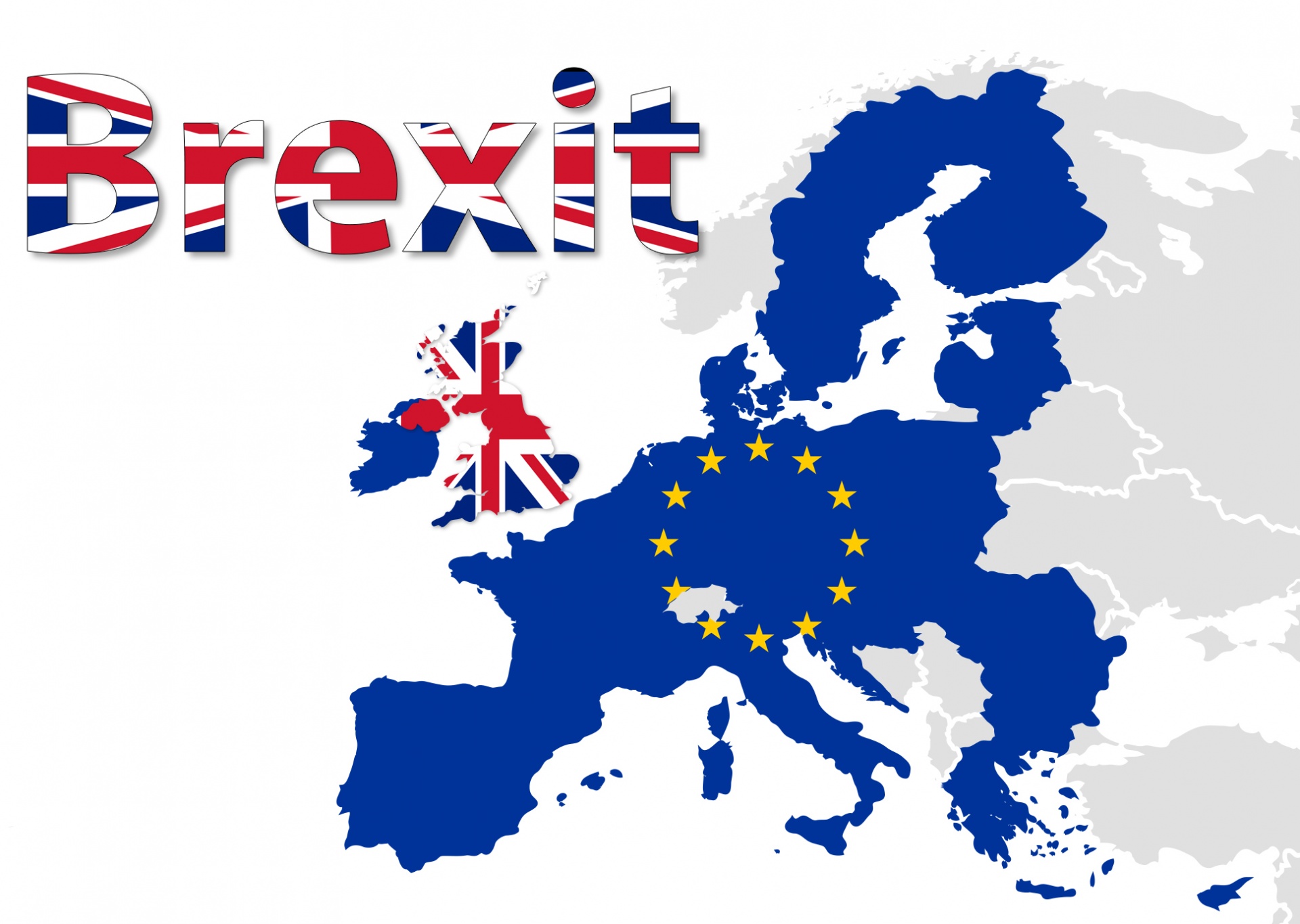
One of the frustrating aspects of reading the U.S. media’s coverage of Brexit is that you’d never get any idea why it happened in the first place. Brexit is treated, automatically, as some kind of pathology, a populist act of wanton self-harm, an absurd idea, etc etc. And from the perspective of an upstanding member of the left-liberal media establishment, that’s all true. If your idea of Britain is formed by jetting in and out of London, a multicultural, global metropolis that is as lively and European as any city on the Continent, you’d think that E.U. membership is a no-brainer. Now that the full hellish economic consequences of exit are in full view, what could possibly be the impulse to stick with it?
I get this. I would have voted Remain. I find London to be far more fun now than it was when I left the place. But allow me to suggest a parallel version of Britain’s situation — but with the U.S. The U.S. negotiated with Canada and Mexico to create a free trade zone called NAFTA, just as the U.K. negotiated entry to what was then a free trade zone called the “European Economic Community” in 1973. Now imagine further that NAFTA required complete freedom of movement for people across all three countries. Any Mexican or Canadian citizen would have the automatic right to live and work in the U.S., including access to public assistance, and every American could live and work in Mexico and Canada on the same grounds. This three-country grouping then establishes its own Supreme Court, which has a veto over the U.S. Supreme Court. And then there’s a new currency to replace the dollar, governed by a new central bank, located in Ottawa.
How many Americans would support this? How many votes would a candidate for president get if he or she proposed it? The questions answer themselves. It would be unimaginable for the U.S. to allow itself to be governed by an entity more authoritative than its own government. It would signify the end of the American experiment, because it would effectively be the end of the American nation-state. But this is precisely the position the U.K. has been in for most of my lifetime. The U.K. has no control over immigration from 27 other countries in Europe, and its less regulated economy has attracted hundreds of thousands of foreigners to work in the country, transforming its culture and stressing its hospitals, schools and transportation system. Its courts ultimately have to answer to the European Court. Most aspects of its economy are governed by rules set in Brussels. It cannot independently negotiate any aspect of its own trade agreements. I think the cost-benefit analysis still favors being a member of the E.U. But it is not crazy to come to the opposite conclusion.
More to the point, the European Economic Community has evolved over the years into something far more ambitious. Through various treaties — Maastricht and Lisbon, for example — what is now called the European Union (note the shift in language) has embarked on a process of ever-greater integration: a common currency, a common foreign policy and now, if Macron has his way, a common central bank. It is requiring the surrender and pooling of more and more national sovereignty from its members. And in this series of surrenders, Britain is unique in its history and identity. In the last century, every other European country has experienced the most severe loss of sovereignty a nation can experience: the occupation of a foreign army on its soil. Britain hasn’t. Its government has retained control of its own island territory now for a thousand years. More salient: this very resistance has come to define the character of the country, idealized by Churchill in the country’s darkest hour. Britain was always going to have more trouble pooling sovereignty than others. And the more ambitious the E.U. became, the more trouble the U.K. had.
August 26, 2019
Russia attempts to retroactively “normalize” the Molotov-Ribbentrop Pact
Just before the outbreak of World War II on the Polish-German frontier, the Soviet Union concluded a non-aggression pact with Hitler’s Germany that included a large slice of Polish territory and a free hand in the Baltic for Soviet expansion (only the early Finnish success prevented total Soviet domination of the eastern Baltic region). The current Russian government is conducting a public relations (propaganda) campaign to recast this pact as being unexceptional diplomatic activity by attempting to cast Britain, France, and all the other countries that had active diplomatic arrangements with Germany as being “just the same” as the infamous Molotov-Ribbentrop Pact. Wikipedia sums up the fate of the two chief diplomats:
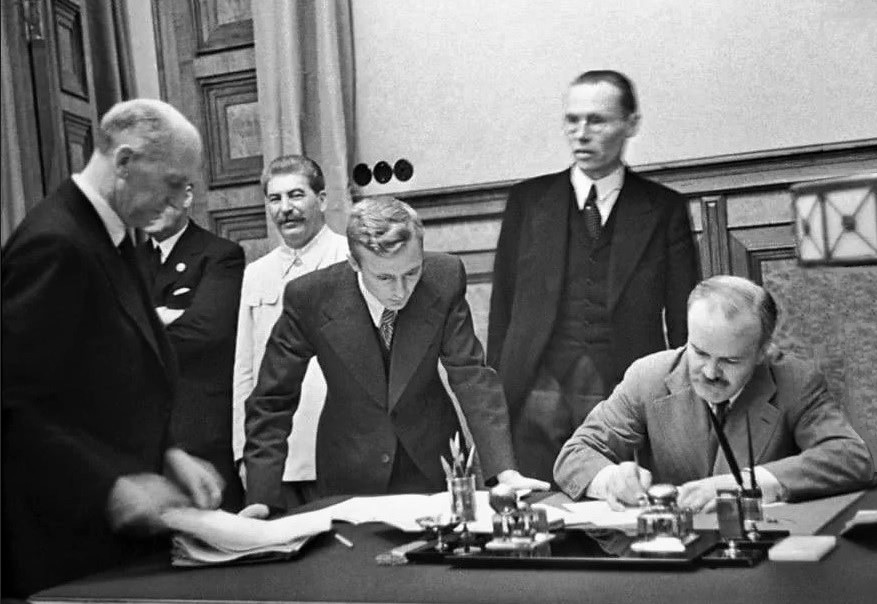
Translation of the Russian caption for this image:
People’s Commissar of Foreign Affairs of the USSR V.M. Molotov signs a friendship and border treaty between the USSR and Germany. Among those present: I.V. Stalin, translator of the Ministry of Foreign Affairs V.N. Pavlov, German diplomat G. Hilger (“truncated” version of the photograph of M. Kalashnikov distributed on the net)
Photograph attributed to Mikhail Mikhaylovich Kalashnikov (1906-1944) via Wikimedia Commons.
The Pact was terminated on 22 June 1941, when Nazi Germany launched Operation Barbarossa and invaded the Soviet Union (thus as well executing the ideological goal of Lebensraum). After the war, von Ribbentrop was convicted of war crimes and executed. Molotov died aged 96 in 1986, five years before the USSR’s dissolution. Soon after World War II, the German copy of the secret protocol was found in Nazi archives and published in the West, but the Soviet government denied its existence until 1989, when it was finally acknowledged and denounced. Vladimir Putin, while condemning the pact as “immoral”, has also defended the pact as a “necessary evil”, a U-turn following his earlier condemnation
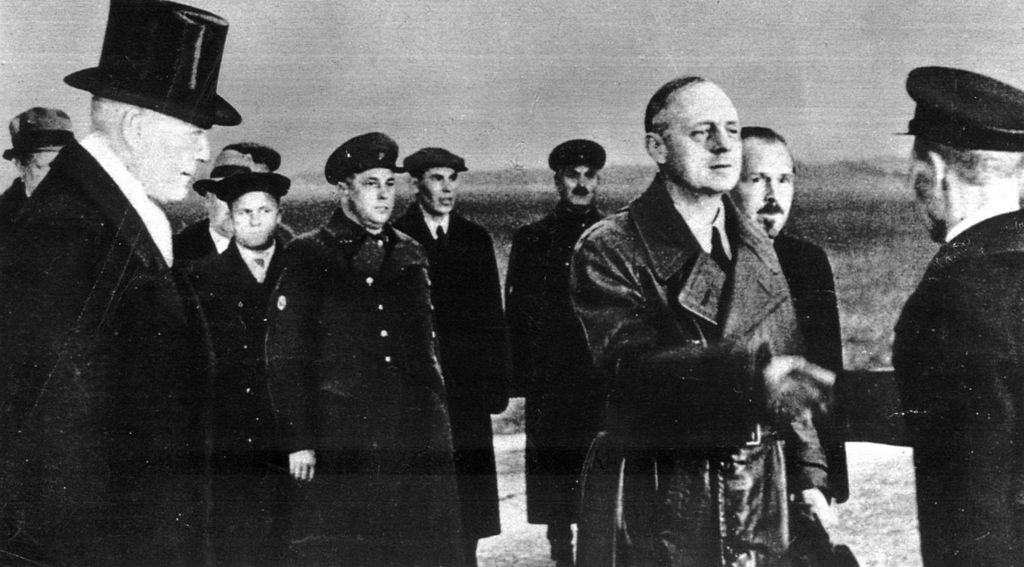
Ribbentrop arrives at Moscow airport, August 1939.
Photograph via Wikimedia Commons.
Arthur Chrenkoff explains why we should vigorously resist this attempt to “normalize” Molotov-Ribbentrop:
1. While the shameful Western appeasement of Hitler, culminating in the infamy of Munich, allowed the Reich to bloodlessly dismember the sovereign and democratic Czechoslovakia, neither Great Britain nor France participated in or benefited from Germany’s cannibalism of this “faraway country of which we know little”. The difference is that while the West remains ashamed of Munich (a name which quickly become synonymous with a craven sell-out), a few years back, Russia’s culture minister Vladimir Medinsky called the Ribbentrop-Molotov pact “a great achievement of Soviet diplomacy”.
2. Unlike all the other agreements signed with Germany during the 1930s, it was the Ribbentrop-Molotov pact that green-lit the armed German aggression and led to the outbreak of the deadliest war in human history. It’s difficult to blame Germany’s neighbours or countries threatened by the Soviet Union (like Poland, Romania and the Baltic states) for trying to stay on Germany’s good side. It was naive and in any case it didn’t work in the end, as they all later found out to their detriment and downfall. Soviet Union, on the other hand, not only climbed into bed with Nazi Germany but it fully and enthusiastically consummated this marriage of convenience.
3. Unlike other agreements cited above, thanks to the “secret protocols” attached to the Ribbentrop-Molotov pact, the Soviet Union was both a co-aggressor in and a co-beneficiary of the start of World War Two. Stalin has relatively bloodlessly acquired the by-then (mid-September) almost defenseless eastern Poland (subsequently incorporated into Belarussian and Ukrainian Soviet Republics; these historically Polish areas remain today parts of Belarus and Ukraine), Bessarabia from Romania (incorporated into the Moldovan Soviet Republic), the Baltic States of Lithuania, Latvia and Estonia, as well as being given a free hand in the invasion of Finland, a country which otherwise might have counted on German friendship and support. All these aggressive territorial gains were the consequence of the Ribbentrop-Molotov division of Eastern Europe between the Reich and the Soviet Union into the respective spheres of interest, soon confirmed as the “facts on the ground” by Wehrmacht and Red Army.
4. While Britain and France, their empires and their allies, fought Germany for almost two years after September 1939, first through the period of the “phony war”, then through the Blitzkrieg in the West and the Battle of Britain, the Soviet Union remained a de facto Nazi ally, continuing to cooperate in security matters and supplying Germany with food and raw materials. Grain trains were still rolling west across the border with the Reich as Wehrmacht was launching Operation Barbarossa in the morning of 22 June 1941. During the period of Nazi-Soviet cooperation, Germany conquered Poland, Norway, Denmark, Belgium, the Netherlands, Luxembourg, France, Yugoslavia and Greece. Soviet exports helped to feed and build up the German war machine before it was unleashed against the West in 1940; German troops surging into the Low Countries walked on their stomachs (to borrow from Napoleon) full of bread baked from Russian wheat or were carried on the tanks and trucks made with Russian coal and ores. Never forget that for Russia, World War Two – or the Great Patriotic War as it is called there – begins only in June 1941, not September 1939, as it does in all Western history books.
5. It’s true that the Ribbentrop-Molotov pact was partly defensive in nature as far as the Soviet Union was concerned, aiming to postpone the inevitable armed clash between the two rival totalitarianisms and in the meantime give Russia some essential breathing space to build up its army and strategic reserves (the top leadership of the Soviet armed forces was decapitated by Stalin during the purges in 1937-8, leaving them even more unprepared to face Germany than would have otherwise been the case). But as I pointed out above, it was also offensive and directly benefited Stalin’s territorial ambitions while it lasted. In some ways, the legacy of the pact lives on in the shape of Poland’s post-war borders, which have nothing to do with its thousand-year history. This is the real #TruthAboutWWII and this is why the Ribbentrop-Molotov pact remains singled out in the infamy of the interwar European democracy.
August 21, 2019
British-EU negotiations under Boris Johnson
In a speech to Slovak journalists, Sean Gabb outlines what he expects the British government to be doing about Brexit now that May has been put out to pasture and Boris Johnson is in charge:
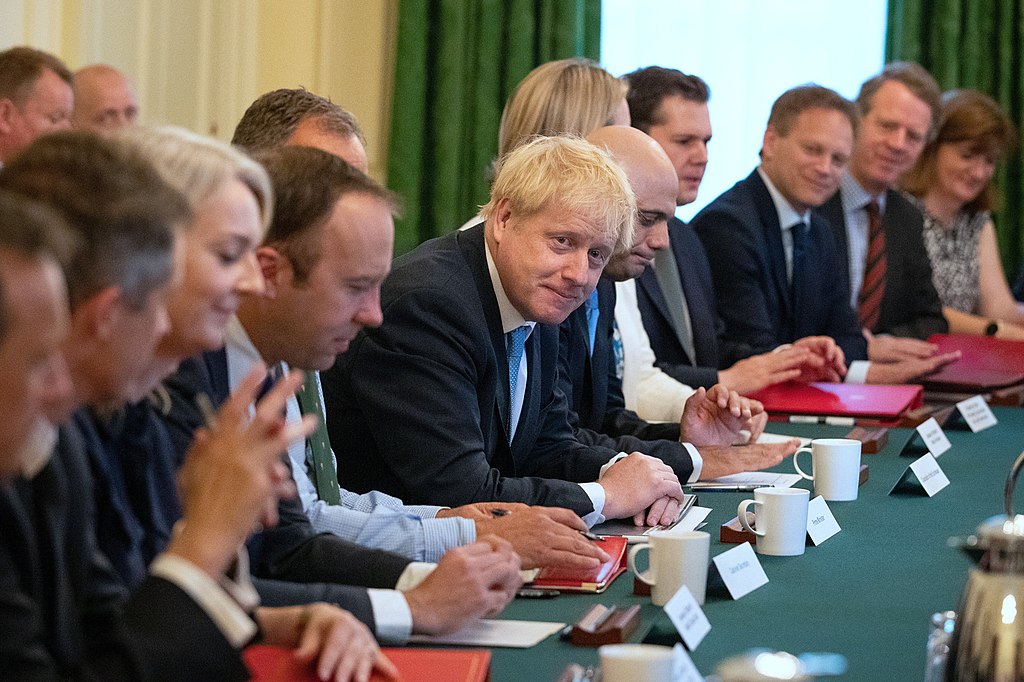
Prime Minister Boris Johnson at his first Cabinet meeting in Downing Street, 25 July 2019.
Official photograph via Wikimedia Commons.
Here, I come to a digression on the nature of how Britain is governed. My country is not particularly democratic. At the same time, there is no cabal of evil persons directing all events and appointments from behind the scenes. This is generally not how ruling classes operate. A more realistic model can be taken from Ian Kershaw’s analysis of the National Socialist revolution in Germany. This proceeded with limited central direction. Before 1939, the leaders were concerned mostly with foreign policy, after that with fighting a big war. Instead, the revolution was decentralised. Reliable men were put in key positions and told to “work towards the Fuhrer” – that is, to act in any situation as they might imagine Hitler himself would act. The result was often administrative chaos. The benefit was that the leadership could concentrate on what it saw as the essentials, and more local knowledge could be used in the overall revolution than would otherwise have been possible.
This is largely how things work in Britain. Our own Transformation is not driven by detailed orders from the Shadowy-Ones-on-High, but by creating a bias within every useful institution to those who are broadly in favour of the Transformation. The benefit is a constrained diversity of approaches that can be presented as a genuine diversity of opinion. The disadvantage is that executive power lies in this country where it has since 1701 – that is, in the hands of the Ministers of the Crown, who are accountable to the House of Commons. If the Prime Minister turns out to be a fool, and the other ministers are too cowardly to stab him in the back, there is no easy way to remove him.
I come at last to the Brexit strategy of the new Government. These people are not right-wing extremists who can eventually be forced to give in. Just like Theresa May, they see Brexit as a problem that needs to be solved. If they could wave a magic wand, they would roll back the calendar to 2016 and make sure that Remain won the Referendum. Or they would roll it back a little farther and make sure the Referendum was not called that year, or at all. But they cannot. Instead, they have to deal with the effects of leaving a political fool in charge for three years of the Brexit process.
Theresa May had one job after 2016. This was to produce the minimal departure I have mentioned. Instead, she negotiated a Withdrawal Agreement that caused a storm of outrage among the English. The details of what this Withdrawal Agreement contained are, again, unimportant. What does matter is that the Withdrawal Agreement was published in English on the European Commission website, and millions of us read its 585 pages. We may not have been that interested in the details of our membership. But the details of our “withdrawal” were unacceptable. She tried three times to force it through the House of Commons. Each time, a majority of some very trashy people were terrified to be seen supporting it. Anyone else less stupid would have tried something else. Instead, Theresa May treated us with open contempt. Whether or not we really cared about it, we had been asked if we wanted to remain in the European Union. Having voted “No!” we expected some show of respect for our clear instructions. We did not welcome a Brexit-in-Name-only.
At first, the damage was confined to the possibility of a Labour Government. Then, with the rise of the Brexit Party, the system as a whole moved towards a crisis of legitimacy. The European elections of the month before last were seen as the second Referendum the Remainers had demanded. It was won by the Leavers. The Conservative were crushed. Labour was humiliated. It seemed that a general election would, for the first time, produce a bloc in the House of Commons of Members opposed not only to the peripheral issue of the European Union, but also to the Transformation.
So Theresa May had to go, and she was replaced by Boris Johnson. His own inclination, I have no doubt, is to get a few cosmetic changes to the existing Withdrawal Agreement, and then tell us he is a diplomatic genius. His problem is that this will no longer do. Theresa May has left too much poison in those waters. Brexit must now be more meaningful than was at first projected. Last week, there was an election in Wales to fill a vacancy in the House of Commons – a bye-election. This should have been won by the Conservatives. Instead, the Brexit Party took enough Conservative votes to give the seat to one of the opposition parties – not the Labour Party, which did badly. The political arithmetic is that anything less than a No-Deal Brexit or a diplomatic triumph will mean a collapse of the Conservative vote at the next general election. And this will not mean a Labour Government, but political chaos and a crisis of legitimacy.
In a post at the Continental Telegraph, Alex Noble shows the quite different political trajectories of Change UK (or whatever they’re calling themselves this week) and the Brexit Party:
[Simon Jenkins in the Guardian claims that] the majority of Britain want to stay in the EU.
Is he right?
Well, the recent defectors from the main parties clearly believed he was – Chuka Umunna, Anna Soubry et al abandoned their positions to form the CUKs and provide the disenfranchised British masses with the staunch Remainer party they had all been failing to demand for so long.
They came out of the blocks fast, called in favours with journalists to get favourable press coverage, and burst upon the political consciousness of Great Britain like a glitter-filled Zeppelin of cross-party europhilia.
And then … oh the humanity.
Whereas Brexit geezer Nigel Farage sauntered out of the blocks under withering crossfire from the establishment and its pet churnalists, and immediately went hypersonic – from 0% to 20% before the establishment pollsters could unlimber their clipboards and stutter their leading questions.
Up and down the country, the British voter was encouraged to overlook the Brexit Party by an establishment still traumatised by the referendum, with pollsters snidely relegating the party to the column entitled “Other” during their obfuscatory enquiries.
And the British voter seized them by the lapels and yanked them into a ferocious Brexit headbutt.
The desperate EU stooges in the Tory party, realising their puppet Treason May was fatally wounded, threw her under the bus and began their Stop Boris campaign, but all the manufactured scandalettes failed to prevent the Johnson Juggernaut from roiling over them and into Downing Street.
For now, the Brexit Party have stalled on 20% – they hold their position now like a lioness crouched in the long grass, waiting for Boris Johnson to reveal the slightest Remainer tendencies. And if he does, the catastrophic injuries he and his party will suffer will make Theresa May’s mauling look like the amuse bouche at the Marquis de Sade’s final soundproofed basement party.
August 5, 2019
More on the still-damaged diplomatic relationship between India and Canada
Ted Campbell quotes from a recent article in the Hindustan Times about the not-yet-healed damage in the diplomatic world between Justin Trudeau’s government and the Indian government of Narendra Modi:
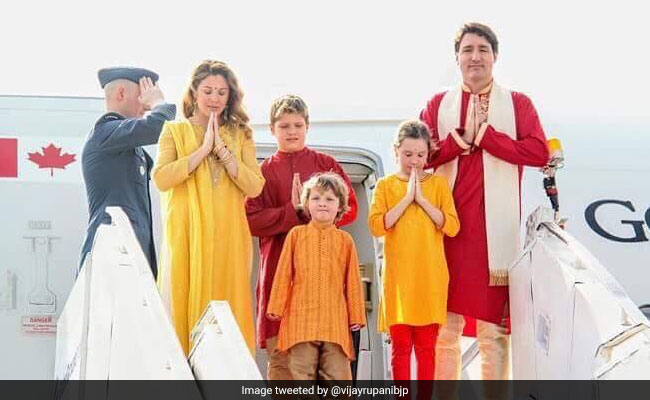
Justin Trudeau and family during India visit
Image via NDTV, originally tweeted by @vijayrupanibjp
In the influential Hindustan Times, Toronto based journalist Anirudh Bhattacharya writes … “in an astonishing attack that will not help heal fraught ties between India and Canada, the former top advisor to the North American nation’s Prime Minister has accused the Indian Government of sabotaging Justin Trudeau’s visit to India in February 2018 to favour his political opponents [and] This scathing statement is in the forthcoming book, Trudeau: The Education of a Prime Minister, written by senior Canadian journalist John Ivison. The author [Ivison] confirmed to the Hindustan Times that Butts’ comment came during an interview.” The article adds that “Indian diplomats didn’t comment on the matter because it is so politically charged and the Canadian Government has yet to respond to questions from HT on its stand on the incendiary remark from Butts.”
So, while some pundits forecast that the return of Gerald Butts would reignite the whole SNC-Lavalin/Jane Philpott and Jody Wilson-Raybould scandal, it appears that the damage will be deeper and we will get a chance to revisit the disaster that Justin Trudeau and Chrystia Freeland visited upon Canadian foreign policy in 2018. India is a rising great power; it helps to contain China in new “Western Approaches:” the Arabian Sea, Indian Ocean and the Bay of Bengal. India is a growing trading power; it is a HUGE potential market for Canadian goods and services. India is one of the top three providers of new Canadians ~ and that’s where our problems with India originated. Someone in the Trudeau PMO thought (since thinking was the problem that probably lets Justin Trudeau off the hook) that it would be a good idea for Prime Minister Trudeau to attend a Khalsa Day parade in Toronto back in April 2017. I explained, back at the time of the India trip fiasco, why that was a mistake and how Jason Kenney had already set the example of doing it right. Now Khalsa Day, also known as Vaisakhi, is an important festival for Sikhs, it marks their New Year. But the festivities, especially in Toronto where 300,000 Sikhs live, are, sometimes, taken over or interrupted by Sikh separatists who advocate violent revolution in India. Jason Kenney saw that in 2012 and he stormed off a stage and berated his hosts, in public for trying to use him to undermine Canadian foreign policy, which valued, as it should, good relations with India. But, in 2017 all the Trudeau PMO (headed by Gerald Butts and Katie Telford) could see were all those Sikh voters. Neither the PMO team nor new Canadian foreign minister Chrystia Freeland was able to prevent Trudeau from being used as a photo-op prop by avowed Sikh separatists … there is no indication that anyone tried although, even though, given the bureaucracy’s corporate memory of events in 2012, I would be amazed in alarms were not sounded.
August 3, 2019
We finally get an explanation for Justin Trudeau’s diplomatically catastrophic India tour
A few days ago, I noted on social media:
This is exactly the sort of suave, diplomatic polish that will smooth over all the damage in the Canada-India relationship. This is a quote from PM Trudeau’s right-hand man in John Ivison’s new book:
“We walked into a buzzsaw — (Narendra) Modi and his government were out to screw us and were throwing tacks under our tires to help Canadian conservatives, who did a good job of embarrassing us,”
http://thepostmillennial.com/out-to-screw-us-butts-blames-indian-pm-for-trudeaus-disastrous-trip/ #JustinTrudeau #India #fiasco #books #GeraldButts #NarendraModi #diplomacy
I figured this had to be some kind of new variant of the old “modifed limited hangout“, but it’s so potentially damaging to an already badly frayed relationship that there had to be more to it … possibly a lot more to it. No rational senior official would say something like that unless there was a much worse revelation that it was intended to camouflage. But whatever it was would have to be “recall the High Commissioner” bad to justify that kind of self-inflicted diplomatic wound.
Justin Trudeau and family during India visit
Image via NDTV, originally tweeted by @vijayrupanibjp
Brian Lilley is similarly puzzled, but he has a simpler explanation: it’s that familiar combination of the Trudeau unwillingness to take responsibility, an over-developed blame-casting habit, and Trudeau’s own frequently demonstrated love of wearing costumes:
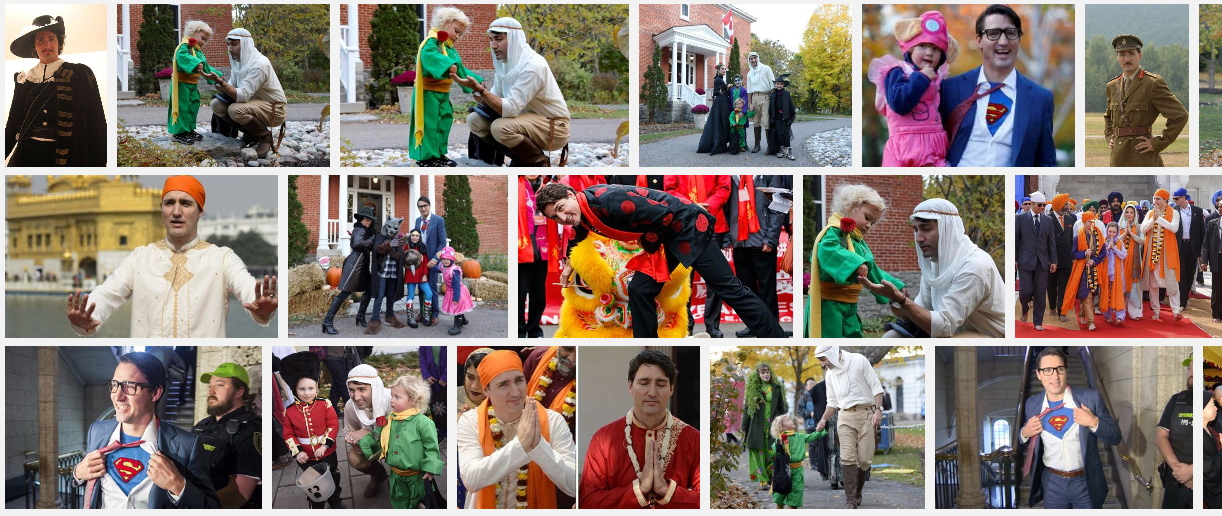
It’s one thing for Butts to think those things, another to voice them in a way that he knows will be made public. It’s also the most tone-deaf assessment of the trip I’ve seen since Sophie Trudeau went on TV and blamed the staff for those outfits.
I mean think about that trip, the two things that got Trudeau in trouble were the invite of the terrorist to dinner and the outrageous outfits. Both of those amount to self-inflicted wounds.
At least Butts admits the photos of Trudeau and his family were a problem.
“Nobody would remember any of that had it not been for the photographs. We should have known this better than anybody — in many ways we’d used this to get elected. The picture will overwhelm words. We did the count — we did forty-eight meetings and he was dressed in a suit for forty-five of them. But give people that picture and it’s the only one they’ll remember,” Butts told Ivison.
[…]
The simple fact of the matter is that the trip to India was a disaster, the kind Trudeau and his team weren’t used to dealing with. So now a year and half later they are still looking to lay the blame anywhere but where it belongs.
With themselves.
August 1, 2019
“People in Ottawa don’t invoke PMO frequently or lightly. It is done to intimidate and obtain compliance”
What we’re not allowed to know can’t hurt us … the federal government apparently figures that no charges can be contemplated if there’s no investigation allowed:
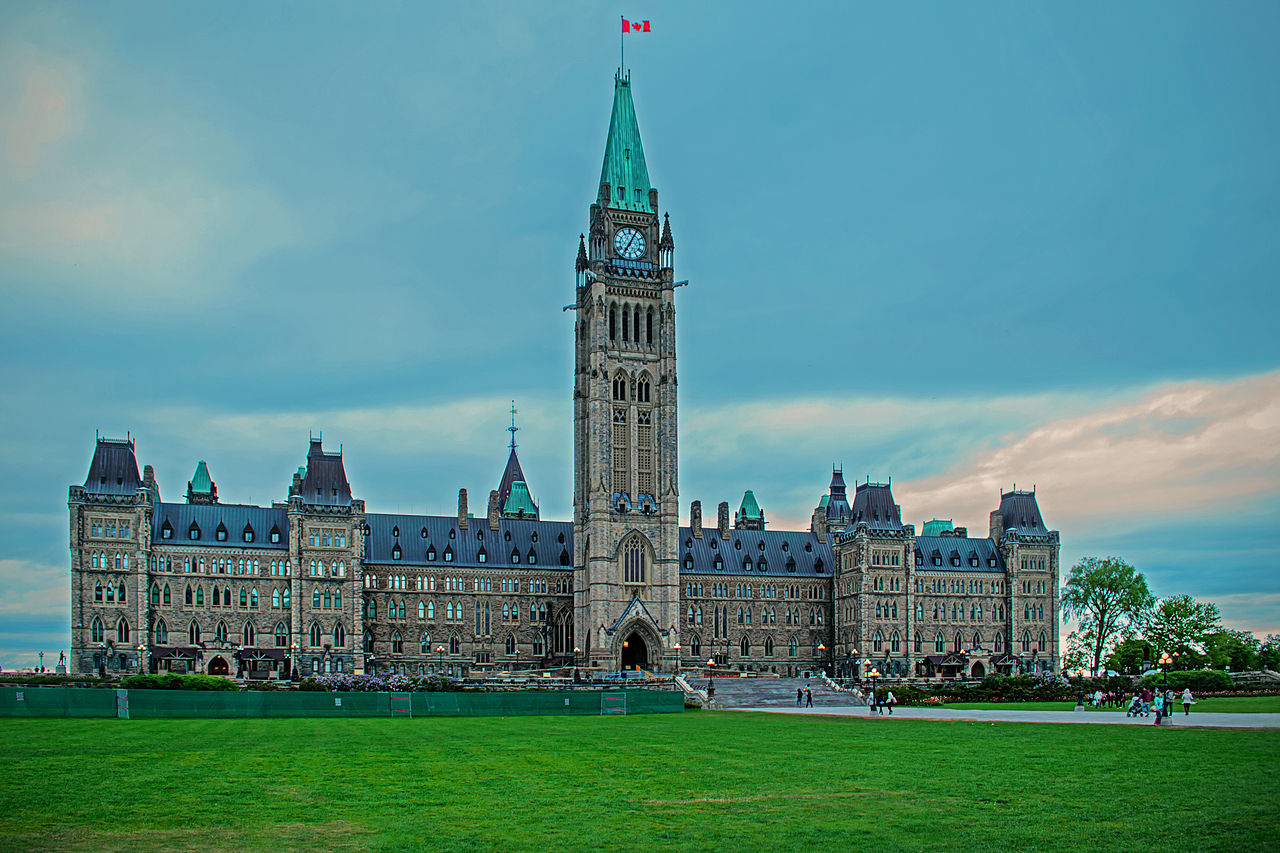
Parliament Hill in Ottawa.
Photo by S Nameirakpam via Wikimedia Commons.
Before colleagues voted to quash a review of whether the Liberal government acted improperly after a bureaucrat asked former ambassadors to temper public comments about China, Liberal MP Rob Oliphant told Parliament’s Foreign Affairs committee that he’s “distressed”.
Apparently, he was not distressed about a Foreign Affairs assistant deputy minister being asked to “check-in” on two former Canadian diplomats to China before making future pronouncements on Canada’s shambolic relations with the communist regime.
Oliphant’s also not distressed about the troubling optics that either diplomat – David Mulroney and Guy Saint-Jacques – felt The Globe and Mail should be aware of their reservations about said interactions, which the paper reported last week.
“I am very distressed, at the tone, at the idea and at the allegations that are being cast about by members of the opposition,” Oliphant, Parliamentary Secretary to the Minister of Foreign Affairs and non-voting member, claimed at the committee’s emergency meeting Tuesday.
Oliphant’s claim comes after either diplomat says the department’s ADM Paul Thoppil told them his call was at the behest of the PMO. Both Prime Minister Justin Trudeau and Foreign Affairs Minister Chrystia Freeland have denied they directed such outreach.
Mulroney, who had earlier warned about travel to China following the detention two Canadians there in December of last year, told the Globe that Thoppil cited the “election environment” and asked him to contact the department before making future statements.
“It wasn’t, in my view, so much an offer to consult and share ideas as to ‘get with the program’. People in Ottawa don’t invoke PMO frequently or lightly. It is done to intimidate and obtain compliance,” Mulroney is quoted as saying.
Saint-Jacques told the Globe that his conversation with Thoppil differed somewhat, “But I can understand that one could come to that conclusion when they say we should speak with one voice.”
July 28, 2019
With the SNC-Lavalin affair fading from memory, Justin Trudeau looks set for the fall election
They say that memories are short in politics, but this short? Thanks largely to the dog days of summer and a complicit media desperate for more government subsidies, Justin Trudeau and the Liberals are being allowed to shed the scandal-tainted skin of four whole months ago to emerge glistening and new with election promises galore. Democracy dies in government subsidies, apparently.
On the other hand, perhaps Canadian voters’ memories will last long enough to get past the casting of ballots in October:
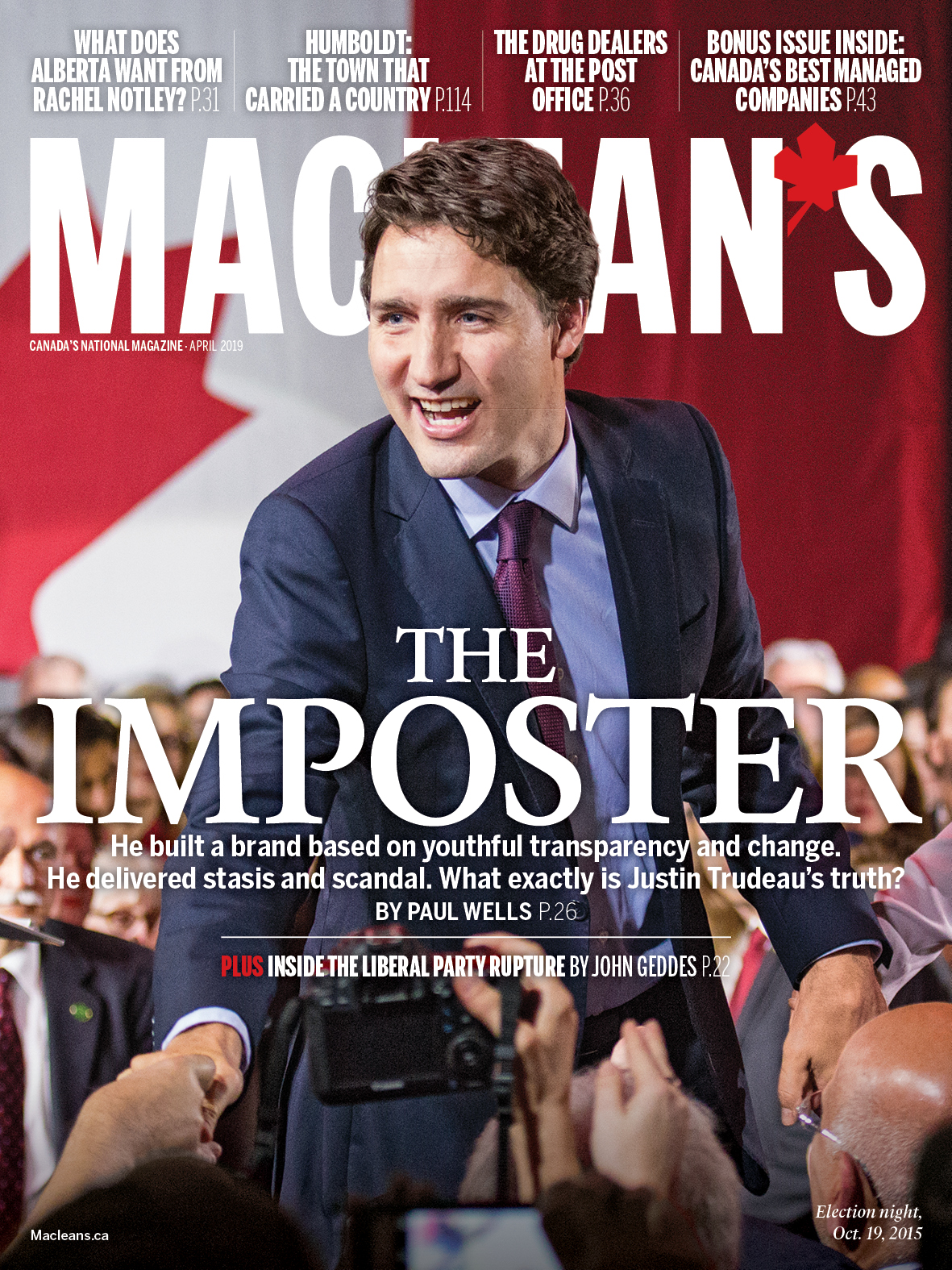
Supposedly, the Liberals have put the SNC-Lavalin scandal behind them: the polls have rebounded, the media have moved on, while the company has worse problems to deal with than a mere hair-raising multi-million-dollar corruption charge.
Even the return of Gerry Butts, the prime minister’s former principal secretary, albeit in a part-time, temporary, what-are-friends-for capacity as adviser to the party’s election campaign, seems to have caused little stir, although he was one of two senior government officials to resign over their part in the affair.
Perhaps the Liberals have concluded the passage of time is enough to earn them a pass from the public. I mean this all took place, what, four months ago? Who even remembers that far back?
But as recent events have shown, the same ingredients that combined to produce the SNC-Lavalin scandal — hubris, a maniacal desire to run everything from the centre, and an unwillingness, in all this overweeningness and control-freakery, to be bound by basic legal and procedural norms — remain very much in place in the prime minister’s office.
For starters, there is the affair of the two ex-ambassadors. First, David Mulroney, Canada’s ambassador to China from 2009 to 2012, then his successor, Guy Saint-Jacques, reported a senior official in the Global Affairs department had called them to demand they clear any public comments on the government’s policy towards China with the government.
Both men are now private citizens. Both have been critical of the government’s handling of the China file. Unlike the most recent former ambassador, former Liberal cabinet minister John McCallum, neither has framed his comments on Sino-Canadian relations in terms of what would assist in the re-election of the Liberals. Apparently, that was the problem.
The official, assistant deputy minister Paul Thoppil, claimed to be speaking on behalf of the PMO and explicitly cited “the election environment” as a reason to shut up. Oh, also the current state of “high tension” between the two countries, presumably over China’s seizure of two Canadians as hostages, which supposedly made it essential for everyone in Canada, whether in the government’s employ or not, to “speak with one voice,” i.e., refrain from criticizing the government.
As a China policy, this has the advantage of closely resembling the Chinese way of doing things. It’s hard to say which is the more extraordinary: the notion that private citizens should be compelled to clear their criticisms of the government with the government, or the notion that they could be.
July 26, 2019
Post-Brexit, consider CANZUK
Tom Colsey explains why in a post-Brexit world, CANZUK might be an attractive economic alternative:
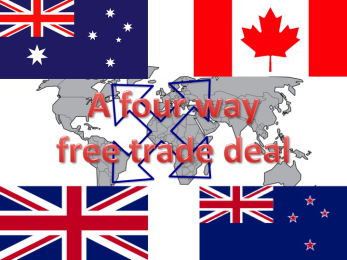
One possible option would mean the island nation would initially turn away from Europe toward certain anglophone Commonwealth nations and former colonies. I talk, of course, of the promising CANZUK proposal that would see Canada, Australia, New Zealand, and the United Kingdom band together with voluntary agreements on multilateral free trade and movement, forming a bloc that would singularly hold the third largest nominal GDP in the world.
The Free Movement Proposal
What makes CANZUK unique is how viable and well-thought-out it is on every level. Unlike within the EU, the grouping would not be consolidated through impositional treaties laced with unpleasant footnotes delegating political power to a bureaucratic institution. Freedom of movement would assist meeting labor market demands across the countries, yet this would be prohibited to those with serious criminal records.
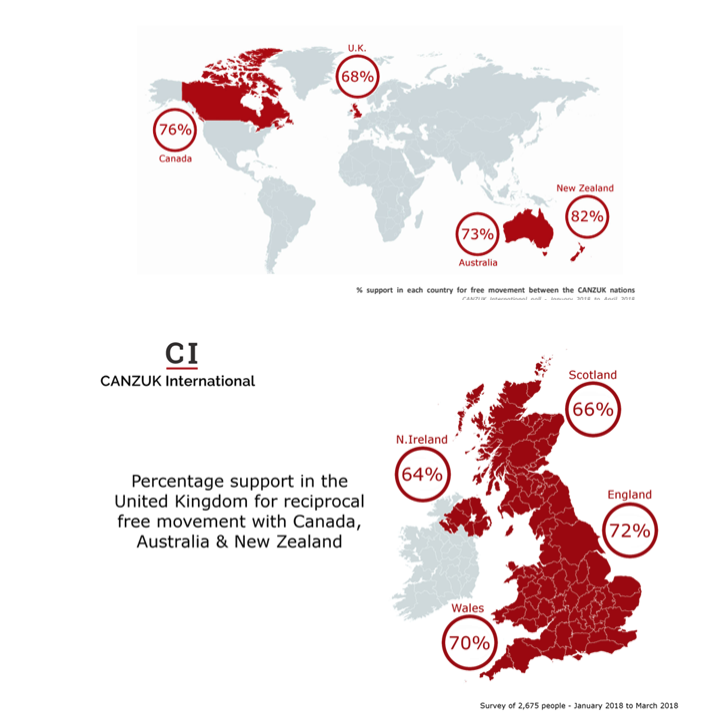
Everything the EU seemed to get wrong about forming unions under a liberal-internationalist pretense, CANZUK proposals seem to get right. They account for social attitudes and the dangers of becoming impositional, eroding national sovereignty. Free movement within the European Union had been widely reviled by the domestic population — and is part of the reason Britain now is set to leave. Yet the very same population overwhelmingly favor the same principle, alternatively implemented, across the CANZUK nations, polling outright majorities in favor in every region.
Perhaps a reason for this is that while the nations are extremely close culturally, they are also resoundingly similar socio-economically. Despite their distances, the states could have been separated at birth (of course, they do share the same monarch).
July 18, 2019
The Allied Occupation of Germany After The Treaty of Versailles I THE GREAT WAR July 1919
The Great War
Published on 17 Jul 2019When the Allied armies marched into German territory in late 1918 under the terms of the armistice, they were surprised to see a relatively untouched land. After the signing of the Treaty of Versailles, the Allied Occupation was made permanent and the troops settled in to stay in a country that did not want them there initially.
» SUPPORT THE CHANNEL
Patreon: https://www.patreon.com/thegreatwar
Merchandise: https://shop.spreadshirt.de/thegreatwar/» SOURCES
Leonhard, Jörn. Der überforderte Frieden. Versailles und die Welt 1918-1923 (CH Beck, 2018)
Macmillan, Margaret. The Peacemakers: Six Months that Changed the World (London: John Murray, 2001).
Le Naour, Jean-Yves. La Honte noire (Hachette, 2004).
Schröder, Joachim, Watson, Alexander. “Occupation during and after the War (Germany)” in: 1914-1918-online. International Encyclopedia of the First World War https://encyclopedia.1914-1918-online…
Roos, Julia. “Schwarze Schmach” in: 1914-1918-online. International Encyclopedia of the First World War https://encyclopedia.1914-1918-online…
Godfroid, Anne. “Occupation after the War (Belgium and France)” in: 1914-1918-online. International Encyclopedia of the First World War https://encyclopedia.1914-1918-online…
Pawley, Margaret. The Watch on the Rhine: The Military Occupation of the Rhineland, 1918-1930 (I.B.Tauris, 2007).
Hart, Keith. “A Note on the Military Participation of Siam in WWI.” Journal of the Siam Society (ndp): 133–136.
Lauter, Anna-Monika. Sicherheit und Reparationen. Die französische Öffentlichkeit, der Rhein und die Ruhr (1919-1923) (Essen: Klartext, 2006).
Krugler, Gilles. “Allemagne decembre 1918. Les premières heures de l’occupation“. In Revue historique des armées 254 (2009): 76-81. https://journals.openedition.org/rha/…
Mignon, Nicolas. “Boche, ex-ennemie ou simplement femme? Le point de vue des responsables politiques et militaires sur la question des mariages entre militaires belges et femmes allemandes pendant les occupations de la Rhénanie et de la Ruhr (1918-1929).” In Revue belge de Philologie et d’Histoire (2013) 91-4 : 1259-1283.»CREDITS
Presented by: Jesse Alexander
Written by: Jesse Alexander
Director: Toni Steller & Florian Wittig
Director of Photography: Toni Steller
Sound: Toni Steller
Editing: Toni Steller
Mixing, Mastering & Sound Design: http://above-zero.com
Motion Design: Christian Graef – GRAEFX
Maps: Daniel Kogosov (https://www.patreon.com/Zalezsky)
Research by: Jesse Alexander
Fact checking: Florian WittigChannel Design: Alexander Clark
Original Logo: David van StepholdA Mediakraft Networks Original Channel
Contains licensed material by getty images
All rights reserved – Real Time History GmbH 2019
Canada’s disputed claims to the Arctic
In the Post Millennial, Jason Unrau writes about the Canadian government’s largely unsupported claims to the Northwest Passage as Canadian territorial waters:
If Canada is serious about defending sovereignty over its Arctic archipelago, Ottawa needs to develop better infrastructure there and start with a permanent military base, says the only MP who attended the International Arctic Forum held in St. Petersburg, Russia.
“The conversation was that it’s international waters. From a Canadian perspective we lay claim to it, but the international community is really looking at it as international waters,” said David Yurdiga, Conservative MP for Fort McMurray–Cold Lake Alberta.
“There are plans to open up the Northwest Passage and connect it as part of international shipping lanes, as they call it … even the U.S. says it’s international waters.”
Canada’s jurisdiction over the waterway was last publicly questioned at the meeting of Arctic Council nations in Finland, where U.S. Secretary of State Mike Pompeo called Canada’s claim “illegitimate”.
[…]
But back in the real world, nobody cares about Canada’s claims to our Arctic archipelago, except for us, said Yurdiga. And barely a month before Scheer and Freeland duked it out on Twitter, in St. Petersburg, according to Yurdiga, only department staff attended the International Arctic Forum – not MPs, nor ministers.
“I was really shocked there was no representative from the government,” Yurdiga said. “We have international communities talking about these as international waters, and we have nobody from the Canadian government pushing back on our sovereignty. We’ve got to be an active player.”

July 15, 2019
War by other means – the “grey zone”
Ted Campbell discusses that field of conflict that isn’t recognizably war, but is still an arena of struggle between state actors:
I said, about 18 months ago, that “Western leaders like Presidents Marcon and Trump, Chancellor Merkel and Prime Ministers Abe, May, Rutte, Trudeau, Turnbull all see ‘war’ as a binary choice ~ you’re either fighting or you’re not, while Putin and Xi see it as spectrum wherein actual armed conflict is only one of many, many choices. We, in the US-led West, are not ‘playing’ the same strategic ‘game’ as our competitors … that’s a mistake on our part.” War in the “grey zone” or a strategy of “constructive ambiguity,” as The Economist explains it, is the most likely form of great power competition for the foreseeable future.
[…]
There are, the report suggests, two overarching strategic concepts for responding to the grey zone threats:
- The report’s proposed strategic concept rests on four (interrelated) notions ~
– Shaping an allied strategy supportive of U.S. and partner objectives over the long term,
– Actively, now, deterring a handful some of the more dangerous forms of grey zone aggression,
– Preventing the day-to-day use of some of the more-elaborate grey zone techniques, and
– Maintaining resilience in the lower-level, persistent competition areas; and
- To implement the strategic concept, the report proposes a preliminary list of about three dozen response options for American and allied officials to consider, such as stationing permanent new military capabilities in key locations, anticipating political meddling and blunting the effects with information operations planned in advance, and denying the aggressor participation in key economic institutions.
That’s all well and good, but: how to implement such a strategy? What to do? How to do it? And who is to do it? The report recommends that:
- America and its allies, partners, and friends ~ and this must include Canada ~ need to decide what actions are intolerable in the grey zone environment. But, the report says, it is hard to stop, much less prevent, gradual, sometimes unattributable actions involving secondary interests, so identifying the actions that the US-led West will seek to deter is the one reliable way to draw a boundary or a “red-line” around the possible effects of grey zone encroachment; and
- The US and its allies should adopt a “multicomponent strategy” like the one outlined in the report, but we must all recognize that it will be of limited utility “if the U.S. government continues to lack a clear coordinating function with the responsibility for overseeing a renewed effort to gain strategic advantage in the gray zone.” The report concludes that an important part of any grey zone response strategy, therefore, is undertaking institutional reform, such as assembling purpose-built office in the U.S. government, and in allied nations and alliances, like NATO, with significant dedicated staff, to conduct real-time counter–grey zone campaigns.
So, what does this mean for Canada?
A couple of months ago I said that the world is changing and Canada must change, too. I made a few recommendations: I said that we have to have an interest-based strategy … one focused on our vital interests in the world. I suggested that we must be less reliant on one or two cornerstones, the USA and NATO, and, instead, build a better foundation with more friends and groups. This is, of course, the exact opposite of what Justin Trudeau has accomplished in the past 3¾ years ~ instead, he has alienated traditional allies, even Australia, and major trading partners like China and rising great powers like India. His ineptitude is stunning … our foreign policy is a national disgrace. We need to rebuild our once-sterling reputation for fair dealing and for doing a fair share. Finally, I said, we need to rebuild our hard (military) power so that we can use our soft power to good effect.
[…]
The point is that some grey zone operations are not “conventional,” and while some grey zone warriors are soldiers, many others are quite decidedly unmilitary … but, we’ve been there before, unconventional warfare is not new, nor are unconventional warriors, whichever side they might be serving. But, the grey zone is never the only area of operation. Just as soft power is only useful if one has enough hard, military power to make one’s voice heard, so grey zone operations are always part of a larger grand strategic plan that aims to secure quite conventional objectives. That’s why war in the grey zone must be fought by both conventional forces, as we fought the first Cold War, for example, and by unconventional forces which might be strange and even a little frightening to those used to seeing “‘war’ as a binary choice ~ you’re either fighting or you’re not.”
We, America, Australia, Britain, Canada, Denmark and, and, and, are being attacked in the grey zone now, whether we like it or not and whether we understand it or not. We need to defend ourselves in both conventional and unconventional ways … and then counter-attack. In fact, the war in the grey zone is being fought, sometimes, even now, on Canadian soil, by Canadians and some political parties and leaders are sometimes complicit in activities that do real, serious harm to Canada’s relations with other great nations. But the war in the grey zone, is, as I said, just above, part of a bigger, grand strategic plan that needs to be countered by both conventional and unconventional means. As much as we need to do (and avoid doing) things that impact the grey zone we must, simultaneously, be prepared to do things that strengthen our position in the “binary,” black and white world of conventional power.
July 6, 2019
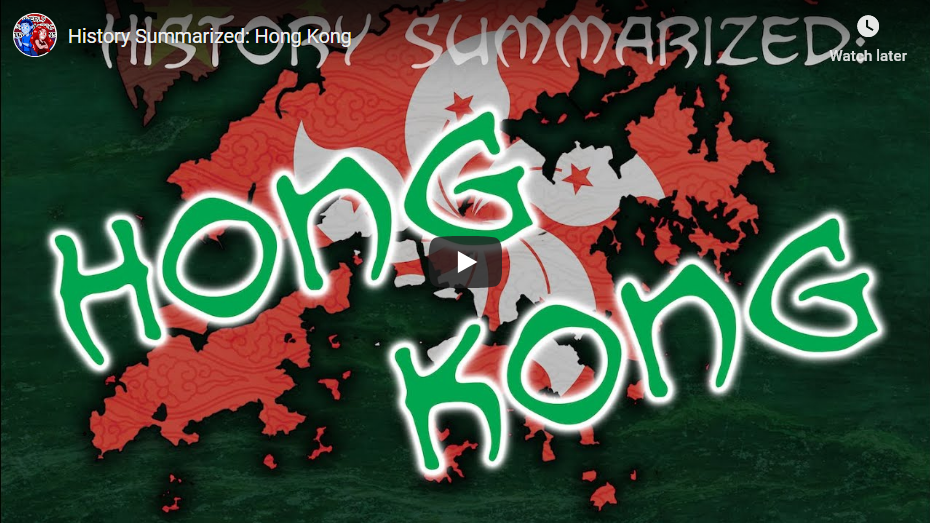
History Summarized: Hong Kong
Overly Sarcastic Productions
Published on 5 Jul 2019Sometimes small corners of the map can have outsized effects on the surrounding world. Hong Kong is undoubtedly one of History’s greatest examples of big things coming from small beginnings. If you’re curious about Hong Kong’s current political situation, there’s no better place to start than at the beginning.
LEARN MORE about Hong Kong’s current events:
China is Erasing its border with HK: https://www.youtube.com/watch?v=MQyxG…
HK’s huge protests, explained: https://www.youtube.com/watch?v=6_Rdn…Further Historical Reading:
A Modern History of China — Steve Tsang https://www.amazon.com/Modern-History…PATREON: https://www.Patreon.com/OSP
July 4, 2019
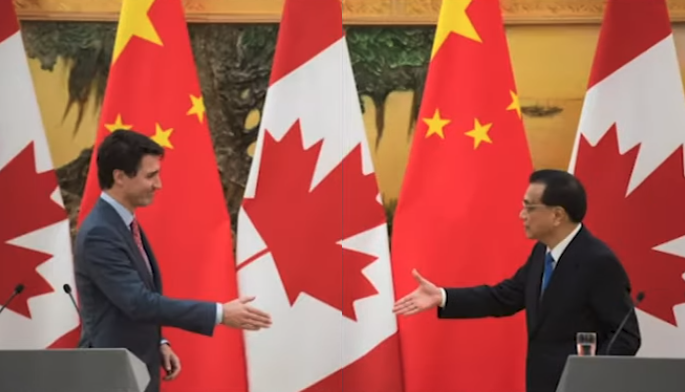
Is there a country with which Justin Trudeau hasn’t messed up Canada’s relationship?
Ted Campbell responds at some length to a Globe and Mail article by Doug Saunders, outlining the degradation of diplomatic relations with almost all our allies and trading partners since Justin Trudeau became PM.
The Globe and Mail‘s award-winning international affairs correspondent Doug Saunders, someone with whom I (almost equally) often disagree and agree, has penned an insightful piece in the Good Grey Globe in which he says that “Suddenly, Canada finds itself almost alone in the world, with a Liberal government realizing that its optimistic foreign policy no longer entirely makes sense … [but, he concludes] … Even if the current crisis in liberal democracy proves temporary and short-lived, we know that it can recur – and likely will. If the institutions of 1945 no longer work and the doctrines of 2015 have failed to have an effect, we should develop new ones that will keep Canada connected to the better parts of the world for the rest of the century.”
[…]“After the Second World War,” Mr Saunders writes, “Canada gained a few more foreign-policy outlets. Canada played a large role in creating the institutions that governed the postwar peace: the United Nations and its various organizations; NATO; the global trade body that became the World Trade Organization; the Bretton Woods institutions, including the International Monetary Fund and the World Bank. Canada was decisive in the international agreement that authorized the future creation of the twin states of Israel and Palestine, giving it a role in the Middle East that expanded with its creation of the institution of peacekeeping after the Suez Crisis in 1956 … [but this really is a silly statement, albeit one that too many Canadians believe to be true. Canada didn’t create the “institution of peacekeeping” in 1956. It was already there, in the United Nation’s case since Ralph Bunch (USA) and Sir Brian Urquhart (UK) created it in 1948 and it had been around since, at least, Woodrow Wilson’s 14 Points speech in 1918, but it is now part of the Laurentian Elite‘s quite dishonest revisions of Mike Pearson’s sterling legacy as a diplomat and politician] … And, starting in the 1950s, Canada became a player and a spender in the new field of foreign aid and development. Under both Liberal and Progressive Conservative governments, Canada used those tools to play a small but well-regarded place in the liberal-democratic order – and to slowly but profitably build its trade and economic relations.”
[…]
I agree with Doug Saunders about the sources of Canada’s current weakness. He neglected to mention the root cause: Pierre Trudeau explicitly rejected, in the late 1960s, the “St Laurent Doctrine” and replaced it with a social “culture of entitlement” which meant that our place in the world had to be sacrificed on the altar of a reinforced social safety net. I agree that Donald J Trump is the key to our and the West’s current angst and confusion, not Vladimir Putin, Xi Jinping or Arab terrorists, all of whom are easier to understand, but I would argue that we would be much better placed to cope with president trump and the 21st century had we not abandoned our role as a leading middle power circa 1970. I have reservations about all three of Mr Saunder’s prescriptions:
- I’m not sure another G-N, not even a “committee to save the world” is a really good idea;
- I am nervous about interfering in the internal affairs of other countries ~ think about “do unto others” and all that; and
- I really doubt that Canadians are ready to spend what’s needed on our defence and, I suspect, they will not be until it is (almost) too late.
Like Mr Saunders, Mr Lang and Professor Paris, I, too, want to save the liberal world order and Canada’s place in it; I’m just not sure that any of the proposed solutions offered by Doug Saunders, by Eugene Lang or even by Professor Roland Paris are going to be enough. I think we need less formality and fewer organizations in international actions and a lot more ad hocery. I hope that we will have new, adult leadership here in Canada in the fall of 2019 and I hope that a new, grownup prime minister will begin, quickly, to mend relations with Australia, India, Japan and the Philippines and other Asian nations, to shore up our relations with Europe and, especially, with Iceland, the Netherlands, Norway, Switzerland and UK. I also hope Canada will open new, more productive dialogues with Africa, the Caribbean and Latin America and with Iran, Russia and China, also. I am convinced that Professor Stein is correct and we must have an “interests-based,” even a selfish suite of foreign, defence, immigration and trade policies. We should not go about looking for enemies, but we must understand that we have precious few friends and, for now, we cannot count on America to be one of them. America, Australia and Britain, China, Denmark and India, Japan, Mexico and the Philippines, and Singapore and Senegal, too, will all act in pursuit of their own interests; Canada needs to be willing and able to do the same and to work with them, even with Donald Trump’s America and Xi Jinping’s China and Vladimir Putin’s Russia when our interests converge and, politely, stand aside when they diverge. The G7 and G20 and a proposed new G9 are all harmless, but also, largely useless, talking shops. Both diplomacy and foreign affairs must be conducted on a case-by-case, country-by-country, issue-by-issue and interest-by-interest basis and diplomacy and foreign affairs can only be conducted with positive effect when Canada is respected for both its examples and values (soft power) and for its hard, economic and military power, too.
Thus, the first step in doing our part to “save the world” is probably the one that most Canadians will have near the bottom of their priority list: rebuilding Canada’s military ~ which must start, after a lot of the fat has been trimmed from a morbidly obese military command and control (C²) superstructure, with steadily growing the defence budget … and that cannot happen until the economy is firing on all cylinders, including energy exports to the world.
June 30, 2019
Woodrow Wilson and the Versailles Treaty
Michael Filozof on the hundred-year anniversary of the Treaty of Versailles and the American President who had so much to do with the casting of the treaty:
Eight months after committing troops to war, Wilson cobbled together a list of progressive war aims in his Fourteen Points. They demanded an end to secret deals (i.e., the Treaty of London and the Sykes-Picot Agreement); “ethnic self-determination” for Poland and Austro-Hungarian territories that would soon become Yugoslavia and Czechoslovakia; “a free, open-minded, and absolutely impartial adjustment of all colonial claims,” and finally, a collective security organization, the League of Nations, which would be formed by a “covenant” (using the biblical term for a pact with God Himself) to maintain peace and territorial security of all nations.
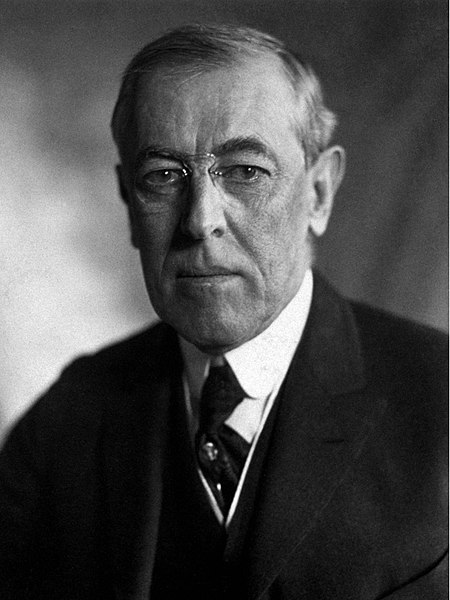
Woodrow Wilson, 1919
Photo via Wikimedia Commons.Upon reading the Fourteen Points, French prime minister George “the Tiger” Clemenceau is said to have sniggered, “God gave us only ten.”
In 1919, Wilson became the first sitting president to venture overseas, practically abandoning his domestic duties and spending six months at the Paris Peace Conference personally negotiating the Treaty of Versailles. He was joined by “The Inquiry,” a group of over 100 academics and professors who surely knew how to fix the world and usher in Wilson’s global utopia.
Initially, Wilson and his Fourteen Points were wildly popular. He was greeted as if he were a latter-day rock star in France and Italy. Delegations from ethnic groups around the world came to Paris to beg Wilson for “self-determination.” (His French and British counterparts, Clemenceau and David Lloyd George, sneered that Wilson “thought he was Jesus Christ.”)
But they were soon to be disappointed. Wilson’s aims were so grandiose that they could not possibly be fulfilled. Italians, who had switched sides in the war to gain territory on the Dalmatian coast, became disillusioned when Wilson refused to accede to Italian demands. The negotiators did create Poland, Czechoslovakia, and Yugoslavia, but all three were destined to become communist dictatorships, and the latter two failed to outlast the twentieth century.
Worst of all was Wilson’s hypocrisy when it came to dealing with Germany. Wilson had railed against German imperialism, but turned a blind eye to the biggest empire at the Conference: Great Britain. A pro-British bigot, Wilson was contemptuous of Irish demands for self-determination and had been disgusted by the Easter Rising of 1916. Wilson granted Britain and France Ottoman territories they had secretly agreed to divvy up in the Sykes-Picot agreement — not as “colonies,” but under the guise of League of Nations “mandates.” He willingly partitioned Germany into two non-contiguous territories, separated by the Polish Corridor, and placed millions of ethnic Germans in the newly created nation of Czechoslovakia and the Free City of Danzig.
On a slightly lighter note, Al Stewart’s “A League of Notions” does a wonderful job of capturing the machinations at Versailles:


