
The Western media and intelligentsia don’t seem to have a clue that the issues in the Middle East are not related to competing political ideologies, but to competing religious tribalism.
The ongoing conflicts throughout the region, and in other parts of the world, are not about democracy versus monarchy; or fascism versus communism; or imperialism versus freedom. Or indeed any of the other childish ideologies Western journalists fell in love with during their undergraduate post modernist deconstructionalist courses by failed ex-[Trotskyites], who simply can’t accept that the last century has proven how appalling and basically evil their over-simplistic ideologies are. (Yes Comrade Corbyn, that’s you and your gushing twitteratti I am slamming!)
In fact the problem in the Muslim world is that they are entering the third decade of the Muslim Civil War.
The Sunni and Shia are at about the point that the Roman Catholics and the Protestants were at in Europe in the 1620s to 30s, and it is only going to get worse. That war was ideological, and paid very little attention to national boundaries. This one is the same. The Christian 30 Years War is about to be repeated in a Muslim civil war, and 30 years might be an optimistic number.
Interestingly the Christians split over three or four centuries into Orthodox and Roman, then split again into Albigensian and Protestant, etc. Eventually it got to the point, after 14 or 15 centuries of slow development, that major conflict broke out. Is it co-incidence that the Muslims have followed a similar path? Is it inevitable that after 14 or 15 centuries of existence, they too are having a major internal conflict? Or is it just that a century of renewed prosperity and development (largely brought on by Western intrusion into their secular affairs) has given them the semi-educated proto-middle-class who traditionally stir up revolutionary stuff they don’t understand?
Whatever the reasons, stupid Westerners are eventually going to have to admit to a few of realities.
- No matter how much you fantasise about the functionality of republics and democracy, you can’t impose systems that don’t work in places that don’t have the necessary pre-requisites.
- No matter how much literacy or free press you do manage to push in, you can’t impose rule of law and understanding of natural law on societies that have very specifically rejected such concepts for eight or nine centuries.
- No matter how much your secularist ideologies (developed from safely behind two millennia of Christian teaching that accepts rule of law and natural law) is offended, you cannot expect a similar acceptance from people whose cultural development of such beliefs is several centuries behind the West.
- No matter what you want to believe, the Muslim civil war is happening.
Let’s hope we really are at least half way through the 30 years…
Nigel Davies, “The ‘Arab Spring’, 1848, and the 30 Years War/s”, Rethinking History, 2015-09-19.
December 8, 2015
QotD: Politics, ideology, tribalism, and religion in the Middle East
November 6, 2015
Turkish politics, post-election
Austin Bay looks at Turkey’s domestic political situation following the re-election of Recep Erdoğan’s Justice and Development Party:
The threat to Turkish democratic institutions is a man notoriously jealous of Ataturk, current president Recep Tayyip Erdoğan. The snap election gave Erdoğan and his Justice and Development Party, AKP, overwhelming control of parliament (316 of 550 seats). The AKP had controlled parliament since 2002, but in the June 7 election it lost its one-party majority. Political haggling among opposition parties, including Ataturk’s Republican Peoples Party, the CHP, failed to produce a coalition government; a new election was necessary.
However, in the intervening month’s domestic terrorist incidents, the fitful war with the Islamic State in the Levant and Syria’s violent chaos dominated Turkish politics.
Erdoğan portrayed himself as the only leader capable of addressing Turkey’s deteriorating security situation. Domestic security certainly diminished; why it did stirs angry accusations. Erdoğan’s political opponents maintain that he used the violence to solidify political support. His more vicious critics accuse him of intentionally permitting violence. For example, they argue his government could have prevented the Oct. 10 terror bombing of a peace march in Ankara, now attributed to ISIL. Over 100 people were murdered in that attack.
Is it an over the top conspiracy theory-type accusation? Possibly. Erdoğan himself, however, believes over the top conspiracy theories, and he uses conspiratorial doubt and fear as political tools. His record for jailing journalists and intimidating political opponents associated with his alleged conspiracies is fact, not theory. The election didn’t assuage his fears — it ignited another surge of arrests. On Nov. 3, police arrested scores of people associated with Erdoğan critic and Muslim cleric Fethullah Gulen. At one time Gulen supported Erdoğan and the moderate Islamist AKP. However, Gulen broke with Erdoğan over credible charges of corruption within Erdoğan’s governing circle.
Daniel Pipes isn’t convinced that the terror stampeded voters in Erdoğan’s direction (especially Kurdish voters), and he suspects fraud in the election results:
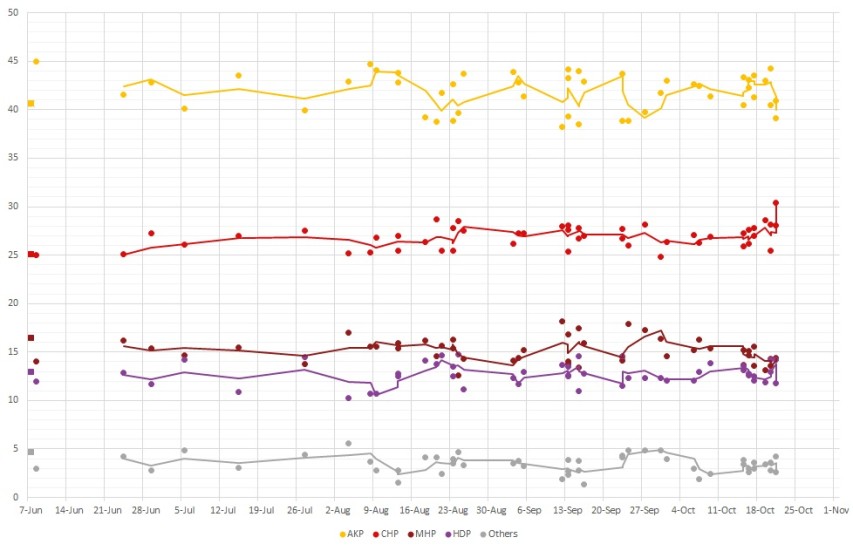
Like other observers of Turkish politics, I was stunned on November 1 when the ruling Justice and Development Party (Adalet ve Kalkınma Partisi, or AKP) was reported to have increased its share of the national vote since the last round of elections in June 2015 by 9 percent and its share of parliamentary seats by 11 percent.
The polls had consistently shown the four major parties winning about the same number of seats as in June. This made intuitive sense; they represent mutually hostile outlooks (Islamist, leftist, Kurdish, nationalist), making substantial movement between them in under five months highly unlikely. That about one in nine voters switched parties defies reason.
Polling results between the June and November 2015 Turkish elections
The AKP’s huge increase gave it back the parliamentary majority it had lost in the June 2015 elections, promising President Recep Tayyip Erdoğan a semi-legal path to the dictatorial powers he aspires to.
But, to me, the results stink of fraud. It defies reason, for example, that the AKP’s war on Kurds would prompt about a quarter of Turkey’s Kurds to abandon the pro-Kurdish party and switch their votes to the AKP.
October 22, 2015
The decline of democracy in Turkey
Last week, Daniel Pipes looked at the increasingly dictatorial ambitions of Turkish president Recep Tayyip Erdoğan:
The Republic of Turkey is undergoing possibly its greatest crisis since the founding of the state nearly a century ago. Present trends suggest worse to come as a long-time Western ally evolves into a hostile dictatorship.
The crisis results primarily from the ambitions of one very capable and sinister individual, Turkey’s 61-year old president, Recep Tayyip Erdoğan. A career politician who previously served four years as the mayor of Turkey’s megacity, Istanbul, and then eleven years as the country’s prime minister, he forwards two goals hitherto unknown in the republic: dictatorship and full application of the Shari’a, Islam’s law code.
During his first eight years of power, 2003-11, Erdoğan ruled with such finesse that one could only suspect these two aspirations; proof remained elusive. This author, for example, wrote an article in 2005 that weighed the contradictory evidence for and against Erdoğan being an Islamist. A combination of playing by the rules, caution in the Islamic arena, and economic success won Erdoğan’s party, Justice and Development (Adalet ve Kalkınma Partisi, or AKP), increasing percentages of the vote in parliamentary elections, going from 34 percent in 2002, to 46 percent in 2007, to 50 percent in 2011.
That 2011 election victory, his third in succession, gave Erdoğan the confidence finally to remove the armed forces from politics, where they had long served as Turkey’s ultimate power broker. Ironically, this change ended the increasing democratization of prior decades for his fully taking charge allowed Erdoğan to develop an oversized ego, to bare his fangs, flex his despotic muscles, and openly seek his twin objectives of tyranny and Shari’a.
Indeed, Erdoğan made his power felt in every domain after 2011. Banks provided loans to the businessmen who kicked back funds to the AKP. Hostile media found themselves subject to vast fines or physical assault. Ordinary citizens who criticized the leader found themselves facing lawsuits, fines, and jail. Politicians in competing parties faced dirty tricks. Like a latter-day sultan, Erdoğan openly flouted the law and intervened at will when and where he wished, inserting himself into legal proceedings, meddling in local decisions, and interfering with police investigations. For example, he responded to compelling raw evidence of his own and his family’s corruption by simply closing down the inquiry.
October 9, 2015
September 30, 2015
QotD: Self-government and the scale problem
The pioneering political thinkers of the West — Greeks, mostly Athenian, including the sublime Aristotle — devoted much thought to this question of scale. Their consensus was that a state of more than about five thousand people (plus slaves, of course) was essentially unmanageable, at least by its citizens. Large empires or alliances of states might attempt to guarantee the freedom and independence of these small states (or might not), but the hard fact was that above around five thousand souls, the participation of the citizen in his own government ceases to be reality, and becomes rather a pious (or impious) myth.
Skip forward to 1789, the year of the French Revolution. As I have written elsewhere, perhaps the most permanent effect of that Revolution was the transformation of local government across France. Overnight, the seemingly timeless boundaries of 60,000 French parishes, each governed in its own unique way — were erased and replaced with 36,000 “communes,” governed identically and now under central direction from Paris.
This model was copied, across most of Europe, for even those national politicians who did not share in the ideals of the Revolution were attracted by the prospect of central power. France has mostly preserved her revolutionary communes, of a piece in land area, though now a city such as Paris is a single commune with more than two million people. In other countries, these small districts were merged and merged again, into ever larger territorial units, ever more bureaucratic and ever more subject to central direction.
[…]
According to me — and I have mulled this at length, with my own feeble mental powers — the Greeks were right. Five thousand is near the top end of a population that can attempt genuine self-government, deciding for themselves what they will and will not put up with, inside their own little domains. In huge conurbations, I would say that is about the maximum size for a self-governing urban borough or ward, necessarily small in area. Outside, rural districts would be rather larger, and there the question of maximum acreage comes into view, balanced against the minimum population to make any formal government necessary.
Boundaries are important. Above the parish or ward, the county seems to be the next higher natural level of government, for the resolution of issues that cross parish boundaries. But at all levels, attention should be given to geography. The boundaries of the jurisdiction should correspond as closely as possible to natural landmarks, and elevations of land, such that e.g. riparian responsibilities can be assigned to the visibly appropriate jurisdiction.
What has all this got to do with the environmental management of the planet? Everything. Where people can see the cause and effect of their actions, problems such as pollution will be tackled, and beauties such as birdsong will not be sacrificed. If the problems aren’t tackled, and the blight spills into another jurisdiction, penalties may be imposed from a higher level, but first give people the chance and the power to solve their own problems at source. Give them ownership, and stable rule by law — not by central planning which rewrites laws for its own convenience.
David Warren, “Five thousand max”, Essays in Idleness, 2015-06-19.
July 17, 2015
India’s wavering devotion to tolerance
Shikha Dalmia looks at India’s changing views on other religions:
If there were ever a religion readymade for liberal democracy — and its commitment to religious freedom — Hinduism would be it. Unlike Christianity (and other monotheistic faiths), Hinduism has no one true doctrine handed down by the one true God to be spread and enforced through the one true Church. It’s a loose, amorphous, and ecumenical faith that accepts that all religions are valid and it doesn’t matter which one you follow, as long as you are going to the same place. Hence, it made sense when Hindu-dominated India, after gaining independence from the British in 1947, enshrined secularism and religious pluralism in its constitution — rather than going through a three-century-long process from the Reformation through the Enlightenment that the West did to pry open space for religious tolerance in Christianity.
However, India’s commitment to religious freedom and toleration has been under serious challenge for a couple of decades with the rise of Hindutva or Hindu nationalism. This ideology, that boasts Prime Minister Narendra Modi among its adherents, has always resented the special space that India’s constitution extends its minority religions — like letting Muslims use sharia in their civil matters. But now it has started openly attacking even their right to exist in India because, it maintains, India belongs only to those that can claim it as their fatherland and holy land — a rather hypocritical requirement given that the rapidly spreading Hindu diaspora enjoys strong religious protections in countries such as America and England that aren’t its “holy land and fatherland.”
That a historically tolerant faith could take such an intolerant turn suggests that a religion’s relationship to liberal values might have less to do with its own inner character and more to do with the existential insecurities of its adherents in a given time.
April 21, 2015
Lee Kuan Yew and Singapore’s amazing economic success
Earlier this month, Alvaro Vargas Llosa examined the economic success of Singapore under the authoritarian rule of Lee Kuan Yew:
Lee Kuan Yew, Singapore’s legendary statesman, who died last month at the age of 91, posed a challenge to those of us who believe in political and economic freedom (and all other freedoms). His combination of authoritarianism and economic freedom, of social engineering and self-reliance, worked. The result was a society that is more prosperous than most others, but free only in some respects.
For years, the best examples one could come up with to show that the marriage of economic and political liberty could work were the liberal democracies of the developed world, whose achievements originated in centuries past and different circumstances.
Lee Kuan Yew’s credentials became strong as many countries that also gained independence in the 1950s or 1960s opted for a mix of nativism and collectivism that kept them poor while tiny Singapore, with no natural resources, emerged as an economic powerhouse. While Mao, Ho Chi Minh, and Castro — not to cite Mobutu, Idi Amin Dada, and others — destroyed the chances of a decent life for many generations, Lee Kuan Yew created the conditions for a 124-fold increase in Singapore’s per capita income in half a century.
[…]
Singapore’s case is exceptional, which makes it a tough challenge for those of us who think freedom is best served by not carving it up. My belief is that Singapore has been able to preserve its curious mix because of the absence of prosperous liberal democracies around it. But its model is based on globalization, and it’s therefore porous to good ideas.
In a world in which more countries, including Asian ones, end up successfully embracing democracy under the rule of law as well as free trade, it will be impossible for the city-state to avoid the comparison and the contagion. It is one thing to preserve an authoritarian model because your neighbors espouse a less successful one, and quite another to perpetuate it in the face of equally or even more successful societies that espouse a freer model.
March 11, 2015
Venezuela, then and now
Kevin D. Williamson looks to the not-too-distant past to see how Venezuela got into the economic disaster they’re currently facing:
Venezuela had a good run of it for about five minutes there, at least in public-relations terms. When petroleum prices were booming, all it took was a few gallons of heating oil from Hugo Chávez to buy the extravagant praise of House members, with Representative Chaka Fattah (D., Philadelphia) issuing statements praising Venezuela’s state-run oil company “and the Venezuelan people for their benevolence.” Lest anybody feel creeped out by running political errands for a brutal and repressive caudillo, Joseph Kennedy — son of Senator Robert Kennedy — proclaimed that refusing the strongman’s patronage would be “a crime against humanity.” Kennedy was at the time the director of Citizens Energy, which had a contract to help distribute that Venezuelan heating oil — Boss Hugo was a brute, but he understood American politics.
Celebrities came to sit at his feet, with Sean Penn calling him a “champion” of the world’s poor, Oliver Stone celebrating him as “a great hero,” Antonio Banderas citing his seizure of private businesses as a model to be emulated in the rest of the world, Michael Moore praising his use of oil for political purposes, Danny Glover celebrating him as a “champion of democracy.” His successor, Nicolás Maduro, continued in the Chávez vein, and even as basics such as food and toilet paper disappeared the American Left hailed him as a hero, with Jesse Myerson, Rolling Stone’s fashionable uptown communist, calling his economic program “basically terrific.” Some of the more old-fashioned liberals at The New Republic voiced concern about Venezuela’s sham democracy, its unlimited executive authority, political repression, the hunting down of government critics, the stacking of elections and the government’s perpetrating violence inside polling places — but Myerson insisted that Venezuela’s “electoral system’s integrity puts the U.S.’s to abject shame.” Never mind that opposition leaders there are hauled off to military prison after midnight raids.
Vice President Biden, who can always be counted on to cut straight to the heart of any political question, ran into Maduro in Brazil and, noting the potentate’s thick mane, commented: “If I had your hair, I’d be president of the United States.” Tragically for the Sage of Delaware, hair transplants don’t work that way.
That is all going down the memory hole. The Obama administration has announced economic sanctions on Venezuela’s rulers and its intelligence agents, citing the “erosion of human-rights guarantees” – erosion, as though this were something new, as though Hugo Chávez hadn’t been a tyrant back when President Obama’s ally Representative Fattah was carrying his political water all over the eastern seaboard. In the New York Times’ account of Venezuela’s woes and Maduro’s misrule, there is no mention at all of the critical role the American Left played in lending legitimacy to Chavismo, of the so-called liberals and progressives who denounced legitimate protests against Maduro’s brutality as nefarious U.S.-backed coup attempts, who remained — and remain — silent on the regime’s censorship, political repression, torture, and economic incompetence. William Neuman of the Times did find an economist — a leftist economist, he assures us — who went so far as to say that certain aspects of the Chávez program “needed to be revised or even discarded to set the nation’s economy on the right track.”
March 6, 2015
QotD: Persecuting political heretics
It seems to be forgotten that the current American theory that political heresy should be put down by force, that a man who disputes whatever is official has no rights in law or equity, that he is lucky if he fares no worse than to lose his constitutional benefits of free speech, free assemblage and the use of the mails it seems to be forgotten that this theory was invented, not by Dr. Wilson, but by Roosevelt. Most Liberals, I suppose, would credit it, if asked, to Wilson. He has carried it to extravagant lengths; he is the father superior of all the present advocates of it; he will probably go down into American history as its greatest prophet. But it was first clearly stated, not in any Wilsonian bull to the right-thinkers of all lands, but in Roosevelt’s proceedings against the so-called Paterson anarchists. You will find it set forth at length in an opinion prepared for him by his Attorney-General, Charles J. Bonaparte, another curious and almost fabulous character, also an absolutist wearing the false whiskers of a democrat. Bonaparte furnished the law, and Roosevelt furnished the blood and iron. It was an almost ideal combination; Bonaparte had precisely the touch of Italian finesse that the Rough Rider always lacked. Roosevelt believed in the Paterson doctrine in brief, that the Constitution does not throw its cloak around heretics to the end of his days. In the face of what he conceived to be contumacy to revelation his fury took on a sort of lyrical grandeur. There was nothing too awful for the culprit in the dock. Upon his head were poured denunciations as violent as the wildest interdicts of a mediaeval pope.
The appearance of such men, of course, is inevitable under a democracy. Consummate showmen, they arrest the wonder of the mob, and so put its suspicions to sleep. What they actually believe is of secondary consequence; the main thing is what they say; even more, the way they say it. Obviously, their activity does a great deal of damage to the democratic theory, for they are standing refutations of the primary doctrine that the common folk choose their leaders wisely. They damage it again in another and more subtle way. That is to say, their ineradicable contempt for the. minds they must heat up and bamboozle leads them into a fatalism that shows itself in a cynical and opportunistic politics, a deliberate avoidance of fundamentals. The policy of a democracy thus becomes an eternal improvisation, changing with the private ambitions of its leaders and the transient and often unintelligible emotions of its rank and file.
H.L. Mencken, “Roosevelt: An Autopsy”, Prejudices, Second Series, 1920
February 10, 2015
QotD: Populists
The strength of the populists consists in a certain naïveté. They actually believe in “democracy.” And they are all mystical “nationalists” within their respective statist domains. They think that the nature of the modern State can be changed; that it would be possible, for instance, to downsize it, to reduce taxes, to maybe pay down some debt, to make the agencies of the State responsive to their individual customers, more reflective of human decency, &c. In power, they confront the reality, of machinery vastly large and complex, regulations fantastically detailed and comprehensive, all backed by the power of written law, to be enforced when necessary by violence. And being crass, the best they can do is empty their chamberpots into the machine, here and there. They prove rank amateurs, and upon their removal from office, the “natural party of government” returns, to make some minor sloppy repairs, then resume the mission of Nanny Statecraft — with ambitious new programmes and departments to reward dependency, and crush the spirit of liberty and enterprise; focusing their efforts to make sure that trouble does not arise from the same quarter again.
The citizen of every modern Nation State is fully integrated with that machinery: strapped into place and identifiable by serial number. There is nothing voluntary in his participation: the definition of an “outlaw” has been amended over time, to mean specifically failure to cooperate with any government agent, or to surrender immediately to his demands. (I laugh, bitterly, when a media smartie proposes e.g. mandatory voting, as if adding more idiots to the electorate will improve anything. And yet I welcome it as a frank admission that democracy is a totalitarian creed.)
I do not see how this machinery could ever be peacefully dismantled, given not only its scale, but its claim to the universal authority once accorded only to God. Now that it has had five centuries to grow (counting from the real Reformation, when such as Henry VIII dissolved the monasteries, and appropriated Church property and titles to the State, subjecting divine to profane authority throughout his realm) I do not anticipate a quick turnaround. I do, however, see that when it collapses, the machinery will come down directly on top of all of us.
David Warren, “Hapless Voters”, Essays in Idleness, 2014-05-26.
January 27, 2015
QotD: Political parties and principles
Normally, [the voters] are suckered. The political class — the class of politicians, senior bureaucrats, self-interested lobbyists, and all their paid flunkeys in media and elsewhere — are much cleverer than “the people,” on political questions. “The people,” for their part, may be individually cleverer than they, but not, as a rule, on political questions, which don’t much interest the great majority of them. The political class have, in addition to whatever native smarts, plenty of experience manipulating “the people,” and the contempt required to be ruthless about it. In a fully-fledged “democracy,” it takes little sophistry for the bad guys to win. But the term is relative, and should the good guys win, it will be another victory for the politicians.
A few days ago, I found myself trying to explain this to a well-intended, rightwing person. He complained that the Conservative Party had turned its back on “conservative principles.” This struck me as an unfair allegation, for the party had never once in the history of Canada, whether at the provincial or Dominion level, embraced “conservative principles,” nor shown the slightest curiosity over what they might be. The purpose of a political party has nought to do with such “principles.” (This goes for all parties including, within five years of their founding, those founded on “principles.”) Rather it is to tax as much as they dare, and distribute the takings among their friends, while “nation building” — i.e. adding to the machinery of State. A party unclear on this essential “principle” of democracy (the one that defeats every other principle) might get itself elected by some fluke, but will not long retain power.
David Warren, “Hapless Voters”, Essays in Idleness, 2014-05-26.
January 21, 2015
QotD: Teddy Roosevelt and the rise of the Progressives
When, after a generation of that sort of compromising, the so-called Progressive party was organized and he [Theodore Roosevelt] seized the leadership of it from the Westerners who had founded it, he performed a feat of wholesale englutination that must forever hold a high place upon the roll of political prodigies. That is to say, he swallowed at one gigantic gulp, and out of the same herculean jug, the most amazing mixture of social, political and economic perunas ever got down by one hero, however valiant, however athirst — a cocktail made up of all the elixirs hawked among the boobery in his time, from woman suffrage to the direct primary, and from the initiative and referendum to the short ballot, and from prohibition to public ownership, and from trust-busting to the recall of judges.
This homeric achievement made him the head of the most tatterdemalion party ever seen in American politics — a party composed of such incompatible ingredients and hung together so loosely that it began to disintegrate the moment it was born. In part it was made up of mere disordered enthusiasts — believers in anything and everything, pathetic victims of the credulity complex, habitual followers of jitney messiahs, incurable hopers and snufflers. But in part it was also made up of rice converts like Roosevelt himself — men eager for office, disappointed by the old parties, and now quite willing to accept any aid that half-idiot doctrinaires could give them. I have no doubt that Roosevelt himself, carried away by the emotional storms of the moment and especially by the quasi-religious monkey-shines that marked the first Progressive convention, gradually convinced himself that at least some of the doctrinaires, in the midst of all their imbecility, yet preached a few ideas that were workable, and perhaps even sound. But at bottom he was against them, and not only in the matter of their specific sure cures, but also in the larger matter of their childish faith in the wisdom and virtue of the plain people. Roosevelt, for all his fluent mastery of democratic counter-words, democratic gestures and all the rest of the armamentarium of the mob-master, had no such faith in his heart of hearts. He didn’t believe in democracy; he believed simply in government. His remedy for all the great pangs and longings of existence was not a dispersion of authority, but a hard concentration of authority. He was not in favor of unlimited experiment; he was in favor of a rigid control from above, a despotism of inspired prophets and policemen. He was not for democracy as his followers understood democracy, and as it actually is and must be; he was for a paternalism of the true Bismarckian pattern, almost of the Napoleonic or Ludendorffian pattern — a paternalism concerning itself with all things, from the regulation of coal-mining and meat-packing to the regulation of spelling and marital rights. His instincts were always those of the property-owning Tory, not those of the romantic Liberal. All the fundamental objects of Liberalism — free speech, unhampered enterprise, the least possible governmental interference — were abhorrent to him. Even when, for campaign purposes, he came to terms with the Liberals his thoughts always ranged far afield. When he tackled the trusts the thing that he had in his mind’s eye was not the restoration of competition but the subordination of all private trusts to one great national trust, with himself at its head. And when he attacked the courts it was not because they put their own prejudice before the law but because they refused to put his prejudices before the law.
In all his career no one ever heard him make an argument for the rights of the citizen; his eloquence was always expended in expounding the duties of the citizen. I have before me a speech in which he pleaded for “a spirit of kindly justice toward every man and woman,” but that seems to be as far as he ever got in that direction — and it was the gratuitous justice of the absolute monarch that he apparently had in mind, not the autonomous and inalienable justice of a free society. The duties of the citizen, as he understood them, related not only to acts, but also to thoughts. There was, to his mind, a simple body of primary doctrine, and dissent from it was the foulest of crimes. No man could have been more bitter against opponents, or more unfair to them, or more ungenerous.
H.L. Mencken, “Roosevelt: An Autopsy”, Prejudices, part 2, 1920.
December 6, 2014
The “low-information voter”
At The Gods of the Copybook Headings, Richard Anderson charts the sad decline of Michael Chong (whose brave attempt to reform our political system has been thoroughly neutered by the powers-that-be), and talks about the infamous “low-information voters” who somehow keep screwing up democracy … or something:
There has been much bemoaning in recent months about the “low information voter.” This is a polite euphemism for “lazy dumb asses.” The lazy dumb ass is a universal phenomenon but our age has take this once marginal figure and made him central to our political concerns. Different eras would have simply ignored the lazy dumb asses and restricted the franchise to people who give a rat’s ass about the political process. Oh what a Golden Age that was!
Why does it matter? A politician who knows that he must confront an engaged and informed electorate won’t try to pull half as many political stunts. Politics is the art of the possible which is another way of saying the art of whatever hell you can get away with. When a critical mass of the electorate are lazy dumb asses the job of the politician becomes easier. Lying is easier. Evading responsibility is easier. It’s the difference between dealing with an omniscience mother and an idiot man child. The electorate was never quite the former but it has now largely become the latter.
Sometimes half a loaf is worse than no loaf. Mr Chong earned some very impressive brownie points with the civic minded set when he resigned from cabinet and then proposed this bill. There was a kind of teary eyed delusion when it was first introduced. A principled politician making a principled stand on the very important principle of responsible government. Many of us nearly fainted from righteous appreciation.
The spectacle of the great and the good talking about the “low-information voter” is quite amusing: what you think they’re talking about isn’t actually the case. In most cases, they’re talking about you.
It’s been less than a century since the franchise was extended to most adults (by chronology, anyway) and a decade or so less for those with two “X” chromosomes. Harking back to some imaginary golden age when voters actually cared seriously about how to cast their votes is nonsense … the vast majority of voters — regardless of how broad or restrictive the franchise might be — were, are, and will forever continue to be low-information voters. This is because of our old friend from the dismal field of economics, the opportunity cost.
The cost to you for educating yourself about the political situation and the current contenders in any given election is almost always orders of magnitude higher than any possible benefit you might personally derive from getting your vote “right”. As a rational being, it’s insane for you to spend any time at all in figuring out who to vote for — this is why party labels are so important. You don’t know whether to vote for Saba Chen-O’Toole-Wenger or Mohammed Jean-Claude Campbell-Mirkovich? Check their party affiliations for a cheater’s guide. Ms. Chen-O’Toole-Wenger is for the Jacobins, while Mr. Campbell-Mirkovich is for the Falangists at least lets you know whether option A is better (for you) than option B. I’m not really a fan of the party system, but it clearly does provide a useful benefit in the voting booth.
November 4, 2014
QotD: Democracies need freedom of speech
In the New Statesman, Sarah Ditum seemed befuddled that the ‘No Platform’ movement — a vigorous effort to deny public platforms to the British National party and the English Defence League — has mysteriously advanced from silencing ‘violent fascists’ to silencing all kinds of other people, like a Guardian feminist who ventured some insufficiently affirming observations about trans-women and is now unfit for polite society. But, once you get a taste for shutting people up, it’s hard to stop. Why bother winning the debate when it’s easier to close it down?
Nick Lowles defined the ‘No Platform’ philosophy as ‘the position where we refuse to allow fascists an opportunity to act like normal political parties’. But free speech is essential to a free society because, when you deny people ‘an opportunity to act like normal political parties’, there’s nothing left for them to do but punch your lights out. Free speech, wrote the Washington Post’s Robert Samuelson last week, ‘buttresses the political system’s legitimacy. It helps losers, in the struggle for public opinion and electoral success, to accept their fates. It helps keep them loyal to the system, even though it has disappointed them. They will accept the outcomes, because they believe they’ve had a fair opportunity to express and advance their views. There’s always the next election. Free speech underpins our larger concept of freedom.’
Mark Steyn, “The slow death of free speech”, The Spectator, 2014-04-19
October 5, 2014
Protest locations in Hong Kong
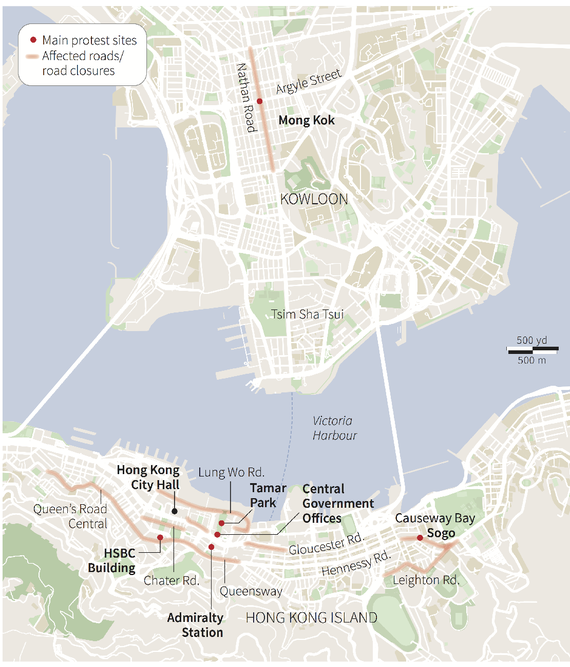
In The Atlantic, Bourree Lam looks at where the Hong Kong protests tend to be located:
Hong Kong’s “umbrella revolution” — an anticipated protest movement with unanticipated mass turnout — is currently spreading across an island slightly bigger than Manhattan.
The Occupy Central with Love and Peace (OCLP) campaign, whose main demands are the resignation of Chief Executive CY Leung and true democracy for Hong Kong, announced months ago that it planned to shut down Hong Kong’s Central District — the city’s financial hub, which also houses government offices (including the Legislative Council’s buildings and the chief executive’s residence) and a luxury-shopping strip featuring a city block-wide Louis Vuitton store (by night it’s where tourist and locals go drinking and clubbing, especially in the Lan Kwai Fong area). Beginning with British colonial rule in 1841, the district has gradually become the main artery of Hong Kong’s business and social life.
But the protest movement, of which the OCLP is now just one part, has expanded in the last few days to the districts of Admiralty, Causeway Bay, and Mongkok — some of the city’s most bustling commercial sectors. On Tuesday, the protests encompassed the areas of Tsim Sha Tsui and Wan Chai. And, in a twist on the ‘Occupy’ movement in the United States, the demonstrations haven’t been confined to public squares; they’ve also spread to intersections, forcing road closures. Protesters, for instance, are currently holding their positions on Connaught Road Central, a major six-lane throughway that connects four districts on the island.
[…]
Update: Zachary Keck is quite pessimistic on the chances for success.
As covered extensively in The Diplomat, tens of thousands of protesters have taken to the streets of Hong Kong demanding democratic reforms. Specifically, the protesters want free and fair elections and universal suffrage to select the city’s government, which Beijing promised as part of the condition for the U.K. handing back the city to mainland China.
Sadly, Occupy Central is doomed to fail. The Chinese government will not accept the protesters’ demands.
Beijing has already made it clear that it views free and fair elections in Hong Kong to be a threat to one-party rule in the country. At most, it will allow Hongkongers to select one of the candidates that it pre-approves. It has also deemed Occupy Central illegal. In other words, the Chinese Communist Party views the issue as one of its “core interests,” and it hasn’t stayed in power this long by compromising on issues that it views as threats to its survival.
[…]
The massive protests that have swept through Hong Kong in recent days have only made it more urgent that the CCP hold the line on the issue. The Party can ill afford an example of mass demonstrations forcing it to compromise on an issue deemed to be of core importance. Before the protests, it was possible the CCP might have assessed that free and fair elections in Hong Kong would not threaten one-Party rule on the mainland because of the “one country, two systems” mantra. However, the Party giving in on a core issue because of mass protests would, without question, set a dangerous precedent for the CCP’s grip on power in mainland China. It therefore will not be done.
This isn’t to say that a violent crackdown is coming. Indeed, as is almost always the case, the CCP will want the local government on the frontlines in handling the protesters, while Beijing directs things from behind the scenes. As Steve Hess has pointed out in The Diplomat, using local governments as scapegoats has long been an effective tool of the CCP. If it means the restoration of stability, that could very well mean the end of CY Leung’s career. It’s also possible some sort of “compromise” will be worked out that allows the protesters to claim some sort of victory without compromising the CCP’s ability to maintain a large degree of control over the chief executive of Hong Kong.


