
The Coalition horrors warned of by the Conservatives have come to pass, at the hands of the Conservatives themselves. They have spent like drunken Trudeau-era Grits. They have compromised their principles and told a key part of their base to stuff it. They have put patronage ahead of promise in their Senate appointments. Short of holding another referendum on national unity, they are as bad as what they claim to abhor.
It should then come as no surprise that Stephen the Spendthrift is rumoured to be in bed with Giles the Traitor. The deal at hand is classic pork-barrelling: Federal subsidies for an uneconomical Quebec City NHL arena. The region is the Tories only stronghold in La Belle Province, naturally a little electoral sweetener wouldn’t go amiss. Tis’ the season to be generous, with other people’s money. The Bloc serve no function except as a pressure group for the Quebecois. Their tautological platform has only one plank: What is Good for Quebec is Good for Quebec. It’s a deal made in political heaven, or hell for those who believe that principle should play a role in politics.
The much-abused Tory base remains loyal. The question is to what? To conservative values? Unlikely. Yes, the Tories have a minority government. That does limit what they can do. Lester Pearson also had two back to back minority governments, and he introduced sweeping changes to the country, albeit most of them bad.
Is the failure of the Harper Tories one of opportunity, or courage? And should the Conservatives at long last win their majority, what mandate will they have? They have governed from the center for so long, how can they justify governing from the RIght? Won’t the rationale then become we can’t take risks because we might lose the majority? So when will the Reform come? As time passes it becomes clear that many Conservatives’ loyalty lies with Team Blue, not conservative ideas or values.
Publius, “The Traitors and the Spendthrifts”, Gods of the Copybook Headings 2010-11-25
November 25, 2010
QotD: “The Traitors and the Spendthrifts”
Even China may not be able to afford their High Speed Rail network
By way of Hit and Run, a brief note of caution about the headlong pace of construction of China’s High Speed Rail:
The Chinese Academy of Sciences (CAS) reported to the State Council recently, urging the large-scale high-speed railway construction projects in China to be re-evaluated. The CAS worries that China may not be able to afford such a large-scale construction of high-speed rail, and such a large scale high-speed rail network may not be practical.
[. . .] Under the current plan, the central government has approved to build, by 2020, 16,000 km of high speed rail providing access to about 90% of the Chinese population.
[. . .]
The report submitted by the Chinese Academy of Sciences said China’s high-speed rail construction has caused debt that has already reached unsustainable levels; particularly since the end of 2008, the government introduced a stimulus plan to fight the global economic crisis and the size of local government borrowing is already very high
As Ronald Bailey points out, China is now occupying the same position in American thoughts that Japan did thirty years ago — the economic juggernaut that is poised to crush weak and defenceless American business. The recent gushing about how wonderful China’s HSR system is and how America should build one too are really just echoes of the 1980’s lament on how Japan’s economic model worked so much better than messy US mixed-market capitalism.
Back in the 1980s, I was a producer for a national weekly PBS foreign policy show called American Interests. We ran a lot of nifty programs on various aspects of the Cold War. Another abiding obsession of the chattering classes was the coming triumph of Japan Inc. over a hapless America. We regularly broadcast shows featuring the likes of Robert Reich, Chalmers Johnson (see H&R obit from yesterday), and Clyde Prestowitz predicting that the wise bureaucrats at the helm of Japan’s Ministry of International Trade and Industry deftly deploying their industrial policy jujitsu would soon bury us Yanks. As evidence, critics of undirected American capitalism pointed out that Japan’s economy was growing at 6 to 8 percent per year. Japan was exporting its way to prosperity and the U.S. was running a huge trade deficit with the East Asian powerhouse. Japan could do no wrong and America could do no right. Then the Japanese bubble burst.
Twenty years later, the new meme of would-be industrial policy mavens is China Inc. Promoters include Thomas Friedman and Clyde Prestowitz. China is growing at a blistering pace of 10 percent per year and exporting its way to prosperity. Once again, we are told that East Asian capitalism directed from the top by wise bureaucrats is going to outcompete the United States and toss us into the dustbin of histoy.
November 23, 2010
Succinct summary of Irish situation
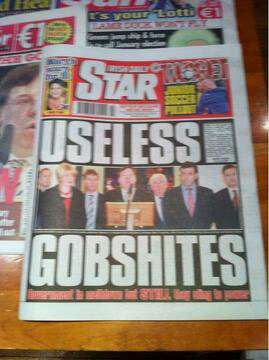
From Andrew Bloch’s Twitpic page and brought to my attention by Damian Penny.
November 5, 2010
November 3, 2010
Monty: The flushing sound you just heard is California’s future
Monty pronounces the final doom of California:
That sound you just heard was the State of California irretrievably flushing itself down the toilet.
[. . .]
California’s most dire problems right now are related to public-employee obligations (pensions and healthcare). The power of public-employee unions in California have held the State and local governments in thrall for years, and with the election of Jerry Brown as Governor, the people of California have opted to spray kerosene on a blaze that was already threatening to overwhelm them.
[. . .]
Well, the die has been cast, California. You have placed your fate into the hands of a political party and a governmental machine that cares for nothing except what it can squeeze out of you to keep the party-train rolling. There will come a time in the not-too-distant future when you will have cause to bitterly regret what happened last night, and to wonder when the disaster truly became unavoidable. Well, now you know: it happened last night when you elected Jerry Brown as your governor. You chose to kowtow to the labor unions; you chose to believe comforting lies rather than the horrible truth.
You will reap the whirlwind.
Update: A couple of Twitter updates from Iowahawk sum things up nicely.
10:28: Boxer, Brown, no on Prop 19: congrats, California. You have officially gone Full Retard.
11:05: And as if California wasn’t already full of idiots, lunatics, and drug abusers, I’m flying there this afternoon.
October 28, 2010
October 25, 2010
Amity Schlaes’ (condensed) The Forgotten Man
An article encapsulating some of the key points of Amity Schlaes’ The Forgotten Man in PDF form:
We all know the traditional narrative of that event: The stock market crash generated an economic Katrina. One in four was unemployed in the first few years. It resulted from a combination of monetary, banking, credit, international, and consumer confidence factors. The terrible thing about it was the duration of a high level of unemployment, which averaged in the mid teens for the entire decade.
The second thing we usually learn is that the Depression was mysterious — a problem that only experts with doctorates could solve. That is why FDR’s floating advisory group — Felix Frankfurter, Frances Perkins, George Warren, Marriner Eccles and Adolf Berle, among others — was sometimes known as a Brain Trust. The mystery had something to do with a shortage of money, we are told, and in the end, only a Brain Trust’s tinkering with the money supply saved us. The corollary to this view is that the government knows more than American business does about economics.
Another common presumption is that cleaning up Wall Street and getting rid of white-collar criminals helped the nation recover. A second is that property rights may still have mattered during the 1930s, but that they mattered less than government-created jobs, shoring up home-owners, and getting the money supply right. A third is that American democracy was threatened by the rise of a potential plutocracy, and that the Wagner Act of 1935 — which lent federal support to labor unions — was thus necessary and proper. Fourth and finally, the traditional view of the 1930s is that action by the government was good, whereas inaction would have been fatal. The economic crisis mandated any kind of action, no matter how far removed it might be from sound monetary policy. Along these lines the humorist Will Rogers wrote in 1933 that if Franklin Roosevelt had “burned down the capital, we would cheer and say, ‘Well at least we got a fire started, anyhow.’”
To put this official version of the 1930s in terms of the Monopoly board: The American economy was failing because there were too many top hats lording it about on the board, trying to establish a plutocracy, and because there was no bank to hand out money. Under FDR, the federal government became the bank and pulled America back to economic health.
When you go to research the 1930s, however, you find a different story. It is of course true that the early part of the Depression — the years upon which most economists have focused — was an economic Katrina. And a number of New
Deal measures provided lasting benefits for the economy. These include the creation of the Securities and Exchange Commission, the push for free trade led by Secretary of State Cordell Hull, and the establishment of the modern mortgage format. But the remaining evidence contradicts the official narrative. Overall, it
can be said, government prevented recovery. Herbert Hoover was too active, not too passive — as the old stereotypes suggest — while Roosevelt and his New Deal policies impeded recovery as well, especially during the latter half of the decade.
H/T to Monty for the link.
QotD: Mark Steyn on China’s coming demographic bomb
In 2009, the US spent about $665 billion on its military, the Chinese about $99 billion. If Beijing continues to buy American debt at the rate it has in recent times, then within a few years US interest payments on that debt will be covering the entire cost of the Chinese military. This summer, the Pentagon issued an alarming report to Congress on Beijing’s massive military build-up, including new missiles, upgraded bombers, and an aircraft-carrier R&D program intended to challenge US dominance in the Pacific. What the report didn’t mention is who’s paying for it.
Answer: Mr and Mrs America.
By 2015, the People’s Liberation Army, which is the largest employer on the planet, bigger even than the US Department of Community-Organizer Grant Applications, will be entirely funded by US taxpayers. When the Commies take Taiwan, suburban families in Connecticut and small businesses in Idaho will have paid for it.
[. . .]
Chinese state-controlled enterprises are buying up everything from copper in Canada to zinc in Australia to bauxite in Jamaica. They’re doing what the first settlers did vis a vis the Indians: They sell us trinkets in return for our resources. That said, I disagree with the conclusion of this video. The danger from China is not its strength, but its underlying weaknesses: As I wrote in America Alone, it will get old before it gets rich, and, unless it’s planning on becoming the first gay superpower since Sparta, the millions of surplus young men whom the One-Child Policy has deprived of female companionship is a recipe for profound social convulsions. That’s actually worse news than if China was cruising to global hegemony — because it means their calculations on how the Sino-American relationship evolves are even less likely to align with ours.
Mark Steyn, “Campaign Countdown”, SteynOnline, 2010-10-25
October 17, 2010
October 4, 2010
A cameo economic round-up by Monty
One of the most interesting features over at Ace of Spades HQ used to be the daily economic round-ups by Monty. Unfortunately, he had to take a breather, but we’re able to get an occasional update like this one:
[In which Monty, long away from the neighborhood, returns to save the local mom-n-pop bank from a hostile takeover through a stylish melange of breakdancing, infectious urban beats, and the rap music that all the youngsters seem to be so fond of. Thrill to the parachute pants, Jheri curls, and mirrored wraparound sunglasses! (The soundtrack, “Monty Raps! Funky Accordion and Theremin Music For These Troubled Modern Times”, now available in fine discout outlets nationwide!)]
[. . .]
I just wouldn’t be me if I didn’t point out that gold is now $1314/oz as I write this. I bought some gold five years back at about $500/oz; that’s a pretty damned good rate of return for something that’s just supposed to be an inflation hedge. The naysayers can continue mumbling that I can’t eat gold, that I will be crucified on a cross of gold, the gold is just metal and has no innate value — I will simply point to the fact that it has outperformed every other investment in my portfolio, and by quite a large margin. And as a long-term store of value, I trust it a hell of a lot more than Treasuries. (Silver has done even better in absolute terms.)
Ah, but what about those safe-haven darlings of investors, municipal bonds? The romance may be on the rocks. I’ve thought for a long time that municipal debt is the next big shoe to drop in this recession/depression/worker’s paradise that we’re living in. Harrisburg, PA made the news recently when they barely escaped having to declare bankruptcy, but Harrisburg is only one of tens or even hundreds of muncipalities in the nation in dire financial straits. There seems to be a belief that the feds will bail them out before things get too grim, but this ignores two facts: a) the appetite for another trillion-dollar bailout is at subzero levels, and b) it’s not clear that taxpayers of one state will be willing to bail out the profligate citizenry of another. Prudent residents of Lincoln, NE or Minot, ND may not wish to fund the rather more lavish lifestyles of a San Diego or Miami. However much we “feel” the federal and state debt, we’d feel a municipal crash a lot harder because it hits us right where we live (literally): trash collection, sewer, water, road repair, snow removal, all the rest. You pay more and more and get less and less from it. (Oh, and guess what the major financial burden on municipal governments is these days? If you said “public-employee pension and health benefits”, give yourself a gold star and then a smack upside the head for being an insufferable know-it-all.)
October 1, 2010
You think you’re struggling with the burden of old debts?
Consider the case of Imperial Germany:
First World War officially ends
The First World War will officially end on Sunday, 92 years after the guns fell silent, when Germany pays off the last chunk of reparations imposed on it by the Allies.The final payment of £59.5 million, writes off the crippling debt that was the price for one world war and laid the foundations for another.
Germany was forced to pay the reparations at the Treaty of Versailles in 1919 as compensation to the war-ravaged nations of Belgium and France and to pay the Allies some of the costs of waging what was then the bloodiest conflict in history, leaving nearly ten million soldiers dead.
H/T to Jon, my former virtual landlord, for the link.
September 12, 2010
QotD: Ireland’s post-boom cleanup
It’s not a good sign when the government has to intervene to prevent a run on a bank that is already owned by the government, but apparently, that’s what it’s doing with Anglo-Irish bank [. . .] One guesses that [. . .] the restructuring will cost a lot, and the “asset-recovery” bank will be worth very little. The Irish economy has a lot of fundamentals going for it — educated population, good corporate tax rates, and considerably fewer regulatory barriers to doing business than you find in Italy or Greece. But as a real economic boom, driven by European integration, brought increasing incomes, the Irish went on a borrowing binge even worse than our own, and inflated their boom into a bubble. One of my favorite stories of the period concerns a friend of mine, an Irish American who was married to an Irishman living in Galway. The level of status-competition that suddenly blossomed among her relatives and in-laws led her to consider opening a boutique that would literally specialize in ugly things which cost unreasonable sums of money.
Cleaning up after that consumer frenzy is going to be long and painful. As it will be for us, though less so.
Megan McArdle, “Ireland Moves to Shore Up State-Owned Bank”, The Atlantic, 2010-09-09
September 8, 2010
Austrian economics? That’s crazy talk
As has been observed over and over again, we’re all Keynsians now. It’s usually meant in the economic sense, but perhaps it’s a reflection of Keynes’ other famous dictum: in the long run, we’re all dead. A different school of economics deserves a longer look:
Common sense is the crux of Austrian theory economics. Austrians look at how individuals act, not how “economies” or “nations” act or behave. Ludwig von Mises, the greatest Austrian thinker, and in my opinion the greatest economist, entitled his great work, Human Action not National Action. The Austrian School was referred to by the Germans as the Psychological School because its analysis started with individual action and how those actions would either attain or fail to attain the goals sought by individuals. In other words, it involves a lot of the “common sense” that guides human behavior most of the time. It’s comforting to know there’s a philosophy of economics that conforms to what human beings actually do rather than how some economist thinks we ought to behave.
Examples of economic Newspeak flourish, especially if you listen to President Obama’s economic team. My favorite example is the present conflict between consumer spending and consumer saving. Since the crash, consumers have cut back on spending and are increasing their savings. Most economists are saying this is bad for the economy; they urge us to spend, spend, spend to save the economy.
Actually, it’s just the opposite: Saving is the road to recovery.
It seems rather obvious that during a downturn of the economy it would be natural for people to save more and spend less: They’re uncertain about their jobs; the values of their homes have plummeted (about 30% since the peak in 2006); their stocks have declined, and their debts are high. Isn’t it common sense that people are doing the rational thing by saving? This is something our parents and grandparents understood well.
September 3, 2010
“Admitting you’re a fan of economics is another way of saying you live a deeply tragic life”
David Harsanyi loves economists — at least the ones he can quote to support his articles:
[. . .] I can’t seem to get enough of economists who blog about human behavior or write wickedly counterintuitive books about how all the bad things we do are good for society.
Professionally speaking, economists are also vital. Where else are columnists going to find a Ph.D. to corroborate all the gibberish we put in our pieces?
But the most crucial lesson I’ve gleaned from smart men and women who practice the dismal science is this: Those who claim to grasp the vagaries of the economy enough to predict the future with any amount of certitude are charlatans.


