
The intensity with which they are held does not prevent nationalist loyalties from being transferable. To begin with, […] they can be and often are fastened up on some foreign country. One quite commonly finds that great national leaders, or the founders of nationalist movements, do not even belong to the country they have glorified. Sometimes they are outright foreigners, or more often they come from peripheral areas where nationality is doubtful. Examples are Stalin, Hitler, Napoleon, de Valera, Disraeli, Poincare, Beaverbrook. The Pan-German movement was in part the creation of an Englishman, Houston Chamberlain. For the past fifty or a hundred years, transferred nationalism has been a common phenomenon among literary intellectuals. With Lafcadio Hearne the transference was to Japan, with Carlyle and many others of his time to Germany, and in our own age it is usually to Russia. But the peculiarly interesting fact is that re-transference is also possible. A country or other unit which has been worshipped for years may suddenly become detestable, and some other object of affection may take its place with almost no interval. In the first version of H. G. Wells’s Outline of History, and others of his writings about that time, one finds the United States praised almost as extravagantly as Russia is praised by Communists today: yet within a few years this uncritical admiration had turned into hostility. The bigoted Communist who changes in a space of weeks, or even days, into an equally bigoted Trotskyist is a common spectacle. In continental Europe Fascist movements were largely recruited from among Communists, and the opposite process may well happen within the next few years. What remains constant in the nationalist is his state of mind: the object of his feelings is changeable, and may be imaginary.
But for an intellectual, transference has an important function […]. It makes it possible for him to be much more nationalistic — more vulgar, more silly, more malignant, more dishonest — that he could ever be on behalf of his native country, or any unit of which he had real knowledge. When one sees the slavish or boastful rubbish that is written about Stalin, the Red Army, etc. by fairly intelligent and sensitive people, one realises that this is only possible because some kind of dislocation has taken place. In societies such as ours, it is unusual for anyone describable as an intellectual to feel a very deep attachment to his own country. Public opinion — that is, the section of public opinion of which he as an intellectual is aware — will not allow him to do so. Most of the people surrounding him are sceptical and disaffected, and he may adopt the same attitude from imitativeness or sheer cowardice: in that case he will have abandoned the form of nationalism that lies nearest to hand without getting any closer to a genuinely internationalist outlook. He still feels the need for a Fatherland, and it is natural to look for one somewhere abroad. Having found it, he can wallow unrestrainedly in exactly those emotions from which he believes that he has emancipated himself. God, the King, the Empire, the Union Jack — all the overthrown idols can reappear under different names, and because they are not recognised for what they are they can be worshipped with a good conscience. Transferred nationalism, like the use of scapegoats, is a way of attaining salvation without altering one’s conduct.
George Orwell, “Notes on Nationalism”, Polemic, 1945-05.
December 16, 2018
QotD: Transferring nationalist passions
December 12, 2018
QotD: G.K. Chesterton’s political Catholicism
Ten or twenty years ago, the form of nationalism most closely corresponding to Communism today was political Catholicism. Its most outstanding exponent — though he was perhaps an extreme case rather than a typical one — was G. K. Chesterton. Chesterton was a writer of considerable talent who whose to suppress both his sensibilities and his intellectual honesty in the cause of Roman Catholic propaganda. During the last twenty years or so of his life, his entire output was in reality an endless repetition of the same thing, under its laboured cleverness as simple and boring as ‘Great is Diana of the Ephesians.’ Every book that he wrote, every scrap of dialogue, had to demonstrate beyond the possibility of mistake the superiority of the Catholic over the Protestant or the pagan. But Chesterton was not content to think of this superiority as merely intellectual or spiritual: it had to be translated into terms of national prestige and military power, which entailed an ignorant idealisation of the Latin countries, especially France. Chesterton had not lived long in France, and his picture of it — as a land of Catholic peasants incessantly singing the Marseillaise over glasses of red wine — had about as much relation to reality as Chu Chin Chow has to everyday life in Baghdad. And with this went not only an enormous overestimation of French military power (both before and after 1914-18 he maintained that France, by itself, was stronger than Germany), but a silly and vulgar glorification of the actual process of war. Chesterton’s battle poems, such as Lepanto or The Ballad of Saint Barbara, make The Charge of the Light Brigade read like a pacifist tract: they are perhaps the most tawdry bits of bombast to be found in our language. The interesting thing is that had the romantic rubbish which he habitually wrote about France and the French army been written by somebody else about Britain and the British army, he would have been the first to jeer. In home politics he was a Little Englander, a true hater of jingoism and imperialism, and according to his lights a true friend of democracy. Yet when he looked outwards into the international field, he could forsake his principles without even noticing he was doing so. Thus, his almost mystical belief in the virtues of democracy did not prevent him from admiring Mussolini. Mussolini had destroyed the representative government and the freedom of the press for which Chesterton had struggled so hard at home, but Mussolini was an Italian and had made Italy strong, and that settled the matter. Nor did Chesterton ever find a word to say about imperialism and the conquest of coloured races when they were practised by Italians or Frenchmen. His hold on reality, his literary taste, and even to some extent his moral sense, were dislocated as soon as his nationalistic loyalties were involved.
Obviously there are considerable resemblances between political Catholicism, as exemplified by Chesterton, and Communism. So there are between either of these and for instance Scottish nationalism, Zionism, Antisemitism or Trotskyism. It would be an oversimplification to say that all forms of nationalism are the same, even in their mental atmosphere, but there are certain rules that hold good in all cases.
George Orwell, “Notes on Nationalism”, Polemic, 1945-05.
November 17, 2018
QotD: Positive and negative nationalism
…nationalist feeling can be purely negative. There are, for example, Trotskyists who have become simply enemies of the U.S.S.R. without developing a corresponding loyalty to any other unit. When one grasps the implications of this, the nature of what I mean by nationalism becomes a good deal clearer. A nationalist is one who thinks solely, or mainly, in terms of competitive prestige. He may be a positive or a negative nationalist — that is, he may use his mental energy either in boosting or in denigrating — but at any rate his thoughts always turn on victories, defeats, triumphs and humiliations. He sees history, especially contemporary history, as the endless rise and decline of great power units, and every event that happens seems to him a demonstration that his own side is on the upgrade and some hated rival is on the downgrade. But finally, it is important not to confuse nationalism with mere worship of success. The nationalist does not go on the principle of simply ganging up with the strongest side. On the contrary, having picked his side, he persuades himself that it is the strongest, and is able to stick to his belief even when the facts are overwhelmingly against him. Nationalism is power-hunger tempered by self-deception. Every nationalist is capable of the most flagrant dishonesty, but he is also — since he is conscious of serving something bigger than himself — unshakeably certain of being in the right.
George Orwell, “Notes on Nationalism”, Polemic, 1945-05.
October 24, 2018
QotD: The diminishing importance of the Russian revolution of 1917
Few 20th-century historians doubted that the 1917 Russian revolution was one of the most influential events of their time, indeed of all time. As the centenary commemoration approaches, however, it seems remarkable how far and how fast the ideology that inspired Lenin and millions of his worldwide followers has receded in significance. Many are the imperfections of capitalism, but almost nobody outside Jeremy Corbyn’s office any longer supposes that communism, least of all the old Soviet brand, offers a credible alternative. This would amaze our grandparents’ generation on both sides of the struggle.
The novels of C.P. Snow are indifferent fiction but intriguing middle-class social history. During the interwar era, many of the intelligent acquaintances of Lewis Eliot, Snow’s fictional alter ego, took it for granted that socialism, or perhaps communism, not only should but would prevail as the guiding doctrine of most democracies.
Lower down the social scale, Clyde shipworkers, indeed most of the world’s industrial classes, saw the Bolsheviks as harbingers of hope. The bayonets thrust into the bosoms of the imperial family in the cellar at Ekaterinburg roused a pleasurable frisson in some radical hearts. Ten Days that Shook the World, the American reporter John Reed’s eyewitness account of October 1917, conveys the thrill the revolution evoked among those who, like himself, considered capitalism doomed.
Max Hastings, “The centenary of the Russian revolution should be mourned, not celebrated”, The Spectator, 2016-12-10.
October 16, 2018
Modernism and the “so-called international style … is the blight of Germany (and of almost everywhere else where it has been tried)”
Theodore Dalrymple on the awful concrete-and-glass monoliths of modern architecture, especially those designs by Le Corbusier, Mies van der Rohe, and Gropius:
The modernism and so-called international style that is the blight of Germany (and of almost everywhere else where it has been tried, which is almost everywhere in the world), and which the author of the article appears to think is apolitical, was hardly without its intellectual, ideological, and political foundations.
And what hideous intellectual, ideological, and political foundations they were! The great figures of modernism — great, that is, in the scope and degree of their baleful influence, not great in artistic or aesthetic merit — were from the first totalitarian in spirit. They were toadies to the rich and bullies to the poor; they were communists and fascists (not in the merely metaphorical sense, either), and by a mixture of ardent self-promotion, bureaucratic scheming, and intellectual terrorism managed to gain virtual control of the world’s schools of architecture. Just try saying in a French architectural school what is perfectly obvious, that Le Corbusier was not a genius except in self-advertisement, that his fascist ideas were repugnant, that he regarded humans in his cities much as we all regard bedbugs in beds, that during the Occupation he suggested deporting millions of people from Paris because he thought they had no business to be there, that his designs were incompetent, and that his constructions were instinct with and the very embodiment of his odious ideas, and see how far you get up the academic ladder! (How, incidentally, were the world’s most beautiful cities and buildings erected without the aid of architectural schools?) Anyone interested in the ideological foundations, as well as effects, of architectural modernism should read James Stevens Curl’s recently published Making Dystopia: The Strange Rise and Survival of Architectural Barbarism (Oxford), a magisterial and to me unanswerable account of one of the greatest aesthetic disasters to have befallen Europe in all its history. A single modernist building in a townscape is like a dead mouse in a bowl of soup, that is to say you cannot very well ignore it however splendid its surroundings may otherwise be.
Ah, you might protest, we have moved on from Mies van der Rohe et al., and so we have. (By the way, Professor Curl is very amusing on the opportunistic evolution of Mies van der Rohe’s name, as well as his equally opportunistic passage from being pro-Nazi to purely careerist refugee from Nazism.) Nonetheless two things need to be said about this supposed moving on from modernism to postmodernism and other isms: first that the damage, reparable only by demolition on a vast and inconceivable scale, has been done, and second that change is not by itself necessarily for the better. The capacity of eminent architects to spend vast sums of money to build aesthetic monstrosities fit to make Vitruvius weep is illustrated by the Whitney Museum in New York and the Philharmonie in Paris, the latter in particular of truly astonishing hideousness, that would have been almost comical had it not absorbed and wasted so much money, in the process becoming for many generations of the future as pleasing an aesthetic experience as a foreign body in the eye.

Philharmonie at the Parc de la Villette, Paris.
Photo by Zairon via Wikimedia Commons.
The mystery is how and why the patrons, those who choose the designs, stand for it. The key, I suppose, is to be found in Hans Christian Andersen — the Emperor’s New Clothes. The patrons are afraid to be thought by the architects not to understand: an accusation that Le Corbusier leveled decades ago at all those who did not approve of his plans to destroy old cities and cover the world with an ocean of raw concrete and a forest of almost identical towers. In other words, it is intellectual and moral cowardice that makes the world go round.
September 22, 2018
QotD: Epicurean influences on Marx
… what’s also interesting is that our friends the Marxists also thought Epicurus was a great philosopher. Marx himself did his doctoral dissertation on the differences between the atomism of Epicurus and his forerunner Democritus.
Most books on Epicureanism published in France in the 20th century were written by Marxists. (Well, I suppose you could say that of most books published in France on any topics in the 20th century…!) I have a booklet on Lucretius at home published in France in the 1950s in a collection called Les classiques du peuple – The classics of the people. In the Acknowledgement section, the author thanks all the Soviet specialists of Epicureanism and materialism for any original insight that might appear in the book.
Marx found in Epicureanism a materialist conception of nature that rejected all teleology and all religious conceptions of natural and social existence.
Martin Masse, “The Epicurean roots of some classical liberal and Misesian concepts“, speaking at the Austrian Scholars Conference, Auburn Alabama, 2005-03-18.
September 6, 2018
Feature History – Chinese Civil War
Feature History
Published on 25 Jul 2017Hello and welcome to Feature History, featuring a civil war that done happened in China.
Help me recognise Taiwan (or not)
https://www.paypal.me/FeatureHistory
Patreon
https://www.patreon.com/FeatureHistory
Discord
https://discord.gg/Zbk4CvR
———————————————————————————————————–
I do the research, writing, narration, art, and animation. Yes, it is very lonely
September 5, 2018
QotD: Why did appeasing the Fascist dictators seem such a sensible policy?
It is a familiar student essay question, whether the revolution could have been averted, but for the world war and resultant loss of up to three million Russian lives. It seems more useful merely to suggest that, in the political and ideological climate of the early 20th century, the collectivist experiment was bound to be attempted somewhere, and Russia or China were obvious testbeds. The consequences for millions of Russian peasants, together with the ferocity of Soviet oppression, were successfully concealed from most western eyes for half a century. The 1789 French revolution killed only a few thousand aristocrats and transferred land to peasants, who thus became ardent upholders of property rights. The Russian version required liquidation of the entire governing class and transfer of land to collective ownership, an incomparably more radical proceeding. Douglas Smith’s 2012 book Former People gives a harrowing account of the fate of the Tsarist aristocracy.
In the West, the gullibility of the Webbs, Bernard Shaw and the rest of the ‘true believers’ was fed by a desperation to suppose the Soviet example viable. ‘Looking around us at our own hells,’ wrote the historian Philip Toynbee, who became a communist at Cambridge, ‘we had to invent an earthly paradise somewhere else’. As late as 1945, the leftist publisher Victor Gollancz brought posterity’s contempt upon himself by declining to publish Animal Farm, George Orwell’s great satire on Bolshevism.
For a counter-revolutionary contemporary perspective, it is impossible to understand the 1930s appeasement of the dictators without grasping the traumatic impact of events in Russia on the propertied classes everywhere. The Winter Palace was stormed only 16 years before Hitler came to power. For at least two decades, Europe’s ‘haves’ were far more frightened of Bolshevism than of fascism.
The ‘clubland hero’ novels of John Buchan and Sapper offer embarrassing glimpses of the British bourgeois view of Lenin’s people and their followers in the decades following the revolution. A belief took hold in polite circles that the bloodiest revolutionaries were not merely communists but also Jews, which meant they were doubly damned in St James’s clubs.
Max Hastings, “The centenary of the Russian revolution should be mourned, not celebrated”, The Spectator, 2016-12-10.
July 24, 2018
Ayn Rand and the Hollywood blacklist
In the August/September issue of Reason, Jesse Walker discusses the role Ayn Rand played in the House Committee on Un-American Activities’ anti-Communist hearings on Tinseltown’s great and good:
Ayn Rand was a blacklist truther. The novelist and screenwriter had been a friendly witness during the House Committee on Un-American Activities’ 1947 hearings on Hollywood subversion — the probe that prompted the studios to announce that they would not hire Communists. But when she was asked about her testimony two decades later, she claimed that the blacklist was a myth.
“I do not know of any red blacklisted in Hollywood,” Rand told a Boston audience in 1967.
“I do know, if the newspaper stories can be trusted, that many of those ‘blacklisted’ people … were working in Hollywood thereafter under assumed names.” The real victims, she insisted, were the hearings’ friendly witnesses. “You talk about the blacklisting of reds. I don’t know of one leftist who has suffered for his views, and conversely, I don’t know of one pro-capitalist who in one form or another did not have to suffer for his views.”
This was misleading, to put it mildly. The blacklist really did exist. It was an organized effort to remove people from the movie industry for their political opinions, and the federal government played a major role in launching it. Anyone who cares about free expression should object to that sort of censorship by proxy, both as it manifested itself in the early days of the Cold War and as it threatens to re-emerge in social media today.
Yes, some of the more talented blacklisted writers continued to find work under assumed names or behind fronts. Dalton Trumbo knew how to write a movie that audiences would pay to see, and so Trumbo’s screenplays remained in demand. But others didn’t do studio work for a long time or left the industry altogether. (Blacklistee Alvah Bessie wound up taking a job as stage manager in a San Francisco nightclub and writing novels on the side.) And even folks like Trumbo found themselves getting paid a lot less. The blacklist eventually dissolved, but that took years. It is simply untrue that no Communists, real or alleged, lost work because of it.
On the other hand, it is true that some of the friendly witnesses of ’47 fared pretty badly. Rand mentioned a few examples at that Boston speech, among them Morrie Ryskind, who worked for those other Marxes when he scripted three Marx Brothers movies. “In Hollywood, he was getting $3,000 a week, which at the time was top money for writers,” she said. But “he has not worked as a writer one day since appearing as a friendly witness.” In Show Trial (Columbia University Press), his engrossing new book about those hearings, the Brandeis historian Thomas Doherty lists several examples of his own, from Jack Moffitt, who stopped getting hired to write motion pictures and fell back on reviewing movies for The Hollywood Reporter, to Fred Niblo Jr., who wound up leaving Hollywood to write religious films for television and documentaries for the State Department. In risk-averse Hollywood, anyone who stuck his head out might lose work for his trouble, especially if he came from the low end of the industry’s totem pole.
But this should not be equated, Doherty writes, “with the state-coerced, institutionally enforced blacklist of Communists, fellow travelers, and stubborn liberals.” That was a more fearsome and intrusive beast.
July 23, 2018
QotD: The revolution of the proletariat wouldn’t play out the way Marx imagined
I remember a friend telling me that multi-culti was knocked out of his young skull when he got a job as a construction worker for the summer. Marxism too. He said if revolution came from the proletariat, the resulting society would view wife beating as a sort of little hobby, on the side, nothing bad, just a little indulgence on Saturday night. (Mind you this was not in the US. The US working class is by and large better than this.) And all those prejudices against other races/sexual orientations/etc? Yeah, the working class had no problems with those. Only a privileged twit like Marx could think that the working class all over the world wanted to unite. They tend to be rather more nationalistic than their “betters” after all. More all sorts of “ists” too (racist, sexist and homophobic[ist for completism]). It’s what works at their level, and virtue signaling buys them nothing.
Sarah Hoyt, “A Very Diverse Cake”, According to Hoyt, 2016-08-31.
July 8, 2018
QotD: Marx on how to run a true communist state
What really clinched this for me was the discussion of Marx’s (lack of) description of how to run a communist state. I’d always heard that Marx was long on condemnations of capitalism and short on blueprints for communism, and the couple of Marx’s works I read in college confirmed he really didn’t talk about that very much. It seemed like a pretty big gap.
[…]
I figured that Marx had just fallen into a similar trap. He’d probably made a few vague plans, like “Oh, decisions will be made by a committee of workers,” and “Property will be held in common and consensus democracy will choose who gets what,” and felt like the rest was just details. That’s the sort of error I could at least sympathize with, despite its horrendous consequences.
But in fact Marx was philosophically opposed, as a matter of principle, to any planning about the structure of communist governments or economies. He would come out and say “It is irresponsible to talk about how communist governments and economies will work.” He believed it was a scientific law, analogous to the laws of physics, that once capitalism was removed, a perfect communist government would form of its own accord. There might be some very light planning, a couple of discussions, but these would just be epiphenomena of the governing historical laws working themselves out. Just as, a dam having been removed, a river will eventually reach the sea somehow, so capitalism having been removed society will eventually reach a perfect state of freedom and cooperation.
Singer blames Hegel. Hegel viewed all human history as the World-Spirit trying to recognize and incarnate itself. As it overcomes its various confusions and false dichotomies, it advances into forms that more completely incarnate the World-Spirit and then moves onto the next problem. Finally, it ends with the World-Spirit completely incarnated – possibly in the form of early 19th century Prussia – and everything is great forever.
Marx famously exports Hegel’s mysticism into a materialistic version where the World-Spirit operates upon class relations rather than the interconnectedness of all things, and where you don’t come out and call it the World-Spirit – but he basically keeps the system intact. So once the World-Spirit resolves the dichotomy between Capitalist and Proletariat, then it can more completely incarnate itself and move on to the next problem. Except that this is the final problem (the proof of this is trivial and is left as exercise for the reader) so the World-Spirit becomes fully incarnate and everything is great forever. And you want to plan for how that should happen? Are you saying you know better than the World-Spirit, Comrade?
I am starting to think I was previously a little too charitable toward Marx. My objections were of the sort “You didn’t really consider the idea of welfare capitalism with a social safety net” or “communist society is very difficult to implement in principle,” whereas they should have looked more like “You are basically just telling us to destroy all of the institutions that sustain human civilization and trust that what is baaaasically a giant planet-sized ghost will make sure everything works out.”
Scott Alexander, “Book Review: Singer on Marx”, Slate Star Codex, 2014-09-13.
July 2, 2018
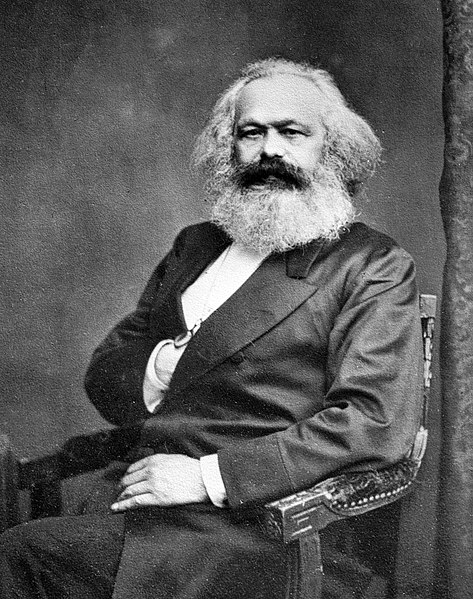
The holy book of Marx and the religion of progress
In the latest Libertarian Enterprise, Sarah Hoyt discusses the religious nature of progressive thought in the western world:
While the left not only filled every nook and cranny of twentieth century “narrative industries” to the point the only way a conservative could work in one of those was under deep, deep cover, the engineers made the internet.
The left didn’t even know it really had any serious opposition left. You can’t blame them too much. Even those of us who were very opposed and very disgusted kept it polite in public and treated them as retarded children who couldn’t take opposition.
Would it have made any difference if we’d talked back, say 30 years ago?
I doubt it.
You see, leftism is as much as anything else a religion. The crazy Marx with his vision of the future created an entire narrative from paradise (pre-capitalism, i.e. it never existed, guys, not even as apes. Apes, as we now know, trade) through fall into capitalism to eventual paradise again, where the New Man (what used to be called the Soviet Man) will be so altruistic and communally oriented that a government isn’t needed. (Like the peace of Islam, there’s only one way to obtain that, and no. Just no. Worldwide species extinction is as fantastical as the idea of that primordial paradise. Humans are humans, and someone will survive. I’m just not interested in letting them send us back ten thousand years.)
You hear it in the talk of the left — particularly the rather intellectually inbred fourth generation, who ate the pap the older people fed them and never had an original thought in their lives — stuff like calling us “reactionaries” (when they’re the ones in power, and have been for a long time, and the ones knee-jerk reacting) and talking about “the future” as belonging utterly to them, and the arrow of history, as though history were the chart in their book, with an arrow beneath.
Their faith doesn’t align particularly well with reality. For instance there’s the whole thing of them talking about us — always — as though we were the ones in power, when they have all the gatekeeping positions and all the contacts.
This dissonance has required them to make up invisible monsters that give us all the power: Patriarchy (a laughable idiocy in America and weak everywhere in the west. While they refuse to see it in the Middle East and Latin America where it actually exists in spades.) Micro aggressions. White privilege (which is so strong that it gives an edge to concentration camp survivors.)
All the while they refuse to admit the real privilege: Leftist privilege. The fastest way to rise in the narrative fields is to be lefter-than-thou. Because they’re in charge and that’s how the system is setup, so they can stay in charge.
Unfortunately this has created their isolation. You see, every song, every movie, ever history book, every fictional book, assures them they’ll win. They know that “the people united shall never be defeated.” They also know that though held back by patriarchy, racism, sexism and all the micro aggressions, the people really are with them. HAVE TO BE, because they’re ideology of the future, and history’s arrow points to their paradise. Every book, movie, etc. says so either subtly or openly. So they KNOW. Everybody knows.
June 17, 2018
May 31, 2018
Megan McArdle’s tweetstorm explaining the Reagan coalition to under-35s
I’d embed all of these, except it would take a week for the page to render, so here’s the start of the thread, and the rest will just be copy-pasta’d text:
This week's column is on the series finale of The Americans, and what the series finale of Soviet Communism did to American politics, particularly on the right.
— Megan McArdle (@asymmetricinfo) May 30, 2018
Fear not, my little chickadees, there will be no spoilers. Except that, as Woddy Allen once remarked of “War and Peace”, “It involves Russia.”
Oh, heck, obviously this tweetstorm is going to be typo-tastic. I think we’re just gonna have to roll with it, folks.
Actually, most of this Tweetstorm is going to be about one small point that I raised in the column, but didn’t have space to explore.
Which is the extent to which those on the left who are under 45, and particularly those who are under 35, fundamentally misunderstand the Reagan coalition, because they don’t remember communism.
There’s a phenomenon in cognitive science called “hindsight bias”. People wildly overestimate their ability to predict events when they know what the outcome was.
Indeed, if you ask them to predict an event, then tell them the outcome, and then ask them what they predicted, some of them will misremember having correctly predicted the outcome.
They will also think they could have predicted an outcome that was designed to be random. Don’t think that you are not one of these people. All of us are, at least to some extent, plagued by hindsight bias. It takes conscious effort to overcome, and you never will, fully.
So once you know that Soviet Communism was doomed to the ash heap of history, because it is an infinitely inferior way of satisfying your society’s basic material needs, you become nearly incapable of imagining what it was like to live in the shadow of the Berlin Wall.
Unless you actually did.
Nonetheless, let me try to explain what it was like to our younger viewers. When I grew up, the Soviet Bloc was just one massive red blob on the map. One that the Soviets had repeatedly demonstrated an interest in expanding.
Whatever you think of American foreign policy post-1945, Soviet foreign policy was like that too, except with nastier. Our client regimes were terrible. Their client regimes were terrible. But we didn’t shoot people to keep them from leaving, or run a totalitarian police state.
It obviously, in hindsight, was not plausible to think that they were going to take over the whole world. They didn’t have the resources. But alas, we did not get the benefit of hindsight when it was happening. Almost until the Wall came down, people were predicting convergence.
There was a large, expansionist power. They were basically singlehandedly keeping Cuba afloat, subsidizing actual, honest-to-God communist groups that wanted to bring the rugged splendors of life without consumer goods to America, and oh, had a history of invading their neighbors
And then there were the nukes. So true, funny story–they were phasing out nuclear drills when I was in grammar school, because someone in the NYC Department of Ed had realized there’s not much point in drilling to become radioactive vapor. Pretty much just happens naturally.
But I had an older teacher who insisted on telling us to get under our desks if the Bomb hit. Also, inexplicably, to tuck our pants into our socks to protect us from fallout.
“I’m afraid your daughter is dead, Mrs. McArdle. But just look at those pristine ankles!”
Were Red Dawn and Top Gun over the top and a little silly? Yes. But folks in the 1980s (at least those of the appropriate age for viewing such things) didn’t watch them *ironically*. They believed the Soviets wanted to bury us. Because they had said stuff like “We will bury you”
We grew up actually afraid that the Soviet Union was going to turn our country into a sheet of radioactive glass. In hindsight, seems obviously overblown, but again: *we didn’t have hindsight*.
Also, even in the 1980s, there was a delusional portion of the left that actually thought life was better for ordinary people in the Soviet Union. That portion had, thankfully, gotten smaller after Hungary. But there was a larger portion that thought maybe it wasn’t really worse.
To be clear, I’m not talking about “Democrats”. I’m talking about hard leftists who I grew up with on the Upper West Side. They existed, and were kind of noisy.
And then there was a larger still part of the left that wasn’t Marxist, but thought that the things they were concerned about, like gender inequality and racism, didn’t exist under communism, or were better.
(NARRATOR: they existed. They weren’t better)
They thought these things because it’s hard to get good information about a police state. People saw America’s oppressions being reported on the front pages of American newspapers, and concluded that they must be worse than places we had no information on.
The existence of various sorts of at least vaguely communist-sympathetic folks inside the country, and an eerie background expectation that at any moment, a large, Imperialist communist power outside our borders might vaporize you, made this a very, very politically salient issue
If you are trying to interpret the Reagan Right without understanding the large emotional impact that this had on voters, you are getting it badly wrong.
As an aside, as I also mentioned in this column, this is *ALSO* true of people who aren’t old enough to remember urban crime in the 1980s.
I was mugged for the first time at the age of 8. In the girl’s bathroom of my grammar school. Which was supposedly the safest on the UWS.
A kid in my high school class was hospitalized after a gang of boys his own age beat and mugged him. At 10 in the morning. Off of Park Avenue.
It’s easy to have a complex, nuanced, high-level response to crime when you’re reading about crime statistics. When you are actually personally, viscerally afraid of being hurt or killed every time you walk out of your front door, your reaction tends not to be so measured.
Was there a racialized aspect to politicians talking about crime? Absolutely. That was not, however, the only thing driving it. When politicians ranted about crime, what they were often really actually talking about was … crime. Which was genuinely scary for everyone.
Which is why, as the excellent “Locking Up Our Own” documents, so many “tough on crime” laws that did huge and disproportionate damage to young black men were originated or supported by the black community. They were most at risk from law enforcement, but also from crime.
We can argue over how important “the Southern Strategy” was to the GOP’s rise. But you can’t argue that race was the whole story. Or even the overwhelming majority of the story. There was a lot going on.
But some of those problems faded, largely of their own accord. And the generation that doesn’t remember them first-hand tends to discount those problems that faded, leaving only the problem which is still with us, to which they overattribute Reagan’s success.
The left frequently suggests that conservatives are insufficiently imaginative when discussing the problems of the poor, leaving out huge areas of complexity and nuance. They’re right. I see young lefties making the same error about the problems of their parents & grandparents.
It’s one part hindsight bias (“*I’d* have known this wasn’t that big a threat”) and one part the simple difficulty of imagining how something feels if you haven’t lived it.
May 10, 2018
Enter ADOLF HITLER stage left I BETWEEN 2 WARS I 1919 Part 4 of 4
TimeGhost History
Published on 8 May 2018The fledgling democracy in Germany struggles to survive as the German Revolution escalates into a downright civil war. In one of the German States Bavaria, Adolf Hitler appears on the stage within the context of the Bavarian Soviet Revolution.
Click here for the rest of the Between 2 Wars series: http://goo.gl/enXJWf
Join the TimeGhost Army at https://timeghost.tv
or on Patreon: https://www.patreon.com/TimeGhostHistoryHosted by: Indy Neidell
Written by Spartacus Olsson and Indy Neidell
Directed by: Spartacus Olsson
Produced by: Astrid Deinhard
Executive Producers: Bodo Rittenauer, Astrid Deinhard, Indy Neidell, Spartacus OlssonA TimeGhost chronological documentary produced by OnLion Entertainment GmbH
CORRECTION: Article 48 of the Weimar Constitution gave the PRESIDENT of the German Reich the power to suspend civil rights and take armed action, nothing else… our apologies. In this episode we meet Adolf Hitler for the first time. Now some might be surprised about how we portray Hitler and his political views in 1919 and this needs some commentary. Before you go off in any specific direction about Hitler and Naziism, you should therefore read our commentary here https://community.timeghost.tv/t/enter-adolf-hitler-from-the-left-between-2-wars-1919-part-4-of-4/262/3:
Commentary regarding our portrayal of Hitler:
Those of you who follow our work since a longer time will know that we are loath to tell a skewed or biased version of the events we portray. Our aim with how we tell Hitler’s story is neither to exonerate him, nor to vilify him; the facts speak for themselves and we are convinced that we neither need to add, nor subtract emphasis to the story of Hitler and the Nazis.
In many other works covering Hitler you will see a tendency to hang the events of this epoch on the leaders that rose to power in the period. While it is unquestionable that the impact of those leaders was far reaching and instrumental in how the events evolved, it should not be forgotten that these men (and a few women) were not created in a bubble. As postulated in the main historiographical theory dealing with the impact of leadership, Zeitgeist Theory (from where we take or brand name btw.) it is easily seen at that it was not the characters that created the times, but the times that created the characters who then steered the events as they evolved.
This is an uncomfortable position to take, because it leads to the next conclusion: Germany, Japan and Italy did also not exist inside bubbles. This in turn leads us to have to look at the entire picture of the world to understand the events that followed. Inevitably this will not lead to a black and white picture of good guys vs. bad guys. Instead we face a complex situation where many cogwheels interact to bring about the situation that eventually leads to war.
To be clear: once again we are not seeking to exonerate, or vilify anyone. What with the extensive crimes against humanity perpetrated by the Axis powers before and during the war, there is always the risk of comparing apples and oranges when you dive into this area. To avoid that conundrum, the war crimes perpetrated by the Allies are often brushed aside, or simply justified as an unfortunate part of war. Again to be clear: while the firebombing of Dresden, Hamburg, Tokyo, Osaka and many other cities does constitute war crimes, it does not exonerate the murder of tens of millions of people by the Nazis. Furthermore the sheer difference in numbers and method speak for themselves (if you must look at a comparison of who was worse than the other).
Our interest will always be to tell the story as accurately as we can and let the story itself provide judgement. At no point will we waiver from telling a part of the story just because it makes one side or the other look better or worse. Also, we will not get involved in the moral arguments surrounding this, such as that certain acts were justified because they led to victory, or were the lesser evil. It is not our job to make that kind of moral judgement – that is up to the philosophers of the world and we’re mere tellers of history.
Regarding Hitler’s political views in 1919:
The fact that Hitler had liberal sympathies in 1919, should not be misunderstood as a foundation for an argument that Naziism was a left wing ideology. While Hitler and Drexler did incorporate social welfare concepts and anti-capitalist ideas into their agenda, the national socialist doctrine is clearly a derivative of conservatism, not progressivism.
Contrary to communism that focuses on class and internationalism, Naziism focuses on race and nationalism. Naziism espouses traditional social conservative views regarding gender roles, division of labour, social values, and foreign relations. Communism claims to be egalitarian while Naziism espouses an elitist world view. Communism seeks to create a completely new economic system based on overthrowing traditional trade and profit ideas, Naziism espouses economic protectionism and state regulated capitalism. In one aspect the two ideologies do share a common denominator, namely in the repression of the financial transfer economy (money lending, property speculation and so on). This last bit has often been misrepresented as proof that Naziism is a left-wing ideology, but that would be a fallacious conclusion as this is not at the centre of the ideology, but rather an artifact of the somewhat contradictory antisemitic ideas of Naziism.
Last but not least the main unique feature of Naziism that differentiates it from Fascism is the outspoken antisemitism at the heart of the ideology. Absurdly Hitler came to equate Jews with robber capitalists AND communism. As strange as that is, it’s a way of thinking that was not only prevalent with Hitler, but also with other political thinkers like Charles Maurras, a Frenchman who formulated an early form of Naziism already in the late 1880s and 1890s (yes we will cover him). The basis of this is their belief in a world conspiracy led by the Jews that was aimed at the overthrow of what they perceived as ‘their race.’ Based on that, robber capitalism and Bolshevik Communism were seen as instruments in this imaginary war of the races. The idea was also promoted within the context of the Russian Revolution, where for instance the fabricated Protocols of The Elders of Zion, aimed to show that the ‘Jewish conspiracy’ was a driving force behind the revolution.


