Quotulatiousness

February 15, 2020

Disrupting railways as an activist tactic appears to work really, really well

As Colby Cosh writes, for all the issues Alberta has with the government in Ottawa, nobody seriously suggested messing up the railways to get attention. Perhaps they should have:
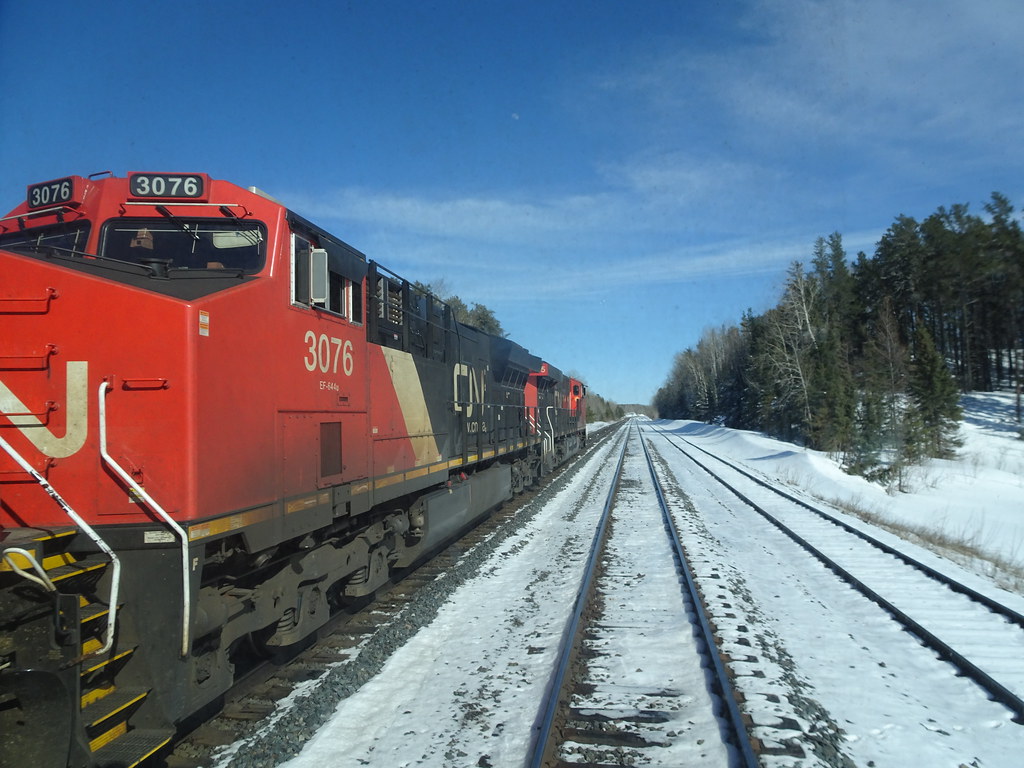
“DSC02285” by Bengt 1955 is licensed under CC BY-NC 2.0

It never occurred to us to mess with the rail network in Eastern Canada — to inconvenience the precious commuters of the Golden Horseshoe — as a means of gaining negotiating leverage. Actually, I’m sure some people must have suggested it, but they would have been written off as selfish, dangerous idiots advocating counterproductive tactics.

The economic impact of the rail protests is big, but surely comparable, at the moment, to that of a big storm. Yet because a B.C. Aboriginal community is carrying its fight with the B.C. government to the guts of Canada, the clamour over whether large public works are now possible at all in Canada has instantly achieved new and unfamiliar volume levels.

The Coastal GasLink that is the source of the strife is a provincially regulated work running from Dawson Creek to the coast; unlike the vastly more expensive problems Alberta has encountered, this technically isn’t an issue for the wider federation at all. Except, whoops, it is! Because someone decided to make it one!

The levels of irony dazzle the imagination. The Canadian West was settled by means of passenger rail, which is supposedly one reason it was chosen as a target by the radicals supporting the Wet’suwet’en hereditary chiefs in their pipeline fight. But intercity commuter rail no longer really exists between the West Coast and Hamilton. The West is ultimately as dependent on rail freight as the East, and maybe more so, but it was that commuter inconvenience that gave rise to an immediate sense of national crisis, while Calgary and Saskatoon and Winnipeg snoozed.

And climate-change activists found themselves blocking rail lines in “solidarity” with the Wet’suwet’en, even though the chiefs’ fight is a question of territorial principle rather than carbon sins. This put the greenies in the position of opposing and thwarting actual rail travel. They admit this is anomalous; nobody likes to attach the word “hypocritical” to himself.

One of the protesters pointed out to the Star‘s Alex Boyd how dependence on rail — dependence of the sort that they spend 364 days a year advocating for intra-city commuters — facilitates unlawful, obstructive protest as a means for the self-anointed to “put pressure on decision-makers.” It is a little harder to block paved roads than railroads, and much harder to sabotage them, if it comes to that — which it might have if the police had used force to immediately disperse the protests. For some, this counts as a feature of rail, not a bug.
January 23, 2020

Pascal’s Wager, environmentalists’ version

Filed under: Economics — Tags: , , , , , — Nicholas @ 05:00

Hector Drummond indulges in a proper “Fisking” of a recent column in the Telegraph:

    We don’t have to buy into the apocalyptic angst of Greta Thunberg, on show again in Davos yesterday, to recognise that something has to be done.

He actually said “Something Has To Be Done”. How about we do a snow dance, Philip? That’s “something”.

    Whether or not you are a sceptic about the impact of CO2 on the climate or question man’s involvement in producing the greenhouse gas, our energy future is a non-carbon one, like it or not.

Our energy future involves a lot of talk about non-carbon energy sources, while relying on “carbon” for a long time to come.

    Virtually every government has committed to this as an overt aspect of public policy and those that haven’t, like China or the US, have a rapidly growing green energy sector poised to exploit the move to a carbon‑free future.

You mean the China that’s building coal-fired power plants at a rate of knots? That China?

Later on, the column invokes Pascal’s Wager, which Hector finds both amusing and irritating:

Seriously? Pascal’s Wager, which has been long ridiculed by most scientists and philosophers and thinkers, is now the basis for the largest and riskiest economic and political transformation in human history?

Pascal’s Wager justifies any proposed change in response to any possible threat. It’s possible that all the ducks in the world are really super-intelligent and they’re about to launch a takeover, so we need to kill them all. It’s possible that nylon stockings are eventually going to cause a nuclear explosion. Make your own ones up. The consequences of doing nothing, should these claims turns out to be true, are calamitous. In fact, they’re far more calamitous than most of the possible climate change scenarios.

Proper risk analysis, on the other hand, tells us to look at probabilities of the possible bad outcomes, not just how bad some possible bad outcome would be, were it true. The catastrophic climate change scenarios all have tiny probabilities. Even the IPCC admits that.

[…]

Then we have to look at the costs of the proposed action. The real costs, that is, not just vague claims like “Oh, moving everything to solar energy would be, like, you know, cool, my friend went to this talk once and she said that apparently solar works just as well as coal”. The costs – the real costs – are what needs be weighed against alternative courses of action.

The costs of abandoning fossil fuels are not zero. Not even remotely. Changing to renewables will be massively expensive, destroy jobs, and hinder prosperity, because they cannot provide anywhere near the energy we need. “Generate growth and prosperity” is nonsense, and Johnston should be ashamed of himself for falling for this.

January 4, 2020

Australia, the firebug country

Filed under: Australia, Environment, Law, Media — Tags: , , — Nicholas @ 05:00

Arthur Chrenkoff rounds up the surprisingly numerous reports of arson over the last few months in Australia:

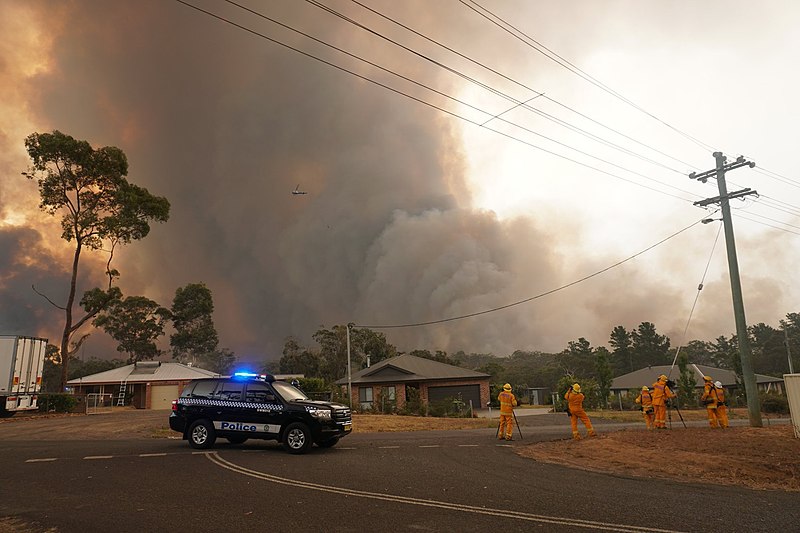
The Green Wattle Creek bushfire moves towards the Southern Highlands township of Yanderra as police evacuate residents from Yanderra Road, 21 December, 2019.
Photo by Helitak430 via Wikimedia Commons

According to my calculations and estimates, the number of individuals around Australia whose arson has contributed to the current bushfire crisis has now passed 200.

This figure is not presented as a counter-argument to those who blame the fires on climate change. Most people (I hope) understand that trees tend not to spontaneously combust, no matter what the air temperature is; when we talk about bushfires starting naturally, we are talking about lightning strikes igniting tinder. The climate change argument posits that the more extreme weather conditions – higher temperatures, drought, etc. – make fires, however started, much more destructive and much more difficult to control and extinguish. These are debates to be had between climatologists, forestry experts and fire fighters. What is painfully clear, however, that Australia has a firebug crisis. It will no doubt be up to future royal commissions and inquiries to calculate exactly what proportion of the current loss and destruction can be attributed to human action, but I suspect it will be a significant one. Man might be making climate change, but man is most definitely making fires start.

Below, a sample of news reports from around the country for the past several months.

[…]

There are no conspiracies here. Though arson has been tried and called for before as a tool of terror, the Australian fires seem to result from the actions of unconnected individuals who are either disturbed or reckless. This is nothing new; as ecological criminologist Paul Read wrote back in November:

    A 2015 satellite analysis of 113,000 fires from 1997-2009 confirmed what we had known for some time — 40 per cent of fires are deliberately lit, another 47 per cent accidental. This generally matches previous data published a decade earlier that about half of all fires were suspected or deliberate arson, and 37 per cent accidental. Combined, they reach the same conclusion: 87 per cent are man-made …

    If I had to guess, I’d say about 10,000 arsonists lurk from the top of Queensland to the southern-most tip of Victoria, but not all are active and some light fires during winter. The most dangerous light fires on the hottest days, generally closer to communities and during other blazes, suggesting more malicious motives. Only a tiny minority will gaze with wonder at the destruction they have wrought, deeply fascinated and empowered. Others get caught up with the excitement of chaos and behave like impulsive idiots.

    As for children, they are not always malicious. Children and youths follow the age-crime curve where delinquency peaks in their late teens. Fire is just one of many misbehaviours. The great majority grow out of it. Four overlapping subgroups include: accidental fire-play getting out of control; victims of child abuse — including sexual abuse — and neglect; children with autism and developmental disorders; and conduct disorder from a younger age, which can be genuinely dangerous.

The more fires, proportionally the more arsonists. And the recent mega-fires are really bringing out all the fire bugs out of the woodwork (or into the woodwork to be more accurate). It is disturbing, but sadly not surprising or unexpected. As some have suggested already, the current crisis, with its large sample of arsonists, provides a good opportunity for more research into the psychology, motivation and behaviour of fire-starters. This might help in the future, but clearly arsonists will always be with us. The task is to make their work more difficult, for example through better management of our forests to make them less combustible. But as much as bushfires are an environmental and land management problem, as we search for solution we can’t forget that they are also a criminal one.

December 19, 2019

QotD: The “fitness club” scam

Filed under: Business, Environment, Health, Quotations — Tags: , , — Nicholas @ 01:00

As any good cult leader knows, the real money in running a cult doesn’t come from the cultists themselves. It comes from the hangers-on who buy your products and vote for you. Think of it like the gym. Notice how all the gyms these days are called “fitness clubs?” It’s a brilliant marketing move, straight out of the UFO cult playbook. Gyms fitness clubs don’t make their money off the small hard core of people who work out every day. Rather, it’s the people who sign up — who join the club — but never actually go.

Here’s how you talk yourself into a gym fitness club membership: “I need to get in shape. So I’ll buy a club membership. That way, I can go whenever I want.” In Festinger’s taxonomy […] you’re at step 2: You’ve taken a significant action in line with your belief. Gyms fitness clubs add a further refinement of late-20th century marketing, in that they offer you a yuuuuge “discount” off the outrageously-high signup fee, but the underlying psychological process is the same.

And now you’re set up for the disconfirmations — that is, all those times you think about going to the gym, but don’t actually go. Objectively you’re wasting your money, but psychologically you’re committed to the idea of yourself as someone who does “fitness” — you’re in a fitness club, after all! And since everyone you know is doing the same thing — fully 75% of conversations one overhears at Starbucks are soccer moms griping about how they need to work out, but just can’t find the time — you’re in, all the way, […].

The “climate change” scam works the same way. When she’s on the campaign trail pimping the “Green New Deal,” Fauxcahontas Warren knows she doesn’t have to pitch it to the eco-freaks; they’d vote for her no matter what. She has to pitch it to the normies, fitness club-style. That’s where the “climate change” nomenclature really pays off. It’s shockingly easy to get people convinced of a lunatic belief. All you have to do is a) get ’em early, and b) overload them with “evidence.” You know the drill: These days, we’re lectured practically from birth that we must Do Something! for The Environment! … and the “evidence” for this, of course, is the ceaseless, dramatic variation in daily temperature the un-indoctrinated call “weather,” plus all the other dramatic variations in climate that didn’t happen. So long as you pitch it with complete self-righteousness, people with the critical thinking skills of five year olds will fall in line every time.

Then all you have to do is get people to take action … which the government, in all its wonderful helpfulness, has already done: Low-flow toilets, those stupid twisty “light” bulbs, toilet paper that either shreds on contact with skin or sandpapers your asshole off, plastic straw bans, mandatory recycling, you name it. And I’m sure y’all realize by now that the fact that none of this stuff actually works is a feature, not a bug. Since it’s the disconfirmations that get you. That’s the pitch to the normies — you obviously care about “the environment,” in the same way you care about “fitness.” Just as the “fitness club” owners will happily keep cashing your checks while you remain a diabetic lardass, so Fauxcahontas will keep cashing your checks while the weather stubbornly remains the weather …

Severian, “What Happens if the UFO Actually Comes?”, Rotten Chestnuts, 2019-09-25.

December 17, 2019

“Oh, shut-up. Pound sand, you scowling urchin”

Filed under: Economics, Environment, Politics — Tags: , , , — Nicholas @ 03:00

I don’t often find myself nodding along with Kurt Schlicter‘s writings, but I have to agree that Greta Thunberg’s fifteen minutes must surely be up by now?

Clearly Greta Thunberg is being exploited by her cynical puppetmasters, but equally clearly she’s a tiresome, bizarre Marxist scold whose exploitation of the hapless dummies who buy into the climate change hoax is part of what is an increasingly violent plot to undermine capitalism and freedom. Recently, the cretins at TIME, which shockingly still exists in 2019, named her “Person of the Year.” That’s appropriate, since 2019 has been a very annoying year.

In 2029, after the world hasn’t ended but her usefulness has, she’ll be a Jeopardy question and probably shacked up with an unemployed performance artist named Björn in an Oslo suburb. Fun fact: “Greta Thunberg” is Swedish for “Cindy Sheenhan.”

But today, we’re all supposed to fall over ourselves over Pippi Longnagging – at least that’s what our betters command – yet it’s unclear why. Teenagers are notoriously ignorant, and ones spewing recycled Marxism are the worst of all. But the idea is not that this tiresome truant is some visionary thinker. The idea is to leverage her youth and awkwardness to keep you from speaking the indisputable truth that she’s a weird brat who presses for an ideology that butchered 100 million people in the last century. And now, she is hinting she wants to run up that score.

Trump mocked her and a zillion pearls were clutched. How dare you … criticize the Luddite pest who presumes to tell you how to live, leveraging the full benefit of her nearly 17 years of experience to explain to you how stuff should be. How dare you!

Oh, shut-up. Pound sand, you scowling urchin.

The kid is a fanatic, and though that’s no fault of her own – she’s a victim of her pinko exploiters – she is still spewing bloodstained poison.

Bloodstained poison, really? Isn’t she just a nice Eastern Norwegian who wants a better world with love and hugging? Or is she yet another aspiring fanatic ready to kill for the kreepy kommie climate kult?

The other day, this malignant muppet “told cheering protesters … ‘we will make sure we put world leaders against the wall’ if they fail to take urgent action on climate change.” Now, maybe her English is bad, or maybe she’s just ignorant, but then again the murder of opponents is the Marxist way.

November 24, 2019

Next stage in religious observance for those participating in the “Great Environmental Awakening”

Filed under: Environment, Media, Politics, Religion — Tags: , , , — Nicholas @ 05:00

Mark Steyn discusses the obvious next step for those newly converted to the Environmentalist religion:

To quote a line from America Alone: “The future belongs to those who show up.” And, while eugenics is universally condemned as morally repugnant, self-eugenics is an idea we can all get behind. Step forward the “Indefinitely Wild” columnist of Outside magazine, Wes Siler:

    I Got a Vasectomy Because of Climate Change
    Getting one was, by far, the most powerful personal action I could take for our planet

Mr Siler claims to be 38 years old, notwithstanding the prose style of an overwrought pre-pubescent. And he cannot stand idly by procreating while the planet burns. Greater love hath no man than to lay down his sperm for the remnants of Malibu […]

In fact, “the absolute biggest difference” you could make would be to kill yourself right now — rather than merely tossing your unborn children into the infernos of California. Alas, the self-extinction movement has not yet reached that stage of despair, although we should certainly encourage them to follow the necessary logic of their epocalyptic torments. For the moment (and, again, as I wrote in America Alone) contemporary progressivism has “adopted a twenty-first-century variation on the strategy of the Shakers, who were forbidden from reproducing and thus could increase their numbers only by conversion”.

As you might have noticed, there aren’t a lot of Shakers around today. Will there be a lot of anguished environmentalists around once every Wes Siler reader has had his scrotum anesthetized?

No. But at least they’ll have saved the planet, right?

Doubtful. Mr Siler notes that every little baby Siler comes with a price tag of 58 tons of carbon emissions per year. But that’s because he’s American. Mr and Mrs Siler could move to Somalia and have thirty kids for the carbon footprint of one Yank moppet. So why are the same people who lecture us that we only have twelve years to save the planet in favor of every Somali moving to Maine or Minnesota and acquiring a western-sized carbon payload?

November 22, 2019

To think we used to joke about environmentalism as a substitute religion…

Filed under: Environment, Politics, Religion, Science — Tags: , , , , — Nicholas @ 03:00

… it’s long since stopped being a joke and become all but the state religion, as Barbara Kay notes on the tenth anniversary of “climategate”:

Rayne pointed out that a cursory perusal of the Environment Canada Adjusted and Homogenized Canadian Climate Data database would illustrate that the daily summer maximum temperatures in Toronto showed no upward trend whatsoever. She further noted that a database for the WMO-certified Pearson Airport site demonstrated there was “absolutely no temporal correlation” for extreme July or August maximum temperatures between 1938 (when the database was initiated) and 2012.

In fact, there was no source in Canada then — and still isn’t — from which CAP could have plucked that ludicrous figure. University of Guelph economics professor Ross McKitrick had at that time just created his invaluable site, yourenvironment.ca, which sets out a complete temporal record of officially recorded air and pollution levels everywhere in Canada. The data for the site is culled from provincial environment and natural resources ministries, or from Environment Canada. Over many decades, no matter where you look in Canada, the graph trends remain resolutely horizontal with tiny upward and downward spikes indicating extreme weather blips.

Every layperson who identifies as an alarmism skeptic has his or her own pivotal moment, and that idiotic “news” story in the Globe was mine. When reporters and editors act like deer in the headlights in the reception and dissemination of demonstrably impossible “information,” it’s clear evidence that they have been gripped by a socially contagious virus. These are the people who in the 19th century would have believed tulip bulb prices were never going to peak, even if every single family on the planet had enough tulip bulbs to fill a half-acre garden.

The late writer Michael Crichton, author of the best-selling 2004 techno-thriller, State of Alarm, was one of the first independent students of environmentalism to define environmentalism as a “religion,” and to observe that its principal characteristic was to cater to the state of alarm he believed is an inherent human need. Its dogmatists act as though they have been appointed Morals Police. And they do not take kindly to dissent.

Al Gore, whose 2006 documentary film An Inconvenient Truth was received with uncritical awe, (one of my friends, normally very brainy, described it as a “religious experience”) was later found by a UK court to contain “nine key scientific errors.” It was deemed rife with “serious scientific inaccuracies, political propaganda and sentimental mush” and the judge ruled that the “apocalyptic vision” presented made it not an impartial scientific analysis, but a “political film.” He continues to hector the world as though that never happened from the depths of a home whose electricity kilowatt hours exceed twenty times the national average.

In 2007, environmental guru David Suzuki stormed out of a Toronto radio station interview when the host suggested global warming was not yet a “totally settled issue.” The incident revealed the mindset of the enviro-ayatollahs. (We see its 16-year-old version in little Pied Piper leader of the Children’s Crusade Greta “how-dare-you” Thunberg.) Suzuki perceived the radio host as a blasphemer, unworthy of his rational rebuttal. Suzuki actually felt enviro-infidels should be literally suppressed, and even opined that politicians who aren’t on board with his views should go to prison. You’d think a guy that far down the rabbit hole would be minding his own enviro P’s and Q’s, but like Al Gore, his real estate portfolio is humongous and his carbon footprint immense.

October 30, 2019

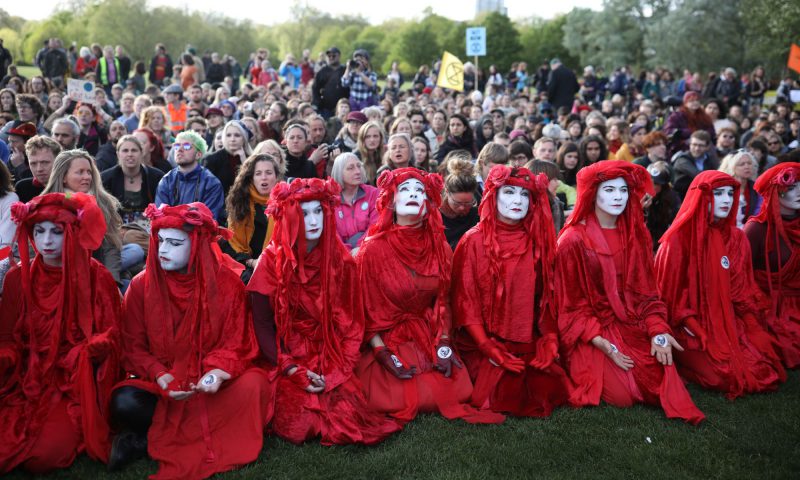
In case it wasn’t already obvious – “Extinction Rebellion isn’t about the climate”

One of the self-described founders of Extinction Rebellion takes to Medium to explain what the organization’s real goals are:

I’ve been with Extinction Rebellion (XR) from the start. I was one of the 15 people in April 2018 who came together and made the collective decision to try to create the conditions that would initiate a rebellion. I was a coordinator of one of the original five working groups, and I’ve been organising with XR day-and-night since then (frugally living off my savings so I don’t have to work, having quit an industry that paid me £1000/week). And I’ve been in RisingUp (the organisation from which XR has emerged) since the first RisingUp action in November 2016. I’m a RisingUp Holding Group member, and a member of the XR Guardianship Team.

And for the sake of transparency: that previous paragraph is all about me “pulling rank” — I’m trying to convince you to listen to what I have to say …

And I’m here to say that XR isn’t about the climate. You see, the climate’s breakdown is a symptom of a toxic system of that has infected the ways we relate to each other as humans and to all life. This was exacerbated when European “civilisation” was spread around the globe through cruelty and violence (especially) over the last 600 years of colonialism, although the roots of the infections go much further back.

[…]

So Extinction Rebellion isn’t about the climate. It’s not even about “climate justice”, although that is also important. If we only talk about the climate, we’re missing the deeper problems plaguing our culture. And if we don’t excise the cause of the infection, we can never hope to heal from it.

This article is calling to all of those who are involved in XR who sometimes slip into saying it’s a climate movement. It’s a call to the American rebels who made a banner saying “CLIMATE extinction rebellion”. It’s a call to the XR Media & Messaging teams to never get sloppy with the messaging and “reduce” it to climate issues. It’s a call to the XR community to never say we’re a climate movement. Because we’re not. We’re a Rebellion. And we’re rebelling to highlight and heal from the insanity that is leading to our extinction. Now tell the truth and act like it.

October 4, 2019

“Economics is … the science of not being able to have your cake and eat it”

Filed under: Economics, Environment, Health — Tags: , , , — Nicholas @ 05:00

Philip Booth on Greta Thunberg’s message and its economic over-simplifications:

In many senses, economic problems are more complex than scientific problems and Thunberg is, implicitly at least, pronouncing on economic matters. Whilst knowledge about climate science is uncertain, a judgement has to be and can be made on the balance of evidence. But economic decisions involve trade-offs. Economics is, as Lionel Robbins put it, the science of not being able to have your cake and eat it. We cannot both decrease carbon emissions hugely and enjoy standards of living increasing at the rate that would have been possible if emissions were not reduced.

It is tempting the believe the green rhetoric that we will all have fluffy green jobs and a green standard of living without any hardship from reducing emissions. We cannot. Reducing carbon emissions quickly to zero means that we will have much less of everything else. We might prefer decarbonisation to other goods and services, but it is not a cost-free choice. We considering this, we should remember that the average income in the UK is ten times the average income in the rest of the world. When other people face these trade-offs the sacrifice of decarbonisation is that much greater.

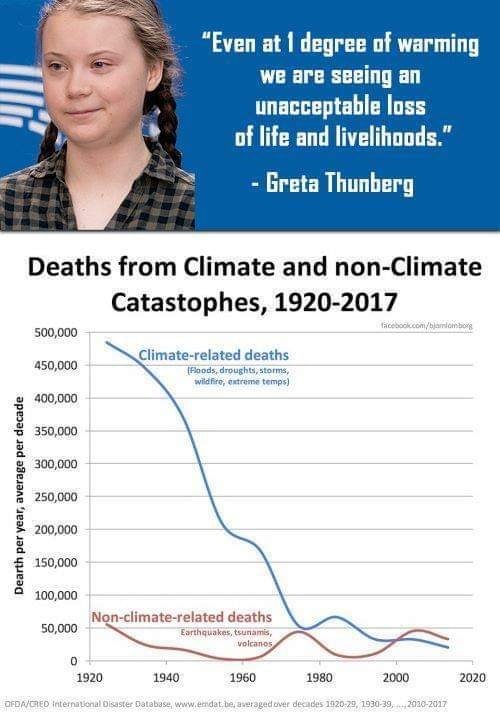
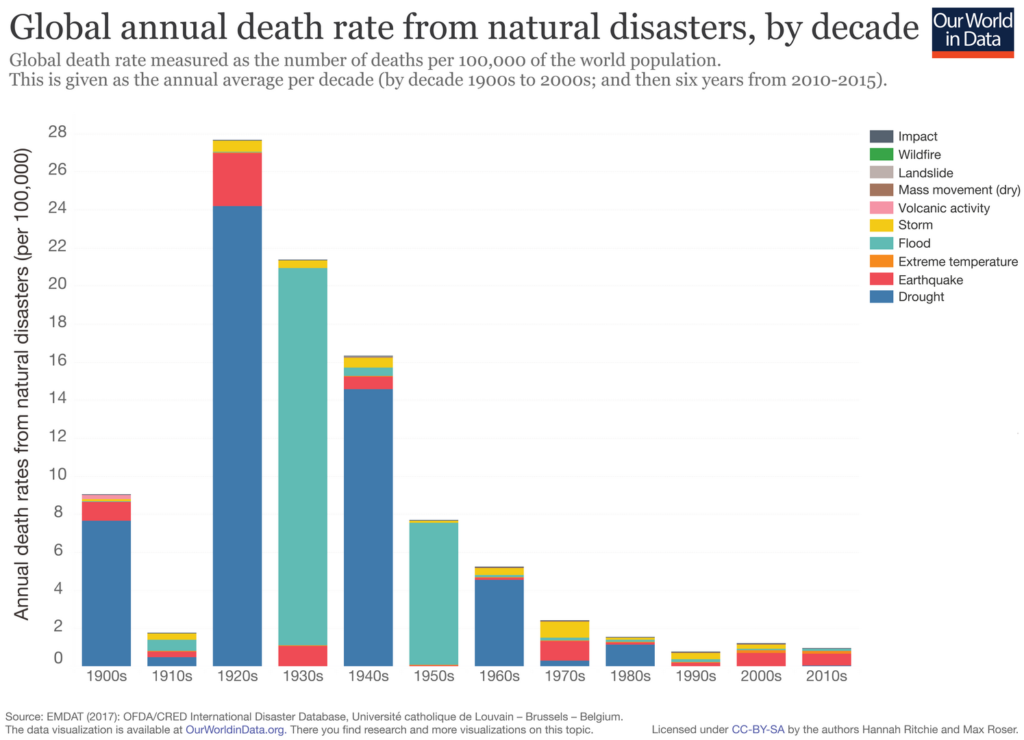
One of the advantages of being richer is that we are more resilient to natural disasters. It follows from this that there is a trade-off between decarbonisation, which might lead to fewer natural disasters, and our ability to cope with them, which might reduce if we become less rich. As we have become richer, deaths from natural disasters have plummeted. The figure shows the fall in deaths in natural disasters over the last century – they have reduced by, perhaps, 90 per cent.

The use of air conditioning illustrates this trade-off in a rather stark way. In a letter on the environment written by Pope Francis in 2015 called Laudato si, the pontiff strongly criticised the adoption of air conditioning in the strongest terms. An academic paper on air conditioning in the US produced such remarkable results that the abstract is worth quoting at length:

    “the mortality effect of an extremely hot day declined by about 80% between 1900-1959 and 1960-2004. As a consequence, days with temperatures exceeding 90°F were responsible for about 600 premature fatalities annually in the 1960-2004 period, compared to the approximately 3,600 premature fatalities that would have occurred if the temperature-mortality relationship from before 1960 still prevailed. Second, the adoption of residential air conditioning (AC) explains essentially the entire decline in the temperature-mortality relationship. In contrast, increased access to electricity and health care seem not to affect mortality on extremely hot days.”

Air conditioning leads to higher carbon emissions and, most likely, higher global temperatures. But the increase in resilience arising from air conditioning is astonishing – it has led to an 80 per cent drop in deaths from heat.

September 27, 2019

QotD: Environmental cultists

There are a million examples, but since climate hysteria is briefly back in the news let’s go with that. That Greta Thunberg freak might not know it — she is, after all, a product of modern “education” — but anyone old enough to remember the early 2000s has heard her spiel before. Al Gore kept telling us that the world would end by 2012 or something; he made a movie about it and everything. Hell, several generations of Americans have heard this nonsense before, going all the way back to the original Earth Day in 1970.

Of course, back then it was global cooling that was going to kill us all, and do you see what I mean about True Believers? The very same people who were convinced that we were all gonna die in a new Ice Age in 1970 were certain we’d die of melted polar ice caps in 2006, just as they’re now positive we’re going to get killed by … whatever it is Thunberg is hectoring the UN about. Normal folks’ skulls would’ve exploded from cognitive dissonance, but the eco-freaks don’t suffer from cognitive dissonance. Because, for them, it never rises to the level of cognition in the first place. If “pulling a U-turn on your deepest convictions” is what it takes to stay in the group, well, start peeling rubber. The cult’s leadership will come up with a retcon in due time.

Two interesting effects flow from this. The first is the growing disconnect between the cult’s leadership and the True Believers. A cult with a big enough membership roster stops being a cult and becomes a movement. Movements beget organizations, which by universal law attract grifters, with predictable-as-sunrise consequences. E.g. Christianity. Back in the mid-first century, Christians were sure that Christ would return in their lifetimes — after all, He said so Himself. His comeback tour kept getting postponed, though, and these days you can be the leader of a major Christian denomination without ever bothering with that “Jesus” guy, much less any of the stuff He said.

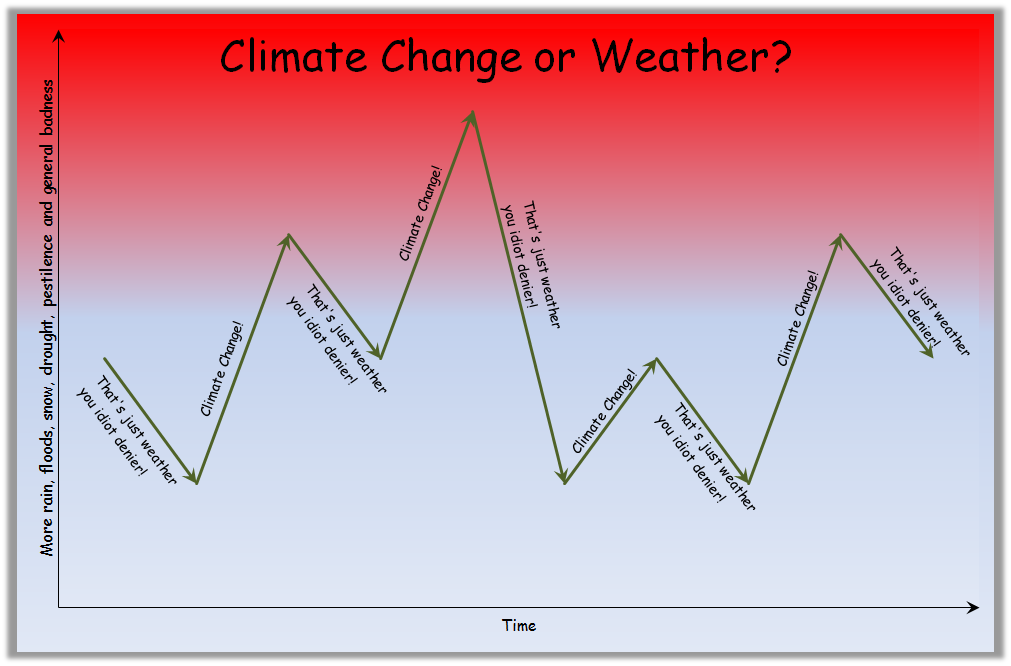
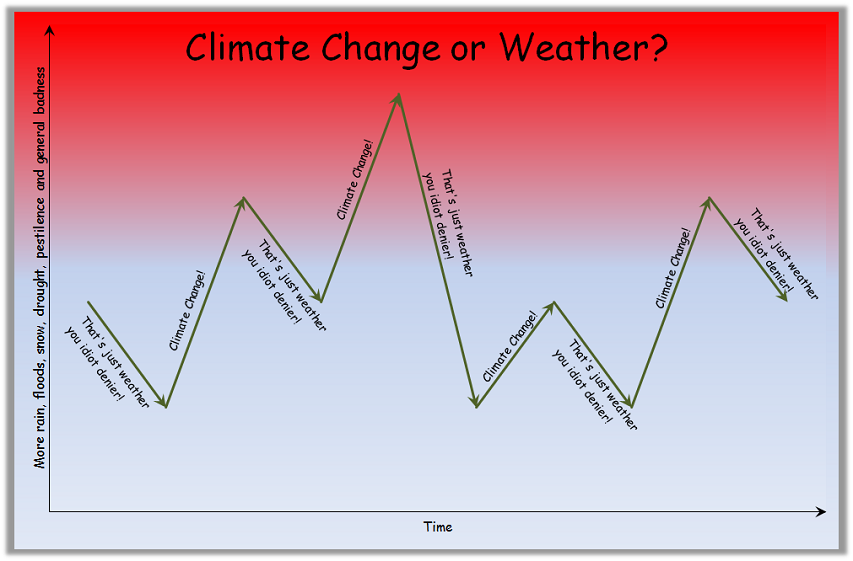
This is why “global cooling” became “global warming,” which is now “global climate change.” We cognitively-normal folks assume that the eco-freaks keep changing the name to avoid cognitive dissonance. After all, the climate “changes” every day — we call it “weather,” but if you’re looking for evidence that your crackpot eco-doom theories are correct, well, just look at how much the temperature varies from noon to midnight!! But see above: Cognitive dissonance is actually a boon to the eco-freaks, because in cult psychology, disconfirmations prove that you were right all along. The eco-freaks would still trot goofy Greta Thunberg out there no matter what it’s called, and she, poor deluded little sod, would keep on doing her thing, because she’s in the cult. So: They, the eco-freaks, didn’t come up with “climate change;” the grifters in charge of Climate Shakedown Inc. did.

Severian, “What Happens if the UFO Actually Comes?”, Rotten Chestnuts, 2019-09-25.

September 23, 2019

The “Global Climate Strike”

The big “let’s all play hooky from school” event’s Toronto organizers have been getting positive coverage from some of the local media, because of course they have. Here’s Tanya Mok for BlogTO, listing the totally reasonable and not in any way unrealistic “demands” of the movement:

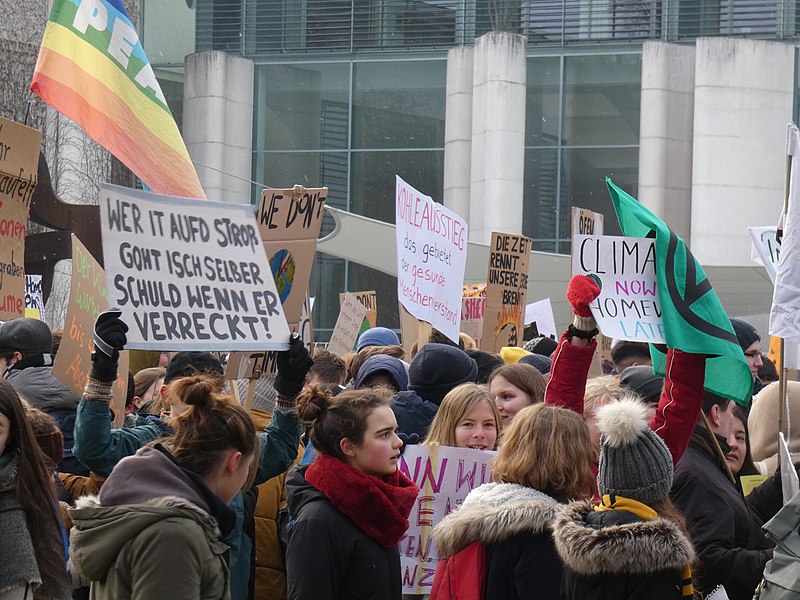
FridaysForFuture Demonstration, 25 January 2018 in Berlin.
Photo by C. Suthorn via Wikimedia Commons.

The coalition has made a list of seven demands, which “reflect the rallying cries of the intersectional movements” they belong to. Some of those demands include:

  • Indigenous rights and sovereignty.
  • The protection of forests, land, and water sources.
  • A shift to publicly-owned renewable energy, and reducing national carbon emission by 65% by 203, reaching zero emissions by 2040.
  • A $15 minimum wage for all, and higher taxation on the rich.
  • Universal public services like health care and dental care, free university and college, housing as a human right, and free public transit.
  • Justice for migrants and refugees, allowing status for all. That includes putting an end to deportations and allowing for the full access to public services.

There will be a concert at Queen’s Park after the rally, as well as a follow-up benefit concert at the Tranzac Club in the evening. A giant street mural project run by Greenpeace will also be taking place prior to the rally, around 10 a.m., at the southern point of Queen’s Park.

September 6, 2019

“This is the worst [weather event] in history!”

Filed under: Environment, Media, USA — Tags: , , , — Nicholas @ 03:00

At some point in the last decade or so, media organizations decided to make the weather report into an extension of the news, to (as I’m sure they’d have explained) provide a richer media experience for their audiences. This has degenerated into some pretty ridiculous weather-event related claims, as it seems every month for the last several years has been “the hottest evah!” if you got your news from the TV. Claiming something is the best/worst in history sounds very impressive, until you realize just how short a time we’re considering when we talk about the weather:

“This is the worst [weather event] in history!” You see it in all the headlines: “Hottest day in history!” “Worst hurricane in history!” “Coldest winter in history!” These headlines make me crazy and it’s not just because they’re being used to shill anthropogenic climate change fears nor is it because a lot of them are false. (For example, since 1924, there have been thirty-five Category Five hurricanes in our part of the Atlantic, most in September. Dorian was just the latest, not the most exceptional.)

No, what really irks me is that phrase “in history” or its companion phrase “ever” (“Worst heat wave ever!”) What the dopes in the media miss, or perhaps willfully ignore, is the fact that we have barely any weather history. Instead, we’ve only been measuring weather data since the second half of the 19th century. I learned this when I read Simon Winchester’s delightful Krakatoa: The Day the World Exploded: August 27, 1883. In it, he notes that the volcano’s explosion was the loudest sound ever recorded — and that it was recorded only because the Victorians had an obsession with record keeping.

Before the Victorians came along, there were always people who kept records, but once the Victorians came along it became a “thing.” For the first time in human history, people had (a) instruments that could measure things with a fair degree of accuracy and that were affordable, and (b) the literacy and leisure time to note and record these things.

Thus, in the late 19th century, owning a reliable thermometer, checking the weather daily, and taking the time to write it down was something entirely new. Before that, there were no reliable thermometers and only the richest could afford such unreliable tools as existed for measuring temperatures. The fact that people were no longer living at subsistence level and were literate enabled them to find the time and have the skills to record data.

That’s why we know how loud Krakatoa was: All over the world, as the sound waves reverberated around the earth, over and over, busy Victorians were looking at their reliable time-pieces (the first affordable, mass-produced watches were driven by railway needs and came onto the market in the late 19th century) and noting down the time at which they heard that strange loud noise.

All of which means that our reliable weather data isn’t about “history” or “ever,” but is, instead, about 150 years old, at most. Everything else is guess work, based upon random reminiscences and best guesses using things such as Arctic core samples or tree rings.

September 4, 2019

Poor Greta Thunberg

Filed under: Environment, Media, Politics — Tags: , , — Nicholas @ 03:00

Theodore Dalrymple on the grim-visaged child star of the environmental movement:

Greta Thunberg at the EU Parliament, 16 April, 2019.
European Parliament photo via Wikimedia Commons.

Poor Greta Thunberg! She is to self-righteousness and self-satisfaction what Mozart was to music, namely an astonishing youthful prodigy. Unlike Mozart, however, she is a very unattractive child, her unattractiveness arising not from her natural physical endowment but from the sheer grimness of her humourless puritanism which is inscribed on her face for all to see. She has succeeded in adding a new vision of hell to the many that I already have, namely being preached at by her for all eternity without intermission.

It is said that she suffers from a psychiatric condition, but whether or not this is so, her awfulness (of which, of course, she is blithely unaware) is not really her fault. Her transformation into a celebrity is the work of adults. It is they who have turned her into the Ayatollah Thunberg, the Khomeini of climate change.

In the days when reaching old age was exceptional, almost implying some kind of personal virtue, it was the elderly who were accorded respect and regarded as the repositories of wisdom. But as the old begin to outnumber the young, it is the young to whom falls the mantle. This is because we value the rare. No only does little Greta belong to a minority, but to a minority of that minority, for no one can deny that she is articulate, however monotonous, programmed or lacking in spontaneity her lines might be.

Adolescence in particular is now regarded as the acme of human existence, from which only decline is possible (and Greta exudes an air of permanent adolescence). I still have not quite made up my mind whether our age is the first of the geriatric adolescent or that of the adolescent geriatric, but I not infrequently notice around me seventy- and even eighty-year-olds who try to dress and comport themselves as if they were still about eighteen or nineteen. I find it sad, for of course the march of time is inexorable in its effects, albeit that it is true that it has slowed somewhat and people now age more slowly than they once did thanks, ultimately, to the material prosperity brought about by the creative destruction of capitalism. Nevertheless, the pretence that we have not aged is futile, though it is not futile only: it is both sad and shallow, in that it implies that life subsequent to adolescence has not brought its own rewards, and moreover that one has in effect learned nothing in the meantime, that the very best that can be hoped for is that one’s knowledge and wisdom, which plateaued at the age of eighteen, have maintained that elevated level ever since.

Based upon my experience of the elderly, I view the arrival of the adolescent geriatric, or the geriatric adolescent, with some consternation or trepidation. From a very early age I have had a liking for the elderly, often preferring them to the young, especially the young of my own and subsequent generations, but I have to admit that when an old person is nasty or querulous, he or she tends to be very nasty or querulous indeed, and exceedingly difficult to handle. In so far as adolescence is an age of egoistic querulousness, therefore, the prospect is daunting of an increase in bad-tempered geriatrics, angry that, despite their wish that they should remain adolescent forever (a wish that they are likely to confuse with a right because they have lived through a period when wishes rapidly transformed themselves into rights), they continue to age and will one day die. The Bible might tell us that there is a time and place for everything, but in the worldview of the geriatric adolescent, there is no time or place for old age.

September 2, 2019

The economics of climate change policies

Filed under: Economics, Environment, Government, Politics — Tags: , , — Nicholas @ 03:00

Tim Worstall explains the economic implications for the various demands that we consume less in order to fight climate change:

A major contention from economists is that if we decide to fight global heating in the wrong manner then we’ll make ourselves poorer than we need be. A major contention from the same economists is that if we don’t fight global heating at all then we’ll make ourselves poorer than we need be. That being the economic point about all of this, we must fight global heating in the correct manner.

The correct manner not being vast plans by bureaucracies. Instead, change market prices with the one intervention – a crowbar into the system just the once with a carbon tax – and then let the economy itself chew through the implications of that.

Do note that the argument is not “poorer than we are now”, it’s poorer in the future than we need to be in that future.

And then we’ve got the varied Green, New Deal, unsoaped hippies and socialist idiots whose demand is rather different. They are insisting that we must be poorer, now, than we are, now. These people really do have to be told to bugger off:

    A sustainable environment means consuming less, not differently.

The only useful measure of how rich you are is “What are you able to consume?” Insisting that you consume less is therefore insisting upon being poorer.

It’s also entirely wrong that consuming differently won’t make a difference. Because again those economists. The thing we consume is value. That’s also the thing that we produce. That Gross Domestic Product, GDP, that is so bewailed as a societal target is nothing but the value added in the economy. GNP is the value which accrues to the people in the economy. NNI is the net value that goes as income to those in the economy. And so on through the different possible combinations of net and gross, national and domestic, production and income.

They’re all measures of value added. Not of resources consumed at all. So, if we face resource constraints all we need to do is change the value we’re producing by using fewer of those scarce resources to do so. Then we can carry on consuming ever greater quantities of value that we’ve gone and created. This must obviously be so – we do quite obviously face resource constraints currently. All economic resources are scarce, that’s what makes them economic resources in the first place, their scarcity. We don’t actually have an economics of atmospheric nitrogen because it’s not scarce. We do have an economics of soil nitrogen because it is scarce. The conversion of one to the other comes at a price – many prices in fact. The conversion itself, the algal blooms from having done so and so on. But the doing also adds value – which is then what humans consume, the value added.

So, the idea that consuming differently won’t make a difference is dribble. Plus, the idea that we must all be poorer in order to sustain that environment is drivel. Simple observation tells us that places with poor people have worse environments than places with rich.

August 16, 2019

The CO2-reduced future the elites want for the rest of us

Arthur Chrenkoff outlines the self-imposed hardship of a new Swedish MEP as he struggles to make his 24-hour weekly commute between Stockholm and Strasbourg (because he’s pretending that there are no flights between those two locations) and explains that it’s emblematic of the kind of future “our” leaders want all of us peasants to be living in the future:

Greta Thunberg at the EU Parliament, 16 April, 2019.
European Parliament photo via Wikimedia Commons.

Listen, I’m all for it; if people want to go back in time as a result of their own free choice that’s wonderful. At least these martyrs for Gaia are putting their money where their mouth is – on train as opposed to plane tickets. They are not being hypocrites, unlike the two hundred celebrities who came on 114 private jets and numerous superyachts to Google’s climate change summit in Sicily the other week. Even St Greta herself, the teenage idiot savant of the green movement, will be eschewing plane travel and going to the UN Climate Action Summit in New York in September on a zero-emission yacht. Want to suffer 24-hour Strasbourg-Stockholm regular commutes or a few weeks at sea between Europe and America so as not to sin again the planet, knock yourself out. My problem starts as soon as the environmental flagellanti decide it’s not enough that simply they care and want to start imposing their totalitarian solutions on everyone else.

[…]

This indeed seems to be the vision of an ecommunist utopia now increasingly on offer from its vocal and influential supporters:

  • As Thunberg herself declares in her musical collaboration with the Brit pop band The 1975 released last month (all proceeds to the pests of Extinction Rebellion who have a tendency to glue themselves to busy intersections): it’s “time to rebel” and for “civil disobedience” … “We have to acknowledge that the older generations have failed, all political movements in their current form have failed, but Homo sapiens have not yet failed … Now is not the time for speaking politely. Now is the time to speak clearly.”
  • David Runciman, politics professor at Cambridge University: “If electoral democracy is inadequate to the task of addressing climate change, and the task is the most urgent one humanity faces, then other kinds of politics are urgently needed … Channeling more energy into these other forms of democracy — into citizens’ assemblies and civil disobedience, rather than elections and party-building — will change our politics drastically. But it may be the only way to ensure our planet does not change beyond recognition.”
  • Greenpeace: “We’re not advocating that everyone adopt a ‘meatless’ diet tomorrow. But we all must develop “meat consciousness” and reduce the level of meat in our diets. Shifting to more plant-based foods is essential to combatting climate change, soil, air and water pollution, ocean dead zones, and myriad other problems caused by industrial livestock production.” Sentiments echoed this week by UN’s Intergovernmental Panel on Climate Change.
  • And don’t even mention Alexandria Ocasio-Cortez’s Green New Deal.

This is the future according to eco-warriors: anti-democratic, anti-growth and prosperity, with your options on everything from how (and if) you travel to what you eat restricted by your moral betters.

As my more favourite Scandinavian, Bjorn Lomborg, wrote recently:

    This year, the world will spend $US162 billion ($230bn) subsidising renewable energy, propping up inefficient industries and supporting middle-class homeowners to erect solar panels, according to the International Energy Agency. In addition, the Paris Agreement on climate change will cost the world from $US1 trillion to $US2 trillion a year by 2030. Astonishingly, neither of these hugely expensive policies will have any measurable impact on temperatures by the end of the century …

    Global warming is a real, man-made problem — but it is just one of many challenges facing humanity. We shouldn’t base our policy decisions on Hollywood movies or on scare scenarios but on the facts. According to the UN Intergovernmental Panel on Climate Change, even if we did absolutely nothing to respond to global warming, the total impact by the 2070s will be the equivalent to a 0.2 per cent to 2 per cent loss in average income. That’s a challenge that requires our attention — but it’s far from the end of the world …

    Despite costing a fortune, the Paris Agreement will have virtually no impact on global temperatures. The UN Framework Convention on Climate Change has estimated that even if every country makes every single carbon cut suggested in the Paris treaty to the fullest extent, CO2 emissions would be cut by only 1 per cent of what would be needed to keep temperature rises under 2C. Incurring an annual $US1 trillion cost while failing to rein in temperature rises is a very poor idea.

« Newer PostsOlder Posts »

Powered by WordPress