Quotulatiousness

November 15, 2011

Idiotic British defence decision is USMC’s gain

Filed under: Britain, Military, USA — Tags: , , , — Nicholas @ 12:44

Lewis Page explains why the USMC is getting a lovely windfall from Britain’s crack-brained decision to get out of the aircraft carrier business:

Blighty’s famous force of Harrier jump-jets, controversially disposed of during last year’s defence review along with the Royal Navy’s aircraft carriers, have been reprieved: the radical vectored-thrust jets, believed by many to have been the best strike planes in Britain’s arsenal, will fly (and almost certainly, fight) again.

However they won’t do so with British roundels on their sides or British pilots in their cockpits. The mothballed fleet of 74 Harriers, plus the UK’s inventory of spare parts, is being bought up lock, stock and barrel by the US Marines.

The US Marines possess a substantial air arm of their own and operate a large fleet of Harriers, with slightly different equipment but structurally the same. They anticipate that the British planes, engines and spares, many of which are in nearly-new condition and have been recently upgraded at significant expense, will allow them to keep flying Harriers into the mid-2020s without difficulty.

“We’re taking advantage of all the money the Brits have spent on them. It’s like we’re buying a car with maybe 15,000 miles on it,” Harrier expert Lon Nordeen tells the Navy Times.

September 30, 2011

British defence minister tries to justify decommission of HMS Ark Royal and the Harrier

Filed under: Britain, Military, Politics — Tags: , , , , — Nicholas @ 11:19

In an update on the EMALS electro-magnetic catapult (things appear to be going well, which is good news for both the USN and the RN), Lewis Page finds the British defence minister still in full denial mode over the decision to scrap the navy’s last carrier and take the Harrier out of service:

The Royal Navy has been doing its best to overcome its current lack of carriers and Harriers in the Libyan campaign, instead inviting a group of the Army’s Apache attack choppers aboard the assault ship HMS Ocean. The Apaches have been doing useful work in the skies above Libya, which they can reach just minutes after taking off (as opposed to the hours it takes for land-based RAF jets to fly in from Italy or — as they are still routinely doing — all the way from the UK). Long haul operations by the RAF are putting its air-to-air tanker fleet under serious strain, and it will not have escaped carrier fans that the just commencing PFI tanker deal is set to cost much more than the Prince of Wales and sister ship Queen Elizabeth combined.

Defence minister Liam Fox made a bizarre statement on the question to reporters yesterday, claiming:

“Harrier could not have carried the weapons we have used to such great effect. They are too heavy. Harriers would have been no help to us at all. The critics have been silenced.”

The weapons used by the RAF so far have mainly been Paveway smartbombs and lightweight Brimstone anti-armour missiles, with a few dubious Storm Shadow air-launched cruise jobs mixed in (these latter missions are normally flown all the way from the UK).

The Harrier was the first British aircraft to be cleared for the latest Paveway IVs — the main weapon now in use by British planes over Libya — ahead of the Tornado and the Typhoon, as the RAF will tell you. It could also carry Brimstone. The Harrier GR9 could also carry Storm Shadow, supposing you actually wanted to.

August 11, 2011

US Navy reduces by one carrier group

Filed under: Military, USA — Tags: , — Nicholas @ 09:40

Strategy Page has the story:

The U.S. Navy has disbanded one of its ten Carrier Strike Groups (SCGs), leaving only nine of them for the eleven aircraft carriers in service. This is a money saving measure, as nuclear powered aircraft (CVN) carriers spend twenty percent of their time out-of-service having maintenance done. Thus only 8-9 CSGs are needed at any one time.

The SCG is actually a complex organization. There is the CVN and its crew, and the CAW (Carrier Air Wing), which includes all the aircraft, pilots and support personnel. The CAWs do not stay with the same CVN, but move around. When a CVN goes in for maintenance, its CAW will move ashore and then to another carrier (usually one coming out of dry dock). Also part of a SCG are the escort ships (usually a destroyer squadron of 2-4 destroyers, cruisers or frigates) and one or two SSNs (nuclear attack subs). There is also one or two supply ships (carrying spare parts and maintenance personnel for all ships, as well as fuel for the escort ships.)

Until a few years ago, the U.S. had twelve carriers, but new ones are not being built quickly enough to replace the older ones that must retire (because of old age). Soon there will only be nine CVNs, and there will be cost cutting pressure to disband another SCG.

August 10, 2011

China’s second-hand aircraft carrier puts to sea for initial trials

Filed under: China, Military, Pacific — Tags: , — Nicholas @ 08:45

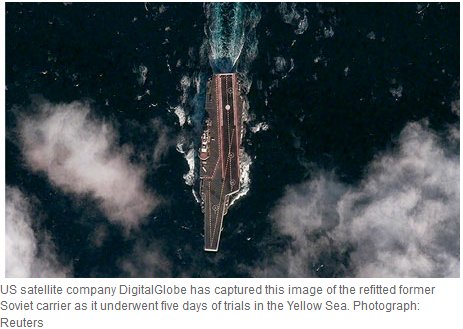
The Shi Lang, formerly the Varyag, is undergoing a set of sea trials:

China’s first aircraft carrier began sea trials on Wednesday, the state-run Xinhua news service reported, a highly symbolic step in what is certain to be a years-long effort to create a carrier presence in the Pacific waters off its coast.

The carrier, once known as the Varyag, left Dalian, its northeast China port for what analysts said would be a test of its rudder, propulsion system and other basics. Xinhua’s two-sentence report stated only that the carrier would make a short voyage before returning to Dalian for further tests.

The Chinese Defense Ministry said last month that the carrier would be used largely for scientific research and training. Foreign military analysts say it could be a decade or more before the Chinese can deploy and operate a true fleet of carriers, the most costly and complex weapons systems in any nation’s arsenal.

July 28, 2011

First F-35C catapult launch

Filed under: Military, Technology, USA — Tags: , , , — Nicholas @ 09:18

Lewis Page has more:

The test launch took place on the landbased steam catapult at US Naval Air Station Lakehurst (also the location of a prototype electromagnetic one of the type the Royal Navy will be compelled to use).

The F-35C is intended to operate from the catapult-equipped fleet carriers of the US Navy and will equip the Royal Navy and the RAF too. The jumpjet F-35B (formerly the chosen British model) will now be delivered only to the US Marines to begin with. The F-35A version, intended for ordinary landbased runway operations, will serve with the US Air Force and many allied nations.

July 27, 2011

Okay, everyone relax: China says aircraft carrier to be used for “research and training”

Filed under: China, Military, Pacific — Tags: , — Nicholas @ 07:44

That’s the latest story from China, which has finally acknowledged that they are rebuilding the former Soviet aircraft carrier Shi Lang:

China has officially acknowledged that it is rebuilding an aircraft carrier it bought more than a decade ago, but says the refurbished ship will be used only for research and training.

A defence ministry spokesman, Geng Yansheng, told reporters on Wednesday that work was under way on refitting an old carrier, a reference to the Varyag, whose stripped-down hull was towed from Ukraine in 1998 and has been under reconstruction for the best part of a decade.

“Building an aircraft carrier is extremely complex and at present we are using a scrapped aircraft carrier platform to carry out refurbishment for the purposes of technological research, experiments and training,” Geng said.

June 10, 2011

Royal Navy still regrets decision to retire their aircraft carriers

Filed under: Africa, Britain — Tags: , , — Nicholas @ 12:56

With a significant portion of the Royal Navy deployed in the Mediterranean, the hasty decision to take HMS Ark Royal out of service looks even dumber now:

Just at the very moment that the decisions of the October 2010 “Strategic Defence Review” start to bite, the Royal Navy is being asked by government to do more than ever. With the crisis in Libya and the Middle East showing no signs of ending, RN warships are spread thin across the globe. A quick snapshot of the fleet shows the pace of operations. With such a tiny fleet, our naval ports are almost empty and there are few vessels able to provide reliefs should the Libya crisis continue or escalate.

RN ships involved in Operation Ellamy off Libya include HMS Ocean, HMS Albion, HMS Sutherland, HMS Liverpool, HMS Brocklesby and HMS Bangor and HMS Triumph. The RFA is playing an increasing role with RFA Fort Rosalie, RFA Wave Knight supporting them. RFA Argus, RFA Fort Victoria and RFA Cardigan Bay are ready off Yemen should UK citizens need to be evacuated. RN patrols in the Arabian Gulf continue (as they have since 1980) with HMS St Albans sailing this week to relieve HMS Iron Duke in addition to the 4 permanently deployed RN minehunters in the Gulf. HMS Richmond is involved in exercises in the Far East and HMS Edinburgh has sailed to relieve HMS York in the South Atlantic along with HMS Scott. RFA Wave Knight is in the Caribbean ready to provide relief in case of hurricanes.

That fleet is spread very thin indeed. If something else happens, the Royal Navy probably can’t provide any significant forces to address it: there aren’t any more ships to send.

June 9, 2011

Is the Shi Lang a naval “Potemkin Village”?

Filed under: China, Military, Russia — Tags: , , , , — Nicholas @ 17:30

David Axe is not losing any sleep over the soon-to-be commissioned Chinese carrier Shi Lang:

Leaving aside her modest size compared to American carriers, her incomplete air wing and escort force and the fact that she’ll sail without the company of allied flattops, Shi Lang could be even less of a threat than her striking appearance implies. Shi Lang’s greatest potential weakness could be under her skin, in her Ukrainian-supplied engines.

Powerplants — that is, jet engines for airplanes, turbines for ships — are some of the most complex, expensive and potentially troublesome components of any weapon system. Just ask the designers of the Pentagon’s F-35 stealth fighter and the U.S. Navy’s San Antonio-class amphibious ships. Both have been nearly sidelined by engine woes.

China has struggled for years to design and build adequate powerplants for its ships and aircraft. Although Chinese aerospace firms are increasingly adept at manufacturing airframes, they still have not mastered motors. That’s why the new WZ-10 attack helicopter was delayed nearly a decade, and why there appear to be two different prototypes for the J-20 stealth fighter. One flies with reliable Russian-made AL-31F engines; the other apparently uses a less trustworthy Chinese design, the WS-10A.

For Shi Lang, China reportedly purchased turbines from Ukraine. Though surely superior to any ship engines China could have produced on its own, the Ukrainian models might still be unreliable by Western standards. Russia’s Kuznetsov, also fitted with Ukrainian turbines, has long suffered propulsion problems that have forced her to spend most of her 30-year career tied to a pier for maintenance. When she does sail, a large tugboat usually tags along, just in case the carrier breaks down.

If Shi Lang is anything like her sister, she could turn out to be a naval version of the mythical “Potemkin village” — an impressive facade over a rickety interior.

H/T to Nicholas “Ghost of a Flea” Packwood for the link.

June 8, 2011

China admits it’s hard to hide 1000ft-long aircraft carrier

Filed under: China, Military, Pacific — Tags: , , — Nicholas @ 07:44

China has finally gotten around to acknowledging that they’re rebuilding the former Soviet aircraft carrier for use by their navy:

Gen Chen Bingde refused to say when the carrier — a remodelled Soviet-era vessel, the Varyag — would be ready.

A member of his staff said the carrier would pose no threat to other nations.

The 300m (990ft) carrier, which is being built in the north-east port of Dalian, has been one of China’s worst-kept secrets, analysts say.

Gen Chen made his comments to the Chinese-language Hong Kong Commercial Daily newspaper.

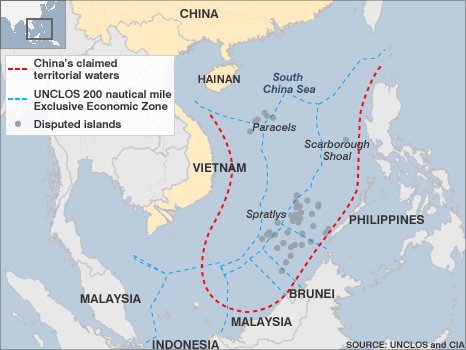
Although the Chinese say that the ship, once ready for operations, won’t enter other countries’ territorial waters, keep in mind that China doesn’t have the same idea about maritime rights as others in the South China Sea region:

Earlier posts about the Shi Lang (nee Varyag) here.

June 3, 2011

China’s first aircraft carrier edges closer to readiness

Filed under: China, Military, Russia, Weapons — Tags: , , , — Nicholas @ 10:25

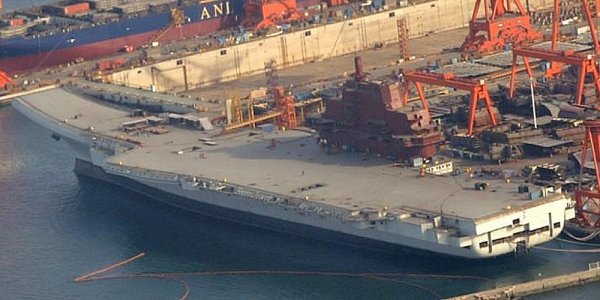
The Chinese navy is a bit closer to having an operational aircraft carrier, as the Shi Lang (formerly Varyag in Russian service) is being equipped with radar and weapons:

In the last month, the new Chinese aircraft carrier, the Shi Lang (formerly Varyag) has had several major electronic systems, and its first weapons, installed. The most notable electronic item to show up are the four AESA radar panels. This is a state-of-the-art radar similar to the one used in the American Aegis system. There were a lot of other electronic items being carried into the Shi Lang, indicating that the ship will be equipped with extensive networked computers and communications systems.

The two main weapons were also installed. One was a new version of the older, Type 730 seven barrel, 30mm close-in anti-missile automatic cannon. Operating like the American Phalanx, the new version of the Type 730 seen on the Shi Lang had ten barrels. The other weapon was the FL-3000N anti-missile systems. These are similar to the American RAM anti-missile missile system, except that they come in a 24 missile launcher and are less accurate. FL-3000N was only introduced three years ago, and uses smaller missiles than RAM. The two meter long FL-3000N missiles have a max range of nine kilometers (about half that for very fast incoming missiles). The 120mm, two meter long missiles now use a similar guidance system to RAM, but are not as agile in flight.

[. . .]

The Shi Lang/Varyag is one of the Kuznetsov class carriers that Russia began building in the 1980s. Originally the Kuznetsovs were to be 90,000 ton, nuclear powered ships, similar to American carriers (complete with steam catapults). Instead, because of the high cost, and the complexity of modern (American style) carriers, the Russians were forced to scale back their plans, and ended up with 65,000 ton (full load) ships that lacked steam catapults, and used a ski jump type flight deck instead. Nuclear power was dropped, but the Kuznetsov class was still a formidable design. The 323 meter (thousand foot) long ship normally carries a dozen navalized Su-27s (called Su-33s), 14 Ka-27PL anti-submarine helicopters, two electronic warfare helicopters and two search and rescue helicopters. But the ship was meant to regularly carry 36 Su-33s and sixteen helicopters. The ship carries 2,500 tons of aviation fuel, allowing it to generate 500-1,000 aircraft and helicopter sorties. Crew size is 2,500 (or 3,000 with a full aircraft load.) Only two ships of this class exist; the original Kuznetsov, which is in Russian service, and the Varyag. Like most modern carriers, the only weapons carried are anti-missile systems like Phalanx and FL-3000N, plus some heavy machine-guns (which are often kept inside the ship, and mounted outside only when needed.) However, Russian practice was been to sometimes install long range anti-ship missiles as well. China may also do this with Shi Lang.

May 15, 2011

US had prepared to fight Pakistan over Bin Laden raid

Filed under: Asia, Military, USA — Tags: , , , , , — Nicholas @ 12:16

Strategy Page reports that the US military had made contingency plans to cover Pakistani military intervention in the raid that killed Osama bin Laden:

On May 2nd, the United States was prepared to go to war with Pakistan. The American raid on that day, which killed Osama bin Laden and seized a huge mass of al Qaeda data from his Pakistani hideout, was carried out without informing Pakistan beforehand. Although Pakistan had years earlier agreed that the U.S. could enter Pakistani territory in hot pursuit of terrorists fleeing Afghanistan, or to grab high ranking al Qaeda leaders, it was always assumed that the U.S. would let the Pakistani military know what was coming. But because the Pakistani government was full of bin Laden fans, the U.S. did not inform Pakistan about the raid until it was underway. Apparently, that message included a reminder that if the U.S. troops in the bin Laden compound were attacked by Pakistani forces, there would be instant, and far-reaching, consequences.

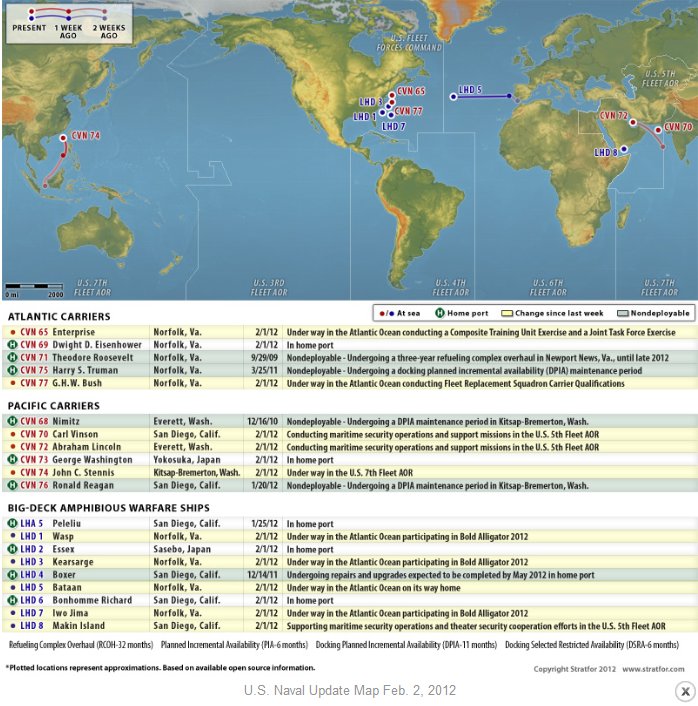
The extent of those consequences have since been pieced together, from unclassified information. By May 2nd, the U.S. had assembled a huge naval and air force in the region, that was pointed at Pakistan. This force would attack any Pakistani troops or warplanes that went after the U.S. forces in the bin Laden compound, or who might be able to do so. The U.S. had assembled three aircraft carriers, hundreds of air force aircraft in Afghanistan and the Persian Gulf, and dozens of helicopters, and thousands of troops, in Afghanistan. Most of these troops didn’t know what they were alerted for. Such alerts happen all the time, often for no reason (as far as the troops are concerned.) But this time, as word of the bin Laden raid got out, it became obvious (at least to those who know how these things work) that the alerts throughout the region were to prepare for the possible need to quickly get the American raiders out, and destroy any Pakistani forces that sought to interfere.

April 28, 2011

Bill for Royal Navy’s new carriers continues to rise

Filed under: Britain, Military, Technology — Tags: , — Nicholas @ 11:26

In news that will surprise nobody who has any familiarity with military equipment purchases, the Royal Navy’s new aircraft carriers are now expected to cost at least another £1bn:

The cost of building two new aircraft carriers for the navy has soared again and could eventually total £7bn.

The latest increases follow a series of costly delays and are largely the result of a decision in last year’s defence review to equip HMS Prince of Wales with aircraft catapults and traps. It is the second of the carriers due to enter into service by 2020.

The first carrier, HMS Queen Elizabeth, will be mothballed when it is completed, leaving Britain without a carrier able to take aircraft for 10 years.

The carriers were officially estimated to cost less than £4bn when they were announced in 2007. The estimate rose to £5bn last year after the Ministry of Defence decided to delay the construction programme to put off costs. Short-term savings led to cost increases in the longer term.

It’d be absolutely normal for the British government to decide to delay the ships’ completion even longer, raising total costs but stretching the purchase out over more budget years. It’s a common false economy, and it’s one of the reasons that military equipment manufacturers have to build possible delay costs into their plans.

March 29, 2011

RAF has only 69 qualified pilots for Typhoon fighters?

Filed under: Africa, Britain, Military — Tags: , , , — Nicholas @ 11:44

I’m not sure how an organization which recently performed brilliantly in their bureaucratic and political struggle against their arch-enemies in the Royal Navy can also be this stupid:

Since the conflict began, a squadron of 18 RAF Typhoon pilots has enforced the Libya no-fly zone from an air base in southern Italy. However, a shortage of qualified fighter pilots means the RAF may not have enough to replace all of them when the squadron has to rotate in a few weeks.

The situation is so serious that the RAF has halted the teaching of trainee Typhoon pilots so instructors can be drafted on to the front line, according to air force sources. The handful of pilots used for air shows will also be withdrawn from displays this summer.

The RAF put in a merciless performance in the recent defence review negotiations, eliminating three two aircraft carriers and downing all of the remaining Harrier jets. Perhaps their emphasis on bureaucratic and political in-fighting meant they had no time or energy to train pilots for their shiny new aircraft?

The Government’s decision to decommission HMS Ark Royal, Harrier jump jets and the Nimrod reconnaissance aircraft — all of which could have played a role in the Libya conflict — has exacerbated the problem. Serving RAF pilots contacted The Daily Telegraph to warn of the risks to the Libya operation. “We have a declining pool of pilots,” one said. “There’s less people to do twice as much work. If we are not training any more we are going to run out of personnel very soon.”

[. . .]

Out of 69 qualified RAF Typhoon pilots, including instructors, 18 are in southern Italy flying missions over Libya. Of the rest, 24 are committed to the Quick Reaction Alert protecting Britain’s air space and six are in the Falklands in a similar role. A further six are being used to train Saudi Arabian air force pilots. That leaves only 15 to replace those currently based in Italy.

Because of the intensity of flying on operations, pilots deploy for a maximum of two months at a time and the replacements for those currently enforcing the no-fly zone in Libya will be expected to deploy at the end of next month.

March 25, 2011

Libya operations do not support UK’s recent defence decisions

Filed under: Africa, Britain, Military — Tags: , , , , , — Nicholas @ 12:15

Lewis Page is doing an analysis of the current British involvement in Libya. He points out that many of the recent decisions by the British government are not being proven by the actual pattern of combat:

Recent combat operations by British and allied forces in Libya are beginning to tell us a lot: not so much about the future of Libya, which remains up for grabs, but about the tools one actually needs for fighting real-world wars against real-world enemy armed forces.

The vast bulk of our own armed forces are set up, equipped and focused on this type of mission — rather than the hugely more common one of battling guerillas and insurgents, as seen in Afghanistan — so the Libyan operations of the last week are very important to us at a time of shrinking budgets and worldwide turbulence. Libya is telling us how well the Coalition government did in its recent Strategic Defence and Security Review — and bluntly, it is showing that the Review was a fiasco.

Mr. Page has not been a fan of the Eurofighter, and sees the initial stages of the Libyan campaign as proving the investment is so much wasted money:

. . . highly advanced specialist air-to-air combat capability has not been necessary here. The RAF has rushed Eurofighter Typhoons to Italy — they were the first British aircraft to arrive there, in fact — but they are pure air-to-air planes at the moment (the RAF doesn’t expect to have them properly ready for use as bombers until 2018). The odds are that they will not fire a shot — and if they do it will be to swat down some rusty old MiG flown by a suicidal pilot. For this job, much cheaper fighters would have been more than adequate: say American F-18s or F-16s, or even our previous embarrassing Tornado F3, now retired.

So, point one: buying the Eurofighter remains a stupid idea on our part.

Canada’s F-18 aircraft have seen more combat in Libyan airspace than the RAF’s Eurofighters, because the F-18 has a ground-attack capability.

On the other hand, Mr. Page rejoiced at the overdue decision to scrap the Nimrod, but the ancient-but-terribly-expensive aircraft appear to have a valid role to play in Libya:

Point two: electronic warfare and AWACS planes are useful, even against the minor regimes who we might genuinely fight in the real world. The decision to keep both in the recent UK Defence Review was sensible (the Nimrod R1 Elint planes were marked for the bin — and have been temporarily been reprieved for duty in the Libyan situation — but replacement “Rivet Joint” aircraft are on order).

The use of the Tornado aircraft for very long range attacks seems like a waste of time and resources:

We are told in official announcements that some 112 Tomahawk cruise missiles were used in the initial strike at the weekend, launched from US and British warships and submarines off the Libyan coast. We are also told that “a number” of Storm Shadow shorter-ranged cruise missiles were launched from Tornado bombers. The Tornadoes had flown 3,000 miles from Kent Norfolk to do so, requiring the aid of repeated air-to-air refuelling assistance both on the way out and on the way back.

We can be pretty sure what the unspecified number of Storm Shadows was, as the Tornado can carry only one Storm Shadow into combat and we are told that a total of four Tornadoes have been assigned to Operation ELLAMY, the British contribution to the Libyan fighting. Some accounts suggest that in fact only three Storm Shadows were fired in the initial long-range Tornado raid.

[. . .]

Our lesson from a shooting war against a national air force — the first we have fought since 1982 — is that you don’t suppress enemy air defences of the sort you actually meet in the real world with deep penetration bombers and clever air-launched weapons (far less with stealth planes). You do it with AWACS and Elint planes and Tomahawks launched from the sea.

And speaking of the sea . . . what about the Royal Navy contribution to the Libya campaign?

Don’t we just wish we had a carrier off Libya now? Shame we scrapped ours just months ago. Nice work, Mr Cameron

There can be little doubt that the Harrier would also have been better for Libya. The Harrier fleet actually had more aircraft modernised to drop the latest smart weaponry — it was a superior battlefield strike plane — and it was cheaper to run. Best of all, it could operate from our also-recently-axed pocket aircraft carriers right off the coast and thus reach the theatre of action in minutes rather than hours. France and the USA both have carriers operating off the Libyan coast right now, but our foolish decisions in the recent review have left us on the sidelines.

Mr. Page still thinks the Royal Navy got royally shafted by the RAF:

Point four: The decisions taken over many years to whittle down the Harrier force to the point where it was barely viable – and then finally axe it in the Review — were totally wrong. Instead the Tornado should have been scrapped. Our present-day fleet of more than 130 of these cripplingly expensive-to-run, slow, lumbering low-altitude jets, assisted by similarly costly tanker planes, has offered us an utterly pathetic capability to deliver three or four dodgy missiles into Libya and a minimalist air support capability thereafter.

Even by the time of the Review, when the Harrier fleet was down to an almost unviable 44 jets, it would have made more sense to keep them, scrap the Tornado and buy or lease some nice cheap F-18s from America to bulk up our strike forces somewhat. The RAF should be ashamed of itself for manipulating the Prime Minister into keeping Tornado; heads should roll.

Is it too late to save the Ark Royal and Invincible? Yes:

To make the situation even more pathetic:

Once, this would have been a sight to strike fear into the hearts of any enemy fleet, a vivid portrait of the naval clout of this island nation.

But, today, these are two ghost ships. This depressing photograph taken yesterday is merely a reminder of the current state of the Royal Navy. Until recently, Britain had three aircraft carriers. The latest round of defence cuts means we have just one carrier — HMS Illustrious — and no planes on board. It only does choppers these days.

Invincible is bound for the Middle East. But Colonel Gaddafi need have no fears about this gallant old warhorse. In a few days’ time she will be off the coast of Libya but she won’t be stopping. She’ll be pressing straight on for Turkey where she is due to be cut up — or ‘recycled’ as an MoD spokesman insisted yesterday.

Back to Mr. Page’s conclusions (not that there should be any surprises based on the examples I’ve included):

Summing up, the lesson of Libya is that the recent Defence Review was, indeed, a dismal failure. RAF empire-preservation saddled us with the useless Tornado at the cost of our carrier capability. The army insisted on preserving pointless tanks and big guns and as a result we are not pulling our weight in Helmand — a war we more or less unilaterally started in 2005 — and we have no option to intervene on the ground in Libya seriously.

The navy made no real effort to help matters. It might have managed to preserve a carrier capability by making concessions on its pointless frigate flotilla, but this it refused to do.

[. . .]

But the chance to change things is not gone yet. So badly fudged were the Strategic Defence and Security Review’s figures that more reorganisation remains on the cards; in effect, a review of the Review is now very likely. The chance is still there to scrap the cripplingly expensive Tornado and Eurofighter altogether and replace them with cheap, excellent F-18s — so getting our carrier capability back in just a few years, as well. When the F-35C actually becomes affordable at last around 2025 we can buy some — by that point its Stealth and other new technologies might actually be becoming relevant for wars that might really happen, along the lines of Libya.

February 7, 2011

X-47B takes flight, Navy pilots feeling threatened

Filed under: Military, Technology, USA — Tags: , , — Nicholas @ 08:46

Lewis Page looks forward to the day US Navy aircraft carriers don’t have pilots cluttering up the works:

The disappearance of swaggering pilots from the flight decks of US naval aircraft carriers came a step closer on Friday with the first flight of the X-47B robot tailhook stealth jet.

The X-47B is intended to demonstrate that unmanned aircraft can take off from aircraft carrier catapults and land back on deck again using tailhook and arrester wires. Such arrested landings have long been regarded as one of the most difficult and dangerous feats for human pilots to master, and US naval aviators tend to measure their manhood (or occasionally these days, womanhood) by the number of “traps” in their logbook.

Not content with automating the Top Guns out of their main trick, the X-47B is also intended to demonstrate autonomous air-to-air refuelling. This is another vital trick which human pilots find quite difficult (the act of flying the probe of the to-be-fuelled aircraft into the basket trailing at the end of the tanker plane’s hose is traditionally described as being of similar difficulty to “taking a running fuck at a rolling doughnut”).

« Newer PostsOlder Posts »

Powered by WordPress