Quotulatiousness

July 14, 2013

“The very definition of grand strategy is holding ends and means in balance to promote the security and interests of the state”

Filed under: Middle East, Military, USA — Tags: , , , — Nicholas @ 11:18

At the Anti-War blog, John Glaser looks at the ongoing costs of empire:

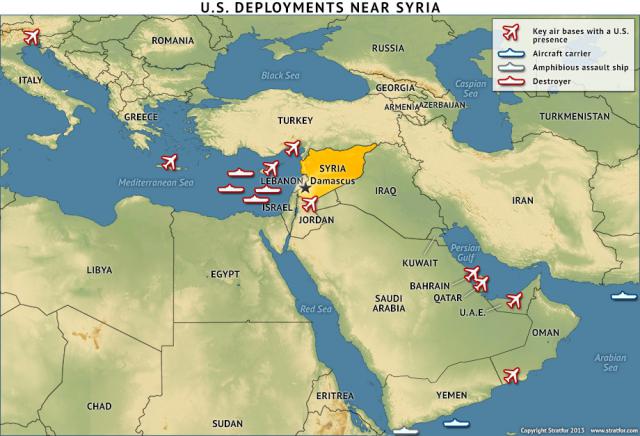
In Foreign Affairs, Michael O’Hanlon and Bruce Riedel suggest a cost-saving measure for America’s empire in the Middle East: opening more U.S. military bases in the region. Instead of relying as it has on expensive “aircraft carriers in and near the Persian Gulf,” the U.S. should move its military presence back onto land in at least three different Gulf states.

The primary purpose of having U.S. military bases peppered throughout the Middle East has traditionally been to exert control over geo-politically vital oil-rich countries and to allow for a rapid and coordinated use of military force at Washington’s command. As a Top Secret National Security Council briefing put it in 1954, “the Near East is of great strategic, political, and economic importance,” as it “contains the greatest petroleum resources in the world” as well as “essential locations for strategic military bases in any world conflict.”

O’Hanlon and Riedel don’t even consider the legitimacy of America’s military presence in the Middle East; for them, it is a natural law that can’t be questioned. So when faced with strained budgets that can’t support a sprawling, costly, and unwarranted empire, they try to figure minor cost cutting measures around the edges instead of reevaluating our military postures as a whole.

A CSIS report last year took a different tack, arguing that “disappearing finances; rising alternative power centers; declining US military predominance; lack of efficacy of key non-military instruments of power; and reduced domestic patience for global adventures,” all require a rethinking of U.S. grand strategy with an eye towards roll-back.

    The very definition of grand strategy is holding ends and means in balance to promote the security and interests of the state. Yet, the post-war US approach to strategy is rapidly becoming insolvent and unsustainable – not only because Washington can no longer afford it but also, crucially, because it presumes an American relationship with friends, allies, and rivals that is the hallmark of a bygone era. If Washington continues to cling to its existing role on the premise that the international order depends upon it, the result will be increasing resistance, economic ruin, and strategic failure.

That first sentence there is one of the most honest you’ll ever see from an elite DC foreign policy think tank. U.S. foreign policy is ultimately promoting “the security and interests of the state.” It isn’t for your sake. It benefits the government and the private interests aligned with it.

May 18, 2013

US Navy’s UAV conducts touch-and-go landing on carrier deck

Filed under: Military, Technology, USA — Tags: , , — Nicholas @ 08:24

It’s still a work in progress: perfect conditions, no particular weather concerns, totally clear flight deck, but it shows that unmanned aircraft are becoming capable of much more than they’ve done so far:

An X-47B Unmanned Combat Air System (UCAS) demonstrator conducts a touch and go landing on the flight deck of the aircraft carrier USS George H.W. Bush (CVN 77), marking the first time any unmanned aircraft has completed a touch and go landing at sea. George H.W. Bush is conducting training operations in the Atlantic Ocean.

May 15, 2013

US Navy successfully launches UAV from aircraft carrier

Filed under: Military, Technology, USA — Tags: , , — Nicholas @ 00:02

Spencer Ackerman talks about yesterday’s step forward for unmanned aircraft in the US Navy:

ABOARD THE U.S.S. GEORGE H.W. BUSH — At 11:19 a.m. today, for the first time in history, a plane without a pilot in it executed one of the most complex missions in aviation: launching off an aircraft carrier at sea. Only the Navy can’t yet land that drone aboard the U.S.S. George H.W. Bush, an even harder but necessary maneuver if large drones are really going to operate off carriers.

On a crisp, bright and nearly cloudless day, about 100 miles off the Virginia coast, the crew of the Bush and the team behind the highly autonomous X-47B loaded up the deck’s second catapult with the drone and shot it off into the sky above the eastern Atlantic. The drone — which has its own callsign, “Salty Dog 502″ — turned downwind and passed over the ship twice, first from 1000 feet overhead and then from 60 feet overhead, before flying back to dry land in Maryland. The launch went exactly as the Navy hoped.

With that, the era of the drone took a major step toward patrolling the skies above the world’s waterways. It’s something the Navy hopes will have big implications for supplementing manned fighter jets in a carrier air wing, providing both persistent surveillance far out at sea and ultimately firing weapons in highly defended airspace that might mean death for human pilots.

Senior Navy officers openly likened the X-47B’s launch off the Bush to the first-ever launch of a plane off the U.S.S. Birmingham in 1910. “It’s one small step for man,” remarked Rear Adm. Matt Winter, the Navy’s chief program officer for unmanned systems, “and one significant technical step for unmanned-kind.”

April 2, 2013

Mistral in Russian is Vladivostok

Filed under: Europe, France, Military, Russia — Tags: , , , — Nicholas @ 08:44

Strategy Page on the largest purchase of Western military equipment by Russia since the end of the Second World War:

The Russian Navy intends to have its version of the French Mistral amphibious ships (the Vladivostok Class) carry 30 helicopters (compared to 16 on the French version) and have several other modifications to the ship itself. The Vladivostok Class ships will be armed with two AK-630 multibarrel 30mm autocannon for anti-missile defense. There will also be two quad-launchers of shoulder fired type anti-aircraft missiles (with a 5 kilometer range and good against helicopters) and two or more DP-65 55mm grenade launchers for defense against divers.

The Vladivostoks will also be winterized for use in arctic conditions. The hull with be strengthened to deal with ice and the well deck door will completely close. The flight deck will have a deicing system and the ship will be modified to operate for extended periods in arctic conditions. There is also different electronics and this means a different arrangement of radomes and antennae.

In the aircraft handling areas below the deck height will be higher for the taller Ka-52K and Ka-29 helicopters. The Ka-52K is a navalized version of the Ka-52 that went into production last year. In addition to being equipped with coatings to resist sea water corrosion, the K model will also have a lightweight version of the high-definition Zhuk-AE AESA radar used on jet fighters. This radar currently weighs 275 kg (605 pounds), but the helicopter version will weigh only 80 kg (176 pounds) and enables the Kh-52K to use the Kh-31 anti-ship missile. This weapon has a range of 110 kilometers and travels at high speed (about one kilometer a second.) The Kh-52K can also carry the sub-sonic Kh-31 missile, which has a range of 130 kilometers. Both of these missiles weigh about 600 kg (1,300 pounds) each.

[. . .]

Russia is buying two French Mistral class amphibious ships for $1.7 billion. This is the largest Russian purchase of Western weapons since World War II. The deal was delayed for a long time because the Russians demanded the transfer of shipbuilding and electronics technology (which is now agreed to).

The French navy received the first of the 21,500 ton Mistrals in 2006, with the second one arriving in 2007. Both were ordered in 2001. These two ships replaced two older amphibious landing ships. This gave France a force of four amphibious ships. The two Mistrals are also equipped to serve as command vessels for amphibious operations. The French have been very happy with how the Mistrals have performed.

The Mistrals are similar in design to the U.S. LPD 17 (San Antonio) class. Both classes are about 200 meters/620 feet long, but the LPD 17s displace 25,000 tons. The French ships are more highly automated, requiring a crew of only 180, versus 396 on the LPD 17. On long voyages on the open ocean, the Mistrals require as few as nine sailors and officers on duty (“standing watch”) to keep the ship going.

March 19, 2013

Considering the future of the aircraft carrier

Filed under: Military, USA — Tags: , , , — Nicholas @ 00:02

At the Thin Pinstriped Line blog, Sir Humphrey considers the arguments put forward by a US Navy officer on the viability of the USN carrier fleet:

Humphrey was lucky enough to be tipped off about the existence of an extremely thought provoking article by a US Navy officer (Captain Hendrix) on the future viability of the US carrier fleet. This was an alternative thinkpiece, produced in an unofficial capacity, but one that does raise some extremely searching questions about the viability of the long term future of the US carrier fleet.

The author conducted a detailed analysis of the cost of the CVN fleet, and also of the airwing attached to it, and broadly concluded that in terms of delivering effect, there were other means that could deliver similar effect for less cost (e.g. stand off missiles, more escort vessels etc). He was also scathing about the overall cost effectiveness of a current airwing, suggesting that large amounts of an aircraft’s use was linked to carrier qualification and not necessarily the delivery of effect. At the same time, the increased use of long range anti-ship missiles will make it more difficult to operate close in to an enemy coastline without being at increased risk. He believes that because of this, in future the F35 will simply not have the range to be able to penetrate enemy air defences, and that instead efforts should focus on development of a navalised UCAV to take over instead of the F35, with any future force structure being built around UCAVs and SSGNs using land attack missiles.

[. . .]

What is perhaps interesting about the paper is that in many ways it revisits a lot of the long term arguments about the validity of carriers, and revisits them to show that the perceived weaknesses remain the same as they always have. One only has to think of the argument in the UK in the 1960s, when the decision was taken to move away from fixed wing carriers that they were inherently vulnerable to attack and could be sunk with ease. Humphrey is always somewhat sceptical of claims about ‘wonder weapons’ that can take out a carrier battle group from nowhere with ease. While there are indeed many very potent long range weapons out there, the problem remains one of getting accurate enough real time intelligence to be able to ensure accurate targeting of the carrier in the event of war.

[. . .]

The issue for UCAVs at present is that they are probably not at a sufficient level of maturity to conduct the wide range of operations that are being envisaged for JSF. It is worth considering that while there is plenty of use of so-called ‘drones’ like the Predator, these are fundamentally fairly simple aircraft designed to not be used in hugely complex missions. To meet the requirements of a new UCAV, you would essentially need to design an entirely new platform from scratch, adding in technologies never used before and then integrate it with all the likely weapons systems expected to be used. You’d then need to ensure the platforms were capable of flying the missions expected of them, which are likely to be very different to the so-called ‘racetrack’ circuits flown by drones in Iraq or Afghanistan.

March 4, 2013

Are we approaching the end of the aircraft carrier era?

Filed under: Europe, Italy, Military — Tags: , , — Nicholas @ 10:31

At the Thin Pinstriped Line, “Sir Humphrey” looks at Spain’s all-but-certain exit from the ranks of carrier-equipped navies:

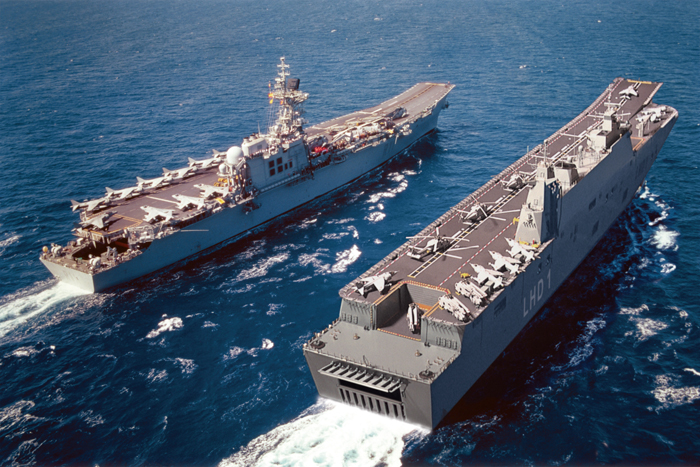
In Spain for instance the veteran carrier Principe De Asturias (PDA) has finally been paid off after some 25 years service as part of budget cuts. It is perhaps ironic to consider that she was originally conceived in the early 1980s as a cheap ‘Sea Control Ship’ solution originally looked at by the US Navy to provide cheaper carriers. Intended to put ASW helicopters to sea as a replacement for the Delado, she represented the closest any nation has perhaps come to a truly ‘austere’ carrier, with minimal support facilities for the airwing. Optimised in the first for ASW, with a very limited fixed wing capability using the Harrier (although never to the same level of development as the UK with the mixed FA2 / GR7 airwing), the PDA was an example in the 1980s of how smaller ‘harrier carriers’ could be built for emerging middle tier navies, providing them with airpower at relatively small cost. In reality she remained the sole of her class built around the world, with the closest other example being a Thai vessel optimised for EEZ protection and to act as a Royal Yacht.

Although the Spanish have built a large LPH, with carrier facilities (the Juan Carlos) as a second platform relatively recently, she is not an aircraft carrier in the conventional sense, and with the Spanish economic crisis deepening, it seems likely that PDA will not be directly replaced by another ‘proper’ aircraft carrier.

Similarly, with the emphasis on Juan Carlos as an assault ship, it seems likely that the small fleet of Spanish harriers (less than 15 airframes) will be increasingly vulnerable to defence cuts in an economy which is desperately struggling. The chances of seeing a credible Spanish fixed wing aviation capability beyond the next few years seem slim, and at a time when they are struggling to afford sustaining a relatively small buy of Eurofighters, it seems hard to envisage introduction of the JSF too.

So, Spain is perhaps the first carrier casualty of the economic crisis, although Italy is also looking increasingly vulnerable. The Guissepe Garibaldi is now nearly 30 years old, and again is unlikely to be directly replaced. Mindful of the recent cuts to the Italian Navy which will see a near 20% cull in manpower, and significant loss of hulls across the fleet, it again seems less and less likely that a credible carrier aviation capability can be sustained in a single hull (the Cavour). Having seen both these nations enter the ‘Carrier Club’ in the 1980s, one cannot help but wonder if they will be leaving it as full time members in the not too distant future?

Spanish navy's Juan Carlos and Principe de Asturias
Juan Carlos and Principe De Asturias

Update: BBC News is reporting that the US Navy is planning a new class of UAV carriers:

The new project has been dubbed Tern (Tactically Exploited Reconnaissance Node) after a sea-bird known for its endurance.

Darpa programme manager Daniel Patt, said: “Enabling small ships to launch and retrieve long-endurance UAVs on demand would greatly expand our situational awareness and our ability to quickly and flexibly engage in hotspots over land or water.”

He added: “It is like having a falcon return to the arm of any person equipped to receive it, instead of to the same static perch every time.”

February 23, 2013

“The sequester’s ‘meat-cleaver approach’ of ‘severe,’ ‘arbitrary’ and ‘brutal’ cuts will ‘eviscerate’ education, energy and medical research spending”

Filed under: Bureaucracy, Economics, Government, USA — Tags: , , , , , — Nicholas @ 10:19

Head for the hills! The sequester is coming!

As in: Batten down the hatches — the sequester will cut $85 billion from this year’s $3.6 trillion budget! Or: Head for the storm cellar — spending will be cut 2.3 percent! Or: Washington chain-saw massacre — we must scrape by on 97.7 percent of current spending! Or: Chaos is coming because the sequester will cut a sum $25 billion larger than was just shoveled out the door (supposedly, but not actually) for victims of Hurricane Sandy! Or: Heaven forfend, the sequester will cut 47 percent as much as was spent on the AIG bailout! Or: Famine, pestilence and locusts will come when the sequester causes federal spending over 10 years to plummet from $46 trillion all the way down to $44.8 trillion! Or: Grass will grow in the streets of America’s cities if the domestic agencies whose budgets have increased 17 percent under President Obama must endure a 5 percent cut!

The sequester has forced liberals to clarify their conviction that whatever the government’s size is at any moment, it is the bare minimum necessary to forestall intolerable suffering. At his unintentionally hilarious hysteria session Tuesday, Obama said: The sequester’s “meat-cleaver approach” of “severe,” “arbitrary” and “brutal” cuts will “eviscerate” education, energy and medical research spending. “And already, the threat of these cuts has forced the Navy to delay an aircraft carrier that was supposed to deploy to the Persian Gulf.”

“Forced”? The Navy did indeed cite the sequester when delaying deployment of the USS Truman. In the high-stakes pressure campaign against Iran’s nuclear weapons program, U.S. policy has been to have two carriers in nearby waters. Yet the Navy is saying it cannot find cuts to programs or deployments less essential than the Truman deployment. The Navy’s participation in the political campaign to pressure Congress into unraveling the sequester is crude, obvious and shameful, and it should earn the Navy’s budget especially skeptical scrutiny by Congress.

The Defense Department’s civilian employment has grown 17 percent since 2002. In 2012, defense spending on civilian personnel was 21 percent higher than in 2002. And the Truman must stay in Norfolk? This is, strictly speaking, unbelievable.

December 7, 2012

Revisiting Pearl Harbour

Filed under: History, Japan, Military, Pacific, USA, WW2 — Tags: , , , , — Nicholas @ 10:38

In a History Today article from 2001, Dan van der Vat looks at the actual history rather than the film treatments of the Japanese attack on Pearl Harbour in 1941:

To recount what actually happened blow by blow, as in the exhaustive Tora, Tora, Tora!, is one thing; to use the event as the backdrop to an avowed fiction, as in From Here to Eternity, is equally legitimate. But to play fast and loose with history by presenting fiction as fact is at best confusing and at worse dangerous — especially when the event is still within living memory, affects current policy and needs to be understood by the young if the lessons of history are to be truly learned.

On Roosevelt’s ‘date that will live in infamy’, six Japanese carriers launched 350 aircraft to immobilise the US battlefleet at the very moment talks were due to resume in Washington. The Americans knew Japan’s propensity for surprise attack (Korea in 1895, the Russians’ Chinese enclave at Port Arthur in 1904, Manchuria in 1931, China in 1937). They were forewarned by their Tokyo embassy of the inclusion of Pearl Harbor in Japan’s war-plans, and they intercepted signals exposing its intentions. Yet the Japanese achieved strategic surprise. But their strategic blunder in not bombing repair facilities and fuel dumps spared the US Navy the crippling embarrassment of having to withdraw 2,200 miles eastward to the continental West Coast.

[. . .]

Initial American reaction to Pearl Harbor included not only rage at Japanese duplicity but also incredulity based on racism. Many witnesses insisted they had seen swastikas on the bombers; surely the Germans must have been behind such a sophisticated stroke. Inability to cope with the reality of America’s most spectacular lost battle led to a flourishing conspiracy industry which sprang up within hours of the bombing.

Even today, extreme revisionists claim that British frogmen came in on the midget Japanese submarines that almost gave the game away by trying to attack before the bombers. That at least one batch of intelligence intercepts from 1941 has not yet been released is taken as proof that they must conceal the ‘smoking gun’ the revisionists so stubbornly seek to this day.

Update: MHQ has the story of the most effective Japanese spy who reported on the comings and goings of US Navy ships at Pearl Harbour:

At 1:20 a.m. on December 7, 1941, on the darkened bridge of the Japanese aircraft carrier Akagi, Vice Admiral Chui­chi Nagumo was handed the following message: “Vessels moored in harbor: 9 battleships; 3 class B cruisers; 3 seaplane tenders, 17 destroyers. Entering harbor are 4 class B cruisers; 3 destroyers. All aircraft carriers and heavy cruisers have departed harbor….No indication of any changes in U.S. Fleet or anything unusual.”

[. . .]

Astonishingly, such critical intelligence was not the work of a brilliant Japanese superspy who had worked his way into the heart of the fleet’s installation. Rather, Takeo Yoshikawa, a naval officer attached to the consulate and known to the Americans, had simply watched the comings and goings of the fleet from afar, with no more access than a tourist. He made little effort to cloak his mission, and almost certainly would have been uncovered if American intelligence had been more on the ball, or if America’s lawmakers had recognized the mortal threat Japan presented. Instead, he raised little suspicion, and his observations helped the Japanese piece together an extraordinarily detailed attack plan, ensuring its success.

December 4, 2012

UAVs move closer to the front rank of US Navy assets

Filed under: Military, Technology, USA — Tags: , , — Nicholas @ 09:50

Strategy Page on the progress of the X-47B UAV:

The U.S. Navy X-47B UCAV (unmanned combat air vehicle) made its first catapult launch on November 29th, 22 months after its first flight. This launch was not from a carrier, but an airfield built to the same size as a carrier deck and equipped with a catapult. This first launch was to confirm that the X-47B could handle the stress of a catapult launch. Another X-47B has been loaded onto the deck of a carrier, to check out the ability of the UCAV to move around the deck. If all goes well, the first carrier launch of an X-47B will take place next year, along with carrier landings. Last year the navy tested its UCAV landing software, using a manned F-18 for the test, landing it on a carrier completely under software control.

It was four years ago that the navy rolled out the first X-47B, its first combat UAV. This compact aircraft has a wingspan of 20 meters (62 feet, and the outer 25 percent folds up to save space on the carrier). It carries a two ton payload and will be able to stay in the air for twelve hours. The U.S. is far ahead of other nations in UCAV development, and this is energizing activity in Russia, Europe and China to develop similar aircraft. It’s generally recognized that robotic combat aircraft are the future, even though many of the aviation commanders (all of them pilots) wish it were otherwise. Whoever gets there first (a UCAV that really works) will force everyone else to catch up, or end up the loser in their next war with someone equipped with UCAVs.

The U.S. Navy has done the math and realized that they need UCAVS on their carriers as soon as possible. The current plan is to get these aircraft into service six years from now. But there is an effort to get the unmanned carrier aircraft into service sooner than that. The math problem that triggered all this is the realization that American carriers had to get within 800 kilometers of their target before launching bomber aircraft. Potential enemies increasingly have aircraft and missiles with range greater than 800 kilometers. The navy already has a solution in development; the X-47B UCAS has a range of 2,500 kilometers

December 2, 2012

USS Enterprise, the first nuclear-powered aircraft carrier, decommissioned

Filed under: Military, USA — Tags: , , — Nicholas @ 12:02

The USS Enterprise was taken out of service yesterday after a long career:

The world’s first nuclear-powered aircraft carrier was retired from active service on Saturday, temporarily reducing the number of carriers in the U.S. fleet to 10 until 2015.

The USS Enterprise ended its notable 51-year career during a ceremony at its home port at Naval Station Norfolk, where thousands of former crew members, shipbuilders and their families lined a pier to bid farewell to one of the most decorated ships in the Navy.

“It’ll be a special memory. I’ve missed the Enterprise since every day I walked off of it,” said Kirk McDonnell, a former interior communications electrician aboard the ship from 1983 to 1987 who now lives in Highmore, S.D.

H/T to Doug Mataconis for the link. He also reported that the Secretary of the Navy announced that the third Ford class carrier will be called Enterprise.

November 28, 2012

Chinese aviators start carrier landing practice

Filed under: China, Military, Technology — Tags: , , , — Nicholas @ 09:52

Strategy Page updates us on the development of China’s aircraft carrier capabilities:

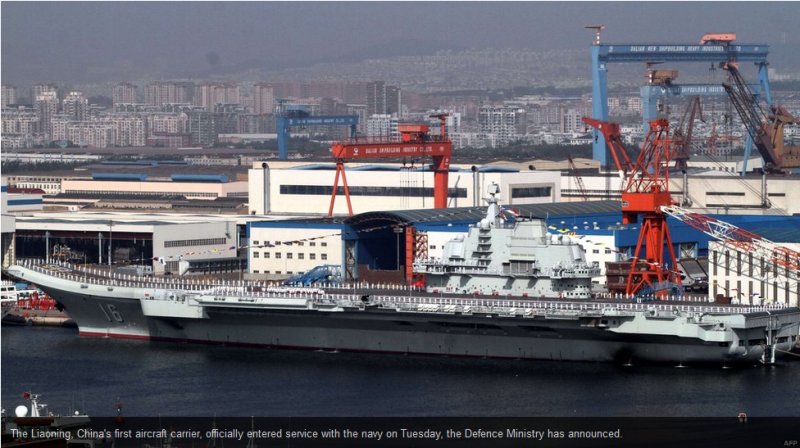
A Chinese aviator, flying a Chinese made J-15 fighter, made the first landing and takeoff from a Chinese aircraft carrier just two months after the ship was commissioned (on September 25th). The first Chinese aircraft carrier, the Liaoning is a 65,000 ton, 305 meter (999 feet) long ship that had spent over a year on sea trials. During that time Liaoning was at sea for about four months. This was all in preparation for flight operations. Last year China confirmed that the Liaoning will primarily be a training carrier. The Chinese apparently plan to station up to 24 jet fighters and 26 helicopters on the Liaoning and use the ship to train pilots and other specialists for four or more additional carriers.

Five years ago the Chinese Navy Air Force began training carrier fighter pilots (or “aviators” as they are known in the navy). In the past Chinese navy fighter pilots went to Chinese Air Force fighter training schools, and then transferred to navy flight training schools to learn how to perform their specialized (over open water) missions. Now, operating from carriers, and performing landings and take-offs at sea, has been added to the navy fighter pilot curriculum. The first class of carrier aviators has finished a four year training course at the Dalian Naval Academy. This included learning how to operate off a carrier, using a carrier deck mock-up on land. Landing on a moving ship at sea is another matter. The Russians warned China that it may take them a decade or more to develop the knowledge and skills needed to efficiently run an aircraft carrier. The Chinese are game and are slogging forward. The first landing and takeoff was apparently carried out in calm seas. It is a lot more difficult in rough weather (when the carrier is moving up and down and sideways a lot) and at night. The latter, called “night traps” is considered the most difficult task any aviator can carry out, especially in rough weather.

They also point out that the US Navy’s experiments with naval UAVs continue and are putting technological pressure on both Russia and China to do the same:

Over the last few years, the U.S. Department of Defense decided that the air force and navy be allowed to develop combat UAVs to suit their particular needs. The X-45 was meant mainly for those really dangerous bombing and SEAD missions. But the Pentagon finally got hip to the fact that the UCAV developers were coming up with an aircraft that could replace all current fighter-bombers. This was partly because of the success of the X-45 in rapidly reaching its development goals, and the real-world success of the Predator (in finding, and attacking, targets) and Global Hawk (in finding stuff after flying half way around the world by itself.)

The U.S. Navy expects UAVs to replace most manned aircraft on carriers and the Chinese are aware of that. So the age of manned aircraft operating from Chinese carriers may be a short one. Chinese engineers are well aware of automatic pilot software and how it works. Now they will have feedback from Chinese carrier pilots and be able to do what the Americans have done.

The usual caveats about UAVs in combat should be noted.

The slow erosion of the US Navy’s carrier capability

Filed under: Military, USA — Tags: , , — Nicholas @ 09:07

At the Thin Pinstriped Line, Sir Humphrey looks at the US Navy’s carriers and the tasks they are being called on to accomplish:

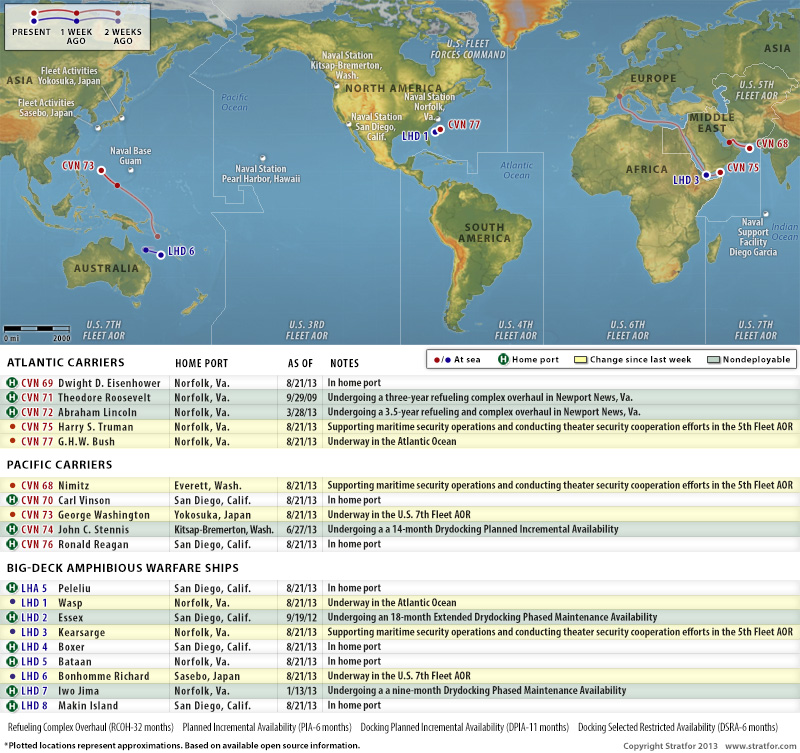
On paper from next week the USN will operate 10 aircraft carriers, all NIMITZ class, after the USS ENTERPRISE is decommissioned. In reality those 10 vessels are going to be thinly stretched across the globe. Right now, of the 10 hulls, Nimitz is undergoing repairs, three are forward deployed (two are in the Gulf, one is in Japan) and another is available for tasking in the US. One (Abraham Lincoln) is available, but is about to enter deep refit for refuelling, while two more are in deep refit or being refuelled, with a further two in minor refit. As of today, the US Navy has just three operational deployed aircraft carriers at sea, with a fourth available in the US if required, and this is unlikely to change before summer 2013. (A good source of information can be found here — http://gonavy.jp/CVLocation.html)

The worry is that these sorts of availability problems will continue to grow as the class gets older. Make no mistake, these are some of the most complex and capable warships on the planet, but they are also getting old. Three of the hulls have now been commissioned for over thirty years, and another two for over twenty years. Although designed for an optimised 50 year lifespan, it is likely that as they age, maintenance is going to be increasingly difficult and availability will suffer.

Although a replacement class is now under construction, only one has been ordered so far, and the deep budget cuts likely to hit the DOD over the next few years means that it is by no means certain that further orders can be guaranteed in time to generate replacement hulls on time. This is a grim situation and it’s likely to get worse before it gets better.

[. . .]

Despite many years, and millions of dollars expenditure, the USN has not yet introduced a wholly new ship class since the DDG51s entered service back in the late 1980s. Although a couple of small ‘Littoral Combat Ships’ have entered service, the programme is delayed and it feels as if it is unlikely to ever yield large scale unit production. The USN surface fleet is getting a lot older though, with the Ticonderoga Cruisers, the older Arleigh Burkes and the residual Oliver Hazard Perry frigates all getting into their late teens through to late twenties. These ships have been worked hard for years, and yet no replacement is currently in site and likely to enter service within the next 5-6 years. The US escort fleet is increasingly reliant on the DDG51, which looks like it will remain in serial production for at least another twenty years. Of the replacement frigates and cruiser programmes, no signs of real progress seem to be occurring. While this situation drags on, funding is going to be needed soon for the next pair of CVNs to ensure serial production of the Ford class continues. So, the USN has a major problem in managing an ever more elderly fleet with ever fewer ships likely to be active. As spares budgets are cut, it will become harder to keep vessels at sea, while procurement of replacements seems ever more delayed.

Earlier this year, I linked to another of Sir Humphrey’s posts, talking about the US Navy’s “East of Suez” moment.

November 25, 2012

21st century navies to watch: China and India

Filed under: China, India, Military, Pacific — Tags: , , , , , — Nicholas @ 12:07

The Economist provides some background on a growing naval rivalry between the two biggest powers in Asia:

Samudra Manthan is the title of a new book on this topic by C. Raja Mohan, an Indian writer on strategic affairs, for whom the myth is a metaphor for the two countries’ competition at sea. This contest remains far more tentative and low-key than the 50-year stand-off over their disputed Himalayan border, where China humiliated India in a brief, bloody war in 1962. But the book raises alarming questions about the risks of future maritime confrontation.

[. . .]

China’s naval plans receive more attention. By 2020 its navy is expected to have 73 “principal combatants” (big warships) and 78 submarines, 12 of them nuclear-powered. Last year its first aircraft-carrier, bought from Ukraine, began sea trials; indigenous carriers are under construction. Proving it can now operate far from its own shores, China’s navy has joined anti-piracy operations in the Gulf of Aden. Of course this evolution is not aimed at India, so much as at building a force commensurate with China’s new economic might, securing its sea lines of communication and, eventually perhaps, challenging American dominance in the western Pacific, with a view to enforcing China’s view of its national sovereignty in Taiwan and elsewhere.

Indian strategists, however, tend towards paranoia where China is concerned. China’s close strategic relations with India’s neighbours, notably Pakistan, have given rise to the perception that China is intent on throttling India with a “string of pearls” — naval facilities around the Indian Ocean. These include ports China has built at Gwadar in Pakistan; at Hambantota in Sri Lanka; at Kyaukphyu in Myanmar; and at Chittagong in Bangladesh.

[. . .]

India’s naval advances are less dramatic. But it has operated two aircraft-carriers since the 1960s, and aims to have three carrier groups operational by 2020, as part of a fleet that by 2022 would have around 160 ships and 400 aircraft, making it one of the world’s five biggest navies. Like China, it also hopes to acquire a full “nuclear triad” — by adding sea-based missiles to its nuclear deterrent. While China has been testing the waters to its south and south-west, India’s navy has been looking east, partly to follow India’s trade links. India fears Chinese “strategic encirclement”. Similarly, China looks askance at India’s expanding defence ties with America, South-East Asia, Japan and South Korea.

October 21, 2012

Inducing take-off, Fireball XL5 style

Filed under: Military, Technology — Tags: , , , — Nicholas @ 11:32

The Economist looks at a back-of-the-envelope proposal from engineers at Airbus that adapts aircraft carrier technology to civil use:

Mindful that many passengers are already nervous about the whole process of getting a plane airborne, the engineers prefer to call their proposal “Eco-climb”. But the idea is straight out of “Fireball”. The aircraft to be launched would sit on a platform that ran along a track where the runway would otherwise be. The platform would accelerate to take-off speed, at which point the plane would lift into the air powered by its own engines.

[. . .]

Altogether, according to Airbus’s back-of-the-envelope calculations, Eco-climb would reduce fuel consumption by 3% on a typical 900km (560-mile) flight, even with existing aircraft designs. But it would also allow for the design of lighter aircraft, with smaller engines, which would cut fuel consumption, noise and emissions further.

Nor is the idea complete fantasy. General Atomics, an American military contractor, has already built and tested a linear-induction-motor-based system of this sort at an airbase at Lakehurst, New Jersey. The General Atomics system is now being scaled up to be fitted on a new generation of aircraft carriers for the American navy.

September 25, 2012

Chinese Navy commissions first aircraft carrier, the Liaoning

Filed under: China, Military — Tags: , , — Nicholas @ 09:13

China’s first aircraft carrier has been commissioned under the name Liaoning (not Shi Lang as most earlier reports had stated). Chinese news agency Xinhua posted this report earlier today:

China’s first aircraft carrier was delivered and commissioned to the People’s Liberation Army (PLA) Navy Tuesday after years of refitting and sea trials.

Overseen by President Hu Jintao and Premier Wen Jiabao, the carrier was officially handed over by the navy’s main contractor, the China Shipbuilding Industry Corporation, at a ceremony held at a naval base in northeast China’s port city of Dalian.

President Hu, also chairman of the Central Military Commission (CMC), endorsed a PLA flag and naming certificate to Senior Captain Zhang Zheng, commanding officer of China’s first carrier, the Liaoning.

“Today will be forever remembered as China’s Navy has entered an era of aircraft carrier,” Zhang told Xinhua on the carrier’s flight deck.

“When I received the PLA flag from the President, a strong sense of duty and commitment welled up in my heart,” said Zhang who has served as commanding officer on the Navy’s frigate and destroyer.

The carrier, rebuilt from the Soviet ship Varyag, was renamed “Liaoning” and underwent years of refitting efforts to install engines, weapons, as well as a year-long sea trial.

BBC News has a series of photos of the Liaoning from purchase to commissioning:


Click to see full-size images at the BBC website

Earlier reports on the progress of the carrier (under the name Shi Lang) can be found here.

« Newer PostsOlder Posts »

Powered by WordPress