
Quotulatiousness

April 18, 2012

Summing up the career of Hunter S. Thompson, graphically

Filed under: Books, History, Media, USA — Tags: , , , , , — Nicholas @ 00:03

At BoingBoing, Mark Frauenfelder reviews Gonzo: A Graphic Biography of Hunter S. Thompson by Will Bingley and Anthony Hope-Smith:

180 pages isn’t much room to examine a life in minute detail. Instead, Bingley tells a story (as if it were written, quite convincingly, by Thompson himself) of Thompson’s frantic search to find meaning in the turbulent era he lived in. Bingley’s story is about a passionate, rebellious genius who sprinted too fast at the beginning of a long-distance race, collapsed early, and spent his remaining decades burnt-out, crawling bewilderedly.

The book’s forward, written by Thompson’s longtime editor, Alan Rinzler, is especially revealing. Rinzler believes that Thompson could have been the “heavyweight champion of American letters,” but his self-destructive behavior, which got worse with each passing year, ruined that opportunity.

[. . .]

After Lono, says Rinzler, “Hunter’s substance abuse, writer’s block and brief attention span were increasing exponentially. He’s slip out to see his dealer and come back so tanked he couldn’t think straight.” Thompson’s work became a series of “repetitious, mediocre, regurgitated articles and books and collections he allowed to be issued and reissued over the last 30 years of his life.”

The Curse of Lono was the last book by Thompson I read, but I don’t doubt Rinzler’s assessment of the quality of Thompson’s books that followed. (Thompson’s awful “Hey Rube!” columns for an ESPN website were enough to keep me uninterested in his newer books). But his earlier work, especially Hell’s Angels, is so good that I will always admire Thompson as a heavyweight contender who showed a very promising start.

I eagerly read much of Thompson’s early work (Fear and Loathing in Las Vegas, Fear and Loathing on the Campaign Trail, The Great Shark Hunt, Hell’s Angels, and The Curse of Lono) in the early-to-mid 80’s, but tapered off soon after that. Several years ago, I picked up a remaindered copy of Hey Rube: Blood Sport, the Bush Doctrine, and the Downward Spiral of Dumbness Modern History from the Sports Desk and it was the literary equivalent of Rome after too many Goth and Vandal sackings: you could still see some great bits and pieces, but everything else had been broken, burned, hacked, and slashed.
September 13, 2011

She was “the only good girl in Hollywood”

Filed under: Books, History, Media — Tags: , , — Nicholas @ 09:59

Robert Fulford reviews a new biography of Myrna Loy:

The making of The Thin Man forms the centrepiece of Emily W. Leider’s well-researched and shrewdly conceived biography, Myrna Loy: The Only Good Girl in Hollywood (University of California Press), out at the end of this month.

MGM produced The Thin Man on a B-movie budget but made a fortune and then turned out five sequels. (At the moment a remake is said to be in preparation, with Johnny Depp as Nick.)

That first film was the great event of Loy’s career. During half a century in movies she co-starred with Cary Grant, Clark Gable and many others, but she made her reputation in the part of Nora Charles, opposite Powell.

[. . .]

The Thin Man began as a novel by Dashiell Hammett, himself a private eye in his pre-literary life. He based the characters on his own decades-long affair with Lillian Hellman, the eminent playwright. Hellman was renowned as a fire-breathing dragon when angry and Hammett was notoriously a morose drunk. We are to understand that Nick and Nora were not precisely modelled on Dash and Lillian.

[. . .]

Loy and Powell got along well as professionals but, despite their fans’ wishes, were romantic only on the set. Powell went for blonds, notably Carole Lombard and Jean Harlow. Loy had four marriages, each of them ending in divorce, none of them lasting as long as the 13 years Nick and Nora kept turning up on the movie screens.

A line attributed to the great John Ford, who directed Loy in The Black Watch and Arrowsmith, provides Leider with the subtitle of her book. Ford called Loy “the only good girl in Hollywood.” In the argot of the day, Ford had “a yen for her.” He may have been teasing her as a response to rejection. Leider says he meant she was not a habitual bed-hopper, like other girls. Apparently she boasted that she never ran off with her leading man, though with both Leslie Howard and Tyrone Power she was tempted.

Hammett’s book came out just after Prohibition ended (in Roosevelt’s first year, 1933), when to drink liquor was to strike a blow for liberty. Many blows are struck in The Thin Man. Nick and Nora are major martini drinkers and proud of it. Nora keeps up with Nick; when she meets him in a bar and he confesses to having five martinis already, she tells the bartender to set up a row of five for her. At one point she complains about Nick “sneaking off, getting drunk … without me.”

The Thin Man movies are among my all-time favourites.

April 4, 2011

No wonder India does not want this Gandhi biography to be published

Filed under: Books, History, India, Media — Tags: , , , — Nicholas @ 10:00

Based on this Wall Street Journal review, it’s far from being another hagiography:

Joseph Lelyveld has written a ­generally admiring book about ­Mohandas Gandhi, the man credited with leading India to independence from Britain in 1947. Yet “Great Soul” also obligingly gives readers more than enough information to discern that he was a sexual weirdo, a political incompetent and a fanatical faddist — one who was often downright cruel to those around him. Gandhi was therefore the archetypal 20th-century progressive ­intellectual, professing his love for ­mankind as a concept while actually ­despising people as individuals.

The strongest objection raised in the Indian debate appears to have been the suggestion that Gandhi was bisexual:

Yet as Mr. Lelyveld makes abundantly clear, Gandhi’s organ probably only rarely became aroused with his naked young ladies, because the love of his life was a German-Jewish architect and bodybuilder, Hermann Kallenbach, for whom Gandhi left his wife in 1908. “Your portrait (the only one) stands on my mantelpiece in my bedroom,” he wrote to Kallenbach. “The mantelpiece is opposite to the bed.” For some ­reason, cotton wool and Vaseline were “a constant reminder” of Kallenbach, which Mr. Lelyveld believes might ­relate to the enemas Gandhi gave ­himself, although there could be other, less generous, explanations.

Gandhi wrote to Kallenbach about “how completely you have taken ­possession of my body. This is slavery with a vengeance.” Gandhi nicknamed himself “Upper House” and Kallenbach “Lower House,” and he made Lower House promise not to “look lustfully upon any woman.” The two then pledged “more love, and yet more love . . . such love as they hope the world has not yet seen.”

August 16, 2010

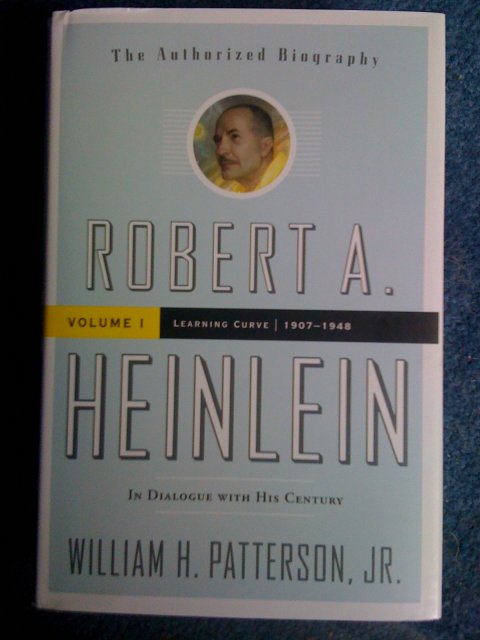
Cory Doctorow on the new Robert Heinlein biography

RAH by PattersonI finished reading the first volume last night, and I can’t wait for volume two. Cory Doctorow summarizes John Clute’s review with his own observations (Clute compared Heinlein’s work to Doctorow’s):

Heinlein was notoriously recalcitrant about his early life and the two wives he was married to before his epic marriage to Virginia Heinlein. He repeatedly burned correspondence and other writings that related to that period. Clute suggests that this is partly driven by Heinlein’s desire to be Robert A Heinlein, titan of the field, without having to cope with his youthful embarrassments. It’s a good bet — lots of the stuff that drives young people to write science fiction also makes them a pain in the ass to be around until they work some of the kinks out of their system (I wholeheartedly include myself in this generalization).

It’s interesting to see his own growth, from his early priggishness (he was nicknamed “the boy general” as a plebe at the Naval Academy) which undoubtedly was not helped by his health issues and tendency to stammer. He was in the shadow of his older brother Rex Ivar for most of his youth, even following him to the Academy three two years later. Rex Ivar was the favourite child in the family and Robert never seemed to be able to do as well in his parents’ eyes as the older boy.

Robert Heinlein was probably a pretty toxic individual as a teenager, based on the evidence Patterson presents — it’s pretty clear even after most of the information was sanitized by Heinlein’s third wife Virginia. Patterson never met Heinlein, and by the time he took on the biography, most of the people who knew Heinlein were fading from the scene. I think he did a very good job with the information available to him, but the biography definitely improves after the Academy years.

Patterson also puts forward a pretty comprehensive case for the idea that Heinlein’s fiction generally conveys Heinlein’s own political beliefs. This is widely acknowledged among Heinlein fans, save for a few who seem distressed by the idea that the blatant racism and sexism (especially in the earlier works) are the true beliefs of the writer at the time of writing and would prefer to believe that Heinlein didn’t write himself into his works. I got into a pretty heated debate with one such person at the Heinlein panel at the 2007 Comicon, who maintained the absurd position that Heinlein’s views could never be divined by reading his fiction — after all, his characters espouse all manner of contradictory beliefs! (To which I replied: “Yes, but the convincing arguments are always for the same set of beliefs, and the characters who challenge those beliefs are beaten in the argument.”) Not that I fault Heinlein for this — it’s an honorable tradition in SF and the mainstream of literature, and I find Heinlein’s beliefs to be nuanced and complex, anything but the reactionary caricature with which he is often dismissed.

It should be no surprise to anyone over 30 that Robert Heinlein’s political and philosophical views changed over his lifetime. This is discussed in some depth in the book, frequently from Heinlein’s own letters to friends at various points. He lost his religious views very early on (if he ever really had them, other than for conforming to familial expectations), and after leaving the Navy he was deeply involved in Upton Sinclair’s EPIC movement.

His belief in world government must have been hard to sustain, given that he had a great deal of experience of the political process, both in Kansas City during the Pendergast years, and in California with EPIC. Corruption, dirty dealing, and backroom bargaining were the way things got done, and it would be hard to believe that things would be better with a single world-wide government.

What seems to have gotten him involved in EPIC was his first-hand experience of poverty and seeing the plight of the “Okies” who’d come to California after the dust bowl wiped out so many farms in the central states. There were not enough jobs for them, even displacing the Mexican migrant labourers, and they were ineligible for state assistance until after they’d been in California for a year. Sinclair appeared to be the only politician with any plan other than oppressing the Okies enough to force them to move on.

May 14, 2010

Remembering Henri le Grande

Filed under: Europe, France, History, Religion — Tags: , , — Nicholas @ 09:18

France is still fond of King Henri IV, who was assassinated 400 years ago:

“If we were to measure his approval ratings now, what result would we get?” wondered Nouvel Observateur magazine in a special report this week. “100% happy? 200%? At any rate a figure to make the late greats turn pale — even more so the not-so-greats who are still alive.” Nicolas Sarkozy, the subtext implied, would do well to watch and learn.

During his reign from 1589 to 1610, Henri le Grand was credited with turning a country torn apart by the wars of religion into a newly confident land where Catholics and Protestants were forced to tolerate, if not like, each other.

He converted from Calvinism to the faith of the vast majority of his subjects, but did not neglect the country’s long-persecuted Hugenot minority. In 1598, 26 years after thousands of people who had gathered for his wedding day died in the St Bartholomew’s Day massacre, he declared the Edict of Nantes, which guaranteed Protestants freedom of worship.

[. . .]

Aside from his political achievements, it is the amorous escapades of the “Green Gallant” which continue to titillate modern-day fans. Married twice but unimpeded by vows of fidelity, Henri had numerous affairs and flings. This week Francois Caviglioli, a journalist, summed him up by referring to a contemporary Italian bon vivant: “Henri seemed to be the Rocco Siffredi of the 16th century. A porn star who was said to never wash.”

Judging by the tributes being paid to him now, Henri IV seems to be working his magic from beyond the grave. Such was the impact of his reign — and the shock of his untimely death — that he has become a martyr who is viewed almost as the personification of good leadership.

A few years ago, I tried to find a good biography of Henri, but there didn’t appear to be anything currently in print (in English). For such an iconic leader, he is not well known outside France . . .

March 1, 2010

Christopher Hitchens’ retrospective on the life of Alexander Haig

Filed under: Government, History, Politics, USA — Tags: , , , — Nicholas @ 09:30

Christopher Hitchens does not come to praise (a would-be) Caesar, but to bury him . . . good and deep:

“Nobody has a higher opinion of General Alexander Haig than I do,” I once wrote. “And I think he is a homicidal buffoon.” I did not then realize that this view of mine was at least partly shared by so many senior figures on the American right.

When I moved to Washington in the very early years of Ronald Reagan’s tenure, I was pretty sure that Haig, then secretary of state, was delusional (and not even in a good way). What I would not have believed then was what has become apparent since — that his boss, Ronald Reagan, often felt the same way.

And this is the nice part of the biography. Go read the whole thing.

« Newer Posts

Powered by WordPress

