
World War Two
Published 7 Feb 2026In spring 1933, Nazi Germany shows how dictatorship becomes normal. This episode of Death of Democracy follows the regime’s second quarter in power, from the first state-organized antisemitic boycott to the destruction of free trade unions and the takeover of the courts. Step by step, democratic institutions are hollowed out through fear, legality, and propaganda. Death of Democracy reveals how tyranny doesn’t arrive overnight — it is made to feel ordinary.
(more…)
February 8, 2026
How Legal Immunity Becomes Absolute Power – Death of Democracy Q2 1933
Comments Off on How Legal Immunity Becomes Absolute Power – Death of Democracy Q2 1933
January 22, 2026
Dresden Part 1 – Targets, Tangents & Genocide
HardThrasher
Published 20 Jan 2026Was Dresden a war crime or a late-war military decision made in cold blood? The firebombing of Dresden (13–14 Feb 1945) remains one of the most infamous episodes of the WW2 history: a firestorm, a shattered city, and a death toll that still sparks argument today.
But most of what “everyone knows” about Dresden is wrong. In Part 1 of this two-part series, you and I will dig into the real reasons Dresden became a target. We also ask the uncomfortable questions: Was Dresden an “innocent” city? How Nazi was it? And what does Dresden reveal about the logic — and limits — of strategic bombing? And because this is my video and I’ll do as I damn well please, we’ll also do a quick overview of nearly 1,000 years of history, because why not. Thus in this you will also get the Northern Crusades, a discussion of pottery, a smattering of Central European history and long discussion of how the Nazis subverted power and used it to abuse people whilst being wildly incompetent at the basics
00:00 – Start
04:39 – Part 1 – A Brief History of Everything in Central Europe
17:36 – Rise of the Nazis and the Nuremberg Laws
30:25 – Military and Industrial Dresden
34:03 – Failure to Prepare for War
40:37 – How did it become a target?
52:37 – Survivor’s Club
(more…)
December 19, 2025
Brendan O’Neill on the Islamophobia racket
In the National Post, Brendan O’Neill criticizes Australian Prime Minister Anthony Albanese in particular, but he’s just the most recent exemplar of western politicians trying to blame society in general and “right wing extremists” in particular for the terrorist attacks by Islamic extremists:
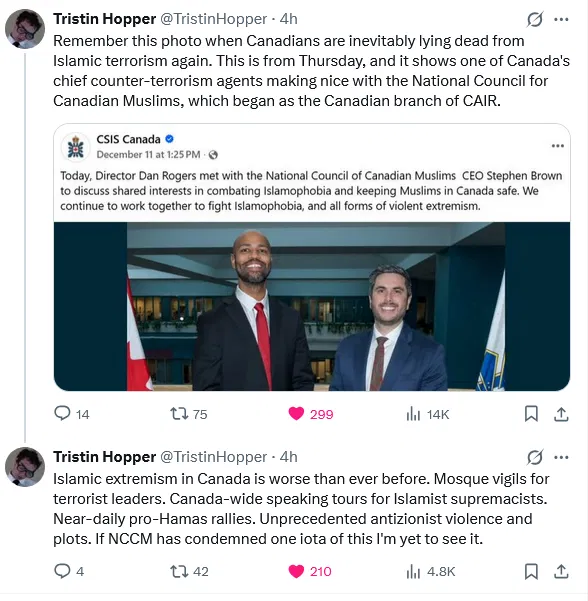
Australian Prime Minister Anthony Albanese spoke a total of 5,022 words in the day after the slaughter of Jews at Bondi Beach. And not one of those words was “Islam”. Or “Muslim”. Or even “Islamic extremism”.
He did talk about the “far right” though. Twice. We need to tackle “the rise of right-wing extremist groups”, he said.
What an odd thing to focus on the day after a father-and-son Islamofascist outfit had mown down 15 innocents, all while proudly displaying the black flag of ISIS.
To fret about the far right hours after suspected Islamic militants had carried out the worst slaughter of Jews in Australian history is cognitive dissonance of epic proportions.
It would be like turning up to the bloody aftermath of a KKK massacre and flat-out refusing to say the words “Klansmen”, “racist” or “white supremacist”. Well, we wouldn’t want to offend the pointed-hood community.
Some Australians were dumbfounded by the PM’s bullish refusal to name the ideology that fuelled this act of antisemitic savagery.
After all, at the time he was holding forth on the various threats to the Aussie way of life, officialdom had found the killers’ ISIS flag and other paraphernalia suggesting they had taken the knee to the death cult of radical Islam.
“What happened at Bondi was an act of radical Islamic terrorism”, thundered Sean Bell of the populist party One Nation. If the PM “cannot be honest” about the “radical Islamic ideology”, he said, “then he has no place leading the country”.
It’s hard to disagree. The first duty of a leader following the barbarous slaying of citizens is to tell the truth. If Albanese can’t even bring himself to mouth the words “Islamic extremism”, how’s he going to fight it?
The PM’s yellow-bellied dodging of the i-word was shocking but not surprising. Other Western leaders have behaved similarly in the wake of Islamist outrages. They have furiously thumbed their thesauruses for spins on the word “extremist” — fanatic, militant, evil — all so that they can avoid committing that most gauche faux pas in polite society: talking about the problems in Islam.
This is the dire handiwork of the Islamophobia industry. For years now, Islam has been ruthlessly ringfenced from free, frank discussion.
Mock Muhammad and you’ll be damned as “phobic”. Crack a joke about the Koran and you can expect a mob of fundamentalists at your front door. Say Islam has an extremism problem and the self-elected guardians of correct-think will drag you off for re-education.
We’ve witnessed the rehabilitation of medieval strictures against “blasphemy”. The end result is that even as women and children writhe in agony from the wounds inflicted on them by Islamist militants, still our leaders won’t say that i-word. It clogs in their throats. They dread cancellation more than they cherish truth.
[…]
After every attack, the same platitudes are trotted out. “Nothing to do with Islam”. “Islam is a religion of peace”. We’re gagged from naming the threat we face, from correctly identifying the men who are killing our fellow citizens.
Believe them when they show you what they are, Oz edition:
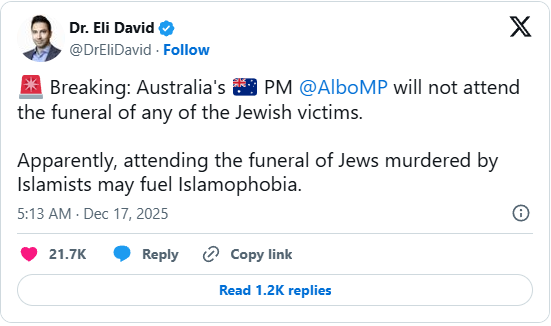
In The Line, Ariella Kimmel thinks there are signs that at least some political figures are getting the right lessons out of the events of the last few years:
In the wake of the terrorist attack in Bondi Beach, it seems as if leaders are finally starting to realize the risk of allowing antisemitic extremism to run unchecked for years.
Calgary’s new mayor offered a powerful example of what this means in practice.
At Calgary City Hall’s Chanukah celebration, Mayor Jeromy Farkas delivered remarks that stood out not only for their eloquence, but for their accountability. He spoke plainly about antisemitism and acknowledged the very real fear that Jewish communities are living with. Most importantly, he made clear that civic leadership means showing up publicly, consistently, and without excuses.
In a room of just over a thousand, he declared “let me be absolutely crystal clear. There is no place for antisemitism in Calgary. Not on our streets, not in our schools or campuses, not at protests, not online, not hidden behind slogans, not excused as politics, because Jewish lives are not expendable. Jewish safety is not expendable.”
That moment was especially symbolic given Calgary’s recent past. Two years ago, then-Mayor Jyoti Gondek refused to attend a Chanukah event amid pressure and controversy. Farkas’ presence this week marked a break from that pattern. It signalled that someone, finally, was willing to take responsibility.
That is what leadership looks like.
The Bondi Beach attack should force a reckoning in Canada. If we want to avoid becoming the next headline, this country must do more than mourn; we must decide, clearly and concretely, that extremism has consequences and that antisemitism will not be indulged.
In Canada, politicians were quick to offer condolences. Statements flowed with the standard lines – “my thoughts are with the community”, “our government condemns all forms of hate”, “no one should be targeted for practicing their religion”. The words are familiar, and quite frankly hollow, because for the past two years, many of the same leaders issuing their thoughts and prayers have either ignored, excused, or actively engaged with movements that normalize hostility toward Jews.
Since October 7, Jewish Canadians have watched as public spaces became hostile territory. Synagogues require police protection, while Jewish schools are shot at and community centres are defaced. Rallies openly glorify terrorist groups, call for the destruction of Israel, and chant slogans that any reasonable person understands as genocidal, such as calls to “globalize the intifada”, “from the river to the sea Palestine will be free”, “there is only one solution, intifada revolution”, and “resistance is justified”.
What makes the current moment particularly dangerous is the gap between rhetoric and reality among leaders. Politicians speak of fighting hate while refusing to enforce existing laws against intimidation, mischief, and hate-motivated harassment. They speak of unity while legitimizing groups and movements that openly reject the safety of Jewish communities, even giving funding through government programs meant to combat antisemitism, to organizations that perpetrate it. They issue statements condemning violence abroad while tolerating the ideological conditions that make violence inevitable at home.
November 30, 2025
Canada’s growing Islamist problem
At Juno News, Joe Adam George points to the problems Britain is having with their well-established Muslim extremists and says Canada has exactly the same issues here:
When 35-year-old Jihad al-Shamie terrorized a Manchester synagogue last month on Yom Kippur pledging allegiance to ISIS, few were shocked by what investigators later uncovered. He attended a Salafi-inspired mosque where extremist rhetoric was routine. His father had praised Hamas’s October 7 attackers as “Allah’s men on earth”. Years of indoctrination taught him that violence was virtue, resistance was glory, and terror was faith.
What unfolded in Manchester is a warning to Canada, where similar currents of Islamist radicalism have been manifestly gathering strength. Across Canadian cities, extremist narratives are taking root among young people through community networks, activist circles, and online echo chambers.
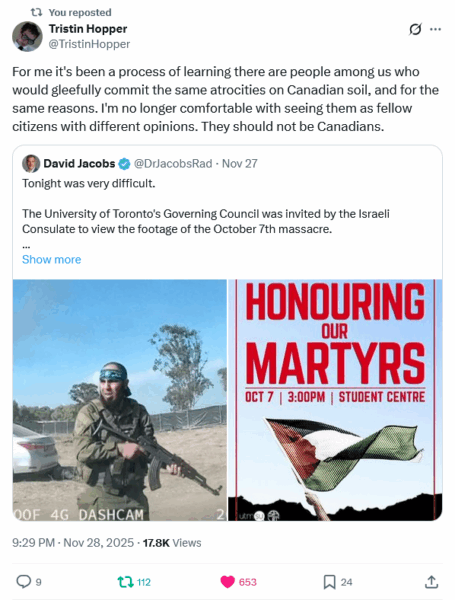
A prominent Shia mosque in Windsor, Ontario, recently held a memorial service for slain Hezbollah leader Hassan Nasrallah — for the second year running — where youths eulogised the notorious terrorist as a “hero” and “martyr”. The Toronto Metropolitan University’s arts faculty funded a research paper which argues that Canada’s designation of Islamist groups as terrorist organizations is deeply flawed because of “systemic Islamophobia” and racism. Such episodes do not merely glorify violence; they sanctify terrorism and rebrand militancy as a necessity.
Earlier this year, Canada’s spy agency, the Canadian Security Intelligence Service, warned it was “increasingly concerned” about the threat of ISIS-inspired attacks. That concern is well-founded. The Royal Canadian Mounted Police reported a staggering 488 per cent rise in terrorism-related charges between April 2023 and March 2024, much of it driven by ISIS-motivated youth radicalisation. In the same period, antisemitic incidents surged by more than 670 per cent. An ISIS-inspired teenager was arrested in Montreal in August for terrorism offences. These are not isolated events but symptoms of a cultural shift — where extremism masquerades as activism and hate is sold as justice.
Since the breakout of the Israel-Hamas war, unrestrained radicalisation has seeped into mosques, schools, charities, and universities — often protected by Canada’s own liberal frameworks. Islamist networks have mastered the art of exploiting the Charter of Rights and Freedoms to propagate radical ideologies while deflecting scrutiny. Wrapped in the language of “human rights” and “anti-racism”, they advance intolerance behind a façade of moral virtue.
As former FBI agent and counter-terrorism expert Lara Burns noted, it’s a tactic that echoes the Muslim Brotherhood’s “sabotage strategy” in North America — infiltrating institutions to steer public debate and soften attitudes toward Islamist causes.
Campaigns to institutionalize so-called “anti-Palestinian racism” (APR) is turning Canada’s classrooms and government offices into laboratories for grievance politics. Marketed as anti-discrimination, APR in reality brands any criticism of Palestinian militancy as racism, giving extremists a moral shield and silencing dissent. Even Canada’s Islamophobia czar, Amira Elghawaby, has been accused of abusing her taxpayer-funded post to conjure up Islamophobia and APR where none existed. During a visit to London in June, she reportedly met officials shaping the UK’s own Islamophobia legislation — a troubling sign of cross-pollination between partisan ideologues.
Comments Off on Canada’s growing Islamist problem
October 14, 2025
White Hoods, Bloody Hands: The Klan as America’s First Terrorists – W2W 048
TimeGhost History
Published 12 Oct 2025From Pulaski to Stone Mountain to Brown v. Board, the Ku Klux Klan evolves from Reconstruction terror to a decentralized, Cold War–era movement that bombed churches, lynched citizens, and hid behind “anti-communism”. We trace the First, Second, and Third Klans — rituals, networks, and the brutal campaign against desegregation and civil rights.
(more…)
Comments Off on White Hoods, Bloody Hands: The Klan as America’s First Terrorists – W2W 048
August 8, 2025
Germany’s Darkest Night Yet? – Rise of Hitler 21 – September 1931
World War Two
Published 7 Aug, 2025September 1931: Berlin descends into chaos as Nazis unleash a violent pogrom on Jewish New Year — while the police stand by. The scandal of the Kurfürstendamm riot rocks Germany, but the month’s headlines don’t stop there: Hitler’s niece is found dead under mysterious circumstances, France’s leaders visit Berlin to a frosty reception, and Japanese troops invade Manchuria. Extremists surge at the polls as democracy teeters — can the Republic survive?
(more…)
Comments Off on Germany’s Darkest Night Yet? – Rise of Hitler 21 – September 1931
July 5, 2025
NYC selects its own Justin Trudeau clone
The winner of the Democratic primary is almost always subsequently elected as the mayor of New York City, so it’s fair to assume that Zohran Mamdani is going to be NYC’s next mayor. And he’s an American version of ultra-progressive former Prime Minister Justin Trudeau:
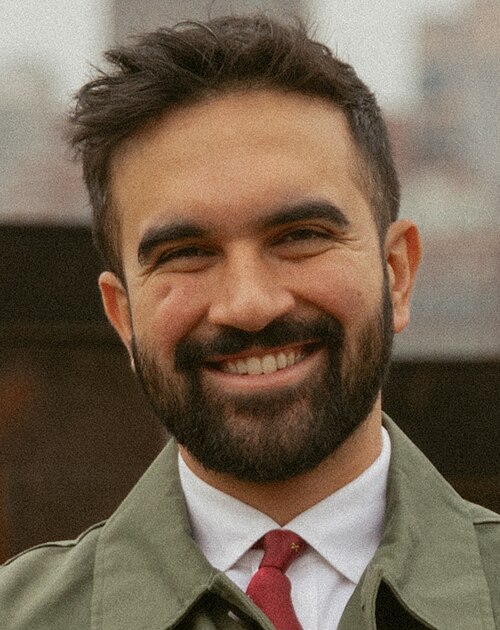
New York State Assemblymember Zohran Mamdani photographed in Assembly District 36, 10 February 2024.
Photo by Kara McCurdy via Wikimedia Commons.
American politics often seem to balance themselves out in the worst possible way. Even as the GOP sheds its last vestiges of affection for limited government and free markets, the opposition Democrats openly embrace bigotry and crazy economic nostrums. Case in point: the rise in New York City of Zohran Mamdani, an avowed socialist who flirts with antisemitism, to represent the Democratic Party in this year’s mayoral election.
The primary race in New York was a snapshot of the Democratic Party’s woes. Despite the presence of other candidates seeking the mayoral nomination, the race ultimately came down to two candidates: Mamdani and Andrew Cuomo, the disgraced former governor of New York.
Before resigning over allegations of sexual harassment, Cuomo, the 67-year-old son of another former governor, was best known for a “controversial directive that told nursing homes they couldn’t deny patients coming from hospitals admission based on a COVID-19 diagnosis”, according to StatNews. He then covered up the large number of ensuing deaths. He was the favoured candidate of the Democratic establishment and the early front-runner for the nomination.
Standing out from the pack of political hopefuls facing Cuomo was Zohran Mamdani, the 34-year-old son of an Oscar-nominated filmmaker and a Columbia University political science professor. Before being elected to the state legislature as a Democrat and a socialist, Mamdani tried his hand as a government employee and a rapper. His musical output included the song “Salaam”, which, as The Independent put it, “praised the ‘Holy Land Five’ — five men convicted in 2008 of donating over $12 million to Hamas”.
To say that New Yorkers are tired of Cuomo is a wild understatement. Like most Americans, New Yorkers are deeply sick of the old party establishment that rallied around Cuomo as well as the man himself. Yet, he was expected to walk away with the nomination and then cruise to victory in a largely one-party city.
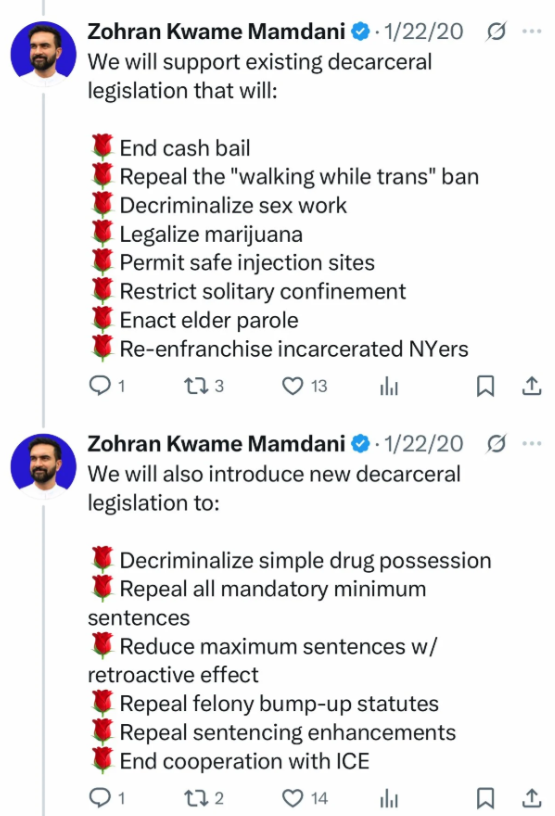
But Mamdani sweetened the pot in the expensive metropolis with promises to freeze rent, make buses free, offer no-cost childcare, lower grocery prices with city-owned grocery stores, and use “public dollars” to build 200,000 apartments. He swears that he “knows exactly how to pay for it, too” with higher taxes on those making more than $1 million per year. Not explicitly part of his campaign, but on the record as his intention, is “the end goal of seizing the means of production”.
In the 2021 recording in which he advocated seizing the means of production, Mamdani endorsed BDS as an issue “that we firmly believe in”. The BDS movement — shorthand for “Boycott, Divestment, and Sanctions” — aims to economically pressure Israel into withdrawing from so-called “occupied territories” and allowing Palestinians to settle throughout Israel. At its extremes, BDS seeks to eliminate the world’s only Jewish-majority state. It’s inspired by the movement against South Africa’s old apartheid regime.
Comments Off on NYC selects its own Justin Trudeau clone
May 9, 2025
The growing problem of antisemitism in Canada
In The Free Press, Casey Babb considers the growing risks to Jews on the streets of Canadian cities after the October 2024 terror attack and resulting Israeli military reaction:
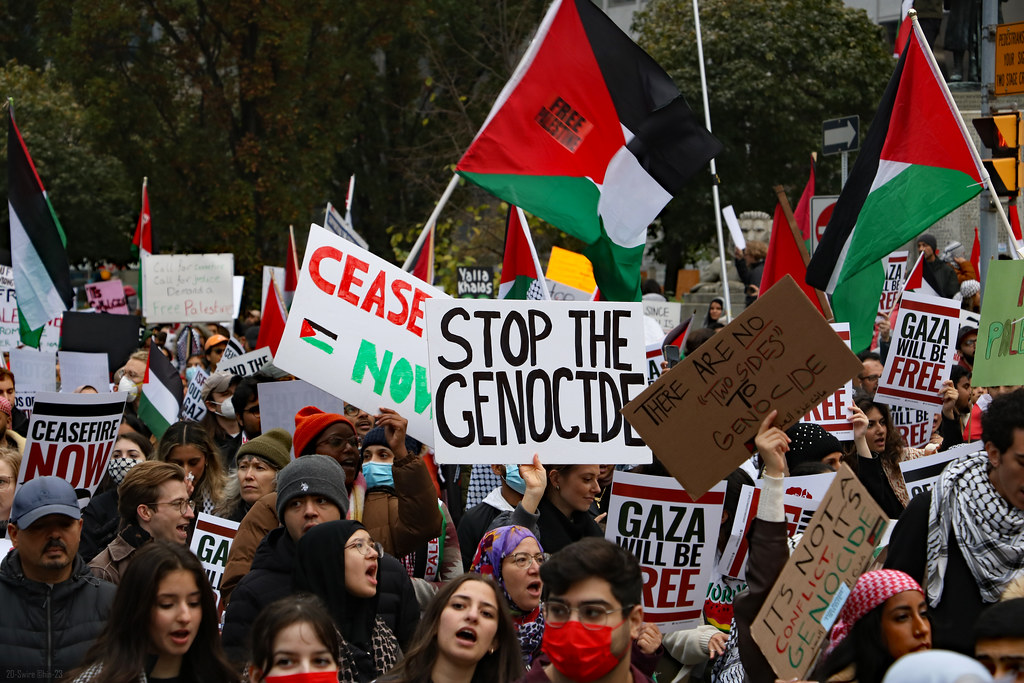
“Free Palestine/Anti-Israel protest” by Can Pac Swire is licensed under CC BY-SA 2.0 

 .
.
Late last year I sat down to breakfast in Ottawa, Ontario, with Dr. Einat Wilf, one of the world’s foremost experts on the Israeli-Palestinian conflict. She had come to Canada’s capital to speak about the war in Israel, what Palestinians really want, and the future of a possible two-state solution. Near the end of our chat, I asked if she had seen any of the “pro-Palestinian” rallies that had become a weekly occurrence in the city. “One of them went by my hotel last night,” Wilf said. “There’s a very dark energy to them. Serious pre-pogrom vibes.”
The word pogrom is the Yiddish word for “devastation” or “destruction”. What it refers to, historically, are the mob attacks that were a regular feature of life for Jews in the 19th and early 20th centuries — attacks that most often were passively or openly supported by the state.
Wilf chose it deliberately.
In the roughly six months since we sat down together, the situation in Ottawa and across the country has only worsened. Canada has become one of the most antisemitic countries in the Western world.
If you doubt that assertion, it’s important to note that’s how others have described it, too.
In a report released on May 6 by Israel’s Ministry for Diaspora Affairs and Combating Antisemitism, it states that from October 7, 2023 through the end of 2024, antisemitism in Canada skyrocketed an astounding 670 percent. Further, between October 7, 2023 and October 7, 2024, there were 1,500 pro-Palestinian rallies in Toronto alone. That’s over four a day — every day — for a year straight.
While the outbreak of antisemitism throughout the West has been precipitous in virtually every country — the tenor, violence, and extremist nature of Jew-hatred in Canada has ratcheted up in a way few other places on Earth have experienced.
Consider the following — much of which has gotten scant media attention.
Targeting Jews in Their Backyards
- In September 2024 protesters sympathetic to Hamas and the “resistance” jubilantly rallied outside a Jewish retirement facility in Ottawa where several Holocaust survivors live, and where 60 percent of the residents suffer from dementia. Chants of “Go back to Europe” and “We want bullets and missiles!” in Arabic could be heard from their bedrooms.
- On Remembrance Day in 2024 at Sir Robert Borden public school in Ottawa, where there is a large Jewish student body, a Palestinian protest song was the only song played during an event to honor Canadian soldiers. When pressed on the choice of music, Principal Aaron Hobbs said it was chosen to add some diversity and inclusion to a day usually about “a white guy who has done something related to the military”.
- There have been numerous instances where, in predominantly Jewish neighborhoods, protesters have dressed up like Palestinian terrorists, including the October 7 mastermind Yahya Sinwar.
- Hundreds of pro-Palestinian protests surrounded the Holocaust Museum in Montreal in March 2024, where they shouted, “Death to Israel” and “Death to the Jews”.
- At a softball game for teenage girls between Canada and Israel as part of last year’s Canada Cup Women’s International Softball Championship in Surrey, British Columbia, protesters stood on the sidelines wearing keffiyehs, holding signs that read “Israel is a genocidal state”, with another equating Israel with Nazi Germany.
- In April, a pro-Hamas rally was staged in Winnipeg, just steps from a Jewish community center where children attend school and day care.
- During Israel’s official day of remembrance for fallen soldiers and victims of terrorism on April 29, protesters stood in front of Beth Emeth Bais Yehuda Synagogue in Toronto waving Palestinian flags. One man wore a sweater that read “Palestinian Holocaust: Never Again Is Now”.
- Earlier this month in Montreal, protesters were filmed chanting “All the Zionists are racists” through megaphones at a school for students ages 4 to 16 with intellectual disabilities and autism-spectrum disorders.
These activities aren’t normal protests. They aren’t in front of the Israeli embassy in Ottawa or the Israeli consulate in Toronto. They aren’t directed toward a specific Israeli policy, law, regulation, or act, and they certainly make no mention of Hamas, Hezbollah, or any other terrorist organization that has brought immense death and destruction upon the Palestinians. These are belligerent acts of aggression designed to intimidate Canada’s Jewish community, to coerce them into silence, and ultimately, to extinguish their public presence.
Comments Off on The growing problem of antisemitism in Canada
May 8, 2025
Aftermath
I’ve read a few books on what happened in Europe after the surrender of Nazi Germany in May of 1945, but there is always more to learn about a continent-wide struggle to recover from a disaster of the magnitude of World War Two:
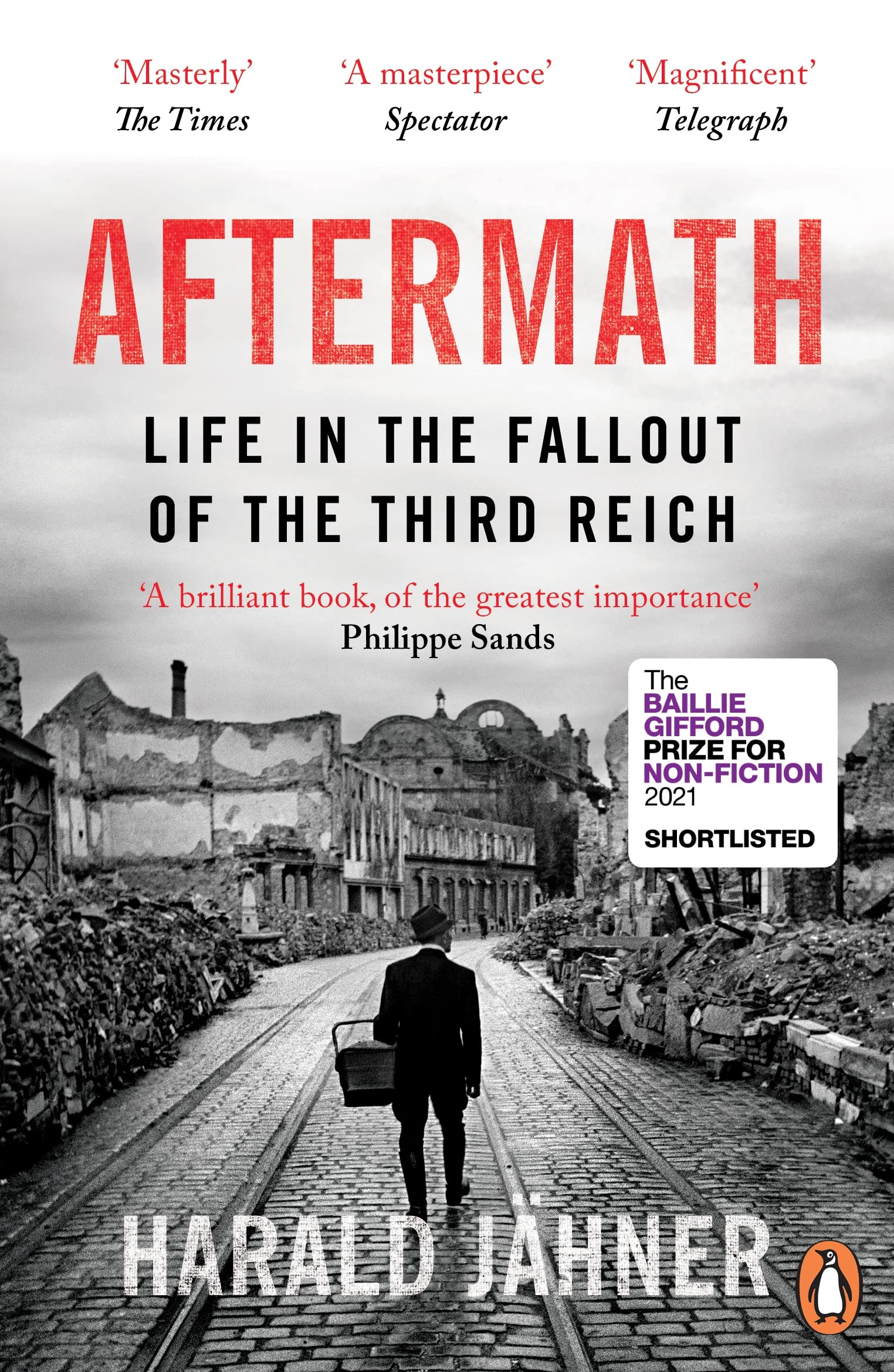
On a train journey earlier this year between Cologne and Berlin, I began to read Harald Jähner’s Aftermath, a fascinating account of the years when Germany emerged from the destruction and shame of the Third Reich.
The war ended 80 years ago today, and in the defeated nation the scenes were primeval and apocalyptic. In Berlin, journalist Ruth Andreas-Friedrich, along with a doctor, actor and musical conductor, discovered a white ox wandering through the streets and, after finding a Russian soldier to shoot it, found themselves suddenly surrounded by a ravenous mob. She recalled: “Suddenly, as if the underworld had been spying on them, a noisy crowd gathered around the dead ox. They crept from a hundred basements. Women, men, children. Were they lured by the smell of blood? Within minutes they were scrambling for meat.” The bourgeois of Middle Europe reduced to an animal state.
Germany was a pile of rubble; the ruins in the Reich‘s capital amounted to 55 million cubic metres, enough for a wall 30 metres wide and 5 metres high stretching all the way to Cologne. In West Berlin, for the next 22 years, up to 800 lorries a day unloaded so much rubble on the former Factory of Armaments Technology that it became known as Teufelsberg, or Devil’s Mountain. The last “rubble brigade” in Dresden only finished work in 1977.
Although Nazi party members were made to clear rubble as a punishment, the Germans hardly needed encouragement; on 23 April, the war not yet over, the municipal building of Mannheim had already declared WE ARE REBUILDING.
The communal process of clearing away seemed to serve a psychological function for a hungry, defeated people, and was encouraged by the new authorities — all the “heroic cinematic rhetoric” employed by the UFA film company of the Nazi regime now used to get the country clearing up. There was even a cinema genre called Trümmerfilm, rubble films, one — And The Heavens Above Us — ending with the Lord’s Prayer being recited among the ruins of Germany.
German POWs, “dispirited, disciplined and dutiful to the point of submissiveness”, made life easy for occupying soldiers while their former victims were far more troublesome. (Russian POWs in France caused such anarchy that they called in a Soviet liaison officer who selected ten at random and shot them, bringing the mob under control.) This led to a bizarre alliance between Allied and German law enforcement working hand-in-hand from the early days of the occupation, with joint raids and weapons searches on displaced persons from Poland and the Soviet Union, which the Poles and Russians “of course saw as an intolerable provocation”.
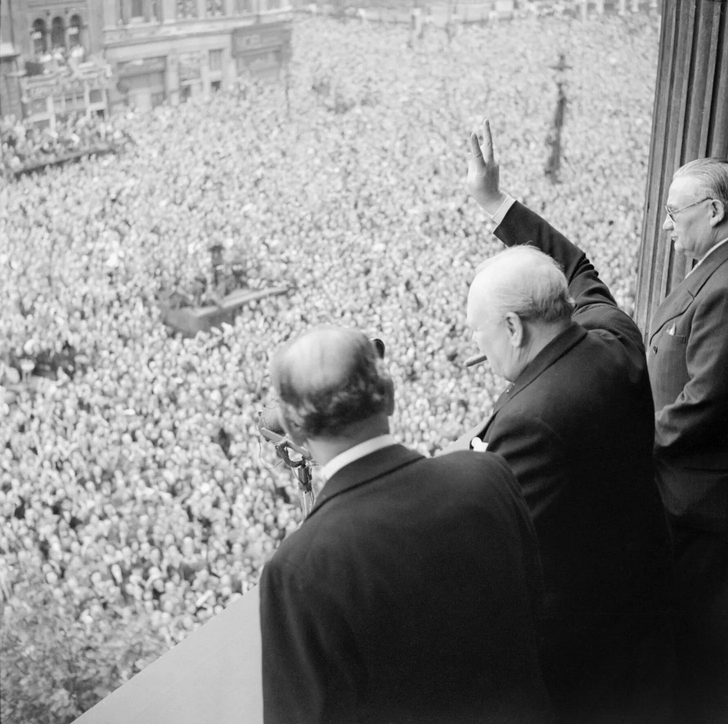
London cheered on May 8, 1945. In Berlin they searched for food and cleared rubble
In a strange irony, there was now a large-scale migration of Jews from Poland to Germany, fleeing fresh persecution despite the horror they had endured. Even here in a camp system under Allied control, there were anti-Semitic attacks from other survivors, so that Jews were eventually separated altogether following the conclusions of the Harrison Report. The Americans, in a likely first in European history, now made Jews an explicitly privileged group, with superior camp conditions.
The Polish Jews set up their own camp in the Munich district of Bogenhausen where locals were confused and disorientated by the new arrivals. These eastern Jews actually looked like the alien caricatures Nazi propaganda had bombarded them with, dressed in oriental clothes from the shtetl, totally unlike the assimilated German Jews they had grown up with. One local complained that “the Jews from the old days were really, how can I put it, very intelligent, polite and unusually friendly and elegant people. And of course the ones who turned up after the war included all sorts.” The Jews “from the old days” were “the good Jews”, he lamented.
Holocaust guilt was in the distant future for most, and newly re-established newspapers weren’t remotely shy about publishing anti-Semitic content. One printed a resident’s complaint about Polish Jews that “these were not people who had been persecuted” but “the sputum, the yeast and the scum of elements who were never deported but, to avoid regular work, came here from the eastern states, in many cases completely illegally, and are now spreading themselves raggedly about the place.”
Comments Off on Aftermath
April 22, 2025
Douglas Murray’s On Democracies and Death Cults
James Pew reviews Douglas Murray’s latest book, On Democracies and Death Cults: Israel and the Future of Civilization (I was first made aware of the book by the sudden uptick in antisemitic posts on social media that directly attacked Murray and his work).
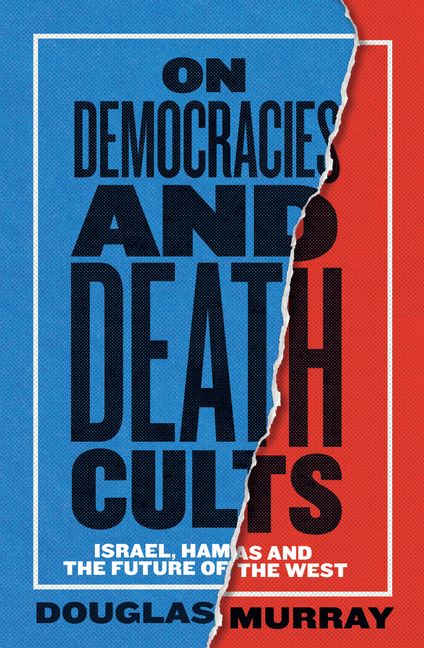
The opening words of On Democracies and Death Cults by Douglas Murray contains a disturbing fact about the situation Israel, and the entire Western world, were thrust into immediately following the barbaric terrorist attacks of October 7, 2023:
Sometimes a flare goes up and you get to see exactly where everyone is standing.
Indeed. Out of all the conflicts occurring all over the world, many of which are more devastating by orders of magnitude and in terms of the scale of humanitarian catastrophe than the IDF’s Gaza campaign, why would Westerners care so much about it? Why do Canadians and Americans take to the streets and occupy college campuses over it? These and many other vital questions are asked by Douglas Murray in On Democracies and Death Cults.
So why should this particular October 7th event, and the IDF’s subsequent military response, which is taking place halfway around the world, be the one that reveals “exactly where everyone is standing”? Murray knows the answer, as do his readers and most clear thinking people who do not harbour secret loathing’s for the Jewish people. The reason is clear and plain as day: the Jews are defending themselves and their homeland from a terroristic death cult bent on their destruction, but for some reason hoards of people from all political stripes from virtually all corners of the world, believe this to be a wholly unacceptable thing for the Jews to do.
The shame I felt for Canada, or more correctly, for things that had been allowed to take place in Canada following the October 7th massacre in Israel, was immediately apparent in the introduction when Murray wrote:
In Canada alone, after October 7, synagogues were firebombed and shot at, Jewish schools were shot at, Jewish shops were fire-bombed, and Jewish-owned bookshops were vandalized.
Future generations will need to contend with the fact that in the immediate aftermath of the worst crisis to strike the Jewish people since the Holocaust, anti-Semitism erupted throughout the West. An inexplicable “shapeshifting” hatred that “locks Jews in an unresolvable set of challenges.” Murray writes:
Jews were once hated because of their religion. Then sometime after the Enlightenment it became hard to hate people because of their religion. At that point the Jews were hated because of their race. Then, after the twentieth century it became unacceptable to hate people because of their race. So, in the twenty-first century, when civilized people cannot hate the Jews for their religion or their race, Jews can be hated for having a state–and for defending it.
Murray’s head is constantly in two places: 1) Israel, including the war zone in Gaza 2) The West. The question of why Israel seems always to be the object of relentless and obsessive international scrutiny, is top of Murrays mind. But as well, the infiltration of radical Islamic ideologies into the Western institutional edifice is not lost on him. Indeed, this knowledge leads him to such observations as the following:
While there were certainly plenty of non-Muslim politicians in the West who decided to attack Israel from the moment the conflict started, it should also be noted that elected Muslim politicians across the West seemed to have a special beef with the Israelis and supported the Palestinian side …
Canada has no shortage of the exact political personage Murray is referring to. The signs of Islamic infiltration and subversion into Canadian society are everywhere. The recent adoption by the Toronto District School Board of policies concerning Anti-Palestinian Racism, is but one example of the phenomenon.
Early in the book Murray mentions the Iron Dome – the Israeli missile defense system. One thing I never considered was the economics involved with the constant rocket attacks on Israel from Gaza. Whereas the cost of a rocket shot from Gaza is estimated at around $300 US, the cost of one of the defense missiles deployed to eliminate Hamas’ rockets is around $100,000 US, and sometimes two defense missiles are required to shoot down one $300 dollar terrorist rocket. The vast amount of economic resources eaten up by the asymmetrical terrorist warfare waged by Hamas is astounding, when one considers the years over which these rocket assaults have taken place.
Comments Off on Douglas Murray’s On Democracies and Death Cults
March 27, 2025
Ban the swastika? Are you some kind of racist?
In Ontario, the elected council for the Region of Durham has been reacting to a few painted swastika graffiti around the region over the last couple of months. To, as a politician might say, “send a message”, they proposed banning the use of the swastika altogether … failing to remember that it’s not just neo-Nazi wannabes who use it:
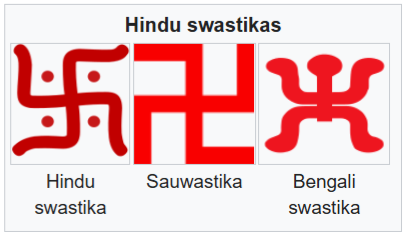
Durham council is adjusting the wording of its calls for a national ban on the Nazi swastika, or “Hakenkreuz“.
This follows efforts by religious advocates to distance their own symbols from the genocidal German fascist regime.
Swastikas often appear in Jain, Hindu and Buddhist iconography.
“The word ‘swastika’ means ‘well-being of all’,” explained Vijay Jain, president of Vishwa Jain Sangathan Canada, at Wednesday’s regional council meeting. “It’s a very sacred word. […] We use it extensively in our prayers.”
“Many Jain and Hindi parents give their children the name ‘Swastika’,” he added. “Many Hindi and Jain people, they keep their [business’s] name as ‘Swastika’. If you go to India, you’ll find the ‘Swastika’ name prominently used.”
“We stand in solidarity with the Jewish community and fully support all of the efforts by authorities to address growing antisemitism in Canada,” he said.
Regional council made its initial call for a ban on Nazi swastikas in February, after two separate incidents of the antisemitic symbol being scrawled inside a washroom at the downtown Whitby library.
On Wednesday, councillors voted to revise that motion to replace the word “swastika” with the term “Nazi symbols of hate”.
B’nai Brith Canada has been spearheading a petition campaign to have the Nazi symbol banned across the country.
The group has increasingly opted to refer to it by the alternative names “Nazi Hooked Cross” or “Hakenkreuz“.
On March 20, B’nai Brith put out a joint statement with Vishwa Jain Sangathan and other religious advocacy groups, calling for further differentiation between the symbols.
“These faiths’ sacred symbol (the Swastika) has been wrongfully associated with the Nazi Reich,” wrote Richard Robertson, B’nai Brith Canada’s Director of Research and Advocacy. “We must not allow the continued conflation of this symbol of peace with an icon of hate.”
Comments Off on Ban the swastika? Are you some kind of racist?
March 12, 2025
Free speech in Canada takes yet another hit, as Palestinian activists granted special protections
In the National Post, Tristin Hopper outlines the jaw-dropping contents of the Guide to Understanding and Combatting Islamophobia published by the federal government recently:

The federal government has dropped a new guide that, according to critics, deems it “racist” to criticize Palestinian advocacy or extremism.
The guide also defines both “sharia” and “jihad” as benign terms that are misrepresented by Westerners, with sharia defined as a means “to establish justice and peace in society”.
It’s contained in “The Canadian Guide to Understanding and Combatting Islamophobia“, a document published last week by the Department of Canadian Heritage.
The report endorses the idea of “anti-Palestinian racism”, an activist term with such a broad definition that it technically deems any criticism of Palestinians or “their narratives” to be racist.
“Public discourse often unfairly associates Palestinian and Muslim identities with terrorism,” reads the guide.
The new guide specifically links to a definition of the term circulated by the Arab Canadian Lawyers Association. Their 99-word definition says that it’s racist to link the Palestinian cause to terrorism, to describe it as “inherently antisemitic” or to say that Palestinians are not “an Indigenous people”.
The term is broad enough that merely acknowledging the existence of Israel could fall under its rubric. The definition describes the Jewish state as “occupied and historic Palestine”, and its creation as “the Nakba” (catastrophe). “Denying the Nakba” is specifically cited as one of the markers of “anti-Palestinian racism”.
In a March 4 statement criticizing the new federal report, the Centre for Israel and Jewish Affairs (CIJA) said that the term is so vague that “denouncing Hamas – the terrorists behind the October 7 massacre – could be portrayed as an act of racism”.
The new report was praised, meanwhile, by the vocally anti-Israel Centre for Justice and Peace in the Middle East, which called Ottawa’s embrace of the term anti-Palestinian racism “groundbreaking.”
“We are extremely pleased that Canada, through this guide, finally recognizes the unique racism that Palestinians experience daily,” said the group’s acting president Michael Bueckert.
The federal government’s new guide writes that Canada’s “understanding of anti-Palestinian racism” is growing, and directs readers to a 2022 report on the phenomenon by the Arab Canadian Lawyers Association.
Comments Off on Free speech in Canada takes yet another hit, as Palestinian activists granted special protections
February 14, 2025
Disarmament Talks, Budget Battles, and Student Duels – Nov 1930
World War Two
Published 13 February 2025November 1930 sees Germany caught between political instability and international disputes. Brüning fights to pass his controversial budget while Germany’s push for global disarmament meets French resistance and Nazi outrage. Meanwhile, Hitler restructures the SA and SS, student duels make headlines, and Berlin’s police chief is attacked in court.
(more…)
Comments Off on Disarmament Talks, Budget Battles, and Student Duels – Nov 1930
December 20, 2024
Election Fever – Rise of Hitler 08, August 1930
World War Two
Published 19 December 2024August 1930 brings Germany to a critical juncture as parties prepare for the September elections. Amid street violence, bans on political uniforms, and soaring unemployment, the stakes couldn’t be higher. This episode unpacks the campaign strategies, shifting alliances, and rising tensions shaping the Republic’s future.
(more…)
Comments Off on Election Fever – Rise of Hitler 08, August 1930
November 5, 2024
“… in an effort at harm reduction, I selected the proven authoritarian over the aspiring totalitarian”
In the National Post, J.D. Tuccille explains why he voted for “literally Hitler” instead of “the historic first woman president” in today’s US election:
“Polling Place Vote Here” by Scott Beale is licensed under CC BY-NC-ND 2.0 
 .
.
For me and millions of other Americans, the 2024 U.S. election is already effectively over. Like most Arizonans, I mailed in my ballot and it awaits the count. Now, I suffer through the remaining days of hectoring political ads and finger-waggers nagging me about how I should have voted. This country doesn’t lack strong opinions about two of the worst candidates to ever grace a presidential race. Unfortunately, I felt obliged to vote for one of them, and in an effort at harm reduction, I selected the proven authoritarian over the aspiring totalitarian; I marked my ballot for Donald Trump.
There’s no doubt that Trump is a thin-skinned narcissist. Legendarily intolerant of criticism or even disagreement, he wants broadcast licenses pulled from news networks that he thinks have been mean to him and called for government to crack down on cable operations that aren’t actually subject to government regulation. The man needs perspective as much as he needs a social studies class.
This is, many Democrats and their media supporters will eagerly tell you, evidence of “fascism“. But, as John Bolton, Trump’s former national security adviser, told The New York Times, “Trump isn’t capable of philosophical thought”. Trump’s authoritarianism isn’t an ideology; it’s a personality disorder.
That should be enough to disqualify a candidate for president. You’d think that, in a nation of 330 million people, if one major party chooses to run a profoundly problematic and authoritarian nominee for president, the other could find somebody more qualified. But you’d be wrong. In Kamala Harris, Democrats picked a vacuous sociopath uninterested in policy, but willing to serve as a vehicle for those around her who have tried their hands at totalitarian speech controls, and who are increasingly hostile to Israel, the only majority-Jewish state on the planet, and to Jews as a people.
In 2021, The Washington Post reported that former staffers for Vice President Harris complained she “would refuse to wade into briefing materials prepared by staff members, then berate employees when she appeared unprepared”. That failure to prepare for responsibilities and public appearances feeds her propensity for word salads, leaving the impression she’s reciting the results of a dropped Scrabble board.
In a Biden-Harris administration already lacking for adult supervision — President Joe Biden’s failing mental faculties are now a matter of record, as is his inability to make decisions — that suggests a potential President Harris would have no firmer hand on the wheel. That would leave the relatively faceless minions around her free to continue to exercise their instincts. And their instincts are terrible.
Comments Off on “… in an effort at harm reduction, I selected the proven authoritarian over the aspiring totalitarian”


