Quotulatiousness

June 21, 2020

Burma Victory (1945)

PeriscopeFilm
Published 31 May 2016

Support Our Channel: https://www.patreon.com/PeriscopeFilm

Made in 1945, BURMA VICTORY is a British documentary about the Burma Campaign during World War Two. It was directed by Roy Boulting. The introduction to the film outlines the geography and climate of Burma, and the extent of the Japanese conquests. The film then describes the establishment of the South East Asian Command (SEAC) under Mountbatten, “a born innovator and firm believer in the unorthodox”, and gives a comparatively detailed account of subsequent military events, including the Battle of Imphal-Kohima and Slim’s drive on Mandalay, Arakan landings, the northern offensive of the Americans and Chinese under Stilwell, and the roles played by Chindits and Merrill’s Marauders. The film ends with the capture of Rangoon and the Japanese surrender. The film focuses on the difficulties of climate, terrain, the endemic diseases of dysentery, malaria, etc., the vital role of air supplies, the shattering of the myth of Japanese invincibility and the secondary role of the Burma campaign in overall Allied strategy.

This film represents a British look at the campaign and was the pet project of Admiral Lord Louis Mountbatten, Supreme Allied Commander, South-East Asia, and he planned it as a joint Anglo-American production. But this scheme foundered over the inability of the U.S. leadership and British to agree on the main theme of the film. The British wanted it to concentrate on the drive southwards to liberate Burma. The Americans, anxious not to be seen to be participating in the restoration of the British Empire, wanted to emphasize the heroic building of the Ledo Road and the drive northwards to relieve the Chinese. In the end the two sides went their separate ways. The Americans produced the Ronald Reagan narrated film The Stilwell Road and the British made Burma Victory. It was the final production of the Army Film and Photographic Unit (AFPU) and was directed, like Desert Victory (1943), by Roy Boulting. Not released until after the war was over, it was hailed and promoted as “the real Burma film”.

The Burma Campaign in the South-East Asian theatre of World War II was fought primarily between the forces of the British Empire and China, with support from the United States, against the forces of the Empire of Japan, Thailand, and the Indian National Army. British Empire forces peaked at around 1,000,000 land, naval and air forces, and were drawn primarily from British India, with British Army forces (equivalent to 8 regular infantry divisions and 6 tank regiments), 100,000 East and West African colonial troops, and smaller numbers of land and air forces from several other Dominions and Colonies. The Burmese Independence Army was trained by the Japanese and spearheaded the initial attacks against British Empire forces.

The campaign had a number of notable features. The geographical characteristics of the region meant that factors like weather, disease and terrain had a major effect on operations. The lack of transport infrastructure placed an emphasis on military engineering and air transport to move and supply troops, and evacuate wounded. The campaign was also politically complex, with the British, the United States and the Chinese all having different strategic priorities.

South East Asia Command (SEAC) was the body set up to be in overall charge of Allied operations in the South-East Asian Theatre during World War II. Admiral Lord Louis Mountbatten served as Supreme Allied Commander of the South East Asia Command from October 1943 through the disbandment of SEAC in 1946.

This film is part of the Periscope Film LLC archive, one of the largest historic military, transportation, and aviation stock footage collections in the USA. Entirely film backed, this material is available for licensing in 24p HD and 2k. For more information visit http://www.PeriscopeFilm.com
May 15, 2020

The Largest Aircraft Ever Built By Britain: The Bristol Brabazon

Filed under: Britain, History, Technology — Tags: , — Nicholas @ 02:00

Mustard
Published 23 Jun 2018

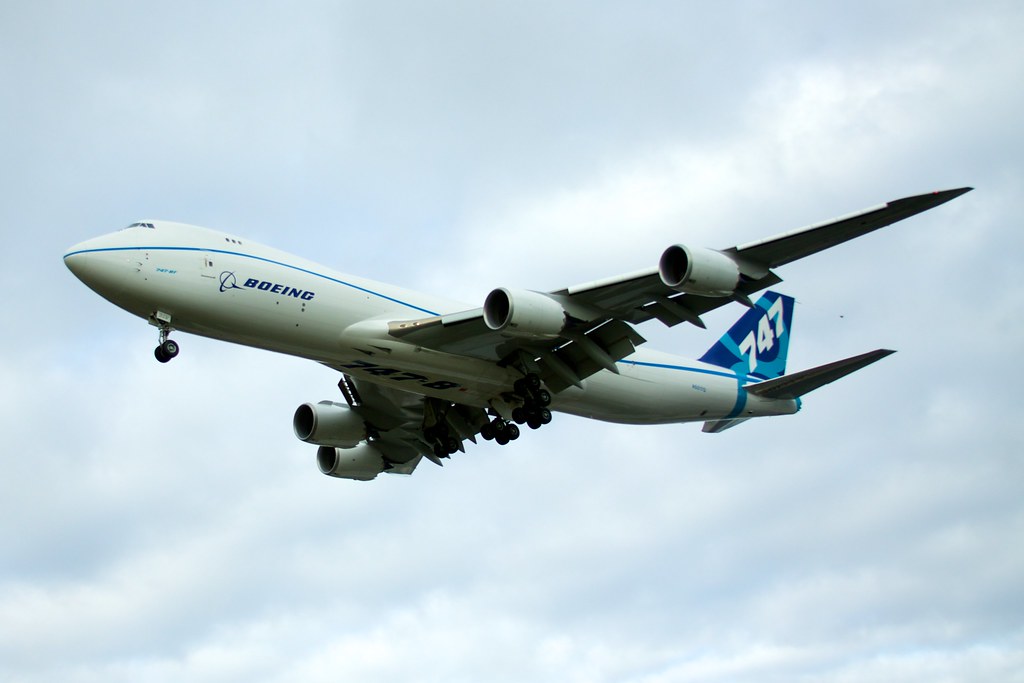
With a wingspan greater than a Boeing 747, the Bristol Brabazon was the largest aircraft ever built by Britain. More a flying oceanliner than plane, it featured sleeping cabins, a dining room, a cocktail bar and lounge, and even a 23-seat movie theater.

The Brabazon was also fitted with cutting edge innovations. A fully pressurized, air conditioned cabin. Electric engine controls, and high-pressure hydraulics to operate its massive control surfaces. Its enormous wing housed more than 16 thousand gallons of fuel, and eight of the most powerful piston engines available. While the first Brabazon used piston engines, later Brabazons were to use turboprop engines that were being developed by Bristol.

The Bristol Brabazon would have true transatlantic capability. Able to fly non-stop from London to New York against prevailing eastern winds. In the 1940s, this would have been quite the feat. Transatlantic flights were almost always done in stages to allow for refueling.

Despite introducing new innovations, many of which influenced the future of aviation, the Brabazon’s driving philosophy was outdated. The Brabazon’s mission was to compete with ocean liners for ultra-wealthy passengers. But this lumbering, super-sized airliner would have been introduced with airlines for 1950s, right when the first jet airliners, like the De Havilland Comet, were taking to the skies. Aircraft like the Dash 80, which would become the 707, were also just around the corner, and would bring a transatlantic crossing down to as little as 7 hours.

After a massive design and development effort, Britain found itself stuck with a plane nobody actually wanted, designed for an era that no longer existed.The program was cancelled and the Brabazon, and its half finished turboprop successor were sold for their weight in scrap.

#BristolBrabazon #BritishAviation #WhiteElephant #Airplanes

For an authoritative resource on the Bristol Brabazon visit:
http://www.historynet.com/bristol-bra…

Special thanks to niltondc for helping to model the Bristol Brabazon:
https://www.youtube.com/user/niltondc

Like the the aviation industry posters found in this video? Visit The Aviation Ancestry Database, containing over 80,000 high-quality examples: http://www.aviationancestry.co.uk/

Special thanks to Nick Arehart for helping clean up our audio:
https://twitter.com/airhrt_

Special thanks to: Coby Tang, Christian Altenhofen and Razvan Caliman for supporting us on Patreon and helping Mustard grow: https://www.patreon.com/MustardChannel

Music (reproduced under license):

Intro & Extro: “Wells Street” – https://www.pond5.com/stock-music/730…

Main Song #1: “Worrying Clock Cycle” – https://www.pond5.com/stock-music/767…

Main Song #2: “The Funk Kit” – https://audiojungle.net/item/the-funk…

April 10, 2020

A French Air Force Rafale-B flight that could have ended even worse for all concerned

Filed under: France, Military — Tags: , , — Nicholas @ 03:00

I’m guessing from what is revealed in this report, the Armée de l’air will be far more reluctant to allow unqualified individuals to get into their fighter aircraft in future:

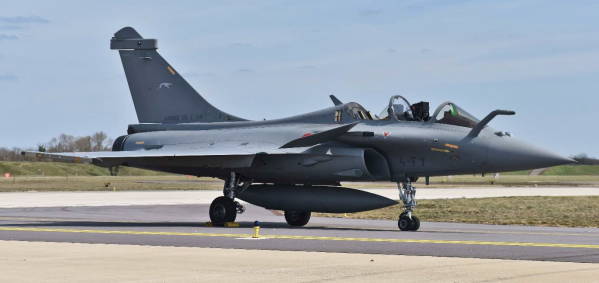
The Rafale-B that was damaged during the accidental passenger ejection in March 2019.
Image from Bureau enquêtes accidents pour la sécurité de l’aéronautique d’État, BEA-A.

An elderly and reluctant Frenchman was ejected from a French Air Force fighter during a retirement day jolly – and narrowly missed taking the pilot with him, an investigation report littered with unintentional howlers has revealed.

The unnamed 64-year-old was éjecté from the two-seat Rafale-B in March from a height of 2,500ft in March last year after grabbing his ejection seat handle to steady himself, France’s BEA-E aviation investigator concluded.

Although the BEA’s full report is in French [PDF], aviation news website Aerotime Hub translated and summarised its contents, revealing the full comedy of errors triggered by a group of enthusiastic colleagues hoping to give their workmate a send-off to remember.

[…] a mechanic gave them both a cursory check, strapped a Go-Pro to an approved bulkhead mounting point so the hapless passenger’s gurning would be preserved for all time, and nodded to the pilot to close the transparent cockpit canopies.

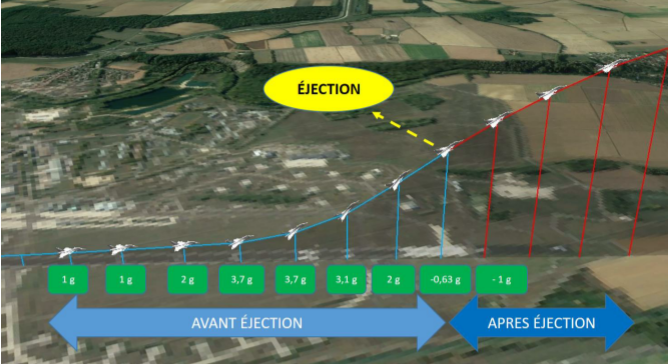
Things got worse when the pilot took off from northeastern France’s Saint-Dizier Robinson airbase. Rather than the gentle ascent at 10°-15° that airline passengers experience, the Frenchman at the Rafale’s controls carried out a typical fighter jet departure and “climbed at 47°, generating a load factor of around +4G. Then, as he levelled off, he subjected his passenger to a negative load factor of about -0.6G”.

Forces exerted by Britain’s most G-force-intensive roller coaster, Alton Towers’ Rita, max out at +4.7G – or four times the normal force of gravity.

Our pensioner, loose in his straps, not really wanting to be there and totally unused to being flung around like a rag doll, reached out to grab something and hang on for dear life. He picked the worst possible handhold: the trigger handle for the ejection seat. After the customary loud bang and whoosh he ceased to be part of the jet’s payload, with the force of the ejection tearing his unsecured helmet and mask from his face.

The Rafale-B’s command ejection system is meant to fire both seats if one of the crew pulls the handle. A very confused pilot, however, was still sitting in his newly canopy-free Rafale wondering what the hell had just happened. He returned to land, conscious all the time that the seat could fire at any moment without warning. Luckily, it didn’t go off.

Approximate reconstruction of the path of the Rafale-B leading up to and following the accidental ejection.
Image from Bureau enquêtes accidents pour la sécurité de l’aéronautique d’État, BEA-A.

April 3, 2020

Taffy Holden, the Accidental Lightning Pilot

Filed under: Britain, History, Military — Tags: , , — Nicholas @ 05:00

The History Guy: History Deserves to Be Remembered
Published 24 Sep 2018

In the United Kingdom in 1966, an RAF ground crewman conducting an electrical test suddenly finds himself airborne. Taffy Holden, the accidental Lightning pilot, deserves to be remembered.

The History Guy uses media that are in the public domain. As photographs of actual events are sometimes not available, photographs of similar objects and events are used for illustration.

Patreon: https://www.patreon.com/TheHistoryGuy

The History Guy: History Deserves to Be Remembered is the place to find short snippets of forgotten history from five to fifteen minutes long. If you like history too, this is the channel for you.

Awesome The History Guy merchandise is available at:
teespring.com/stores/the-history-guy

The episode is intended for educational purposes. All events are portrayed in historical context.

#history #aviation #thehistoryguy

The English Electric Ligthning F1 had another, rather more dramatic appearance on the front page of the Daily Mirror in October 1962:

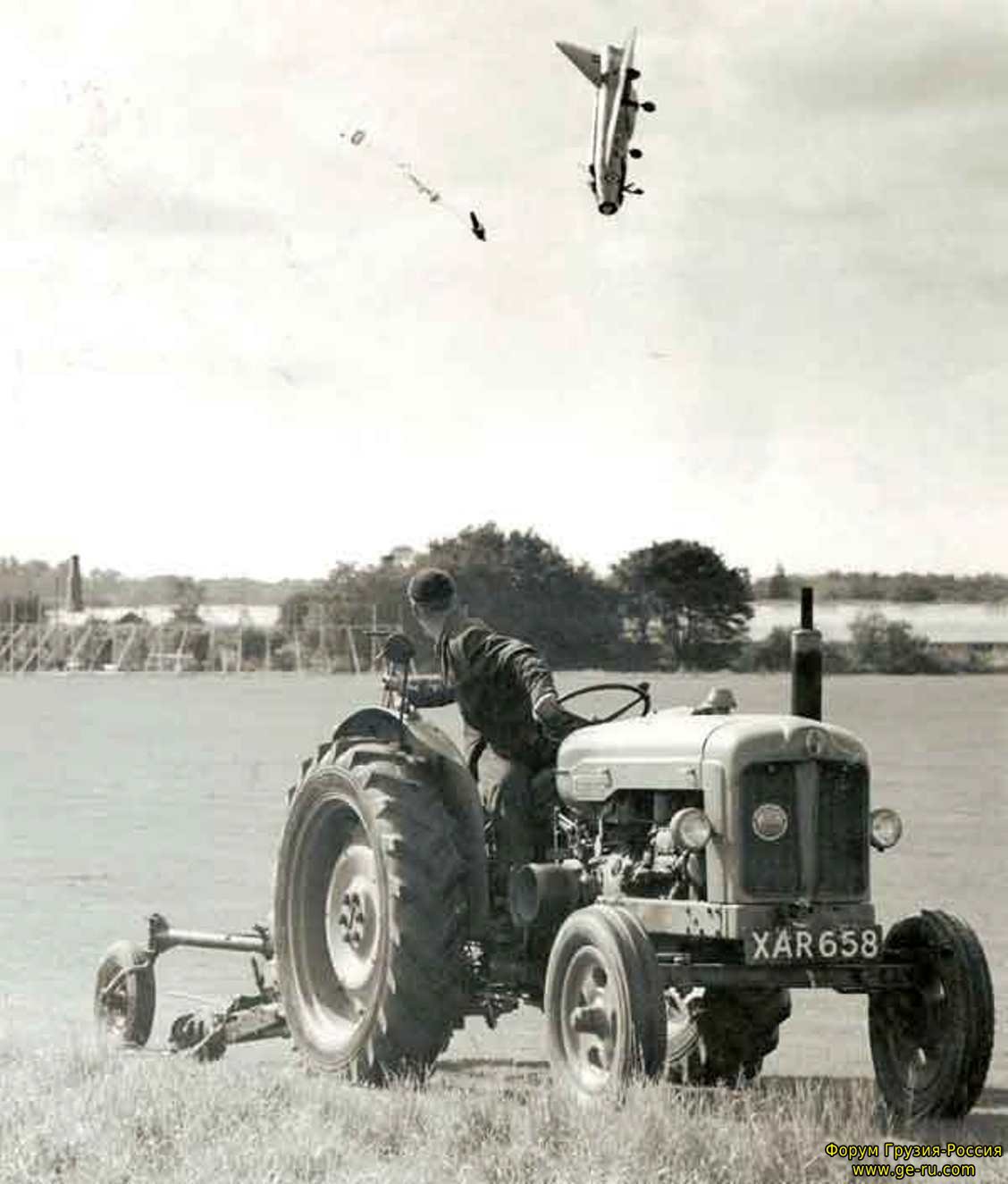
English Electric F1 Lightning interceptor XG332 about to crash on 13 September 1962.
Photo by Jim Mead via Reddit.com.

Whilst carrying out a demonstration flight, there was a fire in the aircraft’s reheat zone. Un-burnt fuel in the rear fuselage had been ignited by a small crack in the jet pipe and had weakened the tailplane actuator anchorage. This weakened the tailplane control system which failed with the aircraft at 100 feet on final approach. The aircraft pitched up violently just as Aird was coming up to land. Aird lost control of the aircraft and ejected.

Luckily, because the nose pitched up he had just enough time to eject.

The tractor in the photograph was a Fordson Super Major. If you look closely at the grill, you’ll see it reads D H Goblin, as in the de Havilland Goblin jet engine.

The tractor driver was 15-year-old Mick Sutterby, who spent that summer working on the airfield. He wasn’t posing for the camera. In fact, he was telling the photographer, Jim Mead, to move on, because he shouldn’t be there.

Mead saw the plane coming in and the nose pitch up. Then Aird ejected and Mead says he had just enough time to line up the shot as the Lightning came down nose first.

Meanwhile, George Aird landed on a greenhouse and fell through the roof, breaking both legs as he landed unconscious on the ground. The water from the sprinkler system for the tomatoes woke him. He’s reported to have said that his first thought was that he must be in heaven.

The photographs taken that day first went to the Ministry of Aviation. Once they were released, Mead sold them to the Daily Mirror.

February 19, 2020

Great Blunders of WWII: The Scattering of Convoy PQ17

Filed under: Britain, Germany, History, Military, Russia, WW2 — Tags: , , , , , — Nicholas @ 06:00

Anthony Coleman
Published 4 Nov 2016

From the History Channel DVD series Great Blunders of WWII.

This is of interest for many reasons, but particularly because my late father-in-law served in the Royal Navy on the Arctic convoys and spent a full winter in the Soviet Union when his convoy couldn’t return before the ice closed the convoy route.

February 2, 2020

Boeing and the kitchen sink

Filed under: Business, USA — Tags: , , — Nicholas @ 05:00

In the Continental Telegraph, Tim Worstall looks at the mess the new Boeing management has inherited and what they may need to do to be seen to be fixing it:

Which brings us to another piece of stock market wisdom, about trying to catch a falling knife. A dangerous occupation and the reference is to trying to call the bottom on some stock that has just had a disaster. At some point, surely, the tumble in price will stop and there will be a bounce. Well, yes, or perhaps maybe, for we must not forget that that proper bottom is that end of life – the bankruptcy – price of nothing. For everything that isn’t about to go bust then yes, there’s a price at which buying in the face of everyone else’s panic can be highly profitable. The question being, well, what is about to go bust? Toys R Us did, after all. Actually, so have quite a lot of retailers just recently. There was no above zero price at which it was sensible to buy in.

So, some stock crashes in price, should we buy in? After all, there is that phenomenon known as the dead cat bounce – anything will bounce at least once if you drop it from high enough. The question becomes one of, well, is this crash a result of something that can be reversed, or perhaps something that’s not going to be terminal for the organisation? Or is this just the start of that realisation process that the organisation is coming to the end of its life and going to that final resting place of a zero dollar valuation?

[…]

So, Boeing and the 737 Max. The changes in airframe had the unfortunate consequence of diving a couple of the planes into the ground. We’ve had a drip of stories about how the development process wasn’t all we would wish it to be. The FAA isn’t going to let it back up into the air until the summer at earliest. The Dreamliner seems to be having demand problems and, well, things aren’t looking good.

But is this the start of some spiral to zero? No, don’t be daft. Partly because the American government simply would not allow that. Boeing’s too much part of the backdrop of the US economy for that to be left to happen. The military business is also of significant value whatever happens to the civil aviation side. And of course the numbers we’re talking about here could be painful to stock holders – they are already in part of course – but at the very worst we’re looking at some tens of billions of problem here. That’s just not enough to drive a company Boeing’s size down to zero. Not in this decade at least, given that the only reasonable competition is Airbus. Global duopolies don’t end that way.

So, at this point there’s an argument to say that trying to catch that falling knife of the Boeing stock price might be worthwhile. So, when might that be? At which point another idea, kitchen sinking. This is when a new management team decides to make themselves look good by declaring how bad things had got under the previous one. Absolutely anything and everything that looks like, it might even smell of a problem in the future is taken out and declared. Provisions are made for this problem on this contract, for that problem that might occur over there, add a bit more and then heck, why not, double it! This has, assuming the company survives this balance sheet massacre, the obvious effect of making the new management team look good over the years. Not just because everything starts from this new low place. But also because many of those provisions – those over-provisions – won’t be needed and can be written back from reserves into the P&L.

January 19, 2020

“Night Witches” – Female Soviet Pilots – Sabaton History 050 [Official]

Filed under: History, Media, Military, Russia, WW2 — Tags: , , , , , , — Nicholas @ 06:00

Sabaton History
Published 18 Jan 2020

This episode is about the Soviet 588th bomber regiment. They were all-female and got the nickname “Night Witches” from the sound their planes made after they killed their engines for maximum effect. This sound made German think of the broomsticks of witches, and they called them “Nachthexen“.

Support Sabaton History on Patreon: https://www.patreon.com/sabatonhistory

Listen to Heroes (where “Night Witches” is featured):
CD: http://bit.ly/HeroesStore
Spotify: http://bit.ly/HeroesSpotify
Apple Music: http://bit.ly/HeroesAppleMusic
iTunes: http://bit.ly/HeroesiTunes
Amazon: http://bit.ly/HeroesAmz
Google Play: http://bit.ly/HeroesGoogleP

Watch the official lyric video of “Night Witches” here: https://www.youtube.com/watch?v=C7NSU…

Listen to Sabaton on Spotify: http://smarturl.it/SabatonSpotify
Official Sabaton Merchandise Shop: http://bit.ly/SabatonOfficialShop

Hosted by: Indy Neidell
Written by: Markus Linke and Indy Neidell
Directed by: Astrid Deinhard and Wieke Kapteijns
Produced by: Pär Sundström, Astrid Deinhard and Spartacus Olsson
Creative Producer: Joram Appel
Executive Producers: Pär Sundström, Joakim Broden, Tomas Sunmo, Indy Neidell, Astrid Deinhard, and Spartacus Olsson
Post-Production Director: Wieke Kapteijns
Edited by: Iryna Dulka
Sound Editing by: Marek Kaminski
Maps by: Eastory – https://www.youtube.com/c/eastory

Eastory YouTube Channel: https://www.youtube.com/channel/UCEly…
Archive by: Reuters/Screenocean https://www.screenocean.com
Music by Sabaton.

Colorizations:
– Olga Shirnina a.k.a. Klimbim – https://klimbim2014.wordpress.com/

Sources:
– Tver United State Museum
– Photo of the instructor Semeon Lykin and a group of pilots posing in front of a Polikarpov Po-2 courtesy of Franco Folini on Flickr
– Po-2 “Sudstroitel”; 588th night light bomber aviation regiment – all courtesy of Segey G on Flickr
– SA-kuva 39220
– Sniper scope icon by DTDesign from the Noun Project

An OnLion Entertainment GmbH and Raging Beaver Publishing AB co-Production.

© Raging Beaver Publishing AB, 2019 – all rights reserved.

January 12, 2020

The shoot-down of Flight 752

Filed under: Government, History, Military, Politics, USA — Tags: , , — Nicholas @ 05:00

Colby Cosh discusses the destruction of Ukraine International 752 in the historical context of the Vincennes incident (later on Friday, the Iranian official position appears to have shifted to accepting responsibility for an accidental missile launch):

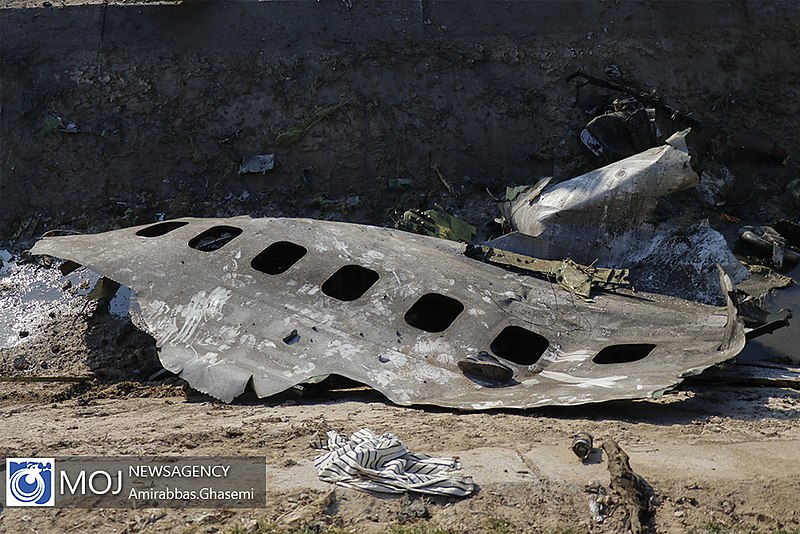
Some of the wreckage of Ukraine International flight 752 near Tehran, Iran.
Photo from MOJ Newsagency via Wikimedia Commons.

It has become fairly obvious, whatever the Iranian authorities may say now or later, that Ukraine International Airlines Flight 752 was shot down after departing Tehran. This was, in truth, overwhelmingly probable the moment the news broke, but there was still widespread shock and disbelief on Thursday when several Western heads of government announced signal-intelligence evidence of a missile strike. There are still “How could such a thing happen?” reactions pouring forth — mostly from people who are old enough, in theory, to recall the USS Vincennes accidentally shooting down an Iran Air Airbus A300 in 1988.

I say “in theory,” but the truth is that popular memory of the Vincennes incident has been much diminished — outside Iran — by later events in the region. This must qualify as one of the good Lord’s most sadistic jests. The United States wasn’t officially at war with anyone in the region at the moment when its best-trained sailors, equipped with scorchingly new and uncannily powerful missile and battlespace-mapping technology, blew up a commercial airliner full of religious pilgrims.

The Navy was in the Gulf not to fight or oppose anybody in particular, but to protect neutral shipping from the Iran-Iraq War. Up to the time of the accident, it was Iraq that demonstrably presented the greater danger to American warships. Ronald Reagan was still president. The First Gulf War wouldn’t kick off until 1990.

In other words: we forgot. The memory of Vincennes was overwritten by a generation of Middle East conflict, like an old computer file.

Which leaves a paradox. Liberals who regard recent U.S. history as one enormous, indistinguishable mass of bloodthirsty actions don’t seem especially aware of one of the most horrifying tactical blunders in American military history. What’s one jet plane more or less in the black ledger of imperialism? Conservatives, meanwhile, are racing to accuse Iran of “murder” in the case of Flight 752.

Blunders can be worse than crimes, according to one of the most famous of all military maxims. But if one points out that Iran’s “murder” of innocents is starting to look like a nightmarish replay of Vincennes, one risks being accused of postulating “moral equivalence” between the United States and Iran.

January 4, 2020

The Rise and Fall of the Japanese Zero

Filed under: History, Japan, Military, Pacific, Technology, USA, WW2 — Tags: , , , — Nicholas @ 06:00

Real Engineering
Published 31 Aug 2018

Patreon:
https://www.patreon.com/user?u=282505…
Instagram:
https://www.instagram.com/brianjamesm…
Twitter:
https://twitter.com/thebrianmcmanus
Discord:
https://discord.gg/s8BhkmN

Thank you to AP Archive for providing footage: https://www.youtube.com/channel/UCHTK…

Get your Real Engineering shirts at: https://standard.tv/collections/real-…

References:
[1] https://www.thoughtco.com/world-war-i…
[2] http://rwebs.net/avhistory/history/ze…
[3] http://aboutjapan.japansociety.org/im…
[4] https://www.history.com/news/the-akut…
[5] https://www.japanpowered.com/history/…
[6] https://www.warbirdforum.com/sakai.htm

Credits:
Narrator/Director: Brian McManus
Co-Director: Mike Ridolfi (https://www.moboxgraphics.com/)
3D Animations: Eli Prenten (http://eliprenten.com/)
Research: Stephanie Sammann (https://www.stephanie-sammann.com/)
Sound: Graham Haerther (https://haerther.net/)

November 30, 2019

WW1 Villar Perosa SMG at the Range

Filed under: History, Italy, Military, Weapons, WW1 — Tags: , , , — Nicholas @ 02:00

Forgotten Weapons
Published 28 Sep 2019

Courtesy of the Morphy Auction Company, I am out at the range today with a very rare Italian Villar Perosa machine gun from World War One. These are pretty unorthodox machine guns, as they were initially designed as aircraft armament and later repurposed as ground guns. The basic design is a pair of actions and barrel with a single rear trigger housing. The actions are (slightly) delayed blowback, feeding from 25-round magazines and firing at about 1500 rpm each. The grip has two separate thumb triggers, which fire the two barrels independently.

For an aircraft application, this allowed a very high volume of fire for a very short time; exactly what aerial combat called for. As an infantry gun, the design was much less practical. The bipod held the gun up, but did not have any firm stop that could be pushed into. Coupled with the lack of a buttstock, the gun was very difficult to keep on pattern with anything but the shortest burst. The small aperture sight certainly doesn’t help things either.

http://www.patreon.com/ForgottenWeapons

Cool Forgotten Weapons merch! http://shop.bbtv.com/collections/forg…

Contact:
Forgotten Weapons
6281 N. Oracle #36270
Tucson, AZ 85704

November 26, 2019

The Avro Arrow

Filed under: Britain, Cancon, History, Military, Technology, USA — Tags: , , , , — Nicholas @ 04:00

The History Guy: History Deserves to Be Remembered
Published 25 Nov 2019

In the 1950s, Canada had one of the world’s most advanced aerospace industries. But the cancellation of the Avro CF-105 “Arrow” changed everything. The History Guy remembers the Avro Arrow and forgotten aviation history. It deserves to be remembered.
(more…)

November 12, 2019

Merlin – The Engine that Won the War

Filed under: Britain, History, Military, Technology, USA — Tags: , , , — Nicholas @ 02:00

Curious Droid
Published 28 Sep 2019

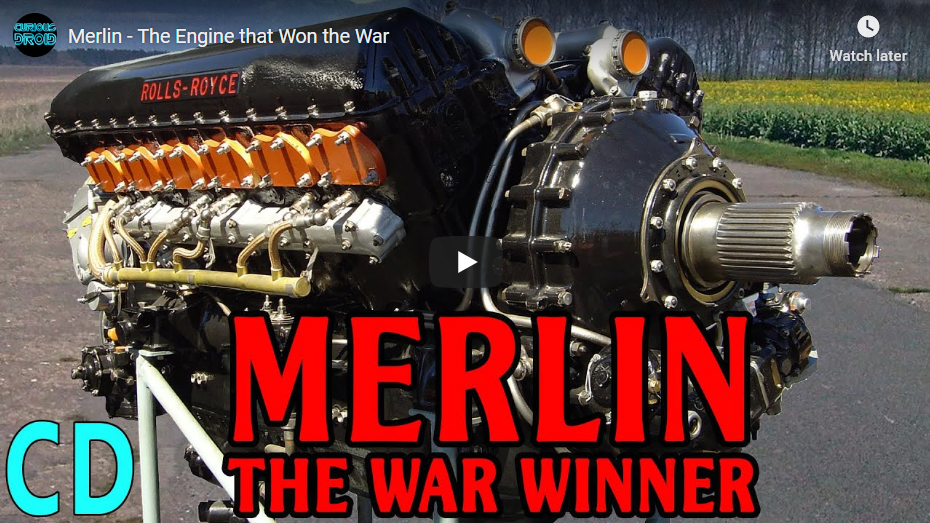
Sounds like a bit of a bold claim that one engine helped change the course of WW2 but when you see the evidence it has a lot of validity but how did one little engine change the course of world events and become the engine that won the war?

I would like to thank David Irwin of Historic Aero Engines not only for the generous use of his footage but as in checking over the script and finished video for technical accuracy.

Historic Aero Engines display team :
https://www.youtube.com/channel/UCtE_…

Patreon https://www.patreon.com/curiousdroid
Paypal.me https://www.paypal.me/curiousdroid

Sponsored by
Craig Fleming, Florian Hesse, Peter Barber

Presented by Paul Shillito

Written and Researched by Paul Shillito with assistance from David Irwin.

Images and Footage:
Historic Aero Engines, Rolls Royce, USAF, RAF, Boeing, Packard,
Joel Trick

Music From the Youtube library
“Magical Gravity” by Asher Fulero
“Saving the World” by Aaron Kenny
“Adrift” by ELPHNT
“Oceans, Rivers, Canyons” by ELPHNT
“The Story Unfolds” by Jingle Punks

October 12, 2019

⚜ | Survivor Bias in World War 2

Filed under: History, Military, Technology, USA, WW2 — Tags: , — Nicholas @ 02:00

Military Aviation History
Published on 31 Aug 2017

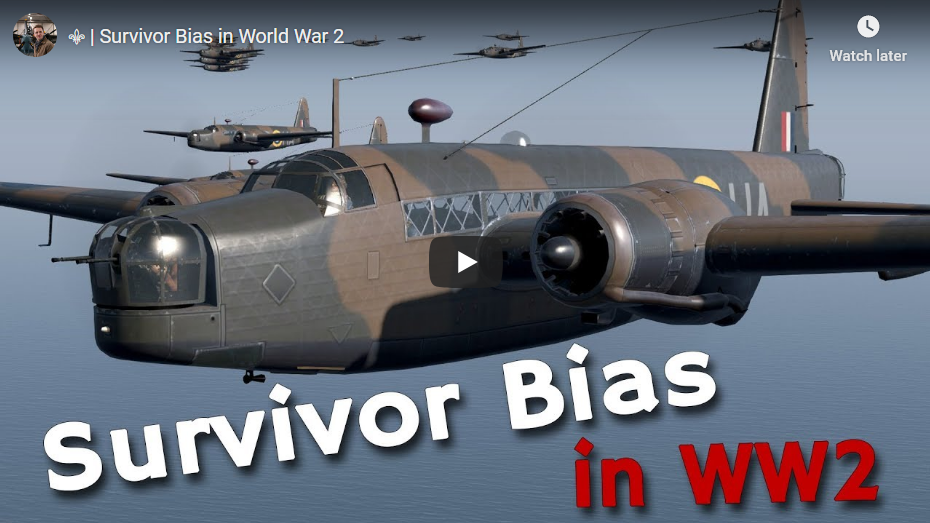
Survivor Bias was a thing in World War 2. Let’s learn what happened.

– You can support my Channel with Patreon: https://www.patreon.com/Bismarck

⚜ Support My Work ⚜
– You can support my Channel with a donation [Paypal]: https://www.paypal.me/BismarckYT

⚜ Find Me On Social Media ⚜
– Twitch: http://www.twitch.tv/bis18marck70
– Twitter: https://twitter.com/Bis18marck70

⚜ Sources ⚜
M. Mangel, F. J. Samaniego, Abraham Wald’s Work on Aircraft Survivability

Abraham Wald, A Reprint of “A Method of Estimating Plane Vulnerability Based on Damage of Survivors”

From the comments:

Military Aviation History
2 years ago (edited)
Hey all, I hope that you like this video. Small correction from my side at 05:00 – It was reprinted in 1980 not 1918. I misspoke. Obviously.

This video was actually planned for the end of September but since I had the script already, I decided to publish it now. As mentioned to my Patreons some days ago, I have a few unexpected home visists to make. The first set was last week and after returning two days ago, I flew off to yesterday for another week abroad. As such it made sense to get such a familiar topic out now since otherwise, there would be nothing.

It should be mentioned that I did not find the “original” study Wald responded to. Either it got lost, or it was never published. Perhaps Wald saw them work on it, saw the errors and published his paper leading the other group to abandon their project. However, there is also a slight chance that over the years parts of the story were exaggerated. Wald certainly published his papers (you’ll easily find it on the internet) and was given the credit for helping US designers — but what of that inital research group? What were their conclusions, their recommendations beyond what is usually linked to Wald? Without their study, no one seems to know.

September 13, 2019

Why You Wouldn’t Want to Fly The First Jet Airliner: De Havilland Comet Story

Filed under: Britain, History, Technology — Tags: , , — Nicholas @ 02:00

Mustard
Published on 1 Dec 2017

Air travel before the Jet Age wasn’t always glamorous. The relentless noise and vibration from a piston powered propeller aircraft often made long flights even more exhausting. Most aircraft also couldn’t fly high enough to avoid bad weather, so air sickness was more common.

After World War Two, as part of an effort to develop its civil aviation industry, Britain stunned the world by unveiling the world’s first jet airliner. The de Havilland Comet was sleek, quiet, and flew higher and faster than any airliner of the day. As piston propeller technology was reaching its limits, the conventional thinking was that jet engines were too unreliable and produced too little power relative to their fuel consumption. But the de Havilland Comet proved that jet travel was the future. When the Comet entered service in 1952, it immediately began breaking travel time records and became a point of national pride for Britain.

The de Havilland Comet was perhaps little too ahead of its time. With such a clean sheet design, there were still lessons to learn. When early Comets suffered from catastrophic depressurization incidents, the entire fleet was grounded and their Certificate of Airworthiness was revoked. Flaws in the design of the aircraft’s fuselage were resolved in later Comet versions. However, the rest of the world was now catching up, and manufacturers including Boeing and Douglas began to offer their own jet airliners. While later version Comets served airlines reliably, they were outsold by competing aircraft. There’s no question However, that the comet paved the way. The British had taken a massive risk and brought the world into the jet age. #DeHavilland #CometAirliner #Airplane

Want to help Mustard grow? Support us on Patreon: https://www.patreon.com/MustardChannel

August 31, 2019

Young Recruits, French Planes, and Graf Spee – WW2 – OOTF 003

Filed under: Britain, France, Germany, History, Military, WW2 — Tags: , , , — Nicholas @ 06:00

World War Two
Published on 30 Aug 2019

How young were British soldiers? Could Graf Spee have gotten away? What was the French air force like? Questions, questions, questions – from you no less! With answers from us Out of the Foxholes.

Join us on Patreon: https://www.patreon.com/TimeGhostHistory
Or join The TimeGhost Army directly at: https://timeghost.tv

Follow WW2 day by day on Instagram @World_war_two_realtime https://www.instagram.com/world_war_t…
Join our Discord Server: https://discord.gg/D6D2aYN.
Between 2 Wars: https://www.youtube.com/playlist?list…
Source list: http://bit.ly/WW2sources

Image sources:
Drawing Morane-Saulnier M.S.406 C1 and Dewoitine D.520 fighters : Kaboldy

Written and Hosted by: Indy Neidell and Nicholas Moran
Produced and Directed by: Spartacus Olsson and Astrid Deinhard
Executive Producers: Bodo Rittenauer, Astrid Deinhard, Indy Neidell, Spartacus Olsson
Creative Producer: Joram Appel
Research by: Indy Neidell, Nicholas Moran, and Joram Appel
Edited by: Wieke Kapteijns

Eastory’s channel: https://www.youtube.com/channel/UCEly…
Archive by Screenocean/Reuters https://www.screenocean.com.

A TimeGhost chronological documentary produced by OnLion Entertainment GmbH.

From the comments:

World War Two
39 minutes ago
One day before the war has being going on for a whole year, we look back at some stuff from 1939 and 1940. And once again Nicholas Moran, the Chieftain https://www.youtube.com/user/TheChieftainWoT joins us to answer your questions. This time he leaves his main turf (tanks) to dive into his other area of expertise; naval battles. Please remember that we can’t field questions from the comments so if you want submit a new question do it here: https://community.timeghost.tv/c/Out-of-the-Foxholes-Qs

Coming out with Out of the Foxholes has been a bit of a challenge as we try to master the crazy amount of stuff going on in our main episodes. But thanks to the fantastic collaboration of the TimeGhost Army on https://www.patreon.com/TimeGhostHistory and https://timeghost.tv we are constantly expanding our capacity and we hope to come out with these a bit more often now! For now, enjoy and remember that tomorrow our first anniversary episode comes out!

« Newer PostsOlder Posts »

Powered by WordPress