
World War Two
Published 7 Jun 2025May 11, 1940: Our WW2 documentary continues as the Battle of France rages and German Panzers rumble through the Ardennes. The Battle of Sedan is on the horizon and Heinz Guderian has one objective: break the French defences! But all is not well for the Germans as Europe’s largest-ever traffic jam threatens to stall the Blitzkrieg.
00:00 Intro
00:51 The Ardennes Advance
08:55 The Air War
15:05 Conclusion
(more…)
June 8, 2025
Day Two – Panzers Stuck in Europe‘s Biggest Traffic Jam! – Ten Days in Sedan
Comments Off on Day Two – Panzers Stuck in Europe‘s Biggest Traffic Jam! – Ten Days in Sedan
June 2, 2025
Fighting at Yenangyaung, 17-19 April 1942
Dr. Robert Lyman on the battle at Yenangyaung between 17-19 April 1942 early in the Burma campaign:
… the Yenangyaung battle is a fascinating one, with its own small degree of controversy, I decided to lay it out in this post. A mystery of the battle is the differing accounts of the Chinese attacks on the 19th April. In the British accounts (including Bill Slim’s in Defeat into Victory) the Chinese are blamed for failing to attack in the morning as they had promised, adding further jeopardy to the fate of the encircled 1st Burma Division. But was this true? The Japanese, Chinese and American accounts differ, so I thought I’d lay out the story to allow you, dear reader, to come to your own conclusion.
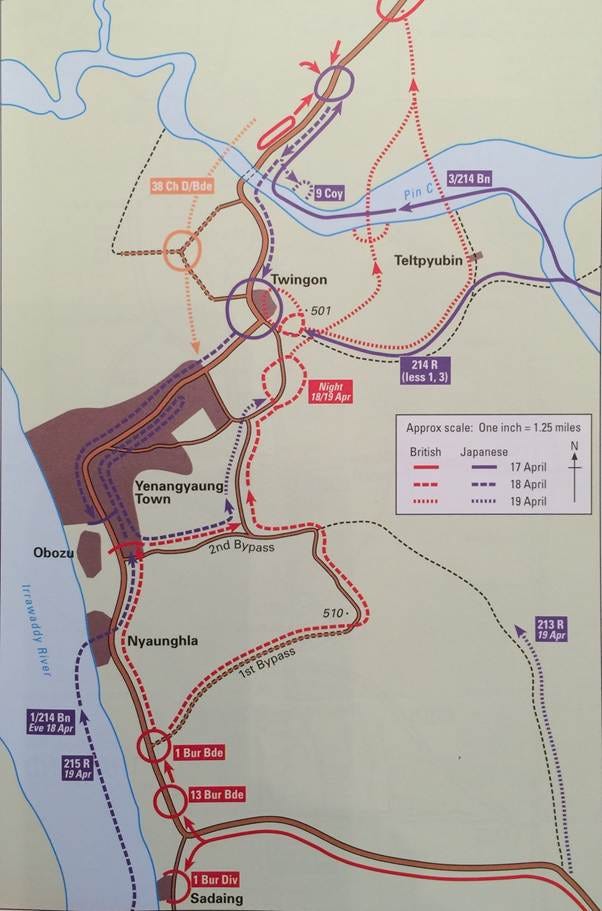
The fabulous map of Yenangyaung produced by the late Ian Lyall Grant.
The scrap at Yenangyaung was the final Corps-sized battle before the order to evacuate Burma Corps was given in early May. The Japanese had pushed out of Rangoon in mid-March, driving up the Irrawaddy on the left and against Toungoo on the right. Allied plans for the defence of Burma were inadequate, both Chinese (on the right) and Slim’s Burcorps (on the left) effectively fighting separate battles. Attempts by General Harold Alexander, the Army Commander, to control the battle and constrain the advancing Japanese ultimately came to naught. Alexander, Slim and Lieutenant General Joe Stilwell, nominally commanding the Chinese 5th Army, tried every trick in the tactical rule book to bring a halt to the relentless Japanese advance, and to destroy them in battle. After a month of fighting in which the Chinese were pushed out of Toungoo, the British lost control of Prome and an attempt to consolidate a defensive line across the country failed, the Japanese moved up the Irrawaddy in an attempt to turn the British flank, breaking in at the oilfield town of Yenangyaung on 17 April. At the time Slim’s Burma Corps was attempting to withdraw to the north from Allamyo. The Japanese infiltration into Yenangyaung cut the British in half. The 1st Burma Division was now cut off in Yenangyaung. The battle by the already weakened division (amounting to probably no more than 4,000 troops) into the Yenangyaung pocket over the period 17 and 19 April proved to be the severest trial yet faced by British troops in the short Burma campaign, the pressure applied by the Japanese exacerbated by the intense heat and the lack of water.
It was critical that Slim defeated this Japanese infiltration, rescue the 1st Burma Division from encirclement and retain the integrity of his Corps. If Yenangyaung were lost the Japanese would be free to sweep north to threaten Mandalay. It was crucial therefore that the divisional commander – Major General Bruce Scott – held on for as long as he could. But Slim had no reserve. The only hope of relief lay in assistance from the Chinese far to his right. He concluded that if he could engineer a attack into the pocket by the Chinese, across the Pin Chaung, combined with a breakout attack by 1st Burma Division, they might have a chance of escape. Nothing else looked likely to succeed.
When asked, Stilwell agreed to Alexander’s request for help to be provided to Slim, and gave him Lieutenant General Sun Lijen’s 38th Division – responsible for the defence of Mandalay – for the task. Chiang Kai-shek had given Sun responsibility for defending Mandalay. At midnight on 16 April Sun received an order from General Lo Cho-yin, “to dispatch his 113th Regiment to Kyaukpadaung, there to be commanded by the British General Slim …” Sun’s friend, Dr Ho Yungchi, recorded that by 3 a.m. he had arrived at Lo’s HQ at Pyawbe to discuss the order. Lo explained that the British were in serious trouble “in the oil town of Yenangyaung and had sent repeated requests for help”. By 6.30 a.m. it was agreed that Sun would personally take command of the 113th Regiment, while the two remaining regiments stayed to defend Mandalay. Sun and 1,121 men of 113th Regiment (commanded by Colonel Liu Fang-wu) arrived at Kyaukpadaung on the morning of 17 April.
Slim recalled: “The situation was not encouraging, and I was greatly relieved to hear that 113 Regiment of the Chinese 38th Division was just arriving at Kyaukpadaung. I dashed off in my jeep to meet their commander and give him his orders … this was the first time I had had Chinese troops under me … I got to like all, or almost all, my Chinese very much. They are a likeable people and as soldiers they have in a high degree the fighting man’s basic qualities – courage, endurance, cheerfulness, and an eye for country.”1
At Yenangyaung, Slim’s plan was for Sun’s 38th Division to attack from the north on the morning of 18th April while the 1st Burma Division, within the pocket, fought its way out. As Slim and Sun Lijen talked, discussing the details of the attack planned for the following morning Slim decided that he would place the Stuart tanks of the 7th Armoured Brigade directly under Sun’s command. It was only a move a man confident in the capabilities of his allies could make. Slim commented that “I was impressed by Sun and it was essential to gain his confidence. His division had no artillery or tanks of its own, and I was therefore arranging that all the artillery we had this side of the Pin Chaung and all available tanks should support his attack.” The commander of the British armoured brigade – Brigadier John Anstice – accepted this arrangement and according to Slim “he and Sun got on famously together”. What’s more, the soldiers worked well together too, Slim recording that the “gunners and tank crews, as is the way of British soldiers, soon got on good terms with their new comrades, and, in spite of language difficulties of an extreme kind, co-operation was, I was assured by both sides, not only close but mostly friendly.”2 Accordingly, at 6.15 a.m. on 18 April, Major Mark Rudkin of 2nd Royal Tank Regiment (2RTR) reported as instructed by Anstice to 38th Division HQ:
There was little activity except for the cooking of breakfast and it seemed most unlikely that the attack could start on time. I asked the British liaison officer with the Chinese what was happening and he informed me that as the Chinese realized that they would not be ready to attack at 0630 hours, they had put their watches back one hour, so that officially they were still attacking at 0630 though the time would in reality be 0730. They had, therefore, not lost “face” by being late.
The plan was that a troop of tanks would follow the leading troops of the leading Chinese battalion and give what support it could. Another troop was to follow the leading infantry battalion and assist the leading troop if required. The tanks would be almost entirely road bound owing to the going off the road.
At 0730 the assaulting Chinese moved forward off the ridge on a front of about four hundred yards, the leading troop keeping very close behind on the road. On foot near the tanks was a Chinese interpreter who carried out liaison between the tanks and infantry.
After advancing about half a mile the leading tank was hit by a Japanese 75-mm gun situated on the road just north of the Pin Chaung which was firing straight up 300 yards of road. The tank was disabled but there were no casualties.
The Chinese advance continued and by afternoon had almost reached the line of the ford on the Pin Chaung which was still held by the enemy. The Chinese had had heavy casualties, especially amongst officers, as it was the custom for Chinese officers to lead, whatever their rank. It was finally decided to hold positions about half a mile north of the crossing and continue the attack next day.3
With the first attack a failure, the Japanese retained their grip on both the ford and the village of Twingon. The situation for the surrounded remnants of the 1st Burma Division was desperate; the Japanese close to achieving a complete victory. Slim and Sun then worked through a plan for another attempt to be made the following morning, 19th April. This day also began badly, however. The Chinese attack was scheduled to begin at 7 a.m. British accounts subsequently recorded that a Chinese attack did not materialise at this time. Slim subsequently recorded in Defeat into Victory that the failure to attack must have been a function of the administrative difficulties faced by the Chinese. He wrote that with the Chinese “lack of signalling equipment, of means of evacuating wounded and of replenishing ammunition, and their paucity of trained junior leaders it was not surprising that to sort themselves out, reform, and start a fresh attack took time”.4 Slim was invariably impressed with what he saw of the Chinese soldier in action, but considered their support and command functions to be shockingly poor and a source of constant frustration to themselves, and to all who had occasion to operate with them.
Slim, and most other British published accounts, including the Indian and British Official Histories, record that the attack finally went in at 3 p.m., when Colonel Liu’s 113th Regiment successfully captured the ford and penetrated into Yenangyaung.5 “When the Chinese did attack they went in splendidly” wrote Slim in admiration. “They were thrilled at the tank and artillery support they were getting and showed real dash. They took Twingon, rescuing some two hundred of our prisoners and wounded. Next day, 20th April, the 38th Division attacked again and with tanks penetrated into Yenangyaung itself, repulsing a Japanese counter-attack. The fighting was severe and the Chinese acquitted themselves well, inflicting heavy losses, vouched for by our own officers.”
1. Slim, Defeat into Victory (1956), p. 63.
2. Ibid., p. 65.
3. Bryan Perrett, Tank Tracks to Rangoon: The Story of British Armour in Burma (London: Robert Hale, 1978)
4. Slim, op. cit., p. 70.
5. Bisheshwar Prasad (ed,) The Retreat from Burma 1941 – 42 (Calcutta, Combined Inter-Service Historical Section, 1954), p. 296.
Comments Off on Fighting at Yenangyaung, 17-19 April 1942
June 1, 2025
Panzers Attack! – Ten Days in Sedan
World War Two
Published 31 May 2025May 10, 1940. A new kind of warfare comes to the fore as a German Panzer Group rumbles through the Ardennes towards Sedan. Heinz Guderian has one goal in mind — Get to the Meuse! If he can manage that, then the Battle of France may be over before it even begins. Can the Allies hold back the armoured armada?
Chapters
01:05 German Forces
04:13 Blitzkrieg Theory, Applied
07:37 The Advance Begins
14:50 The Allied Plan
17:59 A Tight Schedule
20:57 Summary
21:16 Conclusion
(more…)
Comments Off on Panzers Attack! – Ten Days in Sedan
May 25, 2025
Rommel’s Dark Secrets in North Africa – WW2 Fireside Chat
World War Two
Published 24 May 2025Indy and Sparty handle your questions on the German intervention in North Africa. Why did Rommel make such an impact so quickly? What was the war like for the local populations? How deeply involved was Rommel in the persecution of North African Jews?
(more…)
Comments Off on Rommel’s Dark Secrets in North Africa – WW2 Fireside Chat
May 20, 2025
The Battle of Aquino
Canadian Tank Museum
Published 13 Jan 2025You may know about AQUINO Tank Weekend at our Museum, but what was the Battle of Aquino? When did it take place? What happened to the Ontario Regiment RCAC during that action?
Enjoy this short documentary with our Curator Sam Richardson as he gives you a detailed look at the situation in May 1944 during the Italian campaign of the Second World War. Learn more about the soldiers that took part, the battle that took place and why it remains important to our Regiment and our Museum.
(more…)
Comments Off on The Battle of Aquino
April 17, 2025
Why TOG II was BETTER Than You Think
The Tank Museum
Published 20 Dec 2024It was rejected and ridiculed for years — but TOG II is actually much better than you think.
In 1939, the UK Ministry of War issued the spec for a heavy assault tank. This hefty brief included the requirements to cross a 16ft gap, climb over anti-tank obstacles and enough firepower to penetrate 7 inches of concrete. Enter “The Old Gang”, a group of expert engineers, responsible for most of the tanks created during the First World War.
Two vehicles were created during this process — TOG I and TOG II. While the TOG projects have often been rejected as tanks out of time — relics of thinking from trench warfare — Content and Research Officer, Chris Copson, argues that these vehicles were highly innovative in terms of their mobility, armour and firepower.
Despite fulfilling their brief, TOG was sidelined in favour of other projects, and the lone survivor — TOG II — arrived at The Tank Museum in the 1950s. This lumbering beast that never saw active service, sat sidelined whilst surrounded by WW2 legends like the Churchill, Sherman, and the infamous Tiger 131.
But in 2012, a miracle happened. World of Tanks included the super heavy tank in their online video game — launching TOG II into viral popularity. Since then, interest in this unique vehicle has skyrocketed, and now more than ever people want to see TOG II in real life and find out more about its interesting history.
Shop TOG II merch at our online shop: https://tankmuseumshop.org/
00:00 | Introduction
01:24 | An Innovative Spec
05:00 | Innovations in Mobility
10:11 | Innovations in Armour
11:49 | Innovations in Firepower
16:21 | Would TOG II Have Worked?
18:46 | The Legend Lives OnIn this film, Chris Copson unpicks the misconceptions surrounding TOG II — that it was a ridiculous super-heavy tank built for a war from 30 years ago. Instead, this is a vehicle that was highly innovative and represented a significant engineering achievement. Thanks to videos games such as World of Tanks, TOG II is now celebrated as the goofiest super heavy tank in history, and lives on as an internet legend for a whole new generation of tank nuts.
(more…)
Comments Off on Why TOG II was BETTER Than You Think
January 19, 2025
Dozens of Dead Tiger Tanks at Prokhorovka? – Prokhorovka Part 6
World War Two
Published 18 Jan 2025As the dust settles on the fields of Prokhorovka, Indy takes a look at the losses suffered by the Red Army and the Waffen-SS. But we soon see that Rotmistrov and the Soviets have launched a calculated propaganda operation to distort the numbers and paint the battle as a crushing victory.
(more…)
Comments Off on Dozens of Dead Tiger Tanks at Prokhorovka? – Prokhorovka Part 6
January 18, 2025
Buying military surplus is often a bargain, but buying new military equipment is usually a financial black hole
 The Canadian government has — since at least 1968 — always viewed major equipment purchases for the Canadian Armed Forces first and foremost as “regional economic development” projects which channel federal dollars into
 vote-rich areas in need of jobs or to reward provinces and regions for their support of the party in power. This virtually always requires getting all or most of the manufacturing/construction/assembly done in Canada.
To most people this sounds sensible: big military equipment acquisitions mean vast sums of taxpayer money, so why shouldn’t as much of that money as possible be spent in Canada? The answer, in almost every case, is that it will usually be VASTLY more expensive because Canadian industry doesn’t regularly produce these exotic, spendy items, so new factories or shipyards will need to be built, all kinds of specialized equipment will need to be acquired (usually from foreign sources), companies will need to hire and train new workforces, etc., and no rational private industries will spend that kind of money unless they’re going to be guaranteed to be repaid (plus handsome profits) — because CAF equipment purchases come around so infrequently that by the time the current batch need to be replaced, the whole process needs to start over from the very beginning. It would be like trying to run a car company where every new model year means you shut down the factories, fire the workers, destroy the tools and jigs and start over from bare ground. Economic lunacy.
Items like clothing, food, non-specialized vehicles (cars, trucks, etc.) may carry a small extra margin over run-of-the-mill stuff, but it will generally be competitive with imported equivalents.1 Highly specialized items generally won’t be competitively priced exactly because of those specialized qualities. The bigger and more unusual the item to be purchased, the less economic sense it makes to buy domestically. As a rule of thumb, if the purchase will require a whole new manufacturing facility to be built, it’s almost certainly going to be cheaper — and usually faster — to just buy from a non-domestic source.
How much more do Canadian taxpayers have to shell out? Carson Binda has some figures for current procurement boondoggles:
Take the new fleet of warships being built for the Royal Canadian Navy – the River Class Destroyers. The Canadian River Class is based on the British Type 26 Frigates.
The Brits are paying between $1.5 and $2.2 billion in Canadian dollars per ship. Meanwhile, Canada is paying upwards of $5.3 billion per ship, according to the Parliamentary Budget Officer.
That means we’re paying double what the Brits are, even though we are copying their existing design. That’s like copying the smart kids’ homework and still taking twice as long to do it.
If we paid the same amount per ship as the British did for the 15 ships of the River Class, we’d save about $40 billion in procurement costs. That’s twice as much money as the federal government sends to Ontario in health-care transfer payments.
[…]
Prime Minister Justin Trudeau’s government bungled F-35 fighter jet procurement is another example of taxpayers losing out on military procurement contracts.
In 2010, the Harper government announced plans to buy 65 F-35 fighter jets for an inflation-adjusted cost of $190.8 million per unit.
The Liberal government canceled that procurement when it came to power. Fast forward to 2023 and the Trudeau government announced the purchase of 88 F-35s at an inflation-adjusted cost of $229.6 million per unit.
That massive increase in cost was totally avoidable if the Liberals would have just kept the Harper-era contract.
[…]
Because so much budget is wasted overpaying for big ticket items like ships, jets and trucks, soldiers aren’t getting the basics they need to keep Canadians safe.
The defence department bureaucrats can’t even figure out how to buy sleeping bags for our soldiers. National Defence spent $34.8 million buying sleeping bags that were unusable because they were not warm enough for Canadian winters.
Recently, Canadian soldiers sent to Ottawa for training had to rely on donated scraps of food because the military wasn’t able to feed them. Soldiers have gone months without seeing reimbursements for expenses, because of bureaucratic incompetence in our cash-strapped armed forces.
1. Note, however that during the 1980s, the Canadian army wanted to buy Iltis vehicles that were built in Germany at a $26,500 cost per unit. Getting the work done under license in Canada by Bombardier more than tripled the per-vehicle cost to $84,000.
January 12, 2025
Waffen SS T-34s Go into Battle! – Prokhorovka Part 5
World War Two
Published 11 Jan 2025A shocking twist at Prokhorovka as the Germans unleash a new weapon — captured T-34s! As Das Reich tries to hold the line, these iconic Soviet tanks turn their guns on former comrades. On the other side of the Psel, Totenkopf‘s Tiger tanks lead the drive forward.
(more…)
Comments Off on Waffen SS T-34s Go into Battle! – Prokhorovka Part 5
January 6, 2025
See Inside the Last British Heavy Tank | Conqueror | Tank Chats Reloaded
The Tank Museum
Published 6 Sept 2024After the shock appearance of the Soviet IS-3 Heavy Tank, NATO armies set about designing their own heavies to deal with the threat. For the US Army, this was the M103, for the British, this tank – FV 214 Conqueror.
In this film, we explore Conqueror inside and out and talk to ex-Sgt. John Chappell, a former tank commander about his experiences as a Conqueror crewman as part of the British Army of the Rhine in the 1960s.
00:00 | Introduction
02:58 | The FV 200 Series
04:51 | Conqueror
11:35 | See Inside
20:48 | Success? Or Waste of ResourcesThis video features archive footage courtesy of British Pathé.
#tankmuseum
Comments Off on See Inside the Last British Heavy Tank | Conqueror | Tank Chats Reloaded
January 5, 2025
Four Waffen SS Tigers vs 50 T-34s – Prokhorovka Part 4
World War Two
Published 4 Jan 2025A mass of Soviet armour charges at the Leibstandarte Division, it looks like they might smash through the German lines. Then, Michael Wittmann’s Tiger tanks go into action. Will the Waffen SS be able to turn the tide at Prokhorovka? Indy reveals all.
(more…)
Comments Off on Four Waffen SS Tigers vs 50 T-34s – Prokhorovka Part 4
December 31, 2024
“Britzkrieg” – Did British Tactics Help Create Blitzkrieg?
The Tank Museum
Published 30 Aug 2024Where did Blitzkrieg, the tactics that enabled Germany to conquer most of Europe in the first years of WW II come from?
Throughout the 1920s and into the ’30s, the German Army was forbidden from developing tanks or experimenting with armoured warfare, but in the same period, the British Army was at the forefront of mechanization and the use of armour on the battlefield.
In this film, we will look at how British tacticians like JFC Fuller and Basil Liddell Hart developed a new and revolutionary way of warfighting and how these principles were taken up and used to devastating effect by the German Army in 1939 and 1940.
00:00 | Intro
02:14 | A New Form of Warfare
04:12 | Plan 1919
07:54 | New Technology – Better Tanks
14:01 | Trials and Tribulations
17:10 | Partly There
20:12 | Fuller’s ChildrenThis video features archive footage courtesy of British Pathé.
#tankmuseum
Comments Off on “Britzkrieg” – Did British Tactics Help Create Blitzkrieg?
December 29, 2024
Armies of the Soviet Union, Charge! – Prokhorovka Part 3
World War Two
Published 28 Dec 2024On the morning of July 12, 1943, the Battle of Prokhorovka begins! Pavel Rotmistrov’s 5th Guards Tank Army charges into a storm of anti-tank fire from Paul Hausser’s Waffen SS divisions. As vehicles clash and burn, fierce hand-to-hand combat rages all around. In this episode, Indy takes you into the heart of the action as one of history’s most ferocious battles unfolds hour by hour.
(more…)
Comments Off on Armies of the Soviet Union, Charge! – Prokhorovka Part 3
wz.35: Poland’s Remarkably Misunderstood Antitank Rifle
Forgotten Weapons
Published Aug 26, 2024In the 1930s, Poland decided to develop an anti-tank rifle, and the young designer Józef Maroszek came up with the winning system by scaling up a bolt-action service rifle he had already drawn up. The project was kept very secret, out of concern that Germany or Russia would up-armor their tanks if the Polish rifle’s existence and capabilities became known. This secrecy has led to a lot of misconceptions about the rifle today …
Interestingly, the ammunition for the wz.35 used a plain lead core. Polish engineers found that at its incredible 4200 fps (1280 m/s) muzzle velocity, the lead core had excellent armor penetrating capacity. When the German Army later captured and reused the rifles, they didn’t trust this, and reloaded captured Polish ammunition with German tungsten-cored projectiles made for the PzB-39.
Rather than explain the full story of the wz.35 in detail here, I will refer you to http://www.forgottenweapons.com/wz-35/, where I have posted a full monograph on the rifle written by Leszek Erenfeicht.
(more…)
Comments Off on wz.35: Poland’s Remarkably Misunderstood Antitank Rifle
December 22, 2024
Tanks Prepare for Battle! The Greatest Ever? Prokhorovka Part 2
World War Two
Published 21 Dec 2024In the early hours of July 12, 1943, the Waffen SS and the Red Army are ready for battle. SS General Paul Hausser has his armoured spearheads ready to strike at Prokhorovka while Soviet commander Pavel Rotmistrov’s 5th Guards Tank Army readies his counterattack. Today, Indy walks you through the enormous armoured fleets deployed for the coming fight.
(more…)
Comments Off on Tanks Prepare for Battle! The Greatest Ever? Prokhorovka Part 2


