
Forgotten Weapons
Published 13 Oct 2023In the 1970s, South Africa began looking for a domestic-production GMPG to replace its inventory of FN MAG machine guns. The MAG was an excellent weapon, but the ones in South Africa were getting old and worn out, and with the country under international embargo over Apartheid, new guns and parts were not available from FN.
The SS-77 (named for its two designers, Richard Joseph Smith and Lazlo Soregi) began development in 1977, with initially prototypes built by Lyttleton Engineering Works in 1978. The design took elements from several other excellent machine guns — the side-locking action form the SG43 Goryunov, the barrel release and feed mechanism from the MAG, and the gas system from the PK. After an extensive series of testing and tweaking, the gun was formally adopted by the South African Defence Forces in 1986, and went into serial production. Despite the development cycle, the guns still proved to have significant problems in the field. The gas piston was liable to break, along with problems of broken extractors, loose pins, and other issues. The guns were actually recalled from military service and rebuilt in the early 1990s. Following that redesign program, the gun has proven very reliable and successful in service.
A Mini-SS design was also adopted, essentially the same gun scaled down to 5.56mm. Initial plans were to produce a conversion kit to allow the regular SS-77 to use either caliber, but these were never actually produced.
(more…)
January 15, 2024
SS77: South Africa Builds a GPMG on the Shoulders of Giants
January 2, 2024
QotD: Cigarette smuggling and the powers-that-be
[In the 1960s and 70s,] smoking was rapidly becoming an expensive vice … so expensive, in fact, that shaving a few cents per pack could make a real difference in your daily quality of life. If you could get your smokes off the back of a truck at even 30 cents per pack …
At that point, the Powers That Be were in trouble. Butt-smuggling was cutting into their projected tax revenues — tax revenues which, being governments, they’d already spent several years in advance. That’s bad.
Much worse, though, was the realization that, the more people bought their smokes off the back of a truck in Weehawken, the more those people realized that 99% of law “enforcement” is really “convincing people to voluntarily comply with the law”. As they should’ve realized from Prohibition back in the Twenties, and would soon have the opportunity to learn again with the War on Drugs, 1980-present, lifestyle laws are effectively unenforceable. Not even the most draconian techno-fascists, armed with 100% realtime surveillance, can stop people from getting high off something.
And that’s the worst knock-on effect of all, because the attempt turns “getting high” into a rebellious little thrill. You’re not just getting drunk / burning one down / smoking a Mob-supplied cigarette, you’re sticking it to The Man. If you don’t believe me, watch what happens to pot consumption in college towns once it’s fully legalized. Hint: It’s the same thing that happens to college kids’ alcohol consumption after they turn 21 — now that the cheap little thrill of being the rebel with the fake ID is gone, drinking loses a lot of its charm. Similarly, 99% of the “legalize it!” crowd’s “arguments” are just virtue signaling — they’re letting you know what rebels they are by breaking the pot laws. If you really want to cut down the consumption of intoxicants in a college town, at least, simply legalize ’em all. Your few true addicts will provide a spectacular lesson in Darwinism to the student body, but the vast majority of kids will be all but straight-edge.
Severian, “The Mob, Faux-tism, and the Ever-Rising Costs of Compliance”, Founding Questions, 2021-02-02.
December 31, 2023
The British army in Northern Ireland, 1966-1975
Patrick Mercer reviews Huw Bennett’s Uncivil War: The British Army and the Troubles, 1966-1975 for The Critic:
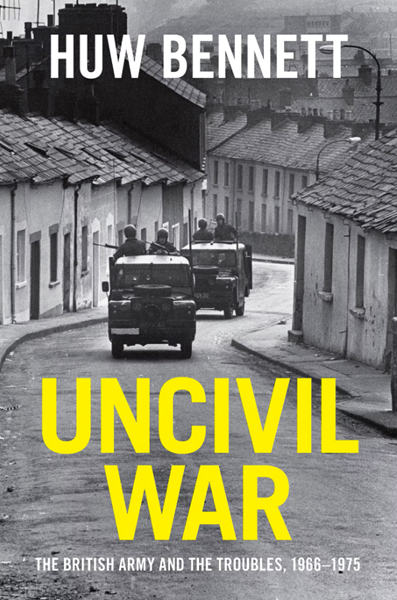
Seen from today’s perspective, the litany of campaigns Britain fought between the World Wars seems unimportant. Yet disasters such as the Jallianwala Bagh massacre in Amritsar in April 1919, and the depredations of the Auxiliaries or Black and Tans in Ireland at much the same time, imperilled imperial strategy. [Richard Dannatt & Robert Lyman’s] Victory to Defeat underlines the actions of relatively small numbers of troops which threatened to unhinge whole campaigns. It makes the perfect counterpoint to Huw Bennett’s Uncivil War, which covers the opening years of the crisis in Northern Ireland in meticulous detail.
Bennett looks at operations in Northern Ireland only up until 1975 — arguably the most intense period — with a promise of further volumes to follow. This is the first, comprehensive attempt to deal in parallel with the political aspects of the campaign as well as the purely military ones. Although densely written, Uncivil War gives a very readable account of the first of three decades of conflict which dominated the everyday life of most of the combat arms of the Army. It now seems ironic, though, that Ulster was always treated as something of a sideshow when compared with the “real soldiering” of deterring the Soviets in Germany.
Central to Bennett’s book is the debacle of “Bloody Sunday” in January 1972, when paratroopers ran amok in Londonderry at a point of the campaign when the IRA was exhausted and finding it almost impossible to recruit. Politically, there might have been a breakthrough; militarily the terrorists were teetering on collapse, but one black sheep unit and the ham-fisted response by the chain of command galvanised the IRA. With a rifle’s crack, they guaranteed bloodshed for years to come.
If ever a victory was turned into defeat in modern times, this was it. Bennett pulls no punches in pointing that out. The interesting contrast with Lyman and Dannatt’s work is that no matter how much had been learnt from the Second World War, the doctrine that emerged could only be tested by blank firing exercises in Germany. Whilst the highly unlikely possibility of a war in Europe was constantly analysed, very little strategic thinking was put into the grinding, long-term campaign in Ulster that was actually killing people.
Certainly there were political initiatives and the intelligence machinery was constantly evolving, but the many battalions and regiments who were charged with everyday deterrence and occasional attrition wandered the streets with little imagination or flair, often only seeming to provide targets for the terrorists. If war against the Soviets was remote, bombs, snipers and ambushes in Ulster were certain. By contrast, the Field Service Pocket Book (India) of 1930 laid out clear advice and principles for operations on the North-West Frontier. In Ulster, we just blundered on.
If the lessons of 1918 were neglected, those that led to victory in 1945 were carefully studied, although any coherent tactical doctrine took until the 1980s to be published. Perversely, the operations that followed both world wars were much the same: small, far-flung, post-imperial scuffles which owed little to “conventional” fighting. Indeed, it might be argued that the real lessons that the Army needed to heed after 1945 were not those of a European war, but those which might have prepared it for long years in Northern Ireland or the former colonies.
December 12, 2023
Rolling a Reliant Robin | Top Gear | BBC
Top Gear
Published 26 Nov 2010Jeremy takes the extreme sport of Reliant Robin rolling to the streets of Barnsley, aided by a string of celebrities who just happen to be on hand to help keep the fabled three-wheeler upright.
(more…)
November 28, 2023
Pierre Trudeau and Canada’s choice to become an international featherweight in the 1970s
In The Line, Jen Gerson endures a foreign policy speech from Mélanie Joly that takes her on a weird journey through some of Canada’s earlier foreign policy headscratchers … usually leading back to Justin Trudeau’s late father:
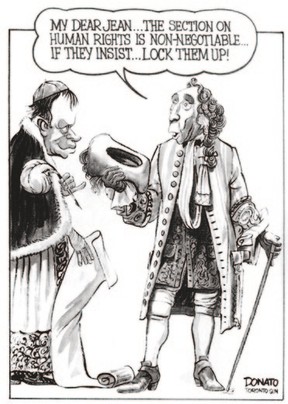
A Toronto Sun editorial cartoon by Andy Donato during Pierre Trudeau’s efforts to pass the Canadian Charter of Rights and Freedoms. You can certainly see where Justin Trudeau learned his approach to human rights.
If I saw a statue of P.E.T. on the roof of a foreign affairs building that looked like it were competing for a 10th place spot in the Eurovision tourney, I don’t know how I’d feel: embarrassed, touched, certainly too polite to say anything honest. I probably wouldn’t be so struck with awe by the sight that I’d be keen to shoehorn the anecdote into a major policy speech in front of the Economic Club.
And yet.
Joly’s speech was striking in that it could be divided into two distinct parts: The first half was a cogent and clear-eyed examination of the state of play of the world, one that acknowledged a fundamental shift in the assumptions that underpin the global order. Nothing one couldn’t glean from the Economist, but grounded nonetheless. The global order is shifting, the stakes have increased, and the world is going to be marked by growing unpredictability.
“Now more than ever, soft and hard power are important,” Joly noted, correctly, ignoring the fact that Canada increasingly has neither, and doesn’t seem to be doing much about that.
And this brings us to the second half of the speech, which was an attempt to spell out the way Canada will navigate this shift, by situating itself as both a Western ally and an honest broker: we are to defend our national interests and our values, while also engaging with entities and countries whose values and interests radically diverge from our own. “We cannot afford to close ourselves off from those with whom we do not agree,” Joly said. “I am a door opener, not a door closer.”
This was clearly intended to be analogous to the elder Trudeau’s historic policy of seeking cooperation with non-aligned countries — countries that declined to join either the Communist or the Western blocs throughout the Cold War.
[…]
If our closest allies treat us like ginger step-children as a result of our own obliviousness and uselessness, our platitude-spewing ruling class is going to seek closer relationships in darker places: in economic ties with China, and in finding international prestige via small and middling regional powers or blocs whose values and interests are, by necessity or choice, far more malleable than our own.
These cute turns of phrase are a matter of domestic salesmanship only. “Pragmatic diplomacy” is a thick lacquer on darker arts.
Which brings us back to Macedonia, again. Or North Macedonia, if you’re a stickler.
Before it declared independence in 1991, Macedonia was a republic within the Socialist Federal Republic of Yugoslavia. During much of Trudeau Sr.’s time, Yugoslavia was led by Josip Tito, a Communist revolutionary who broke with Stalin and spearheaded a movement of non-aligned countries, along with the leaders of India, Egypt, Ghana, and Indonesia. Tito was one of several despotic and authoritarian leaders with whom Trudeau Sr. sought to ingratiate himself to navigate the global order.
P.E.T.’s most ardent supporters maintain a benevolent amnesia about just how radical Trudeau Sr. was relative not only to modern standards, but to world leaders at the time.
During the 1968 election, Trudeau promised to undertake a sweeping review of Canada’s foreign affairs, including taking “a hard look” at NATO, and addressing China’s exclusion from the international community.
In 1969, America elected Richard Nixon a bombastic, controversial, and corrupt president who forced Canada examine the depth of its special relationship with its southern neighbour. At the time, this was termed “Nixon shock.” And it could only have furthered Trudeau Sr.’s skepticism of American hegemony.
It was in this environment of extraordinary uncertainty, and shifting global assumptions and alliances, that Trudeau Sr. called for a new approach to Canadian foreign policy. He wanted a Canada that saw itself as a Pacific power, more aligned to Asia (and China). Trudeau also wanted stronger relationships with Western Europe and Latin America, to serve as countervailing forces to American influence.
November 11, 2023
The Mississauga Train Derailment (1979)
The Raven’s Eye
Published 8 Nov 2022It was called “The Mississauga Miracle” — a train derailment involving 26 cars of toxic and flammable materials, just a few miles from a major Canadian city center. Faced with the prospect of a cloud of killer phosgene gas being released, authorities had no choice but to order the mass evacuation of an entire city …
(more…)
QotD: Diary entry, 11 November, 1979
I hope you’ll forgive my self-insert here, but watching the video on the Mississauga train derailment prompted me to dig up a bit of personal history related to this thankfully non-tragic event in Canadian history. This is what I wrote about the events of that week not at the time (I was far too busy living it to record anything) but a couple of months after the fact. Samuel Pepys I wasn’t. I note in passing that my memories today don’t exactly match what I wrote in early 1980, which does bring home to me the fallibility of “eyewitness” reports after the fact.
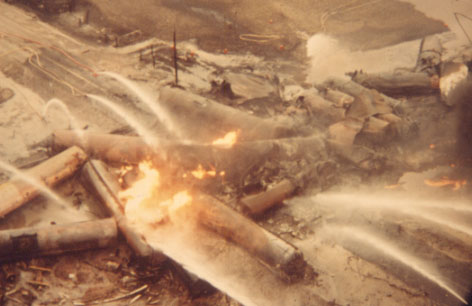
On the night of November 10, 1979, a 106-car Canadian Pacific freight train derailed at Mavis Road, north of Dundas Street. As a result of the subsequent explosion, when one of the tank cars carrying propane exploded, and because other tank cars were carrying chlorine, the decision was made to evacuate nearby residents in one of the largest peace time evacuations in history. This photo shows flames from the wreckage, with hoses pouring water on it.
Photo from the Mississauga Library System website, Identifier M466. Full gallery here.
In November of ’79, on the 11th actually, a chemical train derailed just northwest of [our apartment near Dundas and Hurontario Streets]. It spilled 16 tank cars full of propane and one full of chlorine all over the Mavis Road crossing.
I was driving back to Hamilton on Saturday night to drop off [my girlfriend]. Rockney was inexplicably along with us that night. Around midnight, I noticed the road all around us light up as though dawn had come early. Also noticed a pronounced mushroom-type cloud and lots of incident light at its base. Right there, my mind kicked into Hyperdrive and I analyzed the data, assumed the worst, and nearly swung off the highway to protect us behind an embankment. [The others] saw that it wasn’t an H- or A-type of explosion, and so we didn’t worry too much. Flames [on the eastern horizon] were easily visible from Hamilton.
I went back [to Mississauga], dropped Rockney off [and] noticed a police car blocking the intersection of Dundas and Hurontario with its lights going. Talked to Mum, who was still up, and went to bed at 3:00am.
We were woken up at 10:00am by police evacuating the building. I called Rockney and we all trooped over to his place. I stayed for 1/2 an hour, and decided to go back to the house, change into [my army reserve] uniform, and go up to Brampton for our Remembrance Day parade. On the way, I was stopped by the police and directed to go to Square One, where an evacuation centre had been set up. As I arrived there, the last bus-load of evacuees left headed for Streetsville Secondary School. I arrived there in time [to be given responsibility for security] with 15 assorted army and navy cadets [who were in uniform for their respective Remembrance Day services] who had no officer handy. We cleared the halls [at the direction of police and school authorities] and tried to maintain calm among the evacuated throng.
By 8 that evening, my force had shrunk to seven cadets led by Petty Officer Linda P. An officer cadet of the Air Reserve and five air cadets with him refused to assist me or the police. [I was angry at the time, but he was probably worried about the legal side of providing “aid to the civil power” while in uniform without permission from his chain of command. I was a junior NCO, so that thought never crossed my mind until much later.]
By this time, I had attached Chris P. [a friend of Rockney’s who was evacuated to Streetsville] and several other husky teenagers to my “security force” and we were able to keep things fairly quiet.
As people [started to realize] that they would be there all night, most of them settled down very nicely. [My team of cadets] issued blankets we’d received on a truck from CFB Downsview and shared out the available gym mats [as makeshift mattresses].
A local McDonalds sent in a “breakfast” of cold Big Macs [I’m sure they were hot going out the door, but they took a long time to get to us] — [the non-cadet members of] my security force got more than their fair share, but that was expected. Most of the media had disappeared by this time so we soon got involved in minor disputes with some irate citizens.
Sometime during Monday afternoon a Master Corporal from CFB Downsview called me to arrange a coffee run down to the [emergency crews working to contain] the fire. Nothing came of it in the end [I have no idea why they thought I’d be a useful participant, as I had no transportation other than my own car … maybe I was the only member of the military in the immediate vicinity].
Tried calling Rockney’s place [to see how my family were doing] but got no answer, same at Bill & Clive’s apartment [several miles further east of Rockney’s]. No idea where my parents have gone. [After being evacuated a second time, they’d ended up at the International Centre with the family cat and stayed there until later in the week, as I found out later. My sister hadn’t been at home so she was evacuated elsewhere with her boyfriend’s family. I have no idea where she spent the week.]
Monday night wasn’t too bad, except for [media reports] that there were 3 escaped cons in the area so i couldn’t send girls out alone on security sweeps [outside the school building]. Me, Chris P., Jordan L., and John D. were the only [ones available to do exterior security] now, getting VERY tired. Got an hour’s sleep.
On Tuesday a bunch of students from Humber College showed up. They were all taking the Law Enforcement course and wanted to help me with security. [The] only problem was that the course was 9/10ths female [so] I couldn’t use them [for exterior patrols, which is where we needed help the most].
Also showing up [later on Tuesday] was a local CB radio group who tried to take over from me and my team. It took two hours [of argument] before they gave up and went off to try to take over some other evacuation centre. [Around this time,] vandalism started on the back side of the school and in the portable classrooms. No one was caught at it, unfortunately. [I didn’t note it here, but I strongly suspected that one or more of my volunteers had done some of the damage out of boredom, but I had no proof.]
The biggest problem, however, was racial. A large group of black teenagers had taken over one of the Home Economics classrooms and had 2 competing ghetto blasters to make mucho noise. 2 fights had to be broken up in there and we had to call the police in to cope with the second fight.
[Tuesday] night was uneventful for a change. Wednesday wasn’t, as rumours of being able to go home kept hitting the people in the evacuation centre and nearly overwhelming the security teams at the doors. One asshole, a guy about 20-25 years old, kept buttonholing me and other members of my team and demanding shampoo, of all things. Eventually, someone got him some and he “went to the showers”. [In hindsight, he probably had just come down from whatever drugs he’d been on for the previous few days.]
On Wednesday night, the evacuation centre in Streetsville was shut down and everyone was moved to other facilities on Mississauga Transit buses. Most were taken to the Royal York Hotel in downtown Toronto, but my remaining team members were sent to a Holiday Inn in Scarborough. [I was in rough shape by then and someone got me to hospital to get checked out. I was there for about 10 hours before they discharged me with advice to “get plenty of rest”.]
Thursday we spent in the hotel, charging everything to CP Rail. They must have hit the roof when the bill arrived — especially the bar bill! We threw an “exhaustion party” in our room on Thursday night and on Friday we were finally allowed to go home (most of us, anyway).
When I went back to school the following week, I was given the third degree by the vice principal because the Red Cross didn’t have me listed as an evacuee. I had to get the hospital records to show that I had actually taken part before I was allowed back into class. [A similar thing happened the next unit parade night, as I’d been on TV several times in my uniform during the event and my commanding officer was quite upset about it, thinking I’d been pretending to act in some sort of official capacity, which I hadn’t been.]
October 14, 2023
Ray Manzarek – “Riders On The Storm”
EliasIak2011
Published 30 Nov 2012“The Doors: Mr. Mojo Risin’ — The Story of LA Woman“
September 18, 2023
It turns out that buying up the rights to old rock songs wasn’t a good investment after all
Ted Gioia enjoys a little bit of schadenfreude here because he was highly skeptical of the investments in the first place, although the geriatric rockers who “sold out” seem to have generally made out like bandits this time around:
Back in 2021, investors spent more than $5 billion buying the rights to old songs. Never before in history had musicians over the age of 75 received such big paydays.
I watched in amazement as artists who would never sell out actually sold out. And they made this the sale of a lifetime, like a WalMart in El Paso on Black Friday.
Bob Dylan sold out his entire song catalog ($400 million — ka-ching!). Paul Simon sold out ($250 million). Neil Young sold out ($150 million). Stevie Nicks sold out ($100 million). Dozens of others sold out.
As a result, rock songs have now entered their Madison Avenue stage of life.
Twisted Sister once sang “We’re Not Gonna Take It”. But even they took it — a very large payout, to be specific. A few months ago, the song showed up in a commercial for Discover Card.
Bob Dylan’s song “Shelter from the Storm” got turned into a theme for Airbnb. Neil Young’s “Old Man” was rejuvenated as a marketing jingle for the NFL (touting old man quarterback Tom Brady).
Fans mocked this move. Even Neil Young, now officially a grumpy old man himself, expressed irritation at the move. After all, the head of the Hipgnosis, the leading song investment fund, had promised that the rock star’s “Heart of Gold” would never get turned into “Burger of Gold”.
That hasn’t happened (yet). But where do you draw the line?
I was skeptical of these song buyouts from the start — but not just as a curmudgeonly purist. My view was much simpler. I didn’t think old songs were a good investment. […] But even I didn’t anticipate how badly these deals would turn out.
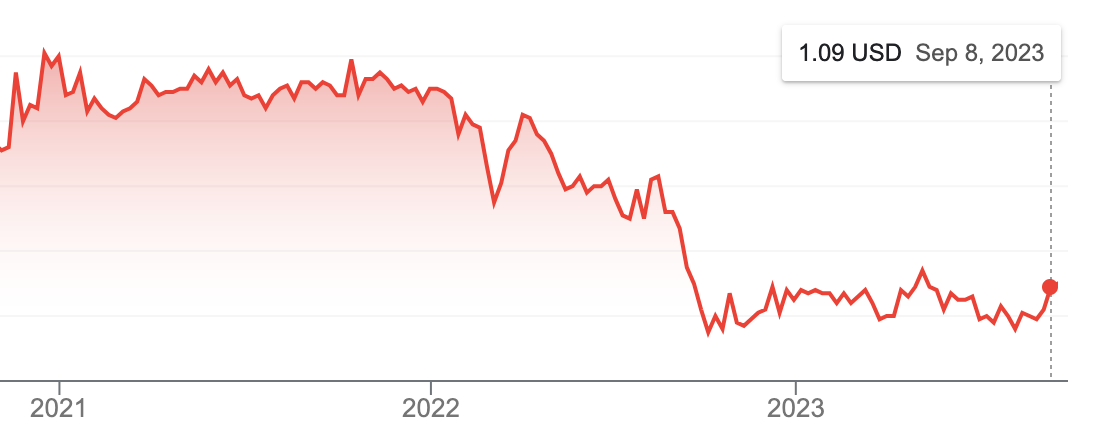
The more songs Hipgnosis bought, the more its share price dropped. The stock is currently down almost 40% from where it was at the start of 2021.
Things have gotten so bad, that the company is now selling songs.
On Thursday, Hipgnosis announced a plan to sell almost a half billion dollars of its song portfolio. They need to do this to pay down debt. That’s an ominous sign, because the songs Hipgnosis bought were supposed to generate lots of cash. Why can’t they handle their debt load with that cash flow?
But there was even worse news. Hipgnosis admitted that they sold these songs at 17.5% below their estimated “fair market value”. This added to the already widespread suspicion that current claims of song value are inflated.
September 14, 2023
QotD: Going to “the mall”
“Eh, it was dead,” you might say.
“What did you do?”
“Nothing.”
Neither was true. Every trip to the mall had a routine. You’d swing by the sausage and cheese store for samples. You’d go to the record store to leaf through the sheaves of albums, nodding at the rock gods’ pictures on the wall, content in the cocoon of your generation’s culture. Head over to Chess King to see if there was something stylish you could wear on a date, if you ever had one; saunter casually into Spencer Gifts to look at the posters in the back, snicker at the naughty gifts, marvel at some electronic thing that cast colored patterns on the wall. Then you’d find a place, maybe by the fountain in the center, and watch the world go past in that agreeably tranquilized state of mall shopping.
Dead? Hardly. Okay, maybe it was the afternoon, low traffic. No movie you really wanted to see, the same stuff in the stores you saw last week. Of course you’d go back tomorrow, because that’s what you did with your friends. You went to the mall.
A dead mall is something else today: a vast dark cavern strewn with trash, stripped of its glitter, its escalators frozen, waiting for the claws to take it apart. The internet abounds with photos taken by surreptitious spelunkers, documenting the last days of once-prosperous malls. We look at these pictures with fascination and sadness. No one said they’d last forever. But there wasn’t any reason to think they wouldn’t. Hanging out as teens, we never thought we’d outlive the mall.
James Lileks, “The Allure of Ruins”, Discourse, 2023-06-12.
September 11, 2023
Golda Meir
Michael Oren reviews Golda a new biopic on the life of Israeli Prime Minister Golda Meir:
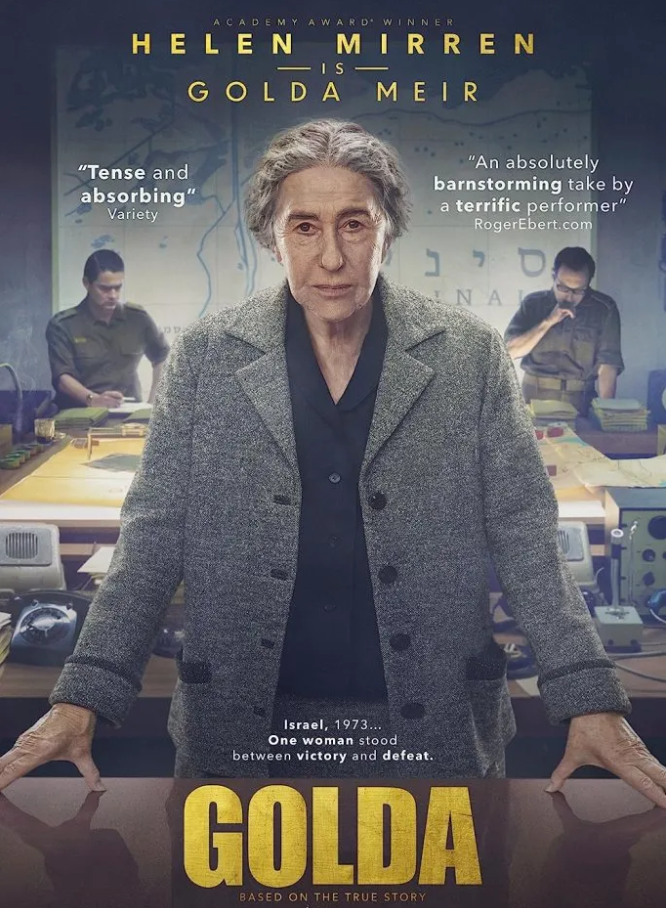
Ever since the 1970s, the entrances to many American Jewish institutions have boasted a single bust. It is not of Theodore Herzl, founder of the Zionist movement, or of Israel’s preeminent leader, David Ben-Gurion, nor even of any prominent American Jew — Justice Louis Brandeis or Rabbi Abraham Joshua Heschel. The likeness is not flattering. Beneath tightly bunned hair, the face is unsmiling, its features decidedly bland. Their owner never graduated college, wrote a transformative book, or commanded an army. Still, that statue embodies an ideal to which most American Jews aspire: at once patriotic yet open-minded, liberal but muscular, courageous and caring. The bust, moreover, is of a woman and not just any woman. With an accent as flat as the Midwestern plains, four packs of unfiltered cigarettes a day and the omnipresent purse that held them, the clunky shoes and grandmotherly attire, she was Everywoman. Yet, in a rags-to-preeminence story so appealing to Americans, that woman rose to become the prime minister of Israel. She was Golda Meir — or, as she’s still colloquially known, simply, Golda.
Until my grandmother’s death at the age of 100, she claimed that the proudest day of her life was hosting Golda for a fundraising event in her Boston home. In 1973, and again in 1974, a Gallup poll named Golda “Woman of the Year”, the only non-American ever to achieve that title, garnering twice as many votes as the runner-up, Betty Ford. Though no feminist — Ben-Gurion once called her “the only man in the government” — she became a poster-child of women’s liberation, appearing under the banner, “But Can She Type?” She served as the subject of two Broadway plays, several documentaries, and a made-for-television movie. Golda characters appear in a variety of productions, from Steven Spielberg’s Munich to season 26, episode 1 of The Simpsons. No fewer than nine English-language biographies have been written about her, in addition to her own memoir, and the recollections of her son. She was — and to a large extent, has remained — an American icon.
Not so for Israelis. For 50 years, the name Golda has been associated with reckless hubris, with humiliation and trauma and the loss of an innocent Israel that can never be retrieved. Most bitterly, the name Golda evokes the memory of the 2,656 Israeli soldiers — 83 times the number, proportionally, of Americans lost on 9/11 — killed on her watch. Israel has no end of streets and facilities named for Ben-Gurion, for Prime Ministers Levi Eshkol, Yitzhak Rabin, and Menachem Begin, but there are few Golda Meir boulevards or university halls. New York has Golda Meir Square, complete with that unprepossessing bust, but not Tel Aviv or Jerusalem. Only among Israeli children, born long after her death, does Golda elicit any excitement as the name of a popular ice-cream chain.
Now, half-a-century after her purportedly disastrous performance during the 1973 Yom Kippur War, there are attempts to revisit Golda’s legacy, to examine it in the light of recently released documents, and to reflect on the complex human being behind the bust. Spotlighting these revisions is a bold and riveting new film by Academy Award-winning director Guy Nattiv, starring the incomparable Helen Mirren. After portraying Queens Elizabeth I and II and Catherine the Great, Mirren praised her latest character “one of the most extraordinary I’ve ever played.” That estimation is more than illustrated by the movie simply titled Golda.
[…]
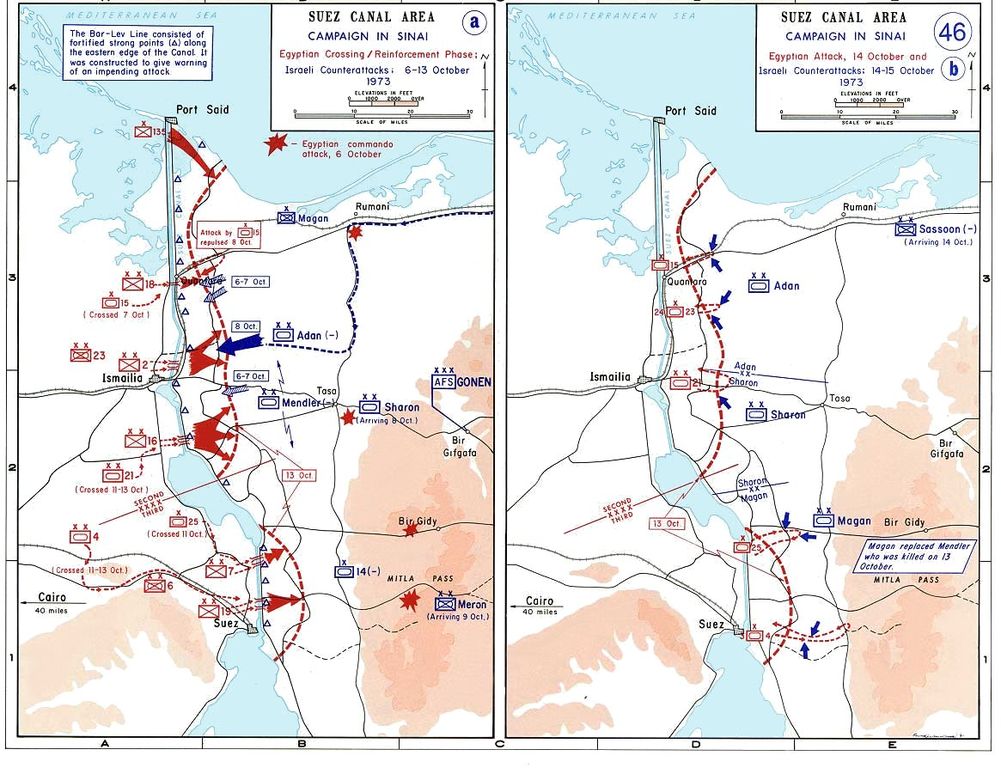
Yom Kippur War — Sinai front 6-15 October, 1973. (via Wikipedia)
Golda Meir remained in her post for another eight months while the people of Israel seethed. Though the Agranat Commission accepted her claim that she acted solely on the defense establishment’s advice and cleared her of any personal responsibility for the war, the population resented the blame placed almost solely on the army. The country, devastated emotionally and economically, was further traumatized by terrorist attacks that killed 52 civilians and wounded 150. Later that year, terrorist leader Yasser Arafat, a holster on his hip, received a standing ovation from the UN General Assembly, which went on to equate Zionism with racism. Succumbing to Arab pressure, 24 of the African countries with which Golda helped establish relations cut ties with Israel. In 1977, the degraded Mapai Party for the first time lost an election to Menachem Begin’s Likud, ending what many Israelis still regard as the state’s golden age.
Such painful events are barely touched upon in either of the Golda films, which prefer to conclude her story with Sadat’s historic visit to Israel in November 1977. The subsequent peace process resulted in the signing of the Egyptian-Israeli peace treaty in 1979, a year after Golda’s death.
Yet her legacy endures — especially now, on the 50th anniversary of the war. Though her standing remains highest in the United States — the Israel National Library reports more searches for her name in English than in Hebrew—in Israel, too, her record is being reconsidered. Here was a woman without military experience who had to rely on men whose expertise on military matters was above reproach. Here was a woman who, when many of those men buckled to pressure, remained clear-headed and strong. And here was a woman who, contrary to long-held wisdoms, repeatedly held out her hand for peace.
Some critics have been unkind to Golda. They take issue with the film’s concentration on her career’s least illustrious period and with the allegedly one-dimensional depiction of a personality known to be compassionate one minute but backbiting the next, alternately maternal and coarse. Most expressed discomfort with the director’s obsession with Golda’s cigarettes — they are practically actors — which earned the film a PG-13 rating for “pervasive smoking”. I, for one, would have liked to see more of Golda’s insecurities about her lack of higher education, military experience, and Hebrew eloquence. I would have welcomed more of the swift-witted Golda who once quipped to Kissinger, arriving in Tel Aviv after exchanging kisses with Egyptian and Syrian leaders, “Why, Mr. Secretary, I didn’t know that you kissed girls, too!”
Nevertheless, Golda must take its place alongside other outstanding portraits of leaders in crisis. Like Gary Oldman’s Churchill in Darkest Hour and Bruce Greenwood’s Kennedy in Thirteen Days, Helen Mirren’s Golda Meir offers a profile of greatness in the face of overwhelming adversity. These are films that, rather than merely report and redramatize facts, show us character. And Golda — the woman, not the myth — should continue to generate our interest as well as our respect. The Everywoman behind the bust should still be revered.
August 28, 2023
The Last Chance | Dorktown
Secret Base
Published 15 Aug 2023The Minnesota Vikings of the 1970s were among the greatest football teams ever assembled. Entering 1974, Bud Grant’s teams had reached two Super Bowls, but lost them both. The good times don’t last forever. It’s time to cash in.
Written and directed by Jon Bois
Written and produced by Alex Rubenstein
Rights specialist Lindley Sico
Secret Base executive producers Will Buikema and Jon BoisKnown goofs:
• At about the 42-minute mark, Jon says Fran Tarkenton held a 45-8-1 record as starter between 1973 and 1976. His record across these years was actually 43-10-1.
(more…)
August 21, 2023
What the parades are for | Dorktown
Secret Base
Published 8 Aug 2023This is the second episode of our seven-part docuseries, The History Of The Minnesota Vikings.
For the Vikings, the 1970s were so full of comedy, drama, and doomed snowmobiling expeditions that we had to split this decade into two episodes. And we STILL had to leave stuff out! What a team.
(more…)
August 11, 2023
Toward a more perfect Homo Sovieticus
Ed West on the interplay between Soviet ideology and Soviet humour during the Cold War:
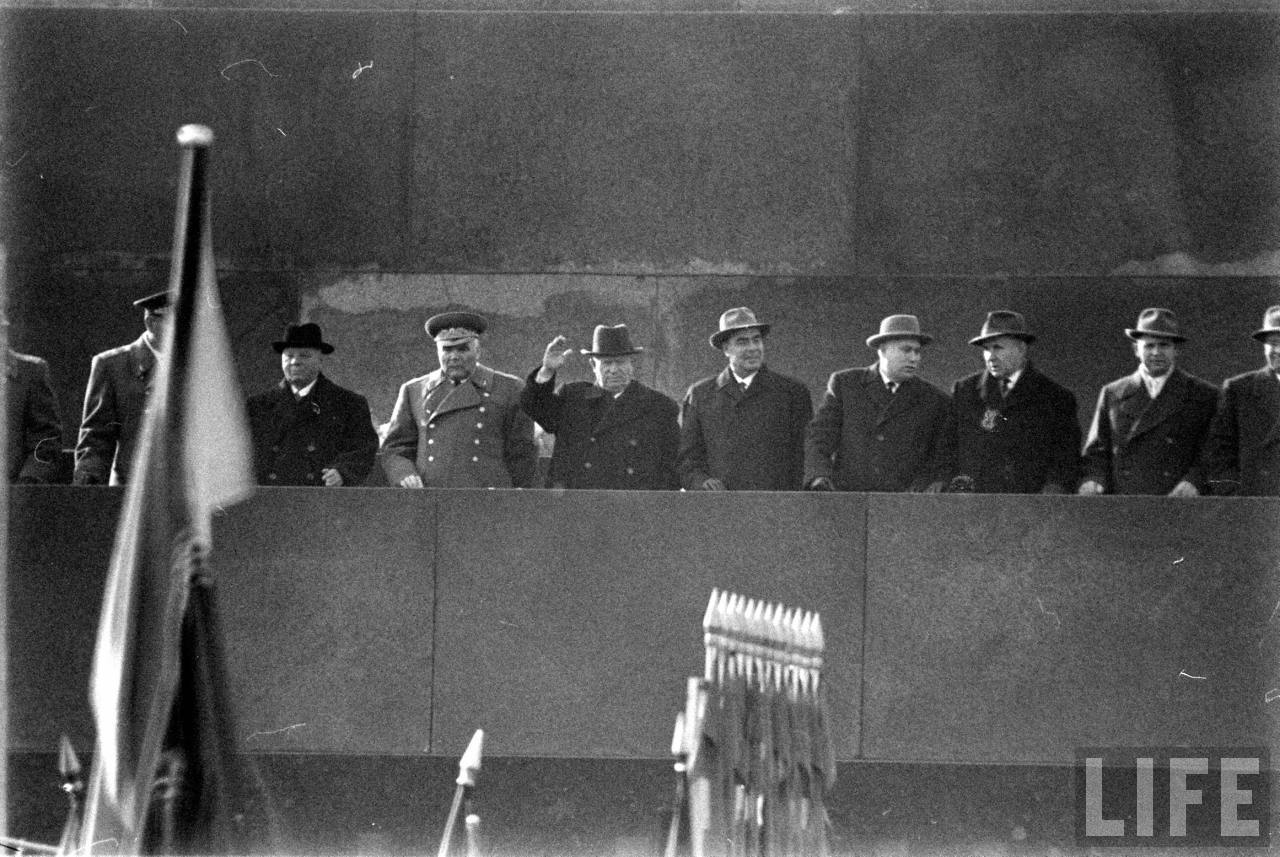
Krushchev, Brezhnev and other Soviet leaders review the Revolution parade in Red Square, 1962.
LIFE magazine photo by Stan Wayman.
Revolutions go through stages, becoming more violent and extreme, but also less anarchic and more authoritarian. Eventually the revolutionaries mellow, and grow dull. Once in power they become more conservative, almost by definition, and more wedded to a set of sacred beliefs, with the jails soon filling up with people daring to question them.
The Soviet system was based on the idea that humans could be perfected, and because of this they even rejected Mendelian genetics and promoted the scientific fraud Trofim Lysenko; he had hundreds of scientists sent to the Gulag for refusing to conform to scientific orthodoxy. Lysensko once wrote that: “In order to obtain a certain result, you must want to obtain precisely that result; if you want to obtain a certain result, you will obtain it … I need only such people as will obtain the results I need.”
Thanks in part to this scientific socialism, harvests repeatedly failed or disappointed, and in the 1950s they were still smaller than before the war, with livestock counts lower than in 1926.
“What will the harvest of 1964 be like?” the joke went: “Average – worse than 1963 but better than 1965”.
The Russians responded to their brutal and absurd system with a flourishing culture of humour, as Ben Lewis wrote in Hammer and Tickle, but after the death of Stalin the regime grew less oppressive. From 1961, the KGB were instructed not to arrest people for anti-communist activity but instead to have “conversations” with them, so their “wrong evaluations of Soviet society” could be corrected.
Instead, the communists encouraged “positive satire” – jokes that celebrated the Revolution, or that made fun of rustic stupidity. “An old peasant woman is visiting Moscow Zoo, when she sets eyes on a camel for the first time. ‘Oh my God,’ she says, ‘look what the Bolsheviks have done to that horse’.” The approved jokes blamed bad manufacturing on lazy workers, while the underground and popular ones blamed the economic system itself. This official satire was of course nothing of the sort, making fun of the old order and the foolish hicks who still didn’t embrace the Revolution and the future.
Communists likewise set up anti-western “satirical” magazines in Poland, East Germany, Czechoslovakia and Hungary, where the same form of pseudo-satire could mock the once powerful and say nothing about those now in control.
Indeed in 1956, the East German Central Committee declared that the construction of socialism could “never be a subject for comedy or ridicule” but “the most urgent task of satire in our time is to give Capitalism a defeat without precedent”. That meant exposing “backward thinking … holding on to old ideologies”.
[…]
Leonid Brezhnev had a stroke in 1974 and another in 1976, becoming an empty shell and inspiring the gag: “The government of the Union of Soviet Socialist Republics has announced with great regret that, following a long illness and without regaining consciousness, the General Secretary of the Central Committee of the Communist Party and the President of the highest Soviet, Comrade Leonid Brezhnev, has resumed his government duties.”
Brezhnev was an absurd figure, presiding over a system few still believed in. His jacket was filled with medals – he had 260 awards by the time of his death – and when told that people were joking he was having chest expansion surgery to make room for all the medals he’d awarded himself, he apparently replied: “If they are telling jokes about me, it means they love me.”
July 28, 2023
QotD: “Stakeholder” Capitalism
Of course, nobody participating in the push to replace shareholder capitalism with stakeholder capitalism would describe it this way. But then, euphemism and branding are each crucial tools in the Marxist’s verbal toolbox. So when you ask a stakeholder capitalist to describe stakeholder capitalism, what you ordinarily hear is that, as a business ethic, it combines the “sustainability” shareholder capitalism supposedly lacks with the “inclusivity” we’re not supposed to recognize is merely stultifying, policed conformity, the yield being a Woke capitalism that replaces production and consumption with “sharing and caring,” taking it out of the realm of the invisible and mechanical, as Adam Smith would have it, and placing it into the realm of values, where it can be used to shape the Greater Good the Marxist pretends he cares about. It’s fascism with a smiley face.
In the stakeholder capitalist system, investors aren’t — or at least, they shouldn’t be — solely interested in profits driven by production and consumption. And this is because to the stakeholder capitalist, itself a euphemism for collectivist corporatist, “it is well proven that our current form of Capitalism is inherently unsustainable because it requires endless growth on a planet with finite resources.”
Of course, none of this is “well proven” — the history of shareholder capitalism suggests the opposite, in fact, as innovation has led to the production of more and more out of less and less — but whether this is or isn’t the material case is incidental to those who are working on this inorganic worldwide paradigm shift commonly known as The Great Reset.
Because the move toward a “caring and sharing” worldwide economy, especially one that we’re told will be both sustainable and inclusive, requires those who care, those who share, and — most importantly, and at the very heart of the turn — those who get to determine what is cared about, who must do the sharing, and how most effectively to police the excesses that the ruling elite determine aren’t sustainable, while slowly dissolving the idea of the individual and his will to make way for an inclusive collective required to run the machinery of the self-installed Elect. It’s a global system of neo-Feudalism dressed in the finery of familiar values that have been deconstructed and re-signified, often without their consumers even aware that the values they reference — which were once commonly understood and largely shared by the civil society — are now their precise inverse: “tolerance”, thus, becomes the violent rejection of intolerance, as they define it; free speech is separated from “hate speech”, as they adjudicate it; individualism is but a controlling fiction maintained by the white male power structure that must be replaced by an ordered and value-determined collection of identity markers that construct you, while simultaneously acknowledging that there is no “you” beyond this assembly of discourses that assign your being its social situatedness, then places you within a collective of those with similar — though never identical — constructions. Once here, you are graded on the intersectional scale. Your relative worth and power come down to not to the content of your character, but rather to the collection and arrangement of your victimization tokens.
Jeff Goldstein, “Maybe I’ll be there to shake your hand, maybe I’ll be there to stakeholder capitalist the land”, protein wisdom reborn!, 2023-04-26.


