
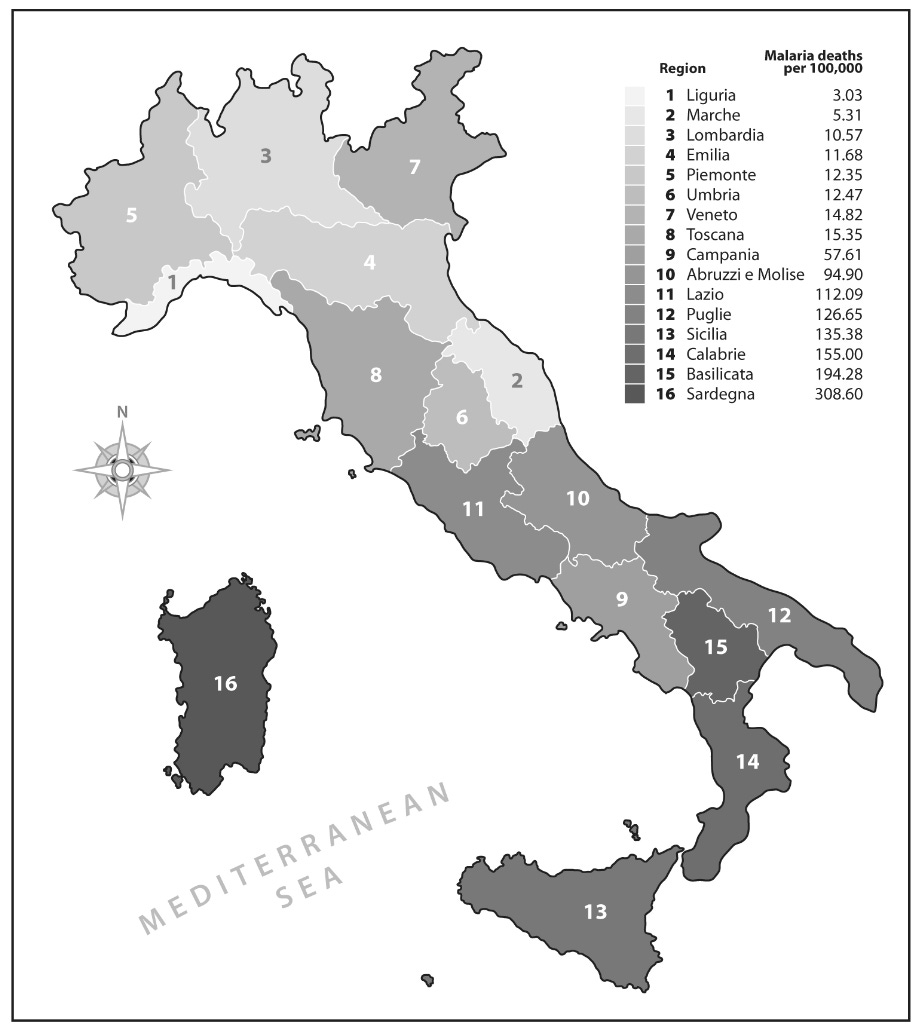
Fun fact: the division between wealthy, industrialized northern Italy and low human capital, fast life history, amoral familist southern Italy lines up almost perfectly with the natural range of Plasmodium falciparum, the protozoan that causes the most virulent and deadly form of malaria.
A virtually identical pair of maps appear in The WEIRDest People in the World (which I reviewed here), only they’re measuring cousin marriage and blood donations.
In retrospect, reading this book while visiting a particularly wet part of the country during a particularly wet summer may not have been the best call I’ve ever made. Yes, I am rationally aware that, thanks to the sterling efforts of the Tennessee Valley Authority, the Boy Scouts of America, and the Malaria Control in War Areas program among others, American mosquitoes have been a nuisance rather than a danger for seventy-five years. Yes, I know that even if I positively identify the mosquito that’s currently sucking my blood as Aedes aegypti, the “yellow fever mosquito”, I’m not actually going to get yellow fever. And yet I spent a solid week having a knee-jerk oh no we’re all going to die every time I heard the telltale whine in my ear.
But weirdly, it was only the mosquitoes. There I was, immersed in a history of infectious disease and therefore poised to overreact to any reminder of the myriad ailments that have plagued humanity for the last several million years, and only the insect vector of a few mostly-eradicated diseases was even around to prompt a case of second year syndrome. I didn’t run into dirty water, or suspicious meat, or visible sores, or coughing or sneezing or fever — not even a rat or a louse or a fly.1 That’s pretty incredible! Here are all these things that used to leave our ancestors weak or sick or dead, and we’ve learned to control them so well that a few years ago societies worldwide shut down over a virus whose fatality rate is a rounding error compared to the fevers and fluxes of the past. In fact we’re so good at controlling infectious disease that it’s often not even on our radar, and that makes it very hard to really wrap our heads around what life was like in the past — which is surely one of the goals of studying history. So thank goodness for Kyle Harper.
Harper is an eminent ancient historian and the author of several books on the late Roman Empire. In the most recent of them,2 the excellent The Fate of Rome: Climate, Disease, and the End of an Empire, he argues that exogenous shocks like the end of the Roman Climate Optimum and three dramatic plagues (Antonine, Cyprianic, and Justinianic) played major roles in destabilizing the Western Empire — if they hadn’t, we might well talk about the “Crisis of the Fifth Century” instead of the Fall of Rome. Here, probably inspired by his research on the role of infectious disease, he widens his scope to take in the vast sweep of humanity’s interactions with the many, many, many organisms that can make us sick. How many? Well, it depends who you ask and how you count:
One standard and often cited catalog of human pathogens includes 1,415 species. A more recent and systematic survey identified 1,611. Oddly enough, there is only about 60 percent overlap between these lists, so the number of unique pathogens identified between them is 2,107. Yet the Global Infectious Diseases and Epidemiology Online Network (GIDEON), a standard database of infectious diseases created for clinicians, lists 1,988 bacteria alone that have been found to infect humans. More than one thousand of these are not in either of the other lists …
This isn’t (mostly) the triumphal tale of mankind’s glorious victory over disease, though the final chapters do have something of that flavor; rather, it’s a thoughtful and richly detailed analysis of all the ways infectious disease has shaped human history. And yes, the second half gives you all the familiar beats, the charismatic megafauna (microfauna?) of epidemiology (bubonic plague, smallpox, HIV) though the stories are told well and updated with aDNA evidence since the last time I read a big “here’s all the stuff that used to kill people” book,3 but to my mind the really good stuff comes in the first half.
When we think about disease, we tend to think about the plagues of civilization, the kind of big, headline-making diseases that do things like burn through an unexposed population in the space of weeks or months, or empty out cities as people flee to the countryside (and bring their germs with them). Even the slower-acting of the “famous” diseases get short shrift, despite the fact that over the course of human history tuberculosis has killed more people than smallpox. On one level this makes sense: these are big dramatic events, a whole ton of people dying all at once has a visible and enormous impact on your society, and if we’re looking to disease for an explanation of How The World Got This Way then epidemics are obvious inflection points. (Also, these diseases played an outsized role in the success of European colonialism in the New World, with which guilty white liberals are fascinated — but you could tell an equally compelling story about the role of tropical diseases in stymying colonial expansion into Africa, as indeed Harper does.)
But they are, as I said, the plagues of civilization — all those exciting, dramatic diseases can only sustain themselves among dense human populations enabled by the spread of agriculture and the state. If we focus on them too much, in other words, we’ll ignore the disease burden of our hunter-gatherer ancestors, which the standard narrative wildly understates.
We know that many contemporary hunter-gatherers are riddled with parasites and bacterial infections, and that while their disease burden seems to be lower than that of agricultural societies, it’s still way higher than for our closest relatives. (One metastudy estimated that infectious disease accounts for 54% of chimpanzee deaths but 72% of hunter-gatherer deaths.) And many of these pathogens go way back. The clade of schistosomiasis that infects humans, for example, branched off in Africa several hundred thousand years ago and may actually predate our species. Whipworms and hookworms migrated with us in the Pleistocene. Vector-borne diseases — especially those transmitted by mosquitoes — can sustain a chain of transmission even among widely-dispersed populations, especially when they can establish chronic infection: P. vivax, the relatively less deadly form of malaria, dates back at least 70,000 years and possible as much as 250,000, and the nematode that causes lymphatic filariasis emerged in Southeast Asia about 50,000 years ago. Forget the popular image of “primal communities” living in harmony with nature only to be interrupted by agriculture’s zoonotic “crowd diseases”: our hunter-gatherer ancestors were plagued with hideous afflictions we modern Westerners can hardly imagine.
Oh, and it also turns out that rather than bovine tuberculosis spreading to humans after we domesticated cows, we actually gave it to them. Twice.4 Also to chimps and dolphins. In fact, the human-adapted strain seems to be ancestral to all the animal strains of TB.5 Whoops.
After the rise of agriculture nothing in this book really upends the broad strokes of the traditional story, but Harper does interestingly complicate everything and suggests plenty of ecological factors that might shed light on the differing courses of human societies. Read it this winter, before the mosquitoes come back.
Jane Psmith, “BRIEFLY NOTED: Further Arguments Against Jared Diamond”, Mr. and Mrs. Psmith’s Bookshelf, 2025-11-03.
- This was obviously summer privilege, there is now plenty of coughing and sneezing in my house.
- Also the only one I’ve read.
- For some reason Harper insists on referring to “tree thinking” in place of phylogenetics and using “time travel” for paleogenomics, but he relies heavily on both.
- Taurine and zebu cattle were domesticated and infected separately.
- The strain of tuberculosis found in the Americas before 1492 is descended from a strain usually found in seals, who presumably got it from other aquatic mammals, who got it from humans in the Old World. The Columbian Exchange, but for whales.
November 14, 2026
QotD: Plagues Upon the Earth
No Comments »
No comments yet.
RSS feed for comments on this post. TrackBack URL


