I have been accused of disliking college students. Guilty as charged. I regard them the way I do the Diversity. I like certain individuals just fine, but as a whole, when it comes to interacting with them as a group, I’m Bartleby the Scrivener: “I would prefer not to”.
Which is an odd position for someone who spent as long as I did toiling in the groves of academe to take, I realize. So let me explain: As with the Vibrancy, I dislike their behavior – intensely. But I don’t blame them for acting that way. If you want to know what’s wrong with our entire Postmodern, homo economicus way of looking at the world, there you go. I don’t blame them, because they have every rational incentive to behave that way, and none not to (indeed, acting other than they do comes with a considerable cost).
College kids don’t read, don’t study, don’t do anything other than attempt, insofar as possible, to regurgitate lectures word-for-word on the “exam”, after which they promptly forget everything. Once more, with feeling: I do not blame them for this, since pretty much everything they “learn” is so worthless, it’s antimatter education. I’m not joking when I say it’s all just Social Justice Mad Libs: “The [group] was oppressed by Whitey through [adjective] [adjective] [noun], and that’s why Pale Penis People are evil.”
For example, I taught for a few semesters at a college that tried very hard to run “African-American” versions of core classes as a marketing stunt. There was “US History to 1865”, for example, and, in parallel, “African-American History to 1865.” Leaving aside the fact that you could cover the whole fucking course in about five minutes – “there sure was a lot of slavery back then!” – even the faculty, all of whom were of course raving SJWs, laughed at the sheer pointlessness of it. “US to 1865” was already nothing but “Negroes and Lesbians save the Republic!”, or vice versa, depending on whether or not the prof teaching the course this semester was the Angry Black Feminist Marxist, or the Angry Marxist Feminist Lesbian.
Severian, “College Kids”, Rotten Chestnuts, 2020-12-12.
September 30, 2023
September 29, 2023
Canada is back on the world stage … the world comedy stage
Tristin Hopper lauds Prime Minister Justin Trudeau’s most unmistakable success in raising Canada’s profile among comedians, satirists, and parodists:
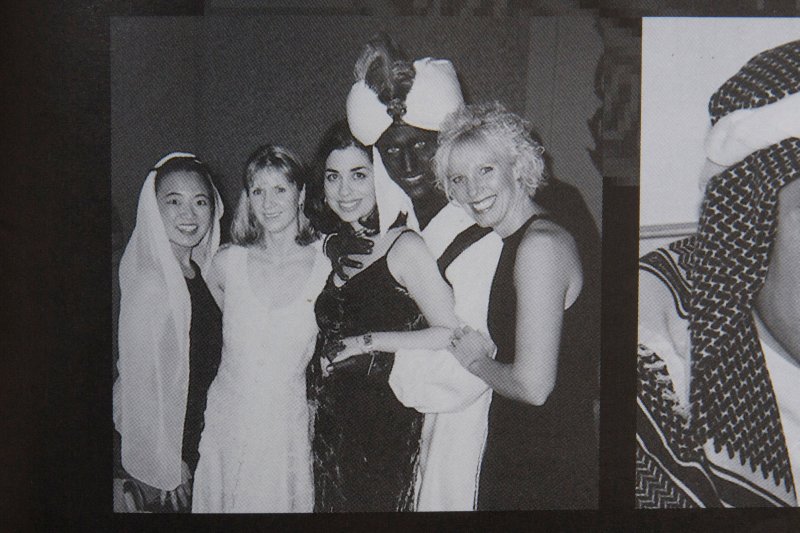
Justin Trudeau with dark makeup on his face, neck and hands at a 2001 “Arabian Nights”-themed party at the West Point Grey Academy, the private school where he taught.
Photo from the West Point Grey Academy yearbook, via Time
For most of Canadian history, it was a given that the identity and reputation of the country’s prime minister was unknown to the world’s non-Canadian satirists. There are no Mort Sahl routines about John Diefenbaker or Peter Sellers impersonations of Lester Pearson — and the one time Saturday Night Live parodied a Canadian prime minister, it was Canadian cast member Mike Myers doing Jean Chrétien.
But that’s all changed under the incumbent Trudeau government. Foreign comedians (even those addressing mostly foreign audiences) are routinely getting laughs out of jokes about Canadian politics.
At the beginning of Justin Trudeau’s premiership in 2015, his high international profile spurred the occasional foreign joke about his unusually good looks or perceived arrogance.
At the 2016 White House Press Correspondent’s Dinner, U.S. President Barack Obama cracked a joke about being told that the new Canadian prime minister had replaced him as the world’s progressive darling. “I said Justin, just give it a rest,” he said.
[…]
South African-born Daily Show host Trevor Noah has done Trudeau-specific segments on the show about half-a-dozen times, and even included an entire Trudeau monologue in his 2022 comedy special I Wish You Would.
“My favourite Trudeau scandal by far is where he went on a trip to India and then became Indian,” Noah said.
In a 2019 Daily Show segment about Trudeau’s blackface scandals, Noah noted the “commitment” of Trudeau having applied black makeup to his face, legs and even arms in one instance. “The whole day were you leaving makeup on doorknobs? … If he touched (other white people) he’d leave a black handprint on them?”
[…]
Just last year, another New York-based Comedy Cellar regular, Andrew Schulz, devoted an entire five minutes to roasting the Canadian prime minister at a show in Canada — yielding a video that’s now pushing two million views on YouTube.
“Yo Punjabis, be honest; when Trudeau did the Punjabi-face, what was more offensive? That he put on the turban or that he made y’all dark skinned?” said Schulz, before launching into a string of jokes about Trudeau’s recent put-down of the Freedom Convoy protests — and the popular rumour that he’s the secret love child of a certain Caribbean dictator.
“His dad would be so embarrassed … because Fidel Castro was all about protest.”
WW2 Jet Engine Development
World War Two
Published 28 Sep 2023Jet planes and jet engine technology revolutionized air travel, as we are all well aware. However, the development of jet planes during WW2 was fraught with all sorts of obstacles and hurdles. Let’s take a look at it.
(more…)
Bored? Lonely? No girlfriend? Mister, you want an AI Girlfriend!
As discussed earlier, GenZ men live in a sexual hellscape unless they meet statistically unlikely criteria. Many of them turn to alternatives like online gaming and porn … but some are apparently paying for AI Girlfriends:

Apparently ads for AI girlfriends have been all over TikTok, Instagram and Facebook lately. Replika, an AI chatbot originally offering mental health help and emotional support, now runs ads for spicy selfies and hot role play. Eva AI invites users to create their dream companion, while Dream Girlfriend promises a girl that exceeds your wildest desires. The app Intimate even offers hyper-realistic voice calls with your virtual partner.
This might seem niche and weird but it’s a fast growing market. All kinds of startups are releasing romantic chatbots capable of having explicit conversations and sending sexual photos. Meanwhile, Replika alone has already been downloaded more than 20 million times. And even just one Snapchat influencer, Caryn Marjorie, makes $100,000 a week by charging users $1 a minute to chat with the AI version of herself.
Of course most people are talking about what this means for men, given they make up the vast majority of users. Many worry about a worsening loneliness crisis, a further decline in sex rates, and ultimately the emergence of “a new generation of incels” who depend on and even verbally abuse their virtual girlfriends. Which is all very concerning. But I wonder, if AI girlfriends really do become as pervasive as online porn, what this will mean for girls and young women? Who feel they need to compete with this?
Most obvious to me is the ramping up of already unrealistic beauty standards. I know conservatives often get frustrated with feminists calling everything unattainable, and I agree they can go too far — but still, it’s hard to deny that the pressure to look perfect today is unlike anything we’ve ever seen before. And I don’t think that’s necessarily pressure from men but I do very much think it’s pressure from a network of profit-driven industries that take what men like and mangle it into an impossible ideal. Until the pressure isn’t just to be pretty but filtered, edited and surgically enhanced to perfection. Until the most lusted after women in our culture look like virtual avatars. And until even the most beautiful among us start to be seen as average.
History-Makers: Plato
Overly Sarcastic Productions
Published 9 Jun 2023For the best experience, project this video onto the wall of a cave.
SOURCES & Further Reading:
Five Dialogues by Plato, translation and introduction by G.M.A. Grube – Introductory Readings in Ancient Greek and Roman Philosophy, Second Edition, edited by C.D.C. Reeve and Patrick Lee Miller – Plato Vol I: Euthyphro Apology Crito and Phaedo from Loeb Classical Library, Edited and Translated by Chris Emlyn-Jones and William Preddy. Stanford Encyclopedia of Philosophy: Plato https://plato.stanford.edu/entries/pl…
I also have a degree in Classical Studies, specifically in “Classics and Philosophy”
(more…)
QotD: Collecting jazz
And there were some things I just didn’t get. Ornette Coleman was one. At the same time Miles Davis was breaking through with modal jazz forms, Coleman invented free jazz with The Shape Of Jazz To Come. Over half a century after the event it is difficult to recapture the shock that greeted the arrival of this record, but it just gave me a headache. Coleman played a white plastic saxophone that looked like a toy, he dressed like a spiv and was a master of the one-liner, the “Zen Zinger” (stuff like, “When the band is playing with the drummer, it’s rock’n’roll, but when the drummer is playing with the band, it’s jazz”), so I really wanted to like his music. But I couldn’t. No matter how much I tried. As far as I was concerned he was improvising up his own sphincter.
Dylan Jones, “The 100 best jazz albums you need in your collection”, GQ, 2019-08-25.
September 28, 2023
North Korea’s special train for “Dear Leader”
In The Critic, Peter Caddick-Adams discusses the North Korean leader’s special train, used to transport Kim Jong Un to destinations within North Korea and further afield to Russia, China, and other rail-accessible destinations:

North Korean leader Kim Jong Un’s private train in China in 2010.
It was pulled by two heavy locomotives. Next an armoured anti-aircraft wagon. After the baggage car came the leader’s steel-plated Pullman, followed by a command coach containing a conference room and communications centre. Connected to them, the 22-man security detail travelled in their own rolling stock. Beyond was a dining car, two coaches for guests, and of all things a bathing wagon, then a second dining car. Bringing up the rear were two sleeping cars, a press wagon for the news hounds, another baggage car and finally another anti-aircraft wagon. The coachwork was of the finest materials, hardwoods and high-grade leather, armour-plated, and bristling with guns and radio antennae. Outside in all weathers, day and night, other protective guards swept along the tracks.
There was something charmingly old fashioned about the decision of Kim Jong Un, leader of North Korea, to travel by train to meet his fellow dictator, Vladimir Putin. Over here, even when buffered by a railcard, Network Rail can sometimes fail spectacularly as an ambassador for this effortless mode of transport. Yet, we forget how important journeying by train was and remains. Important figures frequently opt for the smooth clickety-clack over air or road for their expeditions. The method is discreet, away from prying eyes, yet connected to a nationwide network that avoids congestion. Passengers can wine and dine, sleep, relax, study, converse and think. Rail lines are easy to guard, whereas the boulevards are full of threatening traffic and potential ambush points. Franz Ferdinand, Reinhard Heydrich, Charles de Gaulle and John F. Kennedy found this out to their cost between 1914 and 1963. Fatally in three out of four cases.
Some leaders have a phobia about flying. Stalin was one, which was why the only summit meetings he attended, at Tehran, Yalta and Potsdam, were ones connected to Moscow by rail. Perhaps President Putin, a known fancier of custom-built rolling stock, will now fear a weird kind of Karma for having arranged the eternal flight of his former chef, Yevgeny Prigozhin. The president has several trains, each containing an identical office to those in his state dacha, the Kremlin and St Petersburg. All look the name, making it impossible for the viewer, and potential assassin, to know where he is. Maybe his long-distance travel plans will be dictated by iron roads from now on?
[…]
The North Korean’s father, Kim Jong Il, hated taking to the air, instead relying on his old green-and-yellow-liveried rolling stock to convey him around his hermit kingdom. Loaded with extravagant foods, fine wines and attended by glamorous staff, the elder Kim used it on the last state visit of a North Korean to Russia in 2002. “It was possible to order any dish of Russian, Chinese, Korean, Japanese or French cuisine,” remembered one journalist. “Live lobsters were taken to stations along the route, with cases of Bordeaux and Burgundy”. However, the size, opulence and weight of this upmarket rolling McDonald’s restricted its speed to a graceful 40mph. Kim Senior’s Great Continental Railway Journey took one month. Michael Portillo, eat your heart out.
Paranoid about their personal security, the Kim family have traditionally relied on around 90 special carriages, usually made into three trains. The first handles advance security; the next carries the Kim entourage; whilst the last houses bodyguards and other personnel. The middle train, with its wall-mounted lighting, beds, sofas and armchairs reupholstered in “tasteful” reddish-pink leather (I know), was the one in which the current Kim lounged on his way to summits in Beijing and Hanoi, and travelled south in 2019 to meet President Trump in the Korean Demilitarised Zone.
The recent state visit of Kim aboard the twenty-hour Pyongyang to Vladivostok Express, no stops, should give us pause for thought. With him travelled officials closely connected with his weapons development and military science teams, and his younger sister, Kim Yo Jong. In addition to being the regime’s propagandist-in-chief, she acts as gatekeeper to her overweight, chain-smoking brother, who became leader after the sudden death of their father in 2011. Kim’s North Korean Night Mail carried a significant assembly of his regime’s inner circle.
Gaulois Palm Pistol
Forgotten Weapons
Published 23 Nov 2014The Gaulois (Gallic) was a compact squeeze-type palm pistol made by the Manufrance concern in St. Etienne in the 1890s. It held 5 rounds of 8mm ammunition (similar to the .32 Extra-Short used in other types of palm pistols) and was fired by squeezing the rear grip into the body of the gun.
As with the other weapons of this type that achieved some popularity in the 1880s through early 1900s, the Gaulois eventually faded from the market because of the improvements in conventional handguns. Something like a compact Iver Johnson revolver offered all the capabilities (if not more) of a Chicago Protector or My Friend or Gaulois, without the loading and aiming difficulties of those designs.
(more…)
QotD: “Tenure Track” positions in an American university
A tenure-track position begins with a national (or international) search and a fairly long hiring process (from job-posting to job-offer usually takes around 6-8 months). A newly hired professor is an assistant professor, which means they are on the tenure track but do not yet have tenure. Instead, after about five to six years, they’ll go up for tenure review, where a committee of faculty in their department along with some external reviewers will look at all of the work the professor has done since their appointment and either recommend them for tenure or not; the university leadership structure typically has a role in confirming a grant of tenure but this is generally a rubber-stamp role. By far the most important part of tenure review at large universities is research; this is the part of the system that is “publish or perish”.1 Untenured tenure-track faculty (so, assistant professors) represent roughly 9% of all faculty members in the United States, according to the AAUP.
A professor that passes tenure review becomes an associate professor, which confers tenure (making it difficult to fire them) as well as a bump in pay. After another few years, they can go up for review again for promotion to the next rank, simply professor (often termed “full professor” for clarity), which comes with another bump in pay. This second transition is different from the first though; whereas the review from assistant to associate professor is an “up or out” moment (you either get tenure and stay or get rejected for tenure and leave the department), some professors can and do remain associate professors forever. Finally, a handful of professors who really distinguish themselves may wind up with an endowed chair and we tend to call these folks distinguished professors, though their actual job title will usually be something like “the so-and-so Professor/Chair of this-and-that” where the ‘so-and-so’ is the name of the donor that endowed the money being used for the distinguished professorship. Tenured professors represent roughly 24% of all university professors according to the AAUP, meaning that the total slice of tenured or tenure-eligable professors in higher education is just 33% – one third.
Let me say that again: only one third of all faculty work the way all of you think all faculty works. Just one third. This is a big part of what I mean when I say that the United States’ university system is being pillaged without the public knowing; if you told most people “only one third of college instructors are actually professors, most of your little Johnny’s classes are taught by non-professors now“, they’d be shocked! But that’s the current situation.2
Tenure-track professors generally teach a fixed course-load, expressed in most cases as a load over semesters, so a “2/2” (pronounced “two-two”) load is four courses a year (two in each semester). Tenure-track faculties at research-focused universities (which are all of the flagship state schools) generally teach a 2/2 load; mixed research/teaching schools (your third-string state schools and less well-funded private schools) often have 3/3 loads. Teaching-focused institutions may have 4/4 or 5/5 teaching loads (or more) and of course fractional loads (like a 2/3, etc.) do exist, but are less common.
In addition to teaching, tenure-track faculty are expected to publish research and do “service”. We’ll talk in another post more about these demands (indeed, we’ve talked about research already), but they deserve a few words here. The amount of research demanded varies by the level of institution; at an R1 the general expectation for a faculty member going for tenure in a humanities department is that their book is out3 and they have a good number of articles and other publications besides. At less research-focused universities, you might see instead that tenure is set at a certain number of articles and the book is instead at the jump to full professor.
Meanwhile “service” refers to all of the non-teaching roles faculty fill in a department. The university is predicated on self-governing departments of academics (“colleges” in the literal sense of an association of colleagues) and so departments are effectively run by committees and faculty appointed to do various key roles: student advising, graduate admissions committees, hiring committees, committees on teaching, and of course department chair (and possibly vice or assistant chairs) who steers the department. Of course faculty are assisted in those roles by the department staff who handle much of the paperwork, compliance and book-keeping. Some, but by no means all, of these service jobs come with a “course release” which is to say the faculty member teaches less in order to do the extra service, but there is an expectation of a certain amount of service work always being part of the workload mix.4
Finally, the more important service positions are often restricted to either associate or full professors – you have to get tenure first before you get a particularly loud voice in the running of the department. Nevertheless, even assistant professors are going to be “in the room” when decisions about courses, resource allocation, scheduling, and so on are made, which matters quite a lot. Moreover, because even assistant professors are expected to become permanent members of the department, their interests tend to be considered because, well, frankly, the tenured professors have to live with them for the next few decades, so you might as well be friends. This fact is really important for understanding why departments can be so callous to anyone not on the tenure-track (and why tenure-track faculty can be so oblivious to how callous they are being), because NTT faculty are usually not in the room when decisions are made.
Bret Devereaux, “Collections: Academic Ranks Explained Or What On Earth Is an Adjunct?”, A Collection of Unmitigated Pedantry, 2023-04-28.
1. A phrase that I am sick to death of hearing, but it seems to be functionally the only thing most people in the public know about academia and also the thing that select members of the public seem to think we need repeated to us at every possible opportunity, as if we’re not aware. It’s useless in any case, in history at least. Which hiring numbers being what they are now, by far the most common career path is in fact, “publish and then perish”.
2. In fact, COVID made these numbers look better than they had in the years previously, not because universities hired more tenure-line professors (they didn’t), but because they fired a lot of non-tenure line professors due to COVID, taking advantage of their lack of job protection.
3. In yesteryear, a book simply forthcoming was good enough. These days, that might not even be good enough to get hired as this entire system breaks down. By the end of 2022, I had actually qualified for tenure at the institutions which did not hire me in 2020; I still do not have a tenure track job.
4. So for instance being department chair often comes with a course release, but being on a committee or serving as an undergraduate or graduate advisor often doesn’t.
September 27, 2023
The British army between 1918 and 1940
Richard Dannatt and Robert Lyman recently published Victory to Defeat, which chronicles the decline of the British army’s fighting capabilities in the interwar years. Robert Lyman posted a longer version of Gordon Corrigan’s review for Aspects of History (with permission):
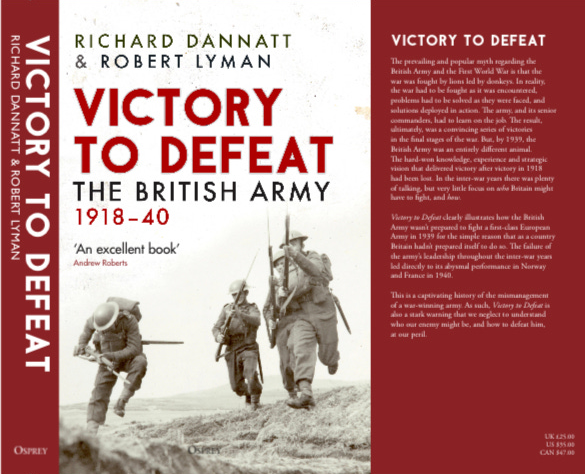
The British Army ended the First World War well trained, well led, well equipped and capable of engaging in all arms intensive warfare. Of all the players, on both sides, this army was unquestionably the most capable of deployment against a first class enemy anywhere in the world. Twenty years later it found itself with very much the same equipment, but with very much less of it, and devoid of either the ability or the means to fight a war in Europe against an enemy which had absorbed the lessons of 1918 but which the British had forgotten. It was the British Army that had invented blitzkrieg (although of course they did not call it that, a term coined by the French press very much later) and used it during the Battle of Amiens and on into the “Hundred Days” that saw the defeat of the German Army on the battlefield, and whatever German myth later averred, it was the British Army that forced that victory on the Western Front, not the French and not the Americans. And yet, in 1939 and 1940 the British were roundly defeated in France and Belgium, in Greece, in Crete and in North Africa. In this important – and to this reviewer almost heart rending – book the authors describe how and why the victors of 1918 were allowed to become incapable of fighting intensive warfare a mere two decades later.
In the first part of the book the authors describe the build up to the First War, and their explanation of the so called “Curragh Mutiny” is much more accurate than many accounts by others (although the officers did not threaten to disobey orders, only to resign, and while Carson’s Ulster Volunteers were indeed incorporated into the British Army as the 36th Ulster Division, so were Redmond’s National Volunteers, into the 16th Irish Division). The authors then go on to show how the British government had, albeit reluctantly, accepted a continental commitment in 1914 and had despatched an expeditionary force to Belgium, described then and later as the finest body of troops ever to leave these shores. Fine they certainly were, well trained, well led and well equipped, but the British Expeditionary Force (BEF) of professional regular soldiers was pitifully small, and with experience of imperial policing and not of war against a first class enemy. With the need to expand enormously and rapidly, this army had to adapt to a theatre where massed artillery, machine guns and barbed wire made any attempt to manoeuvre almost impossible. The book shows how by trial and error, by analysis of operations and by a gradually developing doctrine the British learned to use a combination of all arms to break through German defences and eventually to defeat them. With the infantry, the artillery, the armour, the engineers and increasingly the air all working together to get inside the enemy’s decision making circle, to get him on the back foot and keep him there, these were the elements of blitzkrieg, but it was the defeated Germans who were to absorb those principles and perfect them until twenty years after their defeat they were the most competent army in Europe.
After an excellent account of the British journey from an imperial gendarmerie to a practitioner of intensive war, the next part of the book shows how and why by the time the Second World War came along the British were incapable, not only of deterring war, but of fighting it. The “ten year rule”; the reluctance of governments to spend on defence; the political refusal to contemplate another war in Europe and the reluctance of the public to contemplate another bloodletting like that of the First War; the inability to experiment or to develop tanks and armoured vehicles; the seeming impossibility of reconciling the twin requirements of imperial policing and any commitment to land operations in Europe with the assets available; the myth of the “bomber will always get through” and the absence of any consistent war fighting doctrine, all are lucidly explained. Much of the fault is shown to lie with politicians, and surely the most disgraceful example of political interference was the sacking of the Chief of the Imperial General Staff (CIGS), the professional head of the army, by the leaving of a note on his desk by the very dubious Secretary of State for War, Hore-Belisha. The generals are not spared, however. Despite restrictions on funding and refusal by governments to accept that another war was looming generals could have spoken out, although it does have to be recognised that in a democracy the civil power is paramount.
Attributing quotes to historical figures
As the keeper of a blog that originated as a way to share the interesting quotations I encountered, I’ve had to become much more sensitive about correctly attributing what was said to the authentic original speaker or writer (it was one of the driving forces for me to move toward longer quotes to ensure that the context wasn’t lost). David Friedman has apparently also being collecting quotes, but knowing that they’re bogus:
There are a lot of bogus quotes on line, only some of them described as such. I have tried to limited my collection to things the person they were attributed didn’t say, or didn’t say first, but should have.
Winston Churchill:
If you’re not a liberal when you’re 25, you have no heart. If you’re not a conservative by the time you’re 35, you have no brain.
This is one that can be identified as bogus on internal evidence. Churchill was born in 1874, elected to parliament as a conservative in 1900, switched to the liberal party in 1904 and back to the conservatives in 1924, so was a liberal well after 35. That version of the quote — there are others — probably originated in America, where liberal/conservative was a more natural pairing of opposites than in Churchill’s Britain, where both liberals and conservatives were opposed by Labor.
My preferred version of the line is:
If my son is not a socialist before he is twenty I will disinherit him. If he is a socialist after thirty I will disinherit him.
That makes more sense for Churchill but he didn’t say it either.
The original version is apparently by French premier and historian Francois Guizot (1787-1874):
Not to be a republican at 20 is proof of want of heart; to be one at 30 is proof of want of head.” (I haven’t been able to find the French original).
A still earlier comment along similar rhetorical lines attributed by Thomas Jefferson to John Adams:
A boy of 15 who is not a democrat is good for nothing, and he is no better who is a democrat at 20.
Exchanges
Churchill:
Lady Astor, would you sleep with me for a million pounds?
Astor:
Perhaps I would.
Churchill:
Would you sleep with me for five pounds?
Astor:
Mr. Churchill, what kind of woman do you think I am?!
Churchill:
Madam, we’ve already established that. Now we are haggling about the price.
Astor:
If I were married to you, I’d put poison in your coffee.
Churchill:
If I were married to you, I’d drink it
Shaw to Churchill:
Enclosed find two tickets to my new play. Bring a friend — if you have one.
Churchill to Shaw:
Cannot attend first night. Will attend second night — if there is one.
There is no evidence that any of the three exchanges occurred.
Si non e vero, e ben trovato.
A final quote of unknown origin sometimes attributed to Churchill:
In England, everything is permitted except what is forbidden.
In Germany, everything is forbidden except what is permitted.
In France, everything is allowed, even what is prohibited.
In the USSR, everything is prohibited, even what is permitted.
The fascinating world of trees
The latest book review from Mr. and Mrs. Psmith’s Bookshelf examines Tristan Gooley’s How to Read a Tree:

Okay, I admit it: I read this book because I wanted to know more about the trees in my yard.
I’m afraid that’s not how Tristan Gooley means it to be used. He’s an expert in what he terms “natural navigation“, which means finding your way wherever you’re going using the sun, moon, stars, weather, land, sea, plants and animals. He teaches classes in it. He tested Viking navigation methods in a small boat in the north Atlantic and wrote a scholarly paper about it. He traveled the desert with the Tuareg. He’s the only living person to have crossed the Atlantic solo in both a plane and a sailboat.1 Meanwhile, I consistently walk a block in the wrong direction when I come out of the subway. But I am interested in trees!
Do you think much about trees? Could you draw one from memory and come up with something besides a fat green lollipop? Can you describe a tree you walk past every day with something more than its species and “leaves turn a pretty color in the fall” or “had its whole middle chopped out because planting trees directly under power lines is a terrible idea”? (Or if you live somewhere urban enough to have buried power lines, “they really, really should have made sure all these ginkgos were male”.)2 My guess is that you can’t, because most of us couldn’t, but trees deserve some real thought. They are actually fabulously, unintuitively weird, and learning just a little bit about how they work will dramatically enhance your ability to understand why the world around you is the way it is. I don’t expect I’ll use a tree to find my way any time soon, but since reading the book I’ve started spotting things in my yard and my neighborhood that I’d never noticed before — and noticing things is halfway to understanding them. (Which is, of course, why you must not be permitted to notice that which you are not supposed to understand.)
The most fundamental insight here is that trees are not like animals. This sounds breathtakingly obvious (and indeed, when I shared this pearl of wisdom at the dinner table everyone laughed at me), but it’s hard to internalize. Our increasingly urbanized and domesticated lives have so impoverished our natural imaginary — the available stock of symbols, metaphors, and archetypes through which we understand the natural world — that we’re more or less limited to commensals and charismatic megafauna, and are therefore vaguely surprised when we encounter organisms that work differently.3 And trees really do work differently, in a wide variety of ways that make perfect sense when Gooley points them out.
What are these differences? Well, for one thing, where animals have their physical architecture written into their genes, trees — like all plants — have potential. Sure, they have general growth habits4 (you’d never mistake a willow for a maple), but compare two trees of the same species — even two genetically identical trees cloned from grafts or cuttings of the same parent — and you’ll find dramatic structural differences depending on how the individual tree grew. This isn’t true for animals: one lion might be smaller than another, or bear the scars of an old injury, but all lions have four legs with the same joint anatomy. A lion will never grow a new leg, drop an old one, or add new tendons to support a particularly overworked limb. Trees, on the other hand, do all of those and more, following general rules dictated by species but growing in response to the conditions they encounter. And because only the top of the tree continues to grow up — a branch five feet off the ground will still be five feet off the ground in a decade, though quite a lot thicker — you can read a tree’s whole history in its structure. As with looking at a genome, looking at a tree is a way of looking into the past.
Trees seek the light. Just down the street, my neighbor’s entire front yard is shaded by three enormous oak trees planted in a rough triangle and each arching gently away from the others (with a surprising similarity to the Air Force Memorial) as they try to escape each others’ shade. A few blocks away is a survivor of a similar situation, an old pine tree that’s branchless most of the way up its trunk so you can really see the alarming 15° lean with which it grew. Some long-gone giant cast the shade that sculpted this tree into its present funny shape, and if we were in the woods we might be able to see its stump — Gooley encourages the reader to greet a woodland stump by looking for the “footprint” of the missing tree in its surroundings — but I suspect this one was probably removed to make way for the foundation of the nearby house. (Given the apparent age of the pine and the house, its old neighbor probably met its end around the time the new streetcars turned this farming village on a railroad into a proper suburb.)
1. The late Steve Fossett did it first, but since he holds about a billion other records it feels churlish to take this from Gooley.
2. Only female gingkos drop those awful berries. There are entire all-male cultivars that make fabulous trees, and somehow, inexplicably, I spent every autumn of my childhood scraping horrible stinky mush off the bottoms of my shoes. Why.
3. Also on this front, I recommend Merlin Sheldrake’s Entangled Life, which is exactly the sort of book about fungi you would expect someone named Merlin Sheldrake to write.
4. In fact “tree” is really just a growth habit, evolved independently by thousands of unrelated species of plants, because trees are the crabs of the plant kingdom. [NR: Do read that thread, it’s quite amusing}
Knock Out: The Evolution of Tank Ammunition
The Tank Museum
Published 8 Jun 2023Tank ammunition has gone a long way from basic solid armour piercing shot to the high-tech fin rounds of today. In this video we look at the development of tank ammo in its different forms and how it has evolved from the First World War to the modern battlefield.
(more…)
QotD: Geeks and hackers
Thus, one doesn’t expect a “gaming geek” or a “computer geek” or a “physics geek” to actually produce games or software or original physics – but a “computer hacker” is expected to produce software, or (less commonly) hardware customizations or homebrewing. I cannot attest to the use of the terms “gaming hacker” or “physics hacker”, but I am as certain as of what I had for breakfast that computer hackers would expect a person so labeled to originate games or physics rather than merely being a connoisseur of such things.
One thing that makes this distinction interesting is that it’s a recently-evolved one. When I first edited the Jargon File in 1990, “geek” was just beginning a long march towards respectability. It’s from a Germanic root meaning “fool” or “idiot” and for a long time was associated with the sort of carnival freak-show performer who bit the heads off chickens. Over the next ten years it became steadily more widely and positively self-applied by people with “non-mainstream” interests, especially those centered around computers or gaming or science fiction. From the self-application of “geek” by those people it spread to elsewhere in science and engineering, and now even more widely; my wife the attorney and costume historian now uses the terms “law geek” and “costume geek” and is understood by her peers, but it would have been quite unlikely and a faux pas for her to have done that before the last few years.
Because I remembered the pre-1990 history, I resisted calling myself a “geek” for a long time, but I stopped around 2005-2006 – after most other techies, but before it became a term my wife’s non-techie peers used politely. The sting has been drawn from the word. And it’s useful when I want to emphasize what I have in common with have in common with other geeks, rather than pointing at the more restricted category of “hacker”. All hackers are, almost by definition, geeks – but the reverse is not true.
The word “hacker”, of course, has long been something of a cultural football. Part of the rise of “geek” in the 1990s was probably due to hackers deciding they couldn’t fight journalistic corruption of the term to refer to computer criminals – crackers. But the tremendous growth and increase in prestige of the hacker culture since 1997, consequent on the success of the open-source movement, has given the hackers a stronger position from which to assert and reclaim that label from abuse than they had before. I track this from the reactions I get when I explain it to journalists – rather more positive, and much more willing to accept a hacker-lexicographer’s authority to pronounce on the matter, than in the early to mid-1990s when I was first doing that gig.
Eric S. Raymond, “Geeks, hackers, nerds, and crackers: on language boundaries”, Armed and Dangerous, 2011-01-09.
September 26, 2023
Matt Taibbi – “Canada’s Prime Minister solidifies his status as the world’s most nauseating pseudo-intellectual”
It’s hard to come up with ways to justify Canada’s PM and Parliament for giving a standing ovation for a fucking Waffen SS veteran, and Matt Taibbi doesn’t even try:
Let me get this straight:
A year and a half ago, Canadian Prime Minister Justin Trudeau denounced a Jewish member of parliament named Melissa Lantsman for standing with “people who wave swastikas“. Lantsman had criticized Trudeau for fanning “the flames of an unjustified national emergency” in response to the “Freedom Convoy” trucker protests. The “swastikas” Trudeau referenced were, as even Snopes conceded, virtually all “pictured on signs as a way of mocking and protesting government restrictions”, comme ça:
By saying Lantsman stood with “people who wave swastikas”, in other words, Trudeau really meant she was standing with “people who called me a Nazi”. He declined to apologize, which of course is his prerogative.
This week, both Trudeau and House of Commons Speaker Anthony Rota are under fire after Rota invited, and Trudeau applauded, a 98-year-old former soldier from the 14th Waffen-SS Grenadier Division named Yaroslav Hunka to attend an address by Ukrainian president Volodymyr Zelensky. Rota praised Hunka as a “Canadian hero” from his time fighting the Soviets in World War II when, not that it matters, they were allies to the United States and Canada. Leaving the elderly Hunka out of this for the moment, these politicians could easily have turned up the man’s blogs about joining Hitler’s army, making the applause scene at least approach the max on the cringe scale:
Amid the subsequent outcry, Trudeau squeaked out a handful of sentences that collectively gave off least a faint aroma of apology, though he personally didn’t apologize for anything, and invoked “mistakes were made” phrasing …