
Have I mentioned my theory (which I regard as a certainty) that Higher Education is best understood as a massive money laundering operation? We all had a good chuckle, I’m sure, at that title [“fellowship at the International Centre for the Study of Radicalisation at King’s College in London”], just as we’ve had good chuckles at the ridiculous titles of all the Angry Studies programs infesting colleges nationwide. We’ve probably concluded — correctly — that these are just make-work for otherwise unemployable PhDs who check a few of the Diversity quota boxes.
But when you consider just how much money is involved, it’s a lot harder to laugh. Your average tenured prof makes north of $100 K, and for every one of them, there are at least two administrators, four outreach coordinators, and uncountable Special Assistants to the Assistant Provost’s Special Assistant for Diversity and Inclusion. Not to mention all the classroom space, office space, etc. that this requires (including paying the very real people who have to coordinate that stuff — no easy task — the custodial staff and so on). I’d bet that just one of these programs, all in, runs at least a million dollars per year when you throw in bennies and whatnot.
That’s a LOT of scratch, for one or two classes a semester that barely even make their enrollment numbers.
I dunno what nefarious purpose the Angry Studies programs serve (aside from the obvious, perpetual one of “burning down ambient civilization, just because”), but the “national security” ones I’m sure are basically just “diplomatic” cover for cloak and dagger shit. They used to use academic conferences like that back during the Cold War — who else but an officially credentialed diplomatic representative gets to travel around his enemies’ territory? In this case, of course, none of these people are actually going anywhere near war zones (with the exception of Mx. Kagan, of course, who decided to take command of American forces in the field). But academic “conferences” are good ways to make contacts and pass suitcases full of cash and other goodies around …
… I suspect.
Severian, “Klown Kollege”, Founding Questions, 2022-08-28.
September 18, 2026
QotD: Higher education as a vast money laundering racket
September 17, 2026
British government seeks to retroactively change the Rules of Engagement during “The Troubles”
I’m old enough to have had lengthy conversations with British soldiers and officers who were serving or had recently served in Northern Ireland at the tail end of “The Troubles”. It was a dangerous situation the troops found themselves in and the Rules of Engagement they worked under at least recognized that it wasn’t a normal day at the office back home. On his Substack, Dr. Robert Lyman explains why the current government’s plan to retroactively change the rules that governed the actions of the British military forces is one of the worst possible things they could do:
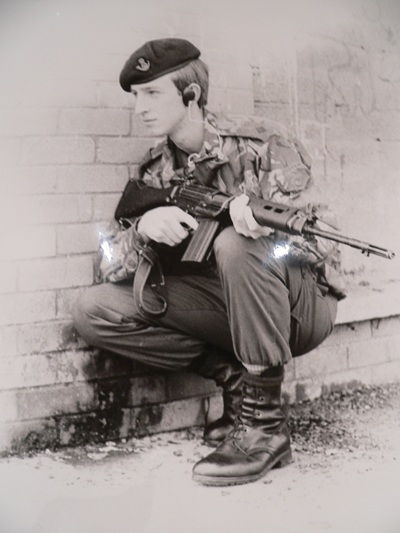
Lieutenant Robert Lyman in the Ballymurphy, 1983, in a photograph snapped by Lieutenant Colonel Bryan Elliott, CO of 1LI at the time. He was driving past in his Landrover and spotted a photo opportunity.
Photo via The War Room
For those who know me well, the idea that I might now be encouraging young men and women not to join the Armed Forces might sound that I had lost my marbles. I can assure you that is not the case. I am deadly serious. This government’s determination, building on the surrender of the previous Conservative government to the varying dictats of the ECHR, will drive an impossible moral and legal wedge between the people who the country ask to do its dirty work, and the government that sends them in harms way. It is an intolerable set of affairs that all sensible people in his country should oppose. What sort of perversity might think that this behaviour is acceptable from any government? I despair, yet it seems that this is precisely what our current morally impoverished government seems to desire.
[…]
The central concern is that the proposed changes will expose servicemen and women, many of whom have already undergone judicial scrutiny for actions undertaken during the Troubles, to further litigation and investigation. In practice, this is likely to encourage a new wave of cases brought by individuals seeking to revisit or reinterpret events from a campaign in which terrorist organisations such as the IRA and INLA were ultimately defeated.
The immediate implications are troubling enough. The longer-term precedent, however, is far more serious. If this legislation proceeds, it will send a clear message to today’s servicemen and women, that even after they have acted lawfully, completed investigations, and fulfilled their duty to the State, they may still face renewed legal jeopardy in later decades. It undermines the fundamental bond of trust between those who serve and the government that sends them into harm’s way.
Every member of the British Armed Forces operates within a strict and clearly defined legal framework. These rules, embodied in the Laws of Armed Conflict and implemented through Rules of Engagement (RoE), govern the use of force in military operations. During my own service, I spent countless hours learning these rules, teaching them to my soldiers, and ensuring they were followed in Northern Ireland, Bosnia, and elsewhere.
This debate is not about whether soldiers should be above the law. Of course they are not, nor should they be. Rather, it is about whether the rules that governed military operations at the time can be retrospectively reinterpreted after a conflict has ended. The concern is that former adversaries will be able to pursue legal action against veterans for actions that were considered lawful under the Rules of Engagement in force at the time.
Today, Policy Exchange published an excellent report examining this issue in relation to former members of the SAS who served in Northern Ireland. The report sets out the problem clearly and persuasively, concluding that the proposed changes should be abandoned. I agree.
Predictably, some MPs have defended the legislation. Diane Abbott, for example, has argued on X that opposition to the changes amounts to “a call for armed forces personnel to be placed above the law.” That characterisation is deeply misleading. The debate has never been about exempting soldiers from the law. It is about subjecting veterans to repeated investigations and additional layers of judicial scrutiny many years after the events in question, often in ways that were never demanded of those they fought against on behalf of the nation.
At its core, this issue is one of fairness. It raises questions about double standards, retrospective judgment, and the constant shifting of the goalposts. Veterans who served under one set of rules are now being told that those rules may no longer be sufficient protection against further legal action.
Is This Table Really 200 Years Old? (Furniture Forensics)
Rex Krueger
Published 16 Sep 2026[AI summary: Rex Krueger investigates a vintage drop-leaf gate leg table to determine whether it was handmade or factory-built. By examining specific construction techniques, joinery, and material choices, Rex deciphers the history of this piece and explains how such multi-purpose furniture served past households.]
All my plans!: https://www.rexkrueger.com/
More Furniture Forensics: • Furniture Forensics
Compass Rose Toolworks: https://www.compassrosetools.com/
Join the Mailing List: http://eepurl.com/g3rkmv
Get my woodturning book: http://www.rexkrueger.com/book
Get My Book, Everyday Woodworking: https://amzn.to/3oyjC0E
Follow me on Instagram: @rexkrueger
You don’t hate the relic media nearly as much as they deserve
The relic media in Canada has — thanks to generous government subsidies — become a maple-flavoured version of the North Korean news media, but even in the United States where there’s still a somewhat competitive market, most media outlets are delighted to act as unpaid propagandists … and have been that way for generations:
Walter Duranty won a Pulitzer Prize for lying about Stalin’s Ukraine famine while millions starved. His employer, the New York Times, never returned that prize. The institutional rot ran deeper than one reporter.
In 1936, Times Moscow correspondent Harold Denny watched the first of Stalin’s Great Purge trials and reported the proceedings as credible. The defendants, Grigory Zinoviev and Lev Kamenev among them, confessed to plotting murder and sabotage. Denny saw no obvious coercion and wrote accordingly. The NKVD had spent weeks breaking these men through sleep deprivation, threats against their families, and relentless psychological torture until they would say anything in open court.
Every confession was fabricated. Every defendant was executed anyway. Stalin murdered roughly 750,000 people during the Great Purge between 1936 and 1938, and the Times gave the operation a veneer of legitimacy at its most critical moment.
Central planners require a monopoly on information to survive. When the newspaper of record in the most powerful capitalist country on earth launders your show trials as fair proceedings, you buy yourself years of Western political goodwill. Stalin purchased that goodwill with useful idiots who confused proximity to power with insight.
You pay for this dynamic today every time an institution that failed catastrophically keeps its credentials, its prizes, and its authority to declare what counts as credible journalism.
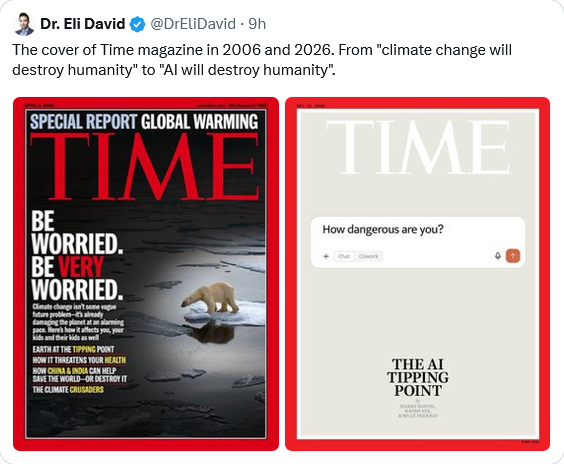
Duranty would have been proud of Time magazine had he been alive today.
The Brutal Life of a Medieval Butcher
Tasting History with Max Miller
Published 24 Mar 2026Tender stewed spiced meat and onions with bright yellow saffron sauce
City/Region: England
Time Period: c. 1430It’s a well-circulated myth that medieval cooks spiced meat heavily in order to hide the fact that the meat had gone bad. And it is, indeed, a myth. Amongst the many reasons why this doesn’t hold up is the fact that in medieval Europe, spices were expensive, and if you could afford to use a lot of them on your meat, you could afford not-spoiled meat. Dishes like this one, which uses five different spices and saffron, which has always been expensive, would be only for the wealthy.
This dish has the classic medieval flavors of warm spices and vinegar, and I really enjoyed it. The meat and onions are tender, the sauce is a beautiful bright yellow, and it’s quite unlike anything we typically eat today.
Brawn en peuerade
Take might broth of Beef or Capon, and then take clean fresh meat, and seeth it, but not too much; And if it be fresh meat, roast it, but not too much, and then cut it in pieces, and cast it into the broth; And then take whole onions, and peel them, and then take vinegar thereto, and cinnamon, … then take cloves, mace, and powdered pepper, and cast thereto, and a little saunders, and set it on the fire, and let boil till the onions and the meat be cooked enough, and not too much; then take liquor made with bread and vinegar and wine … and cast thereto saffron to make the color bright, and salt, and serve it forth.
— Harleian Ms. 279, c. 1430
QotD: Boris Johnson
How can this possibly have happened to the land of Magna Carta and English Common Law, the heroic seafaring nation which coloured the atlas pink and stamped its character on half the world’s nations from Australia and the U.S. to India and South Africa, that invented most of the world’s best sports, produced most of its greatest literature, beat Philip II of Spain, Napoleon, the Kaiser, and Hitler and discovered almost everything worth discovering?
Just when did Britain become so incredibly, embarrassingly shit?
Well, it’s easy to blame Boris, as I have done on occasion, for being a priapic lard-butted lightweight chancer who should never have been given the keys to Number 10. As we’ve learned to our cost, he’s all mouth and no trousers, great for an impromptu bon mot or jolly photo op but perfectly useless in times of crisis, being too easily led, having no opinions of his own, the backbone of sponge and the moral character of a Plecostomus catfish.
James Delingpole, “Britain is now the sick man of Europe”, Breitbart, 2020-08-14.
September 16, 2026
The new front in the British “flag war” – Welsh castles
You may have heard that at least one municipal government in England is trying to ban private citizens flying both the Union flag and the St. George’s Cross, yet actively encouraging the use of other national or political flags. On Substack, Paul Embery shows just how far the anti-British/anti-English activists are willing to go … in this case all the way to Wales (where, yes, there’s already some local anti-English sentiment to start with):
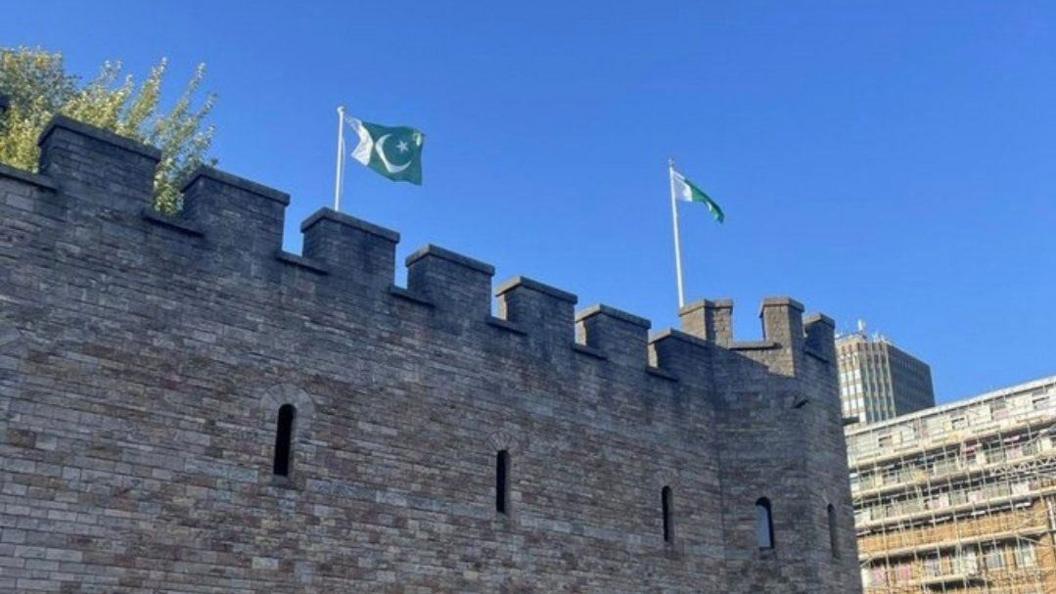
Pakistani flags fly over medieval walls in Cardiff.
Photo from X via Paul Embery
SOMETIMES it’s hard to avoid the conclusion that Britain’s political elites are engaged in some sort of private game to see just how far they can test the patience of the native population before it snaps.
A people who were, and still are, remarkably tolerant in all sorts of ways, including towards those from minority backgrounds and cultures, seem daily to have their good faith exploited.
Only someone who had been living under a rock for the past couple of decades could have failed to notice the gulf that has emerged between our political institutions and everyday folk living outside of our fashionable cities and university towns.
That gulf – which is widening still – explains why a palpable sense of polarisation exists across many parts of the country today.
The latest attempt to stir the pot comes courtesy of Cardiff council, which recently decided to fly the flag of Pakistan from the city’s castle – one of the Welsh nation’s most historic and iconic sites. The flag was apparently hoisted in celebration of Pakistan’s independence day and stayed there over two days (a similar thing happened in 2024 — see image).
Needless to say, a row swiftly broke out, with Reform voices locally and nationally attacking the decision and in return facing accusations from their political opponents – who seemed to close ranks around the issue very tightly – that they were seeking to incite hatred and division.
Recent history tells us that anyone who expresses even mild disapproval about this type of virtuous ingratiation of foreign nationalities and cultures by our public bodies is likely to face taunts of being some kind of embittered xenophobe or reactionary. And, usually, the condemnation will be accompanied by a lecture trumpeting the merits of living in a diverse and multicultural society.
But those who harbour misgivings surely have a point. Because such acts do rank as a kind of provocation. It’s one thing seeking to foster good relations with other nations and cultures – such an approach is eminently sensible – but it’s another thing entirely indulging those nations and cultures to such a degree that many indigenous citizens begin to feel their own country is losing its historical identity and turning into something resembling a supersized version of the Olympic village. And that is where many Britons feel their country is now.
That Pakistan is a member of the Commonwealth did not appear to be the prompt for Cardiff Council’s decision, for no councillor seems to have cited that justification in defence of it. Moreover, the colours of non-Commonwealth nations, such as Poland, have also been displayed over the castle in recent times.
“Oh, it’s only a flag, and it’s just for two days”, the citizens-of-nowhere will argue. Except that it isn’t only a flag, and it isn’t just two days. What we have seen over the past couple of decades is a subtle but concerted effort on the part of Britain’s elite class to embed the ideology of cosmopolitan universalism across all areas of our public life.
These people are globalists in every sense. They see our country as a shop, not a home.
They believe in permissive migration policies, free trade libertarianism and technocratic supranationalism – all things to which large chunks of the population are hostile.
Update: I’ve heard that it helps to actually include the URL …
Update the second, 17 September: Welcome, Instapundit readers! Have a look around at some of my other posts you may find of interest. I send out a daily summary of posts here through my Substack – https://substack.com/@nicholasrusson that you can subscribe to if you’d like to be informed of new posts in the future.
The Korean War Week 117 – The Cost of Rotation – September 15, 1952
The Korean War by Indy Neidell
Published 15 Sep 2026UN Commander Mark Clark is putting together five possible scenarios for hopefully solving the POW issue and getting an armistice, but who knows if the Communists will accept any of them? The war in the skies heats up, though it’s a quiet week on the ground, and we take a look at the pros and cons of the troops rotation system.
00:00 Intro
00:25 Recap
00:48 The Active War
01:23 The POW Issue
04:31 Five Plans
07:46 ROK Increases
08:58 Troop Rotation
11:05 Downsides
13:54 War in the Skies
15:06 Summary
15:13 Conclusion
16:01 Call to Action
Veterans of the GWOT “saw things with our own eyes that are hard for others to believe”
On the social media site formerly known as Twitter, Cynical Publius explains why some of the strongest opposition to Islamification comes from people who’ve seen Islamic culture up close in countries where it’s the majority religion:
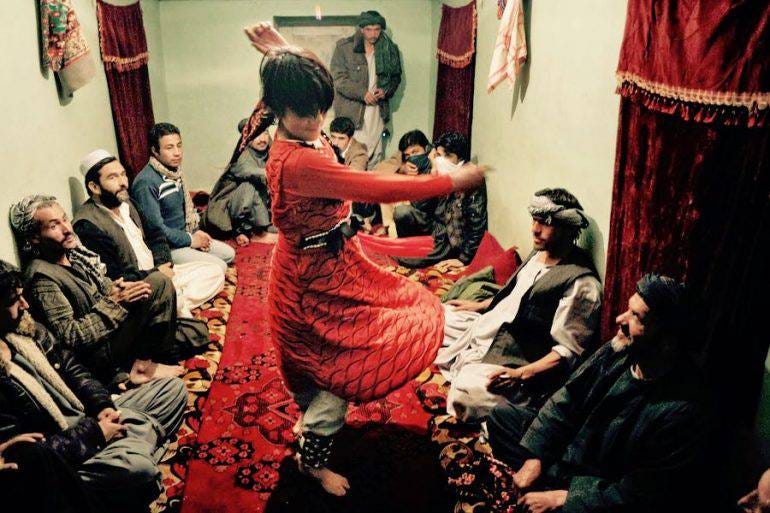
Does this photo of Afghan men watching a young boy dance give you the creeps? It should.
Have you noticed that the community that is most vocal in warning about the Islamification of the USA is the GWOT veterans’ community?
That’s because we saw things with our own eyes that are hard for others to believe:
- The treatment of women as chattel property. Goats are treated better than daughters — no exaggeration.
- Widespread pedophilia and bestiality while at the same time people we call “LGBTQ+” in the West are subject to barbaric methods of execution.
- An absolute lack of freedom of religion.
- Wanton disregard for human life.
- Insanely paranoid antisemitism straight out of The Protocols of the Elders of Zion.
- Wholly corrupt governments; bribery as a uniform standard.
- Tribalism to an extreme: tribe trumps truth and justice, always.
- In the Gulf Arab countries, “Third Country Nationals” from poor Muslim countries engaged in menial labor and literally treated as slaves.
- Absolute confidence that Islam will violently conquer the rest of the world, and a belief that this is just and proper.
- Acceptance of the idea that lying can be and is necessary and proper.
These are not one-off observations; these are widespread norms that are easily observed and experienced in day-to-day life in any nation that accepts Sharia law. ALL OF THESE THINGS ARE COMMONPLACE. Having seen this stuff up close and personal across the entire Middle East, Central Asia and the Horn of Africa, American veterans have unwittingly become like the prophets of old, warning everyone else of the dangers we have seen that we never wish to see come ashore in America.
Yet somehow our voices are not being heard sufficiently, and we now see literal Communists wishing to import these evil practices to the USA en masse, as a path to their own power.
Guess what Commies? It’s the other way around, you are the ones being used and when the Green forces dispose of you Red forces, it’s not going to be pretty.
Wise up.
Update, 17 September: Welcome, Instapundit readers! Have a look around at some of my other posts you may find of interest. I send out a daily summary of posts here through my Substack – https://substack.com/@nicholasrusson that you can subscribe to if you’d like to be informed of new posts in the future.
WWII British Tank Tech Tree
The Tank Museum
Published 8 May 2026In 1939, the Vickers Light Mark VI formed the backbone of the British tank force. It’s hard to believe that in six years technology evolved from this to the mighty Centurion.
But this journey was no walk in the park. It took blood, sweat, lots of tea and various wrong turns. So, in this video we’re going to walk you through the entire British tank family tree to reveal this process.
This is a family tree organised by type not by chronology. That means Light Tanks, Cruiser tanks, Infantry tanks and Assault tanks.
So, without further ado, this is every British tank of World War II.
00:00 | Intro
01:14 | Light Tanks
03:21 | Cruiser Tanks
12:37 | Infantry Tanks
16:08 | Assault TanksThis video features archive footage courtesy of British Pathé.
In this film, join Paul Famojuro for the ultimate deep dive into British tanks of WWII. Over six years Britain’s tanks evolved in a number of curious directions. From the light tanks of the early war to the troubled development of the cruiser tanks concept, the slow-moving infantry tank to the hard-hitting assault tanks, each branch of this tech tree was designed to solve specific problems on the battlefield. There were some successes, just as many failures, and a whole lot of weird and wonderful tanks along the way.
Want to learn more about the British tanks of WWII? Here are some of the sources we used to make this film:
British Tanks and Fighting Vehicles 1914-1945, B.T. White. 1970
British Cruiser Tank A13 Mk I & Mk II, Peter Brown. 2015
British Infantry Tank Mk III Valentine, Parts 1 & 2 Dick Taylor. 2010
The Great Tank Scandal, David Fletcher. 2021
The Universal Tank, David Fletcher. 2021
Centurion Owner’s Workshop Manual, Simon Dunstan. 2017
The Tank Museum Guide to Matilda, Dick Taylor. 2024
The Tank Museum Guide to Comet, Dick Taylor. 2025
A13 Cruiser Mk. V Covenanter Tank. A Technical History, P.M. Knight. 2018
A38, Infantry Tank, Valiant, https://tanks-encyclopedia.com/ww2/gb…#tankmuseum #veday
QotD: Squeaky bum time
I blinked at them. “We’ve entered … what?”
“Squeaky bum time”, they repeated, as if this was a perfectly normal phrase that everyone uses. “You know, when it’s so tense you’re clenching.”
The first time I heard this phrase, I nearly fell off the couch laughing.
But now?
Now I find myself using it during American sports, muttering it to myself during tense moments, while my American family would have no idea what I’m on about.
This is what happens when you live in a British-American household. Your vocabulary becomes a delightful jumble that sounds slightly off to everyone.
Marianne Jennings, “Squeaky Bum Time and Other British Phrases I Never Knew I Needed”, An American’s Guide to British Life, 2025-10-05.
September 15, 2026
“I will choose a path that’s clear, I will choose free will”
For some reason, the idea that humans don’t really have free will is very popular among progressives, even if they know individually that they have free will they believe most of the rest of humanity somehow doesn’t:
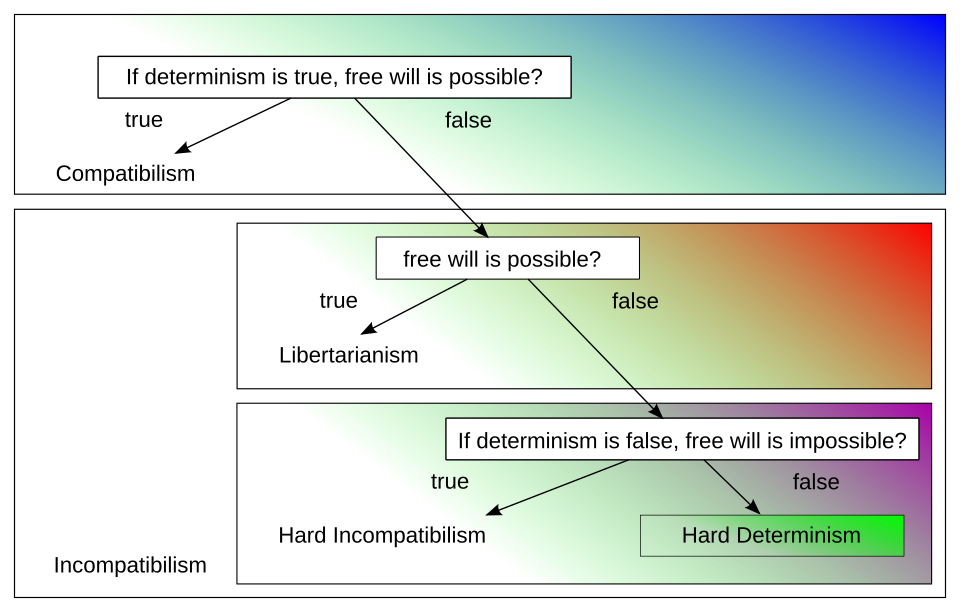
A simplified free will taxonomy
Image by Richardbrucebaxter via Wikimedia Commons.
A fashionable view of human behavior holds that because everything has a cause, no one is truly responsible for their actions.
In his 2023 bestseller “Determined,” Stanford neuroscientist Robert Sapolsky argues that free will is an illusion. “We are nothing more or less than the cumulative biological and environmental luck, over which we had no control, that has brought us to any moment”, he writes. Author and podcaster Sam Harris has spent 15 years making the same case to a popular audience. “Our wills are simply not of our own making,” he writes in Free Will (2012). “Thoughts and intentions emerge from background causes of which we are unaware and over which we exert no conscious control. We do not have the freedom we think we have.”
Common sense pushes back. Consider an example from the psychologist Paul Bloom. Imagine a man who thrashes violently in his sleep and accidentally strikes his wife, breaking her nose. They both wake up, and he is horrified and ashamed. Now imagine a second man who resents his wife and wants to hurt her. He waits until she is asleep and then hits her in the face. When she wakes up, he pretends it was an accident. The difference between these two men is obvious. Any legal or moral system that doesn’t recognize that would collapse.
Yet much of elite discourse encourages us to blur that distinction. Determinists like Messrs. Sapolsky and Harris tell us that behavior can be explained through systems, incentives, trauma, inequality, neurochemistry and social pressure. Much of this is true. But a culture that speaks only this language teaches people that they are spectators in their own lives. The implication, rarely stated outright, is that no one really chooses anything. We are all the first man in the example above, thrashing in our sleep.
The determinists don’t deny that we have wills, or that our actions follow from them. Their argument is that will and action are themselves the products of deeper causes, such as genes, molecules and the environment, and so we can’t really be called free.
Stuart Doyle offers a useful analogy that challenges this claim. Suppose we ask whether an apple is red. The determinist looks closer. He realizes the apple is nothing but atoms. Because no individual atom is red, he concludes the apple can’t really be red. The error is obvious. Color exists at the scale of the apple, not at the scale of an atom.
Free will works the same way. A choice exists at the scale of a person thinking, weighing and deciding. Looking at the molecules underneath and finding no choice there doesn’t prove that choice is an illusion.
A Fall election seems quite likely
One of the advantages of a Westminster-style parliamentary system is that election dates are not fixed, so that the Prime Minister can take advantage of perceived opportunities to win majorities when they arise. It must be very tempting to Mark Carney to call an election as soon as he can, as the Elbozos are still waving their arms and chanting his praises for “standing up to the Bad Orange Man”. His latest notion of trying to add Canada to the European Union as some sort of “associate member” is also popular among people who think that Canada should be more like Europe (the Venn diagram of Elbozos and Europhiles is almost a perfect circle). On X, Jay Currie stares into the abyss of yet another Liberal majority government with a renewed electoral mandate:
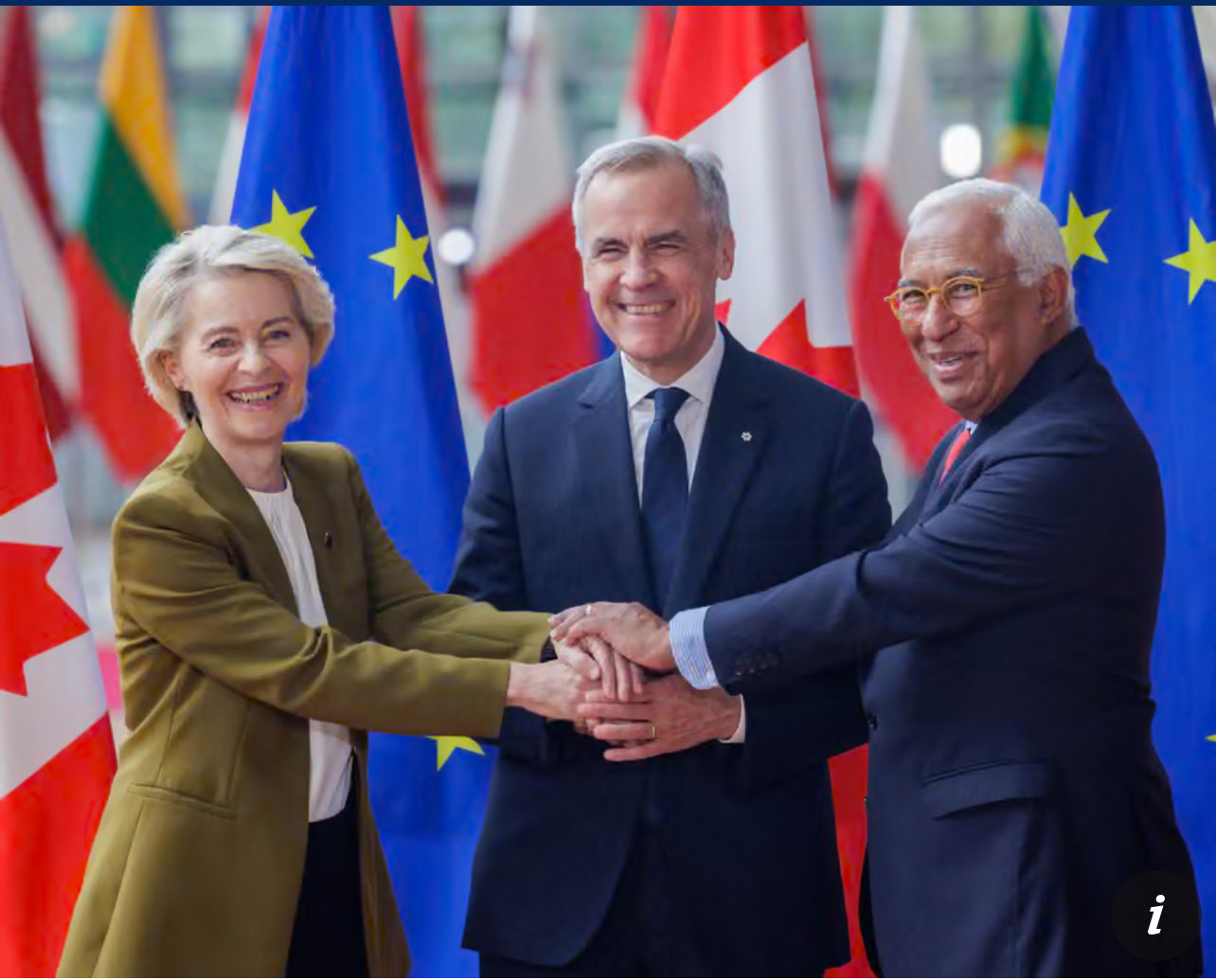
The Prime Minister of all the Canadas is prepping for his Davos 2.0 speech to the European Parliament on the 17th when, apparently, he is going to propose that Canada become some sort of associate member of the EU. God help us.
The developed world can be thought of as two camps: the progressives and, for want of a better term the nationalists (could be traditionalists but that is only one strain within the nationalist camp). The supra nationalist institutions, EU, UN etc are progressive to their core.
Progressives see borders as barriers to progress, believe diversity is strength, see international action as the only way to defeat the horror of “climate change”, want international controls on speech, technology and public health.
For progressives individual rights, the rule of law, property are all barriers to the greatest good for the greatest number. Citizenship is an antique concept best left in the 20th century.
Most importantly progressives see the state, rules and regulations, a constantly refreshed “New World Order” and managed decline as both beneficial and inevitable. Arc of History and all.
Nationalists begin with the tiniest unit in society, the individual, and take that unit seriously. What rights does an individual have? If you start there you automatically circumscribe the power of the state. You also set the state’s direction.
Taking individual rights seriously creates a state in which individuals matter, there their voluntary associations beginning with families, matter. “The greater good” is no more than a suggestion when it comes to protecting individual rights.
The Europe of the EU came out of the ashes of a world in which individuals were subjects rather than citizens (with the notable and sporadic exception of post Revolutionary France) and the concept of individual rights was fragile at best.
The progressive intent of the EU was to treat “Europeans” as interchangeable economic units whose value was locked to group identity and which must be prepared to share the burdens imposed for the greater good.
Nationalism was seen as regressive as was patriotism and the insistence that individuals had rights which over rode the “common good”. After all, the horrors of WWI and II were the products of patriotic nationalism.
The progressive European project worked quite well for the first twenty or so years when Marshall plan aid funded the rebuilding of Europe and membership in the EU was relatively restricted. Expansion and mass immigration strained the Community.
Part of the reason the EU worked quite well in the early years was that its goals were relatively modest, a trading bloc with harmonized economic regulation left individual countries to work out their social, legal and rights structures.
As with any progressive institution the modest goals of the early years were gradually replaced with “ambition”. The 1985 Schengen Agreement eliminated hard borders within the EU. The European Convention on Human Rights harmonized the rights of Europeans.
Part of the progressive ambition was the creation of a hitherto unknown entity known as “the European” superficially similar in concept to “the American”. Questions of nationality could be submerged as this new entity stepped into the world.
For the progressive camp the “European” was a giant step forward into a post national future. As indeed it was for a tiny minority of bureaucrats, academics, journalists, financiers and other members of a self appointed cognitive elite.
People who objected to this grand homogenization of the nations of Europe were obviously frightened of the inevitable future because, well, they were not well educated and, entre nous, not too bright.
For the “Europeans” the great cause of the 21st century was laid out in Rio in 1993 when a conference convened by Canadian Maurice Strong sounded the alarm about “global warming” currently rebranded “climate change”.
Now there was a global threat demanding a supra-national response where the “Europeans” could assume a leadership role by…well, by shipping all of their heavy industry offshore and building very expensive windmills and mandating electric cars.
To no one’s very great surprise the Europeans have managed to de-industrialize and regulate themselves to the point of actual poverty. Fortunately, it was all for the global greater good so the Europeans could congratulate themselves.
Not content with climate virtue, the Europeans (though not the regressive nationalist yobs) took it upon themselves to welcome millions of migrants. An act of humanity and also shrewd as the Europeans had given up having children.
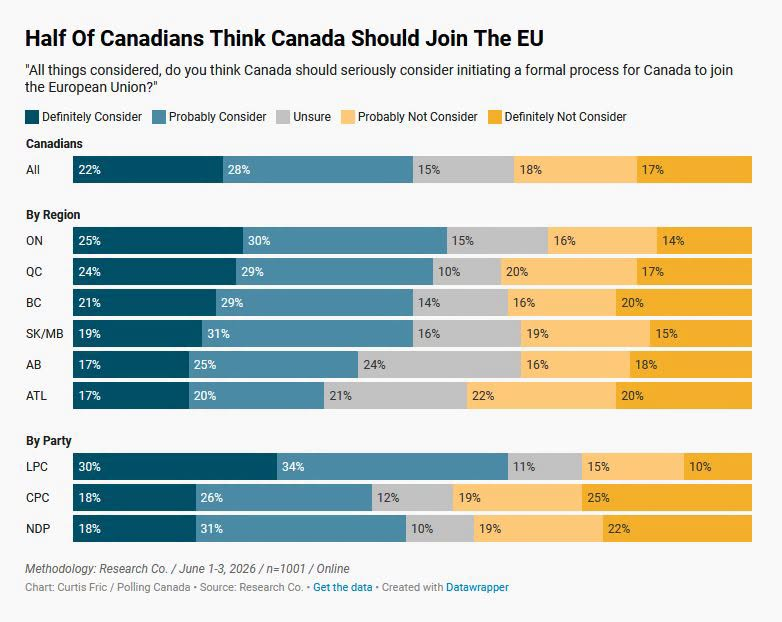
Of course, the idea had been trial-ballooned recently to get Carney-friendly headlines ready in advance:
“Napoleon remains the ghost in professional military education”
InfantryDort responds to a complaint that military leaders are taught Clausewitz without the career of Napoleon for context:
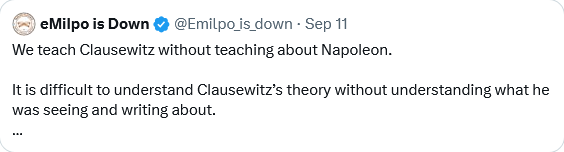
THE THING WE STILL CAN’T TEACH
I’ll bite on this one. Napoleon remains the ghost in professional military education. Why? Let me take a stab at it …
Jomini watched him and tried to turn the phenomenon into rules. Anyone in the U.S. Army has seen this before. If you do something exceptional on the field (especially in training), then you’re often coached that you went outside the lines and need to get back in. You may have succeeded, but it COULD have been a disaster. So we try “putting baby in a corner” because the science of war is safe. The art scares people.
Clausewitz watched the same fire in Napoleon and concluded that rules would never be enough. Two centuries later we are still dissecting the campaigns, naming principles, drawing arrows on maps, and trying to explain what exactly lived inside that man.
Again, why?
There is a part of command that refuses to become curriculum. T.E. Lawrence called it the “kingfisher flash”. Clausewitz reached for the genius. It’s the instant when one mind sees through fog what a hundred educated men cannot see at all, then possesses enough violence of will to act before the moment disappears.
Read that last part again 👆
You can feed that gift with history, sharpen it through hardship. But you CANNOT manufacture it with another degree. It MUST be revealed.
Yet modern institutions are built around the opposite assumption. We stack schools, evaluations, gates, boards, and credentials high enough and convince ourselves that eventually genius will emerge from the assembly line. It won’t. It can’t. Ever.
Worse, the machine often recognizes the dangerous talent and rejects it precisely because it cannot reproduce it. The unusual man is “reckless”. The instinctive one is “unserious.” The officer who refuses the approved path becomes “unqualified”.
READ. IT. AGAIN. 👆 👆 👆
Then war arrives and burns the paperwork. That is the lesson Napoleon keeps trying to teach us from two hundred years away. You can study the flame forever. You still have to recognize it when it walks into the room.
The closest we can come to discovering this genius is testing our officers on it. No more reliance on pure paperwork. I say to these officers: Show us the gift you’re supposed to possess for the highest commands.
Or step aside for someone who will.
The First Military Luger: Swiss Model 1900 s/n 01
Forgotten Weapons
Published 27 Apr 2026The first nation to adopt the Luger was Switzerland, which began testing in late 1898 and formally accepted the Luger in May 1900. Their guns were the first Lugers to be mass produced, as they were the first order received by DWM. The first batch of 600 arrived in Switzerland in May 1901, and today we are taking a look at the very first of that batch — serial number 01. It is the first production military Luger, and that’s a pretty cool landmark.
C&Rsenal Swiss Model 1900 video: • History of WWI Primer 145: Swiss Luger 19…


