
The Great War
Published on 7 Jun 2018The German Army is still threatening Paris and the situation for the Allies looks dire. Reluctantly, General Pershing agrees to put some of the American troops into action at Belleau Wood and Château-Thierry.
June 8, 2018
The Battle of Belleau Wood Begins I THE GREAT WAR Week 202
Comments Off on The Battle of Belleau Wood Begins I THE GREAT WAR Week 202
June 5, 2018
The Landings At ANZAC Cove And Suvla Bay 1915 I THE GREAT WAR On The Road
The Great War
Published on 4 Jun 2018With thanks to Mr. Ali Serim for making this episode possible.
Indy and our guide Can Balcioglu explore the northern landings sites of Gallipoli where the Australian and New Zealand Army Corps (ANZAC) landed in 1915.
Comments Off on The Landings At ANZAC Cove And Suvla Bay 1915 I THE GREAT WAR On The Road
June 3, 2018
Conrad von Hötzendorf – A Military Genius? I OUT OF THE TRENCHES
The Great War
Published on 2 Jun 2018Chair of Wisdom Time!
Comments Off on Conrad von Hötzendorf – A Military Genius? I OUT OF THE TRENCHES
June 1, 2018
50 Miles To Paris – Third Battle Of The Aisne I THE GREAT WAR Week 201
The Great War
Published on 31 May 2018The German spring offensive has lost some traction over the past few weeks but the Allies are still under pressure. With Operations Blücher and York, the Germans are getting within 50 miles of Paris again, just as they did in 1914.
Comments Off on 50 Miles To Paris – Third Battle Of The Aisne I THE GREAT WAR Week 201
May 31, 2018
Admiral David Beatty: “There seems to be something wrong with our bloody ships today”
One of the outcomes of the Battle of Jutland was that naval opinion finally crystalized over the notion of battle cruisers: the loss of three British battle cruisers during the battle (and near-loss of a fourth) proved to most that the design was flawed and that this class of ships should never have sailed into battle against real battleships. A recent post at Naval Gazing begs to differ on this judgement:
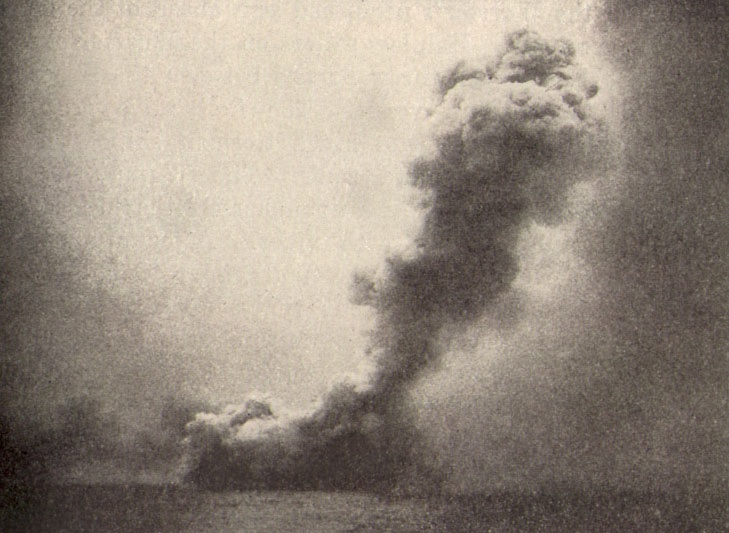
Explosion that sank HMS Queen Mary at the Battle of Jutland, 31 May 1916
Image via Wikimedia Commons.
David Beatty’s famous remark about the destruction of two of his ships by catastrophic magazine explosions during the Battle of Jutland sums up the traditional attitude towards one of the battle’s most famous aspects. Of the 3,326 men aboard the battlecruisers Indefatigable, Queen Mary, and Invincible, only 17 survived. It’s long been believed that the ships themselves were to blame, as they were built with only relatively light armor. Shells supposedly penetrated to the magazines and set them off. Recent research has revealed that this was not the case, and the ships were lost primarily due to defects in operation, not design.
The basic problem with the conventional theory is that no German shell penetrated deep enough into the surviving ships to have been able to set off a magazine if it had hit one. The magazines take up a minority of a battlecruiser’s deck, so if such hits were common, then at least a few of the surviving ships should have seen shells reach their machinery. Instead, German shells were found to detonate with 16-24′ of their first impact with the structure. At the 20° angle the shells were falling at at the time, this puts them no more than 8 feet below the upper deck upon detonation. The only case where shell fragments reached magazine was a hit on Barham at 1758 when fragments from a 12″ shell penetrated the deck over the 6″ magazine. Despite leaving a 12″x15″ hole in the 1″ deck, the fragments had no effect on the powder stored under it.
So is there a different potential cause, one that happened to a surviving ship? A survey of the damage to Beatty’s battlecrusiers reveals a promising candidate. A hit on a turret, such as the one suffered by HMS Lion, could cause a flash to propagate down into the magazine, which would then deflagrate in precisely the manner seen during the battle. A careful examination of Lion‘s damage shows that she came very close to suffering the same fate.
Turret explosions are hardly unknown aboard warships, either as a result of accident or enemy action, and a great deal of care goes into making sure that they don’t set off the magazines. Powder is stored in metal cans or tanks, and flashproof doors and other interlocks are used to make sure that fire does not reach the magazines. Unfortunately, the British had systematically undermined these protections in the search for rate of fire and ammunition capacity, and their magazine practices during the battle can only be described as suicidal.
After the Battle of Dogger Bank, Beatty decided that the reason he was unable to destroy the German battlecruisers was insufficient rate of fire. Not only would opening fire early and firing quickly lead to early hits, but it would also distract the German gunners. However, the British were not particularly confident in their long-range fire control, and began to stuff extra cordite into the handling rooms and other spaces that had been designed to provide flash protection. This was made much worse by a other changes intended to increase rate of fire. Normally, the cordite cases were kept sealed until just before the charges are sent to the gun, but the crews chose to open many of the cases early, take some cordite out of the cases before battle to make it easy to access, and even stored extra charges completely unprotected. In a final effort to make the turrets as dangerous as possible, the majority of the anti-flash safety doors were removed.
The only ship which strongly resisted this trend was Lion, and the efforts of her Gunner, Alexander Grant, deserve most of the credit. When Grant came aboard, he found the situation described above, and quickly reintroduced the traditional magazine safety regulations with the support of Lion‘s captain, Ernle Chatfield. He managed to train the magazine crews to the point where they could provide cordite to the guns faster than the guns could fire it, while observing full safety procedures.
Comments Off on Admiral David Beatty: “There seems to be something wrong with our bloody ships today”
The Battle of Jutland Explained
Ministry of Defence
Published on 25 May 201610,000 men. 250 ships. 12 hours. Two sides. The Battle of Jutland – 100 years ago.
Comments Off on The Battle of Jutland Explained
May 29, 2018
Allied Defense During Spring Offensives 1918 I THE GREAT WAR Special
The Great War
Published on 28 May 2018MHV about Stormtrooper tactics: https://www.youtube.com/watch?v=BNqmA-if-4g
The French and British defenses during the German Spring Offensive 1918 were put to a real test when the Germans attacked. The carefully built defenses had to be abandoned and new lessons had to be learned.
Comments Off on Allied Defense During Spring Offensives 1918 I THE GREAT WAR Special
May 28, 2018
Naval Operations In The Dardanelles Campaign 1915 I THE GREAT WAR On The Road
The Great War
Published on 25 May 2018In our first episode filmed on the former Gallipoli battlefields, Indy and our guide Can Balcioglu explore the naval campaign that preceded the landings at Gallipoli in early 1915.
Comments Off on Naval Operations In The Dardanelles Campaign 1915 I THE GREAT WAR On The Road
May 25, 2018
Bombs Away – German Thirst For Caucasian Oil I THE GREAT WAR Week 200
The Great War
Published on 24 May 2018In the 200th week of the war, the total nature of modern warfare is truly showing its face. The warring nations escalate their bombing campaigns and the German troops in the Caucasus are so thirsty for Caucasian oil, that they are considering to double cross their own allies.
Comments Off on Bombs Away – German Thirst For Caucasian Oil I THE GREAT WAR Week 200
May 22, 2018
The Fightinest Marine – Dan Daly I WHO DID WHAT IN WW1?
The Great War
Published on 21 May 2018Dan Daly was one of only two Marines to be awarded Medals of Honor in two separate conflicts. The first, for his actions in 1901 during the China relief. His second, for his actions during the U.S. invasion and occupation of Haiti in 1915. But he wasn’t done yet and after the U.S. entry into WW1 in April 1917, he was close to receiving his third one on the battlefield of Belleau Wood in France.
Comments Off on The Fightinest Marine – Dan Daly I WHO DID WHAT IN WW1?
May 20, 2018
Black Army of Ukraine – Togoland in WW1I OUT OF THE TRENCHES
The Great War
Published on 19 May 2018Chair of Wisdom Time!
Comments Off on Black Army of Ukraine – Togoland in WW1I OUT OF THE TRENCHES
May 18, 2018
Rebellion I THE GREAT WAR Week 199
The Great War
Published on 17 May 2018The summer of 1918 saw many ethnic and political groups within the warring empires to openly rebel. The Austro-Hungarian Army saw open mutiny every week, the Irish rebelled against the British, the situation in the newly annexed Eastern European territories that were now part of the German Empire was a powder keg. And in France civilians were sentenced to death for treason.
Comments Off on Rebellion I THE GREAT WAR Week 199
May 15, 2018
Evolution of French Infantry During World War 1 I THE GREAT WAR Special
The Great War
Published on 14 May 2018The French soldier in 1914 was already very different from the one in 1918 if you looked at his uniform or equipment. Also the combat tactics evolved considerably in four years of war. The Battle of Verdun, the Nivelle Offensive or the Battle of La Malmaison were important steps during that evolution in which the Poilu became a modern French soldier.
Comments Off on Evolution of French Infantry During World War 1 I THE GREAT WAR Special
May 13, 2018
Marie Curie in WW1 – Who Killed The Red Baron? I OUT OF THE TRENCHES
The Great War
Published on 12 May 2018Chair of Wisdom Time!
Comments Off on Marie Curie in WW1 – Who Killed The Red Baron? I OUT OF THE TRENCHES
May 11, 2018
The Ostende Raid – Peace of Bucharest I THE GREAT WAR Week 198
The Great War
Published on 10 May 2018Even though the first raid on Ostende and the Raid on Zeebrugge were not entirely successful, the Royal Navy is still determined to block access to the German submarine ports in Belgium. And this week they attack Ostende again. Meanwhile, the Germans are planning their next offensives for late May 1918 even though ten percent of the Western Front army has become a casualty in the offensives this year alone.
Comments Off on The Ostende Raid – Peace of Bucharest I THE GREAT WAR Week 198


