Quotulatiousness

November 11, 2019

Mark Knopfler – “Remembrance Day”

Filed under: Britain, Cancon, History, Military, WW1, WW2 — Tags: , — Nicholas @ 04:00

Bob Oldfield
Published on 3 Nov 2011

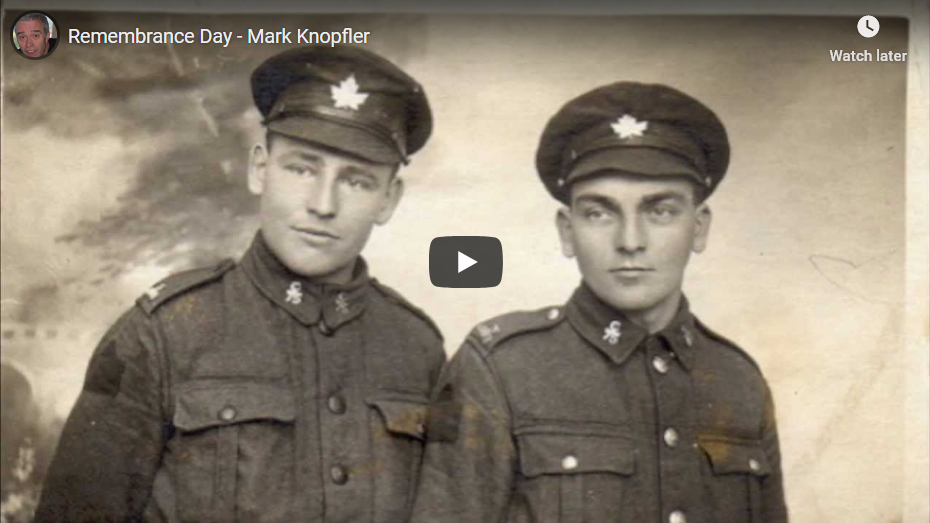
A Remembrance Day slideshow using Mark Knopfler’s wonderful “Remembrance Day” song from the album Get Lucky (2009). The early part of the song conveys many British images, but I have added some very Canadian images also which fit with many of the lyrics. The theme and message is universal… ‘we will remember them’.

In memoriam

Filed under: Britain, History, Military, WW1, WW2 — Tags: , , — Nicholas @ 03:00

A simple recognition of some of our family members who served in the First and Second World Wars:

The Great War

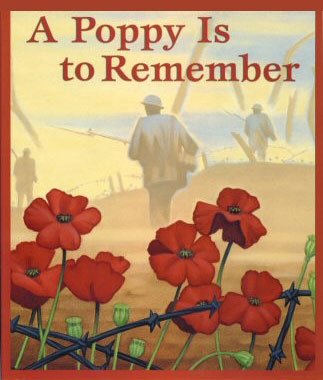
  • A Poppy is to RememberPrivate William Penman, Scots Guards, died 16 May, 1915 at Le Touret, age 25
    (Elizabeth’s great uncle)
  • Private Archibald Turner Mulholland, Argyll & Sutherland Highlanders, mortally wounded 25 September, 1915 at Loos, age 27
    (Elizabeth’s great uncle)
  • Private David Buller, Highland Light Infantry, died 21 October, 1915 at Loos, age 35
    (Elizabeth’s great grandfather)
  • Private Harold Edgar Brand, East Yorkshire Regiment. died 4 June, 1917 at Tournai.
    (My first cousin, three times removed)
  • Private Walter Porteous, Durham Light Infantry, died 4 October, 1917 at Passchendaele, age 18
    (my great uncle)
  • Corporal John Mulholland, Argyll & Sutherland Highlanders, wounded 2 September, 1914 (shortly before the First Battle of the Aisne), wounded again 29 June, 1918, lived through the war.
    (Elizabeth’s great uncle)

The Second World War

  • Flying Officer Richard Porteous, RAF, survived the defeat in Malaya and lived through the war
    (my great uncle)
  • Able Seaman John Penman, RN, served in the Defensively Equipped Merchant fleet on the Murmansk Run (and other convoy routes), lived through the war
    (Elizabeth’s father)
  • Private Archie Black (commissioned after the war and retired as a Major), Gordon Highlanders, captured at Singapore (aged 15) and survived a Japanese POW camp
    (Elizabeth’s uncle)
  • Elizabeth Buller, “Lumberjill” in the Women’s Land Army in Scotland through the war.
    (Elizabeth’s mother)
  • Trooper Leslie Taplan Russon, 3rd Royal Tank Regiment, died at Tobruk, 19 December, 1942 (aged 23).
    Leslie was my father’s first cousin, once removed (and therefore my first cousin, twice removed).

For the curious, the Commonwealth War Graves Commission the Royal British Legion, and the Library and Archives Canada WW1 and WW2 records site provide search engines you can use to look up your family name. The RBL’s Every One Remembered site shows you everyone who died in the Great War in British or Empire service (Canadians, Australians, New Zealanders, South Africans and other Imperial countries). The CWGC site also includes those who died in the Second World War.

In Flanders fields the poppies blow
Between the crosses row on row,
That mark our place; and in the sky
The larks, still bravely singing, fly
Scarce heard amid the guns below.

We are the Dead. Short days ago
We lived, felt dawn, saw sunset glow,
Loved and were loved, and now we lie
In Flanders fields.

Take up our quarrel with the foe:
To you from failing hands we throw
The torch; be yours to hold it high.
If ye break faith with us who die
We shall not sleep, though poppies grow
In Flanders fields.

Lieutenant Colonel John McCrae, MD Canadian Army Medical Corps (1872-1918)

QotD: The British army from WW1 to the end of the Cold War

Filed under: Britain, History, Military, Quotations, WW1, WW2 — Tags: , , — Nicholas @ 01:00

Before WW1 the army was optimised primarily as a colonial police force, coupled with a small expeditionary force of regular soldiers intended to deploy to the continent to work alongside the French or other allies in the event of war. WW1 was an event that really constituted three armies – the small regular/territorial force of barely 300,000 soldiers that mobilised in 1914 and was wiped out to buy time. The interim force of Territorials and Reservists that held the line in 1915-1916 while the army reconstituted, and the civilian volunteer/conscript force from 1916 onwards that saw the army grow to over 4 million men by 1918.

Rapid demobilisation followed, followed by regeneration in the 1920s and 30s to become the most mechanised army in the world by 1939, comprising some 224,000 regulars. It is often forgotten that the British army of 1940 had many more tanks and vehicles than the German Army – history is not kind to the losers. The army in WW2 grew to a citizen force of roughly 3.5 million men, before shrinking post war.

The continuation of National Service, the war in Korea and the end of empire saw the army stay at roughly 330,000 soldiers for much of the 1950s, causing significant damage to the national economy due to the cost and lack of manpower for rebuilding. By 1957 the army estimated that its regular strength was roughly 80,000 personnel (only a quarter of the whole force), many of whom were tied up training two-year National Servicemen. A major factor in the 1957 Sandys Defence White Paper was the need to reduce manpower costs and free people up for other economically important tasks.

The Sandys Review led to a reduction to 165,000 troops most of whom were focused on either colonial policing actions (it is often forgotten that in the early 1960s there were over 100,000 UK service personnel in the Far East) or deployed in Germany as part of the British Army of the Rhine (BAOR). The withdrawal from empire saw the army shrink to a strength of approximately 150,000 by the 1980s, where its role was primarily to provide a corps of four divisions in Germany in the event of general war, supported by mobilisation units from the UK which would provide further divisions to augment BAOR and conduct home defence roles.

The end of the Cold War saw the first deployment of a divisional-sized force, with an armoured division sent to the Gulf in 1990 for Operation Desert Storm. This happened just as the Options for Change review cut BAOR and reduced the army to approximately 120,000. Further deployments to Bosnia and Kosovo in the 1990s followed by the deployment of an armoured division to Iraq in 2003. Operations in Iraq and Afghanistan from 2003-2014 saw the army struggle to sustain itself on two fronts without heavy support from the RN and RAF providing extra manpower and resources.

The 2010 SDSR initially preserved the army at just under 100,000 personnel, although later reviews cut this down to 82,000 regulars supported by a target of approximately 30,000 reservists working in a far more integrated manner. Today the army is struggling to sustain itself at 82,000, with recent manpower figures showing a total of roughly 78,000 troops.

Sir Humphrey, “How Do You Solve a Problem Like a Deployable Division?”, Thin Pinstriped Line, 2017-08-06.

November 4, 2019

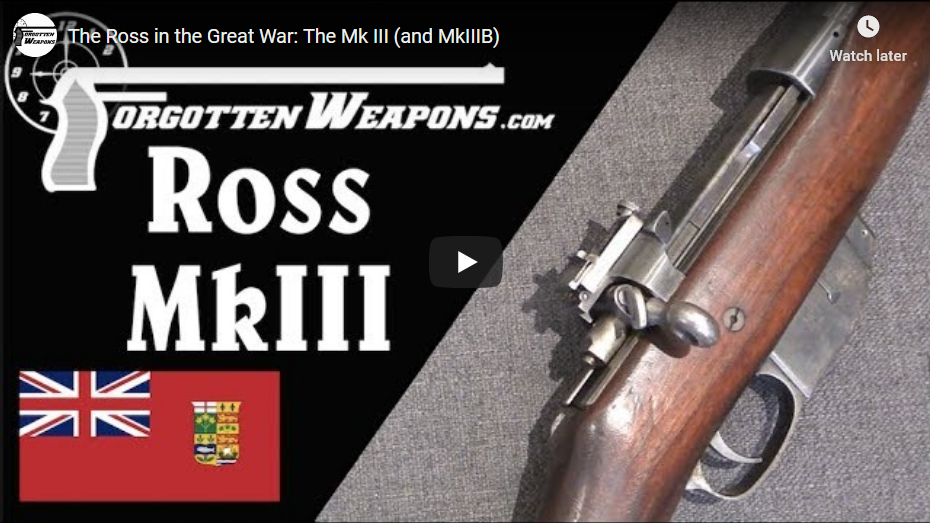
The Ross in the Great War: The Mk III (and MkIIIB)

Filed under: Cancon, History, Military, Weapons, WW1 — Tags: , , , , , — Nicholas @ 02:00

Forgotten Weapons
Published 1 Nov 2019

http://www.patreon.com/ForgottenWeapons

Cool Forgotten Weapons merch! http://shop.bbtv.com/collections/forg…

While the MkII (1905) iteration of the Ross rifle had resolved most of the major mechanical problems from the MkI, it retained a number of characteristics that the Canadian (and British) military was not fond of. In particular, it was not suited to the use of stripper clips. Starting with experimentation on sporting rifles, Ross substantially redesigned the action for the final 1910 pattern – aka the MkIII.

The MkIII used a rotating bolt as before, but with six locking lugs in two rows of three, instead of two large lugs as the MkI and II. The magazine was replaced by a conventional single-stack design, with a stripper clip guide built into the receiver, and with a nicely adjustable rear aperture sight. This would be the model to equip the Canadian infantry who went to Europe to fight in 1914 and 1915 – and it is there that a new set of problems would begin to plague the Ross.

In keeping with its sporting legacy and reputation for outstanding accuracy, the MkIII Ross was made with a rather tight chamber, optimized for the excellent-quality Canadian production .303 ammunition. Britain had been forced to massively increase ammunition supply as the war lengthened, and British standards had widened to accept ammunition that was really of rather questionable quality. The SMLE rifles used by British forces had chambers made to accommodate this, but the Rosses did not. Canadian ammunition was supposed to follow the Canadian troops, but it was usually diverted to other services because of its high quality, and the Canadians left with ammo that was difficult to chamber or extract in the Ross.

This led to men having to beat open rifle bolts, which led to damage to locking lugs, in a viscous circle of escalating problems. By the time of the German gas attack at Ypres, Canadians were ditching their Rosses for Lee Enfields by the thousands, despite specific orders to the contrary. General Haig finally had enough of the issues, and ordered the Ross removed from combat in 1916, to be replaced by the SMLE (which was finally available in sufficient numbers to arm the Canadian troops).

Contact:
Forgotten Weapons
6281 N. Oracle #36270
Tucson, AZ 85704

November 3, 2019

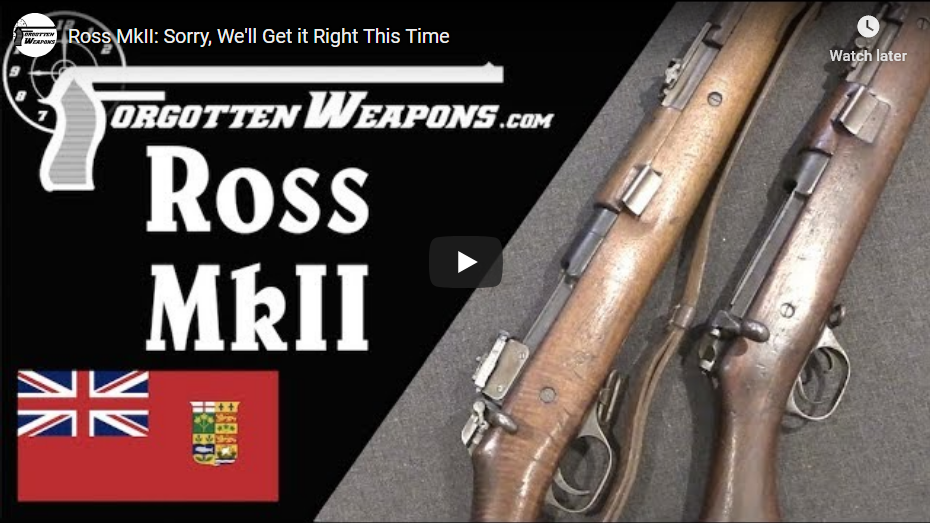
Ross MkII: Sorry, We’ll Get it Right This Time

Filed under: Cancon, History, Military, Weapons, WW1 — Tags: , , , — Nicholas @ 02:00

Forgotten Weapons
Published 30 Oct 2019

http://www.patreon.com/ForgottenWeapons

Cool Forgotten Weapons merch! http://shop.bbtv.com/collections/forg…

The many significant problems with the Model 1903 / MkI Ross rifle had quickly led to the development of the improved MkII design. This strengthened many parts, including the sights, nosecap, bolt latch, and more. The receiver was made thicker, and an extra set of cams added to make the bolt throw smoother. Primary extraction was added by way of angling the locking lugs. Mk II rifles began to come off the Ross Rifle Company production line in December of 1905.

Between its introduction and its replacement by the MkIII in 1912, the MkII Ross would undergo 5 changes in type, mostly involving different rear sights. However, a distinct “long” pattern was also made, designated the MkII**. This model had a longer barrel and some mechanical changes, and was also fitted with a rear aperture sight and stripper clip guide. These would be very successful in competition shooting at the time, and helped salvage the reputation of the Ross after the problems of the MkI.

Overall, 13,700 “long” MkII Rosses were made along with 124,000 of the “short” type. They did see use in World War One, as armament for Canadian artillery units. They were also used as training rifles by the military, and the US government also purchased 20,000 of the MkII3* pattern for use training the multitudes of new US soldiers joining up to fight in Europe.

Many thanks to the private collectors who allowed me access to their rifles to make this video!

Contact:
Forgotten Weapons
6281 N. Oracle #36270
Tucson, AZ 85704

November 2, 2019

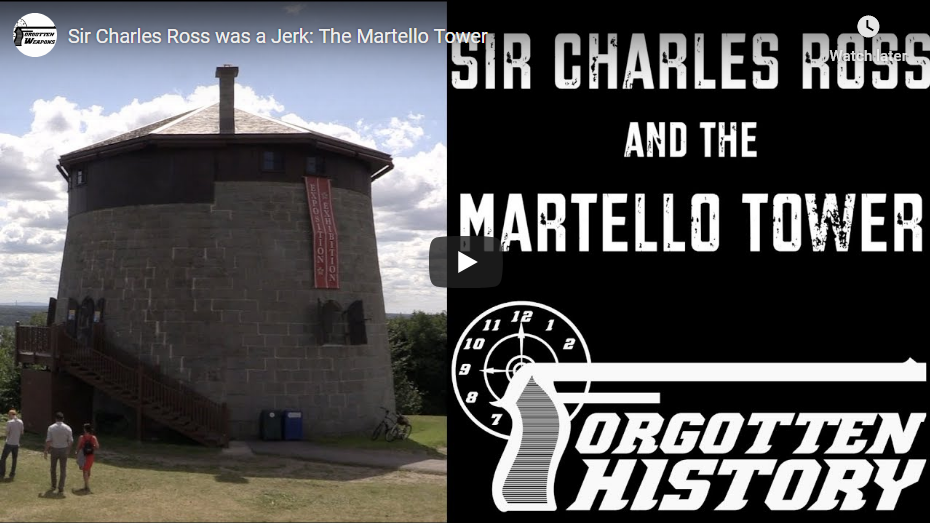
Sir Charles Ross was a Jerk: The Martello Tower

Filed under: Cancon, History, Military, Weapons, WW1 — Tags: , , , , — Nicholas @ 02:00

Forgotten Weapons
Published 29 Oct 2019

Note: These towers were built by the British, not the French. Sorry!

http://www.patreon.com/ForgottenWeapons

Cool Forgotten Weapons merch! http://shop.bbtv.com/collections/forg…

Sir Charles Ross was really a jerk sometimes. Not the sort of guy you would want to go into business with.

Contact:
Forgotten Weapons
6281 N. Oracle #36270
Tucson, AZ 85704

Here are the Wikipedia pages on Sir Charles Ross, Bart. and Martello towers.

October 29, 2019

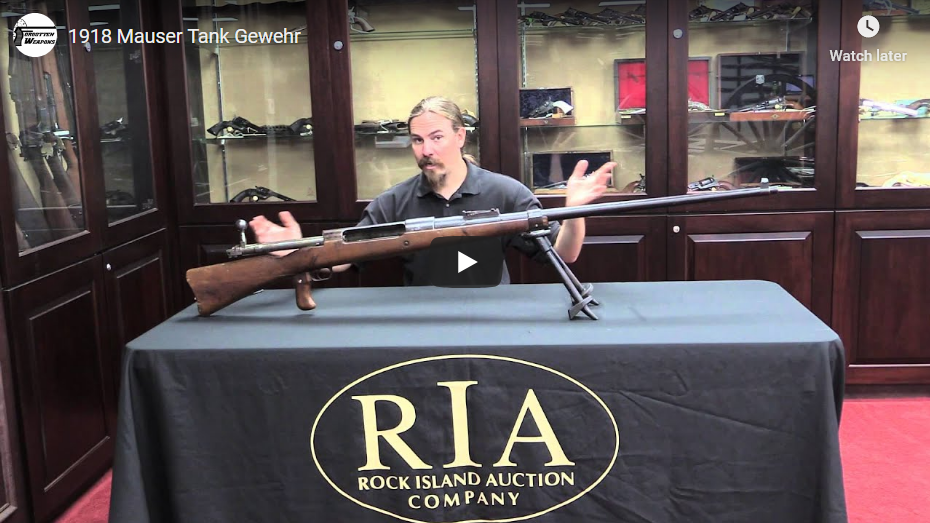
1918 Mauser Tank Gewehr

Filed under: Germany, History, Military, Weapons, WW1 — Tags: , , — Nicholas @ 02:00

Forgotten Weapons
Published on 23 Aug 2015

http://www.patreon.com/ForgottenWeapons

Cool Forgotten Weapons Merch! http://shop.bbtv.com/collections/forg…

Hammer price: $4,750

Germany was the first country to produce a purpose-built antitank rifle, in response to the major Entente tank attack at Cambrai. The design was pretty simple, basically a scaled-up Mauser 98 with 4 locking lugs chambered for the massive 13.2mm TuF cartridge. It would perforate about 20mm of armor plate at 100m, which was nicely effective on WWI tanks. By the end of the war more than 15,000 had been made. Interestingly, a bunch of them ended up at Springfield Armory, where they were used in the development of the .50 BMG cartridge.

October 28, 2019

The Surrender of the Imperial German High Seas Fleet

Filed under: Britain, Germany, History, Military, WW1 — Tags: , , , — Nicholas @ 06:00

Historigraph
Published 26 Oct 2019

Buy Historigraph Posters here! https://teespring.com/en-GB/surrender…
Support the channel on Patreon: https://www.patreon.com/historigraph

#SurrenderOfTheHighSeasFleet #OperationZZ #Historigraph

►Twitter: https://twitter.com/historigraph
►Instagram: https://www.instagram.com/historigraph
►Patreon: https://www.patreon.com/historigraph
►Discord: https://discord.gg/vAFTK2D

Music:

Crypto, Incompetech https://incompetech.com

Rynos Theme, Incompetech https://incompetech.com

Britain’s Naval March, “Hearts of Oak”

Kaiserlicher MarinemarschGruß an Kiel

October 18, 2019

“Angels Calling” – Trench Warfare – Sabaton History 037 [Official]

Filed under: History, Media, Military, WW1 — Tags: , , , — Nicholas @ 06:00

Sabaton History
Published 17 Oct 2019

Trench Warfare was the reality for countless soldiers fighting on the the fronts of World War One. It was a hell on earth. Soldiers had to endure mud, cold, stench of decaying bodies, endless artillery and gas barrages and enemy raiding parties. The Sabaton Song “Angels Calling” is about daily life on the frontlines of The Great War.

Support Sabaton History on Patreon: https://www.patreon.com/sabatonhistory

Listen to Attero Dominatus (where “Angels Calling” is featured):
CD: http://bit.ly/AtteroDominatusStore
Spotify: http://bit.ly/AtteroDominatusSpotify
Apple Music: http://bit.ly/AtteroDominatusAppleMusic
iTunes: http://bit.ly/AtteroDominatusiTunes
Amazon: http://bit.ly/AtteroDominatusAmzn
Google Play: http://bit.ly/AtteroDominatusGooglePlay

Check out the trailer for Sabaton’s new album The Great War right here: https://www.youtube.com/watch?v=HCZP1…

Listen to Sabaton on Spotify: http://smarturl.it/SabatonSpotify
Official Sabaton Merchandise Shop: http://bit.ly/SabatonOfficialShop

Hosted by: Indy Neidell
Written by: Markus Linke and Indy Neidell
Directed by: Astrid Deinhard and Wieke Kapteijns
Produced by: Pär Sundström, Astrid Deinhard and Spartacus Olsson
Creative Producer: Joram Appel
Executive Producers: Pär Sundström, Joakim Broden, Tomas Sunmo, Indy Neidell, Astrid Deinhard, and Spartacus Olsson
Post-Production Director: Wieke Kapteijns
Maps by: Eastory
Edited by: Iryna Dulka
Sound Editing by: Marek Kaminski

Eastory YouTube Channel: https://www.youtube.com/channel/UCEly…
Archive by: Reuters/Screenocean https://www.screenocean.com
Music by Sabaton.

Sources:
National Army Museum
National Library of Scotland
Bibliothèque nationale de France
Wellcome Images
Sleeping soldiers courtesy of FORTEPAN/Komlós Péter
Crosshair by DTDesign from the Noun Project
Colorized photos by Alexander Vedel Christensen
IWM: Q 69986, Q 45584, Q 6420, Q 6419, Q 33350, Q 745, Q 6421, Q 24579, Q 10685, Q 445, Q 32420, Q 517, Q 65065, Q 69983, Q 79501, Q 9333, E(AUS) 572, E(AUS) 1497, Q 6969

An OnLion Entertainment GmbH and Raging Beaver Publishing AB co-Production.

© Raging Beaver Publishing AB, 2019 – all rights reserved.

From the comments:

Sabaton History
2 days ago
What? The Sabaton History special editions of EVERY album? Nooo.. Really? Sounds awesome! And.. How can I get those? … As a reward for supporting Sabaton History on Patreon? Get out of here! .. Oh.. I should head over to https://www.patreon.com/sabatonhistory to check it out? Gotcha! Cheers!

October 11, 2019

Bethlehem Steel 37mm Cannon – WWI Era

Filed under: France, History, Military, USA, Weapons, WW1 — Tags: , , — Nicholas @ 02:00

Forgotten Weapons
Published on 6 Jul 2014

http://www.forgottenweapons.com

Theme music by Dylan Benson – http://dbproductioncompany.webs.com

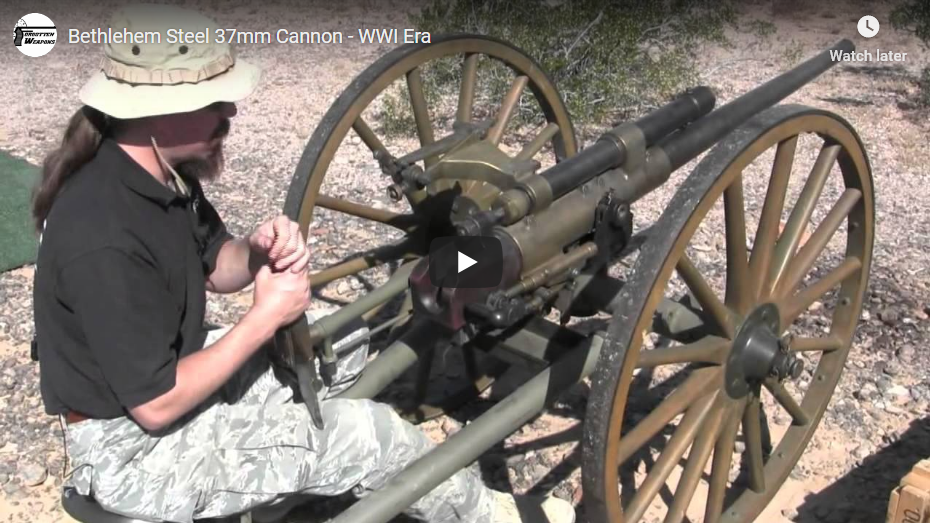
The 37mm gun was found in many guises during World War One – that caliber was the smallest allowed to use exploding projectiles by the 1899 Hague accords. Every nation in the world, it seems, used 37mm guns of one type or another. Well, one particular version I had the chance to look at was built by Bethlehem Steel in Pennsylvania for the French Army. Chambered for the same 37x136mm Hotchkiss Heavy cartridge used in US naval service, 200 were purchased in 1916. Only 15 were actually shipped before the US Army seized the bulk of the order in 1917 – but they were never put into any sort of service by the US military. The French tested the guns for suitability as an infantry gun, anti-tank gun, anti-aircraft gun, and naval landing gun – and found it unsuitable for all roles. It was probably tested only as a backup in case the redesign of the Mle 1916 Tir Rapid ran into problems.

At any rate, the 15 guns sent to France were sent back at the end of the war, and the guns remained in US Army inventory until 1921, when they appear to have been distributed out the National Guard units.

I think this is a very cool gun for the present-day enthusiast. In addition to the historical links to WWI, it has the practical benefits of being relatively light and using ammunition relatively inexpensive to reload. And, of course, the free mount and shoulder rest and iron sights give it more the feel of a shoulder rifle than later light artillery that use precisely adjusted mounts. This one is just more fun to shoot! Alas, there are very few still in existence. Perhaps an opportunity for someone who wants to make a reproduction Big Boy’s Toy?

September 28, 2019

The Freikorps Fights On – Estonia and Latvia War For Independence I THE GREAT WAR 1919

Filed under: Britain, Germany, History, Military, Russia, WW1 — Tags: , , , , , — Nicholas @ 06:00

The Great War
Published 27 Sep 2019

Support 16 Days in Berlin: https://realtimehistory.net/indiegogo

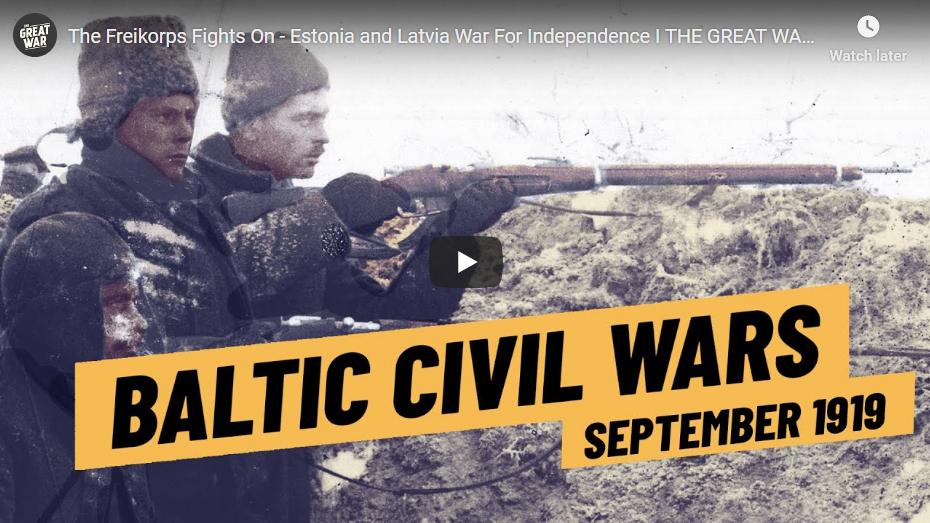
After the Battle of Cesis it seemed the situation in Latvia and Estonia was about to quieten down. But the German soldiers in the region and the ongoing conflict with Bolshevik Russia meant the 2nd half of 1919 saw even more fighting in the Baltics.

» SUPPORT THE CHANNEL
Patreon: https://www.patreon.com/thegreatwar
Merchandise: https://shop.spreadshirt.de/thegreatwar/

»CREDITS
Presented by: Jesse Alexander
Written by: Jesse Alexander
Director: Toni Steller & Florian Wittig
Director of Photography: Toni Steller
Sound: Toni Steller
Editing: Toni Steller
Mixing, Mastering & Sound Design: http://above-zero.com
Maps: Daniel Kogosov (https://www.patreon.com/Zalezsky)
Research by: Jesse Alexander
Fact checking: Florian Wittig

Channel Design: Alexander Clark
Original Logo: David van Stephold

A Mediakraft Networks Original Channel

Contains licensed material by getty images
All rights reserved – Real Time History GmbH 2019

September 20, 2019

“Cliffs of Gallipoli” Part 2 – The Great War – Sabaton History 033 [Official]

Filed under: Britain, History, Media, Middle East, Military, WW1 — Tags: , , — Nicholas @ 04:00

Sabaton History
Published on 19 September 2019

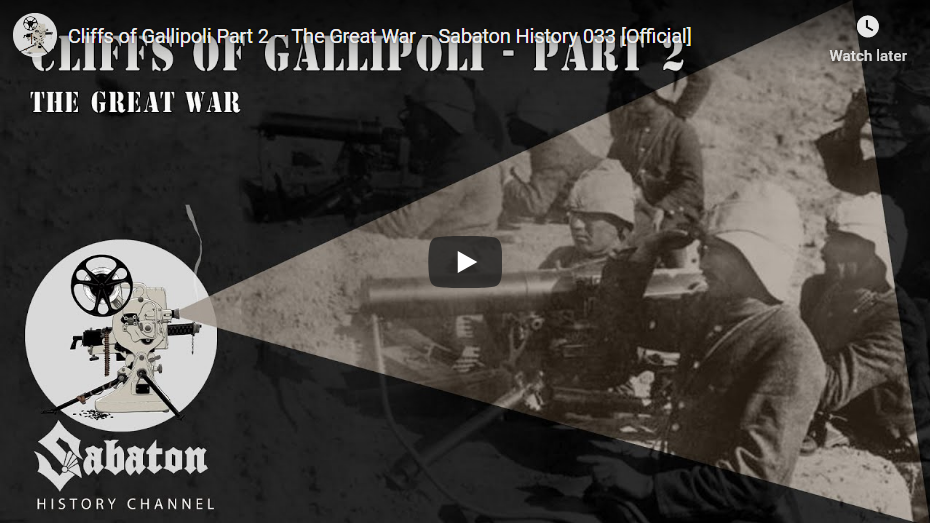
The second part of our coverage of the Sabaton song “Cliffs of Gallipoli” is about the brutal fighting that took place once the landings had come to a standstill. A stalemate similar to the Western Front caused thousands of Ottoman and Allied soldiers to have to endure endless charges, barrages, sniper fire in addition to the hot summer climate of South-Eastern Europe.

Support Sabaton History on Patreon: https://www.patreon.com/sabatonhistory

Watch Part 1 of Cliffs of Gallipoli here: https://youtu.be/oDac6Oswyns

Listen to The Art of War (where “Cliffs of Gallipoli” is featured):
CD: http://bit.ly/TheArtOfWarStore
Spotify: http://bit.ly/TheArtOfWarSpotify
Apple Music: http://bit.ly/TheArtOfWarAppleMusic
iTunes: http://bit.ly/TheArtOfWariTunes
Amazon: http://bit.ly/TheArtOfWarAmz
Google Play: http://bit.ly/TheArtOfWarGooglePlay

Watch the Official Lyric Video of Cliffs of Gallipoli here: https://www.youtube.com/watch?v=oOCe2…

Hosted by: Indy Neidell
Written by: Markus Linke and Indy Neidell
Directed by: Astrid Deinhard and Wieke Kapteijns
Produced by: Pär Sundström, Astrid Deinhard and Spartacus Olsson
Creative Producer: Joram Appel
Executive Producers: Pär Sundström, Joakim Broden, Tomas Sunmo, Indy Neidell, Astrid Deinhard, and Spartacus Olsson
Maps by: Eastory
Edited by: Iryna Dulka
Sound Editing by: Marek Kaminski

Eastory YouTube Channel: https://www.youtube.com/channel/UCEly…
Archive by: Reuters/Screenocean https://www.screenocean.com
Music by Sabaton.

Sourses:
– IWM: Q 13450, 2509-07, Q 13324, Q 13249, Q 13219, HU 57426, Q 13585, Q 13676, Q 13667, Q 13637, Q 13714, Q 13663, Q 13680, Q 13709, Q 13335, Q 13285, Q 13447, Q 56637, HU 105641, Q 13622, Q 13633, Q 13647, Q 13689, Q 13677, Q14394, Q 13625
– Australian War Memorial
– A soldier of the Indian Labour Corps courtesy of National Army Museum of New Zealand

An OnLion Entertainment GmbH and Raging Beaver Publishing AB co-Production.

© Raging Beaver Publishing AB, 2019 – all rights reserved.

Huot: Canada’s Ross-based Prototype Automatic Rifle from WW1

Filed under: Cancon, History, Military, Weapons, WW1 — Tags: , , , , — Nicholas @ 02:00

Bloke on the Range
Published on 18 Jul 2019

Patreon: https://www.patreon.com/BlokeOnTheRange

Due to a shortage of Lewis guns and a glut of withdrawn Ross Mk.III rifles once the Canadian Expeditionary Force had been completely re-equipped with Lee-Enfield SMLE rifles, Monsieur Huot proposed to modify Ross rifles into an automatic rifle / light machine gun (LMG) configuration.

5 of these are known to exist, this is number 2, and is in the Seaforth Highlanders of Canada museum in Vancouver: https://www.seaforthhighlanders.ca/ho…

Many thanks to them for the opportunity to handle and film this exceptionally rare piece! Please give them a visit!

September 15, 2019

Worse Than Versailles? – The Treaty of Saint-Germain I THE GREAT WAR 1919

Filed under: Europe, History, WW1 — Tags: , , , , , , — Nicholas @ 04:00

The Great War
Published on 13 Sep 2019

Signup for your FREE trial to The Great Courses Plus here: http://ow.ly/F9LC30po9ux

The Great Courses Plus is currently available to watch through a web browser to almost anyone in the world and optimized for the US, UK, and Australian markets. The Great Courses Plus is currently working to both optimize the product globally and accept credit card payments globally.

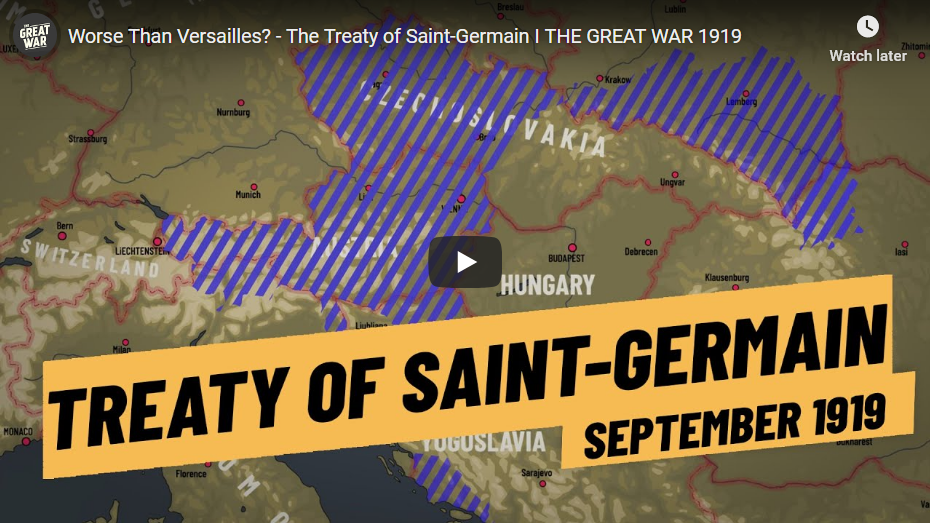
The Treaty of Versailles between the Allies and Germany was only one of the peace treaties that followed the defeat of the Central Powers. The new Austrian republic, one of the countries that emerged from the collapse of the Austro-Hungarian Empire, also tried to get a favorable deal with the Allies in Paris in 1919. Like Versailles, the The Treaty of Saint-Germain caused an outcry across the country.

» SUPPORT THE CHANNEL
Patreon: https://www.patreon.com/thegreatwar
Merchandise: https://shop.spreadshirt.de/thegreatwar/

»CREDITS
Presented by: Jesse Alexander
Written by: Jesse Alexander
Director: Toni Steller & Florian Wittig
Director of Photography: Toni Steller
Sound: Toni Steller
Editing: Toni Steller
Mixing, Mastering & Sound Design: http://above-zero.com
Motion Design: Christian Graef – GRAEFX
Maps: Daniel Kogosov (https://www.patreon.com/Zalezsky)
Research by: Jesse Alexander
Fact checking: Florian Wittig

Channel Design: Alexander Clark
Original Logo: David van Stephold

A Mediakraft Networks Original Channel

Contains licensed material by getty images
All rights reserved – Real Time History GmbH 2019

September 14, 2019

Apocrypha: WW1 Tour Sneak Peek

Filed under: Cancon, France, History, Military, WW1 — Tags: , , , — Nicholas @ 04:00

Forgotten Weapons

Want to see all of my Apocrypha behind-the-scenes videos? They are a perk for Patrons who help directly support Forgotten Weapons:

http://www.patreon.com/ForgottenWeapons

Cool Forgotten Weapons merch! http://shop.bbtv.com/collections/forg…

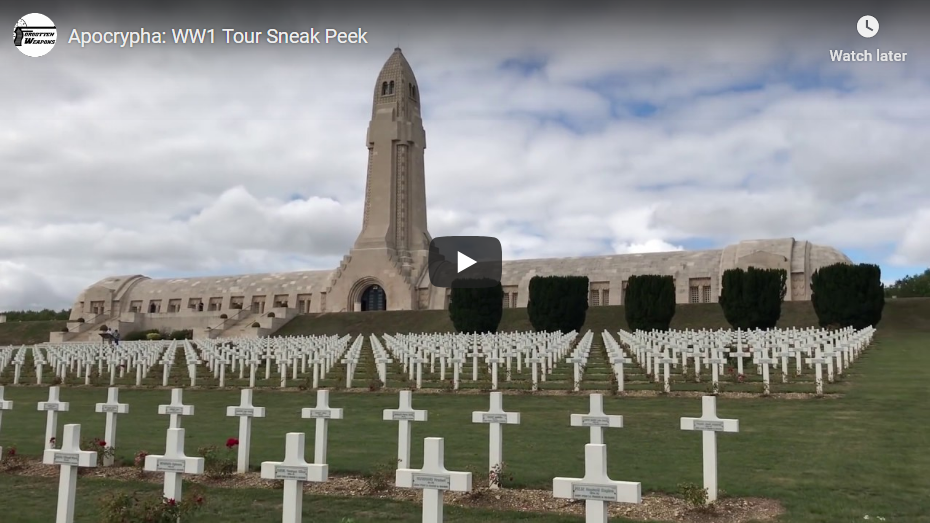
I partnered up with Military Historical Tours to guide a World War One battlefield tour this week, and I figured I’d give you a bit of a peek into it. We are looking at the war chronologically, starting with a day in Belgium to look at the German attack in 1914, visiting the remains of Fort de Loncin in Liege and the Mons cemetery. Next was a day in Ypres for the stagnation into trench warfare in 1915, seeing the Dodengang up on the Yser and then the Bayernwald trenches, Passchendaele Museum, and Kitchener’s Wood. The year of 1916 marks two of the huge Western Front offensives, and we took one day on the Somme (Beaumont-Hamel and Lochnagar Crater) and a day at Verdun (Driant’s command post and tomb, Fort Vaux, Fleury Village, and the Douaumont Ossuary). Today we move to the Chemin des Dames to look at the disastrous French Nivelle Offensives at the Plateau de Californie and the Caverne du Dragons, and tomorrow we will see the arrival of significant American forces and the Hundred Days Offensive the ended the war, through the sites of Les Mares Farm, Belleau Wood, and Blanc Mont. We have a great group of people along, and it’s been a lot of fun, if quite sobering at times. I hope to see you on a future tour!

https://www.miltours.com

Contact:
Forgotten Weapons
6281 N. Oracle #36270
Tucson, AZ 85704

« Newer PostsOlder Posts »

Powered by WordPress