Quotulatiousness

October 18, 2019

“Angels Calling” – Trench Warfare – Sabaton History 037 [Official]

Filed under: History, Media, Military, WW1 — Tags: , , , — Nicholas @ 06:00

Sabaton History
Published 17 Oct 2019

Trench Warfare was the reality for countless soldiers fighting on the the fronts of World War One. It was a hell on earth. Soldiers had to endure mud, cold, stench of decaying bodies, endless artillery and gas barrages and enemy raiding parties. The Sabaton Song “Angels Calling” is about daily life on the frontlines of The Great War.

Support Sabaton History on Patreon: https://www.patreon.com/sabatonhistory

Listen to Attero Dominatus (where “Angels Calling” is featured):
CD: http://bit.ly/AtteroDominatusStore
Spotify: http://bit.ly/AtteroDominatusSpotify
Apple Music: http://bit.ly/AtteroDominatusAppleMusic
iTunes: http://bit.ly/AtteroDominatusiTunes
Amazon: http://bit.ly/AtteroDominatusAmzn
Google Play: http://bit.ly/AtteroDominatusGooglePlay

Check out the trailer for Sabaton’s new album The Great War right here: https://www.youtube.com/watch?v=HCZP1…

Listen to Sabaton on Spotify: http://smarturl.it/SabatonSpotify
Official Sabaton Merchandise Shop: http://bit.ly/SabatonOfficialShop

Hosted by: Indy Neidell
Written by: Markus Linke and Indy Neidell
Directed by: Astrid Deinhard and Wieke Kapteijns
Produced by: Pär Sundström, Astrid Deinhard and Spartacus Olsson
Creative Producer: Joram Appel
Executive Producers: Pär Sundström, Joakim Broden, Tomas Sunmo, Indy Neidell, Astrid Deinhard, and Spartacus Olsson
Post-Production Director: Wieke Kapteijns
Maps by: Eastory
Edited by: Iryna Dulka
Sound Editing by: Marek Kaminski

Eastory YouTube Channel: https://www.youtube.com/channel/UCEly…
Archive by: Reuters/Screenocean https://www.screenocean.com
Music by Sabaton.

Sources:
National Army Museum
National Library of Scotland
Bibliothèque nationale de France
Wellcome Images
Sleeping soldiers courtesy of FORTEPAN/Komlós Péter
Crosshair by DTDesign from the Noun Project
Colorized photos by Alexander Vedel Christensen
IWM: Q 69986, Q 45584, Q 6420, Q 6419, Q 33350, Q 745, Q 6421, Q 24579, Q 10685, Q 445, Q 32420, Q 517, Q 65065, Q 69983, Q 79501, Q 9333, E(AUS) 572, E(AUS) 1497, Q 6969

An OnLion Entertainment GmbH and Raging Beaver Publishing AB co-Production.

© Raging Beaver Publishing AB, 2019 – all rights reserved.

From the comments:

Sabaton History
2 days ago
What? The Sabaton History special editions of EVERY album? Nooo.. Really? Sounds awesome! And.. How can I get those? … As a reward for supporting Sabaton History on Patreon? Get out of here! .. Oh.. I should head over to https://www.patreon.com/sabatonhistory to check it out? Gotcha! Cheers!

October 11, 2019

Bethlehem Steel 37mm Cannon – WWI Era

Filed under: France, History, Military, USA, Weapons, WW1 — Tags: , , — Nicholas @ 02:00

Forgotten Weapons
Published on 6 Jul 2014

http://www.forgottenweapons.com

Theme music by Dylan Benson – http://dbproductioncompany.webs.com

The 37mm gun was found in many guises during World War One – that caliber was the smallest allowed to use exploding projectiles by the 1899 Hague accords. Every nation in the world, it seems, used 37mm guns of one type or another. Well, one particular version I had the chance to look at was built by Bethlehem Steel in Pennsylvania for the French Army. Chambered for the same 37x136mm Hotchkiss Heavy cartridge used in US naval service, 200 were purchased in 1916. Only 15 were actually shipped before the US Army seized the bulk of the order in 1917 – but they were never put into any sort of service by the US military. The French tested the guns for suitability as an infantry gun, anti-tank gun, anti-aircraft gun, and naval landing gun – and found it unsuitable for all roles. It was probably tested only as a backup in case the redesign of the Mle 1916 Tir Rapid ran into problems.

At any rate, the 15 guns sent to France were sent back at the end of the war, and the guns remained in US Army inventory until 1921, when they appear to have been distributed out the National Guard units.

I think this is a very cool gun for the present-day enthusiast. In addition to the historical links to WWI, it has the practical benefits of being relatively light and using ammunition relatively inexpensive to reload. And, of course, the free mount and shoulder rest and iron sights give it more the feel of a shoulder rifle than later light artillery that use precisely adjusted mounts. This one is just more fun to shoot! Alas, there are very few still in existence. Perhaps an opportunity for someone who wants to make a reproduction Big Boy’s Toy?

September 28, 2019

The Freikorps Fights On – Estonia and Latvia War For Independence I THE GREAT WAR 1919

Filed under: Britain, Germany, History, Military, Russia, WW1 — Tags: , , , , , — Nicholas @ 06:00

The Great War
Published 27 Sep 2019

Support 16 Days in Berlin: https://realtimehistory.net/indiegogo

After the Battle of Cesis it seemed the situation in Latvia and Estonia was about to quieten down. But the German soldiers in the region and the ongoing conflict with Bolshevik Russia meant the 2nd half of 1919 saw even more fighting in the Baltics.

» SUPPORT THE CHANNEL
Patreon: https://www.patreon.com/thegreatwar
Merchandise: https://shop.spreadshirt.de/thegreatwar/

»CREDITS
Presented by: Jesse Alexander
Written by: Jesse Alexander
Director: Toni Steller & Florian Wittig
Director of Photography: Toni Steller
Sound: Toni Steller
Editing: Toni Steller
Mixing, Mastering & Sound Design: http://above-zero.com
Maps: Daniel Kogosov (https://www.patreon.com/Zalezsky)
Research by: Jesse Alexander
Fact checking: Florian Wittig

Channel Design: Alexander Clark
Original Logo: David van Stephold

A Mediakraft Networks Original Channel

Contains licensed material by getty images
All rights reserved – Real Time History GmbH 2019

September 20, 2019

“Cliffs of Gallipoli” Part 2 – The Great War – Sabaton History 033 [Official]

Filed under: Britain, History, Media, Middle East, Military, WW1 — Tags: , , — Nicholas @ 04:00

Sabaton History
Published on 19 September 2019

The second part of our coverage of the Sabaton song “Cliffs of Gallipoli” is about the brutal fighting that took place once the landings had come to a standstill. A stalemate similar to the Western Front caused thousands of Ottoman and Allied soldiers to have to endure endless charges, barrages, sniper fire in addition to the hot summer climate of South-Eastern Europe.

Support Sabaton History on Patreon: https://www.patreon.com/sabatonhistory

Watch Part 1 of Cliffs of Gallipoli here: https://youtu.be/oDac6Oswyns

Listen to The Art of War (where “Cliffs of Gallipoli” is featured):
CD: http://bit.ly/TheArtOfWarStore
Spotify: http://bit.ly/TheArtOfWarSpotify
Apple Music: http://bit.ly/TheArtOfWarAppleMusic
iTunes: http://bit.ly/TheArtOfWariTunes
Amazon: http://bit.ly/TheArtOfWarAmz
Google Play: http://bit.ly/TheArtOfWarGooglePlay

Watch the Official Lyric Video of Cliffs of Gallipoli here: https://www.youtube.com/watch?v=oOCe2…

Hosted by: Indy Neidell
Written by: Markus Linke and Indy Neidell
Directed by: Astrid Deinhard and Wieke Kapteijns
Produced by: Pär Sundström, Astrid Deinhard and Spartacus Olsson
Creative Producer: Joram Appel
Executive Producers: Pär Sundström, Joakim Broden, Tomas Sunmo, Indy Neidell, Astrid Deinhard, and Spartacus Olsson
Maps by: Eastory
Edited by: Iryna Dulka
Sound Editing by: Marek Kaminski

Eastory YouTube Channel: https://www.youtube.com/channel/UCEly…
Archive by: Reuters/Screenocean https://www.screenocean.com
Music by Sabaton.

Sourses:
– IWM: Q 13450, 2509-07, Q 13324, Q 13249, Q 13219, HU 57426, Q 13585, Q 13676, Q 13667, Q 13637, Q 13714, Q 13663, Q 13680, Q 13709, Q 13335, Q 13285, Q 13447, Q 56637, HU 105641, Q 13622, Q 13633, Q 13647, Q 13689, Q 13677, Q14394, Q 13625
– Australian War Memorial
– A soldier of the Indian Labour Corps courtesy of National Army Museum of New Zealand

An OnLion Entertainment GmbH and Raging Beaver Publishing AB co-Production.

© Raging Beaver Publishing AB, 2019 – all rights reserved.

Huot: Canada’s Ross-based Prototype Automatic Rifle from WW1

Filed under: Cancon, History, Military, Weapons, WW1 — Tags: , , , , — Nicholas @ 02:00

Bloke on the Range
Published on 18 Jul 2019

Patreon: https://www.patreon.com/BlokeOnTheRange

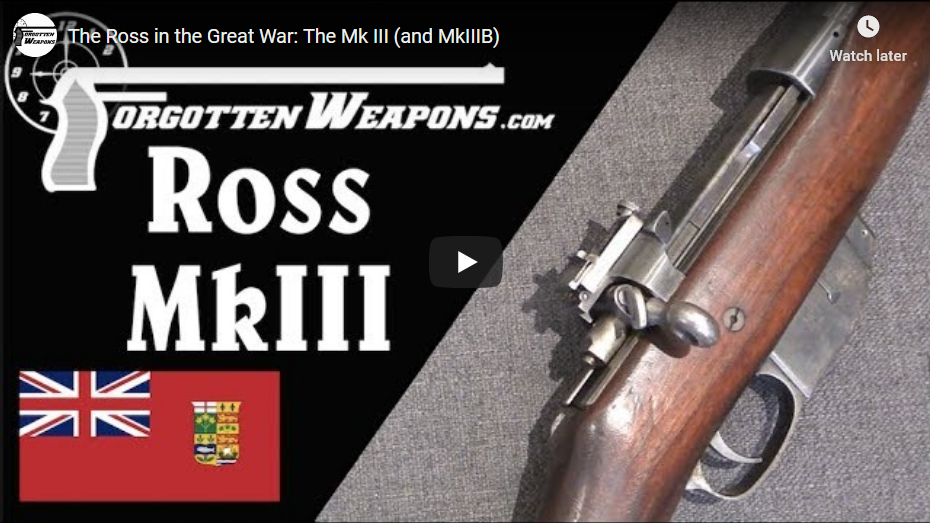
Due to a shortage of Lewis guns and a glut of withdrawn Ross Mk.III rifles once the Canadian Expeditionary Force had been completely re-equipped with Lee-Enfield SMLE rifles, Monsieur Huot proposed to modify Ross rifles into an automatic rifle / light machine gun (LMG) configuration.

5 of these are known to exist, this is number 2, and is in the Seaforth Highlanders of Canada museum in Vancouver: https://www.seaforthhighlanders.ca/ho…

Many thanks to them for the opportunity to handle and film this exceptionally rare piece! Please give them a visit!

September 15, 2019

Worse Than Versailles? – The Treaty of Saint-Germain I THE GREAT WAR 1919

Filed under: Europe, History, WW1 — Tags: , , , , , , — Nicholas @ 04:00

The Great War
Published on 13 Sep 2019

Signup for your FREE trial to The Great Courses Plus here: http://ow.ly/F9LC30po9ux

The Great Courses Plus is currently available to watch through a web browser to almost anyone in the world and optimized for the US, UK, and Australian markets. The Great Courses Plus is currently working to both optimize the product globally and accept credit card payments globally.

The Treaty of Versailles between the Allies and Germany was only one of the peace treaties that followed the defeat of the Central Powers. The new Austrian republic, one of the countries that emerged from the collapse of the Austro-Hungarian Empire, also tried to get a favorable deal with the Allies in Paris in 1919. Like Versailles, the The Treaty of Saint-Germain caused an outcry across the country.

» SUPPORT THE CHANNEL
Patreon: https://www.patreon.com/thegreatwar
Merchandise: https://shop.spreadshirt.de/thegreatwar/

»CREDITS
Presented by: Jesse Alexander
Written by: Jesse Alexander
Director: Toni Steller & Florian Wittig
Director of Photography: Toni Steller
Sound: Toni Steller
Editing: Toni Steller
Mixing, Mastering & Sound Design: http://above-zero.com
Motion Design: Christian Graef – GRAEFX
Maps: Daniel Kogosov (https://www.patreon.com/Zalezsky)
Research by: Jesse Alexander
Fact checking: Florian Wittig

Channel Design: Alexander Clark
Original Logo: David van Stephold

A Mediakraft Networks Original Channel

Contains licensed material by getty images
All rights reserved – Real Time History GmbH 2019

September 14, 2019

Apocrypha: WW1 Tour Sneak Peek

Filed under: Cancon, France, History, Military, WW1 — Tags: , , , — Nicholas @ 04:00

Forgotten Weapons

Want to see all of my Apocrypha behind-the-scenes videos? They are a perk for Patrons who help directly support Forgotten Weapons:

http://www.patreon.com/ForgottenWeapons

Cool Forgotten Weapons merch! http://shop.bbtv.com/collections/forg…

I partnered up with Military Historical Tours to guide a World War One battlefield tour this week, and I figured I’d give you a bit of a peek into it. We are looking at the war chronologically, starting with a day in Belgium to look at the German attack in 1914, visiting the remains of Fort de Loncin in Liege and the Mons cemetery. Next was a day in Ypres for the stagnation into trench warfare in 1915, seeing the Dodengang up on the Yser and then the Bayernwald trenches, Passchendaele Museum, and Kitchener’s Wood. The year of 1916 marks two of the huge Western Front offensives, and we took one day on the Somme (Beaumont-Hamel and Lochnagar Crater) and a day at Verdun (Driant’s command post and tomb, Fort Vaux, Fleury Village, and the Douaumont Ossuary). Today we move to the Chemin des Dames to look at the disastrous French Nivelle Offensives at the Plateau de Californie and the Caverne du Dragons, and tomorrow we will see the arrival of significant American forces and the Hundred Days Offensive the ended the war, through the sites of Les Mares Farm, Belleau Wood, and Blanc Mont. We have a great group of people along, and it’s been a lot of fun, if quite sobering at times. I hope to see you on a future tour!

https://www.miltours.com

Contact:
Forgotten Weapons
6281 N. Oracle #36270
Tucson, AZ 85704

September 13, 2019

“Cliffs of Gallipoli” Part 1 – The Great War – Sabaton History 032 [Official]

Filed under: Britain, History, Media, Middle East, Military, WW1 — Tags: , , — Nicholas @ 06:00

Sabaton History
Published on 12 Sep 2019

While the British were already dying by the thousands in the trenches in Western Europe, their high command decided to try to break the stalemate with an attack on the Ottoman Empire in the Dardanelles. This is the first episode on the Sabaton song “Cliffs of Gallipoli” about the Allied landings on the shores off Gallipoli.

Support Sabaton History on Patreon: https://www.patreon.com/sabatonhistory

Listen to The Art of War (where “Cliffs of Gallipoli” is featured):
CD: http://bit.ly/TheArtOfWarStore
Spotify: http://bit.ly/TheArtOfWarSpotify
Apple Music: http://bit.ly/TheArtOfWarAppleMusic
iTunes: http://bit.ly/TheArtOfWariTunes
Amazon: http://bit.ly/TheArtOfWarAmz
Google Play: http://bit.ly/TheArtOfWarGooglePlay

Watch the Official Lyric Video of “Cliffs of Gallipoli” here: https://www.youtube.com/watch?v=oOCe2…

Hosted by: Indy Neidell
Written by: Markus Linke and Indy Neidell
Directed by: Astrid Deinhard and Wieke Kapteijns
Produced by: Pär Sundström, Astrid Deinhard and Spartacus Olsson
Creative Producer: Joram Appel
Executive Producers: Pär Sundström, Joakim Broden, Tomas Sunmo, Indy Neidell, Astrid Deinhard, and Spartacus Olsson
Maps by: Eastory
Edited by: Iryna Dulka
Sound Editing by: Marek Kaminski

Eastory YouTube Channel: https://www.youtube.com/channel/UCEly…
Archive by: Reuters/Screenocean https://www.screenocean.com
Music by Sabaton.

Sources:
– IWM: Q 57165, Q 1309, Q 515124, Q 13550, Q 13411, Q 53319, Q 13297, Art. IWM ART 4279, Q 112876, IWM ART 2452
– Photos of Ottoman Cavalry courtesy of the National Library of Israel
– Archives New Zealand
– New Zealand troops landing at Gallipoli taken by Joseph McBride

An OnLion Entertainment GmbH and Raging Beaver Publishing AB co-Production.

© Raging Beaver Publishing AB, 2019 – all rights reserved.

From the comments:

Sabaton History
2 days ago (edited)
Thats right, “Cliffs of Gallipoli” will be featured in not one but two Sabaton History episodes! The next episode will dive into a different but equally perspective of the battle.

Joakim already mentions it in the call to action of this episode, but we’re making Sabaton History Special Editions of all the older Sabaton albums, just like we did with The Great War. Those who support us at a certain level on Patreon before the end of November will be rewarded with the Sabaton History Edition of the Sabaton album Heroes. Check out our Patreon page to find out more! -> https://www.patreon.com/sabatonhistory

Cheers!

September 12, 2019

Book Review: The Ross Rifle Story

Filed under: Books, Cancon, History, Military, Weapons, WW1 — Tags: , , , , — Nicholas @ 04:00

Forgotten Weapons
Published on 8 Sep 2019

http://www.patreon.com/ForgottenWeapons

Cool Forgotten Weapons merch! http://shop.bbtv.com/collections/forg…

The Ross Rifle Story is the Bible of Ross rifle collecting — it is the only substantial reference work on the subject and it has a tremendous amount of information about the development of the Ross. However, it is also one of the worst-edited firearms reference books I am aware of. It has a second Table of Contents on page 85 — need I say more than that?

Well, I will. The photographs are black and white and often too dark or too light. Beyond it really being two separate manuscripts printed back to back, the organization is really lacking. Finding information in the book is sometimes very difficult, as the subject matter jumps around a lot. The story of the Ross — especially separating the civilian and military development — is a pretty complicated one, and even a well-edited book on the subject might be a bit difficult to parse. This book is really bad at times.

But for all that, it does have the information (with only a few errors), and it’s the only book that does. If you are interested in the Ross, this is a must-have book despite its problems.

A second printing was run in 2002, and not much effort was put into marketing it. Despite the online prices all being $300+, the seller still has a couple dozen copies remaining as of this writing. To order one (for $100 plus shipping, via PayPal) email him at ross.rifle.story@sympatico.ca .

Contact:
Forgotten Weapons
6281 N. Oracle #36270
Tucson, AZ 85704

August 24, 2019

“82nd All The Way” – Alvin York – Sabaton History 029 [Official]

Filed under: History, Media, Military, USA, WW1 — Tags: , , — Nicholas @ 04:00

Sabaton History
Published on 22 Aug 2019

When the Americans joined the Great War in Europe, the 82nd “All American” division was the division that would engage in heavy fighting at St Mihiel. Among them was Alvin York, leading his battalion at the ferocious Battle of Hill 223.

Support Sabaton History on Patreon: https://www.patreon.com/sabatonhistory

Listen to The Great War (Where “82nd All the Way” is featured):
CD: http://nblast.de/SabatonTheGreatWar
Spotify: https://sabat.one/TheGreatWarSpotify
Apple Music: https://sabat.one/TheGreatWarAppleMusic
iTunes: https://sabat.one/TheGreatWarItunes
Amazon: https://sabat.one/TheGreatWarAmazon
Google Play: https://sabat.one/TheGreatWarGooglePlay

Watch the official music video for “82nd All the Way” right here: https://www.youtube.com/watch?v=0LS0Z…

Hosted by: Indy Neidell
Written by: Markus Linke and Indy Neidell
Directed by: Astrid Deinhard and Wieke Kapteijns
Produced by: Pär Sundström, Astrid Deinhard and Spartacus Olsson
Creative Producer: Joram Appel
Executive Producers: Pär Sundström, Joakim Broden, Tomas Sunmo, Indy Neidell, Astrid Deinhard, and Spartacus Olsson
Maps by: Eastory
Edited by: Iryna Dulka
Sound Editing by: Marek Kaminski

Eastory YouTube Channel: https://www.youtube.com/channel/UCEly…
Archive by: Reuters/Screenocean https://www.screenocean.com
Music by Sabaton.

Sources:
– IWM: Q 516, 23706
– National Library of Scotland: 3155
Saturday Evening Post scan and Alvin York portraits courtesy of the Tennessee State Library & Archives.
– National WWI Museum and Memorial
– Alvin York colorized by Chiel Zilverberg

An OnLion Entertainment GmbH and Raging Beaver Publishing AB co-Production.

© Raging Beaver Publishing AB, 2019 – all rights reserved.

From the comments:

Sabaton History
2 days ago
This video is about the 82nd Division who, together with Sergeant Alvin York stormed Hill 223 in September 1918. Just before that, the “Lost Battalion” made a stand against German forces in the same area. We have made an episode about the Sabaton Song “Lost Battalion” as well, which you can watch right here: https://youtu.be/pgNxijbDlJM

We love the reception of our weekly videos, and have some great stuff coming up over coming weeks. We want as many of our fans to see this, so make sure to share this channel with your friends, family, neighbours, colleagues, teachers and other loved ones. You’d be doing them and us a real favour! Cheers!

August 8, 2019

QotD: Austrians – strudel-eating surrender monkeys

Filed under: Europe, History, Italy, Military, Quotations, WW1 — Tags: , , , , , , — Nicholas @ 01:00

Oh yes, did I mention the Austrians? A grand military tradition. The Radetzky march, all that stuff. Let’s look at their record more closely, shall we?

The Austrians (or rather the Habsburgs) built up a moderately large empire by persuading the Magyars that they could be sort of equal partners in the empire in an unequal sort of way, expert politicking and setting one lot of Slavs against another in the Balkans and central Europe, and marrying into the right ducal families in bits of what was later to become Italy. They never quite managed to sort out the Serbs, however, who felt that fighting nobly against the Turks was their speciality, and they were forced out of Switzerland early on by a small boy with an apple on his head.

The year 1683 may reasonably be considered a turning point for Western Christendom. Over the preceding century or so the Turkish Ottoman Empire had steadily advanced up the Balkan peninsula and after being balked, as it were, for many years by Macedonians, Bulgars, Albanians, Serbs, Bosnians, Croats, Slovenians, Slavonians and some I’ve probably forgotten, finally got as far as the Habsburg capital, Vienna, to which they laid siege. The siege failed, and the Turks were repelled, never again to return. Why? Because Austria was rescued by the Poles under Jan III Sobieski.

Under the noted and renowned Empress Maria Theresa, a War of the Austrian Succession was held. In keeping with tradition, it was mainly fought between the French and the English in Belgium (the French, opposed to Austria, won), except for an unimportant sideshow which appears to have been between the French and the Indians in Saratoga. The upshot was naturally that the Austrians let the Prussians have Silesia. Twice, to be on the safe side. A few years later the Seven Years War, largely fought between the English and the French in Belgium (the English, opposed to the Austrians, won) confirmed the result.

When it came to the French revolutionary and the Napoleonic wars, the Habsburgs were naturally on the side of the divine right of kings (well, Marie-Antoinette was a Habsburg herself) and against mob rule, liberty, fraternity, and most certainly equality. In furtherance of this cause, the Austrians fought the French at such places as Marengo, Austerlitz, and Wagram – among other names listed on the Arc de Triomphe in Paris. By 1812 the Austrians decided to try being on the same side as Napoleon for a change. Napoleon promptly invaded Russia, with predictable results. Following Napoleon’s final defeat at a battle in Belgium which the Austrians fortunately weren’t in time to get to, they regained most of their possessions in Italy at the peace talks due to diplomatic manoeuvrings by the master of the art, Metternich, but lost influence in Germany.

In the 1850s Austria failed to back her treaty partner Russia when the latter was invaded by the Turks, French and English in the Crimean war. Sardinia/Savoy/Piedmont, the leading state in the Italian peninsula, fought with the Allies, gaining international favour when it came to removing the Austrian influence during the subsequent wars of the Italian unification. Austria lost battles at places like Magenta and Solferino, and with them most of its Italian possessions except Venice.

In 1864 the Austrians did actually win a battle, a small naval engagement near Heligoland in the North Sea, against the Danes, against whom they were fighting in support of the Prussians over the Schleswig-Holstein question, of course. Emboldened by this masterstroke, they promptly came to blows with their erstwhile allies and were soundly whipped at the battle of Sadowa-Königgratz. The Italians got most of the rest of their country back in the resulting confusion.

The Austrians managed to stay out of trouble for another few decades after that, building up a national economy based on cheap dance music and diplomatic manoeuvrings in the Balkans. Unfortunately they got out of their depth in this respect; in 1914 the foreign minister [actually Chief of the General Staff] Conrad von Hötzendorff, believing himself to be the reincarnation of Metternich, decided to start the First World War to impress a woman he fancied. It could reasonably be argued that all the countries involved lost the First World War, even the winners, but Austria, after some Pyrrhic successes against the Serbs, a certain amount of back-and-forth against the Russians in Galicia and a cheap and ultimately futile win at Caporetto after the Russians had pulled out and the Germans had sent rather a lot of extra troops, ended up losing its entire empire, its monarchy, access to the sea and any self-respect whatsoever. It also managed to export Adolf Hitler to Germany during this period, which was singularly unfortunate; he absorbed Austria into a Greater Germany and then lost a rather big war in the most spectacular of fashions, as you are probably aware. This ended the military involvement of Austria in world affairs, at least for the moment.

I rest my case.

Albert Herring, “Why neither the French nor the Italians are the worst military nation”, Everything2, 2002-01-07.

July 18, 2019

The Allied Occupation of Germany After The Treaty of Versailles I THE GREAT WAR July 1919

Filed under: Britain, France, Germany, History, Military, WW1 — Tags: , , , , , — Nicholas @ 04:00

The Great War
Published on 17 Jul 2019

When the Allied armies marched into German territory in late 1918 under the terms of the armistice, they were surprised to see a relatively untouched land. After the signing of the Treaty of Versailles, the Allied Occupation was made permanent and the troops settled in to stay in a country that did not want them there initially.

» SUPPORT THE CHANNEL
Patreon: https://www.patreon.com/thegreatwar
Merchandise: https://shop.spreadshirt.de/thegreatwar/

» SOURCES
Leonhard, Jörn. Der überforderte Frieden. Versailles und die Welt 1918-1923 (CH Beck, 2018)
Macmillan, Margaret. The Peacemakers: Six Months that Changed the World (London: John Murray, 2001).
Le Naour, Jean-Yves. La Honte noire (Hachette, 2004).
Schröder, Joachim, Watson, Alexander. “Occupation during and after the War (Germany)” in: 1914-1918-online. International Encyclopedia of the First World War https://encyclopedia.1914-1918-online…
Roos, Julia. “Schwarze Schmach” in: 1914-1918-online. International Encyclopedia of the First World War https://encyclopedia.1914-1918-online…
Godfroid, Anne. “Occupation after the War (Belgium and France)” in: 1914-1918-online. International Encyclopedia of the First World War https://encyclopedia.1914-1918-online…
Pawley, Margaret. The Watch on the Rhine: The Military Occupation of the Rhineland, 1918-1930 (I.B.Tauris, 2007).
Hart, Keith. “A Note on the Military Participation of Siam in WWI.” Journal of the Siam Society (ndp): 133–136.
Lauter, Anna-Monika. Sicherheit und Reparationen. Die französische Öffentlichkeit, der Rhein und die Ruhr (1919-1923) (Essen: Klartext, 2006).
Krugler, Gilles. “Allemagne decembre 1918. Les premières heures de l’occupation“. In Revue historique des armées 254 (2009): 76-81. https://journals.openedition.org/rha/…
Mignon, Nicolas. “Boche, ex-ennemie ou simplement femme? Le point de vue des responsables politiques et militaires sur la question des mariages entre militaires belges et femmes allemandes pendant les occupations de la Rhénanie et de la Ruhr (1918-1929).” In Revue belge de Philologie et d’Histoire (2013) 91-4 : 1259-1283.

»CREDITS

Presented by: Jesse Alexander
Written by: Jesse Alexander
Director: Toni Steller & Florian Wittig
Director of Photography: Toni Steller
Sound: Toni Steller
Editing: Toni Steller
Mixing, Mastering & Sound Design: http://above-zero.com
Motion Design: Christian Graef – GRAEFX
Maps: Daniel Kogosov (https://www.patreon.com/Zalezsky)
Research by: Jesse Alexander
Fact checking: Florian Wittig

Channel Design: Alexander Clark
Original Logo: David van Stephold

A Mediakraft Networks Original Channel

Contains licensed material by getty images
All rights reserved – Real Time History GmbH 2019

July 17, 2019

TAB Short: US Military Railway Guns In Action

Filed under: History, Military, Railways, Technology, USA, Weapons, WW1 — Tags: , — Nicholas @ 02:00

The Armourer’s Bench
Published on May 19, 2019

During World War One massive railway guns were used to reach deep behind enemy lines and attack enemy infrastructure with both sides using the massive artillery pieces. In this episode Matt takes a look at some archival footage of America’s massive railway guns ranging from 10 to 16 inches.

Check out our accompanying article for more information and sources at:
https://armourersbench.com/2019/05/19/us-military-railway-guns-in-action/

If you enjoy our work please consider supporting us via Patreon, TAB is a viewer supported, non-monetised channel and any help is very much appreciated!

We have some great new perks, check out our Patreon page here: https://www.patreon.com/thearmourersb…

The Answer:
According to the original footage notes the mystery item is a 60-feet tall captured German field periscope ‘claimed to have been used by the German Crown Prince during the war’.

Footage:
https://catalog.archives.gov/id/24749

July 12, 2019

“Devil Dogs” – U.S. Marines – Sabaton History 023 [Official]

Filed under: Germany, History, Media, Military, USA, WW1 — Tags: , , , — Nicholas @ 06:00

Sabaton History
Published on 11 Jul 2019

The United States entered the battlefields of Europe in 1918. Among the first Americans to participate in the fight were the U.S. Marines, who quickly adopted the name “Devil Dogs”. One of their most notable engagements is the Battle of Belleau Wood in June 1918, where the Marines fought the battle-hardened Germans for 26 days.

Support Sabaton History on Patreon (and possibly get a History Channel special edition): https://www.patreon.com/sabatonhistory

Pre-order The Great War here: https://www.sabaton.net/pre-order-of-…

Check out the trailer for Sabaton’s new album The Great War right here: https://www.youtube.com/watch?v=HCZP1…

Watch more videos on the Sabaton YouTube channel: https://www.youtube.com/user/Sabaton?…
Listen to Sabaton on Spotify: http://smarturl.it/SabatonSpotify
Official Sabaton Merchandise Shop: http://bit.ly/SabatonOfficialShop

Hosted by: Indy Neidell
Written by: Markus Linke and Indy Neidell
Directed by: Astrid Deinhard and Wieke Kapteijns
Produced by: Pär Sundström, Astrid Deinhard and Spartacus Olsson
Creative Producer: Joram Appel
Executive Producers: Pär Sundström, Joakim Broden, Tomas Sunmo, Indy Neidell, Astrid Deinhard, and Spartacus Olsson
Maps by: Eastory
Edited by: Iryna Dulka
Sound Editing by: Marek Kaminski

Eastory YouTube Channel: https://www.youtube.com/channel/UCEly…
Archive by: Reuters/Screenocean https://www.screenocean.com
Music by Sabaton.

Sources:
IWM: Q 61342, Q 70181, NTB 319-2, IWM 687, 1061-08e, IWM 508-67, IWM 501-9, IWM 435, IWM 778, Q 98994, IWM 484

An OnLion Entertainment GmbH and Raging Beaver Publishing AB co-Production.

© Raging Beaver Publishing AB, 2019 – all rights reserved.

From the comments:

Sabaton History
2 days ago
This episode is about the US Marines and their actions during the Battle of Belleau Wood in 1918. While most of the footage in this episode is depicting the Marines and the Germans in 1918, and some of it is even depicting the actual fighting in Belleau wood, there is not a whole lot footage or imagery from the action. So for whoever is enough of a history buff to spot that some of our illustrative material is in fact depicting other engagements, well spotted! We try to use authentic material whenever we can, but in the end we have to make an episode visually attractive and dramatic, and we can’t do that with just looking at Indy’s head for 15 minutes (although I’m sure that many of you wouldn’t mind). That was the announcement. Peace, rock on and cheers!

July 5, 2019

“Far From The Fame” – Karel Janoušek – Sabaton History 022 [Official]

Filed under: Europe, History, Media, Military, WW1, WW2 — Tags: , , , — Nicholas @ 04:00

Sabaton History
Published on 4 Jul 2019

The life of Karel Janoušek is anything but ordinary. Throughout his live, he served in the militaries and air forces of multiple countries, but time and again he ends up fighting for his native Czechoslovakia. The Sabaton song “Far from the Fame” on the Heroes album describes his life, his adventures and his experiences.

Support Sabaton History on Patreon: https://www.patreon.com/sabatonhistory

Check out the trailer for Sabaton’s new album The Great War right here: https://www.youtube.com/watch?v=HCZP1…

Listen to Sabaton on Spotify: http://smarturl.it/SabatonSpotify
Official Sabaton Merchandise Shop: http://bit.ly/SabatonOfficialShop

Hosted by: Indy Neidell
Written by: Markus Linke and Indy Neidell
Directed by: Astrid Deinhard and Wieke Kapteijns
Produced by: Pär Sundström, Astrid Deinhard and Spartacus Olsson
Creative Producer: Joram Appel
Executive Producers: Pär Sundström, Joakim Broden, Tomas Sunmo, Indy Neidell, Astrid Deinhard, and Spartacus Olsson
Maps by: Eastory
Edited by: Iryna Dulka
Sound Editing by: Marek Kaminski

Eastory YouTube Channel: https://www.youtube.com/channel/UCEly…
Archive by: Reuters/Screenocean https://www.screenocean.com
Music by Sabaton.

Source:
Icon by Stephen Hutchings from iconfinder.com
IWM: 1034-4, Q 97835, Q 112704, Q 112720, D 1730, CH 15869, H 26244, CL 3333), D 10206

An OnLion Entertainment GmbH and Raging Beaver Publishing AB co-Production.

© Raging Beaver Publishing AB, 2019 – all rights reserved.

« Newer PostsOlder Posts »

Powered by WordPress