
World War Two
Published 18 Jun 2022The Soviets have put civilians to work by the hundreds of thousands, building line after line of defenses in the Kursk salient, where they are sure the Germans are soon to attack. Meanwhile the Allies are making moves in preparations for two big upcoming offensives of their own — in Sicily and the Central Solomon Islands.
(more…)
June 19, 2022
Kursk: Soviets Dig-In for Blitzkrieg – WW2 – 199 – June 18, 1943
Comments Off on Kursk: Soviets Dig-In for Blitzkrieg – WW2 – 199 – June 18, 1943
Why Hate Speech Laws Backfire
ReasonTV
Published 26 Feb 2022Here’s a brutal irony about regulating hate speech: Such laws often end up hurting the very people they are supposed to protect.
——————
Follow us on Twitter: https://twitter.com/reasonReason is the planet’s leading source of news, politics, and culture from a libertarian perspective. Go to reason.com for a point of view you won’t get from legacy media and old left-right opinion magazines.
—————-
That’s one of the central lessons in Jacob Mchangama’s important new book, Free Speech: A History from Socrates to Social Media. Mchangama heads up the Danish think tank Justitia. He’s worried about a proposal that would make hate speech a crime under European Union (EU) law and give bureaucrats in Brussels sweeping powers to prosecute people spewing venom at religious and ethnic minorities, members of the LGBT+ community, women, and others.Europe’s history with such laws argues against them. In the 1920s, Germany’s Weimar Republic strictly regulated the press and invoked emergency powers to crack down on Nazi speech. It censored and prosecuted the editor of the anti-Semitic Nazi paper Der Stürmer, Julius Streicher, who used his trial as a platform for spreading his views and his imprisonment as a way of turning himself into a martyr and his cause into a crusade. When the Nazis took power in the early ’30s, Mchangama stresses, they expanded existing laws and precedents to shut down dissent and freedom of assembly.
Contemporary scholarship suggests that there can be a “backlash effect” when governments shut down speech, leading otherwise moderate people to embrace fringe beliefs. Mchangama points to a 2017 study published in the European Journal of Political Research that concluded extremism in Western Europe was fueled in part by “extensive public repression of radical right actors and opinions.”
In 1965, the United Kingdom passed a law banning “incitement to racial hatred,” but one of the very first people prosecuted under it was a black Briton who called whites “vicious and nasty people” in a speech. More recently, Mchangama notes that radical feminists in England “have been charged with offending LGBT+ people because they insist there are biological differences between the sexes. In France, ‘an LGBT+ rights organization was fined for calling an opponent of same-sex marriage a ‘homophobe.'”
“Once the principle of free speech is abandoned,” warns Mchangama, “any minority can end up being targeted rather than protected by laws against hatred and offense.”
That’s what happened in Canada in the 1990s after the Supreme Court there ruled that words and images that “degrade” women should be banned. The decision was based in part on the legal theories of feminist author Andrea Dworkin, whose books on why pornography should be banned were briefly seized by Canadian customs agents under the laws she helped to inspire.
First Amendment rights are still popular in the United States, with 91 percent of us in a recent survey agreeing that “protecting free speech is an important part of American democracy.” But 60 percent of us also said that the government should prohibit people from sharing a racist or bigoted idea.
Hearing hateful words and ideas outrages and discomforts most of us, but Mchangama’s history of free speech underscores that state suppression can grant those words and ideas more power and influence. And that the best antidote to hate in a free and open society is not to hide from it but to openly—and persuasively—confront it.
Listen to my Reason Interview podcast with Jacob Mchangama at https://reason.com/podcast/2022/02/16….
Written by Nick Gillespie. Edited by Regan Taylor.

Comments Off on Why Hate Speech Laws Backfire
June 18, 2022
“Fusion is 30 years away and always will be” … how much progress have we made toward practical fusion energy?
One of the readers of Scott Alexander’s Astral Codex Ten has contributed a review of The Future of Fusion Energy by Jason Parisi and Justin Ball. This is one of perhaps a dozen or so anonymous reviews that Scott publishes every year with the readers voting for the best review and the names of the contributors withheld until after the voting is finished:

Fusion is the power which lights the stars. It is the source of all elements heavier than hydrogen in the universe. Wouldn’t it be great if we could use and control this power here on Earth?
I predict that we will get fusion before 2035 (80%) or 2040 (90%). I am a professional plasma physicist, a fusioneer if you will, so I probably know more about this subject than you, but am likely to overemphasize its importance.
The Future of Fusion Energy is the best introduction to fusion that I know. I can confirm that the information it contains is common knowledge among plasma physicists. My parents, who are not physicists, can confirm that it is accessible and interesting to read.
Things are changing fast in fusion right now, and The Future of Fusion Energy is already out of date in some important ways. I will summarize our quest for fusion as it is portrayed in the book, describe what has happened in the field since 2018, and make some predictions about where we go from here. The predictions are my own and do not reflect the opinions of Parisi or Ball.
Why Don’t We Have Fusion Already?
There is an old joke:
Fusion is 30 years away and always will be.
What happened? Why has fusion failed to deliver on its promise in the past?
By the 1970s, it was apparent that making fusion power work is possible, but very hard. Fusion would require Big Science with Significant Support. The total cost would be less than the Apollo Program, similar to the International Space Station, and more than the Large Hadron Collider at CERN. The Department of Energy put together a request for funding. They proposed several different plans. Depending on how much funding was available, we could get fusion in 15-30 years.
How did that work out?
Along with the plans for fusion in 15-30 years, there was also a reference: “fusion never”. This plan would maintain America’s plasma physics facilities, but not try to build anything new.
Actual funding for fusion in the US has been less than the “fusion never” plan.
The reason we don’t have fusion already is because we, as a civilization, never decided that it was a priority. Fusion funding is literally peanuts: In 2016, the US spent twice as much on peanut subsidies as on fusion research.

Comments Off on “Fusion is 30 years away and always will be” … how much progress have we made toward practical fusion energy?
Do you remember Julia from 2012?
If you don’t remember the amazing life story of Julia Faceless, here’s Chris Bray to refresh your memory:
In 2012, the Obama campaign released a cartoon depiction of the choice America was facing, boiled down to a single figure: The Life of Julia.
Julia was actually, literally faceless, and entirely alone, traveling through life without family, friends, or colleagues. But ahh, like the story about the guy who asks God about the two sets of footprints, Julia wasn’t alone alone: She was supported, at all times, by the endless beneficence of the centralized state, our one true parent and deity, the very lifesource. She was able to begin learning as a child because Barack Obama gave her a HeadStart program; she was able to start a business as an adult because Barack Obama gave her an SBA loan. The God-Patriarch Barack walked with her always, enabling her to live, giving her the substance of her life.
That’s how it works, of course: You need programs so you can do stuff. How can a human being possibly reproduce without government programs to support and subsidize reproduction? It’s a biological impossibility — as is well known, the uterus isn’t even activated until the first government check arrives. You can’t do things on your own, and you certainly can’t do things with the informal support of family, friends, or community. Life requires the empowerment that comes with formalized systems of dependency.
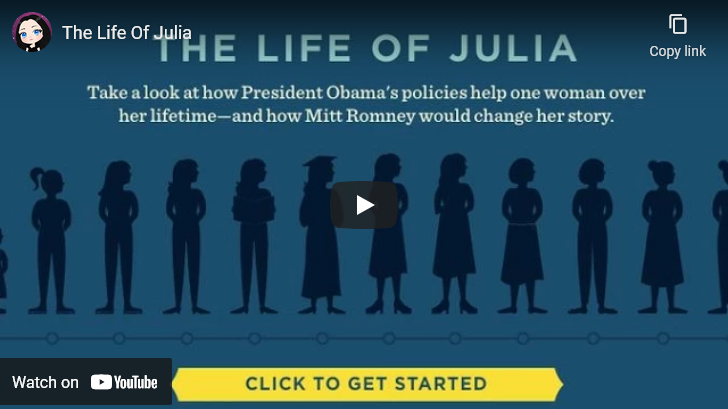
Chris then follows up an earlier post on the administration’s muscular deconstruction of student-led activities and organizations at Stanford with some further evidence that even at the college campus level, deliberate infantilization of adults continues at an ever-increasing pace. Adulting is hard, man!
That’s way beyond you, poor debilitated child. Why don’t you try something that’s within your range of ability, like going for a walk around campus? You know, we have a formal organization that can support you in the attempt. To take a walk. Here. On campus.
The message of stories like this, and the message of the administrative actions they describe, is a message of weakness, fearfulness, debilitation, and dependency: You can’t. Imagine telling a healthy twenty year-old that he shouldn’t try to go camping in the mountains, ’cause it’s probably just way too hard for him. See, Stanford’s student life administrators are helping.
What you’re doing in your late teens and early twenties, whether you go to college or not, is learning adulthood — acquiring habits of independence and resourcefulness that you’ll carry for the rest of your life. (Ideally your parents will already deliver you to legal adulthood with a big part of this training already in place.) The message, don’t try to take a trip to the mountains, it’s too hard for you, is a knife in the heart of that journey. It’s a disgusting and shameful thing to communicate to young adults.
Comments Off on Do you remember Julia from 2012?
M60: Its Purpose, Mechanics, and Development
Forgotten Weapons
Published 25 Feb 2022https://utreon.com/c/forgottenweapons/
http://www.patreon.com/ForgottenWeapons
Cool Forgotten Weapons merch! http://shop.forgottenweapons.com
Contact:
Forgotten Weapons
6281 N. Oracle 36270
Tucson, AZ 85740

Comments Off on M60: Its Purpose, Mechanics, and Development
QotD: Celebrities “came up out of the lagoon and helped themselves to all the culture they could find. They just ate everything.”
SO YOU’RE SAYING CELEBRITIES ARE A CULTURE PROBLEM?
Well, actually, I’m asking.
Are celebrities one of the reasons our culture is now so chaotic and unstable?
There is a strong case for “yes”.
For starters, celebrities have many flaws.
They can be self centered, as when Madonna was asked to celebrate Aretha Franklin. She referenced herself more than 50 times, and Ms. Franklin 4 times.
They can be naive, as when Gal Gadot lead a sing-along with fellow celebrities from the comfort and protection of their beautiful homes. She now agrees this was “in poor taste”.
Celebrities are not durable. That’s our our fault. We raise them up and we strike them down. And because we have the attention span of a French monarch, their moment in the spot light is fleeting. But it means our relationship with them is often fleeting.
Celebrities are vulnerable. Being a celebrity is incredibly perilous. Living in the very thin air up there, no mortal should wish for this. So celebrities suffer. They have break downs. They slide into drug dependency and bad relationships. At this point it is hard for them to be exemplars. Unless of course we are struggling too.
But here’s the key reason to treat celebrities as a culture problem.
In the course of the 20th century, celebrities ate their way through Western society, consuming or discrediting any and every elite that dared compete with them.
In this period, people still cared about scientists and other experts. They saw editors, publishers, judges, and professors as figures of authority. They admired and sought to emulate people of exalted social standing. They looked to religious leaders to address the big issues of the day. Artists, a few of them, were consulted. Designers, some of them, were gods.
This is mostly gone. Celebrities brought them low. It’s not clear that they meant to. It’s more likely that the simply won the popularity contest of contemporary culture.
We could choose between (nearly) dead white males, cranky, pipe smoking, vest wearing, utterly pompous creatures who would occasionally stoop to correct us. Or we could go with the effortlessly charismatic, blindingly beautiful, funny, endearing, eager-to-please people. I mean just look at the people in the “selfie” above. You can’t help but be wowed. Game, set and match to the movie star.
Celebrities remind me of the Rem Koolhaas library in Seattle.
This never fails to make me think of a mechanical monster that’s just crawled out of Seattle’s Elliot Bay and climbed the hill looking for lunch.
That’s what celebrities did. They came up out of the lagoon and helped themselves to all the culture they could find. They just ate everything.
It started with children’s books. They had to write em. Then it was lines of perfume and clothing. They had to design em. Then of course it was politics. How could we possibly do without em? Most of the people running for office in the US are now strikingly attractive. Some of them could actually be part-time models. This is the celebrity effect.
But here’s the other reason that the celebrity influence might be a cause of our instability. It is that they have colonized our young. There are lots of ways of making this argument, but I think “exhibit A” is probably TikTok. This platform matters because it mints celebrity. And that matters because a fifteen year old typically believes he or she matters in exact proportion to his or her fame.
Grant McCracken, “Culture Problem: celebrities”, Future Watch: an anthropological pov, 2022-03-17.
Comments Off on QotD: Celebrities “came up out of the lagoon and helped themselves to all the culture they could find. They just ate everything.”
June 17, 2022
Oikophobia run rampant
In the New English Review, Theodore Dalrymple considers the prevalence of oikophobia in western culture:

In an article for the American Mind, Daniel Mahoney draws our attention to a recent book on the phenomenon of oikophobia, the dislike or even hatred of one’s own country or culture, which now seems so prevalent in western academic and intellectual circles as to be almost an orthodoxy or requirement for acceptance into the intellectual class. Of course, no social trend or phenomenon is entirely new or has an indisputable starting point: for example, George Orwell drew attention to English self-hatred many years ago. But the spread of oikophobia has been of epidemic proportion in late years.
It seems to me that Mr. Mahoney’s analysis can be extended. The first question to ask is why oikophobia should now be so prevalent. To this, I should tentatively reply that it is because of the mass intellectualization of society consequent upon the spread of tertiary education. Intellectuals have an inherent tendency to be oppositional to all received opinion or feeling, for there is no point in going to the trouble of being an intellectual if one ends up thinking and feeling what the great mass of the people around one think and feel. Love of country and inherited custom is so commonplace as to appear almost normal or natural, and much of it, of course, is unreflecting.
But intellectuals are supposed to reflect. That is their function, and they are inclined to reject received opinion, not because it is wrong but because it is received. It goes without saying that received opinion can be wrong and even wicked or evil, in which case the strictures of intellectuals are necessary and salutary; but intellectuals themselves may promote wrong or even wicked opinions, partly from the a priori need to distinguish themselves from the run of mankind.
The phobia in oikophobia is the fear of being taken for one of the common run of mankind.
The second question about oikophobia is the old one of cui bono? Again, one must not confuse the psychological or social origin or function of an opinion with its justification or correctness in the abstract, but once one has decided that an opinion is mistaken or deleterious in its effect, it is natural to ask where it comes from and what interests it serves.
In my opinion, oikophobia is generally bogus, that is to say insincere, as is its cognate, multiculturalism. The oikophobe and the multiculturalist are not really interested in other cultures, except as instruments with which to beat their fellow citizens. The reason for their lack of real interest in other countries is not difficult to find and is of very common application. The fact is that it is very difficult genuinely to enter into a culture, or subculture, other than one’s own, even when that culture or subculture is close to or adjacent to one’s own.
Comments Off on Oikophobia run rampant
June 16, 2022
Among GenZ adults, LGBT identification tracks far higher than LGBT behaviour
In conversation on social media the other day, I speculated that in years gone by, some possibly significant proportion of self-identified lesbians would probably identify as asexuals today. Coming of age long before more relaxed modern attitudes toward non-heterosexual relationships, women who were not attracted to men would probably assume that this lack of attraction meant they must be lesbians. Similarly, Eric Kaufmann discusses a recent survey that shows some interesting divergence among GenZ adults between their declared sexual orientation and their actual behaviour:
A granular look at survey data on same-sex behaviour and LGBT identity shows that identification is increasingly diverging from behaviour. More importantly, those who adopt an LGBT identity but display conventionally heterosexual behaviour are a growing and distinct group, who lean strongly to the left politically and experience considerably greater mental health problems than the rest of the population.
By contrast, those who engage in same-sex behaviour are more politically moderate and psychologically stable. These facts sit awkwardly with the progressive view that the rise in LGBT identity, like left-handedness, is explained by people increasingly feeling that they can come out of the closet because society is more liberal. My analysis of these data raise another interesting question: Has some of the increase in anxiety and depression among young people, like the LGBT identity surge, arisen from a culture that values divergence and boundary-transgression over conformity to traditional norms and roles?
[…]
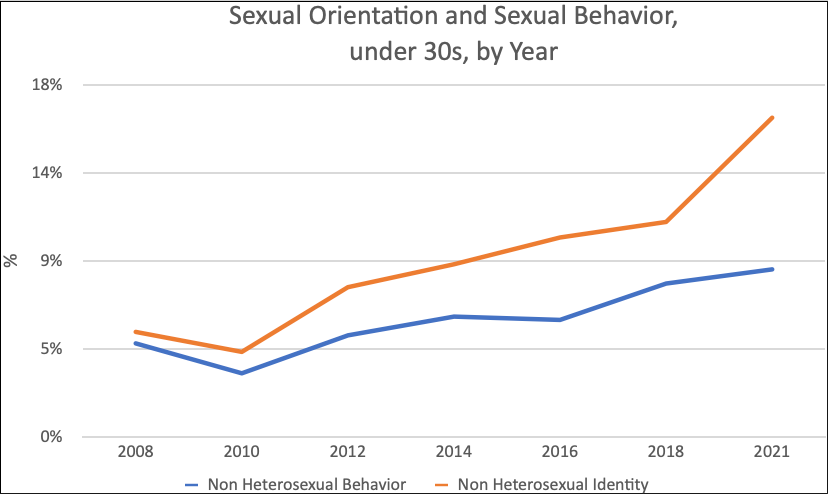
But has the LGBT share of young people really tripled in a decade? It has not. First, a growing share of LGBT identifiers engage in purely heterosexual behaviour. Figure 1, drawn from the General Social Survey (GSS), shows that, in 2008, about five percent of Americans under the age of 30 identified as LGBT and a similar number had a same-sex partnership in that year. By 2021, the proportion identifying as LGBT had increased 11 points to 16.3 percent but the share reporting same-sex relations had only risen four points, to 8.6 percent. LGBT identity had become twice as prevalent as LGBT behaviour. We must also bear in mind that 20 percent of young people now report no sex in the previous year, which means the four-point rise in same-sex partnering since 2008 is actually closer to a three-point rise: not nothing, but hardly a sexual revolution.
The trend towards greater LGBT identification has been particularly pronounced for young women, among whom there are three bisexuals for every lesbian in the 2018–21 period. Among young men, on the other hand, gays outnumber bisexuals and the LGBT total is only half as large as it is for women. Other large major surveys conducted by the Foundation for Individual Rights in Education (FIRE) and by Cooperative Congressional Election Study (CCES) find a similar pattern.
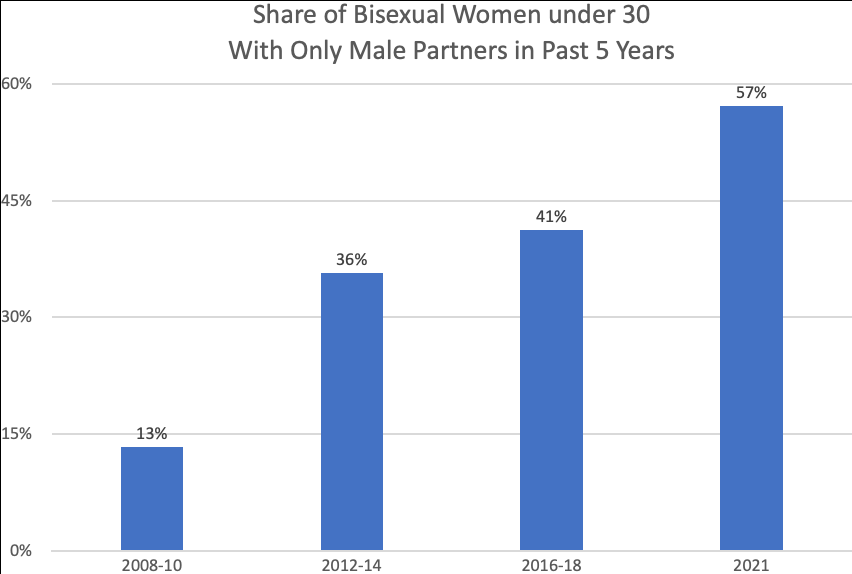
Furthermore, the GSS data show that bisexual women are the fastest-growing category, accounting for a disproportionate share of the post-2010 rise. A closer look at trends among female bisexuals in figure 2 shows that an increasing share of them display conventional sexual behaviour. In 2008–10, just 13 percent of female bisexuals said they only had male partners during the past five years. By 2018 this was up to 53 percent, rising to 57 percent in 2021. Most young female bisexuals today are arguably LGBT in name only.
June 15, 2022
Istanbul: City of Spies – WW2 – Spies & Ties 18
World War Two
Published 14 Jun 2022Neutral Turkey appears to be an island of peace in a sea of war. But if you look a little closer though and there’s another story. Assassins ply their deadly trade. Spies slip in and out of occupied Europe. The Allies and Axis battle for influence. The secret war is in full swing.
(more…)
Comments Off on Istanbul: City of Spies – WW2 – Spies & Ties 18
June 14, 2022
Gender dysphoria and body dysmorphia
Once upon a time, in the dark recesses of ancient history (say, 2015 or so), most of the people expressing dissatisfaction with their birth gender were male. Shortly after that, the numbers inverted significantly and today it’s predominantly females demanding “gender affirming” treatment:
Girls who reject femininity or self identify as male or “non-binary” actually have a form of body dysmorphia. Rejecting their feminine body parts, for instance by flattening their chests, shows repulsion toward the areas they feel are not fit for acceptance. The trend of “binding” to produce a flat, androgynous body is dangerous, cutting off the air supply and possibly causing permanent damage, but it is encouraged as a precursor to transitioning from female to male.
In fact, transgendered people who were born women tend to suffer from eating disorders in an “extremely high proportion”, according to the Duke University Health System.
Make no mistake, a young woman who is dieting obsessively does not wish to look feminine or capable of having children. Many women who achieve their desired weight by extreme dieting cease to have periods and even grow downy hair on the face which resembles the incoming beard of a pre-pubescent man.
So is gender dysphoria essentially interchangeable with body dysmorphia? The woke people working at the NHS and gender reassignment clinics would never admit it, and would deny any correlation despite the statistics. But they are seeing more gender dysphoric young women than ever.
According to this article, entitled “Why Are So Many Females Coming out as Trans/Non-Binary?” in recent years the proportion of young women coming out as trans as opposed to men has increased dramatically. This shows a reversal from the previous trend years ago of more men wishing to become the opposite sex. But the incidence of actual transitions carried out does not show a corresponding rise for women, and that should prove many young women eventually grow out of identifying as trans, or “desist” from the desire to become male. “Desistance” refers to the situation where a young person who experiences gender dysphoria eventually “grows out of it” and decides not to go through with a sex change.
The occurrence of desistance among youngsters supports the position that they should not be allowed to undergo irreversible operations such as mastectomy or be pumped full of hormones (including puberty blocking “treatments”) which they are likely later to regret. Sadly, many medical “experts” don’t believe the figures cited for desistance among young people and discount them as flawed due to the looser criteria for diagnosing gender dysphoria used in the past. In other words, young boys who liked to wear dresses and would have been diagnosed as transgendered in previous years would not so qualify today, but young girls who hate their bodies and want to mutilate their breasts would be eligible for such “treatments”. The reasoning goes on that a whole raft subsisted of boys who were merely “gay boys who may have been experimenting with different ways of expressing gender but who were never really transgender in the first place”.
Such conclusions defy common sense or any logic or human decency. This article cites the findings of one Thomas Steensma, a clinician and researcher at the Centre of Expertise on Gender Dysphoria at the VU University Medical Centre in Amsterdam. He conveniently found in a study that desistance rates were lower in older, female children than in young boys.
H/T to Blazing Cat Fur for the link.
Comments Off on Gender dysphoria and body dysmorphia
QotD: Generation snowflake
So no, no surprises here. Their collective personality makes the Millennials unusually suited for the flirtation with socialism. They are a great match; if this was Tinder, Marx would be getting super liked all the time.
Socialism is the response of a spoiled child when faced with the world that does not genuflect to its every wish the way their parents did – the world as it is must therefore be evil and has to be changed to something radically different. Gen Y, of course, did not just magically became the way they are – they were brought up like that, so we all bear the blame and the responsibility for a generation who resents not being managers in their 20s and not being recognised as special anymore by all their elders. Clearly, the capitalism has failed when I’m not showered down with money after I graduate from my double in media and gender studies.
Arthur Chrenkoff, “Socialism as a Millennial religion”, The Daily Chrenk, 2019-02-19.
Comments Off on QotD: Generation snowflake
June 13, 2022
Lightning fast interceptor turned nuclear strike bomber: the Canadair CF-104 Starfighter
Polyus Studios
Published 29 Sep 2020Don’t forget to like the video and subscribe to my channel!
Support me on Patreon – https://www.patreon.com/polyusstudiosThis is an UPDATED version of the video. It includes many changes and corrections to the original video. Many thanks to Gary Watson for all his contributions!
Starting in 1959 Canadair began building Canada’s fastest jet at their plant in Montreal. It was designed as a sleek high altitude and high speed interceptor, but was adapted for low level ground strike missions with conventional and nuclear weapons. It was the Canadair CF-104 Starfighter, Canada’s missile with a man in it.
0:00 Introduction
0:33 Historical Context
2:01 Design Choice
4:15 Canadair’s Production Run
6:50 Configuration and Specifications
11:04 Nuclear Strike Role
12:13 Operational History
16:06 Conventional Role
17:53 Retirement and Replacement
19:28 Accidents, Controversy and Legacy
22:56 ConclusionMusic:
“Denmark” – Portland Cello ProjectResearch Sources:
Canadair CF-104 Starfighter by Harold A. Skaarup (http://silverhawkauthor.com/canadian-…)
Canadair CF-104 Starfighter by Canadian Starfighter Association (http://canadianstarfighterassociation…)
CF-104 Flight Operations by Air Force Museum of Alberta (https://www.rcaf.museum/history/rcaf-…)
Story of the F-104 Starfighter in Norwegian Service by Bjorn Hafsten (http://starfighter.no/hist-en3.html)
Starfighters with Turkey by Joe Baugher (http://www.joebaugher.com/usaf_fighte…)
ASN Aviation Safety Database by Aviation Safety Network (http://aviation-safety.net/wikibase/d…)
Starfighter by David L. Bashow (Fortress Publication, 1990, ISBN: 0-919195-12-1)
Photography credit 6mins10sec: Gary WatsonFootage Sources:
Personal Footage – Gary Watson
Cold War Fighter Pilot – Ken Castle, CD, Flight-Lieutenant (ret’d) – Canada Aviation and Space Museum (https://youtu.be/sEUOFyPLL94)
CF 104 Baden Soellingen 1965 – Gordon Price (https://youtu.be/4UZ9PE58Eq0)
CF104 Germany 1983/4 441 Squadron CAF – Tom Hammond (https://youtu.be/xrqjAKHflCo)
Great Planes Lockheed F-104 Starfighter – Discovery Channel (1996)
Avro Canada CF 100 Canuck – Avro (1956)#Starfighter #CanadianAerospace #PolyusStudios

Comments Off on Lightning fast interceptor turned nuclear strike bomber: the Canadair CF-104 Starfighter
June 12, 2022
The “w-word” is no longer allowed, please update your Newspeak Dictionary, citizens
Brendan O’Neill on how the dreaded “w-word” is being actively erased from woke vocabulary [Note — to avoid being prosecuted under some progressive British law, I’m protecting the innocent eyes of my readers by substituting [the “w-word”] in this article to avoid offence]:
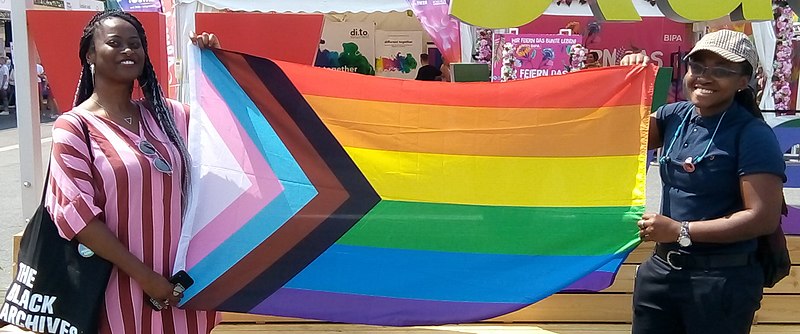
Two people at EuroPride 2019 in Vienna holding an LGBTQ+ pride rainbow flag featuring a design by Daniel Quasar; this variation of the rainbow flag was initially promoted as “Progress” a PRIDE Flag Reboot.
Photo by Bojan Cvetanović via Wikimedia Commons.
Over the past week we have witnessed two biological males – or men, as we used to call them – winning first and second place in a [the “w-word”]‘s cycling race. We’ve watched as the Crown Prosecution Service has hired a diversity consultant who is trans and who has previously suggested that [the “w-word”] could be replaced with “womxn”. We’ve heard that civil servants have received equality training telling them that the phrase “adult human female” – which is the dictionary definition of [the “w-word”] – is a transphobic dogwhistle. We’ve seen the publication of a new study by King’s College London which suggests that one way around sex / gender controversies might be to change the wording of questions in official documents like the census. For example, you could ask respondents “Do you menstruate?” rather than “Are you a [the “w-word”]?”.
Anyone who doubts that the word [the “w-word”], and the entire idea of [the “w-word”]hood, is being erased, sacrificed at the altar of the ideology of transgenderism, will surely have had a rude awakening these past few days. When men can claim [the “w-word”]‘s sporting prizes, it is clear that [the “w-word”]‘s sport risks becoming a thing of the past. When powerful institutions like the CPS and the civil service flirt with the idea that it is sinful to utter the words “adult human female”, it is obvious that even talking about [the “w-word”] has become a risky business. When even someone as globally influential as Michelle Obama uses the unpronounceable word “womxn”, as she did in a story shared to her Instagram page, you know that it’s not just time-rich, purple-haired campus crazies who have tumbled down the rabbit hole of genderfluidity. No, from the sporting world to the political world, from the justice system to the state bureaucracy, the idea that sex can be changed, and that language must be changed to avoid offending the trans minority, is orthodox now.
Strikingly, Mrs Obama’s use of the word “womxn” was related to the Roe v Wade controversy. She shared on Instagram a series of slides created by the nonprofit campaign group When We All Vote. One of them said: “State lawmakers will have the power to strip womxn of the right to make decisions about their bodies and their healthcare.” There is a dark irony to this comment, and one that exposes just how messed up the war on [the “w-word”]hood has become. That Obama-endorsed IG slide frets about [the “w-word”] being stripped of the right to control their bodies and yet it implicitly strips [the “w-word”] of the right to use certain words when they talk about themselves and what they need. “Womxn” is a reprimanding word, used to remind the female masses that their kind includes men now too. As Dictionary.com said of “womxn” when it added it in 2019, it is designed to be “inclusive of trans and non-binary” people. That is, blokes. In stripping out the old, supposedly problematic word “[the “w-word”]“, even as it wrings its hands over [the “w-word”] – sorry, womxn – being stripped of their bodily autonomy, When We All Vote unwittingly highlights the profound confusions and deep illiberalism behind today’s erasure of [the “w-word”]hood.
Barely a day passes without fresh reports about the linguistic war on [the “w-word”]kind. So the recent civil-service story involves a group called A:gender, which supports trans and intersex people who work in government departments. The Times got hold of some training videos A:gender has produced, which are shown to thousands of civil servants every year, one of which claims that it is impossible to define [the “w-word”] and that saying “adult human female” can be “transphobic”. Beware, these woke educators warn the civil service, of “transphobia [that] is increasingly presented as feminism”. To reiterate, this is civil servants we’re talking about, the people responsible for the smooth functioning of the nation. And they’re being told that if you say out loud what the dictionary says [the “w-word”] is, then you are a bigot. They’re being told that the likes of JK Rowling, whose great thoughtcrime is to understand biology, promote hatred dressed up as feminism.
Eisenhower Lays Out His Plans for Sicily – WW2 – 198 – June 11, 1943
World War Two
Published 11 Jun 2022The Allies bomb Mediterranean islands in preparation for their invasion of Sicily next month; they also prepare a lot of deceptions to mislead the enemy as to where they will attack. The German plans for the summer offensive against the Kursk salient are ever more concrete, and in the field this week, the Chinese stop the Japanese offensive cold.
(more…)
Comments Off on Eisenhower Lays Out His Plans for Sicily – WW2 – 198 – June 11, 1943
“Culture is upstream of politics; and the culture is clearly changing”
In the free-to-cheapskates segment of Andrew Sullivan’s Weekly Dish, he discusses some of the cultural sea change convulsing American society and how that will inevitably feed into the political situation in an election year:

A building burning in Minneapolis following the death of George Floyd.
Photo by Hungryogrephotos via Wikipedia.
We]re now two years out from what may in retrospect be seen as peak “social justice”. In the summer of 2020, a hefty section of the elite was enthralled with the idea of the police being defunded, demobilized and demonized. Critical theory’s critique of liberal democracy as a mere mask for “white supremacy” everywhere. Countless people were required to read woke tracts — from DiAngelo to Kendi — as part of their employment. Corporate America jumped in, shedding any pretense of political neutrality; mainstream media swiftly adopted the new language and premises of critical theory. The Trump madness, and his attempted sabotage of an election, largely silenced liberals in their clash with the left. They had a more immediate threat. And rightly so.
But now look where we are.
Last year, Eric Adams became mayor of New York City, propelled by minority voters horrified by surging crime and chaos. This past week, DA Chesa Boudin, scion of leftwing terrorists, was ousted by minority voters in San Francisco, after he allowed much of the city to become a chaotic hellhole in pursuit of “racial justice”.
Recent polling suggests a sea-change in attitudes. Pew found that only three percent of African-Americans put “racism/diversity/culture” as the most important issue to them while 17 percent cited “violence/crime”, and 11 percent said “economic issues”. (Among Democrats overall, “49% now view racism as a major problem, down from 67% about a year ago”.) New York City voters now put “crime” ahead of “racial inequality” as their most urgent concern by a huge ratio of 12:1. Polling in San Francisco found that 67 percent of Asian-Americans wanted Boudin gone — a sign that the Democrats’ ascendant coalition of non-whites is now fast-descendant.
Hispanics also appear to be fleeing the left. In the usually Dem-friendly Quinnipiac poll last month, “48% of Hispanic registered voters said they wanted Republicans to take control of the House of Representatives, while just 34% said they wanted Democrats in power. In addition, 49% of Hispanic voters said they wanted the GOP to win the Senate, while 36% said they wanted Democrats to remain in control of the chamber.” Biden’s approval among Hispanics is now 24 percent. I’m not sure what to make of this, but even if it’s half true, it’s an electoral emergency for Democrats.
Some Dem pols have noticed the vast cultural gap between most Latino voters and wealthy white leftists, and adjusted. Democratic Congressman Ritchie Torres last week criticized the use of the absurd term “Latinx” — because denying the sex binary is not exactly integral to a culture where the language itself is divided into masculine and feminine. AOC, of course, demurs.
Elite imposition of the new social justice religion — indoctrinating children in the precepts and premises of critical race and gender theory — has also met ferocious backlash as parents began to absorb what their kids were being taught: that America is a uniquely evil country based forever on white supremacy; that your race is the most important thing about you; that biological sex must be replaced by socially constructed genders of near-infinite number; and that all this needs to be taught in kindergarten. Yes, some of this was politically exploited or hyped by the right. But if you think there is no there there in this concern about schooling, you’re dreaming.
Across the country, school boards are thereby in turmoil, with those supporting less ideological education on the march. On the question of trans rights, there is broad support for inclusion — but most Americans are understandably uncomfortable with pre-pubescent kids having irreversible sex changes, and with trans women competing with women in sports. For which those normies are called “hateful”.
Comments Off on “Culture is upstream of politics; and the culture is clearly changing”


