
Scenic Routes to the Past
Published 13 Jan 2023This video explores the surprising traces of French and American colonial history along the 150 miles of Mississippi River between St. Louis and Cairo, Illinois.
(more…)
January 14, 2023
Colonial History on the Mississippi River
Comments Off on Colonial History on the Mississippi River
Star Megastar: Spain’s Massive 10mm Autopistol
Forgotten Weapons
Published 19 Sep 2022In the late 1980s, the Spanish gun maker Star decided to join the new hot trend of 10mm semiauto pistols. The cartridge was getting a lot of press, and Star saw this as an opportunity to ride the wave and also the get a pistol on the market that would attract IPSC competitors. Unlike some companies adapting existing .45ACP designs to 10mm, Star decided to start from scratch to build a pistol that was massive and durable; able to handle the power of the cartridge without any worries.
Star engineer Eduardo Zamacola (who had previously designed the M38/30/31 series for Star) had the first prototypes ready in 1990, in both 10mm Auto and .45 ACP. The design took cues from the Petter designs of France and SIG, with full-length internal slide rails and a removable modular fire control system. It offered 12 round capacity in .45 and 14 rounds in 10mm.
The pistol was quite massive and heavy (1.4kg / 3.1 lb), and failed to sell well from the start. The 10mm craze flared out rather quickly — it remains a niche cartridge to this day, despite periodic releases of new 10mm pistols (the SIG 320 in 10mm being the most recent). What really killed the Megastar, though, was the 1994 Assault Weapons Ban in the US. This prohibited new magazines holding more than 10 rounds, and the whole point of the bulk of the Megastar was to allow larger double-stack magazines. With those no longer available, there was really not much reason to get a Megastar instead of something like a 1911. In total, just 978 were made in 10mm and 5,424 in .45ACP, with production ending in 1995.
(more…)
Comments Off on Star Megastar: Spain’s Massive 10mm Autopistol
QotD: What would it be like to always believe you’re right?
I think I’m starting to see it now. The weird disconnect between [progressives’] personal behavior and their collective behavior has always baffled me. We all had great fun with that journalist who called Barack Obama “sort of God”, but it was so funny, in part, because all Leftists present themselves as “sort of God” — I have never been so certain in my judgment, so secure in my righteousness, about anything as the typical Leftist is about everything. I’m pretty comfortable saying “I don’t know” when I really don’t know …
This is not because I’m such a humble guy. If anything, it’s the reverse — it’s because “being right” is such an important part of my self-concept that if I’m going to put my reputation on the line, I need to really BE right. And as we all know, 99% of being right comes from acknowledging all the times you were wrong. Admitting I don’t know when I really don’t know is painless. Admitting I was wrong when I thought I was right stings, but it doesn’t hurt nearly as bad as my own inner self-knowledge of being wrong. That really stings, and so I’d rather take the pain of admitting I was wrong any number of times to the much greater pain of actually being wrong on something fundamental.
To the Leftist, none of that computes. They’re always right. About everything. They literally can’t be wrong. And if what they were right about yesterday is 180 degrees from what they’re right about today, well, that’s just Reality reconfiguring itself. The Earth is stable; it’s the sun and stars that are moving around it. And if that leaves you with deferents and epicycles and retrograde motion and all that, well, so be it. See above, re: the physical impossibility of them being wrong …
… at least as individuals. But get them in a group, and all of a sudden a whole roomful of sort-of-Gods turns into a persecuted minority, even when everyone in the group agrees with everyone else. Even when the group, collectively, controls everything. If you think it’s bad in politics, y’all, go to a faculty meeting at the nearest college. To hear them tell it, the wolf is always at the door. Donald Trump and his jackbooted stormtroopers really are lurking behind every bush, waiting to jump out and pour bleach on them while yelling “This is MAGA country, bitch!” They’re afraid of their own students, because they just know those kids are out there thinking Unapproved Thoughts, and somehow those Unapproved Thoughts can physically harm them … even though they control the grade book, and can — and of course do — punish Unapproved Thought with extreme prejudice.
[…]
If I’m reading Zorost correctly, the answer might be as simple as: They can’t abstract, so they’re literally physically incapable of Reality-testing their heuristics. The Experts have given them the TORAH (that’s The One Right Answer, H8rz!), and since they can only evaluate individual cases as they come into view — they can only micro-focus on each parked car in the lot, to return to the earlier metaphor — they can’t draw the really-obvious-to-non-autists conclusion that they are not a persecuted minority, but in fact control everything.
Severian, “Why Are They Always Underdogs?”, Founding Questions, 2022-09-07.
Comments Off on QotD: What would it be like to always believe you’re right?
January 13, 2023
QotD: Hillary Clinton
Camille Paglia, “Prominent Democratic Feminist Camille Paglia Says Hillary Clinton ‘Exploits Feminism’”, Washington Free Beacon, 2017-05-15.
Comments Off on QotD: Hillary Clinton
January 12, 2023
How the New York Times describes the Congressional Republican dissidents
It’s not the news, it’s the substitution of opinion for reporting:
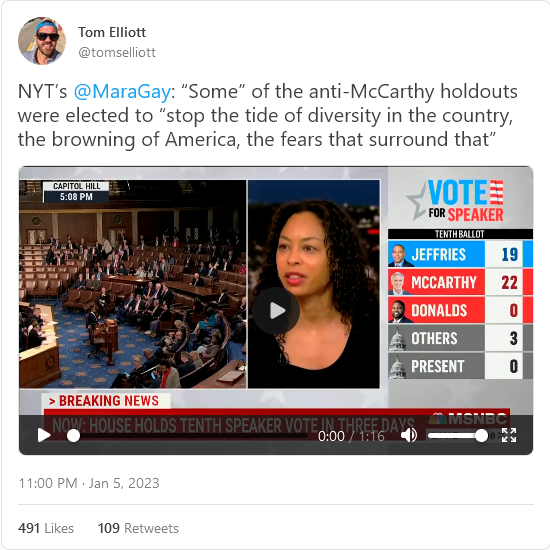
Here’s the political journalist Mara Gay — currently of the New York Times, formerly of the Wall Street Journal and The Atlantic — explaining what the twenty Republican holdouts were up to in their maneuvering over the selection of a Speaker of the House:
It’s leftie Twitter in human form, with all of the slogans. Angry, hateful voters, disturbed by “diversity”, sent some dumb atavists to represent them in D.C., because they hate government and want to “burn it to the ground”. (“And really, that’s what these people were sent to do.”)
Time magazine, which apparently still exists, comes to much the same conclusion, in a piece that I tragically can’t read in full without creating an account, which I wouldn’t do for a free steak dinner or a blanket future pardon from the governor of my choice:
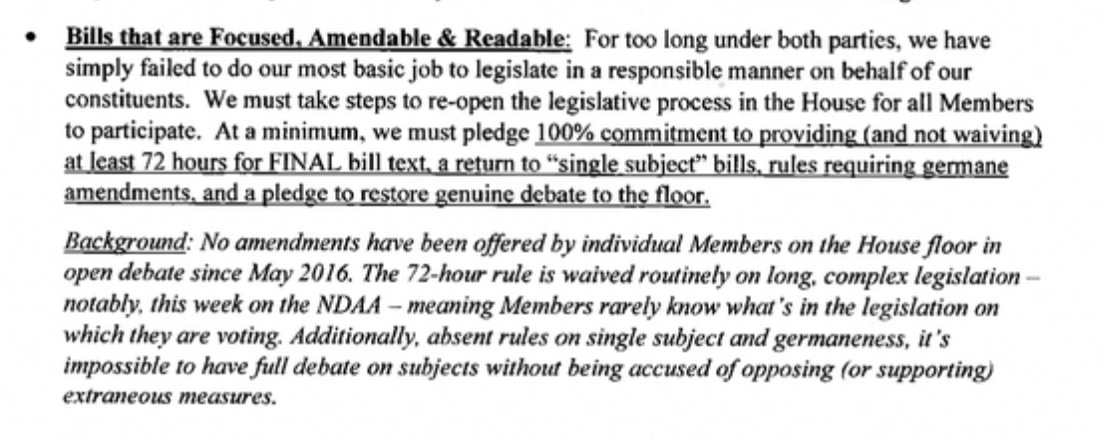
So the twenty GOP holdouts hate government and want to sow chaos and burn democratic norms to the ground, mainstream political journalists calmly explain. Now, via RedState, here’s a letter from seven of the holdouts listing their actual demands as conditions for their vote. Sample demand:
So the monsters who hate government and want to burn it all down were demanding clearly written legislation that every legislator has time to read and fully debate before casting their vote on it.
Subject of Journalism: We want bills that are focused and readable
Journalist: They want to destroy all government because of racism
It’s not even sort of an interpretation or an argument about the thing being discussed — it’s just a wholesale invention, completely severed from the thing that’s allegedly being analyzed. It’s like you ordered a tuna melt, so the waitress broke into your house and mailed your couch to Finland. “There’s your tuna melt,” she says, handing you the receipt from the post office. It’s so aggressive a non-sequitur that it would usually suggest the need for a neurology consult. Have you recently suffered a serious fall, Ms. Gay? Have you experienced dizziness or unexplained nause— oh, wait, I see from your chart that you’re just a political journalist.

Comments Off on How the New York Times describes the Congressional Republican dissidents
January 11, 2023
Al Capone’s Soup Kitchen
Tasting History with Max Miller
Published 10 Jan 2023
(more…)
Comments Off on Al Capone’s Soup Kitchen
“[T]o the ordinary American, those values [diversity, equity, and inclusion] sound virtuous and unobjectionable”
John Sailer writes in The Free Press on the rapid rise of the “diversity, equity, and inclusion” bureaucracy in American higher education:

Graphic for Rhode Island College’s Office of Diversity, Equity and Inclusion.
The principles commonly known as “diversity, equity, and inclusion” (DEI) are meant to sound like a promise to provide welcome and opportunity to all on campus. And to the ordinary American, those values sound virtuous and unobjectionable.
But many working in academia increasingly understand that they instead imply a set of controversial political and social views. And that in order to advance in their careers, they must demonstrate fealty to vague and ever-expanding DEI demands and to the people who enforce them. Failing to comply, or expressing doubt or concern, means risking career ruin.
In a short time, DEI imperatives have spawned a growing bureaucracy that holds enormous power within universities. The ranks of DEI vice presidents, deans, and officers are ever-growing — Princeton has more than 70 administrators devoted to DEI; Ohio State has 132. They now take part in dictating things like hiring, promotion, tenure, and research funding.
More significantly, the concepts of DEI have become guiding principles in higher education, valued as equal to or even more important than the basic function of the university: the rigorous pursuit of truth. Summarizing its hiring practices, for example, UC Berkeley’s College of Engineering declared that “excellence in advancing equity and inclusion must be considered on par with excellence in research and teaching”. Likewise, in an article describing their “cultural change initiative”, several deans at Mount Sinai’s Icahn School of Medicine declared: “There is no priority in medical education that is more important than addressing and eliminating racism and bias.”
DEI has also become a priority for many of the organizations that accredit universities. Last year, the Council for Higher Education Accreditation, along with several other university accrediting bodies, adopted its own DEI statement, proclaiming that “the rich values of diversity, equity and inclusion are inextricably linked to quality assurance in higher education”. These accreditors, in turn, pressure universities and schools into adopting DEI measures.
Much of this happened by fiat, with little discussion. While interviewing more than two dozen professors for this article, I was told repeatedly that few within academia dare express their skepticism about DEI. Many professors who are privately critical of DEI declined to speak even anonymously for fear of professional consequences.
The Invention of DEI
How has this fundamental shift taken place? Gradually, then all at once.
For decades, university administrators have emphasized their commitment to racial diversity. In 1978, Supreme Court Justice Lewis Powell delivered the court’s opinion in Regents of the University of California v. Bakke, taking up the question of racial preferences in higher education. Powell argued that racial preferences in admissions — in other words, affirmative action — could be justified on the basis of diversity, broadly defined. Colleges and universities were happy to adopt his reasoning, and by the 1980s, diversity was a popular rallying cry among university administrators.
By the 2010s, as the number of college administrators ballooned, this commitment to diversity was often backed by bureaucracies that bore such titles as “Inclusive Excellence” or “Diversity and Belonging”. Around 2013, the University of California system — which governs six of the nation’s top 50 ranked universities — began to experiment with mandatory diversity statements in hiring. Diversity statements became a standard requirement in the system by the end of the decade. The University of Texas at Austin in 2018 published a University Diversity and Inclusion Action Plan, which began to embed diversity committees throughout the university.
Then came the Black Lives Matter demonstrations of 2020. The response on campus was a virtual Cambrian explosion of DEI policies. Any institution that hadn’t previously been on board was pressured to make large-scale commitments to DEI. Those already committed redoubled their efforts. UT Austin created a Strategic Plan for Faculty Diversity, Equity, and Inclusivity, calling for consideration of faculty members’ contributions to DEI when considering merit raises and promotion.
White Coats For Black Lives, a medical student organization that calls for the dismantling of prisons, police, capitalism, and patent law, successfully petitioned medical schools around the country to adopt similar plans, including at UNC–Chapel Hill, Oregon Health & Science University, and Columbia University. In some cases, administrators even asked White Coats For Black Lives members to help craft the new plans.
All at once, policies that previously seemed extreme — like DEI requirements for tenure and mandatory education in Critical Race Theory — became widespread.
Comments Off on “[T]o the ordinary American, those values [diversity, equity, and inclusion] sound virtuous and unobjectionable”
January 10, 2023
Catherine the Great & the Volga Germans
Tasting History with Max Miller
Published 16 Aug 2022
(more…)
Comments Off on Catherine the Great & the Volga Germans
QotD: A useful life lesson
Severian, “The Stakeholder State”, Rotten Chestnuts, 2020-01-22.
Comments Off on QotD: A useful life lesson
January 9, 2023
QotD: Property is theft
Pictures of the looting that followed the devastation in New Orleans have been flashed around the world. Everyone is, or at least pretends to be, shocked and horrified, as if the breakdown of law and order couldn’t happen here, wherever here happens to be. Smugness is, after all, one of the most pleasant of feelings; but for myself, I have very little doubt that it could, and would, happen where I live, in Britain, under the same or similar conditions. New Orleans shows us in the starkest possible way the reality of the thin blue line that protects us from barbarism and mob rule.
Of course, an unknown proportion of the looting must have arisen from genuine need and desperation. Who among us would not help himself to food and water if he and his family were hungry and thirsty, and there were no other source of such essentials to hand?
But the pictures that have been printed in the world’s newspapers are not those of people maddened by hunger and thirst, but those of people wading through water clutching boxes of goods that are clearly not for immediate consumption. There are pictures of people standing outside stores, apparently discussing what to take and how to transport it, and of men loading the trunks of cars with a dozen cartons of nonessentials. They are thinking ahead, to when the normal economy reestablishes itself, and the goods that they have stolen will have a monetary value once more.
Theodore Dalrymple, “The Veneer of Civilization”, Manhattan Institute, 2005-09-26.
Comments Off on QotD: Property is theft
January 8, 2023
“Russians 27 miles from Poland!” – Ep 228 – January 7, 1944
World War Two
Published 7 Jan 2023That’s what the headlines say as the Red Army continues its advance in Ukraine. There are also plans afoot for a northern offensive to end the siege of Leningrad. There are also plans afoot for an Allied amphibious attack in Italy at Anzio. Both of these are set to go off within a couple weeks, so January promises to be full of active conflict.
(more…)
Comments Off on “Russians 27 miles from Poland!” – Ep 228 – January 7, 1944
Conservatives “vote harder”, progressives take advantage of “procedural outcome manipulations”
Theophilus Chilton on a key difference between progressives and conservatives in how they address perceived problems with “the system”:

“Polling Place Vote Here” by Scott Beale is licensed under CC BY-NC-ND 2.0 


 .
.
Over the past decade or so, many folks on the broad Right have noticed that practically all of our institutions don’t really work as they should. The natural tendency on the part of normie conservatives is to chalk this up to incompetence and corruption. Granted, those do come into play – and will continue to do so increasingly. Yet structurally speaking, our institutional dysfunctionality runs a lot deeper than a little graft or some skimming off the top. Our institutional failures are both purposeful and towards a specific end.
Normies can perhaps be forgiven for not immediately coming to this conclusion. After all, as the name suggests, they’re the norm. They’re the mainstream. They’re not out on the “fringe” somewhere, for better or for worse. These are conservatives who have been conditioned by decades of playing by the rules to trust the rules and the processes under which government and institutions operate (even if they think they “distrust government” or whatever). They’re the ones who believe we have to keep voting harder because voting is the only “proper” way to act in our system. And yet, many times they end up being mystified that not only do the institutions and procedures not “work right” but that nobody in power (even their own so-called representatives) seems the least bit bothered by this.
Yet, purposeful it truly is. There is a concept about our institutions that I wish every conservative understood, which is that of “manipulating procedure outcomes”. Basically, what this refers to is the process by which bad actors will take an established procedure — a rule or statute, an institution inside or outside of government, a social or political norm — and subvert it to their own use while still “technically” adhering to procedure. However, the process of doing so completely warps the results from those which “should” happen had the procedure been played straight. This intentionality explains why our institutional failures always seem to tend in one direction — Cthulhu always seems to swim left, so to speak. The American Left are masters at manipulating procedural outcomes, while the American Right rigidly tries to adhere to “the way things oughta be” and end up getting outmanoeuvered every time.
Allow me to give some examples of this; seeing them will start to train the eye towards recognising other instances of this process.
Let’s take, for example, the recent revelations of government censorship of dissident ideas and individuals that we saw in the Twitter files. Now, we all know that the government can’t censor speech and ideas because of the First Amendment. So this means that they’d never do so … right? (LOL) Well, as the Twitter files revealed — and which absolutely assuredly applies to every other major tech company in the field — FedGov and the alphabet agencies simply use companies like Twitter as a way to work around the 1A. They can’t censor directly, but they can rely upon a combination of selective pressure on tech companies and ideologically friendly personnel within these companies to censor and gather information about right-leaning, and especially dissident Right, users all the same. And technically, none of this is illegal, because muh private company and all that. So a functional illegality nevertheless remains within the boundaries of “procedure”.
The same type of manipulation is underway with regards to the Second Amendment, too. Again, the plain wording of the 2A, as well as a long train of prior judicial interpretive precedence, militates against federal and state governments really being able to restrict the gun rights of Americans (not that they don’t try anywise). They can’t make it illegal to buy or own guns. Schemes like prohibitively taxing ammo won’t pass muster either. So if you’re a left-wing fruitcake who hates the Constitution and badly wants to disarm your fellow Americans for further nefarious purposes, what do you do?
Well, you make it too legally dangerous for gun owners to actually use their guns for anything beyond target shooting. You install a bunch of Soros-funded prosecutors in all the jurisdictions that you can so that you can go light on criminals but throw the book at gun owners who defend themselves from criminals. You creatively interpret laws to mean that harming someone while defending yourself is a crime or, barring that, open up self-defenders to civil attack from the criminal’s family. From a self-defence perspective you set up an anarchotyrannical regimen that can be used against ideological enemies. This is basically the same thing the Bolsheviks did when they were consolidating their power as “Russia” transitioned to “the Soviet Union”, as recorded by Solzhenitsin in The Gulag Archipelago. They used administrative courts and ideological judges to punish people who legitimately defended themselves against criminals. If you injured someone who was attacking or robbing you, you went to the gulag. Of course, as we’re also seeing today, these criminals were functionally agents of the Regime by that point.
Comments Off on Conservatives “vote harder”, progressives take advantage of “procedural outcome manipulations”
Caesar Salad and Satan’s Playground
The History Guy: History Deserves to Be Remembered
Published 7 Sep 2022The rare example of a food fad that has maintained its popularity, the tangy dressing on romaine lettuce salad has a history as rich as a coddled egg, involving multiple nations, a bevy of movie stars, an infamous American divorcee, a disputed origin story, and, prominently, alcohol. And, perhaps surprising to many, is unrelated to the notorious Roman dictator.
(more…)
Comments Off on Caesar Salad and Satan’s Playground
QotD: Unintended consequences, fuel economy division
whenever americans say that they *need* a massive pickup truck that gets 12mpg just show them the Subaru Sambar
utility vs. ego pic.twitter.com/NqexDbQcok
— sam (@sam_d_1995) May 11, 2022In response, a lot of people will defend their big truck purchase by saying they need a larger vehicle for their family, their business, or just because they like it. And to an extent, market forces are partly responsible for the increase in truck sizes, particularly when it comes to features like crew cabs. But it turns out that even a lot of people who like the big trucks don’t know the full story of how their trucks got so big.
The rest of the story is something the folks at Freakanomics might enjoy because it is a classic tale of unintended consequences. In brief, Obama-era fuel regulations incentivized automakers to build bigger trucks.
One particular goal of the Obama Administration was to increase fuel efficiency through the typical political process: telling someone else to do it. To that end, the DOT and the EPA handed down a series of standards that nearly doubled the miles-per-gallon requirements for cars and light trucks.
The administration praised their own new standards as “groundbreaking”. Transportation Secretary Ray LaHood predicted that the program would “result in vehicles that use less gas, travel farther, and provide more efficiency for consumers than ever before”.
The intent was to put pressure on automakers and force them to work out the engineering to meet the tough new standards. Their blindspot was failing to recognize that by placing the regulations solely on cars and small trucks, they had created a much simpler solution.
The new platform-based standards set fuel economy targets based on wheelbase and tread width, that is, how far apart the wheels are. If your vehicle is longer and wider, the fuel-economy targets shrinks. In the words of Dan Edmunds of Edmunds.com, “There was kind of an incentive to maybe stretch the wheelbase a couple of inches and set the tires maybe an inch [farther] apart, because you get a bigger platform and slightly smaller target.”
The regulations meant to get better mileage out of vehicles also made it easier for larger vehicles to meet fuel-efficiency standards. In what should have been an unsurprising move, when faced with the choice between reengineering their vehicles or simply going bigger, automakers chose to go bigger.
AndToddSaid, “The Real Reason Why Are Trucks Getting Bigger”, Todd’s Mischief blog, 2022-05-13.
Comments Off on QotD: Unintended consequences, fuel economy division
January 7, 2023
Propaganda to support the narrative
Chris Bray is definitely possibly most likely not kidding around here:
We can’t award the gold medal yet, because the contestants are still showing up at the starting line.
Elsewhere at Substack, A Midwestern Doctor recently highlighted some of the most egregious vaccine propaganda that appeared during the current forever-pandemic, in a piece that has the potential to safely and effectively vaccinate your mind against bullshit:
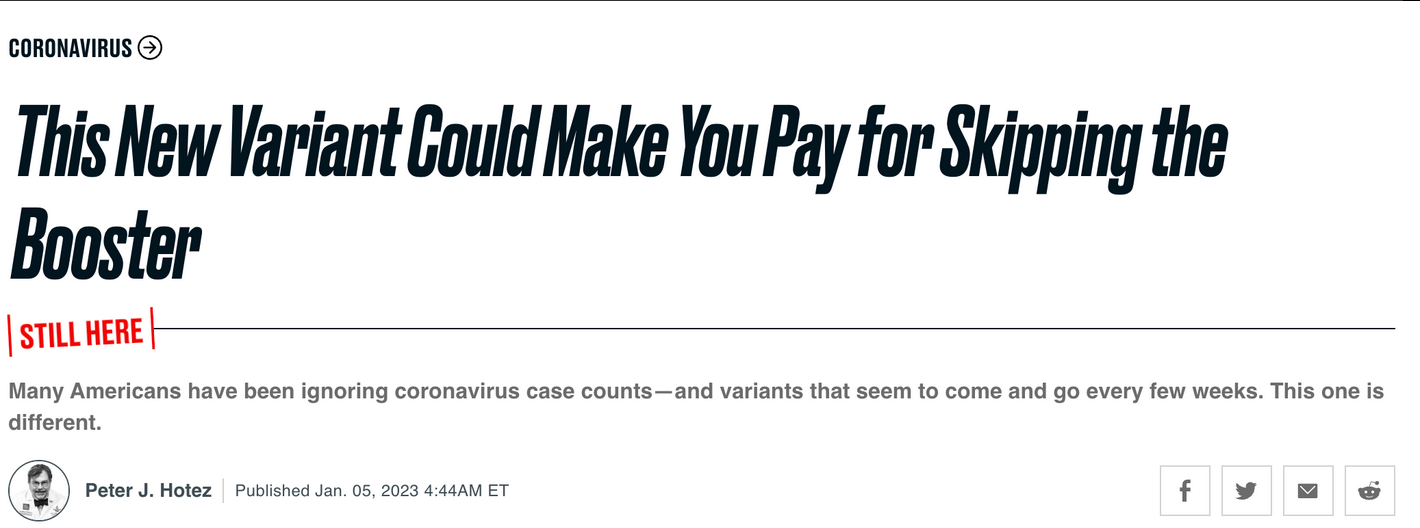
But now we need to add a new example from the current week, because Peter Hotez exists and keeps publishing. His latest piece of analysis calmly warns that the new variant is maybe possibly or not the Most Worstest Evuh, in a huge rhetorical first that tries to overcome Covid exhaustion with louder hysteria:
tHiS oNe iS diFFeReNtttttttttt&#*$*$%^#&@, Version 957,1095,397.02. Your next winter of severe illness and death will be everything you were promised in your first winter of severe illness and death, we swear. If you died last time, JUST WAIT UNTIL YOU DIE AGAIN THIS TIME, FOOL.
How can you spot propaganda? Like this, from a paragraph near the bottom of Hotez’s latest:
Unfortunately, XBB.1.5 is still too new to have clinical data in-hand to show exactly what vaccines mean in terms of warding it off. At the Texas Children’s Hospital Center for Vaccine Development, we, like other groups, are scrambling to look at our own vaccine’s effects on XBB.1.5. However, the writing is on the wall here — boosting is your best bet at protecting yourself and your loved ones.
First sentence: We have no data about this. Third sentence: The thing we have no data for is your best bet to do the thing that we have no data for.
Every claim Hotez makes is a version of this maybe-definitely-uncertainty-certainty soup, telling you he doesn’t know while telling you that he knows

Comments Off on Propaganda to support the narrative


