
Uploaded on 25 Aug 2017
Check out The Tank Museum on YouTube: http://youtube.com/thetankmuseum
Indy and Tank Museum curator David Willey take a look at the British Mark IV tank. Over 1000 of these tanks were built and they are an iconic symbol of early tank warfare during World War 1. We discuss crew conditions and other important details in this episode.
August 26, 2017
Inside A British Mark IV WW1 Tank I THE GREAT WAR Special
Comments Off on Inside A British Mark IV WW1 Tank I THE GREAT WAR Special
Building a French Cleat System for Power Tools
Published on 26 Jul 2015
For a written tutorial check out my blog at http://wilkerdos.com/2015/07/power-tool-french-cleat-system/
Follow me on Facebook at https://www.facebook.com/wilkerdos
Visit Triton’s homepage: http://www.tritontools.com
This week I build individual holders for each one of my power tools so that I can store them on a French cleat system.
Comments Off on Building a French Cleat System for Power Tools
August 25, 2017
Solving the mystery of the fate of H.L. Hunley‘s crew
When the Confederate submarine H.L. Hunley was found, the bodies of the crew were still in their duty positions within the vessel, as if they’d been unaware or unable to do anything to save the situation. Sarah Knapton reports on what is now believed to have killed the crew almost instantaneously:
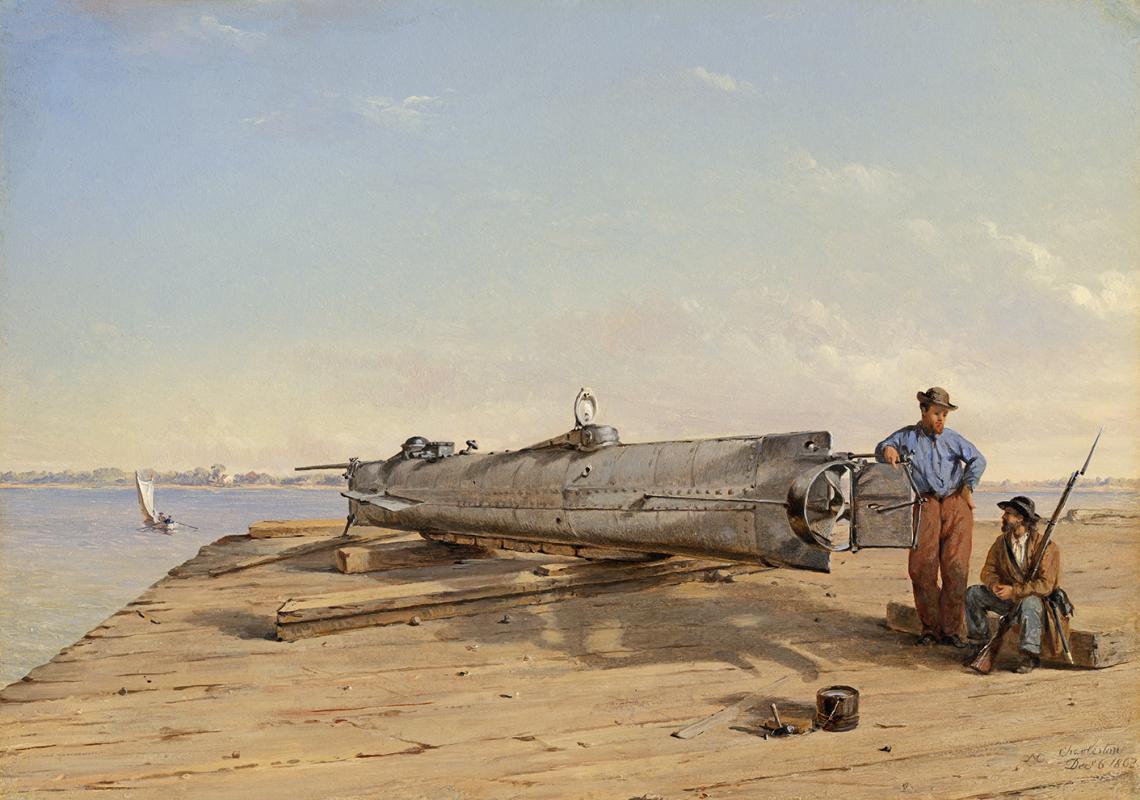
“Submarine Torpedo Boat H.L. Hunley, Dec. 6, 1863″ by Conrad Wise Chapman.
“The inventor of this boat, a man named Hunley, can be seen; also a sentinel. This boat, it was at first thought would be very effective; twice it went out on its mission of destruction, but on both occasions returned with all the crew dead. After this had happened the second time, someone painted on it the word ‘coffin.’ There was just room enough in it for eight men, one in front of the other, with no possibility of anyone sitting straight. The third time it started out, it never came back, nor was anything ever heard from it, but as one of the United States men-of-war in the harbor (USS Housatonic) was sunk at about the same time, the supposition was that they both went to the bottom together. Other objects to be seen in the picture are, Sullivan’s Island, and a Dispatch boat.” – Conrad Wise Chapman, 1898 (via Wikimedia)
The mystery of how the crew of one of the world’s first submarines died has finally been solved – they accidentally killed themselves.
The H.L. Hunley sank on February 17 1864 after torpedoing the USS Housatonic outside Charleston Harbour, South Carolina, during American Civil War.
She was one of the first submarines ever to be used in conflict, and the first to sink a battleship [Housatonic was actually a sloop-of-war, not a battleship].
It was assumed the blast had ruptured the sub, drowning its occupants, but when the Hunley was raised in 2000, salvage experts were amazed to find the eight-man crew poised as if they had been caught completely unawares by the tragedy. All were still sitting in their posts and there was no evidence that they had attempted to flee the foundering vessel.
Now researchers at Duke University believe they have the answer. Three years of experiments on a mini-test sub have shown that the torpedo blast would have created a shockwave great enough to instantly rupture the blood vessels in the lungs and brains of the submariners.
“This is the characteristic trauma of blast victims, they call it ‘blast lung,'” Dr Rachel Lance.
“You have an instant fatality that leaves no marks on the skeletal remains. Unfortunately, the soft tissues that would show us what happened have decomposed in the past hundred years.”
The Hunley‘s torpedo was not a self-propelled bomb, but a copper keg of 135 pounds of gunpowder held ahead and slightly below the Hunley‘s bow on a 16-foot pole called a spar
The sub rammed this spar into the enemy ship’s hull and the bomb exploded. The furthest any of the crew was from the blast was about 42 feet. The shockwave of the blast travelled about 1500 meters per second in water, and 340 m/sec in air, the researchers calculate.
Comments Off on Solving the mystery of the fate of H.L. Hunley‘s crew
August 23, 2017
Playing with fire – James May Q&A Extras (Ep36) – Head Squeeze
Published on 30 Aug 2013
James May reminisces about his misspent youth playing with matches and debates the merits of using foam to put out flames from petrol.
Comments Off on Playing with fire – James May Q&A Extras (Ep36) – Head Squeeze
August 22, 2017
Romanian Guns of WW1 I THE GREAT WAR Special feat. C&Rsenal
Published on 21 Aug 2017
Othais’ episode about the Romanian Mannlicher: https://www.youtube.com/watch?v=MhuuFnaCMOw
In this special episode, Indy and Othais talk about the Romanian rifles and pistols of WW1, namely the Mannlicher M1893 and a very odd Spanish revolver that still puzzles Othais.
Comments Off on Romanian Guns of WW1 I THE GREAT WAR Special feat. C&Rsenal
August 20, 2017
Evaluating Used Hand Tool Condition
Published on 8 Aug 2017
Shopping or used hand tools can be fun, but it’s important to know what you’re buying to make sure it’s a deal. Hand tool expert Ron Herman shares a bit of knowledge with us about considering the condition of used hand tools. For more information on hand tools, visit: http://www.popwood.com/tools/woodworking-hand-tools
Comments Off on Evaluating Used Hand Tool Condition
August 19, 2017
Pricing electricity generated by wind versus more traditional sources
Australia’s Catellaxy Files responds to a series of misleading pro-wind statements by pointing to the appropriate method of calculating electricity costs:
The first thing to understand – which The Conversation does not – is that electricity is not like pairs of shoes that can be sold at the same price tomorrow as today. The product consumers demand is not a quantity of megawatt hours but the continuous supply of electricity – its permanent availability to them in whatever quantity they require. This necessity for continuous supply places a premium on “despatchable” power from fossil-fuel, nuclear or hydro plants. This type of power is more valuable than power that cannot be controlled (wind, solar), and much more valuable than power that cannot even be predicted (especially wind). Moreover, power that is rapidly despatchable (hydro, some gas turbines) in response to sudden surges in demand or unexpected failures at other plants is more valuable still for its ability to plug gaps at short notice.
These differences in the value of different types of electricity already render The Conversation’s comparison of coal and wind power per megawatt hour useless. And rectifying its analysis is not, as pretended, just a matter of adding in “balancing costs” such as additional rapidly despatchable sources, extra storage capacity, or upgraded transmission equipment. For the insertion of a low-quality, unreliable source into the grid also reduces the efficiency and increases the cost of baseload power from coal or other sources which need to operate continuously to be efficient.
This leads to a second major unappreciated fact, which is that suppliers do not make economic decisions based on costs. Instead they make decisions based on the estimated difference between costs and revenue. If wind power can underbid baseload coal whenever the wind is blowing, existing coal stations won’t start up, and new ones won’t be built, because they cannot operate efficiently being turned on and off all the time, and therefore cannot generate enough revenue to justify operation or construction as the case may be. This in turn leads to a higher and higher percentage of unreliable power in the mix, with eventual blackouts.
The only way of assessing the true cost of wind and solar is to look at the overall electricity price before and after renewables are added to the mix. Once you do that you find overwhelming evidence from all over the world that markets with even modest shares of power from intermittent renewables have considerably higher prices than those without. That this is not a coincidence is confirmed by both the tightness of the correlation, and the equally impressive correlations over time within the same market – as the share of renewables increases, the price of electricity goes up, and it goes up very sharply with even 20-30% of nameplate capacity, or 5-10% of energy output, sourced from wind.
Although the discussion is about Australia’s wind power experiment, the details are also relevant to Ontario, as a recent study pointed out:
Electricity prices in Ontario have increased dramatically since 2008 based on a variety of comparative measures. Ontario’s electricity prices have risen by 71 percent from 2008 to 2016, far outpacing electricity price growth in other provinces, income, and inflation. During this period, the average growth in electricity prices across Canada was 34 percent.
Ontario’s electricity price change between 2015 and 2016 alone is also substantial: the province experienced a 15 percent increase in one year. This was two-and-a-half times greater than the national average of 6 percent during the same period.
From 2008 to 2015, electricity prices also increased two-and-a-half times faster than household disposable income in Ontario. In particular, the growth in electricity prices was almost four times greater than inflation and over four-and-a-half times the growth of Ontario’s economy (real GDP).
The large electricity price increases in Ontario have also translated to significant increases in monthly residential electricity bills. Between 2010 and 2016, monthly electricity bills (including tax) in major Canadian cities increased by an average of $37.68. During the same period, electricity bills in Toronto and Ottawa increased by $77.09 and $66.96, respectively. This means that residents in Toronto experienced electricity price increases of double the national average between 2010 and 2016.
In Toronto and Ottawa, the average monthly bills for residential consumers including taxes in 2016 were $201 and $183, respectively.
Much of the reason for Ontario’s much-higher-than-average electricity costs are the provincial government’s dodgy crony capitalist methods for increasing alternative energy sources in the power mix:
The problem of skyrocketing electricity prices and high bills is a made-in-Ontario problem directly tied to the provincial government’s policy choices. Ontario’s policies around renewable energy (wind, solar, and biomass) have resulted in large additional costs for consumers. More specifically, Ontario’s high electricity prices can be attributed to poorly structured long term contracts, the phase-out of coal energy, and a growing electricity supply and demand imbalance in the province that is resulting in Ontario exporting electricity at a loss.
Comments Off on Pricing electricity generated by wind versus more traditional sources
August 17, 2017
The Most Important Invention You Never Thought About
Published on 26 Jul 2017
One entrepreneur’s invention cut world poverty and revolutionized manufacturing. Learn more with Steve Davies: https://www.youtube.com/watch?v=7QLoeehMw0w&list=PL-erRSWG3IoBe1BsaqgTwYx0nS4nl2m_N&index=2
LEARN MORE:
How to Sabotage Progress (video): During the earliest part of the Industrial Revolution, workers worried about losing their jobs to machinery would throw their shoes into the machines in order to sabotage production. We’re seeing recurrence of sabotage again today, but there’s no more successful saboteur than regulation. Duke University Professor Michael C. Munger explains. https://www.youtube.com/watch?v=K0nSiwnbv4oThe Box: How the Shipping Container Made the World Smaller and the World Economy Bigger (book): Economist Marc Levinson delves into the history of the shipping container and how the invention changed the world. https://www.amazon.ca/Box-Shipping-Container-Smaller-Economy/dp/0691170819/ref=as_li_ss_tl?ie=UTF8&qid=1502034038&sr=8-1&keywords=The+Box:+How+the+Shipping+Container&linkCode=ll1&tag=quotulatiousn-20&linkId=ca8f280248e61c2c42aaae2b3c5f1395
An Awesome Map of World Trade and Shipping (article): Daniel Bier uses UCL Energy Institute’s timelapse of global shipping to illustrate spontaneous order. https://fee.org/articles/an-awesome-map-of-world-trade-and-shipping/
TRANSCRIPT:
For a full transcript please visit: http://www.learnliberty.org/videos/the-most-importa%E2%80%A6er-thought-about/
Comments Off on The Most Important Invention You Never Thought About
August 16, 2017
Thompson SMG in 30 Carbine
Published on 17 Oct 2016
When the US military released a request for what would become the M1 Carbine in 1940, the Auto-Ordnance Corporation offered up a Thompson submachine gun simply rechambered for the new .30 Carbine cartridge. This entailed a new magazine, a receiver modified for the longer magazine, and a new barrel and bolt face – but the other Thompson parts could remain unchanged from the standard .45 ACP models. This made the submission a pretty cheap and easy effort for Auto-Ordnance … which is a good thing, considering that it was almost assured to be rejected.
The stipulations for the new carbine included a weigh requirement of 5 pounds, and the Thompson weighed more than double that (in both .45ACP and .30 Carbine forms). Only a few were made, and the one submitted for military testing was rejected outright on the basis of weight. This example is serial number 1, and resides at the Cody Firearms Museum.
Comments Off on Thompson SMG in 30 Carbine
August 13, 2017
August 12, 2017
Why The Government Shouldn’t Break WhatsApp
Published on 3 Jul 2017
Encryption backdoors – breaking WhatsApp and iMessage’s security to let the government stop Bad Things – sounds like a reasonable idea. Here’s why it isn’t.
A transcript of this video’s available here: https://www.facebook.com/notes/tom-scott/why-the-government-shouldnt-break-whatsapp/1378434365572557/
Comments Off on Why The Government Shouldn’t Break WhatsApp
August 9, 2017
How to use a Wooden Spokeshave | Paul Sellers
Published on 8 Aug 2017
Wooden spokeshaves may seem like they’ve been superseded, but they are very useful in the day to day of woodworking. A wooden sole means minimal friction and Paul shows how to easily micro adjust the blade for a variety of uses.
To make the Poor Man’s Spokeshave, see the series on YouTube (link: https://youtu.be/jZwzBbcwbgU).
Comments Off on How to use a Wooden Spokeshave | Paul Sellers
August 8, 2017
Tank Chats #15 Tortoise
Published on 25 Feb 2016
Tank Museum Historian, David Fletcher is currently unavailable, so rather than make you all wait, Curator David Willey is here to present Tortoise!
The A39 Tortoise is the ultimate manifestation of the British concept of the heavily armoured, but slow, ‘Infantry’ tank.
It was built in 1947, making it a contemporary of the highly successful Centurion tank. The Tortoise proved to be too slow and unwieldy for the conditions of modern warfare and was a nightmare to transport.
The only service that the Tortoise had was when two tanks took part in trials in Germany in 1948. The Tank Museum’s Tortoise is now the only surviving example.
Comments Off on Tank Chats #15 Tortoise
August 6, 2017
A Shooting Board – Why You Should Make One – 264
Published on 23 Oct 2016
Build article: https://jayscustomcreations.com/2016/10/a-shooting-board/
Comments Off on A Shooting Board – Why You Should Make One – 264
August 5, 2017
History of Writing – The Alphabet – Extra History
Published on Jul 29, 2017
Where did the alphabet come from? How did it develop, and why? The writing systems first developed in Sumer provided a basis for the written word, but their system of characters also inspired a shift to single phoneme systems where each letter represents a distinct sound.
Comments Off on History of Writing – The Alphabet – Extra History


