
Too often these days when people want to use a scientific study to bolster a political position, they utter the phrase, “It was peer reviewed” like a magical spell to shut off any criticism of a paper’s findings.
Worse, the concept of “peer review” is increasingly being treated in the popular discourse as synonymous with “the findings were reproduced and proven beyond a shadow of a doubt.”
This is never what peer review was intended to accomplish. Peer review functions largely to catch trivial mistakes and to filter out the loons. It does not confirm or refute a paper’s findings. Indeed, many scientific frauds have passed easily through peer review because the scammers knew what information the reviewers needed to see.
Peer review is the process by which scientists, knowledgeable in the field a paper is published in, look over the paper and some of the supporting data and information to make sure that no obvious errors have been made by the experimenters. The most common cause of peer review failure arises when the peer reviewer believes that the experimenters either did not properly configure their instrumentation, follow the proper procedures or sufficiently document that they did so.
Effective peer review requires that the reviewers have a deep familiarity with the instruments, protocols and procedures used by the experimenters. A chemist familiar with the use of a gas-chromatograph can tell from a description whether the instrument was properly calibrated, configured and used in a particular circumstance. On the other hand, a particle physicist who never uses gas-chromatographs could not verify it was used properly.
Shannon Love, “No One Peer-Reviews Scientific Software”, Chicago Boyz, 2009-11-28
December 10, 2009
QotD: Peer review
At this rate, we’ll all think of a place when we hear the name “Darwin”
It’s a long article, but well worth reading in full:
People keep saying “Yes, the Climategate scientists behaved badly. But that doesn’t mean the data is bad. That doesn’t mean the earth is not warming.”
Let me start with the second objection first. The earth has generally been warming since the Little Ice Age, around 1650. There is general agreement that the earth has warmed since then. See e.g. Akasofu. Climategate doesn’t affect that.
The second question, the integrity of the data, is different. People say “Yes, they destroyed emails, and hid from Freedom of information Acts, and messed with proxies, and fought to keep other scientists’ papers out of the journals . . . but that doesn’t affect the data, the data is still good.” Which sounds reasonable.
There are three main global temperature datasets. One is at the CRU, Climate Research Unit of the University of East Anglia, where we’ve been trying to get access to the raw numbers. One is at NOAA/GHCN, the Global Historical Climate Network. The final one is at NASA/GISS, the Goddard Institute for Space Studies. The three groups take raw data, and they “homogenize” it to remove things like when a station was moved to a warmer location and there’s a 2C jump in the temperature. The three global temperature records are usually called CRU, GISS, and GHCN. Both GISS and CRU, however, get almost all of their raw data from GHCN. All three produce very similar global historical temperature records from the raw data.
[. . .]
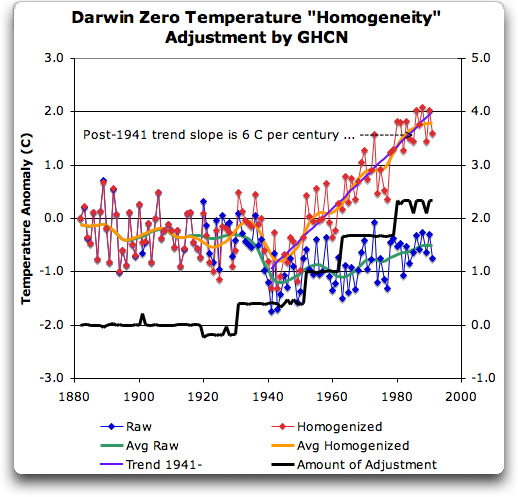
Yikes again, double yikes! What on earth justifies that adjustment? How can they do that? We have five different records covering Darwin from 1941 on. They all agree almost exactly. Why adjust them at all? They’ve just added a huge artificial totally imaginary trend to the last half of the raw data! Now it looks like the IPCC diagram in Figure 1, all right … but a six degree per century trend? And in the shape of a regular stepped pyramid climbing to heaven? What’s up with that?
Those, dear friends, are the clumsy fingerprints of someone messing with the data Egyptian style . . . they are indisputable evidence that the “homogenized” data has been changed to fit someone’s preconceptions about whether the earth is warming.
One thing is clear from this. People who say that “Climategate was only about scientists behaving badly, but the data is OK” are wrong. At least one part of the data is bad, too. The Smoking Gun for that statement is at Darwin Zero.
I’m in no way qualified to pass judgement on any of this. My bias is usually to trust that the scientist has no pre-decided outcome in mind . . . and that they verify their data supports the conclusions before publishing. Climategate/Climaquiddick shows that, at least in one field, this is not true.
Normally, this sort of science-by-press-release is quickly exposed (think of the cold fusion and the Korean human cloning announcements, for example), which works to quickly stamp out the inclination among others who might try to game the system. In the case of AGW, they did more groundwork before going to the press . . . but if Darwin Zero is an example of the kind of work they did everywhere, then it’s just a better-hidden case of science-by-press-release.
Except — and this is huge — the implications of the deception were not limited to a few undeserving white-coated “scientists” getting press coverage and grant money. The AGW movement aimed at nothing less than a take-over of the entire economy, putting carbon commissars in charge of everything. Their work would lead to pseudo-scientific based controls over all human activities (because, as the EPA recently decided, all greenhouse gases must be regulated . . . and there’s carbon dioxide produced every time you exhale).
December 9, 2009
Hyping space travel
Colby Cosh finds the marketing hype from Virgin Galactic to be more than a little over the top:
I continue to be awestruck at Sir Richard Branson’s gift for hype. On Monday he rolled out Virgin Galactic’s “SpaceShipTwo”, dutifully described by Wired magazine as “the first commercial spacecraft” and “the first commercial spaceship”. This must be galling for the folks at the spaceflight research firm SpaceX. In July of this year, to little fanfare, they successfully put a Malaysian satellite into low earth orbit using a privately designed and built unmanned rocket, the Falcon 1. This is definitely commerce, and RazakSat is definitely up there in space, bleeping away in Malay. Surely everything else is Bransonian semantics?
SpaceShipTwo, despite the name, is an airplane — a very sophisticated and impressive airplane, designed to make brief suborbital hops after being carried aloft by another airplane. Branson’s hundreds of more-money-than-they-know-what-to-do-with customers are buying the aviation experience of a lifetime, one that nobody returns from unmoved. But it will be an aviation experience. “Space” is defined in custom, international law, and Virgin marketing literature as “high enough that airplanes mostly don’t work anymore”. To get there as an airplane passenger, by virtue of a few seconds of rocket boost tacked onto a conventional flight, seems a little like a technical cheat — the equivalent of trying to join the Mile High Club by oneself in the john.
The EPA wants to regulate, well, everything
The EPA’s decision that greenhouse gases fall under their regulatory control, while not surprising, should be overturned:
What Jackson has done, though, is inadvertently offer the strongest case against the EPA’s dubious decision on carbon dioxide. If the EPA’s actions really converge on as many spheres of public life as Jackson asserts, then a single crusading regulatory agency is in no position — and should have no authority — to regulate all of them.
No worries, we’re told. The EPA wouldn’t do it. It’s a bluff. It has other things in mind. In this case, it is all about hastening much-needed “action” on climate change by employing a technique universally known as blackmail.
The timing of the EPA announcement gives President Barack Obama the ammunition he needs to make a climate deal in Copenhagen, where leaders from around the world have gathered for one last chance to save mankind — until they all fly to by-then temperate Mexico next year for the last last chance to save mankind.
Obama, as we know, has no authority to enter into a binding international treaty (isn’t the Constitution irritating?), as any treaty must be ratified by the Senate — a Senate that won’t pass a cap-and-trade scheme any time soon if we’re lucky.
Now that the EPA can duplicate any suicidal emissions pact world leaders can cook up (exempt: emerging nations, poor nations, and nations that value prosperity), the president would not need to ratify a thing. And who needs treaties when the Obama administration has already threatened the Senate with unilateral regulations on greenhouse gases unless a cap-and-trade bill is passed? The administration need only mirror the agreement it can’t make.
December 8, 2009
The downside to “ethical” shopping
There are some odd results of changing your shopping habits to be more environmentally conscious, says a recent study:
As the owner of several energy-efficient light bulbs and a recycled umbrella, I’m familiar with the critiques of “ethical consumption.” In some cases, it’s not clear that ostensibly green products are better for the environment. There’s also the risk that these lifestyle choices will make us complacent, sapping the drive to call senators and chain ourselves to coal plants. Tweaking your shopping list, the argument goes, is at best woefully insufficient and maybe even counterproductive.
But new research by Nina Mazar and Chen-Bo Zhong at the University of Toronto levels an even graver charge: that virtuous shopping can actually lead to immoral behavior. In their study (described in a paper now in press at Psychological Science), subjects who made simulated eco-friendly purchases ended up less likely to exhibit altruism in a laboratory game and more likely to cheat and steal.
[. . .]
It would be foolish to draw conclusions about the real world from just one paper and from such an artificial scenario. But the findings add to a growing body of research into a phenomenon known among social psychologists as “moral credentials” or “moral licensing.” Historically, psychologists viewed moral development as a steady progression toward more sophisticated decision-making. But an emerging school of thought stresses the capriciousness of moral responses. Several studies propose that the state of our self-image can directly influence our choices from moment to moment. When people have the chance to demonstrate their goodness, even in the most token of ways, they then feel free to relax their ethical standards.
H/T to Radley Balko for the link.
How to get rid of pesky dinosaurs
According to recent theorizing, you don’t incinerate ’em, you broil ’em:
The asteroid impact that ended the age of dinosaurs 65 million years ago didn’t incinerate life on our planet’s surface — it just broiled it, a new study suggests. The work resolves nagging questions about a theory that the impact triggered deadly wildfires around the world, but it also raises new questions about just what led to the mass extinction at the end of the Cretaceous period.
The impact of a 10-kilometre asteroid is blamed for the extinction of the dinosaurs and most other species on the planet. Early computer models showed that more than half of the debris blasted into space by the impact would fall into the atmosphere within eight hours.
The models predicted the rain of shock-heated debris would radiate heat as intensely as an oven set to “broil” (260 °C) for at least 20 minutes, and perhaps a couple of hours. Intense heating for that long would heat wood to its ignition temperature, causing global wildfires.
December 7, 2009
A Devil’s Dictionary for Copenhagen
Tunku Varadarajan updates Ambrose Bierce for the Copenhagen conference:
A is for anthropogenic: (as in anthropogenic global warming, or “AGW”), a $10 word for “man-made” which global-warmists wield as proof of expertise — no one more so than Al Gore, who, after having invented the Internet, turned his prodigious mind to the conundrum of AGW.
[. . .]
C is for the University of East Anglia’s Climate Research Unit, the now-discredited source of much of the data used to fuel climate hysteria. In November, in an episode that was oh-so-predictably dubbed Climategate, a cache of leaked emails showed that researchers systematically hid or manipulated data that was inconsistent with the accepted narrative of man-made climate change. (Read John Tierney’s clear-headed critique here.) Don’t forget carbon dioxide, a colorless, odorless gas once considered essential to life on earth, not to mention bubbles in Champagne. (Although it’s now regarded as a poisonous pollutant, you can, however, trade it.) Think also of consensus — the idea that science is settled by an asserted poll of experts after all objections from dissenting scientists have been suppressed.
Do as we say, not as we do
It will come as no real surprise to anyone that the Copenhagen gab-and-grabfest will “produce as much carbon dioxide as a town the size of Middlesbrough”:
On a normal day, Majken Friss Jorgensen, managing director of Copenhagen’s biggest limousine company, says her firm has twelve vehicles on the road. During the “summit to save the world”, which opens here tomorrow, she will have 200.
“We thought they were not going to have many cars, due to it being a climate convention,” she says. “But it seems that somebody last week looked at the weather report.”
Ms Jorgensen reckons that between her and her rivals the total number of limos in Copenhagen next week has already broken the 1,200 barrier. The French alone rang up on Thursday and ordered another 42. “We haven’t got enough limos in the country to fulfil the demand,” she says. “We’re having to drive them in hundreds of miles from Germany and Sweden.”
And the total number of electric cars or hybrids among that number? “Five,” says Ms Jorgensen. “The government has some alternative fuel cars but the rest will be petrol or diesel. We don’t have any hybrids in Denmark, unfortunately, due to the extreme taxes on those cars. It makes no sense at all, but it’s very Danish.”
The airport says it is expecting up to 140 extra private jets during the peak period alone, so far over its capacity that the planes will have to fly off to regional airports — or to Sweden — to park, returning to Copenhagen to pick up their VIP passengers.
I’d point out the irony, but the earnest types in the AGW movements don’t do irony.
December 5, 2009
Met Office reacts to Climategate
Britain’s Met Office is taking strong measures in light of the Climategate revelations:
The Met Office plans to re-examine 160 years of temperature data after admitting that public confidence in the science on man-made global warming has been shattered by leaked e-mails.
The new analysis of the data will take three years, meaning that the Met Office will not be able to state with absolute confidence the extent of the warming trend until the end of 2012.
The Met Office database is one of three main sources of temperature data analysis on which the UN’s main climate change science body relies for its assessment that global warming is a serious danger to the world. This assessment is the basis for next week’s climate change talks in Copenhagen aimed at cutting CO2 emissions.
December 4, 2009
Britain lowers defences against alien invasion
It’s true . . . the British are now wide-open to invaders from Rigel: they’ve re-assigned their UFO investigation forces to other duties:
The Ministry of Defence has closed its UFO unit after more than 50 years of investigating reported UK sightings.
A hotline and e-mail address for the public to report possible sightings was shut on 1 December because it had no “defence value”, the MoD said.
The officer handling reports has moved to another post, saving £44,000 a year.
The MoD said the unit had received thousands of reports, although none had yielded proof of aliens or any security threat to the UK.
Well of course they’d say that, wouldn’t they? Expect the mothership to show up any day now . . .
Debunking the porn-violence link
After giving up all hope of finding “uncontaminated” study subjects, a Quebec researcher concludes that the long standing claim that viewing pornography leads to violence and sexual crimes doesn’t appear to be true:
Lajeunesse, unable to find any smut-free young chaps, carried out a detailed study on 20 students who admitted having a fondness for filth. It seems that 90 per cent of all porn is viewed on the internet nowadays, at least in French Canada. Unsurprisingly single chaps watch spend about four times as much time looking at porn as those in committed relationships.
“Not one subject had a pathological sexuality. In fact, all of their sexual practices were quite conventional,” reports Lajeunesse.
“Pornography hasn’t changed their perception of women or their relationship … Those who could not live out their fantasy in real life with their partner simply set aside the fantasy … men don’t want their partner to look like a porn star,” he adds.
The study was funded by Canada’s Centre de Recherche Interdisciplinaire sur la Violence Familiale et la Violence Faite aux Femmes (CRI-VIFF, or the Interdisciplinary Research Center on Family Violence and Violence Against Women). However Lajeunesse firmly rejected the idea that goggling over naughty pics, vids etc leads men to mistreat the ladies they encounter in real life.
Amusingly, while putting this post up, my iTunes playlist offered up Rough Trade’s “Crimes of Passion”.
Don’t bother your pretty little heads about all this “science” stuff
The non-scientists among us (that’s you and you and you and . . .) should just take a pill, sit back, and stop trying to understand the science:
And history repeats itself with climate change. We tell you people of the imminent dangers from the earth warming, and what do you do? You mock us. You question our motives. People who can’t even convert Fahrenheit to Celsius try and tell us we did the science wrong. Now emails have leaked from the Climate Research Unit that apparently show that scientists were fixing the data and trying to suppress the scientific research of dissenters, and you people demand answers from us. I have one thing to say to that. How dare you!
You do not understand the first thing about climate research. Man-made global warming is settled science. Disaster is imminent. We know this. It is a fact. We don’t waste time on studies that say otherwise, the same way we don’t waste time on studies that assert that the earth is flat. We are very smart people, and when we say something is so, you should just accept it.
So you think what is in those emails is important? Well, what exactly do you know? Do you see the white lab coats we wear? That color symbolizes pure science. Were someone like you to wear one, within five minutes it would be stained with neon orange powdered cheese and wet with drool from you trying to comprehend the data sets people like me look at every day.
December 3, 2009
The hidden damage from Climategate
Daniel Henninger correctly identifies the worst result of Climategate . . . not the still-ongoing debate about AGW, but the damage to science as a whole due to the unethical, unscientific, and (in some cases) illegal activities of the CRU:
Surely there must have been serious men and women in the hard sciences who at some point worried that their colleagues in the global warming movement were putting at risk the credibility of everyone in science. The nature of that risk has been twofold: First, that the claims of the climate scientists might buckle beneath the weight of their breathtaking complexity. Second, that the crudeness of modern politics, once in motion, would trample the traditions and culture of science to achieve its own policy goals. With the scandal at the East Anglia Climate Research Unit, both have happened at once.
I don’t think most scientists appreciate what has hit them. This isn’t only about the credibility of global warming. For years, global warming and its advocates have been the public face of hard science. Most people could not name three other subjects they would associate with the work of serious scientists. This was it. The public was told repeatedly that something called “the scientific community” had affirmed the science beneath this inquiry. A Nobel Prize was bestowed (on a politician).
Global warming enlisted the collective reputation of science. Because “science” said so, all the world was about to undertake a vast reordering of human behavior at almost unimaginable financial cost. Not every day does the work of scientists lead to galactic events simply called Kyoto or Copenhagen. At least not since the Manhattan Project.
The would-be green tyrants will recover from Climategate, but the rest of the scientific community will suffer for their sins. Malpractice and deliberate deceit in one area will continue to taint genuine scientists for years to come.


