
Overly Sarcastic Productions
Published on 3 May 2019He’s fast! He’s smart! He should really put on some pants! It’s history’s most marketable deity, Hermes himself!
(but red, who are those other two guys?)
(shhhhh)PATREON: http://www.Patreon.com/OSP
May 4, 2019
Miscellaneous Myths: Hermes
Comments Off on Miscellaneous Myths: Hermes
April 30, 2019
Japan’s monarchy
Colby Cosh looks at the astonishingly successful Japanese monarchy over the last few centuries of change:

Emperor Akihito and Empress Michiko at the Tokyo Imperial Palace in Chiyoda Ward, Tōkyō Metropolis on April 24, 2014.
US State Department photo by William Ng, via Wikimedia Commons.
Most everybody knows how the office of the Japanese Emperor became “ceremonial” for the better part of 700 years, and how the archipelago was governed in isolation by what we call the shogunate. The first Westerners who established diplomatic relations with Japan in the 19th century did not think of the Emperor as analogous to Queen Victoria at all. For years they thought of the Mikado as primarily a religious functionary, a sort of pope performing funny, tedious rites in seclusion. (As anyone who has been watching Japanese news in the run-up to Golden Week knows, there is some truth to this.)
Even as reality dawned on those foreign barbarians, their presence in Japan led to social breakdown, civil war, and a sharp, sudden revival of the power of their monarchy — the Meiji Restoration. This is still an awe-inspiring event. Japan was confronted by a little-known and hated outer realm, and was able to adapt with inexplicable confidence. It did not descend into psychic and economic malaise, but almost immediately began to compete with obtrusive Western “powers.” After centuries in abeyance, their constitution somehow allowed them to conjure a enlightened despot of enormous ability, the Meiji Emperor, at the precise moment one was required.
This led in time to the war in the Pacific — and to a second miracle of the same kind. If matters had been left up to American public opinion in 1945, or to the allies of the United States, or even to the American executive branch, the Japanese monarchy would have been abolished and the Emperor given a humiliating trial and death. Such a procedure could have easily been justified then, and can be justified in retrospect now. U.S. foreign policy almost always, in practice, seems to follow the country’s republican instincts.
But while Japan was defeated, it had not been invaded. So Gen. Douglas MacArthur and a few foreign-policy brainiacs reached a magnificent, cynical modus vivendi: they would exploit and reshape the Japanese monarchy rather than smashing it. As a soldier, MacArthur, made Supreme Commander of occupied Japan, would have shot the Emperor with his own sidearm and never lost a minute’s sleep. But he and others somehow managed to overcome racial and political prejudices, and perform an act of American “nation-building” that was not a cruel joke.
Comments Off on Japan’s monarchy
April 28, 2019
The Battle of Lützen – 1632 – The 30 Years War (in Swedish, with English sub-titles)
Gripen
Published on 3 Dec 2015One of the bloodiest battles of the Thirty Years War. Sweden vs. the Holy Roman Empire. A mass grave has been found, with the victims from the battle. Are they Swedish/Finnish soldiers or German mercenaries?
(This Swedish documentary has English subtitles).
From the comments:
Blah b
2 years ago
This documentary is often painful to watch, the way inexperienced modern people with no sense of empathy project their values onto those times. They weren’t “defenseless men standing still”. Armies had learned the hard way that massed musket fire won battles. If everybody is looking for cover and looking out for themselves, you can never operate such rigid units.So the individual soldier was harshly drilled to indeed stand still even with cannonballs tearing through his unit, or another unit standing 30-80 meters away. Because if individuals acted as individuals, the battle would be lost and the army would be destroyed.
But when that machine operated, it would win battles. The system invented by Maurice of the Netherlands ensured that if you were attacking a group of musketeers, every 20-25 seconds, they could deliver a crushing volley that can kill or injure 10-25% of a another unit, that means they only needed 2-3 salvos to achieve a local victory. Untrained units would literally never touch a musketeer, as his unit would’ve routed the attackers before they got within touching range.
Also there were no standing armies, there was no national identity as such. Mercenaries were totally acceptable. Mercenaries could become very loyal and reliable if paid on time [and] consistently, and would easily crush national armies that usually lacked the routine of professional soldiers. Loyalty and your identity was constructed differently. It would’ve been perfectly normal for me to utterly hate and maybe kill my neighbours if they were of a different religion. Otherwise, a Swedish protestant from far away was an ally with the right ideas. I wouldn’t have been able to understand him and everything would be alien about him, but I’d consider him a friend, and Catholics from the next village where I’d lived all my life would be enemies.
Unless the king comes around and says the Catholics are friends. Because the king is appointed by God who runs the world on a day to day [basis], and you obey without question. If the king says it’s so, that means God himself agrees and says it’s so, and you don’t question God. Loyalty until death is about the least you owed your king in those days.
People who can’t understand how such things worked historically, really should not be making documentaries…
Comments Off on The Battle of Lützen – 1632 – The 30 Years War (in Swedish, with English sub-titles)
April 23, 2019
David Warren’s musings on the Notre-Dame de Paris fire
There have been other incidents since the fire, most pressingly the horrific bombing attacks on Easter Sunday in Sri Lanka, but David Warren would still like us to remember what happened a week ago in Paris:
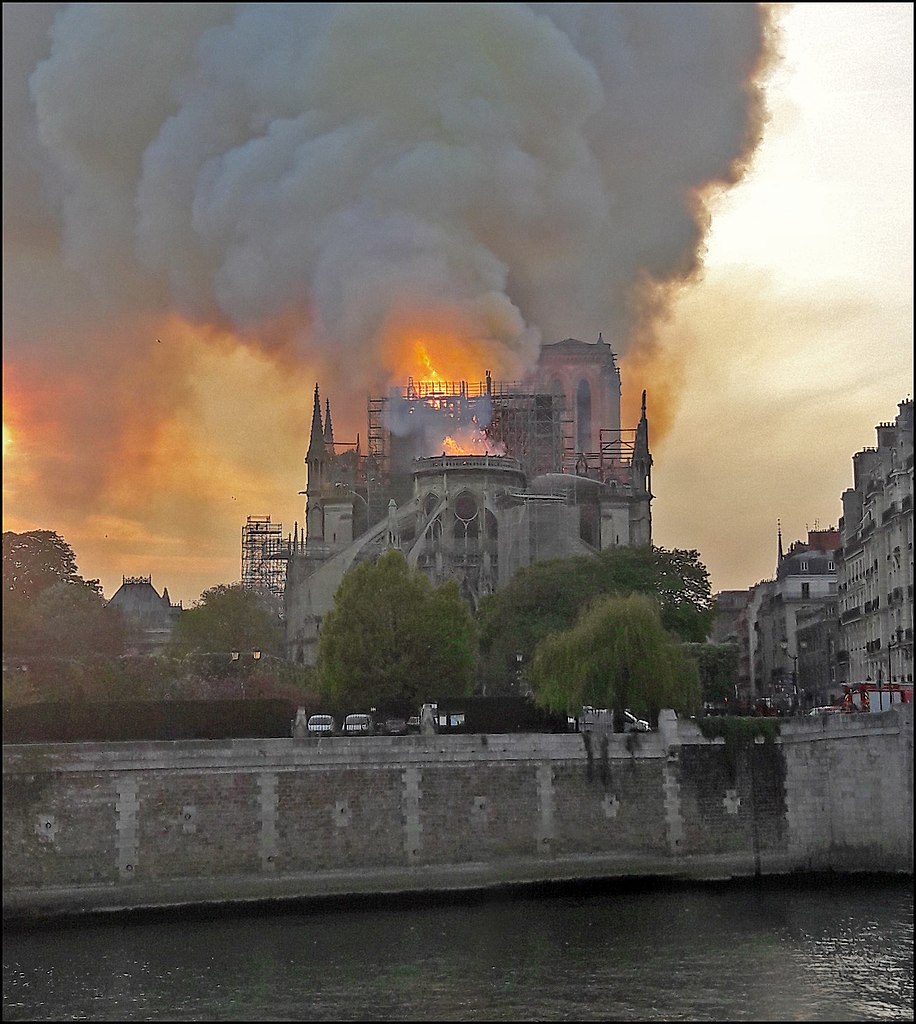
A week has passed since the fire in, or on, Notre Dame de Paris; let me be the last to comment on a story that is stale-dated by any meejah standard. It dominated international mindwaves for only two days, but left images that viewers may be able to recall many decades from now.
“The church is on fire,” is a commonplace thought, when a church is visibly on fire, and I who am commonplace was thinking that while turning to the news. As an old meejah hack, who happens to know a little about Gothic architecture, I was prepared to discount the “fake news” that would be disseminated in “live time.” For instance, when told that the roof had collapsed, with strong hints that the building was now a write-off, I reflected that the roof is a hat, only. Stone vaulting lies underneath it, except the circle much of the spire fell through (as burnt offering onto the altar). Stone doesn’t burn easily; and even fallen vaulting can be repaired, having been erected with technology we would consider primitive today.
A spectacle: to see the ancient oak timbers, of great girth, burning up like matchsticks. But the craft masons of Notre Dame — far, far in advance of our modern Lego builders — expected fire and lived in a time so simple that they knew oak doesn’t burn without help. It isn’t big matchsticks. The idea that you need some serious accelerants to make it burn, and that only the accelerants would flame like that, was among my initial thoughts. We’ll see what comes of investigations. I also recalled two recent attempts to torch the cathedral, associated with terrorism.
Instead, the explanation of a clumsy accident by restoration workers was immediately accepted by the talking heads, and even Fox News hung up on a guest who had another theory. In favour of the politically correct, plausible account, I learnt that a fire alarm had sounded 23 minutes before the blaze itself was spotted. Paradoxically, this showed the ruinous consequences of depending exclusively on modern technology: the computers directed the first responders to the wrong place, away from the actual heat source.
I can easily believe in electrical short circuits as a fire hazard, especially since having had myself to flee a building where a cost-cutting landlord was having an elevator repaired by what I characterized as “a Romanian comedy team.” (They buzz-sawed through a live electrical cable, then themselves fled the scene of their handiwork as smoke shot up the shaft through the building. Luckily this smoke warned all tenants to evacuate; the building’s siren alone would have been taken by everyone as yet another false alarm.)
Comments Off on David Warren’s musings on the Notre-Dame de Paris fire
April 22, 2019
Siege of Vienna – Charge of the Winged Hussars – Extra History – #3
Extra Credits
Published on 20 Apr 2019Leopold knew it was time to get the Holy Roman Empire involved if he wanted to keep Vienna, but it wouldn’t be as simple as asking for a favor. Charles of Lorraine and Sobieski of Poland would be the ones to lead the charge on the battlefield against the Janissaries.
Join us on Patreon! http://bit.ly/EHPatreon
Comments Off on Siege of Vienna – Charge of the Winged Hussars – Extra History – #3
April 18, 2019
Holiday Tales: Easter!
Overly Sarcastic Productions
Published on 30 Mar 2018Happy Good Friday, everyone! Easter’s in two days, so let’s take a hot minute to see if we can figure out what exactly we’re celebrating when we pull out our egg baskets and chocolate bunnies, and why exactly we do it the way we do. Will we be able to unravel the mysteries of Easter before Jesus’s death timer hits zero? (Spoiler: no!)
PATREON: www.patreon.com/user?u=4664797
Comments Off on Holiday Tales: Easter!
April 17, 2019
Some good news in the aftermath of the Notre-Dame de Paris fire
Mark Steyn, who is not normally noted for his habit of bringing good news, actually has some good news to share as the authorities in Paris evaluate the damage to the cathedral after the fire of April 15th:
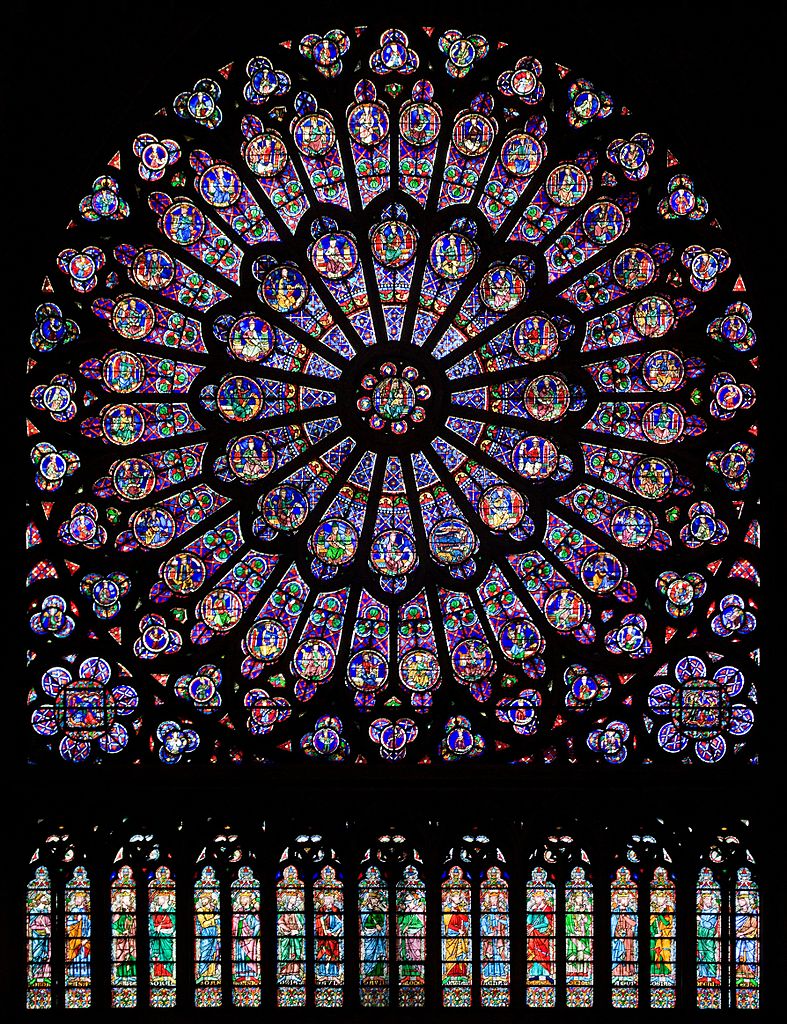
The north rose window of the Cathédrale Notre-Dame de Paris, in a photo from 22 August, 2010. This and the other two rose windows are reported to have survived the fire of 15 April, 2019.
Photo by Julie Anne Workman. License: CC-BY-SA 3.0 via Wikimedia Commons.
Twenty-four hours after Notre Dame de Paris began to burn, there is better news than we might have expected: More of the cathedral than appeared likely to has, in fact, survived intact – including the famous rose windows, among the most beautiful human creations I’ve ever seen. The “new” Notre Dame will be mostly high up and out of sight, which is just as well given that modern man prides himself on having no smidgeonette of empathy with his flawed forebears and thus the chances of historic recreation of the animating spirit of 1160 are near zero.
There is an architectural debate to be had, I suppose, about whether a reconstructed twelfth-century cathedral requires nineteeth-century appurtenances such as its spire. But the minute that starts you risk some insecure dweeb like Macron, on whose watch the thing went up in smoke, getting fanciful ideas about bequeathing to posterity some I M Pei pyramid on the top of the roof. France’s revolution, unlike America’s, was aggressively secular, and it ultimately found expression in the 1905 law on the separation of churches and the state. Since then the French state has owned the cathedral, and thus it will be Macron who ultimately decides what arises in its place.
Beyond that are the larger questions: When the iconic house of worship at the heart of French Christianity decides to mark Holy Week by going up in flames, it’s too obviously symbolic of something … but of what exactly? Two thousand churches have been vandalized in the last two years: Valérie Boyer, who represents Bouches-du-Rhône in the National Assembly, said earlier this month that “every day at least two churches are profaned” – by which she means arson, smashed statutes of Jesus and Mary, and protestors who leave human fecal matter in the shape of a cross. This is a fact of life in modern France.
As it is, there is no shortage of excitable young Mohammedans gleefully celebrating on social media. In 2017 some inept hammer-wielding nutter yelling “Allahu Akbar!” had a crack at Notre Dame, and a couple of years before that the historian Dominique Venner blew his brains out on the altar to protest same-sex marriage. I love France but, in recent years, it’s hard not to pick up on the sense that it’s coming apart – and that, when the center cannot hold, the things at that center, the obsolete embodiments of a once cohesive society, are a natural target.
In addition, the authorities’ eagerness to assure us that it was an accident at a time when such a conclusion could not possibly be known – and when their own response to the emergency was, to put it politely, somewhat dilatory – was itself enough to invite suspicion: “Sure, it might be an accident. But, even if it weren’t, they’d still tell us it was…”
So, precisely because Paris is full of people who would love to burn down Notre Dame four days before Good Friday, it seems bizarrely improbable that it should happen by accident: that a highly desirable target should be taken out by some slapdash workman leaving a cigarette butt near his combustible foam take-out box – the lunchpack of Notre Dame – and letting the dried-out twelfth-century timbers do the rest.
The Rose Window was spared! pic.twitter.com/D5NjepKzh3
— The French History Podcast (@FrenchHist) April 16, 2019
Comments Off on Some good news in the aftermath of the Notre-Dame de Paris fire
April 16, 2019
The fire at Notre-Dame de Paris
The central Paris landmark has been severely damaged by a fire that broke out beneath the roof of the cathedral early in the evening of April 15th. Here are a few images from the Wikimedia Commons page on the fire:
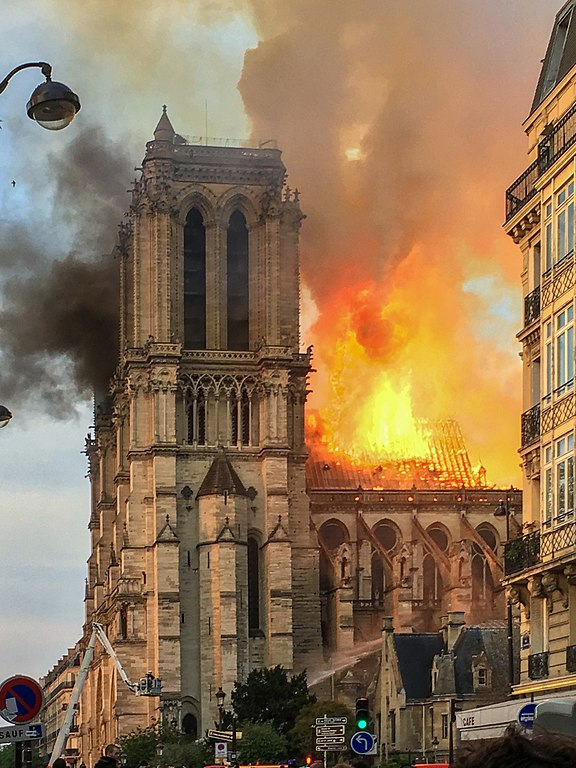
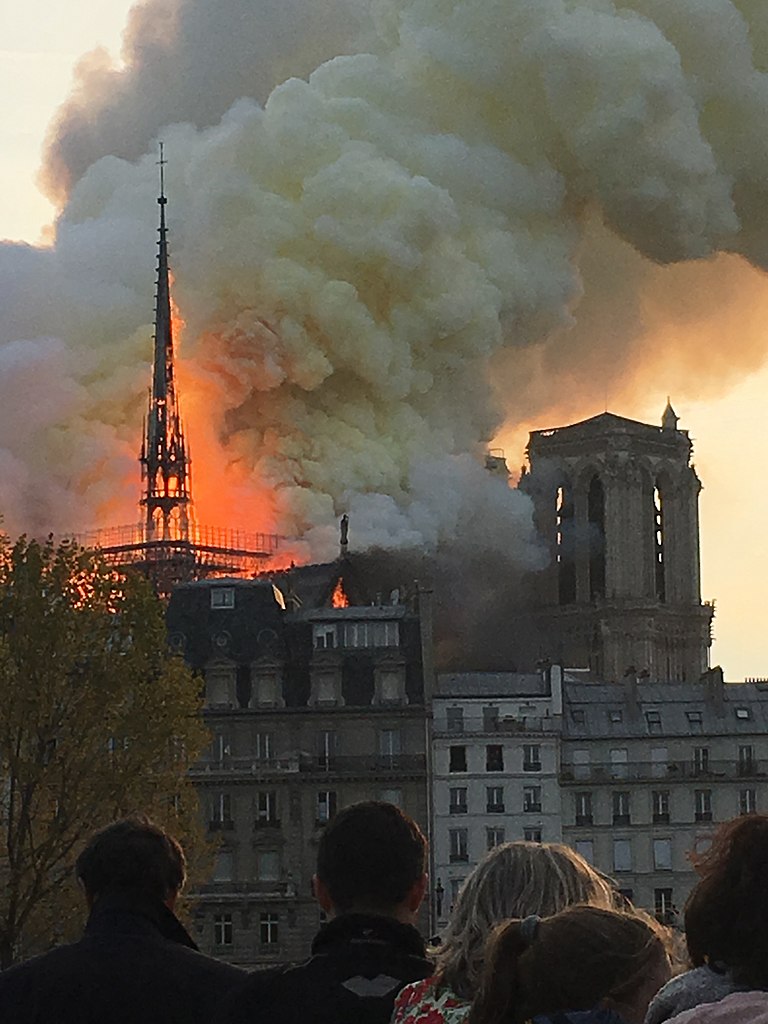
Officials were quick to announce that the fire was not the result of terrorist action … while the fire was still raging (that is, before anyone could have made any scientific determination on the cause), which only made those inclined to suspect terrorist activity even more suspicious. Conspiracy theorists gotta theorize, after all. Robert Harris discusses this aspect of the story at the New English Review:
Ruling out any cause other than accidental fire, at such an early stage, did seem to be an assumption made with [undue] rapidity, not least because it occurred within a week of Easter when such a religious landmark would be a prime target within a city and a nation that has suffered more than its share of acts of Islamist terrorism, and especially at a time when numerous French churches have been targeted.
The international media was similarly unanimous in describing the cause of the blaze, with some carrying critical coverage of Youtube’s automated topical descriptors linking the event with 9/11. Even Fox News’ Shepard Smith was rather more than simply unwilling to entertain the speculations of one French interviewee that tried to note some of the above surrounding circumstances.
Prima facie, it might have also been thought that it was peculiar that such a serious fire became so advanced during a time of day when the cathedral would have been in use by public visitors. There have been numerous serious fires during periods of restoration, as the mainstream media rightly noted, but less mentioned was the likely fact that such work would have ceased some hours before smoke became visible.
[…]
The prospect of a terrorist act rears but there is perhaps some reason to assume a non-terrorist motive because there doesn’t seem to have been any claims of responsibility. It may be thought that any Islamist organisation linked with the blaze of such a major Christian/Western landmark would be very keen to boast about the deed on social media when the story hit the international news. Alternatively, the inferno could have been caused by a lone-wolf terrorist attack but such individuals commonly swear allegiance to a particular group and/or make some sort of public statement before a given attack.
If religiously motivated terrorism can be deemed to be unlikely at this stage, obvious alternatives still remain, such as an act of criminal arson or non-religious terrorism in which the perpetrators might be less keen to voice their involvement with the crime. For example, the blaze could have been an act of secular quasi-terrorism/arson/vandalism by the left-wing ‘Black-Bloc’, which has been responsible for much of the recent violence within the ‘Yellow Vest’ protest movement. It may therefore be suggested that the French authorities came to an unduly prompt reaction, given the surrounding circumstances.
Comments Off on The fire at Notre-Dame de Paris
April 9, 2019
Siege of Vienna – Opening Bombardment – Extra History – #1
Extra Credits
Published on 6 Apr 2019Mehmed IV wanted to live up to, and even surpass, the legacy of his forefather Mehmed II, who had secured the Ottomans’ inheritance to the Roman Empire through his conquest of Constantinople. So the current Mehmed decided to target Vienna — but Emperor Leopold dismissed these threats…
Over a hundred thousand Ottoman troops are heading for Vienna. Only 15,000 men defend the walls. They have only six days to prepare the city. How long can they hold?
Join us on Patreon! http://bit.ly/EHPatreon
Comments Off on Siege of Vienna – Opening Bombardment – Extra History – #1
March 31, 2019
QotD: Gandhi’s not-so-non-violent followers
… it is not widely realized (nor will this film tell you) how much violence was associated with Gandhi’s so-called “nonviolent” movement from the very beginning. India’s Nobel Prize-winning poet, Rabindranath Tagore, had sensed a strong current of nihilism in Gandhi almost from his first days, and as early as 1920 wrote of Gandhi’s “fierce joy of annihilation,” which Tagore feared would lead India into hideous orgies of devastation — which ultimately proved to be the case. Robert Payne has said that there was unquestionably an “unhealthy atmosphere” among many of Gandhi’s fanatic followers, and that Gandhi’s habit of going to the edge of violence and then suddenly retreating was fraught with danger. “In matters of conscience I am uncompromising,” proclaimed Gandhi proudly. “Nobody can make me yield.” The judgment of Tagore was categorical. Much as he might revere Gandhi as a holy man, he quite detested him as a politician and considered that his campaigns were almost always so close to violence that it was utterly disingenuous to call them nonviolent.
For every satyagraha true believer, moreover, sworn not to harm the adversary or even to lift a finger in his own defense, there were sometimes thousands of incensed freebooters and skirmishers bound by no such vow. Gandhi, to be fair, was aware of this, and nominally deplored it — but with nothing like the consistency shown in the movie. The film leads the audience to believe that Gandhi’s first “fast unto death,” for example, was in protest against an act of barbarous violence, the slaughter by an Indian crowd of a detachment of police constables. But in actual fact Gandhi reserved this “ultimate weapon” of his to interdict a 1931 British proposal to grant Untouchables a “separate electorate” in the Indian national legislature — in effect a kind of affirmative-action program for Untouchables. For reasons I have not been able to decrypt, Gandhi was dead set against the project, but I confess it is another scene I would like to have seen in the movie: Gandhi almost starving himself to death to block affirmative action for Untouchables.
From what I have been able to decipher, Gandhi’s main preoccupation in this particular struggle was not even the British. Benefiting from the immense publicity, he wanted to induce Hindus, overnight, ecstatically, and without any of these British legalisms, to “open their hearts” to Untouchables. For a whole week Hindu India was caught up in a joyous delirium. No more would the Untouchables be scavengers and sweepers! No more would they be banned from Hindu temples! No more would they pollute at 64 feet! It lasted just a week. Then the temple doors swung shut again, and all was as before. Meanwhile, on the passionate subject of swaraj, Gandhi was crying, “I would not flinch from sacrificing a million lives for India’s liberty!” The million Indian lives were indeed sacrificed, and in full. They fell, however, not to the bullets of British soldiers but to the knives and clubs of their fellow Indians in savage butcheries when the British finally withdrew.
Richard Grenier, “The Gandhi Nobody Knows”, Commentary, 1983-03-01.
Comments Off on QotD: Gandhi’s not-so-non-violent followers
March 28, 2019
QotD: Sharia law
In order of importance, [Sharia] has four sources. First, there is the Koran, which is the record of what was revealed to Mohammed by God, speaking through the Archangel Gabriel, Its injunctions are absolutely binding on the faithful. Second, there is the sunna, or the practice of Mohammed, as understood from the hadith, or traditional stories of his sayings and doings. These are less holy than the Koran, being only what was observed of a particularly honoured man, and not the direct Word of God given at third hand. Also, there are nearly two million of them, and they often contradict one another. But they count, once any consistent doctrine can be divined from them on a particular issue, as reliable guides. Third, there is the ijima or consensus of opinion among the ulema, or learned Moslems. Fourth, there is qiyas, or a process of analogical reasoning by which, in the absence of any rule or precedent, a case is to be decided in a manner consistent with the existing body of law. In addition to these, we can be fairly certain that much law has been inherited from pre-Islamic Arabian custom, and from the near eastern societies that subsequently became Moslem.
The main development of Islamic law came to an end in the eighth century with the Foundation of what remain the four traditional schools of legal interpretation. The task of all succeeding jurists was seen increasingly to consist as no more than the application and development of principles already laid down. Then, some time during the tenth century, there came what is known as “The Closure of the Gate of Interpretation ”. Since then, the exercise of itjihad — or independent judgment — has not, in theory, been permitted at all.
Islamic law differs from our own not only in its derivation, but also in its content. With us, despite what remains from the old regimes, and despite a great mass of socialist legislation during the present century, law is a means largely of protecting life and property. Among the Islamic lawyers, this has been an end only incidental to the main one, of ensuring conformity to the will of God. “The sacred law of Islam…” according to the great western scholar of the subject, Joseph Schacht, “is an all-embracing body of religious duties, the totality of Allah’s commands that regulate the life of every Muslim in all its aspects”. Not surprisingly, any country where the government takes Islam seriously is invariably, in western terms, an exceptionally gloomy and repressive place.
Let us look at Saudi Arabia. Within the bounds set by Islamic law, the country is an absolute monarchy. It lacks even the pretence of representative institutions and freedom of the press. All public officers are appointed by the King, and are responsible in the final instance to him alone. No religion other than Islam is tolerated in public — not even the sale of crosses being allowed — and anyone who is not a Moslem is made a victim of official discrimination. All publications are subject to a searching, and what often strikes westerners as a frivolous, censorship. On the 13th of March, 1989, The Times was allowed on sale only after the censors had snipped out the relevant part of a photograph in which a lady was showing more of herself than was thought decent. Women, indeed, are treated as inferior beings, and this treatment goes far beyond the close regulation of their dress by the police. They can be divorced at will. The range of employments open to them is restricted by law, and they can take none that involves contact with any man not related to them. They cannot drive cars. They cannot travel unaccompanied by a male relative. Adultery and certain other sexual acts carry the death penalty. The drinking of alcohol, while not absolutely prohibited, is discouraged. Tobacco is only grudgingly allowed. Gambling is forbidden. Music and dance are frowned on.
Comments Off on QotD: Sharia law
March 18, 2019
6 Worst British Rulers – Anglophenia Ep 8
Anglophenia
Published on 15 Jul 2014Britain has had a number of great kings and queens, but also some truly terrible ones. Siobhan Thompson looks at the worst of the worst.
Comments Off on 6 Worst British Rulers – Anglophenia Ep 8
March 17, 2019
Apologizing for the Crusades
Perhaps our media-seeking politicians and activists are running out of other things to apologize for, so next on the apology tour may well be the Crusades:
Wherever one looks, the historic crusades against Islam are demonized and distorted in ways designed to exonerate jihadi terror. “Unless we get on our high horse,” Barack Obama once chided Americans who were overly critical of Islamic terror, “and think this [beheadings, sex-slavery, crucifixion, roasting humans] is unique to some other place, remember that during the Crusades and the Inquisition, people committed terrible deeds in the name of Christ.”
Others, primarily academics and self-professed “experts,” insist that the crusades are one of the main reasons modern day Muslims are still angry. According to Georgetown University’s John Esposito, “[f]ive centuries of peaceful coexistence [between Islam and Christendom] elapsed before political events and an imperial-papal power play led to [a] centuries-long series of so-called holy wars that pitted Christendom against Islam and left an enduring legacy of misunderstanding and distrust.”
Nor is this characterization limited to abstract theorizing; it continues to have a profound impact on the psyche of Westerners everywhere. Thus in 1999 and to mark the 900th anniversary of the crusader conquest of Jerusalem, hundreds of devout Protestants participated in a so-called “reconciliation walk” that began in Germany and ended in the holy city. Along the way, they wore T-shirts bearing the message “I apologize” in Arabic. Their official statement:
Nine hundred years ago, our forefathers carried the name of Jesus Christ in battle across the Middle East. Fueled by fear, greed and hatred … the Crusaders lifted the banner of the Cross above your people … On the anniversary of the first Crusade, we … wish to retrace the footsteps of the Crusaders in apology for their deeds … We deeply regret the atrocities committed in the name of Christ by our predecessors. We renounce greed, hatred and fear, and condemn all violence done in the name of Jesus Christ.
After outlining the Western concept of “Just War” in contrast to the Islamic concept of “Jihad”, Raymond Ibrahim puts the Crusades into historical context:
From the very start, at Clermont in 1095, Pope Urban never offered forgiveness of sins (but rather remission of the penances for sins to which crusaders had already confessed). Those who took the cross were required to be sincerely penitent.
This is a far cry from what Muslims were (and are) taught about fighting and dying in jihad: Every sin they ever committed is instantly forgiven, and the highest level of paradise is theirs. “Lining up for battle in the path of Allah,” Muhammad had decreed in a canonical hadith, “is worthier than 60 years of worship.” Muhammad also said, “I cannot find anything” as meritorious as jihad, which he further likened to “praying ceaselessly and fasting continuously.” As for the “martyr” — the shahid — he “is special to Allah,” announced the prophet. “He is forgiven from the first drop of blood [he sheds]. He sees his throne in paradise. … Fixed atop his head will be a crown of honor, a ruby that is greater than the world and all it contains. And he will copulate with seventy-two Houris.” (The houris are supernatural, celestial women — “wide-eyed” and “big-bosomed,” says the Koran — created by Allah for the express purpose of gratifying his favorites in perpetuity.)
Crusader motives also had to be sincere: “Whoever shall set forth to liberate the church of God at Jerusalem for the sake of devotion alone and not to obtain honor or money will be able to substitute that journey for all penance,” Urban had said. Similarly, Spanish Prince Juan Manuel (d. 1348) explained that “all those who go to war against the Moors in true repentance and with a right intention … and die are without any doubt holy and rightful martyrs, and they have no other punishment than the death they suffer.”
In this, Christian war significantly departed from Islamic jihad. Allah and his prophet never asked for or required sincere hearts from those flocking to the jihad; as long as they proclaimed the shahada — thereby pledging allegiance to Islam — and nominally fought for and obeyed the caliph or sultan, men could invade, plunder, rape and enslave infidels to their hearts’ content.
The cold, businesslike language of the Koran makes this clear. Whoever wages jihad makes a “fine loan to Allah,” which the latter guarantees to pay back “many times over” in booty and bliss either in the here or hereafter (e.g., Koran 2:245, 4:95, 9:111). “I guarantee him [the jihadi] either admission to Paradise,” said Muhammad, “or return to whence he set out with a reward or booty.”
In short, fighting in Islam’s service — with the risk of dying — is all the proof of piety needed. Indeed, sometimes fighting has precedence over piety: Many dispensations, including not upholding prayers and fasting, are granted those who participate in jihad. Ottoman sultans were actually forbidden from going on pilgrimage to Mecca — an otherwise individual obligation for Muslims, especially those who can afford it, such as the sultan — simply because doing so could jeopardize the prosecution of the jihad.
Little wonder that, whereas there was never a shortage of Muslims willing to participate in a jihad, “85-90 percent of the Frankish knights did not respond to the pope’s call to the Crusade,” explains Tony Stark, and “those [10-15 percent] who went were motivated primarily by pious idealism.”
Little wonder that there are still countless jihadis today but no crusaders.
Comments Off on Apologizing for the Crusades
March 12, 2019
Genocide in the French Revolution – the Vendée from 1793 to 1795
In Quillette, Jaspreet Singh Boparai tells the long-suppressed story of the counter-revolution centred in the Vendée and the genocidal repression that followed:
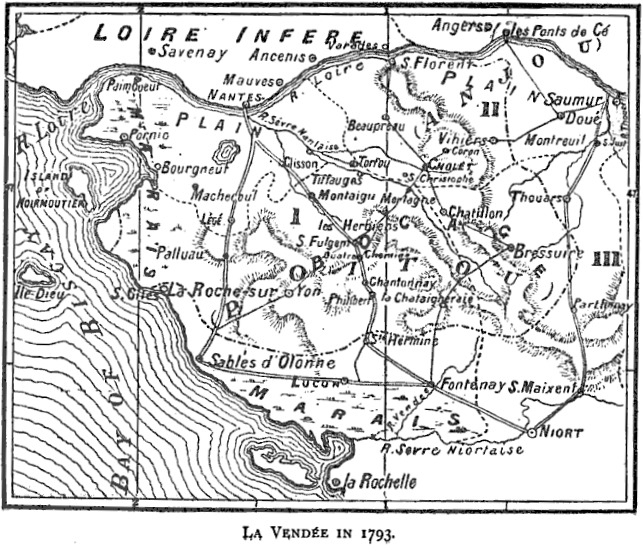
Map of the Vendée region of France in 1793. From page 123 of Francois-Severin Marceau (1769-1796) by Thomas George Johnson published in 1896 in London.
Via Wikimedia Commons.
On March 4 2011, the French historian Reynald Secher discovered documents in the National Archives in Paris confirming what he had known since the early 1980s: there had been a genocide during the French Revolution. Historians have always been aware of widespread resistance to the Revolution. But (with a few exceptions) they invariably characterize the rebellion in the Vendée (1793–95) as an abortive civil war rather than a genocide.
In 1986, Secher published his initial findings in Le Génocide franco-français, a lightly revised version of his doctoral dissertation. This book sold well, but destroyed any chance he might have had for a university career. Secher was slandered by journalists and tenured academics for daring to question the official version of events that had taken place two centuries earlier. The Revolution has become a sacred creation myth for at least some of the French; they do not take kindly to blasphemers.
[…]
The Vendée is a region in the west of France whose residents became renowned for their piety after Protestants were driven out of the area in the wake of King Louis XIV’s Edict of Fontainebleau (1685). Throughout the 18th century, the Vendée was, culturally, politically and economically, a backwater. The closest major city, Nantes, remains noted for its role in the slave trade.
Vendéens seem to have welcomed the French Revolution, at least initially. Everybody was annoyed with high levels of taxation. Even the pious were fed up with what they had to pay to the Church. The problem was not so much with the clergy as with parish assemblies (fabriques), which controlled parish finances. Vendéens had little quarrel with the local nobility, who as a rule stayed in the region and knew the peasantry well. Few of them spent any time in Paris, Versailles or even Nantes. The nobles too resented centralized administration.
The revolutionary government was determined to break the remaining power of the Catholic church, and seized most of the church properties, followed by a secularization of the church hierarchy in France which was intended to turn the priests and bishops into civil servants loyal to the French state rather than to the Pope in Rome. Resistance to this was particularly strong in Nantes and the surrounding region, which encouraged the revolutionary government to shut down all churches that did not conform to state directives. At the same time, the government introduced conscription, which was even more fiercely opposed in the Vendée and triggered armed conflict.
The rebels’ volunteer army numbered between 25,000–40,000 peasants whose main fighting experience consisted of drunken brawls in village taverns. They had no uniforms; most wore “sabots” (wooden clogs) instead of boots. Yet they consistently managed to beat back well-armed, experienced professional soldiers. A few had hunting rifles and were excellent shots; but the vast majority were armed with pitchforks, shovels and hoes. When the Revolutionary forces retreated, the rebels went back home to attend to their farms so that their families would not starve.
Revolutionary generals did not expect them to fight so fiercely. Of course, the rebels had no reinforcements behind them, and they knew that if they did not repel the Revolutionaries their homes would be destroyed, and their families butchered. The Vendéens were not paid for their fighting. Their main rewards for winning a battle was not being slaughtered for a little while longer. Under the circumstances, their discipline was outstanding, as even the Revolutionary generals admitted.
But the resources of the rebels were few, and casualties could not be replaced, unlike the government’s forces, so the tide eventually turned against the outnumbered rebels.
It became customary to drown brigands naked, not merely so that the Revolutionaries could help themselves to the Vendéens’ clothes, but also so that the younger women among them could be raped before death. Drownings spread far beyond Nantes: on 16th December, General Marceau sent a letter to the Revolutionary Minister of War triumphantly announcing, among other victories, that at least 3,000 non-combatant Vendéen women had been drowned at Pont-au-Baux.
The Revolutionaries were drunk with blood, and could not slaughter their brigand prisoners fast enough — women, children, old people, priests, the sick, the infirm. If the prisoners could not walk fast enough to the killing grounds, they were bayoneted in the stomach and left on the ground to be trampled by other prisoners as they bled to death.
General Westermann, one of the Revolution’s most celebrated soldiers, noted with satisfaction that he arrived at Laval on December 14 with his cavalry to see piles of cadavers — thousands of them — heaped up on either side of the road. The bodies were not counted; they were simply dumped after the soldiers had a chance of strip them of any valuables (mainly clothes).
The final death toll could only be an educated guess:
Reynald Secher estimates that just over 117,000 Vendéens disappeared as a result of the brigands’ rebellion, out of a population of just over 815,000. This amounts to roughly one in seven Vendéens fatally affected by military actions and the Crusade for Liberty. Though some areas lost half their population or more, with notably heavy losses at Cholet, which lost three fifths of its houses as well as the same proportion of its people. Colleges, libraries and schools were destroyed as well as churches, private houses, farms, workshops and places of business. The Vendée lost 18 percent of its private houses; a quarter of the communes in Deux-Sèvres saw the destruction of 50 percent or more of all habitable buildings. Other consequences of the Crusade for Liberty included a widespread epidemic of venereal disease.
Comments Off on Genocide in the French Revolution – the Vendée from 1793 to 1795
March 10, 2019
Irish Potato Famine – The American Wake – Extra History – #4
Extra Credits
Published on 9 Mar 2019Not all of the 214,000 Irish immigrants in 1847 made it safely to their new homes — and of those who did, many faced classism and xenophobia and even bullying from the “Ulster Irish” or “Scots-Irish” folks who had previously established themselves. In New York City specifically, the Five Points neighborhood became an infamous center of conflict — while local Irish-American John Joseph Hughes became instrumental in restoring Irish Catholicism.
Join us on Patreon! http://bit.ly/EHPatreon
Comments Off on Irish Potato Famine – The American Wake – Extra History – #4


