Quotulatiousness

May 15, 2013

Google UK marks the 150th birthday of Frank Hornby

Filed under: Britain, Business, History, Railways — Tags: , , , , — Nicholas @ 08:09

If you go to https://www.google.co.uk/ today, you’ll see the Google doodle has a distinct toy train motif:

Google UK doodle for Frank Hornby

At The Independent, Matilda Battersby tells the story:

The search engine Google is celebrating the 150th birthday of visionary toy maker Frank Hornby, whose model railways, Meccano sets and Dinky toys are still being played with by children today.

Born in Liverpool on 15 May 1863, Hornby was behind three of the most popular toy lines of the 20th century despite having no formal engineering training.

[. . .]

Meccano’s turnover for the 1910 financial year was £12,000. His son Roland joined the business, and when the operation began exporting to Europe, he opened Meccano France Ltd in Paris. Two offices in Germany soon followed.

Having dabbled in politics in later life, Hornby died of a heart condition and diabetes in Maghull, near Liverpool, on 21 September 1936. Two years previously he had set up Dinky Toys to manufacture miniature model cars and trucks.

In 1938 his son Roland launched the Hornby Dublo model railway system — a posthumous honour to his father.

Enthusiasts around the world still collect Hornby train sets, Dinky Toys and Meccano models. The modern business also make Scalextric cars and Airfix kits.

H/T to Roger Henry for the link.

April 23, 2013

What we know (so far) about the would-be Via bombers

Filed under: Cancon, Law, Railways — Tags: , , , , , , , — Nicholas @ 09:18

Maclean’s has a summary pulling together files from Nicholas Köhler, Charlie Gillis, Michael Friscolanti and Martin Patriquin on what is known about the two men arrested yesterday in a plot to commit an act of terror on a Canadian passenger train:

One of the men, Raed Jaser, is believed to have grown up in a Palestinian family with Jordanian roots. Court records seem to indicate he went on to a troubled history in Toronto, where authorities arrested him after a months’-long investigation they say ultimately leads back to al-Qaeda elements in Iran.

Although he is not a Canadian citizen, Jaser, 35, appears to have been in Ontario for at least two decades.

In October 1995, a man with the same name and year of birth was criminally charged in Newmarket, Ont., with fraud under $5,000 (the charge was withdrawn a year later). In December 2000, a week after his 24th birthday, Jaser was arrested and charged again, this time with uttering threats. Although court records show he was convicted of that charge, it’s not clear what sentence he received.

[. . .]

Details about the other man police say was involved in the plot, [Chiheb] Esseghaier, a resident of Montreal, are also coming into focus. A highly trained engineer, he had the resumé of an academic poised to go places.

As recently as last month he was publishing research papers.

The March 2013 edition of journal Biosensors and Bioelectronics published a paper on advanced HIV detection by Esseghaier, Mohammed Zourob and a fellow PhD student named Andy Ng.

According to his CV, Esseghaier was born in Tunisia. He received an engineering degree from Institut Tunisia’s National des Sciences Appliquées et de Technologie in 2007, with his masters degree following in 2008. He then moved to Université de Sherbrooke to research “SPR biosensor and gallium arsenide semi-conductor biofunctionnalization.” In November 2010, he joined Institut National de la Recherche Scientifique (INRS), a graduate institution associated with the Université du Québec.

March 27, 2013

The Beeching Report, 50 years on

Filed under: Britain, History, Railways — Tags: , , , , — Nicholas @ 09:36

In 1963, the British government published The Reshaping of British Railways, which became more commonly known as the Beeching Report. It was the trigger for the most substantive cuts in rail service and the focal point for a huge public outcry (and probably tipped the following national election to the Labour Party, too). The British railway system (which had been “rationalized” in 1923 and then fully nationalized in 1948) was bleeding money with little or no chance to pay back the debts it was running up. The operating deficit for British Railways ratcheted up from £16.5 million in 1956 to £104 million in 1962, with no likely end in sight. The Beeching Report was the government’s attempt to address the issue once and for all. History Today linked to this summary of the report and the public’s reaction by Charles Loft from 2003:

The lasting popular view of Beeching is of a cold-blooded accountant, concerned only with finance, whose report examined the railways in a vacuum when what was needed was a study of transport as a whole. One historian has called Beeching’s appointment ‘a tragedy for the nation’ and accuses him of ‘callously’ ignoring the social consequences of closures. Another, in a work entitled The Great Railway Conspiracy, suggests that the closure programme was at least partly motivated by a deliberate anti-rail bias on the part of the Conservative government of the day.

Such suspicions have been fuelled by a number of factors. Prior to 1962 closure proposals had (in effect, although not in law) to be approved by the relevant local Transport Users’ Consultative Committee. These committees rarely exercised a veto, but their hearings provided such an effective forum for critics of railway management, and took up so much time and effort, that they deterred railway managers from a vigorous pruning of the system. In 1956 the Ministry suggested that it might be better to publish a closure programme as part of a plan à la Beeching and have ‘one big row’ about it, than to fight a series of individual battles, but the British Transport Commission decided to experiment with diesel railbuses and other economies instead. Yet by 1959 it was clear that such measures were insufficient and therefore attempts were made to accelerate the rate of closures. [. . .]

Beeching’s apparent disregard for the social consequences of closure was merely a reflection of the fact that his report was a statement of what the railways should do as a business. What they should do as a social service was for ministers to decide, as only they could weigh the resulting costs against competing demands on the Exchequer. Because Beeching had little to say about social need and there was no legislative provision for subsidising loss-making services, the idea took root that the issue had simply been ignored. However, it was always accepted that many loss-making lines would have to be retained, particularly in urban areas where it was recognised that rail performed a vital role in reducing road congestion. Of course, the point at which hardship justified a loss was bound to be open to dispute; and in cases where losses were high and hardship affected relatively few, those few were unlikely to be consoled by the logic behind the process.

The Treasury’s concern over public spending levels also led it to initiate a series of studies of long-term demand in various sectors, in order to prioritise public investment. No such study of transport had been undertaken in Whitehall since the war and an initial attempt in 1957 revealed little more than officials’ lack of information or expertise on the subject. This problem proved difficult to solve. Such expertise could not be acquired overnight, and Whitehall was unable to establish a common measure for judging investment in road and rail. Instead, transport planning quickly crystallised around a choice between investing in rail and restricting road transport, or investing in roads and leaving the railways to perform only those tasks which they could accomplish profitably. As one Treasury under-secretary put it, the growth of road traffic in the 1950s meant that ‘Whitehall is … collectively fumbling after a new policy to meet new conditions which threaten to overwhelm us – indeed they may already have done so’.

[. . .]

In comparison to the lack of transport planning that typified the mid-1950s, the Beeching era represented a high point in transport policy-making. This is not to say that the resulting policy was unequivocally correct. Better roads were needed, but motorway-building did not offer a straightforward solution to congestion, and it is easy to point to regrettable rail closures. Some lines, such as Nottingham-Mansfield, have reopened, others, such as Oxford-Cambridge, may do so in the future; and the isolation of towns such as Hawick and Louth from the rail network was an act of dubious wisdom.

If these were errors, they were not Beeching’s, but politicians’. However, ministers of transport can never hope to satisfy our demand for unlimited road space and excellent public transport, as the availability of the former increases the latter’s cost. The lasting opprobrium heaped upon the memory of Dr Beeching is testimony to this fact — and to the gulf between the images conjured up by politicians’ talk of modernisation and the pains which, in reality, it all too often involves.

January 7, 2013

“[N]o person in Canada stands above or outside of the law”

Filed under: Cancon, Law, Liberty, Media, Railways — Tags: , , , , — Nicholas @ 15:09

Christie Blatchford on the inability of Canadian police to shut down protests by First Nations groups that violated the law:

Saying “I do not get it,” an Ontario Superior Court judge Monday bemoaned the passivity of Ontario police forces on illegal native barricades and issued a lament for the state of law-and-order in the nation.

“…no person in Canada stands above or outside of the law,” Judge David Brown said in a decision that was alternately bewildered and plaintive.

“Although that principle of the rule of law is simple, at the same time it is fragile. Without Canadians sharing a public expectation of obeying the law, the rule of law will shatter.”

Judge Brown was formally giving his reasons for having granted CN Rail an emergency injunction last Saturday night, when the railway rushed to court when Idle No More protesters blocked the Wymans Road crossing on the main line between Toronto and Montreal.

December 31, 2012

Railroads see traffic boom as pipelines are delayed

Filed under: Business, Economics, Railways, USA — Tags: , — Nicholas @ 12:53

The increase in railroad traffic from handling shipments of shale oil is having a very positive effect on the rail companies’ bottom lines:

Energy companies behind the oil boom on the Northern Plains are increasingly turning to an industrial-age workhorse — the locomotive — to move their crude to refineries across the U.S., as plans for new pipelines stall and existing lines can’t keep up with demand.

Delivering oil thousands of miles by rail from the heartland to refineries on the East, West and Gulf coasts costs more, but it can mean increased profits — up to $10 or more a barrel — because of higher oil prices on the coasts. That works out to roughly $700,000 per train.

The parade of mile-long trains carrying hazardous material out of North Dakota and Montana and across the country has experts and federal regulators concerned. Rail transport is less safe than pipelines, they say, and the proliferation of oil trains raises the risk of a major derailment and spill.

Since 2009, the number of train cars carrying crude hauled by major railroads has jumped from about 10,000 a year to a projected 200,000 in 2012. Much of it has been in the Northern Plains’ Bakken crude patch, but companies say oil trains are rolling or will be soon from Texas, Colorado and western Canada.

November 23, 2012

The bridge that eats trucks

Filed under: Railways, Randomness, USA — Tags: , — Nicholas @ 09:38

It’s a bridge so fearsome that it has its own website for breathtaking footage of trucks coming to grief at 11’8″:

If you’re paying attention this week when you drive that tall truck down South Gregson Street, you’ll get fair warning about the low bridge ahead.

A series of yellow diamond signs, starting a block in advance, will tell you about the 11-foot, 8-inch clearance.

Then the yellow lights will go crazy, the ones with an overhead sign that says: OVERHEIGHT WHEN FLASHING.

You’ll have one last chance to escape disaster. You can turn onto Peabody Street, just before Gregson runs beneath the railroad bridge that carries freight and passenger trains across downtown Durham.

But if you’re not paying attention — you dummy! — you’ll make plenty of noise as you crash into that low bridge. It will peel the roof off your moving van. It will scatter the hay bales or building supplies stacked much too high on your flatbed.

It might leave your box truck wedged beneath the overpass. The tow-truck driver will have to deflate your tires before he can haul your sorry self away.

You can watch a collection of truck decapitation clips here: http://11foot8.com/

November 4, 2012

Remembering the Toronto, Hamilton & Buffalo Railway

Filed under: Cancon, History, Railways — Tags: , , , — Nicholas @ 10:13

My friend John Spring is sharing some of his vast collection of railway film and photos with Canrail Video, and they’ve posted this excerpt of footage on the railway, including some of the last runs under steam on the TH&B:

TH&B Steam from the collection of John Spring. Copyrighted material ©2012 Canrail Video Productions. All rights reserved. You can however, link to this show from your site. This video will be shared for a short time only. You can view is and other John Spring films on future Canrail/Green Frog productions in the near future.

For more information on the railway, check the TH&B Railway Historical Society page or the Yahoo group (full disclosure: I founded the historical society, although I’m not currently active with the organization). I’m also the moderator for the discussion group.

September 29, 2012

CN experiments with natural gas for its locomotives

Filed under: Business, Cancon, Railways, Technology — Tags: , , — Nicholas @ 00:01

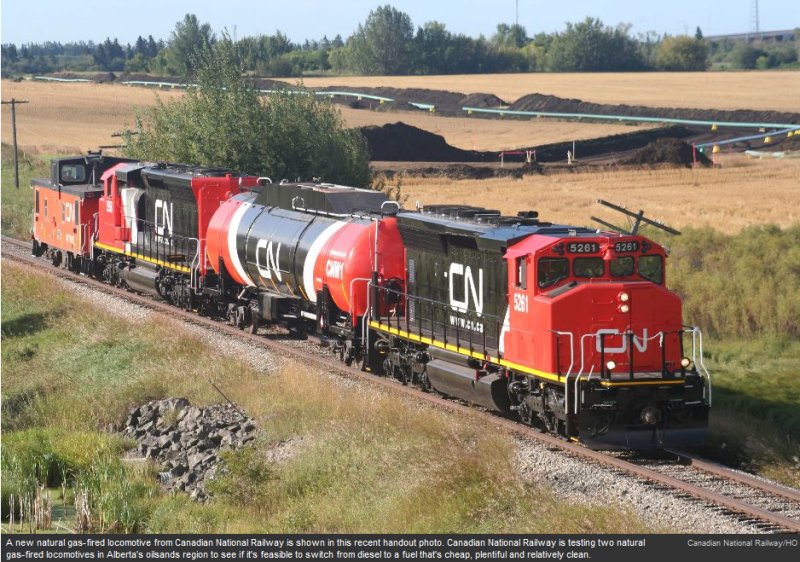
Canadian National Railways is running a limited experiment with a pair of retro-fitted diesel locomotives converted to running on natural gas:

Canadian National Railway is exploring whether its feasible to use cheap and relatively clean natural gas to power its trains instead of diesel.

CN has retrofitted two of its existing diesel-fired locomotives to run mainly on natural gas. It’s testing the locomotives along the 480-kilometre stretch between Edmonton, a key energy processing and pipeline hub, and the oilsands epicentre of Fort McMurray, Alta.

Longer term, CN and three other partners are looking at developing an all-new natural gas locomotive engine as well as a specialized tank car to carry the fuel.

August 31, 2012

Where would London be without the Tube?

Filed under: Books, Britain, Media, Railways — Tags: , — Nicholas @ 09:27

At sp!ked, Neil Davenport reviews a new book about London’s iconic underground:

The closing ceremony of the 2012 London Olympics was notable for its groaning reliance on tourist-shop icons — all black cabs, bowler hats, Houses of Parliament, red pillar-boxes and Mini Coopers. In a dreary way, what could we expect? A tourist-shop portrayal of Britain is still internationally recognisable and, for the organisers, safe enough to avoid party-pooping controversy. Curiously, though, one famous figure of the capital was noticeable by its absence: the London Underground. With its roundel logo, distinctive trains and elegantly functional map, few landmarks of London are as richly iconic as this. Indeed, as a character player in umpteen films, novels and pop songs, no London setting would be complete without the Underground.

Throughout the network’s history, though, Londoners’ relationship with the Tube has often been uneasy and aggravating: overcrowding, delays, cancellations, the fare’s dent on the wallet and, for the middle classes, striking tube workers and their ‘inflated’ salary. Nevertheless, it is only when the Tube is not working properly that we become aware of its magnitude. Unlike Tower Bridge or Beefeaters, the Tube isn’t a remote or mythical symbol of London. It’s the living, working and organic lifeblood of the capital. It is the way in which millions of Londoners are able to work and play and thus, unlike Parliament, has meaning to ordinary people’s lives.

The boons and banes of the tube for Londoners (and visitors) are warmly captured in Andrew Martin’s Underground, Overground: A Passenger’s History of the Tube. A novelist and former ‘Tube Talk’ columnist for the London Evening Standard, Yorkshireman Martin pithily combines an authoritative history of the network’s development with personal reflections on his daily journeys. People can say they have become Londoners when they can navigate the vast system and reflect on its highs and lows, quirks and anomalies. Whether we admit it or not, Londoners will have their favourite stations and lines (the author’s is the Central line, mine the Victoria). They will notice the art décor splendour of Arnos Grove station or the beautifully rich tiles at Baker Street. They will curse themselves for falling asleep on the last tube (it’s that gentle rocking motion that sends you off to the Land of Nod) and waking up, as I have on numerous occasions, in High Barnet.

The Northlander “was like northern Ontario on wheels”

Filed under: Cancon, Economics, Railways — Tags: , , , — Nicholas @ 00:06

Chris Selley remembers Ontario Northland’s The Northlander, which the Ontario government will be phasing out next month:

Long-distance rail travel for real folks, as opposed to wealthy tourists, took another sad hit recently with the announced cancellation of the Northlander — the Ontario Northland Railway’s leisurely 11-hour putter from Toronto’s Union Station to Cochrane, Ont., whence the more legendary Polar Bear Express will still take you to Moosonee, on James Bay.

It’s not sad in any commercial sense: The provincial government claims each ticket sold was subsidized to the tune of $400 (though other mathematical interpretations are available). And it’s not sad because senior citizens will now be crammed on to buses to go to their far-flung medical appointments. That’s unfortunate, no question: Trains are fundamentally more civilized than buses. But many communities the size of those served by the Northlander don’t even have buses anymore. This is the age we live in.

I find it sad, firstly, because I have fond childhood memories of that trip. There used to be a train that ran past Cochrane, all the way to Kapuskasing, where we had family friends, and it used to run overnight. There was something wonderfully odd about getting ready for bed while trundling up the Don Valley. In the winter, the train was like a strange, slow teleportation to a different planet: You went to sleep in Toronto’s grey-brown approximation of the season and awoke, after a night of groggily perceived stopping and starting, horn blasts and various crashes and bangs, to a blinding white, empty snowscape. Stumbling to the dining car — well, the box-of-cereal-and-milk car — you would find the spaces between the cars encased in snow and ice, like the inside of an old freezer.

It wasn’t fast, or slick. It was a bit ramshackle. But it was folksy. It was like northern Ontario on wheels.

The earlier post on the cancellation.

August 21, 2012

Farewell to The Northlander

Filed under: Cancon, Economics, Railways — Tags: , — Nicholas @ 12:00

The economics of long-distance passenger rail service is brutal: this announcement is not really a surprise, but it is disappointing anyway.

If a train stops running through the hinterland, does anybody hear?

The Ontario government has just announced the end of the line for the Northlander. The Ontario Northland train that runs between Toronto and Cochrane, Ontario, will cease service at the end of September.

What’s the word for that? Disappointing doesn’t cut it. Short-sighted is accurate, but insufficient. Regrettable is an understatement, too.

You’d think as a nation once united by the railway, we would have coined a term to cover the loss, the heartache, the sense of isolation, betrayal and rejection that comes from losing a railway line.

The only expression that comes close is “they’ve killed another train.”

Time and time again, we’ve seen passenger service reduced to little more than a quaint memory in many parts of the country.

Despite the historical appeal, long distance passenger rail loses money just about everywhere: government subsidies have been necessary for decades to keep the trains running. Political jockeying may keep a line open for a longer period, but nothing is going to change the facts. Passenger trains can be competitive for short-to-medium distances, but quickly lose out in efficiency (and potential profits) to air service over medium-to-long distances. Every time someone rides a VIA or Ontario Northland passenger train, the taxpayer is picking up part of the tab (and the longer the distance being travelled, the greater the required subsidy from the government).

Garnet Rogers explains what happens next:

The last train rolled out of town today;
You might have seen it on the news.
We gathered round the engine yard
To say our good-byes to the crews.
Well the cheering stopped, the laughter died
It dwindled down the tracks
“That’s that”, I heard someone say,
“We’ve fallen through the cracks.”

July 2, 2012

Alex Tabarrok on the slow rail and infrastructure bottleneck

Writing at Marginal Revolution, Alex Tabarrok wonders “Why haven’t the $500 bills been picked up?”:

High speed rail, especially California’s project, looks to me to be monorail economics, a costly boondoggle whose appeal lies not in rational calculation […] but in the desire of some politicians (and voters) to feel visionary and sexy. In theory, CA HSR might work but the inevitable reviews, delays, lawsuits and special interest payoffs make the prospects of a beneficial project look dim, demosclerosis kills.

Slow speed rail, however, i.e. freight transport, isn’t sexy but Warren Buffett is investing in rail and maybe we should as well. In particular, there are basic infrastructure projects with potentially high payoffs. Congestion in Chicago, for example, is so bad that freight passing through Chicago often slows down to less than the pace of an electric wheel chair. Improvements are sometimes as simple as replacing 19th century technology with 20th century (not even 21st century!) technology. Even today, for example:

    …engineers at some points have to get out of their cabins, walk the length of the train back to the switch — a mile or more — operate the switch, and then trudge back to their place at the head of the train before setting out again.

In a useful article Phillip Longman points out that there are choke points on the Eastern Seaboard which severely reduce the potential for rail:

    …railroads can capture only 2 percent of the container traffic traveling up and down the eastern seaboard because of obscure choke points, such as the Howard Street Tunnel in downtown Baltimore. The tunnel is too small to allow double-stack container trains through, and so antiquated it’s been listed on the National Register of Historic Places since 1973. When it shut down in 2001 due to a fire, trains had to divert as far as Cincinnati to get around it. Owner CSX has big plans for capturing more truck traffic from I-95, and for creating room for more passenger trains as well, but can’t do any of this until it finds the financing to fix or bypass this tunnel and make other infrastructure improvements down the line.

July 1, 2012

“Canada was born in debt”

Filed under: Cancon, Economics, Government, History, Railways — Tags: , , — Nicholas @ 11:08

At the Worthwhile Canadian Initiative blog, Livio Di Matteo explains one of the less mentioned but urgent reasons behind confederation in 1867:

The trials and tribulations of the European Union, its debt crisis and the Euro and the suggestion that part of the solution lies in a stronger fiscal union reminds me of the forces behind the drive for Canadian confederation in the mid-nineteenth century. Canadians are usually taught in school that major forces driving Confederation were the potential threat of territorial aggrandizement by the United States in the wake of the Civil War or the need for a larger market given Britain’s move to free trade and the end of Reciprocity with the Americans or the desire to generate the economic resources to build a railway to the west so that it could serve as an investment frontier.

One factor that receives very little mention is the fact that the prior to 1867 the colonies of British North America were heavily in debt and faced a fiscal crisis of their own. The solution to the colonial debt crisis that Confederation allowed was the creation of the federal government that was given strong revenue raising powers and assumed provincial debts and thereby stabilized the public credit. Public debt charges in 1867 already accounted for 29 percent of federal budgetary expenditure and by 1880 had only been whittled down to about 24 percent. Canada was born in debt.

Canada was created with a large debt as the provincial and local levels of government had invested heavily in transportation infrastructure — canals and railways in particular. In 1850, there were only about 66 miles of track in operation but by 1860 about 2000 miles of track had been built in eastern Canada. The total cost of building these railways in British North America up to 1867 was 145.8 million dollars the bulk of which was for the Province of Canada — Ontario and Quebec. By way of comparison, Canada’s GDP in 1870 has been estimated at about 383 million dollars.

[. . .]

Confederation was designed to fix a massive debt problem. Creation of a new political entity — the dominion government — would allow for the current debt burden to be serviced and for more credit to be obtained on foreign markets to fund the railway projects of the late 19th century — the CPR, Canadian Northern, etc… Confederation was a solution to the debt crisis but required a form of government that reduced sovereignty for the member units in order to stabilize the public credit. In the Canadian case, as acrimonious as the discussions were, the process was facilitated by the fact that the member units were all British colonies with similar institutions.

June 26, 2012

Railway engineering, 1947 style

Filed under: Britain, History, Railways, Technology — Tags: , , — Nicholas @ 00:03

London, Midland & Scottish Railway documentary that shows the relaying of St. Pancras Junction with prefabricated trackwork, along with the associated changes to the signalling system.

What struck me while watching this was the ages of most of the track crew: I’d have expected them to be a bunch of teens-to-early 20’s guys, but there are a lot of old gaffers still doing the heavy lifting here. Oh, and of course the work clothes: caps, hats, jackets, and braces. Not a hard hat or much in the way of obvious safety gear in sight. They may or may not have been better men in those days, but they earned their aches and pains honestly.

H/T to Roger Henry for the link, who pointed out “This will get your pulses racing. Also makes you realize that working on the railroad was for real men. Mechanisation has come a looong way since then.”.

June 22, 2012

Greek government getting serious about debt issues: selling off government land

Filed under: Economics, Europe, Government, Greece, Railways — Tags: , , — Nicholas @ 10:18

It’s surprising it’s taken this long for the Greek government to consider selling off excess government-owned land as a way to address some of their debt issues:

There’s little that shouts “seriously rich” as much as a little island in the sun to call your own. For Sir Richard Branson it is Neckar in the Caribbean, the billionaire Barclay brothers prefer Brecqhou in the Channel Islands, while Aristotle Onassis married Jackie Kennedy on Skorpios, his Greek hideway.

Now Greece is making it easier for the rich and famous to fulfill their dreams by preparing to sell, or offering long-term leases on, some of its 6,000 sunkissed islands in a desperate attempt to repay its mountainous debts.

The Guardian has learned that an area in Mykonos, one of Greece’s top tourist destinations, is one of the sites for sale. The area is one-third owned by the government, which is looking for a buyer willing to inject capital and develop a luxury tourism complex, according to a source close to the negotiations.

However, if you’re in the market for a lovely little Greek island, you should also consider that land costs are going to be only a small part of your investment:

Only 227 Greek islands are populated and the decision to press ahead with potential sales has also been driven by the inability of the state to develop basic infrastructure, or police most of its islands. The hope is that the sale or long-term lease of some islands will attract investment that will generate jobs and taxable income.

Also on the block for sale are other government monopolies:

In its battle to raise funds, the country is also planning to sell its rail and water companies. Chinese investors are understood to be interested in the Greek train system, as they already control some of the ports. In a deal announced earlier this month, the Greek government also agreed to export olive oil to China.

Update: Ah, I didn’t notice that the article had originally been published in 2010, hence my expressed surprise that it had taken so long for these measures to be considered.

« Newer PostsOlder Posts »

Powered by WordPress