
I remember a friend of mine, buying a couple of cheeses at Liverpool. Splendid cheeses they were, ripe and mellow, and with a two hundred horse-power scent about them that might have been warranted to carry three miles, and knock a man over at two hundred yards. I was in Liverpool at the time, and my friend said that if I didn’t mind he would get me to take them back with me to London, as he should not be coming up for a day or two himself, and he did not think the cheeses ought to be kept much longer.
“Oh, with pleasure, dear boy,” I replied, “with pleasure.”
I called for the cheeses, and took them away in a cab. It was a ramshackle affair, dragged along by a knock-kneed, broken-winded somnambulist, which his owner, in a moment of enthusiasm, during conversation, referred to as a horse. I put the cheeses on the top, and we started off at a shamble that would have done credit to the swiftest steam-roller ever built, and all went merry as a funeral bell, until we turned the corner. There, the wind carried a whiff from the cheeses full on to our steed. It woke him up, and, with a snort of terror, he dashed off at three miles an hour. The wind still blew in his direction, and before we reached the end of the street he was laying himself out at the rate of nearly four miles an hour, leaving the cripples and stout old ladies simply nowhere.
It took two porters as well as the driver to hold him in at the station; and I do not think they would have done it, even then, had not one of the men had the presence of mind to put a handkerchief over his nose, and to light a bit of brown paper.
[…]
From Crewe I had the compartment to myself, though the train was crowded. As we drew up at the different stations, the people, seeing my empty carriage, would rush for it. “Here y’ are, Maria; come along, plenty of room.” “All right, Tom; we’ll get in here,” they would shout. And they would run along, carrying heavy bags, and fight round the door to get in first. And one would open the door and mount the steps, and stagger back into the arms of the man behind him; and they would all come and have a sniff, and then drop off and squeeze into other carriages, or pay the difference and go first.
Jerome K. Jerome, Three Men in a Boat (to say nothing of the dog), 1889.
February 15, 2014
QotD: Cheese with range and striking power
February 3, 2014
Rick Mercer visits the West Coast Railway Heritage Park
Rick travels to Squamish, BC to ride and restore historic locomotives.
January 15, 2014
Top Gear – Car hit by train – Safety Message
December 2, 2013
London’s Underground system
H/T to Eric Kirkland for the link.
November 29, 2013
Australian railway’s Chinese-made locomotives falsely certified as asbestos-free
A growing concern for companies that deal with Chinese businesses is when safety is compromised and (as in this case) required safety certifications are falsified:
Railway workers have been exposed to potentially hazardous asbestos after the deadly dust was found in locomotives brought in from China.
The breach of a 10-year ban on the import of products containing the carcinogenic fibre is not the first incident of its kind.
Unions are now demanding tougher policing of Chinese imports, describing the current asbestos-free certificates as a farce.
Last year freight carrier SCT imported 10 locomotives made by China Southern Rail (CSR) to tow iron ore bound for China to port.
To comply with the decade-old Australian ban on asbestos imports, they were certified asbestos-free. However, this was not the case.
National secretary of the Rail, Tram and Bus Union Bob Nanva says maintenance workers raised concerns about the dust.
“We had our maintenance workers repairing a number of diesel engines,” he said.
“They identified a lot of white dust among those engines and asked the question as to whether or not that dust was safe.”
The workers’ concerns were justified. White asbestos — or chrysotile — was found throughout the locomotives, in insulation around the exhaust and muffler system, around coolant pipes and in the brake exhaust section near the roof of the driver’s cabin.
[…]
This is not the first time China has broken the Australian ban on asbestos.
Last year more than 25,000 Chinese-made Great Wall, Chery and Geely cars were recalled after asbestos was discovered in their engine gaskets and brakes.
In decades to come experts expect hundreds of thousands of Chinese casualties from asbestos.
A 1980s film by Szechuan University smuggled out from China shows the tragic story of China’s own Wittenoom — at Dayao, in the province of Yunnan — where asbestos exposures had led to the fatal cancer — mesothelioma.
Back in Australia, it was the same type of blue asbestos, from the Wittenoom mine, that lined Melbourne’s blue Harris trains, potentially poisoning passengers when the walls were broken.
So dangerous were the trains they were sealed in plastic and buried in quicksand at a quarry in Clayton.
Blue asbestos, which is more likely to cause the cancer mesothelioma, is now banned in both countries — but China is now the world’s largest user of white asbestos, which Perth’s asbestos expert Professor Bill Musk warns still causes cancer.
H/T to Craig Zeni for the link.
November 25, 2013
Amtrak even manages to lose money on food services
As I’ve said several times before, long distance passenger rail service is an economic dead-end, and the latest story on Amtrak’s financial situation just reinforces that:
As any popcorn-stand profiteer posing as a movie house operator can attest, captive eaters create golden opportunities to supersize profits. But on the Southwest Chief — and Amtrak trains in general — food and beverages are a financial drain. Last week, the inspector general revealed at a congressional hearing that Amtrak lost $609 million on its meal services over the past six years, citing all kinds of eye-popping details about giveaways to staff, spoiled food, and service workers earning about four times the standard industry wage. Defenders of Amtrak argue that the report was just a headline-grabbing jab that distracts from the larger story of the organization’s resurgence.
But the food service fiasco is just the tip of the iceberg. Amtrak has a chaotic management culture, routinely misappropriates funding, and is hamstrung by insane union work rules, as has been described in great detail by its former president, David Gunn.
Amtrak’s been running red ink since its founding in 1971, and tales of its financial imprudence are nothing new. But the 2008 law that authorizes it to operate is set to expire, so Congress is once again mulling what to do with this rolling money-gusher. The Brookings Institution has come out with a major study claiming that in the last five years Amtrak has finally gotten on the right track. The study, titled A New Alignment: Strengthening America’s Commitment to Passenger Rail, characterizes the 2008 legislation as a success that should be tweaked and renewed.
By glossing over facts, the Brookings report obscures the real story. In the last five years, Amtrak has grown increasingly reliant on public subsidies at all levels of government. Between 2007 and 2011, it received a record $8.4 billion in federal funding — a 50 percent increase over the prior five-year period. States have now become major contributors to Amtrak’s bottom line, kicking in an additional $842 million over the same timeframe. Amtrak’s ridership gains in the past few years are a nearly undetectable blip when placed in the context of the larger U.S. transportation network.
I’d often heard that the only profitable portion of the Amtrak network was the Northeast Corridor, but even that heavily used section is only profitable if you play accounting games:
So what about the Northeast Corridor (NEC), which is the busiest section of rail in the U.S.? Contrary to Brookings’ assertions, the NEC is also a giant money pit. The study claims the NEC generated a $205.4 million operating balance in 2011, but that figure was arrived at using Amtrak’s own selective bean counting methods. In violation of generally accepted accounting practices, routine maintenance expenses are counted as capital expenditures, according to O’Toole, while real capital expenditures never appear on Amtrak’s books because the federal government picks up the tab. According to calculations arrived at by Andrew Selden, an attorney and vice present of the United Rail Passenger Alliance, the federal government has poured roughly $40 billion into capital projects for the NEC since 1975. Now Amtrak says it needs another $151 billion to bring high-speed rail to the corridor by 2040.
November 2, 2013
It’s “time” for a change
In Quartz, Allison Schrager wonders why we still bother with daylight savings time and four separate timezones for continental US states:

Click to see full-size version at Quartz
This year, Americans on Eastern Standard Time should set their clocks back one hour (like normal), Americans on Central and Rocky Mountain time do nothing, and Americans on Pacific time should set their clocks forward one hour. After that we won’t change our clocks again — no more daylight saving. This will result in just two time zones for the continental United States. The east and west coasts will only be one hour apart. Anyone who lives on one coast and does business with the other can imagine the uncountable benefits of living in a two-time-zone nation (excluding Alaska and Hawaii).
It sounds radical, but it really isn’t. The purpose of uniform time measures is coordination. How we measure time has always evolved with the needs of commerce. According to Time and Date, a Norwegian newsletter dedicated to time zone information, America started using four time zones in 1883. Before that, each city had its own time standard based on its calculation of apparent solar time (when the sun is directly over-head at noon) using sundials. That led to more than 300 different American time zones. This made operations very difficult for the telegraph and burgeoning railroad industry. Railroads operated with 100 different time zones before America moved to four, which was consistent with Britain’s push for a global time standard. The following year, at the International Meridian Conference, it was decided that the entire world could coordinate time keeping based on the British Prime Meridian (except for France, which claimed the Prime Median ran through Paris until 1911). There are now 24 (or 25, depending on your existential view of the international date line) time zones, each taking about 15 degrees of longitude.
Now the world has evolved further — we are even more integrated and mobile, suggesting we’d benefit from fewer, more stable time zones. Why stick with a system designed for commerce in 1883? In reality, America already functions on fewer than four time zones. I spent the last three years commuting between New York and Austin, living on both Eastern and Central time. I found that in Austin, everyone did things at the same times they do them in New York, despite the difference in time zone. People got to work at 8am instead of 9am, restaurants were packed at 6pm instead of 7pm, and even the TV schedule was an hour earlier. But for the last three years I lived in a state of constant confusion, I rarely knew the time and was perpetually an hour late or early. And for what purpose? If everyone functions an hour earlier anyway, in part to coordinate with other parts of the country, the different time zones lose meaning and are reduced to an arbitrary inconvenience. Research based on time use surveys found Americans’ schedules are determined by television more than daylight. That suggests in effect, Americans already live on two time zones.
H/T to Tyler Cowen for the link.
September 22, 2013
The Station to Station train
Wired‘s Douglas Wolk looks at the Station to Station train tour:
Adam Auxier is Station to Station’s train producer – an energetic, affable guy who just happens to know pretty much everything there is to know about trains and their history. He put together the assortment of gorgeous old train cars that make up the vehicle for Doug Aitken’s coast-to-coast art-and-music tour (and helped Aitken to select the stations where it’s stopping), and he’s been overseeing the train and telling fascinating tales about its provenance and its route.
The cars on the Station to Station train were built between 1916 and 1953; Auxier arranged for them to be chartered from private owners who maintain them as a labor of love and rent them out to offset the cost of keeping them railworthy. (He has contact with all of them through his tour company, Altiplano Rail.) “A car like this seems wonderful,” Auxier says, pointing up at the skylights of the double-decker “Superdome” that serves as the train’s dining car and kitchen, “but it’s 65 years old. Imagine taking a 65-year-old car at 90 miles an hour across Missouri!”
The train’s individual cars all have stories of their own, all of which are at Auxier’s fingertips. “The Mojave, which is the Levi’s car, actually ran on this route, between Chicago and L.A.,” he says. “The Santa Fe Railway was a big promoter of the Southwest as a place for tourism – they did up the interiors of their cars with beautiful Southwestern art and carpet patterns. The lounge car up at the front was built for the president of the Norfolk & Western railroad in 1916, and it’s basically the private jet of its era. It was a mobile office, so an executive of that time would put it on a scheduled passenger train and take along a chef – he’d have a bedroom, an office and a kitchen for himself. It allowed him to go to any point on the railroad and conduct business.”
September 4, 2013
“Despite a rash of deadly train crashes…”
Coyote Blog indulges in a good old-time fisking of an article built on the claim that there has been a “trend” of increasingly deadly railway accidents:
The best way to explain the phenomenon is with an example, and the Arizona Republic presented me with a great one today, in the form of an article by Joan Lowy of the Associated Press. This in an article that reads more like an editorial than a news story. It is about the Federal requirement for railroads to put safety electronics called Positive Train Control (PTC) on trains by a certain date. The author has a pretty clear narrative that this is an absolutely critical piece of equipment for the public good, and that railroads are using scheming and lobbying to unfairly delay and dilute this critical mandate (seriously, I am not exaggerating the tone, you can read it for yourself.)
My point, however, is not to challenge the basic premise of the article, but to address this statement in her opening paragraph (emphasis added).
Despite a rash of deadly train crashes, the railroad industry’s allies in Congress are trying to push back the deadline for installing technology to prevent the most catastrophic types of collisions until at least 2020, half a century after accident investigators first called for such safety measures.
The reporter is claiming a “rash of deadly train crashes” — in other words, she is saying, or at least implying, that there is an upward trend in deadly train crashes. So let’s ask ourselves if this claimed trend actually exists. She says it so baldly, right there in the first seven words, that surely it must be true, right?
[…]
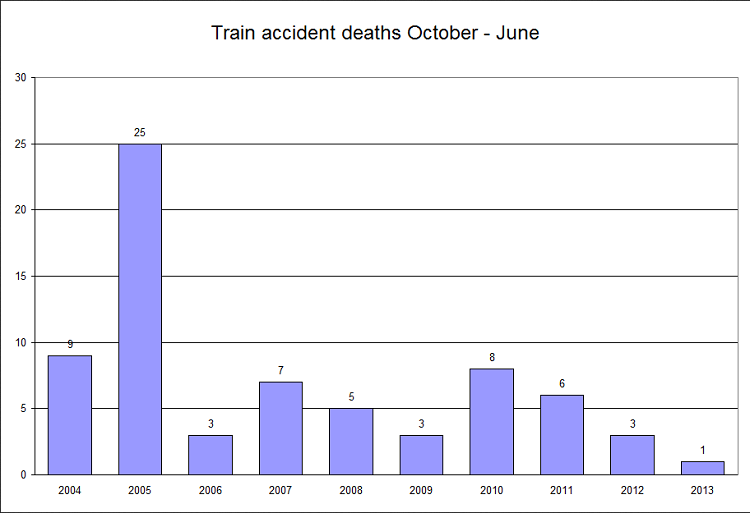
So let’s go to the data. It is actually very easy to find, and I would be surprised if Ms. Lowy did not actually have this data in her hands. It is at the Federal Railway Administration Office of Safety Analysis. 2013 data is only current through June and seems to be set up on an October -September fiscal year. So I ran the data only for October-June of every year to make sure the results were comparable to 2013. Each year in the data below is actually 9 months of data.
By the way, when one is looking at railroad fatalities, one needs to understand that railroads do kill a lot of people every year, but the vast, vast majority of these — 99% or more — are killed at grade crossings. People still do not understand that a freight train takes miles to stop. (see postscript below, but as an aside, I would be willing to make a bet: Since deaths at grade crossings outnumber deaths from collisions by about 100:1, I would be willing to bet any amount of money that I could take the capital the author wants railroads to invest in PTC and save far more lives by investing it in grade crossing protection. People like Ms. Lowy who advocate for these regulations never, ever seem to consider prioritization and tradeoffs.)
Anyway, looking at the data, here is the data for people killed each year in US railroad accidents (as usual click to enlarge any of the charts):
So, rather than a “rash”, we have just the opposite — the lowest number of deaths in a decade. One. I will admit that technically she said rash of “fatal accidents” and this is data on fatalities, but I’m going to make a reasonable assumption that one death means one fatal accident — which certainly cannot be higher than the number of fatal accidents in previous years and is likely lower.
Most of you will agree that this makes the author’s opening statement a joke. Believe it or not — and this happens a surprising number of times — this journalist is claiming a trend that not only does not exist, but is of the opposite sign.
August 7, 2013
Infrastructure does not lead development – it lags
In the Wall Street Journal, Larry Schweikart and Burton Folsom correct the misunderstanding that development and growth will follow infrastructure:
History says it doesn’t work like that. Henry Ford and dozens of other auto makers put a car in almost every garage decades before the National Interstate and Defense Highways Act in 1956. The success of the car created a demand for roads. The government didn’t build highways, and then Ford decided to create the Model T. Instead, the highways came as a byproduct of the entrepreneurial genius of Ford and others.
Moreover, the makers of autos, tires and headlights began building roads privately long before any state or the federal government got involved. The Lincoln Highway, the first transcontinental highway for cars, pieced together from new and existing roads in 1913, was conceived and partly built by entrepreneurs — Henry Joy of Packard Motor Car Co., Frank Seiberling of Goodyear and Carl Fisher, a maker of headlights and founder of the Indy 500.
Railroads are another example of the infrastructure-follows-entrepreneurship rule. Before the 1860s, almost all railroads were privately financed and built. One exception was in Michigan, where the state tried to build two railroads but lost money doing so, and thus happily sold both to private owners in 1846. When the federal government decided to do infrastructure in the 1860s, and build the transcontinental railroads (or “intercontinental railroad,” as Mr. Obama called it in 2011), the laying of track followed the huge and successful private investments in railroads.
In fact, when the government built the transcontinentals, they were politically corrupt and often — especially in the case of the Union Pacific and the Northern Pacific — went broke. One cause of the failure: Track was laid ahead of settlements. Mr. Obama wants to do something similar with high-speed rail. The Great Northern Railroad, privately built by Canadian immigrant James J. Hill, was the only transcontinental to be consistently profitable. It was also the only transcontinental to receive no federal aid. In railroads, then, infrastructure not only followed the major capital investment, it was done better privately than by government.
August 5, 2013
A morbid bit of railway history
I read about the London Necropolis Railway in The Fuller Memorandum by Charles Stross. I foolishly assumed he’d made it up for the purposes of the story. Not at all:
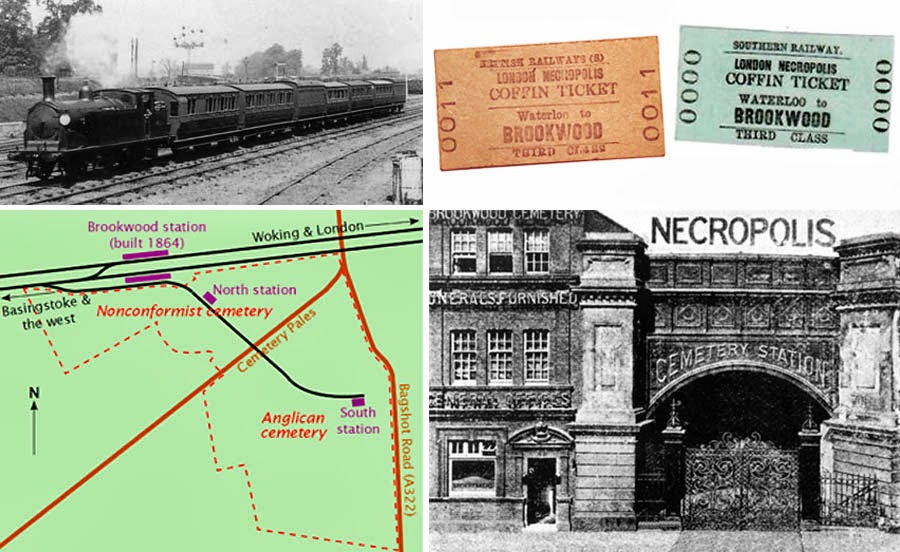
[Sir Richard] Broun was fascinated by the recently-emerged technology of steam trains. In 1848, Waterloo Station had only just been opened, and the railways themselves were still considered something of a novelty. Broun, along with his partner Richard Sprye, concocted a plan to ease the overcrowding issue with the help of this new invention. Buying up a 1,500 acre site outside Woking, they proposed the creation of a dedicated railway of the dead: a line (serviced by London & Southwest Rail) used for the sole purpose of transporting the deceased from London to ‘Brookwood Cemetery’ for burial.
[…]
The railway was inaugurated on 13th November 1854, with its own dedicated platform at Waterloo Station. A timetabled service would transport coffins down at night and mourners by day, delivering them to one of two stations: the Conformist station on Brookwood’s sunny side; or the non-conformist station on its dark north face. To prevent upsetting any delicate Victorian sensibilities, each ‘coffin train’ was divided into classes to separate the dead from their poorer neighbours. Even in death, it seemed, the idea of sharing a carriage with a pauper was anathema.
[…]
Until the 1940s it remained a weird London institution, a ghoulish Victorian hangover that resisted time, social change and falling demand. Ultimately, it took the Luftwaffe to close it down: during the heavy bombing raid of 16th April 1941 the Waterloo terminus was obliterated. The LNR had shipped its last cadaver.
H/T to Dave Slater for the link.
July 25, 2013
Spanish passenger train may have been running at 190 km/h in an 80 km/h zone
The horrific railway crash near Santiago de Compostela that has taken at least 80 lives may have been caused by excessive speed, which this video certainly seems to confirm:
The BBC reports that the engineer may have admitted travelling at a speed more than twice what that curve was rated for:
At least 130 people were taken to hospital after the crash, and 95 are still being treated, health officials say.
The 32 seriously injured include children.
People from several nationalities are among the wounded, including five Americans and one Briton.
[…]
A spokeswoman for the Galicia Supreme Court said the driver, who was slightly injured in the crash, was under investigation.
Named by Spanish media as Francisco Jose Garzon Amo, he is expected to face questioning by police on Thursday.
It was unclear whether anyone else was subject to investigation.
The train’s carriages have been removed from the track by cranes and sent for analysis.
The president of railway firm Renfe, Julio Gomez Pomar, was quoted by El Mundo newspaper as saying the driver, who was aged 52, had 30 years of experience with the company and had been operating trains on the line for more than a year.
He said the train which derailed had no technical problems.
“The train had passed an inspection that same morning. Those trains are inspected every 7,500km… Its maintenance record was perfect,” he told Spanish radio.
But Mr Garzon, who was trapped in the cab after the accident, is quoted as saying moments after the crash that the train had taken the curve at 190 km/h (118mph) despite a speed limit on that section of 80km/h, unidentified investigation sources have told Spanish media.
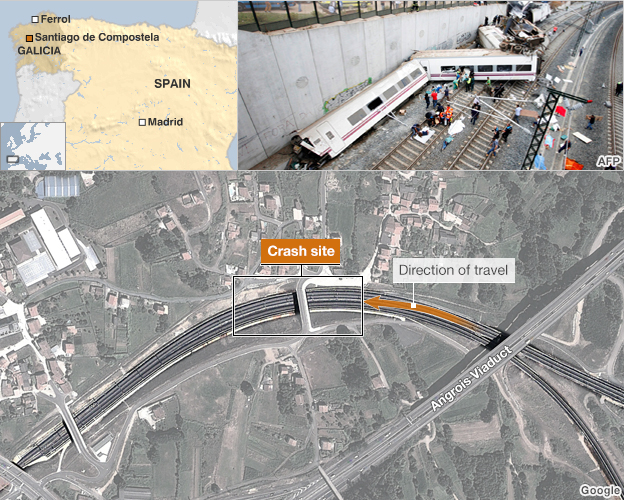
Update: The Renfe high speed trains use a safety system known as ASFA (Anuncio de Senales y Frenado Automatico or signal notification and automatic braking). The BBC says railway safety experts are confounded that the engineer was even able to exceed the speed limit in the area of the crash:
Sim Harris from Rail News told the BBC he was baffled as to how this could have happened.
“Modern trains have got so many systems on board to stop ‘over speed’ of this extreme kind,” he said.
“The ability of the driver to break the rules in this way is very limited indeed by the on-board systems of the train.”
The most modern train safety systems use equipment on the track and within the driver’s cab to replace traditional signals and control the speed and movement of the train automatically.
With a system such as the European Train Control System (ETCS), a driver would not be able to break the speed limit.
While parts of Spain’s rail network — including a large section of the route the train had travelled from Madrid — do have the ETCS in operation, the curve where Wednesday’s derailment took place relies on a less sophisticated safety system known as ASFA.
ASFA — Anuncio de Senales y Frenado Automatico or signal notification and automatic braking — relies on a series of beacons to communicate with the driver’s cab — so does not have the constant communication of ETCS.
The system gives audio and visual warnings to the driver if speed limits are surpassed, and will step in and brake the train if there is no response from the cab.
July 20, 2013
Investigators still don’t know what caused the explosion in Lac-Mégantic derailment
In the Globe and Mail, Jacquie McNish and Grant Robertson report on the ongoing investigations into the causes of the fatal explosion:
Federal officials probing the Lac-Mégantic disaster are testing the chemical composition of crude oil carried by the runaway train as they seek to answer the crucial question of what triggered the unusual and devastating explosion after the derailment.
[…]
Edward Burkhardt, chairman of Montreal, Maine & Atlantic Railway Inc., which operated the derailed train, said Canadian authorities have impounded the rail cars to take “a huge number of samples of oil.” He said the investigators and officials in the rail and oil industries “are asking how come there were explosions here. Crude does not blow up.”
People familiar with the investigation said the TSB is examining the composition of the oil that fuelled the explosion.
Industry sources said there are several possibilities. One is whether the crude, which came from the Bakken oil region of North Dakota, contained volatile chemicals. A possible scenario is that additives were intentionally combined with the crude oil to speed up the transfer of the syrupy oil, common for pipelines but rare in the rail industry. Another possibility is that the tanker cars had chemical contaminants from a previous shipment. Another question is whether the oil contained high levels of flammable hydrogen sulphide gas, which is sometimes present in Bakken oil.
[…]
Regulators in the United States say rail carriers are responsible for knowing what they are carrying, and that the shipper and the railway company are required to work out such details when the train is being loaded.
“The carriers have to know exactly what it is that they’re hauling at all times,” said Warren Flateau, a spokesman for the Federal Railway Association in Washington.
Mr. Burkhardt said MM&A received a detailed bill of lading from the U.S. oil services company, which he declined to identify, and no chemicals were identified as being present in the crude. The intermediary oil services company leased the rail cars, loaded them with oil and then contracted three separate railway companies to transport them.
The first carrier was Canadian Pacific Railway, which handed over the train to MM&A in Montreal. From there, MM&A was to deliver the oil cars to a small rail company in New Brunswick owned by the Irving family.
July 9, 2013
Time to let the media in to Lac-Mégantic
In Maclean’s, Paul Wells makes a strong case that it’s high time to let the media in to the disaster area of downtown Lac-Mégantic so they can do their job:
It was when I saw that Justin Trudeau had toured the Lac-Mégantic disaster site that I started to think something is seriously screwy about this whole situation.
I take seriously the sincerity of every politician arriving at Lac-Mégantic to tour the site of Saturday’s early-morning train derailment, and I note that it is starting to be a long list. I stand to be corrected on this chronology, but in very rough order it has included Premier Pauline Marois, NDP leader Thomas Mulcair, Prime Minister Stephen Harper, several members of Marois’s cabinet, two members of Harper’s, and Trudeau. On Tuesday Olivia Chow and another NDP MP will add their names to the list of MPs, MNAs and other dignitaries who have walked through the zone where the devastation occurred and the lives were lost. I assume it has been a harrowing experience for all of them.
But to some extent I can only assume, because no journalist has been allowed to take the same walk the politicians have taken. I did a radio interview today, and the reporter said, “The Prime Minister said it’s like a war zone. What have you seen?” And I said, more or less, I’ve seen some Sûreté du Québec scrums, and the haunted eyes of a few lucky survivors.
Now. There are reasons reporters wouldn’t be allowed to see the accident zone, and reasons why politicians would. But the parade of the latter is starting to make the curtain drawn in front of the former seem faintly ridiculous. The accident zone was hot for days, although apparently not so hot that a succession of politicians couldn’t get close. There are other security concerns, though apparently not insurmountable (see: succession of politicians). And political figures are responsible for authorizing relief efforts. But that’s less true for opposition politicians, and a whole lot less so again when it comes to leaders of third parties.
CNN reports that the CEO of the parent company that owns the MMA claims the Lac-Mégantic train was tampered with before the runaway:
The driverless train that barreled into a small Quebec town and derailed, unleashing a deadly inferno that killed at least 13 people, may have had its brakes inadvertently disabled, the chairman of the company operating the train said Tuesday.
Firefighters in the nearby town of Nantes put out a blaze on the train hours before it rolled into Lac-Megantic. Ed Burkhardt, chief executive officer and president of Rail World, the parent company of the Montreal, Maine & Atlantic Railway, told media outlets there’s evidence the engine powering the brakes was shut down at some point.
The matter needs further investigation, he told the Montreal Gazette. His company has begun an internal inquiry, he said.
“There are a number of missing pieces here,” Burkhardt told the paper, saying he didn’t suspect “the event was malicious or an act of terrorism.”
Pressed to elaborate by CNN affiliate CTV, Burkhardt wrote in an e-mail exchange, “We are now aware the firefighters shut down the locomotive. By the time (Montreal, Maine & Atlantic) people found out, it was too late.”
It’s possible that the firefighters who were called to the scene of the earlier (small) fire may have shut down the diesel engines as a precaution, not realizing that the engines were maintaining the air pressure in the brake system. If the engineer who went off-shift had not locked down enough of the hand brakes to hold the train on that grade, it would account for the train later running downhill towards Lac-Mégantic.
July 7, 2013
Locomotive in Lac-Mégantic derailment had been on fire hours before the crash
In the 680News round-up of details from the Lac-Mégantic explosion and fire, there’s a fascinating bit of news I hadn’t heard before:
Responding to a reporter’s question during Saturday’s news conference, Lauzon confirmed that firefighters in a nearby community were called to a locomotive blaze on the same train a couple of hours before the derailment. Lauzon said he could not provide additional details about that fire since it was in another jurisdiction.
This may or may not have any bearing at all on the subsequent runaway and crash, but it’s of interest. So far, there have been three reported deaths from the explosions and fire, with at least 40 people still unaccounted for. The PM will be visiting the town soon:
Prime Minister Stephen Harper is planning to visit this Quebec community Sunday, one day after powerful explosions caused by a train derailment levelled the town’s downtown core and killed at least one person, with police predicting the death toll would rise.
“We do expect we’ll have other people who will be found deceased unfortunately,” Lt. Guy Lapointe, a spokesman with Quebec provincial police, told a news conference Saturday night.
Authorities in Quebec say two more people are confirmed dead in the train derailment and massive fire in Lac-Mégantic to bring the declared death toll to five.
“We also expect that down the line … there will be more people reported missing than people actually found dead.”
Lapointe refused to give any estimate of people unaccounted for because emergency crews couldn’t reach a two-kilometre-square section of the town out of concern that five of the train’s tanker cars could still explode.


