Quotulatiousness

July 6, 2014

Lac-Mégantic, then and now

Filed under: Cancon, Railways — Tags: , — Nicholas @ 10:30

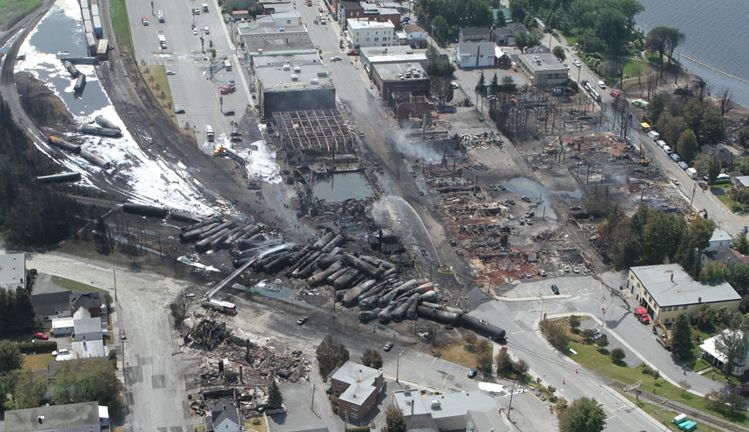
Maclean’s has a one-year retrospective photo essay on the derailment and explosion in Lac-Mégantic, one year ago.

Last July, a runaway train carrying crude oil derailed in downtown Lac-Mégantic, Que., and exploded, horrifically. The disaster killed 47 people and left a pile of twisted, burning metal in what remained of the town’s core. Martin Patriquin revisited the tragedy a year on and spoke to townspeople who are struggling to recover. “We aren’t enraged. Only terrorists get enraged. We are builders,” said Raymond Lafontaine, who lost three family members in the disaster and runs a local construction business.

Photographer Will Lew went to Lac-Mégantic, a town slowly recovering from the aftermath of Canada’s deadliest rail disaster. His photos revisiting scenes of devastation capture a gradual return to normalcy.

The photos are split, so you can move the slider to see the before-and-after images.

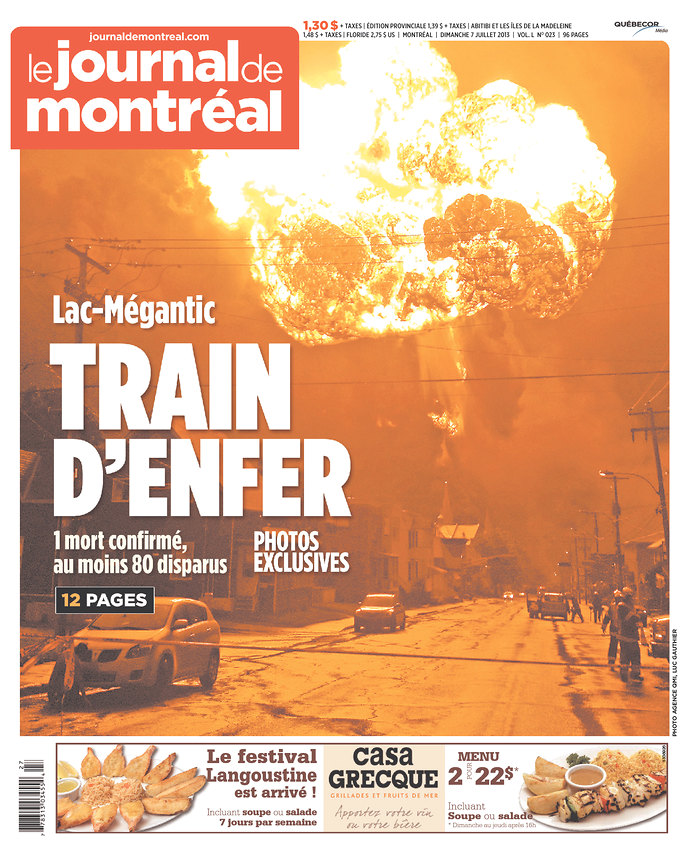
The front page of Le Journal de Montréal, courtesy of Newseum, with one of the most dramatic photos of the tragedy:

Front page of Le Journal de Montréal, 2013-07-07

July 2, 2014

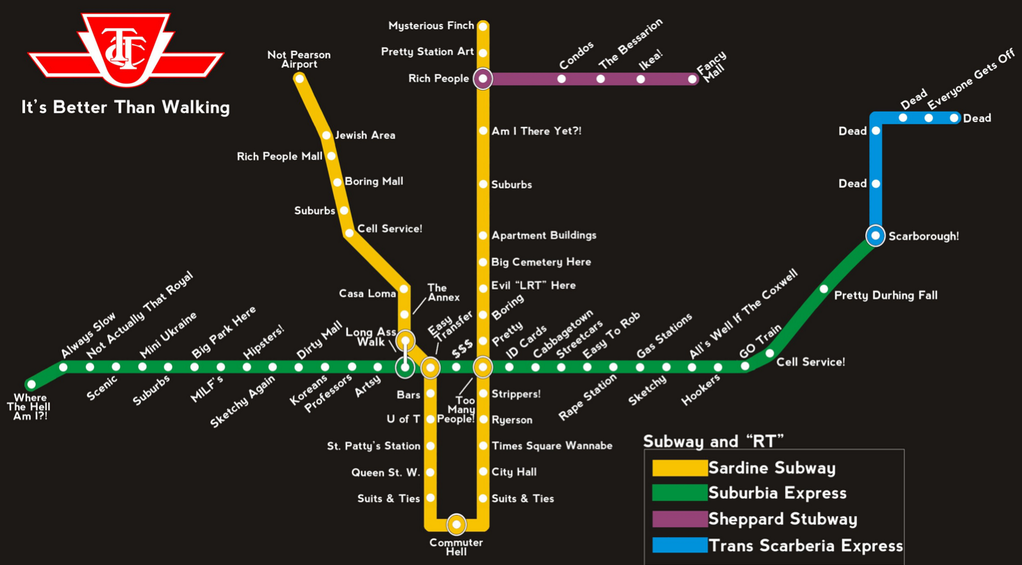
Toronto transit map, with real-world station descriptions

Filed under: Cancon, Humour, Railways — Tags: , , — Nicholas @ 10:56

Tyler Snowden tweeted this last year and Andrew Coyne retweeted it today:

TTC map in real life

June 28, 2014

Ayn Rand’s fascination with trains … as killing devices

Filed under: Books, Media, Railways — Tags: — Nicholas @ 10:25

Kevin Baker apparently reads Rand’s Atlas Shrugged purely for the killing porn:

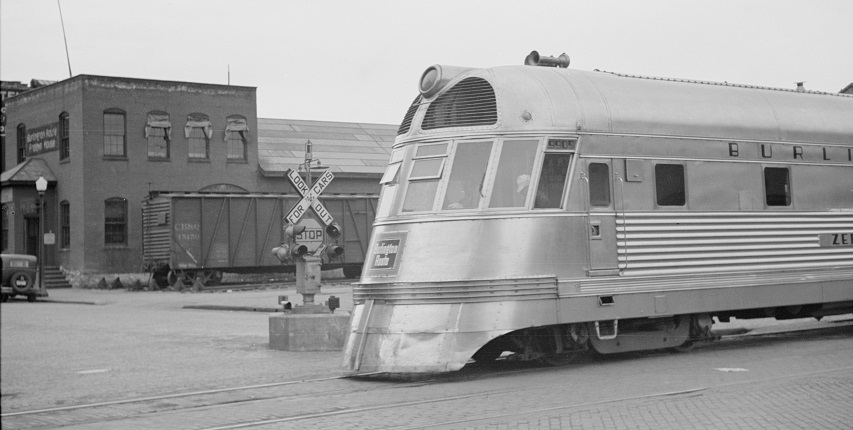
In her major opus, Atlas Shrugged, railroad management exemplifies the sort of endeavor her great heroes of capitalism, the prime movers, love to take on. She claimed to have taken rides in the locomotives of the New York Central while researching the book, and to have driven the 20th Century Limited, boasting that while she was at the controls of that extraordinary train, “nobody touched a lever except me.” Trains are such an indispensable motif in Atlas Shrugged, that, when some of Rand’s acolytes produced a slavishly faithful film adaptation of her book set in the present day, they had to invent a convoluted rationale involving resource shortages and industrial disasters to explain how railroads had once again become the dominant form of long-distance transportation.

Trains were more than just a magnificent obsession for Rand. They also served as a sort of avenging angel. […]

Rand later writes a scene in which, as the nation’s infrastructure is crumbling during what she terms a “strike” by the prime movers, a rail bridge falls apart and a Taggart Transcontinental train tumbles into the Mississippi River — one more vehicle crowded with thinkers of philosophically impure thoughts. And in yet another scene, Eddie Willers, the loyal aide to the book’s heroine, is aboard a train when it breaks down out in the Arizona desert. The other passengers and crew manage to be rescued by a passing wagon train(!), but Eddie refuses and pleads, “Don’t let it go!” while looking up helplessly at the locomotive. The others abandon the train and Eddie, almost certainly to his death.

It was such passages that led Whittaker Chambers, in his 1957 National Review takedown of Rand and her just-released book, to famously write, “From almost any page of Atlas Shrugged, a voice can be heard, from painful necessity, commanding, ‘To the gas chambers — go!’ ” By then Rand had lingered so long on her screed that trains, the cutting edge of American technology and design when she began, were about to be all but eliminated by the prime movers.

But reading of her love for trains’ capacity to kill at least allows one to understand her appeal to the modern Republican right. Her extended descriptions of those who will die and why they deserve to die resemble nothing so much as the climactic passages of Tim LaHaye and Jerry B. Jenkins’s Left Behind series, in which, after another set of righteous people have been raptured out of harm’s way, the authors dwell in loving detail on the torments to be inflicted by the returning deity of the Apocalypse — in this case, not Jesus Christ, but John Galt. Different god, same gas chamber.

June 20, 2014

British steam locomotives

Filed under: Britain, History, Railways — Tags: — Nicholas @ 00:01

H/T to Jon, my former virtual landlord, for the link.

May 21, 2014

New French trains built slightly too wide – €50 million spent so far to modify stations

Filed under: Cancon, Europe, France, Railways — Tags: , — Nicholas @ 09:35

SNCF (the French national passenger railway company) was very proud of the new fleet of passenger trains they’d ordered from manufacturers Alstom and Canada’s Bombardier … until it became clear that SNCF had been given the wrong dimensions to fit in many of the older French passenger stations:

It is a minor miscalculation, but one that will cost the French taxpayer a fortune.

France’s national rail operator SNCF — which runs its prestigious TGV fast trains — has sparked hilarity, anger and ridicule after building a new generation of regional trains that are too wide for 1,300 stations, meaning platforms will have to be “shaved” to stop them getting stuck.

The appalling blunder, which the French transport minister on Wednesday dubbed “comically tragic”, has already reportedly cost the state-controlled SNCF some €50 million (£40.5 million), sparking uproar at a time of austerity.

It was revealed by Wednesday’s Canard Enchaîné, the satirical weekly, whose cartoon showed a line of commuters on a busy platform being told: “The Paris-Brest train is entering the station. Please pull in your stomachs.”

The mistake was made as part of a €15 billion makeover of France’s Regional Express Trains, or TER, shared between Alstom, the French trainmaker and Bombardier, its Canadian rival.

[…]

Aware that France’s provincial stations — some of them ancient — came in various shapes and sizes, SNCF had asked the regional rail operator, Réseau ferré de France, or RFF, which is in charge of all French tracks, to work out the right measurements for the new trains.

Upon their advice that station widths varied by around 10cm in all, SNCF concluded the new trains could be 20 cm wider than their predecessors.

However, in an oversight that would cost it dear, the operator forgot to factor in some 1,300 stations built more than 50 years ago that are far narrower than today’s norms. “SNCF’s wise engineers forgot to verify the reality in the field,” wrote Le Canard.

May 18, 2014

The Past at Work Railway Mania (1980)

Filed under: Britain, History, Railways — Tags: , , — Nicholas @ 12:33

Uploaded on 25 Oct 2011

Part 8 of the 8-part series “The Past at Work”
Written & Presented by Anthony Burton
First broadcast 13th May 1980 (BBC 2)
See also: http://www.bbc.co.uk/archive/steamtrains/7309.shtml and http://www.imdb.com/title/tt1718607/episodes

H/T to Eric Kirkland for the link.

April 6, 2014

You’re doing it wrong, Mr. Fireman

Filed under: Humour, Railways — Tags: — Nicholas @ 08:29

"It's always good to read the ENTIRE instruction manual first ..."

“It’s always good to read the ENTIRE instruction manual first …”

H/T to André and Eric for the photo and caption, respectively.

March 11, 2014

“Orange army” to restore Cornwall rail line by early April

Filed under: Britain, Railways — Tags: — Nicholas @ 08:21

Remember the rather dramatic photos of the storm that hit the Cornish coast and took out part of the main railway line at Dawlish?


DAWLISH, UNITED KINGDOM – FEBRUARY 05: Railway workers inspect the main Exeter to Plymouth railway line that has been closed due to parts of it being washed away by the sea at Dawlish on February 5, 2014 in Devon, England. With high tides combined with gale force winds and further heavy rain, some parts of the UK are bracing themselves for more flooding. (Photo by Matt Cardy/Getty Images)

The effort to restore the sea wall and the railway line is going well, with a hoped-for re-opening date of 4 April:

Haberfield reckons there are two premier construction jobs in the world at the moment – the race to finish the football World Cup stadiums in Brazil and this one, the repairs to the train line that hugs the Devon coast at Dawlish after the devastation of the great storm of 4 and 5 February. “You’ll always be able to look back at this and say you were there and you helped fix it,” he says.

Haberfield is a member of the 1,000-strong “orange army” that has been working night and day to fix the hole, the 100-metre breach in a section of sea wall that supported the mainline track from London to the far south-west of Britain — and dozens of other less spectacular but nonetheless tricky breaks along a 3.7-mile stretch.

Network Rail (NR), the owner and operator of Britain’s railway infrastructure, has announced that it is expecting the line to re-open on 4 April — a huge relief to residents and business people whose lives have been disrupted by the break in the line and a vital boost for the region’s tourism industry before the Easter holidays.

The repair work to the line, which is costing around £15m, has been a triumph for imaginative thinking and teamwork. In the early days the first job was making sure that another Atlantic storm heading Devon’s way did not cause more damage to the main breach. One early idea was to rush in a rail-mounted concrete spraying machine that had been specially built to repair a tunnel in Devon and was standing idle. It shored up the sea wall, prevent further devastation and may have helped save houses that were teetering on the edge.

Another was the decision to drop a row of shipping containers in front of the seawall, each filled with 70 tonnes of rubble, to act as a temporary breakwater as more bad weather came in.


DAWLISH, UNITED KINGDOM – FEBRUARY 05: Waves crash against the seafront and the railway station that has been closed due to storm damage at Dawlish on February 5, 2014 in Devon, England. With high tides combined with gale force winds and further heavy rain, some parts of the UK are bracing themselves for more flooding. (Photo by Matt Cardy/Getty Images)

March 10, 2014

Amtrak now hoping to buy good press with a “residency”

Filed under: Media, Railways, USA — Tags: , — Nicholas @ 10:13

Amtrak P42DC locomotive #29 with a Blue Water or Wolverine train waits on a siding for a train in the opposite direction to pass in Comstock, Michigan

Amtrak P42DC locomotive #29 with a Blue Water or Wolverine train waits on a siding for a train in the opposite direction to pass in Comstock, Michigan (source: Wikipedia)

In Reason, Ed Krayewski looks at Amtrak’s attempt to get some good media coverage by sponsoring a writer with a private rail car:

Do you write? Are you looking for a free ride? Do you like Amtrak, or can you at least avoid disparaging it? If so, it wants to hear from you:

    Amtrak is excited to announce the official launch of the #AmtrakResidency program.

    #AmtrakResidency was designed to allow creative professionals who are passionate about train travel and writing to work on their craft in an inspiring environment. Round-trip train travel will be provided on an Amtrak long-distance route. Each resident will be given a private sleeper car, equipped with a desk, a bed and a window to watch the American countryside roll by for inspiration. Routes will be determined based on availability.

Amtrak is one of those worst of both worlds public/private hybrids. Instead of using the power of privatization to improve services previously offered by government (what happens in successful public private partnerships), Amtrak is a “for-profit” corporation that doesn’t actually turn a profit because it gets annual funding from the federal government and various state governments who have stepped in any time the feds have tried to trim funding.

February 16, 2014

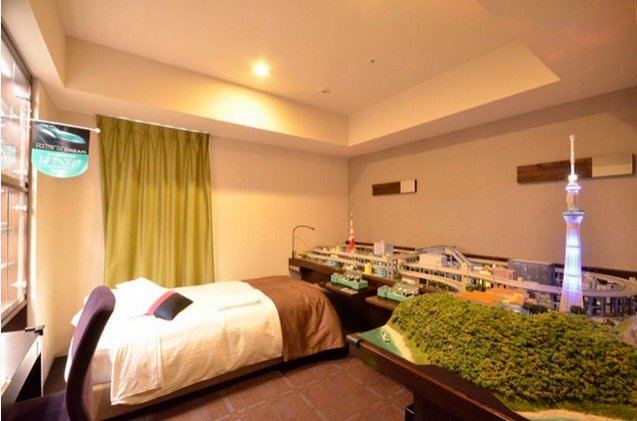
Hotel room with a built-in model train layout

Filed under: Business, Japan, Railways — Tags: , — Nicholas @ 10:43

Another case of Japan finding a niche clientele, this time in specialized hotel accommodation:

A Hotel Room Where Train Nerds Can Get Action. Train Action.

Tokyo hotel room with train layout 1

In most Japanese hotel rooms, you just sleep. In some, you might do other things. But in this Tokyo hotel you can play with toy trains.

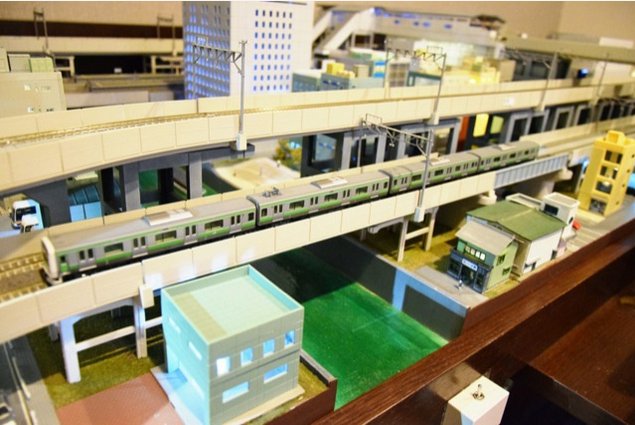
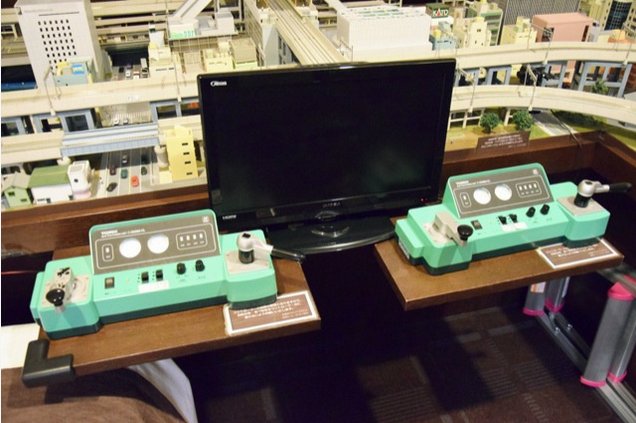
At the Washington Hotel in Tokyo’s geek district of Akihabara, room 1304 is quite different from the rest. It’s outfitted with a diorama that has Tokyo Tower, Tokyo Skytree, and thirty meters of model train track!

Tokyo hotel room with train layout 2

Tokyo hotel room with train layout 3

H/T to Jeff Shultz for the link.

February 15, 2014

QotD: Cheese with range and striking power

Filed under: Food, Humour, Quotations, Railways — Tags: , — Nicholas @ 10:17

I remember a friend of mine, buying a couple of cheeses at Liverpool. Splendid cheeses they were, ripe and mellow, and with a two hundred horse-power scent about them that might have been warranted to carry three miles, and knock a man over at two hundred yards. I was in Liverpool at the time, and my friend said that if I didn’t mind he would get me to take them back with me to London, as he should not be coming up for a day or two himself, and he did not think the cheeses ought to be kept much longer.

“Oh, with pleasure, dear boy,” I replied, “with pleasure.”

I called for the cheeses, and took them away in a cab. It was a ramshackle affair, dragged along by a knock-kneed, broken-winded somnambulist, which his owner, in a moment of enthusiasm, during conversation, referred to as a horse. I put the cheeses on the top, and we started off at a shamble that would have done credit to the swiftest steam-roller ever built, and all went merry as a funeral bell, until we turned the corner. There, the wind carried a whiff from the cheeses full on to our steed. It woke him up, and, with a snort of terror, he dashed off at three miles an hour. The wind still blew in his direction, and before we reached the end of the street he was laying himself out at the rate of nearly four miles an hour, leaving the cripples and stout old ladies simply nowhere.

It took two porters as well as the driver to hold him in at the station; and I do not think they would have done it, even then, had not one of the men had the presence of mind to put a handkerchief over his nose, and to light a bit of brown paper.

[…]

From Crewe I had the compartment to myself, though the train was crowded. As we drew up at the different stations, the people, seeing my empty carriage, would rush for it. “Here y’ are, Maria; come along, plenty of room.” “All right, Tom; we’ll get in here,” they would shout. And they would run along, carrying heavy bags, and fight round the door to get in first. And one would open the door and mount the steps, and stagger back into the arms of the man behind him; and they would all come and have a sniff, and then drop off and squeeze into other carriages, or pay the difference and go first.

Jerome K. Jerome, Three Men in a Boat (to say nothing of the dog), 1889.

February 3, 2014

Rick Mercer visits the West Coast Railway Heritage Park

Filed under: Cancon, Humour, Media, Railways — Tags: , — Nicholas @ 14:38

Rick travels to Squamish, BC to ride and restore historic locomotives.

January 15, 2014

Top Gear – Car hit by train – Safety Message

Filed under: Britain, Humour, Railways — Tags: , , — Nicholas @ 00:01

December 2, 2013

London’s Underground system

Filed under: Britain, History, Railways — Tags: , — Nicholas @ 09:07

H/T to Eric Kirkland for the link.

November 29, 2013

Australian railway’s Chinese-made locomotives falsely certified as asbestos-free

Filed under: Australia, Business, China, Railways — Tags: — Nicholas @ 08:15

A growing concern for companies that deal with Chinese businesses is when safety is compromised and (as in this case) required safety certifications are falsified:

Railway workers have been exposed to potentially hazardous asbestos after the deadly dust was found in locomotives brought in from China.

The breach of a 10-year ban on the import of products containing the carcinogenic fibre is not the first incident of its kind.

Unions are now demanding tougher policing of Chinese imports, describing the current asbestos-free certificates as a farce.

Last year freight carrier SCT imported 10 locomotives made by China Southern Rail (CSR) to tow iron ore bound for China to port.

To comply with the decade-old Australian ban on asbestos imports, they were certified asbestos-free. However, this was not the case.

National secretary of the Rail, Tram and Bus Union Bob Nanva says maintenance workers raised concerns about the dust.

“We had our maintenance workers repairing a number of diesel engines,” he said.

“They identified a lot of white dust among those engines and asked the question as to whether or not that dust was safe.”

The workers’ concerns were justified. White asbestos — or chrysotile — was found throughout the locomotives, in insulation around the exhaust and muffler system, around coolant pipes and in the brake exhaust section near the roof of the driver’s cabin.

[…]

This is not the first time China has broken the Australian ban on asbestos.

Last year more than 25,000 Chinese-made Great Wall, Chery and Geely cars were recalled after asbestos was discovered in their engine gaskets and brakes.

In decades to come experts expect hundreds of thousands of Chinese casualties from asbestos.

A 1980s film by Szechuan University smuggled out from China shows the tragic story of China’s own Wittenoom — at Dayao, in the province of Yunnan — where asbestos exposures had led to the fatal cancer — mesothelioma.

Back in Australia, it was the same type of blue asbestos, from the Wittenoom mine, that lined Melbourne’s blue Harris trains, potentially poisoning passengers when the walls were broken.

So dangerous were the trains they were sealed in plastic and buried in quicksand at a quarry in Clayton.

Blue asbestos, which is more likely to cause the cancer mesothelioma, is now banned in both countries — but China is now the world’s largest user of white asbestos, which Perth’s asbestos expert Professor Bill Musk warns still causes cancer.

H/T to Craig Zeni for the link.

« Newer PostsOlder Posts »

Powered by WordPress