Published on 31 Mar 2013
Filmed after the start of the Blitz, ‘City Bound’ is an exploration of the daily commute into London from the suburbs in 1941.
‘Between half past five and ten o’clock each morning five million people are moved from home to work by London’s transport system. Before this can be done, underground and overground transport must be cleaned and refuelled. Then from the outer ring of London, past green fields and suburban gardens, the move into London begins. Trains, motor omnibuses, and electric trams bring hundreds of thousands into the centre of the city, to work in the shops, offices, and factories of the largest city in the world.’
(Films of Britain – British Council Film Department Catalogue – 1941)
December 11, 2014
London’s Transport System During World War Two – 1941
December 7, 2014
Kings Cross, 1956
Published on 26 Mar 2013
London’s King’s Cross station in the age of steam. Soon diesels would replace steam power and Mr Hammond, General Manager of British Railways Eastern Region, explains how he will reduce his fleet of locomotives by a factor of four. You can also learn how to swing a buckeye coupler. They are very heavy, but the shunter in this film makes it look easy.
December 5, 2014
The urban light-rail mania
If you live in a city, chances are that the politicians of your ‘burgh are talking light rail. Unless, of course, you already are suffering under the burden of a light rail project snarling traffic during construction … and snarling traffic in operation. Light rail, in general, is an attempt to resurrect the streetcar era by vast infusions of tax dollars. It’s an attempt to solve a traffic management problem in one of the more inefficient ways possible: to get a few people out of their cars and into modern streetcars instead.
I’m not anti-rail by any means. I travel five days a week on a heavy rail commuter train that does a pretty fair job of getting me where I need to go in a timely and economical fashion. Worse than that, I’m a railway fan — as I’ve mentioned before, I founded a railway historical society. I’m not against light rail due to some sort of anti-rail bias … I’m against it because it’s almost always too expensive, too inflexible, and too politicized.
Georgi Boorman wonders why so many cities are still falling into the light rail trap:
In a previous piece, I discussed the radical ideological roots of the mass transit scam. There are some, such as Seattle City Councilwoman Kshama Sawant (who urged Boeing factory workers to seize control of the plant and begin building mass transit) who believe centralization and a complete shift to mass transit are crucial for cities’ futures. Others simply buy into this myth that light rail and trolleys will somehow elevate their cities to the next level of sophistication — the very prospect of which is ignorant, at best, and self-indulgent, at worst.
The overwhelming evidence shows that these mass transit projects do little to improve our quality of life, in terms of easing congestion and expanding access to jobs and, despite popular perception, have no significant net environmental benefits since they rarely succeed in their express goal of removing cars from the road or decreasing congestion-induced idle times, a frequently cited contributor to greenhouse-gas emissions. As the satirical online newspaper The Onion reported, “98% of Americans favor public transportation for others.” That statistic may be fake, but we’ve all experienced the sentiment.
Even the writers of The Simpsons seem to understand the comical nature of light-rail adoption in American cities, brilliantly satirizing the salesmanship by transit authorities. The salesman, “Lyle Lanley,” begins by comparing the Simpsons’ town of Springfield to Shelbyville. “This is more of a Shelbyville idea,” he says slowly, turning his back to the crowd. “Now, wait a minute!” the Springfield mayor responds hastily, “We’re just as smart as the people of Shelbyville—just tell us your idea and we’ll vote for it!”
Gleefully, Lanley begins his presentation; with a grand sweeping gesture, the salesman uncovers a model of the city, complete with buildings, trees, and a brand new Springfield Monorail zooming through the town on its miniature tracks. Holding up a map labeled with all the towns to which he’s sold monorails, he exclaims, “By gum, it put them on the map!” Continuing his pitch, Langley heightens the townspeople’s imaginations and sells them on the “novel” idea of their very own monorail.
In other words, the buy-in had nothing to do with demand for a certain kind of transportation, and everything to do with wanting do the same as other cities that have, or are building, the same thing. Of course, 50 years ago the Seattle Center monorail (built by the German company Alweg) could easily have been said to have elevated the Emerald City at the 1962 World’s Fair, being the cutting-edge of rail technology at the time; but building monorails, light rails, and streetcars in 2014 is a regressive move that mirrors the past rather than engages with the present while leaving room for future innovation.
December 4, 2014
Fully Fitted Freight (1957)
Published on 29 Nov 2013
How freight was moved around Britain by rail in the 1950s, although in reality a lot of it was unfitted.
December 3, 2014
The Tech Model Railroad Club’s role in the rise of the hacking community
Steven Levy talks about one of the less likely origins of part of the hacking world — MIT’s model railroad club:
Peter Samson had been a member of the Tech Model Railroad Club since his first week at MIT in the fall of 1958. The first event that entering MIT freshmen attended was a traditional welcoming lecture, the same one that had been given for as long as anyone at MIT could remember. LOOK AT THE PERSON TO YOUR LEFT … LOOK AT THE PERSON TO YOUR RIGHT … ONE OF YOU THREE WILL NOT GRADUATE FROM THE INSTITUTE. The intended effect of the speech was to create that horrid feeling in the back of the collective freshman throat that signaled unprecedented dread. All their lives, these freshmen had been almost exempt from academic pressure. The exemption had been earned by virtue of brilliance. Now each of them had a person to the right and a person to the left who was just as smart. Maybe even smarter.
There were enough obstacles to learning already — why bother with stupid things like brown-nosing teachers and striving for grades? To students like Peter Samson, the quest meant more than the degree.
Sometime after the lecture came Freshman Midway. All the campus organizations — special-interest groups, fraternities, and such — set up booths in a large gymnasium to try to recruit new members. The group that snagged Peter was the Tech Model Railroad Club. Its members, bright-eyed and crew-cutted upperclassmen who spoke with the spasmodic cadences of people who want words out of the way in a hurry, boasted a spectacular display of HO gauge trains they had in a permanent clubroom in Building 20. Peter Samson had long been fascinated by trains, especially subways. So he went along on the walking tour to the building, a shingle-clad temporary structure built during World War II. The hallways were cavernous, and even though the clubroom was on the second floor it had the dank, dimly lit feel of a basement.
The clubroom was dominated by the huge train layout. It just about filled the room, and if you stood in the little control area called “the notch” you could see a little town, a little industrial area, a tiny working trolley line, a papier-mache mountain, and of course a lot of trains and tracks. The trains were meticulously crafted to resemble their full-scale counterparts, and they chugged along the twists and turns of track with picture-book perfection. And then Peter Samson looked underneath the chest-high boards which held the layout. It took his breath away. Underneath this layout was a more massive matrix of wires and relays and crossbar switches than Peter Samson had ever dreamed existed. There were neat regimental lines of switches, and achingly regular rows of dull bronze relays, and a long, rambling tangle of red, blue, and yellow wires—twisting and twirling like a rainbow-colored explosion of Einstein’s hair. It was an incredibly complicated system, and Peter Samson vowed to find out how it worked.
There were two factions of TMRC. Some members loved the idea of spending their time building and painting replicas of certain trains with historical and emotional value, or creating realistic scenery for the layout. This was the knife-and-paintbrush contingent, and it subscribed to railroad magazines and booked the club for trips on aging train lines. The other faction centered on the Signals and Power Subcommittee of the club, and it cared far more about what went on under the layout. This was The System, which worked something like a collaboration between Rube Goldberg and Wernher von Braun, and it was constantly being improved, revamped, perfected, and sometimes “gronked” — in club jargon, screwed up. S&P people were obsessed with the way The System worked, its increasing complexities, how any change you made would affect other parts, and how you could put those relationships between the parts to optimal use.
November 27, 2014
A time-capsule from 1961 – Terminus
Published on 16 Mar 2012
John Schlesinger’s outstanding “fly on the wall” film about a day in the life of Waterloo Station. It was nominated for a BAFTA Film Award for Best Documentary. As well as being a masterpiece of film it has a magnificent soundtrack composed by Ron Grainer (who later composed the Doctor Who theme).
Published Crown copyright material has protection for 50 years from date of publication. Copyright on this film has thus expired.
H/T to Eric Kirkland for the link.
November 9, 2014
QotD: Railway travel
We got to Waterloo at eleven, and asked where the eleven-five started from. Of course nobody knew; nobody at Waterloo ever does know where a train is going to start from, or where a train when it does start is going to, or anything about it. The porter who took our things thought it would go from number two platform, while another porter, with whom he discussed the question, had heard a rumour that it would go from number one. The station-master, on the other hand, was convinced it would start from the local.
To put an end to the matter, we went upstairs, and asked the traffic superintendent, and he told us that he had just met a man, who said he had seen it at number three platform. We went to number three platform, but the authorities there said that they rather thought that train was the Southampton express, or else the Windsor loop. But they were sure it wasn’t the Kingston train, though why they were sure it wasn’t they couldn’t say.
Then our porter said he thought that must be it on the high-level platform; said he thought he knew the train. So we went to the high-level platform, and saw the engine-driver, and asked him if he was going to Kingston. He said he couldn’t say for certain of course, but that he rather thought he was. Anyhow, if he wasn’t the 11.5 for Kingston, he said he was pretty confident he was the 9.32 for Virginia Water, or the 10 a.m. express for the Isle of Wight, or somewhere in that direction, and we should all know when we got there. We slipped half-a-crown into his hand, and begged him to be the 11.5 for Kingston.
“Nobody will ever know, on this line,” we said, “what you are, or where you’re going. You know the way, you slip off quietly and go to Kingston.”
“Well, I don’t know, gents,” replied the noble fellow, “but I suppose some train’s got to go to Kingston; and I’ll do it. Gimme the half-crown.”
Thus we got to Kingston by the London and South-Western Railway.
We learnt, afterwards, that the train we had come by was really the Exeter mail, and that they had spent hours at Waterloo, looking for it, and nobody knew what had become of it.
Jerome K. Jerome, Three Men in a Boat (to say nothing of the dog), 1889.
November 8, 2014
QotD: The light rail obsession among municipal politicians
I just don’t get it — why the obsession with streetcars? Why pay zillions of dollars to create what is essentially a bus line on rails, a bus line that costs orders of magnitude more per passenger to operate and is completely inflexible. It can never be rerouted or moved or easily shut down if changes in demand warrant. And, unlike with heavy rail on dedicated tracks, there is not even a gain in mobility since the streetcars have to wallow through traffic and intersections like everyone else.
What we see over and over again is that by consuming 10-100x more resources per passenger, rail systems starve other parts of the transit system of money and eventually lead to less, rather than more, total ridership (even in Portland, by the way).
Warren Meyer, “I Can’t Understand the Obsession with Streetcars”, Coyote Blog, 2014-10-23.
October 24, 2014
The joys of public transit
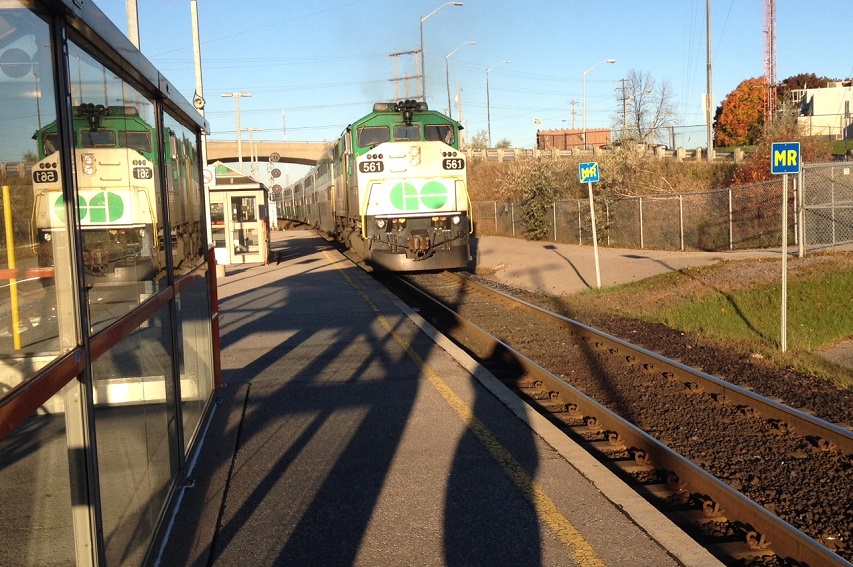
As you may have noticed, the pace of posting here on the blog has gone down a bit this week, as I haven’t had as much free time in the morning as usual: I’ve been commuting into Toronto. The good part is that my destination is quite close to Toronto Union Station, so I can take the GO train in rather than driving.
Yesterday, I just missed my train:

That’s my 08:31 train departing the platform. I got to the head of the stairs just as the doors closed. Fortunately there’s another train not long afterwards (although it’s not an express, so it takes longer).
October 15, 2014
October 9, 2014
“Japan’s high-speed rail system may end up being the victim of its own success”
An interesting look at how the Japanese Shinkansen system has literally shaped Japan’s urban development pattern:
At 10am on 1 October 1964, with less than a week and a half to go before the start of the Tokyo Olympic Games, the two inaugural Hikari Super Express Shinkansen, or “bullet trains,” arrived at their destinations, Tokyo and Osaka. They were precisely on time. Hundreds of people had waited overnight in each terminal to witness this historic event, which, like the Olympics, heralded not just Japan’s recovery from the destruction of the second world war, but the beginning of what would be Japan’s stratospheric rise as an economic superpower. The journey between Japan’s two biggest cities by train had previously taken close to seven hours. The Shinkansen had made the trip in four.The world’s first high-speed commercial train line, which celebrates its 50th anniversary on Wednesday, was built along the Tokaido, one of the five routes that connected the Japanese hinterland to Edo, the city that in the mid-1800s became Tokyo. Though train lines crisscrossed the country, they were inadequate to postwar Japan’s newborn ambitions. The term “shinkansen” literally means “new trunk line”: symbolically, it lay at the very centre of the huge reconstruction effort. All previous railways were designed to serve regions. The purpose of the Tokaido Shinkansen, true to its name, was to bring people to the capital.
[…]
In an interview in the Tokyo Shimbun newspaper last week, Takashi Hara, a political scholar and expert on Japanese railroads, said the policy of extending the Shinkansen was promulgated by Kakuei Tanaka, Japan’s prime minister from 1972 to 1974. “The purpose was to connect regional areas to Tokyo,” Hara said. “And that led to the current situation of a national Shinkansen network, which completely changed the face of Japan. Travel times were shortened and vibration was alleviated, making it possible for more convenient business and pleasure trips, but I have to say that the project just made all the [connecting] cities part of Tokyo.”
And where the Shinkansen’s long tentacles go, other services shrivel. Local governments in Japan rely heavily on the central government for funds and public works — it’s how the central government keeps them in line. Politicians actively court high-speed railways since they believe they attract money, jobs and tourists. In the early 1990s, a new Shinkansen was built to connect Tokyo to Nagano, host of the 1998 Winter Olympics. The train ran along a similar route as the Shinetsu Honsen, one of the most romanticised railroads in Japan, beloved of train buffs the world over for its amazing scenery – but also considered redundant by operators JR East because, as with almost all rural train lines in Japan, it lost money. There were only two profitable stations on the line — Nagano and the resort community of Karuizawa — and both would be served by the new Shinkansen. A large portion of the Shinetsu Honsen closed down; local residents who relied on it had to use cars or buses.
Meanwhile, the bullet train has sucked the country’s workforce into Tokyo, rendering an increasingly huge part of the country little more than a bedroom community for the capital. One reason for this is a quirk of Japan’s famously paternalistic corporations: namely, employers pay their workers’ commuting costs. Tax authorities don’t consider it income if it’s less than ¥100,000 a month — so Shinkansen commutes of up to two hours don’t sound so bad. New housing subdivisions filled with Tokyo salarymen subsequently sprang up along the Nagano Shinkansen route and established Shinkansen lines, bringing more people from further away into the capital.The Shinkansen’s focus on Tokyo, and the subsequent emphasis on profitability over service, has also accelerated flight from the countryside. It’s often easier to get from a regional capital to Tokyo than to the nearest neighbouring city. Except for sections of the Tohoku Shinkansen, which serves northeastern Japan, local train lines don’t always accommodate Shinkansen rolling stock, so there are often no direct transfer points between local lines and Shinkansen lines. The Tokaido Shinkansen alone now operates 323 trains a day, taking 140 million fares a year, dwarfing local lines. This has had a crucial effect on the physical shape of the city. As a result of this funnelling, Tokyo is becoming even denser and more vertical — not just upward, but downward. With more Shinkansen passengers coming into the capital, JR East has to dig ever deeper under Tokyo Station to create more platforms.
August 20, 2014
Britain’s railway system under private and public ownership
At the Adam Smith Institute blog, Ben Southwood asks the question “What would we consider a successful railway system?”
Under many measures, the railways have performed remarkably since privatisation. It is not surprising that the British public would nevertheless like to renationalise them, given how ignorant we know they are, but it’s at least slightly surprising that large sections of the intelligentsia seem to agree.
Last year I wrote a very short piece on the issue, pointing out the basic facts: the UK has had two eras of private railways, both extremely successful, and a long period of extremely unsuccessful state control. Franchising probably isn’t the ideal way of running the rail system privately, but it seems like even a relatively bad private system outperforms the state.
Short history: approximately free market in rail until 1913, built mainly with private capital. Government control/direction during the war. Government decides the railways aren’t making enough profit in 1923 and reorganises them into bigger regional monopolies. These aren’t very successful (in a very difficult macro environment) so it nationalises them — along with everything else — in the late 1940s.
By the 1960s the government runs railways into the ground to the point it essentially needs to destroy or mothball half the network. Government re-privatises the railways in 1995 — at this point passenger journeys have reached half the level they were at in 1913. Within 15 years they’ve made back the ground lost in the previous eighty.
August 19, 2014
Transportation Safety Board report on the Lac-Mégantic runaway train and derailment
The full report is available to download from the TSB’s website.
This summary of the Transportation Safety Board of Canada’s (TSB) Railway Investigation Report R13D0054 contains a description of the accident, along with an overview of the analysis and findings, the safety action taken to date, five key recommendations, and what more needs to be done to help ensure an accident like this does not happen again.
[…]
Shortly after the engineer left, the Nantes Fire Department responded to a 911 call reporting a fire on the train. After shutting off the locomotive’s fuel supply, the firefighters moved the electrical breakers inside the cab to the off position, in keeping with railway instructions. They then met with an MMA employee, a track foreman who had been dispatched to the scene but who did not have a locomotive operations background.
Once the fire was extinguished, the firefighters and the track foreman discussed the train’s condition with the rail traffic controller in Farnham, and departed soon afterward. With all the locomotives shut down, the air compressor no longer supplied air to the air brake system. As air leaked from the brake system, the main air reservoirs were slowly depleted, gradually reducing the effectiveness of the locomotive air brakes. Just before 1 a.m., the air pressure had dropped to a point at which the combination of locomotive air brakes and hand brakes could no longer hold the train, and it began to roll downhill toward Lac-Mégantic, just over seven miles away.
[…]
Almost all of the 63 derailed tank cars were damaged, and many had large breaches. About six million litres of petroleum crude oil was quickly released. The fire began almost immediately, and the ensuing blaze and explosions left 47 people dead. Another 2000 people were forced from their homes, and much of the downtown core was destroyed.
The pileup of tank cars, combined with the large volume of burning petroleum crude oil, made the firefighters’ job extremely difficult. Despite the challenges of a large emergency, the response was well coordinated, and the fire departments effectively protected the site and ensured public safety after the derailment.
Published on 19 Aug 2014
Animation – Sequence of events in the Lac-Mégantic derailment and fire
On 6 July 2013, a unit train carrying petroleum crude oil operated by Montreal, Maine & Atlantic Railway (MMA) derailed numerous cars in Lac-Mégantic, Quebec, and a fire and explosions ensued.
August 7, 2014
Streetcars – trying to use 19th century technology for 21st century problems
In addition to my already admitted train fetish, I’m also a low-key fan of the streetcar. Some of that, I’m sure, is that a streetcar is really just a one-car passenger train on a short journey with frequent stops. But I recognize that streetcars and trams are not a realistic solution to urban transit needs today … unlike far too many city and regional transportation planners. The Economist has a short explainer this week, backup up this argument:
Streetcars — otherwise known as trolleys or trams — had their golden age around 100 years ago, carrying urban workers to nascent suburbs around Europe and America. But commuters had little love for these rickety, crowded electric trains, and by 1910 many were abandoning them for the convenience of cars or buses. Streetcars have been making a comeback, however, with new lines rumbling to life in at least 16 American cities, and dozens more in the works. Tucson, Arizona, inaugurated its new streetcar service in late July, and streetcar operators in Washington, DC, begin training this week—the city’s much-delayed service is expected to start later this year. But for all their nostalgic charm, streetcars are also increasingly controversial: a number of cities, such as San Antonio, Texas, are now rethinking their plans, complaining of high costs and limited public support. Critics grumble that streetcars gobble up scarce transit funds for a slow, silly service used mainly by tourists.
[…]
Streetcars are also incredibly expensive to build and maintain, with huge up-front capital costs in laying down rails and buying cars. Tucson’s project ultimately cost nearly $200m and opened years late, in part because the city needed to clear utilities from under the tracks, install overhead electrical connections and repave much of the four-mile route. A 3.6-mile line in Cincinnati, Ohio, now under construction is expected to cost at least $133m. Federal grants have gone some way to help pay for these projects, but cash spent on streetcars displaces spending on other, more cost-effective forms of public transport like buses, which offer cheaper and more-efficient service but are considerably less sexy. The capital cost per mile of a streetcar is between $30m and $75m, while a rapid bus service costs anywhere between $3m and $30m, according to the American Public Transportation Association.
All this investment might make some sense if streetcars offered an efficient way to move people around. But here, too, the evidence is flimsy. Riders — and especially tourists — may find streetcars less intimidating than buses, but these vehicles tend to offer slow journeys across walkable distances. European tramlines tend to be fairly long and isolated from other traffic, which ensures a swifter journey. But in America streetcars travel shorter distances along rails that mix with other traffic, so streetcars invariably inch along. And while these tracks may be reassuring to developers, they make it impossible to navigate busy streets: buses can ride around obstacles but trams must stay put and wait. Indeed, their slow speeds and frequent stops mean they often add to congestion. This may not bother tourists keen on a novelty ride, but it is no solution to America’s public transport problems.
If you want to include light or heavy rail in your city’s public transit network, it has to be either grade-separated from cars and pedestrians or it needs to be buried underground or raised in the air: mixing streetcars with cars and trucks — even if you manage to rebrand them with a more modern-sounding moniker — worsens traffic, creates unhappy interactions between the rail and non-rail vehicles, costs vast amounts of money, and rarely draws enough passenger traffic to come close to breaking even. I’m no fan of buses, but in almost every case, the economic case for buses is far more sound than the case for streetcars.
August 2, 2014
The Burlington “Zephyr” in 1939
Visit the Retronaut for three more photos in this series. Wikipedia says:
The Pioneer Zephyr is a diesel-powered railroad train formed of railroad cars permanently articulated together with Jacobs bogies, built by the Budd Company in 1934 for the Chicago, Burlington and Quincy Railroad (CB&Q), commonly known as the Burlington. The train featured extensive use of stainless steel, was originally named the Zephyr, and was meant as a promotional tool to advertise passenger rail service in the United States. The construction included innovations such as shotwelding (a specialized type of spot welding) to join the stainless steel, and articulation to reduce its weight.
On May 26, 1934, it set a speed record for travel between Denver, Colorado, and Chicago, Illinois, when it made a 1,015-mile (1,633 km) non-stop “Dawn-to-Dusk” dash in 13 hours 5 minutes at an average speed of 77 mph (124 km/h). For one section of the run it reached a speed of 112.5 mph (181 km/h), just short of the then US land speed record of 115 mph (185 km/h). The historic dash inspired a 1934 film and the train’s nickname, “The Silver Streak”.
The train entered regular revenue service on November 11, 1934, between Kansas City, Missouri; Omaha, Nebraska; and Lincoln, Nebraska. It operated this and other routes until its retirement in 1960, when it was donated to Chicago’s Museum of Science and Industry, where it remains on public display. The train is generally regarded as the first successful streamliner on American railroads.