Quotulatiousness

March 21, 2015

British journalist mourns the loss of innocence in model railway layouts

Filed under: Britain, Railways — Tags: , — Nicholas @ 03:00

From the tone of Mr. Simkins’ “shocked-and-horrified” tone, I can only assume he’s been in a coma since roughly 1967:

HO scale nude figures

I’d always considered the world of model railways to be the last surviving example of a rose-tinted Britain that no longer exists. Enthusiasts of this quaint and captivating hobby invariably seem to use 1950 as their cultural template when designing their layouts.

In the real world it may all be Pendolino trains, gleaming concourses in steel and glass, and rail replacement bus services; but in model railwayland you’d always find puffing steam trains barrelling along in front of an idealised balsawood countryside that was never far from Adlestrop.

And therein, of course, lay their charm. Whenever I visited an exhibition I always revelled in the tiny trackside details as much as the engines themselves: the miniature sheep, the artificial grass, the miniature coal lorries waiting at the level crossing, and the old-fashioned station platforms.

Best of all, I loved the human figurines awaiting the arrival of the train they’re destined never to board. In the world of model railwayland, fashion as well as technology seemed to have stopped around the end of rationing, with each tiny passenger clad in pleated skirts or duffel coats.

But now an enterprising model railway emporium in Devon is set to shatter this cosy fictional world. Buffers of Axminster is selling a new range of steamy miniature figurines to reflect the laid-back (literally in some cases) attitudes and cultural mores of modern Britain.

They may be new to Mr. Simkins, but scale figures of nudes have been available as long as I can remember (although North American ads for them had to be careful not to expose too much scale detail, for fear of offending the postal authorities…)

H/T to Elizabeth for the link.

March 18, 2015

Level crossings are dangerous … very dangerous

Filed under: Railways, USA — Nicholas @ 05:00

Liveleak has two separate video angles of a recent fatal accident at a grade crossing in the Louisville Kentucky area. The first one shows the accident itself:

Cell phone footage captures the moment a Toyota Camry ignores the warning signals and drives into the path of a freight train in Buechel, Kentucky on March 14, 2015. Two people on the passenger side of the car were killed instantly, while the driver and another passenger were critically injured. The Camry was pushed at least a mile down the track.

The second video shows just how long it can take for a loaded freight train to stop even after the brakes are thrown into full emergency stop mode:

March 15, 2015

Toronto’s streetcars

Filed under: Cancon, Railways — Tags: , , — Nicholas @ 03:00

In a post somewhat misleadingly titled “Narrow-gauge railways”, David Warren comments on Toronto’s still-extant streetcars:

We have trolleys still, in Toronto. For decades the bureaucrats have been trying to get rid of them, and replace them with “environmental” buses, but praise the Lord, He has always put something in their way. I mentioned gauge earlier, and I wanted to explain what makes the city so special. It is the unique gauge of our trolley tracks: four feet, ten and seven-eighths. Our new, articulated, “environmental” streetcars — high-tech and incredibly expensive, compared even to the last round of million-dollar cars — had to be specially adapted to this gauge. It was selected in the nineteenth century by the city fathers, and for good reason: so that no other train in Canada, or on the planet for that matter, could ride on our rails. They were prissy, these fine old Orangemen: they didn’t want freight trains shunting downtown, the way they then did in Hamilton and elsewhere, with their steam and coal-dust billowing everywhere. They wanted electric, “environmental” streetcars. The Greater Parkdale Area has been under the tyranny of the do-goods for a long time.

Actually, if I remember correctly, the streetcar gauge was adopted more to keep out the radial railway companies than to prevent freight from intruding into Toronto’s urban streets.

QotD: Catching a train

Filed under: Humour, Quotations, Railways — Tags: — Nicholas @ 01:00

We caught the train by the skin of our teeth, as the saying is, and reflecting upon the events of the morning, as we sat gasping in the carriage, there passed vividly before my mind the panorama of my Uncle Podger, as on two hundred and fifty days in the year he would start from Ealing Common by the nine-thirteen train to Moorgate Street.

From my Uncle Podger’s house to the railway station was eight minutes’ walk. What my uncle always said was:

“Allow yourself a quarter of an hour, and take it easily.”

What he always did was to start five minutes before the time and run. I do not know why, but this was the custom of the suburb. Many stout City gentlemen lived at Ealing in those days — I believe some live there still — and caught early trains to Town. They all started late; they all carried a black bag and a newspaper in one hand, and an umbrella in the other; and for the last quarter of a mile to the station, wet or fine, they all ran.

Folks with nothing else to do, nursemaids chiefly and errand boys, with now and then a perambulating costermonger added, would gather on the common of a fine morning to watch them pass, and cheer the most deserving. It was not a showy spectacle. They did not run well, they did not even run fast; but they were earnest, and they did their best. The exhibition appealed less to one’s sense of art than to one’s natural admiration for conscientious effort.

Occasionally a little harmless betting would take place among the crowd.

“Two to one agin the old gent in the white weskit!”

“Ten to one on old Blowpipes, bar he don’t roll over hisself ’fore ’e gets there!”

“Heven money on the Purple Hemperor!” — a nickname bestowed by a youth of entomological tastes upon a certain retired military neighbour of my uncle’s, — a gentleman of imposing appearance when stationary, but apt to colour highly under exercise.

My uncle and the others would write to the Ealing Press complaining bitterly concerning the supineness of the local police; and the editor would add spirited leaders upon the Decay of Courtesy among the Lower Orders, especially throughout the Western Suburbs. But no good ever resulted.

Jerome K. Jerome, Three Men on the Bummel, 1914.

February 23, 2015

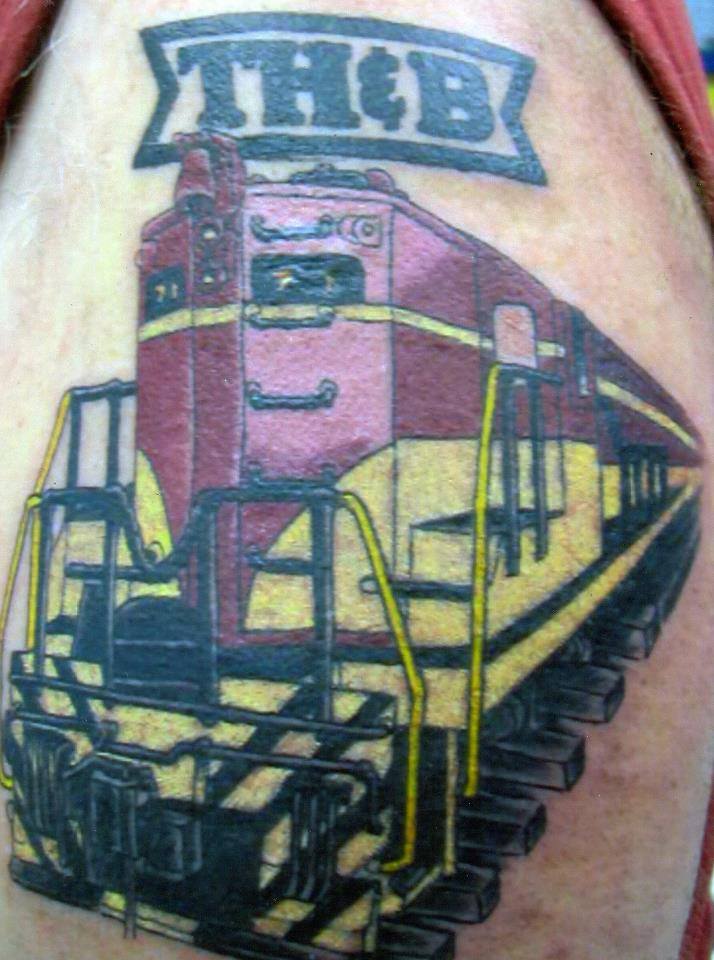
I thought I was a fan of the old TH&B Railway…

Filed under: Railways, Randomness — Tags: , , — Nicholas @ 05:00

I mean, after all, I founded a historical society based on the study of the railway … but Mel McInnis puts me into the shade with his dedication to the old Toronto, Hamilton & Buffalo Railway:

Mel's Toronto Hamilton and Buffalo tattoo

February 16, 2015

Ontario Southland Railway plow chase

Filed under: Cancon, Railways — Tags: , — Nicholas @ 06:00

Published on 12 Feb 2015

On February 3, Ontario Southland operated their first plow of the season from Salford south to Tillsonburg, then west to St. Thomas. This was also the first time a pair of F units have been used in plow duty on the railroad.

H/T to Laura Spring for the link.

February 11, 2015

Light rail – cool but ultra-expensive. Buses – cheap and flexible but lack glamour

Filed under: Economics, Government, Railways, USA — Tags: , , — Nicholas @ 05:00

At Mother Jones, Kevin Drum looks at the image problem of buses compared to the seemingly irresistable pull of light rail (at least to municipal politicians looking to overspend and under-deliver):

Josh Barro thinks our cities are building too much light rail. It’s expensive, often slow, and offers virtually no advantage over simply opening up a bus line. The problem, according to a 2009 report from the Federal Transit Administration, is that “Bus-based public transit in the United States suffers from an image problem.” But what if transit agencies tackled that image problem head on?

[…]

So perhaps we need a two-pronged marketing campaign if we want to attract more suburbanites onto buses. They need to be convinced that new bus lines are both bourgeois1 and safe. I might add that although Barro doesn’t highlight this particular feature, the Orange Line mentioned in the report also has “high frequencies.” That’s a key feature too, and it costs money. But it still costs less to run a high-frequency bus than an above-ground light rail system.

Maybe we need more celebrities to ride the bus. I’ll bet if George Clooney took the bus to work, it would suddenly become a lot more popular. You’d probably need to increase service to accommodate all the paparazzi, but surely that’s a small price to pay?

1I confess to some curiosity here. Did focus group participants really refer to the Orange Line as a “bourgeois bus”? That seems a bit unlikely to me.

February 8, 2015

An ordinary February day on the railway in New Brunswick

Filed under: Cancon, Railways — Tags: , — Nicholas @ 05:00

EPIC CATCH!!! Dashing Thru the Snow – CN Train 406 West at Salisbury, NB (Feb 3, 2015)

I’m not even sure how many locomotives this train had …

Railfanning Post Blizzard of 2015 Storm #3.

Canadian National Railway locomotive 2304 (ES44DC) plows through huge snow drifts and gives me a big ass snow shower as it leads the daily CN manifest train 406 West (Moncton, NB to Saint John, NB) at Salisbury, New Brunswick.

I’m not sure how the train crew can even see with all that snow on the locomotive’s nose!

Southern New Brunswick was hit with three major blizzards in less than a week, and there is more snow in the forecast.

Filmed at 3:05pm, Tuesday February 3, 2015 at mile 11 of the CN Sussex Subdivision.

H/T to Roger Henry for the link.

February 4, 2015

CP Rail offering engineer training to office staff

Filed under: Business, Cancon, Railways — Tags: , , — Nicholas @ 04:00

Laura Spring linked to this interesting bit of news that CP Rail is “encouraging” non-unionized employees to take training on how to operate locomotives:

A Canadian railway company is training its managers and office workers to drive locomotives and load trains, a move one labour lawyer says could be an attempt to prepare for a possible work stoppage.

Documents show CP Rail has encouraged office employees to step away from their desks and cubicles and sign up for training both on the trains and in the rail yards.

The use of office workers driving trains could be a major safety concern, said Wayne Benedict, a former railroader who now works as a labour lawyer in Calgary.

“You’ve got them climbing onto a train that’s a mile and a half long, with a hundred and some cars, weighing 16,000 tonnes, with dangerous goods, going through our cities,” he said. “And they are not professional, running trades employees. They are running human resource professionals, or other managers and supervisors.”

CBC News has obtained an internal CP Rail document dated Feb. 19, 2014, encouraging non-union employees to sign up for training as a locomotive engineer or conductor. It calls the training “a requirement at Canadian Pacific. It is also the single best way for a management employee to learn what the business is truly about. It is a fundamental cornerstone to the development of our railway culture.”

The document also suggests, “no matter what your role is at CP, this experience will make you better at what you do.”

The program is targeted mainly towards mechanical and engineering workers, but open to any non-union employees.

January 22, 2015

The seductive appeal of the big project

Filed under: China, Railways, USA — Tags: , , — Nicholas @ 02:00

In a Forbes post from a few years back, Warren Meyer looks at the appeal of the megaproject to those inclined to think that what society really needs is someone in control:

What is it about intellectuals that seem to, generation after generation, fall in love with totalitarian regimes because of their grand and triumphal projects? Whether it was the trains running on time in Italy, or the Moscow subways, or now high-speed rail lines in China, western dupes constantly fall for the lure of the great pyramid without seeing the diversion of resources and loss of liberty that went into building it.

Writers like Thomas Friedman and Joel Epstein in the Huffington Post have eulogized China and its monumental spending projects. These are the same folks who, generations ago, tried disastrously to emulate Mussolini’s “forward-thinking” economic regime in the National Industrial Recovery Act. These are the same folks who wanted to emulate MITI’s management of the Japanese economy (which drove them right into a 20-year recession). These are the same folks who oohed and ahhed over the multi-billion dollar Beijing Olympics venues while ignoring the air that was un-breathable. These are the same folks who actually believed the one Cuban health clinic in Sicko actually represented the standard of care received by average citizens. To outsiders, the costs of these triumphal programs are often not visible, at least not until years or decades later when the rubes have moved on to new man crushes.

These writers worry that the US is somehow being left behind by China because its government builds more stuff than we do. We are “asleep.” Well, here is my retort: Most of the great progress in this country occurred when the government was asleep. The railroads, the steel industry, the auto industry, the computer industry — all were built by individuals when the government was at best uninvolved and at worst fighting their progress at every step.

In particular, both Friedman and Epstein think we need to build more high speed passenger trains. This is exactly the kind of gauzy non-fact-based wishful thinking that makes me extremely pleased that these folks do not have the dictatorial powers they long for. High speed rail is a terrible investment, a black hole for pouring away money, that has little net impact on efficiency or pollution. But rail is a powerful example because it demonstrates exactly how this bias for high-profile triumphal projects causes people to miss the obvious.

Which is this: The US rail system, unlike nearly every other system in the world, was built (mostly) by private individuals with private capital. It is operated privately, and runs without taxpayer subsidies. And, it is by far the greatest rail system in the world. It has by far the cheapest rates in the world (1/2 of China’s, 1/8 of Germany’s). But here is the real key: it is almost all freight.

January 19, 2015

The Cape Breton & Central Nova Scotia Railway shuts down operations

Filed under: Business, Cancon, Railways — Tags: , , — Nicholas @ 02:00

In the Globe and Mail, Eric Atkins tells the tale of another shortline railway shutting down operations:

The railway, which did not reapply for a $3-million yearly government subsidy, has been granted permission by a Nova Scotia regulator to abandon the 100 miles of track between Port Hawkesbury and Sydney by October.

The move leaves some factories facing soaring shipping costs and scrambling to find new ways to bring in raw materials.

Beverage container maker Trans-Atlantic used to rely on the railway for 70 or 80 railcars a year carrying plastic pellets from Quebec and South Carolina. John MacLean, vice-president of the manufacturer that employs 40 people, said the railway raised the $600-per-car rate by $5,500 in the fall, and last week notified customers each car would cost $18,000.

“They obviously don’t want to do business here,” Mr. MacLean said by phone from Sydney. “They opted not to take the subsidy but they cited a decrease in traffic as the reason they had to increase the rate.”

The loss of rail service means Trans-Atlantic has been saddled with the expense of trucking its raw material from Moncton, and has lost the flexibility and storage the rail cars offered.

“We have to be very vigilant on the way we operate. It has a huge effect on our competitiveness,” he said.

[…]

Railway executives said at December hearings they did not renew the subsidy application because the future costs of maintaining and repairing the line outweighed the scrap and market value of the steel and other materials.

The railroad’s bridges and culverts would need repairs that cost at least $30-million, while the company figures it can get $15-million to $20-million scrapping and selling the rails and other material.

“As a company we feel that’s a much better use of our assets than simply operating on a subsidy that allows us to break even for 500 carloads a year. That’s why we did not renew,” said Josée Danis, assistant vice-president of Cape Breton & Central Nova Scotia Railway.

December 27, 2014

The Railroad Signal – New York Central Railroad Educational Documentary 1948

Filed under: History, Railways, Technology, USA — Tags: , — Nicholas @ 00:02

Uploaded on 30 Nov 2011

New York Central Railroad Educational Documentary from 1948 that gives an overview of railroad signals and related safe working infrastructure used by trains, as well as the ongoing improvements to the signalling systems due to technological advances.

The film was released as part of the NYC’s “Running the Railroad” series, and features many examples of different signalling systems in use by the New York Central Railroad, as well as lots of scenes of passenger and freight trains. .

December 25, 2014

Canadian Pacific Holiday Train 2014

Filed under: Cancon, Railways — Tags: , — Nicholas @ 05:00

December 20, 2014

“The Freight Yard” – New York Central Railroad

Filed under: Business, History, Railways, USA — Tags: — Nicholas @ 00:03

Uploaded on 14 Apr 2011

New York Central Railroad (NYC) publicity film from the late 1940’s, part of their “Running the Railroad” series. Archival footage shows freight yards of all types, along with steam and diesel locomotives.

The New York Central Railroad (NYC), known simply as the New York Central in its publicity, was a railroad operating in the Northeastern United States. Headquartered in New York, the railroad served most of the Northeast, including extensive trackage in the states of New York, Pennsylvania, Ohio, Michigan, Indiana, Illinois, and Massachusetts, plus additional trackage in the Canadian provinces of Ontario and Quebec. The railroad primarily connected greater New York and Boston in the east with Chicago and St.Louis in the midwest along with the intermediate cities of Albany, Buffalo, Cleveland, Cincinnati, and Detroit. The NYC’s Grand Central Terminal in New York City is one of its best known landmarks.

December 17, 2014

Carrying The Load – London Midland & Scottish Railway Documentary

Filed under: Britain, History, Railways, WW2 — Tags: , — Nicholas @ 00:03

Published on 20 Apr 2012

London Midland & Scottish Railway educational film that explains the role played by the railways during World War Two.

« Newer PostsOlder Posts »

Powered by WordPress