
As if compelled by unseen forces — one imagines that scene in The Exorcist — my fellow traveller adjusts his AirPods, straightens his spine, and “locks in”. Before him lies the cluttered still life of Productivity™: a crumpled FT, a bottle of protein-infused kefir, and two boiled eggs sweating inside their polypropylene coffin. For several moments, he sits with priestly solemnity. Then, as the train inches forward, so does he.
And so, begins his morning recital. I would call it theatre, but theatre requires even the slightest concession to its audience. There is no risk of such grace here.
“Jenny? You still there? Jenny? Excellent.”
He repeats her name as though invoking the supernatural. Dale Carnegie once advised this rigmarole; it’s meant to build something called rapport. Unfortunately, Dale Carnegie never sat captive before a disciple who had taken his gospels quite so literally.
“Jenny (build rapport), could you run those numbers by me again? (assert authority). I’m hoping to parallel-path with you moving forward (signal tribal membership). Great! (convey enthusiasm). Jenny, let’s circle back at 1400 GMT; I want to put a pin into an area of emerging awareness.”
By this point in the sermon, I’d developed several areas of emerging resentment and the unignorable desire to drive pins into eardrums — mostly mine. His monologue, which suggested he charged by the word, stretched unabated from Reading to London Paddington, where he skulked off the platform and into the neon vomit of the city like a Roman senator descending into the Suburra.
In the false refuge of a nearby pub, the missionaries gather and gab incessantly. Chirruping clots of earnest twenty-somethings discuss REM-centric sleep regimes, dopamine stacking, and some Santeria called “sunlight dosing”. They sip protein-riddled IPAs. They recite “Huberman says …” as the devout once invoked St Augustine.
These rituals — the 21st-century Lascaux cave paintings — serve one purpose: to peacock one’s devotion to a deity known as The Grind. Like all deities, The Grind demands a daily sacrifice for a distant, mostly hypothetical reward.
We have struggled to name this social pathology. Grind culture. Hustle culture. 996. No days off. Whatever it is, it is not working. In truth, it is the inbred relation of Performative Reading — Performative Working. This theatre drips with all the fripperies of work and none of the results. Much like a Hinge premium account, or indeed the British state.
Christopher Gage, “Mourning Routine: The Cult of Performative Work”, Oxford Sour, 2025-12-03.
March 7, 2026
QotD: Grind culture and performative working
March 6, 2026
QotD: Operations, strategy, and tactics
[…]
Strategy is the upper layer of military analysis. Fundamentally strategy concerns the identification of final objectives, the way those objectives can be achieved and the resources to be used to achieve those objectives; these three components of strategy in US doctrine are termed “Ends, Ways, and Means” respectively. Strategy is thus the “big picture” thinking behind an action, including the decisions to both commence hostilities and end them.
[…]
Tactics are the lowest layer of military analysis. Tactics concern the methods to be used to win battles. Things like flanking, suppressive fire, ambushes, etc. are tactics. A military’s tactical system is often spelled out in doctrine. In theory, operations is designed to deliver forces to battles in such a way (positioning, comparative force, etc.) that their tactics can win those battles, while strategy should aim to ensure that winning those particular battles will achieve the desired political end (whatever concessions are desired). It is important to distinguish actions which are strategy (designed to directly produce a desired end to the conflict) from those which are merely tactical (designed to achieve a local success or advantage in a given engagement). It is important when assessing failures in war to distinguish between strategic failures (typically a failure to come up with realistic goals and the means to reach them), operational failures (e.g. logistics failures or unreasonable maneuver timetables) and tactical failures (e.g. failure to use combined arms effectively).
Bret Devereaux, “Miscellanea: A Very Short Glossary of Military Terminology”, A Collection of Unmitigated Pedantry, 2022-03-25.
March 5, 2026
QotD: Chinese cooking
What is it like? Well, Dunlop barely manages to cover this in a 400-page book, so I hesitate even to try, but let me hit a few of the high points. First, diversity. China is a continent masquerading as a country, both in population and in geographic extent, so its cuisine is comparably diverse. Most cooking traditions have one or two basic starches, China has four or five.1 China extends through every imaginable biome, from rainforest to tundra, desert to marshlands, and much of the genius of Chinese food lies in combining the delicious bounties offered up by this kaleidoscope in interesting or unexpected ways.
One way to think of Chinese eating is that much of it is a sort of “internal” fusion cuisine. Because China was ruled from very early on by a centralized bureaucracy with a fanaticism for river transport, the process of culinary remixing has been going on for much longer than it has in most places. The Roman Empire could have been like this, but the shores of the Mediterranean all have pretty similar climates, so there were fewer ingredients to start the process with. Already very early in Chinese history, before the 7th century, we hear of the imperial city being supplied with:
oranges and pomelos from the warm South, […] the summer garlic of southern Shanxi, the deer tongues of northern Gansu, the Venus clams of the Shandong coast, the “sugar crabs” of the Yangtze River, the sea horses of Chaozhou in Guangdong, the white carp marinated in wine lees from northern Anhui, the dried flesh of a “white flower snake” [a kind of pit viper] from southern Hubei, melon pickled in rice mash from southern Shanxi and eastern Hubei, dried ginger from Zhejiang, loquats and cherries from southern Shanxi, persimmons from central Henan, and “thorny limes” from the Yangtze Valley.
If we think of chefs as artists, the Chinese ones have since ancient times had the advantage of an outrageously diverse set of paints. But these ingredients aren’t combined willy-nilly, without respect for their time or place of origin. The Chinese practically invented the concept of terroir, and their organicist conception of the universe in which everything is connected to everything else implied strict rules about which foods were to be eaten when, both for maximum deliciousness and to ensure cosmic harmony.
In the first month of spring, [the emperor] was to eat wheat and mutton; in summer, pulses and fowl; in autumn, hemp seeds and dog meat; in winter, millet and suckling pig. An emperor’s failure to observe the laws of the seasons would not only cause disease, but provoke crop failure and other disasters.
The obsessions with freshness and seasonality come to their culmination in the one area where Chinese cuisine stands head and shoulders above all others: green vegetables. In the West, “eating your greens” is a punishment, or at best a chore, and it’s easy to see why. In much of the world vegetables are bred for yield and transportability, kept in refrigerators for weeks, and then boiled until no trace of flavor remains. Dunlop and I have one thing in common: when we’re not in China, of all the delights of Chinese cooking it’s the green vegetables that we miss the most.
When I bring American friends to a real Chinese restaurant, sometimes they’re shocked that the vegetable dishes cost the same amount as the main courses. Why does a side dish cost so much? But no Chinese person would ever think of a vegetable course as a “side” dish, they’re part of the main attraction, and more often than not they’re the stars of the show. In the West, you can now get decent baak choy, but this is just one of the dozens and dozens of leafy greens that the Chinese regularly consume, many of them practically impossible to find outside Asia.
My own favorite is the sublime choy sum. I remember once getting off a transoceanic flight, starving and exhausted, and being offered a bowl of it over plain white rice. The greens had been scalded for a few seconds with boiling water, then tossed around a pan for no more than a minute — just long enough that the leaves were so tender they seemed to dissolve in your mouth, but the stems still held snap and crunch. The seasoning was subtle — maybe a few cloves of garlic, some salt, a splash of wine or vinegar. Just the right amount to bring out the deep, earthy flavors of the vegetable, to somehow make them brighter and more forward, but not to overpower them.2 It was one of the most delicious things I’ve ever eaten. I think I’ll still remember it when I am old.
Did you notice that in the previous paragraph I spent almost as much time describing the texture of the food as its flavor? That’s no coincidence. Of course the Chinese care about flavor, everybody does (except the British, ha ha), but relative to many other culinary traditions the Chinese put a disproportionate emphasis on the texture of their food as well. I’ll once again draw on a bastardized version of the Whorf hypothesis: English is a big language with a lot of borrowings, so we have a correspondingly large number of words for food textures. Imagine explaining to a foreigner the difference between “crunchy” and “crisp”, or between “soft” and “mushy”. That is already more semiotic resolution than most languages have when it comes to the mouthfeel of their food, but Chinese takes it to a whole ‘nother level.
John Psmith, “REVIEW: Invitation to a Banquet by Fuchsia Dunlop”, Mr. and Mrs. Psmith’s Bookshelf, 2024-02-05.
- One of them, potatoes, has a particularly fraught history. Potatoes started seriously spreading in China right around the time of the mass famines that accompanied the collapse of the Ming dynasty. Accordingly, they got a reputation of being food for poor people. They’ve never really managed to overcome this association, and are generally shunned by the Chinese, especially in high-end cuisine, despite several government campaigns to encourage people to eat them since they’re nutritious and easy to grow in arid conditions.
- There’s a pattern in Chinese gastronomy where extremely intense, over-the-top flavors are a bit low-status, and flavors so pure and subtle they verge on bland are what the snooty people go for. This is true across regions (the in-your-face food of Sichuan is less valued than the cuisine of the Cantonese South, or the cooking traditions of Zhejiang in the East), but it’s also true within regions (in Sichuan, the food of Chongqing is much spicier than the food of Chengdu, and correspondingly lower status).
March 3, 2026
QotD: The rise of archives-based history in the late Middle Ages
All of this, I suggest, is because people increasingly thought factual accuracy was important. And that only comes with the increasing sense of linear time. The chronicles of the first two or three Crusades, for instance, are filled with wild exaggerations and impossible claims … but they’re not lies. They just serve a different purpose. They’re called “histories”, but that’s a misleading translation (of the word historia, I’ll admit). What they really are is much closer to exempla — saints’ lives, that kind of thing. Their point isn’t “This and that actually happened”; it’s more like “Let us all praise God, for the wondrous things he allowed us to do!”
Gesta Francorum means “deeds of the French”, but in the sense of “The wonders done in God’s name,” not “a list of battles and their outcomes”.
Severian, “The Ghosts (II)”, Founding Questions, 2022-05-18.
March 2, 2026
QotD: King Stephen and “the anarchy”
At this point, I ought to mention that the year is 1120; the young man is William Adelin, heir to the throne of England; and the “ferry” is the infamous White Ship.
Anyway, back to the story: the wine keeps flowing and, before long, the crew are drunk too. Not far out of port, the ship hits a submerged rock and rapidly sinks.
In all, hundreds are drowned — and yet that is just the start of the tragedy.
William’s father, King Henry I, had gone to great lengths to proclaim an heir. As the son of William the Conqueror, he knew just how messy succession could get. He had himself inherited the throne from his brother, William Rufus. This second William had died of a chest complaint — specifically, an arrow in the lungs (the result of a hunting “accident”). Henry was determined that his son would inherit the throne without mishap — and so carefully prepared the ground for a smooth transfer. Indeed, the name “Adelin” signified that the third William was the heir apparent.
The sinking of the White Ship left Henry with one remaining legitimate heir, his daughter Matilda. She was a formidable character, also known as Empress Maud (by virtue of her first marriage to the Holy Roman Emperor). She was, nevertheless, a woman — a big problem in an age when monarchs were expected to lead their men in battle. When Henry died in 1135, Maud’s cousin — Stephen of Blois — seized the throne. This was widely welcomed by the English nobility, but Maud wasn’t giving up easily, and she had powerful allies. Her second husband was Geoffrey, Count of Anjou; her illegitimate half-brother, Robert of Gloucester, was a wealthy baron; and her uncle was King David I of Scotland.
Stephen was assailed on all sides — by Geoffrey in Normandy, by Robert in England, by invading Scots and rebellious Welshmen. The civil war (if that’s what you can call this multi-sided free-for-all) dragged on for almost 20 years. There weren’t many set-piece battles, but there was lots of looting and pillaging in which countless nameless peasants perished.
In the end it was the death of another heir — Stephen’s son, Eustace — that opened the way to peace. The war-weary king agreed that Maud’s son (the future Henry II) would succeed him. And thus “The Anarchy” came to end: two decades of pointless devastation — and all because some young fool got pissed on a boat.
Peter Franklin, “Why Boris needs an heir apparent”, UnHerd, 2020-08-17.
March 1, 2026
QotD: Even when you know the gun isn’t loaded … it might be loaded
At the first gun shop at which I worked, which was also a pawn shop, we had a relationship with a pawn shop owner down in the city. Every few months, he’d drive out to see us with a briefcase containing a few old Colt Police Positives and Smith .38/.32 Terriers and Browning Vest Pockets and suchlike and we would swap him a big box of Lorcins and Hi-Points and Jennings and cash to make up the difference.
One time he came up, the sticking point in the negotiations was a PPK, an early Interarms-marked stainless example. Initially he was thinking about keeping it. Then he wanted too much for it. Then he relented and we added it to our side of the pile.
He handed the Walther to me, and I locked the slide back and checked the chamber, and passed it to a coworker over at the computer. She printed a trigger tag out for it and handed it, slide still locked back, to one of the other salespeople, who put it in the showcase.
Then our buddy the pawn shop owner crawfished. I sighed and pulled the gun from the showcase, removed the trigger tag, and laid it on the counter between him and my boss. About the time pawn shop guy was leaving, I was walking out of the store to cross the street and get lunch for everybody.
When I came back, there was the PPK, sitting on the counter by the computer. “Arthur changed his mind again?” I asked, and was told that, indeed, he had sat in his car for a moment and then came back in and threw the Walther in on the deal at the last minute. Sweet! I still had the trigger tag handy, so I put it back on the gun and passed it to the salesman who put it back in the showcase with one hand while eating his hamburger with the other.
I wandered off to a far corner of the showroom where I could eat my burger in peace, back turned to the sales floor, when *KA-BAM!*
A customer is standing there with the PPK in his hand and an appalled look on his face, smoke wisping theatrically from the barrel and a divot in the linoleum at his feet containing a flattened Winchester Silvertip.
That’s right, Arthur had loaded the PPK back up in his car, and then brought it back in to add to the trade, and not one person who handled it from the time I picked it up and put the trigger tag on it to the time the customer made the loud noise had bothered to inspect the chamber because, hey, we had already done that when he brought it in the first time, right?
Lesson learned: I don’t care if I set the gun down and just look away for a second; that gun gets checked again when I pick it up. Period. Unless it has been in my field of vision the whole time, I don’t know what might have happened to it while I wasn’t paying attention.
Tamara Keel, “Formative experiences …”, view from the porch, 2011-08-16.
February 28, 2026
QotD: The “Balance of Terror” in the missile age
This also meant that a devastating nuclear “first strike” could now be delivered before an opponent would know it was coming, or at least on extremely short notice. A nuclear power could no longer count on having enough warning to get its nuclear weapons off before the enemy’s nuclear strike had arrived. Bernard Brodie grappled with these problems in Strategy in the Missile Age (1959) but let’s focus on a different theorist, Albert Wohlstetter, also with the RAND Corporation, who wrote The Delicate Balance of Terror (1958) the year prior.
Wohlstetter argued that deterrence was not assured, but was in fact fragile: any development which allowed one party to break the other’s nuclear strike capability (e.g. the ability to deliver your strike so powerfully that the enemy’s retaliation was impossible) would encourage that power to strike in the window of vulnerability. Wohstetter, writing in the post-Sputnik shock, saw the likelihood that the USSR’s momentary advantage in missile technology would create such a moment of vulnerability for the United States.
Like Brodie, Wohlstetter concluded that the only way to avoid being the victim of a nuclear first strike (that having the enemy hit you with their nukes) was being able to credibly deliver a second strike. This is an important distinction that is often misunderstood; there is a tendency to read these theorists (Dr. Strangelove does this to a degree and influences public perception on this point) as planning for a “winnable” nuclear war (and some did, just not these fellows here), but indeed the point is quite the opposite: they assume nuclear war is fundamentally unwinnable and to be avoided, but that the only way to avoid it successfully is through deterrence and deterrence can only be maintained if the second strike (that is, your retaliation after your opponent’s nuclear weapons have already gone off) can be assured. Consequently, planning for nuclear war is the only way to avoid nuclear war – a point we’ll come back to.
Wohlstetter identifies six hurdles that must be overcome in order to provide a durable, credible second strike system – and remember, it is the perception of the system, not its reality that matters (though reality may be the best way to create perception). Such systems need to be stable in peacetime (and Wohlstetter notes that stability is both in the sense of being able to work in the event after a period of peace, but also such that they do not cause unintended escalation; he thus warns against, for instance, just keeping lots of nuclear-armed bombers in the air all of the time), they must be able to survive the enemy’s initial nuclear strikes, it must be possible to decide to retaliate and communicate that to the units with the nuclear weapons, then they must be able to reach enemy territory, then they have to penetrate enemy defenses, and finally they have to be powerful enough to guarantee that whatever fraction do penetrate those defenses are powerful enough to inflict irrecoverable damage.
You can think of these hurdles as a series of filters. You start a conflict with a certain number of systems and then each hurdle filters some of them out. Some may not work in the event, some may be destroyed by the enemy attack, some may be out of communication, some may be intercepted by enemy defenses. You need enough at the end to do so much damage that it would never be worth it to sustain such damage.
This is the logic behind the otherwise preposterously large nuclear arsenals of the United States and the Russian Federation (inherited from the USSR). In order to sustain your nuclear deterrent, you need more weapons than you would need in the event because you are planning for scenarios in which some large number of weapons are lost in the enemy’s first strike. At the same time, as you overbuild nuclear weapons to counter this, you both look more like you are planning a first strike and your opponent has to estimate that a larger portion of their nuclear arsenal may be destroyed in that (theoretical) first strike, which means they too need more missiles.
What I want to note about this logic is that it neatly explains why nuclear disarmament is so hard: nuclear weapons are, in a deterrence scenario, both necessary and useless. Necessary, because your nuclear arsenal is the only thing which can deter an enemy with nuclear weapons, but that very deterrence renders the weapons useless in the sense that you are trying to avoid any scenario in which you use them. If one side unilaterally disarmed, nuclear weapons would suddenly become useful – if only one side has them, well, they are the “absolute” weapon, able to make up for essentially any deficiency in conventional strength – and once useful, they would be used. Humanity has never once developed a useful weapon they would not use in extremis; and war is the land of in extremis.
Thus the absurd-sounding conclusion to fairly solid chain of logic: to avoid the use of nuclear weapons, you have to build so many nuclear weapons that it is impossible for a nuclear-armed opponent to destroy them all in a first strike, ensuring your second-strike lands. You build extra missiles for the purpose of not having to fire them.
(I should note here that these concerns were not the only things driving the US and USSR’s buildup of nuclear weapons. Often politics and a lack of clear information contributed as well. In the 1960s, US fears of a “missile gap” – which were unfounded and which many of the politicians pushing them knew were unfounded – were used to push for more investment in the US’s nuclear arsenal despite the United States already having at that time a stronger position in terms of nuclear weapons. In the 1970s and 1980s, the push for the development of precision guidance systems – partly driven by inter-agency rivalry in the USA and not designed to make a first strike possible – played a role in the massive Soviet nuclear buildup in that period; the USSR feared that precision systems might be designed for a “counter-force” first strike (that is a first strike targeting Soviet nuclear weapons themselves) and so built up to try to have enough missiles to ensure survivable second strike capability. This buildup, driven by concerns beyond even deterrence did lead to absurdities: when the SIOP (“Single Integrated Operational Plan”) for a nuclear war was assessed by General George Lee Butler in 1991, he declared it, “the single most absurd and irresponsible document I had ever reviewed in my life”. Having more warheads than targets had lead to the assignment of absurd amounts of nuclear firepower on increasingly trivial targets.)
All of this theory eventually filtered into American policy making in the form of “mutually assured destruction” (initially phrased as “assured destruction” by Secretary of Defense Robert McNamara in 1964). The idea here was, as we have laid out, that US nuclear forces would be designed to withstand a first nuclear strike still able to launch a retaliatory second strike of such scale that the attacker would be utterly destroyed; by doing so it was hoped that one would avoid nuclear war in general. Because different kinds of systems would have different survivability capabilities, it also led to procurement focused on a nuclear “triad” with nuclear systems split between land-based ICBMs in hardened silos, forward-deployed long-range bombers operating from bases in Europe and nuclear-armed missiles launched from submarines which could lurk off an enemy coast undetected. The idea here is that with a triad it would be impossible for an enemy to assure themselves that they could neutralize all of these systems, which assures the second strike, which assures the destruction, which deters the nuclear war you don’t want to have in the first place.
It is worth noting that while the United States and the USSR both developed such a nuclear triad, other nuclear powers have often seen this sort of secure, absolute second-strike capability as not being essential to create deterrence. The People’s Republic of China, for instance, has generally focused their resources on a fewer number of systems, confident that even with a smaller number of bombs, the risk of any of them striking an enemy city (typically an American city) would be enough to deter an enemy. As I’ve heard it phrased informally by one western observer, a strategy of, “one bomb and we’ll be sure to get it to L.A.” though of course that requires more than one bomb and one doubts the PRC phrases their doctrine so glibly (note that China is, in theory committed to developing a triad, they just haven’t bothered to actually really do so).
Bret Devereaux, “Collections: Nuclear Deterrence 101”, A Collection of Unmitigated Pedantry, 2022-03-11.
February 27, 2026
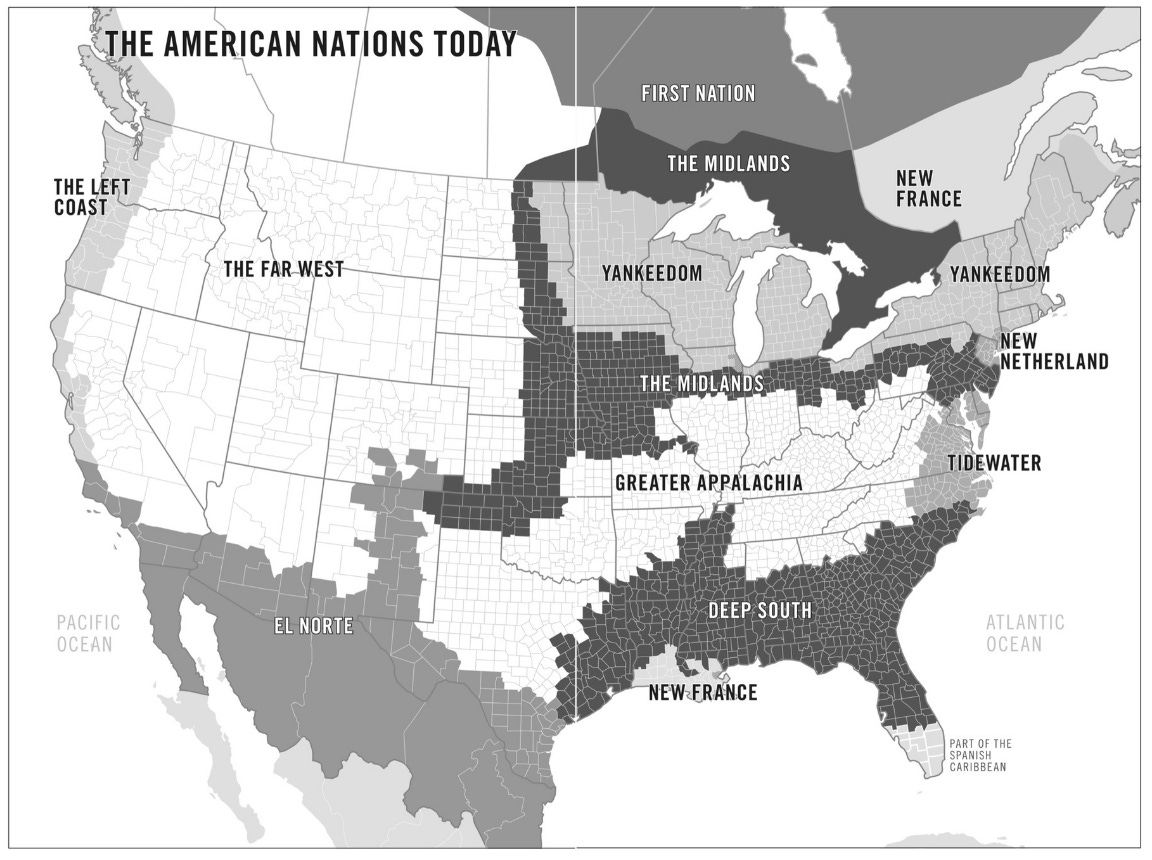
QotD: American cultural regions
Colin Woodard, by contrast, assigned himself the far more ambitious task of tracing the history of all America’s regional cultures, from their various foundings right up to the present, and he does about as good a job as anyone could with a mere 300 pages of text at his disposal: it’s necessarily condensed, but the notes are good and he does provide an excellent “Suggested Reading” essay at the end to point you towards thousands of pages worth of places to look when you inevitably want more of something. Intrigued by the brief discussion of the patchwork of regional cultures across Texas? There’s a book for that! Several, in fact.
Woodard divides the US into eleven distinctive regional cultures, which he calls “nations” because they share a common culture, language, experience, symbols, and values. For the period of earliest settlement this seems fairly uncontroversial — you don’t need to read a lot of American history to pick up on the profound cultural differences between, say, the Massachusetts townships that produced John Adams and the Virginia estates of aristocrats like Washington, Jefferson, and Madison, let alone the backwoods shanties where Andrew Jackson grew up. As the number of immigrants increased, though (and this began quite early: several enormous waves of German immigrants meant that by 1755 Pennsylvania no longer had an English majority), it doesn’t seem immediately obvious that the original culture would continue to dominate.
Woodard’s response to this concern is twofold. First, he cites Wilbur Zelinsky’s Doctrine of First Effective Settlement to the effect that “[w]henever an empty territory undergoes settlement, or an earlier population is dislodged by invaders, the specific characteristics of the first group able to effect a viable, self-perpetuating society are of crucial significance for the later social and cultural geography of the area, no matter how tiny the initial band of settlers may have been”. (The nation of New Netherland, founded by the Dutch in the area that is now greater New York City, is the paradigmatic example: both Zelinksy and Woodard argue that it has maintained its distinctively tolerant, mercantile, none-too-democratic character despite the fact that only about 0.2% of the population is now of Dutch descent.)3 But his second, and more convincing, approach is just to show you that the people who moved here in 1650 were like that and then in the 1830s their descendants moved there and kept being like that and, hey look, let’s check in on them today — yep, looks like they’re still like that. Even though between 1650 and now plenty of Germans (or Swedes or Italians or whoever) have joined the descendants of those earliest English settlers.
Most of the book is given over to the six nations — Yankeedom, New Netherland, the Midlands, Tidewater, the Deep South, and Greater Appalachia — that populated the original Thirteen Colonies and still occupy most of the country’s area. Told as the story of the distrust or open bloody conflicts between various peoples, American history takes on a ghastly new cast: have you ever heard of the Yankee-Pennamite Wars, fought between Connecticut settlers and bands of Scots-Irish guerillas over control of northern Pennsylvania? Or the brutal Revolution-era backcountry massacres committed not by the Continental Army or the redcoats but by warring groups of Appalachian militias? What about the fact that Pennsylvania’s commitment to the American cause was made possible only by a Congressionally-backed coup d’état that suspended habeas corpus, arrested anyone opposed to the war, made it illegal to speak or write in opposition to its decisions, and confiscated the property of anyone who suspected of disloyalty (if they weren’t executed outright)? Gosh, this is beginning to sound like, well, literally any other multiethnic empire in history. (It also offers some fascinating points of divergence for alternate history.)4
Jane Psmith, “REVIEW: American Nations, by Colin Woodard”, Mr. and Mrs. Psmith’s Bookshelf, 2024-02-19.
- Including plenty of Jane Psmith-bait like discussion of who was into boiling (the East Anglians who adopted coal early and moved to New England) vs. roasting (the rich of southern England who could afford wood and moved to the Chesapeake Bay), discussions of regional vernacular architecture, the distinctive sexual crimes each group obsessed about (bestiality in New England, illegitimacy in Chesapeake) and so on — I love this book.
- Incidentally, if you’ve only read Scott Alexander’s review of Albion’s Seed, do yourself a favor and read the actual book. Yes, Scott gives a perfectly cromulent summary of the main points, but it’s a such gloriously rich book, full of so many stories and details and painting such a picture of each of the peoples and places it treats, that settling for the summary is like reading the Wikipedia article about The Godfather instead of just watching the darn movie.
- Yes, there is a book for this, and it’s apparently Russell Shorto’s The Island at the Center of the World, which I have not read and don’t particularly plan to.
- Off the top of my head:
- The Deep South tried to get the United States to conquer and colonize Cuba and much of the Caribbean coast of Central America as future slave states;
- There were a wide variety of other secession movements in the run-up to the Civil War, including a suggestion that New York City should become an independent city-state that was taken seriously enough for the Herald to publish details of the governing structure of the Hanseatic League;
- In 1784 the residents of what is now eastern Tennessee formed the sovereign State of Franklin, which banned lawyers, doctors, and clergymen from running for office and accepted apple brandy, animal skins, and tobacco as legal tender. They were two votes away from being accepted as a state by the Continental Congress.
February 26, 2026
QotD: “Naming of Parts” by Henry Reed
We had daily cleaning. And tomorrow morning,
We shall have what to do after firing. But today,
Today we have naming of parts. Japonica
Glistens like coral in all the neighboring gardens,
And today we have naming of parts.This is the lower sling swivel. And this
Is the upper sling swivel, whose use you will see,
When you are given your slings. And this is the piling swivel,
Which in your case you have not got. The branches
Hold in the gardens their silent, eloquent gestures,
Which in our case we have not got.This is the safety-catch, which is always released
With an easy flick of the thumb. And please do not let me
See anyone using his finger. You can do it quite easy
If you have any strength in your thumb. The blossoms
Are fragile and motionless, never letting anyone see
Any of them using their finger.And this you can see is the bolt. The purpose of this
Is to open the breech, as you see. We can slide it
Rapidly backwards and forwards: we call this
Easing the spring. And rapidly backwards and forwards
The early bees are assaulting and fumbling the flowers:
They call it easing the Spring.They call it easing the Spring: it is perfectly easy
If you have any strength in your thumb: like the bolt,
And the breech, the cocking-piece, and the point of balance,
Which in our case we have not got; and the almond blossom
Silent in all of the gardens and the bees going backwards and forwards,
For today we have the naming of parts.Henry Reed, 1942.
February 25, 2026
QotD: The notion of “history”
We are closer in time to them than they were to the men who built the Pyramids — by a long shot — and think about that for a second. That’s the vast scope of merely literate human history. Human settlement itself goes back at least another 6,000 years before that, and probably a lot longer.
So far as we can tell, well into historical time men had no real conception of “the past”. Even those men who had recently died weren’t really gone, and again I find Jaynes useful here, but he’s not necessary; it’s obvious by funeral customs alone. They had a basic notion of change, but it was by definition cyclical — the sun rises and sets, the moon goes through its phases, the stars move, the seasons change, but always in an ordered procession. What once was will always return; what is will pass away, but always to return again.
Linear time — the sense of time as a stream, rather than a cycle; the idea that the “past” forecloses possibilities that will never return — only shows up comparatively late in literate history. Hesiod wrote somewhere between 750 and 650 BC; his was the first work to describe a Golden Age as something that might’ve actually existed (as opposed to the Flood narratives of the ancient Middle East).
Note that this is not yet History — that would have to wait another 300 years or so. Whereas a Thucydides could say, with every freshman that has ever taken a history class, that “We study the past so that we don’t make the same mistakes”, that would’ve been meaningless to Hesiod — we can’t imitate the men of the Golden Age, because they were a different species of man.
Note also that Thucydides could say “Don’t make the mistakes of the past” because “the past” he was describing was “the past” of currently living men — he was himself a participant in the events he was describing “historically”.
The notion that the Golden Age could return, or a new era begin, within the lifetime of a living man is newer still. That’s the eschaton proper, and for our purposes it’s explicitly Christian — that is, it’s at most 2000 years old. Christ explicitly promised that some of the men in the crowd at his execution would live to see the end of the world (hence the fun medieval tradition of the Wandering Jew). And since that didn’t happen, you get the old-school, capital-G Gnostics, who interpreted that failure to mean that it was up to us to bring about our own salvation via secret knowledge …
… or, in Europe starting about 1000 AD, you get the notion that it’s up to us to somehow force Jesus to return by killing off all the sinners. I can’t recommend enough Norman Cohn’s classic study The Pursuit of the Millennium if you want the gory details. Cohn served with the American forces denazifying Europe, so he has some interesting speculations along Vogelin’s lines, but for our purposes it doesn’t matter. All we need to do is note that this was in many ways The Last Idea.
Severian, “The Ghosts”, Founding Questions, 2022-05-17.
February 24, 2026
QotD: The! Exclamation! Mark!
To the grammatically sane, reading the exclamation mark in its proper mode, the modern world appears increasingly deranged, authored seemingly by caffeinated twelve-year-olds. The delirium jumps at you in emails, on billboards, from the end of every other sentence.
The exclamation mark — the name a dead giveaway — means to exclaim. To cry out or speak suddenly or excitedly, as from surprise, delight, horror, etc. That line and dot seize your attention. Help! Now, it seizes your last nerve. Stop! If everything is exclamatory, then nothing is.
To the cynic, the exclamation mark is a hypodermic needle spiking foreign joy into the bloodstream of language. With each excitable email, I wonder, is this person in need of urgent medical attention? Or have they overdosed on Adderall?
Christopher Gage, “Against Enthusiasm”, Oxford Sour, 2025-11-21.
February 23, 2026
QotD: Faith, Hope, and Charity defended Malta
France has collapsed, Hitler is eating Europe alive, and Mussolini doesn’t want to miss out. He wants birthday cake without bringing a present.
Poor show
So he looks at a map and asks the Italian Air Force:
“Who can we bomb that’s really close?”
Answer: Malta, 49 miles away.
The Italians begin their great wartime contribution by flying at 14,000 feet and dropping bombs with the accuracy of a man throwing darts after fourteen pints. Half land in the sea, a few hit fields.
But accuracy wasn’t the point. They just wanted to show Berlin they were “in the war”.
For the Maltese, who had never seen modern bombing, even bad Italian bombing was terrifying.
And unfortunately for them, this was only the warm-up act.
Maynard’s Defence: Faith, Hope and Charity
Air Commodore Foster Maynard is given the job of defending Malta with basically nothing.
He had been promised four fighter squadrons.
Zero have arrived. Typical early war British brilliance.
His only aircraft were some slow, ancient Fairey Swordfish.
Great for torpedoing ships, hopeless for intercepting bombers.
These were the famous “Stringbags”. We will hear from them later on.
Then like an archaeologist opening a cursed tomb the British discover 18 Gloster Gladiators in crates on the island. They were meant for HMS Glorious and HMS Eagle.
What followed was peak British wartime admin:
- Maynard asks the Navy to release some Gladiators.
- He gets permission.
- The ground crew assemble several.
- THEN the Navy says “No actually, stop, pack them back up.”
- THEN the decision gets reversed again.
- So they unpack them, reassemble them … again.
After all this faffing, three Gladiators emerge ready to fight.
Next problem: no fighter pilots.
Big problem I feel, anyway …
Maynard asks for volunteers. Eight bomber men step forward, either heroic or mildly insane.
Problem solved.
A journalist on the island, Harry Kirk, watching these three lonely biplanes scramble day after day, nicknames them Faith, Hope and Charity after his mother’s brooch.
The names stick. The legend begins.
On 21 June 1940 Pilot Officer George Burges shoots down a Savoia-Marchetti bomber over Valletta, the island’s first air victory.
The Maltese take it as a sign from God.
(It wasn’t, but let them have the moment.)
“MALTA: PART 1, Foreboding”, WWII Matters, 2025-11-17.
February 22, 2026
QotD: The shift from “motte-and-bailey” construction to stone castles
To talk about how these designs work, we need to clear some terminology. The (typically thin) wall that runs the circuit of the castle and encloses the bailey is called a “curtain wall“. In stone castles, there may be multiple curtain walls, arranged concentrically (a design that seems to emerge in the Near East and makes its way to Europe in the 13th century via the crusades); the outermost complete circuit (the primary wall, as it were) is called the enceinte. Increasingly, the keep in stone castles is moved into the bailey (that is, it sits at the center of the castle rather than off to one side), although of course stone versions of motte and bailey designs exist. In some castle design systems, with stone the keep itself drops away, since the stone walls and towers often provided themselves enough space to house the necessary peacetime functions; in Germany there often was no keep (that is, no core structure that contained the core of the fortified house), but there often was a bergfriede, a smaller but still tall “fighting tower” to serve the tactical role of the keep (an elevated, core position of last-resort in a defense-in-depth arrangement) without the peacetime role.
While the wooden palisade curtain walls of earlier motte and bailey castles often lacked many defensive features (though sometimes you’d have towers and gatehouses to provide fighting positions around the gates), stone castles tend to have lots of projecting towers which stick out from the curtain wall. The value of projecting towers is that soldiers up on those towers have clear lines of fire running down the walls, allowing them to target enemies at the base of the curtain wall (the term for this sort of fire is “enfilade” fire – when you are being hit in the side). Clearly what is being envisaged here is the ability to engage enemies doing things like undermining the base of walls or setting up ladders or other scaling devices.
The curtain walls themselves also become fighting positions. Whether on a tower or on the wall itself, the term for the fighting position at the top is a “battlement”. Battlements often have a jagged “tooth” pattern of gaps to provide firing positions; the term for the overall system is crenellation; the areas which have stone are merlons, while the gaps to fire through are crenals. The walkway behind both atop the wall is the chemin de ronde, allure or “wall-walk”. One problem with using the walls themselves as fighting positions is that it is very hard to engage enemies directly beneath the wall or along it without leaning out beyond the protection of the wall and exposing yourself to enemy fire. The older solution to this were wooden, shed-like projections from the wall called “hoarding”; these were temporary, built when a siege was expected. During the crusades, European armies encountered Near Eastern fortification design which instead used stone overhangs (with the merlons on the outside) with gaps through which one might fire (or just drop things) directly down at the base of the wall; these are called machicolations and were swiftly adopted to replace hoardings, since machicolations were safer from both literal fire (wood burns, stone does not) and catapult fire, and also permanent. All of this work on the walls and the towers is designed to allow a small number of defenders to exchange fire effectively with a large number of attackers, and in so doing to keep those attackers from being able to “set up shop” beneath the walls.
[I]t is worth noting something about the amount of fire being developed by these projecting towers: the goal is to prevent the enemy operating safely at the wall’s base, not to prohibit approaches to the wall. These defenses simply aren’t designed to support that much fire, which makes sense: castle garrisons were generally quite small, often dozens or a few hundred men. While Hollywood loves sieges where all of the walls of the castle are lined with soldiers multiple ranks deep, more often the problem for the defender was having enough soldiers just to watch the whole perimeter around the clock (recall the example at Antioch: Bohemond only needs one traitor to access Antioch because one of its defensive towers was regularly defended by only one guy at night). It is actually not hard to see that merely by looking at the battlements: notice in the images here so far often how spaced out the merlons of the crenellation are. The idea here isn’t maximizing fire for a given length of wall but protecting a relatively small number of combatants on the wall. As we’ll see, that is a significant design choice: castle design assumes the enemy will reach the walls and aims to prevent escalade once they are there; later in this series we’ll see defenses designed to prohibit effective approach itself.
As with the simpler motte and bailey, stone castles often employ a system of defense in depth to raise the cost of an attack. At minimum, generally, that system consists of a moat (either wet or dry), the main curtain walls (with their towers and gatehouses) and then a central keep. Larger castles, especially in the 13th century and beyond, adopting cues from castle design in the Levant (via the crusades) employed multiple concentric rings of walls. Generally these were set up so that the central ring was taller, either by dint of terrain (as with a castle set on a hill) or by building taller walls, than the outer ring. The idea here seems not to be stacking fire on approaching enemies, but ensuring that the inner ring could dominate the outer ring if the latter fell to attackers; defenders could fire down on attackers who would lack cover (since the merlons of the outer ring would face the other way). As an aside, the concern to be firing down is less about the energy imparted by a falling arrow (though this is more meaningful with javelins or thrown rocks) and more about a firing position that denies enemies cover by shooting down at them (think about attackers, for instance, crossing a dry moat – if your wall is the right height and the edges of the moat are carefully angled, you can set up a situation where the ditch never actually offers the attackers any usable cover, but you need to be high up to do it!).
Speaking of the moat, this is a common defensive element (essentially just a big ditch!) which often gets left out of pop culture depictions of castles and siege warfare, but it accomplishes so many things at such a low cost premium. Even assuming the moat is “dry”! For attackers on foot (say, with ladders) looking to approach the wall, the moat is an obstacle that slows them down without potentially providing any additional cover (it is also likely to disorder an attack). For sappers (attackers looking to tunnel under the walls and then collapse the tunnel to generate a breach), the depth of the ditch forces them to dig deeper, which in turn raises the demands in both labor and engineering to dig their tunnel. For any attack with siege engines (towers, rams, or covered protective housings made so that the wall can be approached safely), the moat is an obstruction that has to be filled in before those engines can move forward – a task which in turn broadcasts the intended route well in advance, giving the defenders a lot of time to prepare.
Well-built stone castles of this sort were stunningly resistant to assault, even with relatively small garrisons (dozens or a few hundred, not thousands). That said, building them was very expensive; maintaining them wasn’t cheap either. For both castles and fortified cities, one ubiquitous element in warfare of the period (and in the ancient period too, by the by) was the rush when war was in the offing to repair castle and town walls, dig out the moat and to clear buildings that during peace had been built int he firing lines of the castle or city walls.
Bret Devereaux, “Collections: Fortification, Part III: Castling”, A Collection of Unmitigated Pedantry, 2021-12-10.
February 21, 2026
QotD: Warren G. Harding’s successful depression-breaking policies
Driven by academia, this is where American history has placed Franklin Delano Roosevelt (in office 1933-1945) and Warren Gamaliel Harding (in office 1921-1923). It is impossible to see FDR absent a “great presidents” ranking; it is likewise impossible to see Harding absent the lowest rungs.
Both men came into office with an economy in tatters and both men instituted ambitious agendas to correct the respective downturns. Yet their policies were the polar opposite of one another and, as a result, had the opposite effect. In short, Harding used laissez faire-style capitalism and the economy boomed; FDR intervened and things went from bad to worse.
Despite these clear facts, in C-SPAN’s latest poll ranking US presidents, FDR finished third in the rankings, while Harding finished 37th. Surveying how both handled the economy, scholars ranked FDR third in that category, while Harding came in at 32. This is a tragedy of history.
America in 1920, the year Harding was elected, fell into a serious economic slide called by some “the forgotten depression“. Coming out of World War I and the upheavals of 1919, the economy struggled to adjust to peacetime realities, falling into a serious slump.
The depression lasted about 18 months, from January 1920 to July 1921. During that time, the conditions for average Americans steadily deteriorated. Industrial production fell by a third, stocks dropped nearly 50 percent, corporate profits were down more than 90 percent. Unemployment rose from 4 percent to 12, putting nearly 5 million Americans out of work. Small businesses were devastated, including a Kansas City haberdashery owned by Edward Jacobson and future president Harry S. Truman.
The nation’s finances were also in shambles. America had spent $50 billion on the Great War, more than half the nation’s GNP (gross national product). The national debt jumped from $1.2 billion in 1916 to $26 billion in 1919, while the Allied Powers owed the US Treasury $10 billion. Annual government spending soared more than twenty-five times, from around $700 million in 1916 to nearly $19 billion in 1919.
Harding campaigned on exactly what he wanted to do for the economy – retrenchment. He would slash taxes, cut government spending, and roll back the progressive tide. He would return the country to fiscal sanity and economic normalcy.
“We need a rigid and yet sane economy, combined with fiscal justice,” he said in his inaugural address, “and it must be attended by individual prudence and thrift, which are so essential to this trying hour and reassuring for our future”.
The business community expressed excitement about the new administration. The Wall Street Journal headlined on Election Day, “Wall Street sees better times after election”. The Los Angeles Times headlined the following day, “Eight years of Democratic incompetency and waste are drawing rapidly to a close”. Others read “Harding’s Advent Means New Prosperity” and “Inauguration ‘Let’s Go!’ Signal to Business”.
The day after Harding’s inauguration, the Times editors predicted “good times ahead”, writing, “The inauguration yesterday of President Harding and the advent of an era of Republicanism after years of business harassment and uncertainty under the Democratic regime were hailed” by the nation’s business leaders. I. H. Rice, the president of the Merchants and Manufacturers Association, told the press, “Good times are now ahead of us. Prosperity is at our door. We are headed toward pre-war conditions … Business men are well pleased with President Harding’s selections for his Cabinet and by the caliber of men he has chosen we know that he means business”.
Under Harding and his successor, Calvin Coolidge, and with the leadership of Andrew Mellon at Treasury, taxes were slashed from more than 70 percent to 25 percent. Government spending was cut in half. Regulations were reduced. The result was an economic boom. Growth averaged 7 percent per year, unemployment fell to less than 2 percent, and revenue to the government increased, generating a budget surplus every year, enough to reduce the national debt by a third. Wages rose for every class of American worker. It was unparalleled prosperity.
Ryan S. Walters, “The Two Presidents Whose Economic Policies Are Most Misunderstood by Historians”, Foundation for Economic Education, 2022-03-05.
February 20, 2026
QotD: The burden of “emotional labour”
Researchers at Stanford have finally given a name to something many women have been dealing with for years. It’s called mankeeping. And it’s helping explain why so many women are stepping away from dating altogether.
Yes, from the pages of Vice, it’s a men-are-the-problem-and-therefore-unnecessary article. Because we haven’t had one of those in weeks.
Mankeeping describes the emotional labour women end up doing in heterosexual relationships.
Lesbian relationships being entirely free of aggravation and disappointment, you see. With rates of failure and divorce twice that of heterosexuals, more than double that of gay male couples, and with high rates of alcoholism and spousal abuse. What one might infer from that, I leave to others.
[Mankeeping] goes beyond remembering birthdays or coordinating social plans. It means being your partner’s one-man support system. Managing his stress.
And,
Interpreting his moods.
At which point, readers may wish to share their favourite joke about female indirectness and the two dozen possible meanings of the words “I’m fine” when uttered by a woman, depending on the precise intonation and the current alignment of the planets.
Readers may also note the replacement of a once common but now seemingly unfashionable grievance – “Men don’t express their feelings” – with one of a much more modish kind – “Men are expressing their feelings and it’s exhausting and unfair”.
Holding his hand through feelings he won’t share with anyone else. All of it unpaid, unacknowledged, and often unreciprocated.
One more time:
All of it unpaid,
It occurs to me that there’s something a little dissonant about the framing of affection and basic consideration – say, remembering your partner’s birthday – as “unpaid”. As “emotional labour”. As if being in a relationship or having any concern for those you supposedly care about were some onerous, crushing chore. As if you should be applauded – and financially compensated – for the thirty-second task of adding a birthday to the calendar on your phone.
The attitude implied by the above would, I think, explain many failures on the progressive partner-finding front and the consequent “stepping away from dating altogether”. Though possibly not in ways the author intended.
Before we go further, it’s perhaps worth pondering how the conceit of “emotional labour” is typically deployed by a certain type of woman. Say, the kind who complains, in print and at great length, about the “emotional labour” of hiring a servant to clean her multiple bathrooms. Or writing a shopping list. Or brushing her daughter’s hair.
And for whom explaining to her husband the concept of “emotional labour” is itself bemoaned as “emotional labour”. The final indignity.
The kind of woman who bitches in tremendous detail about her husband and his shortcomings – among which, an inability to receive instructions sent via telepathy – in the pages of a national magazine, where friends and colleagues of said husband, and perhaps his own children, can read on with amusement. The kind of woman who tells the world about how hiring servants is just so “exhausting”, while professing some heroic reluctance to complain.
As I said, worth pondering.
But back to the pages of Vice, where Ms Ashley Fike is telling us how it is:
According to Pew Research, only 38 percent of single women in the US are currently looking for a relationship. Among single men, that number jumps to 61 percent. The gap says a lot. Women aren’t opting out of love. They’re opting out of being someone’s therapist with benefits.
Stoic, heroic women burdened by needy, emotional men. It’s a bold take.
And I can’t help but wonder what all of those single women, cited above, are doing instead of finding a suitable mate and building a happy life, perhaps even a family. Are they searching for a sense of purpose in causes, protests and political fashion, fuelled at least in part by envy and resentment? Just speculation, of course. But it would, I think, explain the tone and emotional convulsions of so many single, progressive women.
The Guardian calls mankeeping a modern extension of emotional labour, one that turns a partner into a life coach. This isn’t about avoiding vulnerability. It’s about refusing to carry someone else’s emotional weight while getting little to nothing in return. And there’s nothing wrong with feeling that way.
Again, the term “emotional labour” and its connotations of calculation, antagonism, and something vaguely inhuman. As if the concept of wanting to care, to help, to remember those birthdays, were somehow alien or offensive.
The reliance on this conceit – as the basis for an article, perhaps an entire worldview – doesn’t strike me as an obvious recipe for contentment, or indeed love. What with the endless cataloguing of shortcomings. All those reasons to resent.
Some men have started opening up more, which is good.
Ah, a glimmer of hope.
But too often, that openness lands in the lap of the person they’re sleeping with instead of a friend or a therapist. Vulnerability without boundaries can feel more like a burden than a breakthrough.
So, don’t bore your wife with your troubles, gentlemen. No, search out a therapist. Or, “Be vulnerable, like we asked, but somewhere else”.
David Thompson, “Let’s Be Alone And Unhappy”, Thompson, blog, 2025-11-16.


