
October 4, 2010
The moral blindness of the 10:10 campaign
Eric S. Raymond watched the eye-opening propaganda piece from the 10:10 campaign:
I believe it was the historian Robert Conquest who said that every organization eventually behaves as though it is run by a secret cabal of its enemies. I have seldom seen any more convincing evidence of this than the “No Pressure” video released by the anti-global-warming activist campaign 10:10.
[. . .]
The reaction from AGW skeptics was no surprise; many fulminated that the mask had slipped, and this video is the agenda of environmental fascism writ large. Thoughtcrime brings death! Conform! Obey! Or die . . . and the survivors get pieces of their friends spattered all over them as a warning. I think we open a more interesting inquiry by taking the 10:10 campaign at their word. They thought they were being funny.
[. . .]
There’s a mind-boggling disconnect from the feelings of ordinary human beings implied here, a kind of moral and emotional incompetence. It’s as though the 10:10 campaigners were so anesthetized by the secretions of their own zealotry that they became incapable of understanding how anyone not living deep inside their reality-tunnel would react.
[. . .]
To update Lewis, your garden-variety power-mad monster might commit the atrocities in this video, but only because they are not funny — because they spread fear or demonstrate power and ruthlessness. The kind of idealism that aims to be “tormenting us for our own good” may be what is required before you think blowing up schoolchildren with the push of a button is funny.
As many have commented, how could this video possibly have been professionally written, directed, acted, filmed, and edited with nobody actually noticing how awful it was? Were they all so morally sure of the righteousness of their cause that the didn’t recognize (or care) how most people would react to their casual — even cheerful — butchery?
The war heckler’s latest book
P.J. O’Rourke has a new book coming out soon:
O’Rourke, the reformed ex-radical, editor of National Lampoon during the “Animal House” era, war correspondent and, lately, target of what he calls “ass cancer,” continues the anti-statist argument in his new book, “Don’t Vote: It Just Encourages the Bastards” (Atlantic Monthly Press). References to Milton Friedman, Friedrich Hayek and Adam Smith (to whose “Wealth of Nations” he once devoted an entire volume) prove O’Rourke can do the philosophical heavy lifting — yet make it all float on a fluffy cloud of wit. Among his best one-liners:
* “The free market is a bathroom scale. We may not like what we see when we step on the bathroom scale, but we can’t pass a law making ourselves weigh 165. Liberals and leftists think we can.”
* “We’re individuals — unique, disparate, and willful, as anyone raising a household of little individuals knows. And not one of those children has ever written a letter to Santa Claus saying, ‘Please bring me and a bunch of kids I don’t know a pony and we’ll share.’ “
* “The most sensible request of government we make is not, ‘Do something!’ But ‘Quit it!’ “
* “Conservatism is a flight from ideas. As in, ‘Don’t get any ideas,’ ‘What’s the big idea?’ and ‘Whose idea was that?’ “
O’Rourke, 62, is a cool Republican. It’s a lonely job. What can the rest of the party do to join him?
“I don’t think Republicans have ever been cool,” he says. “Abraham Lincoln tried growing a beard.”
Yes, and look what happened to him.
“It’s always going to be cooler to have wild visionary ideas for society and the future. All we can really do is see that we’ve got a society where as many people grow out of cool as fast as they possibly can.”
H/T to Paul Davis for the link.
October 1, 2010
QotD: Principles versus positions
As I was explaining to an attractive young woman the other day, most of my views — my basic political commitments — have not changed in twenty years: I support freedom of expression, equality of opportunity, equal rights for women, etc. and so forth.
Twenty years ago my views were called left wing and these days my views are called fascist.
Nicholas Packwood, “True Colours”, Ghost of a Flea, 2010-10-01
“No pressure” . . . BOOM!
I have to imagine that this little propaganda number was put together by the anti side rather than the pro side:
You don’t agree with this program? No pressure . . . we’ll blow up your kids. James Delingpole thinks it’s great (but not for the cause it supposedly represents):
But with this new monstrosity, truly the great Richard Curtis has excelled himself. It’s so bad, it makes his previous shimmering masterpieces of emetica – Love Actually, The Girl In The Cafe, The Boat That Rocked – look like Battleship Potemkin. It makes the Vicar of Dibley look like a collaboration between Oscar Wilde and Shakespeare. It’s so deliciously, unspeakably, magnificently bleeding awful it makes you wish that the man could be given a ticker tape parade in every major capital city, in gratitude for the devastating damage he has (unwittingly) wrought on the eco-fascist cause.
Update: Apparently, James isn’t the only one who thinks this is sending exactly the wrong message — the campaign is trying to recall the clip:
That, at any rate, is what they keep trying to do — cancelling it whenever it appears on You Tube, pulling it from their campaign website and so on.
Unfortunately their efforts are being frustrated by people on the sceptical side of the climate debate, who keep peskily insisting on reposting the video where everyone can view it. And rightly so. With No Pressure, the environmental movement has revealed the snarling, wicked, homicidal misanthropy beneath its cloak of gentle, bunny-hugging righteousness.
I don’t think any of us will ever be able to look at another Richard Curtis movie in quite the same way ever again. It may even be that we will now never, ever be able to enjoy another episode of the Vicar of Dibley, because all we’ll be able to think about is Dawn French with a Panzerfaust beneath her cassock ready to blast off the heads of any members of her congregation who don’t believe in Man Made Global Warming. What a sad day this is for us all.
Update, the second: Iowahawk thinks this may well be a great subject for a Harvard Business School case study. Using the principles of “new journalism”, he carefully recreates the situation, constructing dialogue to fit the theme:
London, sometime earlier this year: The 10:10 Project, a nonprofit NGO focused on reducing carbon, convenes a high level meeting in their posh modern conference room. After reviewing PowerPoint on the results of their latest government grant proposals and white-liberal-guilt fund raising campaigns, the 10:10 marketing team reports that previous communication efforts have not been proceeding as expected.
“Perhaps what we need is a fresh new campaign,” offers one of the conferees. “Something different, provocative… something edgy. Something that will really get our message across.” This is greeted with great excitement. The finance director pours through spreadsheets and identifies a budget source. An executive screening committee is appointed who develop timelines and begin scheduling meetings with London’s top agencies and independent film production firms.
Several weeks later, after sitting through a half dozen agency presentations that have yet to meet their standards, 10:10’s highly paid executive brain trust arrives at a meeting at the sleek offices of London’s hottest agency Splodey, Youngblood, Gutz & Bones. After introductions, small talk, and pastries, SYG&B’s creative director — winner of 5 British Clio awards — strolls confidently to the television monitor at the front of the room and walks the 10:10 clients through a scene-by-scene video storyboard pitching a new promotional mini-movie that will solve their communication dilemma. The smoothness of the presentation masks the hundreds of late night man-hours and debating the SYG&B creative department spent in crafting it — but it was worth it.
“Brilliant!” exclaims the 10:10 executive committee chair, to the enthusiastic nods of his colleagues. “Add one more exploding child, and I think we have a winner.”
Read the whole thing, as they say.
September 30, 2010
QotD: Unintended consequences
Sometimes I think of the political blogosphere as a huge commons. An individual blogger can gain in readership or influence by attacking or ridiculing some enemy, but at the cost of making that enemy stronger in the world as a whole.
I also believe that every time the words “stimulus” or “fiscal policy” are blogged it helps the electoral prospects of the Republican Party, no matter what the content of the blog post.
Tyler Cowen, “Department of Unintended Consequences”, Marginal Revolution, 2010-09-28
September 25, 2010
Colbert performance mocks the legislators who invited him
Mary Katharine Ham observes how this will play out during the remainder of the American election this year:
One wonders exactly what Democrats thought would come of this. A Roll Call story Thursday showed at least a few members of Congress were concerned that the event would become a side show (implying, rather frighteningly, that some thought it wouldn’t).
Now, they’ve managed to portray themselves, not just as fat and happy incumbents willing to irresponsibly throw our money at problems, but as fat and happy incumbents who hire a court jester with our money to entertain them while they irresponsibly throw our money at problems. That ought to be great for the party’s message this fall.
[. . .]
And, as Jim Geraghty notes, this allows every single Republican challenger to ask the incumbent Democrat he’s running against, “Can you justify this embarrassing use of our tax dollars, and the literal mockery that the Democratic Congress has become?”
[. . .]
The problem is not that a comedian made jokes in front of a Congressional committee. Colbert’s hilarious. The problem is that his appearance laid bare what voters suspect about Congress — that it’s just one really expensive joke.
September 23, 2010
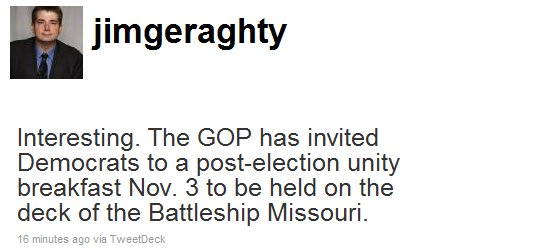
Not that they’re getting too confident, or anything
Tweet of the day, from Jim Geraghty:
September 20, 2010
The first debate in the Delaware Senate race
I haven’t been following the Christine O’Donnell campaign, but this is quite funny:
[George Stephanopoulos] Good evening, ladies and gentlemen, and welcome to the first official debate of this election cycle. I’m George Stephanopoulos, and with me tonight are two candidates for the United States Senate, Delaware Democrat Chris Coons, and Republican Christine O’Donnell.
[Chris Coons] Hello George, it’s a pleasure to be here.
[Christine O’Donnell] YOUR VOICE IS THE PITIFUL WHINE OF GNATS, AND YOU REEK WITH THE STINK OF FEAR.
[George Stephanopoulos] Outstanding. The format tonight will be as follows: I’ll ask each of you a question, and you will have two minutes to respond. Your opponent will then have one minute in which to offer a rebuttal. Christine O’Donnell, the first question goes to you: The economic stimulus bill passed last year has been the topic of much discussion. Some argue that it gave the American economy a much-needed shot in the arm, while others claim that it’s effects have been marginal or even harmful. What is your opinion on this, and what, if anything, should we have done differently?
[Christine O’Donnell] JUST AS THE GODDESS CIRCE DID DECEIVE THE COMPANIONS OF ODYSSEUS INTO DRINKING OF THE ENCHANTED WINE, SO DID PRESIDENT OBAMA THROUGH HIS CUNNING DECEIVE THE AMERICAN PEOPLE. HE HAS BOUND OUR ECONOMY TO THE YOKE OF PUBLIC SPENDING, MUCH AS THE TRICKSTER GOD LOKI WAS BOUND BY ODIN TO THE ENTRAILS OF HIS SON, NARI, WHOSE SCREAMS WERE AS THE CRIES OF A THOUSAND DYING EAGLES.
It gets better from there. As they say, read the whole thing. H/T to Ace.
September 17, 2010
QotD: Goodbye “climate change”, hello “global climate disruption”
President Obama’s Science Czar John Holdren is worried about global warming. Having noticed that there hasn’t actually been any global warming since 1998, he feels it ought to be called “global climate disruption” instead. That way whether it gets warmer or colder, wetter or drier, less climatically eventful or more climatically eventful, the result will be the same: it can all be put down to “global climate disruption.”
And that will be good, because it will give Holdren the excuse to introduce all the draconian measures he has long believed necessary if “global climate disruption” is to be averted: viz, state-enforced population control; a rewriting of the legal code so that trees are able to sue people; and the wholesale destruction of the US economy (“de-development” as he put it in the 1973 eco-fascist textbook he co-wrote Paul and Anne Ehrlich Human Ecology: Global Problems And Solutions).
Holdren is not the only person having problems with the “world not warming and everyone growing increasingly sceptical” issue. So too is Dave “Grocer” Cameron’s excuse for a government. Its solution? Work out ways of brainwashing the populace with state-funded propaganda.
James Delingpole, “Global warming is dead. Long live, er, ‘Global climate disruption’!”, Telegraph.co.uk, 2010-09-17
September 16, 2010
Army, RN, RAF, and Trident replacement: pick any three
The British coalition government has declared that they will retain the nuclear option (that is, buy replacements for their current Trident submarines), but still seem to think that you can take £20bn from the Defence budget (in addition to the 10-20% savings you’re already demanding be made) and still have three viable services. Perhaps it’s a strange form of new math:
The £20bn replacement of the UK’s Trident nuclear deterrent could be put off until after 2015, according to reports.
The BBC said ministers were considering delaying the planned 2014 date in an effort to reduce short-term costs and head off a pre-general election political row.
The Ministry of Defence (MoD) said no decisions had yet been taken on the future of the submarine-based missile system, which is currently the subject of a value-for-money review.
It has been formally excluded from the ongoing strategic defence and security review (SDSR) but the Treasury has made clear the under-pressure MoD budget will have to pay for it. An influential committee of MPs yesterday warned that that decision would have very significant consequences for future defence spending.
Just as the coalition took office, it was mentioned that the previous Labour government had committed to spend £37bn on various new weapon systems, but had not actually provided the funding to make those purchases. Add a Trident replacement bill on top of that and there is no way to successfully pay the bills out of the current military budget.
There are always economies that can be made in military spending: it’s not unreasonable to assume that savings of 10% can be found in any military force. 20% is pushing the envelope too much unless a scaling-back of commitment is also part of the reduction. 20% cuts, no reduction in tasks, and the Trident replacements (even if you reduce the fleet from four to three) can’t be done.
Update: Lewis Page thinks the Trident replacement is essential:
Proper new Trident, with submarine-launched ballistic nukes, is the right call for the UK. Its cost is tiny compared to UK government spending — just half of a single year’s Department for Work and Pensions budget would buy new Trident boats, arm them, crew them and cover their running costs for decades.
Compared to the MoD’s much smaller budget the costs look bigger, but they are still small — and ICBM submarines represent far and away the best value for money in the MoD. For perhaps £20bn to £30bn in acquisition costs you get an unstoppable, unfindable nuclear hammer capable of shattering a nation in an afternoon. When one reflects that we have spent the same money to get the Eurofighter — a wildly expensive and now rather oldfashioned pure air-to-air platform — new Trident looks like a steal.
One major reason that the Eurofighter is such poor value for money, of course, has been repeated delay so as to achieve short-term savings in the past. This is also true of nearly every other procurement project in the MoD: cumulatively, past politicians failing to grasp nettles are now costing us billions every year. It has to stop, and stop now — as a taxpayer, quite frankly I don’t see why I should pay still more billions down the road just to keep Mr Cameron in Downing Street and Mr Clegg in the Cabinet today.
September 15, 2010
The real results of Turkey’s referendum
Austin Bay is still hopeful for a secular Turkish government, but the results of the recent referendum don’t encourage quite as much hope:
Turkey’s leading political organizations both portray the choice between them as “either us or darkness.” This rhetorical demonization is typical of successful democracies. Ataturk deserves credit for establishing a democratic structure that survived his death in 1938 by 72 years.
Turkey’s actual circumstances, however, are much more complex and murky. Start with the referendum’s irony. The constitution had many undemocratic articles and was in fact imposed by the military after a coup in 1980. The European Union ruled that many of these elements did not meet EU membership standards. Thus the ironic situation of an Islamist political party promoting constitutional changes in order to meet Western European democratic standards. Aligning Turkey with Europe was one of Kemal Ataturk’s long-term goals.
Yet the judicial reforms approved this week may be an anti-democratic trap door, for they give the AKP the ability to limit systemic checks and balances on executive power. The AKP can pack the courts. The judiciary has protected the Turkish military. The AKP distrusts the military because it fears a coup, and with good reason. The military sees itself as the protector of the secular state and a bulwark against Muslim fundamentalist usurpation.
September 13, 2010
Sir Humphrey Appleby on Brussels
As long as they’re allowed, http://sirhumphreyappleby2010.blogspot.com/ will be posting some fascinating memos from Sir Humphrey Appleby KCB CVO on various topics of interest. If-and-when the Official Secrets Act is invoked, of course, we will be deprived of this wonderful insight into the real workings of modern parliamentary government.
For example, here is Sir Humphrey on the manifold advantages of Brussels:
Any attempt by this new government to weaken our ties with the European Union must be firmly resisted. Our membership has been a godsend. Since no cabinet minister is really au fait with all the provisions of the treaty of Rome, we can guide them towards our desired decisions by telling them there are obligations under the treaty, and deflect them from unwelcome actions by saying that the treaty prohibits them. In addition we can cite some of the myriad directives, which can be creatively adapted to our purposes by skilful translation from the original French. Since few of them have progressed beyond O level in any modern language, our version is unlikely to be challenged. And of course when we want to get rid of a minister for a few days we can always arrange an emergency meeting in Brussels, Strasburg or Luxembourg to give us a few days breathing space.
Brussels provides a model for modern government. Legislation can be brought forward only by officials, not by elected members. All important posts are filled by appointment, not election. Political ‘leadership’ is rotated every six months, to ensure that no one ever gets a real grip on the job. The proliferation of nations and languages gives officials endless scope for fomenting distrust, confusion and conflict between members. And there is no nonsense about financial constraints: the auditors have refused to approve the EU accounts for the past fourteen years, but they go on spending happily regardless.
Ministers in previous governments have occasionally expressed concern about this in their early months, but we have always found that after a few visits to Brussels and contingent exposure to the legendary Belgian hospitality, their opposition has cooled remarkably, and indeed they express enthusiasm for further visits, which of course we are more than happy to arrange.
September 10, 2010
Maxime Bernier for PM!
Now that most of us have given up on any actual free market policies coming out of the PMO, perhaps it’s time to look to someone who still appears to have libertarian tendencies:
It seems the libertarian Conservative MP is offside with the rest of his Quebec caucus colleagues over the issue of funding a multi-million-dollar hockey rink. He was conspicuously absent from a photo-op this week, in which Quebec MPs donned Nordiques jerseys to show their support for the arena and the possibility of bringing an NHL team back to the provincial capital.
“It was instructive that Quebec MP Maxime Bernier, who opposes public handouts for private enterprise, was missing from the photograph and e-mailed me a curt ‘no comment’ when asked about the merits of federal support for the arena,” National Post columnist Don Martin wrote at the time.
Mr. Bernier has since taken to the local airwaves in his Beauce riding to pour cold water on the idea of the Tories showering taxpayer dollars on sports facilities while battling a $56-billion deficfit.
Corporate give-aways of millions of dollars to billionaire sports team owners shouldn’t be merely controversial: they should be anathema. It’s that much worse when the government is deeply in debt.
Update: Maxime Bernier in his own words:
The hard reality is that we have just been through a global economic crisis — which remains very preoccupying and is likely not over — and governments in both Quebec City and Ottawa are heavily indebted. Our government has just posted a huge $56-billion deficit and the priority is to get back to a balanced budget through reductions in our own programs, and avoid by all means getting involved in risky financial ventures.
I was not at all impressed by the Ernst & Young study, which concluded that the project would be “profitable” — but only on the assumption that governments provide full funding for the construction as well as the repairs and renovations that will be necessary over the next 40 years. That’s a deceptive way of putting it. The conclusion should rather be that the project is simply not profitable and will constitute a financial burden for taxpayers for decades to come, even in the best scenario. That’s why not a single private player has been found to invest in it.
Just about any business would be “profitable” if they never had to pay rent for their business premises or buy, build, and maintain their own buildings. That isn’t the way ordinary businesses operate, and professional sports teams shouldn’t be any different. We don’t elect governments to be the primary supporters of sports team owners . . . no matter how many “complimentary” premium seats at the stadium may be offered to individual politicians.
As the great French economic Frédéric Bastiat wrote, “Government is the great fiction through which everybody endeavours to live at the expense of everybody else.” When such large amounts are in play, it is impossible to calculate exactly who has received how much. We would need to go beyond a single file and take into account all public spending items, going as far back as possible.
That’s what Quebec separatists like to do. They keep telling us that Quebec has been on the losing side of the financial equation and that Ottawa has systematically been favouring Ontario for more than a century. Meanwhile, people in the rest of the country believe that Quebec is the spoiled child of the federation. Each region can point towards many examples to nurture its frustrations. It is a pointless debate which can only divide our country.
Oh, swoon!


