Quotulatiousness

May 5, 2025

Make America Austere Again?

Filed under: Economics, Government, Media, Politics, USA — Tags: , , , , — Nicholas @ 03:00

The first 100 days of the BOM haven’t been quite what anyone expected. Close allies and trading partners were shocked at the new administration’s devotion to 1920s tariff “diplomacy”, supporters were dismayed to not get lots and lots of perceived wrongdoers of the Biden administration getting perp-walked for the cameras, and ordinary Americans were presented with a much worse domestic economy than they were promised:

Trump wasn’t totally fixated on economic matters … he still found time in his busy schedule to troll Catholics on his Truth Social platform.

On Wednesday, in the prelude to a cabinet meeting, U.S. President Donald Trump made yet another remark to chill the blood for those concerned about his country. Trump’s cat-and-mouse game of arbitrary changes to American import tariffs is starting to raise concerns about prices and supply chains for consumer goods. The American economy has unexpectedly shrunk in the first 100 days of Trump 2.0, even though workers and businesses are scrambling to make purchases before the effects of Trump tariffs set in. The underlying state of the economy is probably worse than the short-term numbers.

Trump says this is all a matter of “get(ting) rid of the Biden ‘Overhang'”, i.e., it’s his immediate predecessor’s fault. And let’s face it: no other politician on Earth would say anything else 100 days into an executive term. If that was as far as Trump went, it wouldn’t be of unusual concern. What struck me was his separate remark implying that, yeah, tariffs might foul up supply chains a little in the transition to the glorious economy of the future, but haven’t we Americans had it too soft for too long?

“Maybe the children will have two dolls instead of 30 dolls,” the president mused. “So maybe the two dolls will cost a couple bucks more than they would normally.” The message, which brazenly puts the contentment of children front and centre, is one you can’t imagine any other American leader delivering so directly in peacetime: have you all considered being happy with less?

The answer one would expect the median American voter to give is “Hell no”. It’s crazy that I should have to write this, but consumer abundance is a defining feature of the United States! During the Cold War, American supermarkets were the unanswerable argument for economic freedom: you could summarize the United States pretty reasonably as “It’s the country that coined the word ‘super-market'”. In our hyper-interconnected social-media world, I see a dozen conversations a week in which some European boasts of affordable healthcare, walkable neighbourhoods and having July and August and half of September off work every year: the inevitable answer from Americans is “OK, but have you been inside a Buc-ee’s, Gustav?”

Of course, it’s been a very long time since media-decried austerity in government has actually meant any kind of actual reduction in outlay … it’s usually just a (very) slight decrease in the rate of increase rather than actual dollar-value reduction. But, as Chris Bray points out, this time for sure:

I was planning to spend $100 on groceries this morning, but then I decided to slash my grocery budget, so the amount I actually spent on groceries plummeted to just $99.97, plus a small eight dollar supplemental on previously deferred grocery needs, bringing the total to a shockingly parsimonious $107.97. These major cuts caused serious alarm in my household.

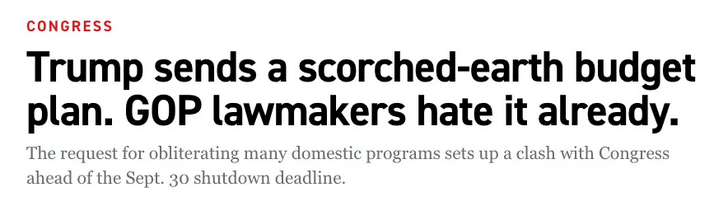
Donald Trump, Politico warns, is scorching the earth:

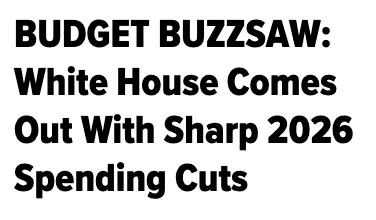
This is the common theme everywhere, as the administration offers the first not-very-detailed hints about its plans for FY ‘26 discretionary federal outlays. The Huffington Post concludes that Trump is pulling out the BUZZSAW:

The Federal News Network sums up the size of the hit, and compare the topline number to the language about scorched earth and buzzsaws:

    Overall, the administration is looking to increase national security spending next year by 13% and decrease non-defense discretionary spending by 7.6%, meaning the White House is asking for $1.7 trillion for the discretionary budget down from $1.83 trillion this year.

While the White House plans don’t get into the subject of total federal spending, focusing narrowly on discretionary spending, the implication is that federal spending overall will go from about $7 trillion to about … $7 trillion. But TBD.

You can read the entire White House proposal for discretionary funding here. Trump is proposing deep cuts in some federal departments and programs, but is also proposing to offset those cuts with sharp increases in military spending and “homeland security”, meaning border security and sending poor gentle immigrants to places where Chris Van Hollen will fly to stare into their beautiful eyes.
QotD: English intelligentsia and the Soviet Union

Filed under: Books, Britain, History, Politics, Quotations, Russia, WW2 — Tags: , , , — Nicholas @ 01:00

It is important to realize that the current Russomania is only a symptom of the general weakening of the Western liberal tradition. Had the M.O.I. chipped in and definitely vetoed the publication of this book, the bulk of the English intelligentsia would have seen nothing disquieting in this. Uncritical loyalty to the U.S.S.R. happens to be the current orthodoxy, and where the supposed interests of the U.S.S.R. are involved they are willing to tolerate not only censorship but the deliberate falsification of history. To name one instance. At the death of John Reed, the author of Ten Days that Shook the World — a first‐hand account of the early days of the Russian Revolution — the copyright of the book passed into the hands of the British Communist party, to whom I believe Reed had bequeathed it. Some years later, the British Communists, having destroyed the original edition of the book as completely as they could, issued a garbled version from which they had eliminated mentions of Trotsky and also omitted the introduction written by Lenin. If a radical intelligentsia had still existed in Britain, this act of forgery would have been exposed and denounced in every literary paper in the country. As it was, there was little or no protest. To many English intellectuals it teemed quite a natural thing to do. And this tolerance of plain dishonesty means much more than that admiration for Russia happens to be fashionable at this moment. Quite possibly that particular fashion will not last. For all I know, by the time this book is published my view of the Soviet regime may be the generally-accepted one. But what use would that be in itself? To exchange one orthodoxy for another is not necessarily an advance. The enemy is the gramophone mind, whether or not one agrees with the record that is being played at the moment.

I am well acquainted with all the arguments against freedom of thought and speech — the arguments which claim that it cannot exist, and the arguments which claim that it ought not to. I answer simply that they don’t convince me and that our civilization over a period of 400 years has been founded on the opposite notice. For quite a decade past I have believed that the existing Russian regime is a mainly evil thing, and I claim the right to say so, in spite of the fact that we are allies with the U.S.S.R. in a war which I want to see won. If I had to choose a text to justify myself, I should choose the line from Milton:

By the known rules of ancient liberty.”

The word ancient emphasizes the fact that intellectual freedom is a deep‐rooted tradition without which our characteristic Western culture could only doubtfully exist. From that tradition many of our intellectuals are visibly turning away. They have accepted the principle that a book should be published or suppressed, praised or damned, not on its merits but according to political expediency.

And others who do not actually hold this view assent to it from sheer cowardice. An example of this is the failure of the numerous and vocal English pacifists to raise their voices against the prevalent worship of Russian militarism. According to these pacifists, all violence is evil, and they have urged us at every stage of the war to give in or at least to make a compromise peace. But how many of them have ever suggested that war is also evil when it is waged by the Red Army? Apparently the Russians have a right to defend themselves, whereas for us to do so is a deadly sin. One can explain this contradiction in only one way — that is, by a cowardly desire to keep in with the bulk of the intelligentsia, whose patriotism is directed toward the U.S.S.R. rather than toward Britain.

I know that the English intelligentsia have plenty of reason for their timidity and dishonesty; indeed, I know by heart the arguments by which they justify themselves. But at least let us have no more nonsense about defending liberty against fascism. If liberty means anything at all, it means the right to tell people what they do not want to hear. The common people still vaguely subscribe to that doctrine and act on it. In our country — it is not the same in all countries: it was not so in Republican France, and it is not so in the United States today — it is the liberals who fear liberty and the intellectuals who want to do dirt on the intellect: it is to draw attention to that fact I have written this preface.

George Orwell “The Freedom of the Press”, 1945 (written as the preface to Animal Farm, but not published in Orwell’s lifetime).

May 3, 2025

German democracy under threat from extremely extreme extreme right AfD

Filed under: Germany, Media, Politics — Tags: , , , , — Nicholas @ 04:00

That, at least is the judgement of the German domestic intelligence agency assigned responsibility for sniffing out threats to German democracy:

This morning, the Federal Office for the Protection of the Constitution (BfV) officially reclassified Alternative für Deutschland as a “confirmed right-wing extremist” organisation. The BfV is Germany’s primary domestic intelligence agency; it is subject to the Ministry of the Interior and tasked, among other things, with policing the democratic respectability of ordinary Germans and their political parties. The upgraded AfD classification is supported by an extensive and totally secret 1,100-page assessment of AfD activities and beliefs, which BfV analysts have been preparing since last year.

Everybody expected the BfV to do this. Leading Social Democrats in particular have been urging the BfV to release their new assessment for months. They see it as a political justification for initiating ban proceedings against the party. As I wrote last week, it is now likely that the new CDU/SPD government, or the new Bundestag, or both, will ask the Federal Constitutional Court in Karlsruhe to weigh an AfD prohibition. This new assessment matters mostly because it is the first concrete move in that direction.

The only thing that is really surprising about this news, is the timing: I and everybody else expected the BfV to wait until the CDU and the SPD form a new government and appoint a new Interior Minister. Instead, the sitting Interior Minister Nancy Faeser appears to have forced this assessment through in the final four days of her tenure. This, and not AfD poll numbers (as some have speculated), is the reason this is happening now.

[…]

Among other things, the assessment allegedly cites these extremely right-wing remarks from an 11 August 2024 speech by Hannes Gnauck, who sits on the AfD federal executive committee:

    We must also be allowed to decide once again who belongs to this nation and who does not. There is more to being German than simply holding citizenship papers. All of us here in this market square are connected by much more than just a common language. We are connected by an invisible and simply inexplicable bond. Each and every one of you has more in common with me than any Syrian or Afghan, and I don’t have to explain that – it’s simply a law of nature.

The assessment also includes this absolutely extremist 25 August 2024 statement by Dennis Hohloch, an AfD staffer in the Brandenburg state parliament:

    Diversity means multiculturalism. And what does multiculturalism mean? Multiculturalism means a loss of tradition, a loss of identity, a loss of homeland, murder, manslaughter, robbery and gang rape.

Finally, the BfV would like us to know that their assessment includes this insanely extreme (and since-deleted) tweet from Martin Reichardt, a Bundestag staffer:

    Failed migration policy and asylum abuse have led to the importation of 100,000 people from deeply backward and misogynistic cultures.

Obviously the BfV are leaking their choicest, least arguable, and juiciest bits of evidence – the stuff they think will really turn ordinary Germans against those evil AfD Nazis. I invite you re-read these three passages with that in mind, and then try to imagine for yourself what an absurd cultural and ideological bubble these people must inhabit, to find these remarks scandalous.

Poilievre to run in Alberta riding when the byelection is set

Filed under: Cancon, Media, Politics — Tags: , , , — Nicholas @ 03:00

After losing the seat he’d held for more than 20 years in this week’s federal election, Pierre Poilievre’s political future was clouded. An Alberta MP-elect, Damien Kurek has volunteered to resign so that Poilievre can run in his riding.

Seatless Conservative leader Pierre Poilievre will run in an Alberta byelection as Conservative MP Damien Kurek “temporarily” steps aside.

In a press release, Kurek, the Battle River—Crowfoot MP-elect, said he was relinquishing his seat for Poilievre because it’s “what’s best for Canada” and the riding. Kurek was first elected in the Alberta riding in 2019.

Poilievre lost his Ottawa-area seat to a Liberal challenger by more than 4,000 votes in Monday’s election.

“The people of Battle River—Crowfoot will be represented well by Pierre for the remainder of this Parliamentary session, and I will keep working with our incredible local team to do everything I can to remain the strong voice for you as I support him in the process, and then run again here in Battle River—Crowfoot in the next general election,” Kurek said in a statement.

At a press conference in Ottawa on Friday, Prime Minister Mark Carney said he would call a byelection as soon as possible and that the government would play “no games” with Poilievre’s quest to win a seat.

Apparently, Carney is going with the less-unfriendly path rather than delaying the call for a byelection for the full allowable period (as Justin Trudeau certainly would have done).

May 2, 2025

Trump’s victory lap after getting his preferred PM elected in Canada

In the National Post, Tristin Hopper rounds up American reactions to the Liberal victory in the Monday election, as many Americans seem to agree that Carney’s win was at least partly their doing:

As the U.S. awoke to a renewed Liberal government on their northern border, Americans of all political persuasions embraced the view that they — for better or worse — had caused it.

“Carney owes his job to President Donald Trump,” was the Tuesday view of the Washington Post editorial board, declaring that the U.S. president had singlehandedly thwarted the election of a populist Conservative government in Canada.

The Centre for American Progress Action Fund — a left-wing Washington, D.C.-based think tank — framed Carney’s win as a model for how anti-Trump rhetoric can win elections.

“Prime Minister Carney’s success demonstrates that resistance to President Trump’s bullying has mass popular appeal,” read a statement.

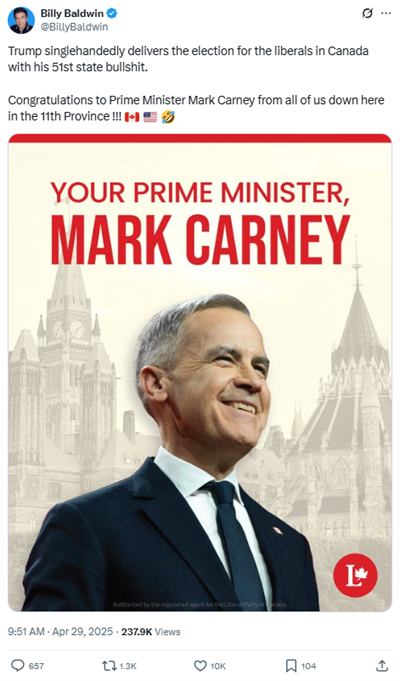
Actor Billy Baldwin, a perennial backer of progressive causes, cheered Carney’s victory with a viral social media post declaring “Trump singlehandedly delivers the election for the liberals in Canada with his 51st state bullsh-t.”

Even Rolling Stone, which put Justin Trudeau on the magazine’s cover in 2017, opined that Canada’s newest Liberal government was effectively a Trump creation. “Donald Trump single-handedly elected a new Canadian Liberal Government that was down 25 points in January with his endless ’51st State’ bloviation,” wrote the publication.

Conservative podcaster Ben Shapiro broke down the Canadian election in an extended segment on his Tuesday show, framing it as a direct failure of Trump’s foreign policy.

“Let’s be real about this; the rhetorical attacks on Canada have not actually resulted in a net good for the United States,” said Shapiro. A perennial critic of Trump’s tariff policy, Shapiro said that the White House’s habit of “yelling at Canada” had helped install a “far left-leaning internationalist” hostile to U.S. interests.

“All of this started off as a joke, and I think President Trump is so committed to the bit at this point that he couldn’t get off the train,” said Shapiro, in reference to Trump’s repeated pledges to turn Canada into the “51st state”.

A Republican consultant quoted anonymously by Politico on Tuesday was of a similar view, saying the outcome in Canada was a “pretty specific result based on the tariffs and 51st state trolling.”

On his Substack, Paul Wells offers some advice to Mark Carney about his dealings with Pierre Poilievre at this awkward time for the Conservative leader:

Stornoway in the Rockcliffe Park area of Ottawa, Ontario. It has been the official residence of the leader of the Official Opposition in Parliament since 1950.

One danger for Mark Carney is that he will be taught how to be a terrible politician by terrible politicians. A low-stakes test case is at hand. In this as in all things, a decent guiding principle should be: Don’t be like your opponent, and don’t be like your predecessor.

The test at hand is the uncomfortable predicament of Pierre Poilievre, who used to be a Member of Parliament and may want to be one again. In the meantime he is still the leader of the Conservative Party of Canada.

Poilievre lost his seat in Carleton on Monday night. This is not entirely his fault. Liberal campaign teams from neighbouring ridings were invited to spend part of their time door-knocking in Poilievre’s riding. But candidates should try to win even when their opponents work hard to defeat them. I bet this thought has occurred to Poilievre since Monday.

The usual route to the Commons, for a leader who is not yet an MP, is to run in a by-election. Often new leaders find a sitting MP somewhere to vacate their seat and enable a by-election. Brian Mulroney ran in Central Nova in 1983, Jean Chrétien in Beauséjour in New Brunswick in 1990, Stephen Harper in Calgary Southwest in 2002.

Assume Poilievre can find some Conservative MP-elect willing to abandon a seat they just won so Poilievre can try his chance (again). How should Carney react?

It’s really a question in three parts. Should a by-election be held quickly or much later? Should the Liberals run a candidate? Should the Poilievre family keep living at Stornoway, the Opposition leader’s official residence, in the meantime?

I’m hearing from a lot of people who say Carney should wait as long as the law permits — up to a half year after a seat opens — before calling the by-election; that the Liberals should definitely run a candidate; and that Poilievre and his family should be evicted from their current fancy abode.

I spent part of Wednesday debating these questions with readers on Substack Notes. Most of the people offering this advice — let him twist, then hit him hard — pointed out that if Poilievre had a say about an adversary’s career plans, he would do everything in his power to make that adversary hurt.

I think it’s bad advice. It manages to be bad tactics and bad for the soul. The two considerations don’t always line up, but here they do.

Carney should call a by-election as soon as possible after a sitting MP resigns — 11 days after the notice of vacancy is received, the minimum permitted in law. If asked, he should prefer that the Poilievre family stay at Stornoway in the meantime. And while the third question is less clear, I’d argue that the Liberals should refrain from running a candidate in the by-election.

This plan would have Poilievre back in the Commons as soon as possible, with minimal risk and discomfort. He’ll be lucky to receive such generous treatment and, while I’m less confident than ever that I know how he thinks, what he should feel is gratitude. I suspect the feeling would confuse him.

The New York Times still values “the narrative” more than the truth

Filed under: Media, Military, Politics, USA — Tags: , , , , , — Nicholas @ 03:00

Alex Berenson on the way the New York Times chose to present the summary of the crash investigation on the fatal collision between a US Army Black Hawk helicopter and a commercial passenger aircraft over Washington DC:

The New York Times cannot stop mangling the truth to serve its political goals.

On Sunday, the paper exhaustively examined the collision between an Army Black Hawk and an American Airlines jet that killed 67 people over the Potomac in January.

The massive 4,000-word article claimed the crash had many causes, including an overworked air traffic controller. “Missteps, Equipment Problems and a Common but Risky Practice Led to a Fatal Crash“, the Times proclaimed.

Except that’s not really what happened. Or what the Times found.

Yes, the controller was busy. Yes, the Black Hawk pilots wore night-vision goggles that can, ironically, complicate seeing in cities with lots of ambient light.

Those choices and problems raised the risks of an accident.

But despite all the words the Times devoted to explaining the crash, its root cause was simple. The Black Hawk was flying too high. It flew directly into the CRJ700 regional jet. The plane’s pilots and passengers had no chance.

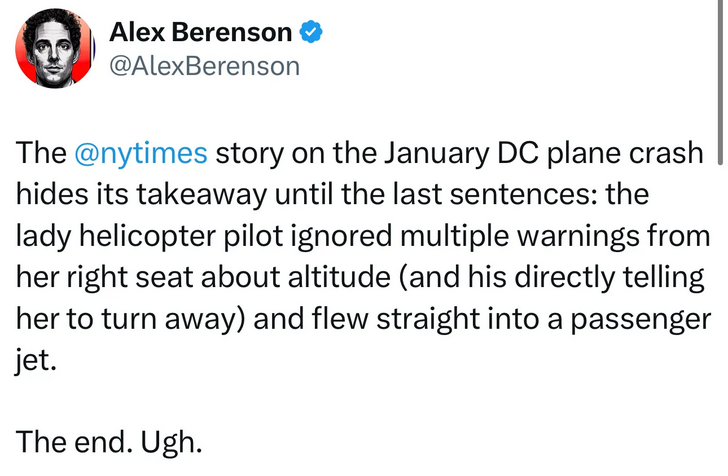
That’s the reality. The second reality is that an inexperienced female Army pilot, Capt. Rebecca Lobach, 28, (CORRECTION: original article said 36) was at the controls of the Black Hawk when it hit the CRJ700, on a training and evaluation mission.

What the Times actually found, the news in the article, is that the Lobach’s copilot repeatedly warned her the helicopter needed to descend in the minutes before the accident. Just seconds before the crash, he suggested she tack left, a path that would likely have avoided the jet.

She didn’t respond.

In other words, the story here is that Lobach — who had never deployed overseas but had volunteered in the Biden White House and whose obituary prominently called her a certified advocate for “sexual harassment” victims — flew her helicopter into a passenger jet and killed 67 people, including herself.

May 1, 2025

Canada’s Conservative Party – every silver lining has a cloud

Filed under: Cancon, Media, Politics — Tags: , , , , , — Nicholas @ 05:00

In the National Post, Colby Cosh considers the state of the party for the federal Conservatives after an election campaign that looked radically different than the one they had prepared to fight for more than a year:

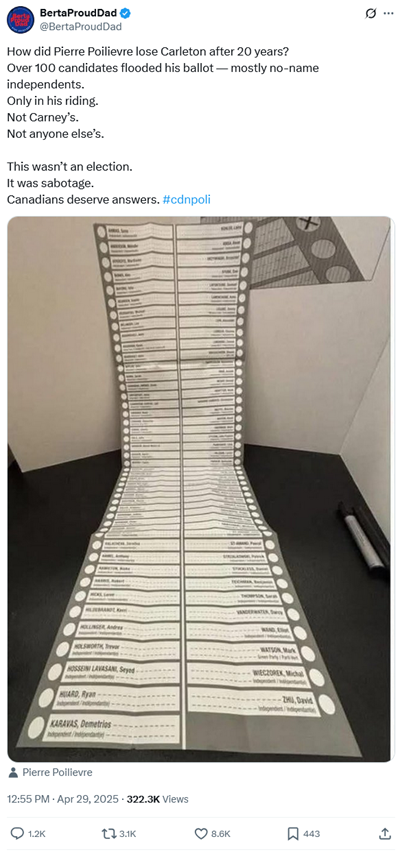
Pierre Poilievre’s riding had an insane number of protest candidates registered for the election. Oddly, the same wasn’t true in any other riding in the country. This was an organized protest for electoral reform, supposedly.

The Conservative opposition is now bound to have a difficult year, with their leader inexplicably, inexcusably ejected from the Commons. Dedicated haters of Pierre Poilievre won’t find anything at all inexplicable about the Carleton disaster, but there will need to be a proper autopsy. Especially since Poilievre’s party gathered more vote share nationally than any right-wing party — or combination thereof! — has achieved since the days of Mulroney.

Even in Ontario, Poilievre’s Conservatives got over a million more votes than the hyper-critical Ford PCs did in a provincial election 60 days earlier, and they are headed toward a higher vote share within the province. So is Poilievre a generational leader potentially on the brink of a dynasty, or an unloved boob who got caught flat-footed by a change in public mood? I promise you that the quarrelling over that question is well underway.

I assume the CPC will keep its unlucky leader, which leaves only the question, “So then what?” The Liberals don’t have to call a by-election until six months after someone decides to resign to make way for Poilievre. And maybe I ought to say “if someone decides”. It’s not essential for a party leader to have a Commons seat, but it would certainly be ideal, especially with the Commons hung.

The Conservatives are bound to find themselves adopting more of a team approach to the Opposition job by default, and maybe this ought to have been considered while it was still optional. Even by Canadian standards, the CPC campaign was very leader-focused, and was obviously predicated on the idea that the people really wanted Poilievre and would like him more as they saw more of him. (And, again, this may actually have happened!) Now there’s a chance the CPC’s House leadership performs well over the next year or so — and then has to fade into the wallpaper behind the guy who already lost.

The economics of migration

Lorenzo Warby wonders if an entire discipline can commit suicide:

Can an academic discipline seriously decline? Yes. Disciplines which were once mainstays of universities have either vanished or shrunk to pale shadows of their former selves.

What about a social science? One can envisage a social science disappearing. The most obvious way is it gets utterly discredited and replaced. A less obvious way is its institutional bases could disappear. A final way is its entire social basis disappears.

The West is currently marked by two entirely different discourses on migration that seem unable to interact. One is migration-as-economic-boon. This is the outlook of mainstream Economics. Migrants add to the economic activity of societies and potentially retard the effect of an ageing population by replacing absent local children with foreign migrants. This discourse invokes the authority of Economic Theory and its statistical methods.

This outlook typically treats criticism of migration as economically illiterate, socially retrograde, or morally bankrupt; or some combination of thereof. It is protected by the Self-Righteous, Knowing scoff which is such a feature of the modern professional-managerial class. They are the Masters of Knowledge, and of Moral Concern, who the plebs should defer to.

The other discourse talks in terms of social and democratic decay, increased crime, threats of violence, increased fiscal stress, even the possibility of civil war.

This is the world where, in Sweden — due to the stress on social and fiscal order from migration — it has become policy to pay migrants to go away. This is the world where highly intelligent and informed folk quietly discuss how the performance of economists on migration has been so catastrophically bad, it may bring down the entire discipline.

The adherents of the second, problems-with-migration, discourse are well aware of what mainstream Economics has to say on migration, and judge it to be obviously and demonstrably — even catastrophically — false. That it is much harder for migrants to contribute positively to a society than mainstream Economics admits, and this gets worse the higher the rate of migration. A recent Dutch study (Jan van de Beek, Joop Hartog, Gerrit Kreffer, Hans Roodenburg, The Long-Term Fiscal Impact of Immigrants in the Netherlands, Differentiated by Motive, Source Region and Generation, IZA DP No. 17569, December 2024. https://docs.iza.org/dp17569) found that:

    Only 20% of all immigrants [to the Netherlands] make a positive lifetime net contribution to the public budget. Groups with large contributions come from Scandinavia, the Anglo-Saxon world and a few other countries like France and Japan.

The adherents of the first discourse seem either utterly unaware of the second discourse, or protected from even considering it by the Self-Righteous Knowing scoff. Their mastery of Theory is such, they cannot possibly be so catastrophically wrong.

The notion that migration could break a society along its existing fracture lines to the point of civil war would absolutely be treated with the Self-Righteous Knowing scoff, despite there being — as is discussed below — at least three historical examples of precisely that happening.

April 30, 2025

After the votes were counted

Filed under: Cancon, Government, Media, Politics — Tags: , , , , , — Nicholas @ 05:00

John Carter suggests that votes should be allocated to reflect the costs imposed on the voters by taxation, that is to ensure that those with the most “skin in the game” at least have their votes weighted more than those who pay little or no taxes but can still vote themselves more benefits:

Have you ever noticed how election results are regularly broken down geographically, as well by the demographic categories of age, sex, and – depending on the country – race, yet we almost never see the results separated into taxpayer vs taxeater status?

So anyhow.

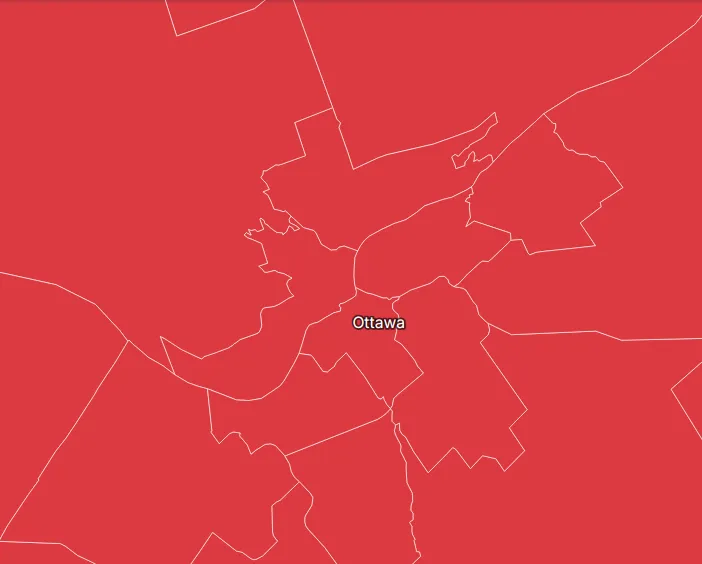
For my American readers, in Canadian elections the Liberal Party is denoted by red, as the Devil and Karl Marx intended.

It is absolutely no surprise that Ottawa voted solidly for the Liberal Party of Canada, whose base consists of three primary groups: migrants, public sector workers, and baby boomers, all of whom are regime client groups, and all of whom are tightly packed into the nation’s capital.

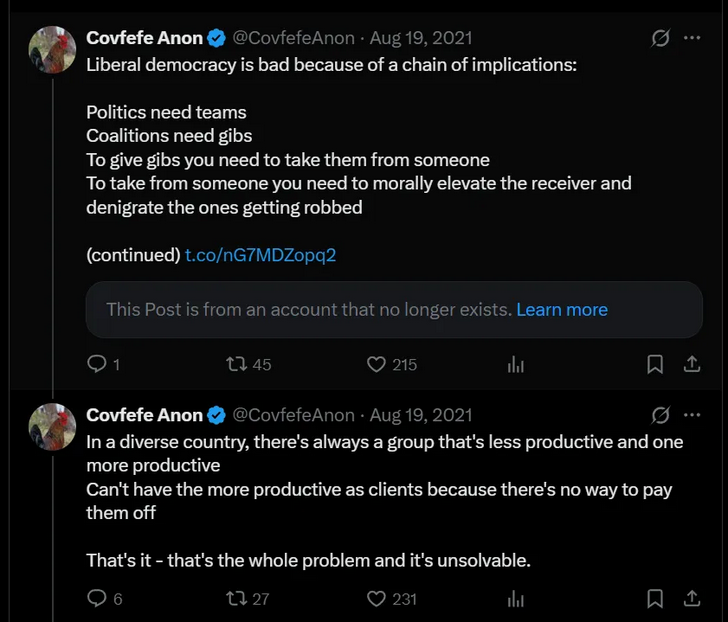
Perhaps it’s that it’s tax season and I’m in a grumpy mood because I just got the bad news, but I can’t help but wonder about how electoral politics would change if only taxpayers were allowed to vote. It’s common for “taxpayers” to be used as a synonym for “the voting public”, but this is a bit of linguistic legerdemain which obscures a core dynamic rotting the heart out of every liberal democracy: most of the population are not, in fact, taxpayers. First there are those who don’t earn enough to pay taxes, such as university students; then there are those receiving direct welfare payments of one form or another; then there are public employees, who although they pay tax on paper, are clearly net recipients of government largess since their paychecks come from taxes in the first place.

The most successful parties in country after country are the parties that mobilize client groups by promising to steal money from productive citizens and transfer that wealth to their non-productive clients. This dynamic is baked into the cake of any universal suffrage democracy, which is why Universal Suffrage is a Suicide Pact. Parties need client groups for electoral support; wealth can only be plundered from the productive; therefore the only available relationship is to cultivate non-productive clients.

The problem, of course, is that over time this destroys the economic productivity of the liberal democracy, because the productive groups will become less productive because what’s the point, or they’ll just look for the exits, while the client groups will swell, becoming simultaneously too expensive to maintain and to electorally heavy to dislodge.

I suspect you could fix all of this by simply tying votes to tax receipts, with only those who are net taxpayers being given the franchise in any given election. At a stroke this would disenfranchise the welfare underclass, government bureaucrats, and university students, all of whom should be prohibited from voting as a matter of principle. If you wanted to be really fancy, you could implement a tax-weighted vote: the more taxes you pay, the more your vote counts.

In addition to the salutary effects of reducing the electoral weight of female voters (since men tend to pay more in taxes), weighting votes by tax receipts would lead to a very interesting incentive structure. On the one hand, everyone hates paying taxes, and wants to minimize the taxes they pay; if only taxpayers were voting, this would place a strong downward pressure on taxes and, hence, on the size of government (thus forcing states to find other ways of funding themselves, via e.g. tariffs or service fees). On the other hand, people like to vote, so there would be a strong incentive not to evade taxes. On the gripping hand, since paying more tax means your vote counts for more, there would be a countervailing incentive to pay as much tax as you can afford. One might imagine a state functioning as a sort of de facto oligarchy, with the billionaires happily paying obscene levels of tax in order to gather as much political power to their class as possible, and enforcing their tyranny by voting to keep taxes on everyone else to the absolute bare minimum. This would be a truly dystopian brier patch to be thrown into.

Alas, we do not inhabit such a political experiment. Returning to the ostensible topic of yesterday’s Canadian election, however, it would probably not be an exaggeration to posit that if we did inhabit such a system, Canada’s Conservative Party would have rolled the Liberals in this and, in all likelihood, almost every other election.

That is not, however, what happened.

The high-level outcome is that, after running the country into the ground for the last decade, the Liberal Party has been elected for the fourth consecutive time, with a mandate to complete the project of crashing the plane of Dominion with no survivors. It brings me absolutely no pleasure to report that I predicted the Liberals would win before the election was even called. The Liberals are four seats short of forming a majority in parliament, meaning they cannot quite form a stable government on their own. This is not a problem for the Liberals, however. Despite the glorious collapse of the New Democratic Party – which plummeted from 25 seats in the last federal election to 7 in the current election, by far their lowest in 30 years – the NDP retains just enough seats for them to form a stable coalition government with the Liberals. In other words, the outcome of this election is that Canada will be in essentially the same situation it was in before the election, with the only meaningful difference being that the Liberals have a few more seats than they did before.

April 29, 2025

Canadian federal election result

1984 and the Politicizing of Language

Feral Historian
Published 16 Aug 2024

A dive into 1984 in relation to modern politics can’t be done without pissin’ in everyone’s Froot-Loops, so grab a tall glass of Victory Gin and let’s talk about how The Party functions, how doublethink makes us crazy, and how it’s not just those nutters on the other side that do it.

I take a few jabs at current sacred cows of the Left and Right here. Hopefully the comments won’t look like Hate Week.

00:00 Intro
01:46 Thoughtcrime and Doublethink
12:27 War is Peace
17:46 Oligarchal Collectivism
22:12 MiniTrue

Post-release edit: It’s been pointed out that I grossly oversimplified the military analysis later in the video, which is true. Man-portable air defense systems and maneuver warfare are a lot more complicated than this video implies. As for that one particular doublethink example mentioned so very briefly, some of the counterpoints have been … impressive contortions of language in their own right. But not interesting enough to discuss the matter further.

April 28, 2025

QotD: “Redpill poisoning”

Filed under: Media, Politics, Quotations, USA — Tags: , , — Nicholas @ 01:00

    Hunter Ash @ArtemisConsort
    There is a phenomenon I call redpill poisoning where someone sees through the establishment matrix, but then starts assuming the exact opposite of that narrative is always true. This oneshots a lot of smart people.

Absolutely. Among other things, I think this explains why a large minority of conservatives have become suckers for Russian propaganda about the Ukraine war.

I like your term “redpill poisoning” and will adopt it.

ESR, Twitter, 2025-01-25.

April 27, 2025

“[T]he practical reality of electoral politics throughout the west: the choice is between a Leftward Ho! party and a Ratchet party”

Filed under: Australia, Britain, Cancon, Media, Politics — Tags: , , — Nicholas @ 03:00

Mark Steyn on the steady leftward march of pretty much every western nation that never, ever stops and only rarely slows down:

A ratchet allows rotation in one direction, but prevents rotation in the other direction. That’s been a common explanation of most western governments for decades … leftward motion occurs, but can only be stopped, never reversed.

In a shrewd assessment of the current campaign Down Under, Paul Collits cites a certain “niche Canadian”:

    Mark Steyn says that we cannot vote our way out of the Western mess. The 2025 Australian election is living proof of the truth of his claim. Whoever wins here will inherit an unholy mess, and will not have the will to address it.

Of course, he could be talking about next week’s Canadian election or last month’s German election. As we have noted, Fred Merz, the incoming chancellor in Berlin, has yet to take office but what Americans call the honeymoon is over before the coalition has been officially pronounced man and wife. Hermann Binkert, head honcho of Germany’s INSA polling agency, says the country has never seen loss of approval on this scale between the election and the formation of the government. The so-called “far-right” AfD is now leading in multiple polls. Which would be super-exciting if voting hadn’t already taken place.

In America, the new administration certainly has the “will to address” the “unholy mess” but the Trumpian Gulliver is beset on all sides by District Court Lilliputians whose position is that what a Democrat president has done cannot “lawfully” be undone. This is a pseudo-“constitutional” recognition of the practical reality of electoral politics throughout the west: the choice is between a Leftward Ho! party and a Ratchet party. If the Left wins, they dissolve the border and trannify your kids. If the “Right” wins (Stephen Harper, Scott Morrison), they may pause some of the more obviously crazy stuff but they never actually reverse the direction of travel. Unless they’re the UK Tories (Cameron, May, Johnson, Sunak), in which case they stay in the leftie lane without even shifting down to third gear.

So “politics”, as increasingly narrowly defined, is less and less likely to save you. Because the gap between “politics” and reality grows ever wider. Consider the instructive example of one Hashem Abedi. Mr Abedi and his brother plotted the Ariana Grande concert bombing in Manchester. It was, from the Abedi viewpoint, a huge success: twenty-two dead, half of them kids, plus a thousand injured. It was a big deal at the time: lots of flowers, teddy bears, and heart-rending renditions of “Don’t Look Back in Anger”.

So you’d have thought even the British state would have at least pretended to take it seriously. Hashem Abedi was detained at His Majesty’s Pleasure, and under one of the three supposedly toughest prison regimes in England and Wales. Nevertheless, on April 12th he put three of his guards in hospital with what were described as “life-threatening injuries“. A fortnight later, two are still there. How did a maximum-security prisoner manage to do that? Well, he used boiling cooking oil and weaponised kitchen utensils.

So how did he get hold of boiling cooking oil? Was he a finalist for Maximum Security Masterchef? Ah, well. The details remain vague, and as usual the worthless UK media has shown not the slightest curiosity in how the Ariana Grande perp came close to bulking up his death toll by fifteen per cent.

April 26, 2025

The week-before-the-vote Bullshit Bulletin

Filed under: Cancon, Media, Politics — Tags: , , , — Nicholas @ 04:00

The Line‘s invaluable bullshit tracker includes some steaming bullshit from Mark Carney, the Conservative campaign, and, perhaps the most acrid bullshit from the NDP’s Jagmeet Singh:

Jagmeet Singh, the empty turban. He is the current (and possibly last) leader of the federal New Democratic Party, and it’s his conscious actions that may have doomed his party to parliamentary oblivion.

This article, about a recent meeting between Singh and the Toronto Star editorial board, is just absolutely bonkers. Jagmeet. Our dude. We like you. We do. But this is some epic bullshit.

This passage, in particular:

    The NDP leader stood by his decision not to plunge the country into an early election last fall while support for Justin Trudeau’s Liberals plummeted, telling the Star‘s editorial board he “couldn’t stomach” the idea of causing Pierre Poilievre’s seizure of power, and that he made the choice to put Canada’s interests ahead of those of the New Democratic Party.

    “While we could have won lots of seats, it would have meant a Pierre Poilievre majority Conservative government, and I could not stomach that,” Singh said, making the argument that an election would have jeopardized progress on pharmacare deals and dental care expansion. “I love my party. I care deeply about it. I want us to win. I want us to up our seats. I know we’re good for people. But in that moment, I made a decision for the interest of the country ahead of my party. And that was a decision I made wide-eyed, and I stand by that decision.”

Hmmm. Okay. So. Let’s take that at face value. If only for the sake of argument.

Singh realizes what the logical endpoint of that argument is, right? … right?! The story of this election, to the extent there is a single one, is that the NDP collapse made it impossible for the Conservatives to win. We have lots of criticisms of the CPC campaign; we’ve made some already and we’ll have more to say when it’s over. But we recognize the truth that without a strong NDP, even a perfect and flawless Conservative campaign was always going to be an uphill battle. It’s just a really difficult situation for the Conservatives to overcome.

And you know what Singh could do to make that a permanent state of affairs? Give up! Tank the NDP completely. Do a national tour asking everyone to vote Liberal. Defect and become a Liberal. Spend his post-politics career, which seems set to start sometime early next week, campaigning for a two-party system, under which the Liberals defeat the Conservatives over and over.

End the vote splitting by ending the NDP. That’s a case that many Liberals have made before. And fair enough. But it’s some kind of bullshit to see Singh himself making it, and we can’t imagine his NDP colleagues are particularly pleased to see their leader taking a position that the Liberals took years ago: that the best way for left-leaning voters to stop the Conservatives is to put the country first, and vote for them.

Lies, damned lies and government statistics

Filed under: Cancon, Economics, Food, Government, Media, Politics — Tags: , — Nicholas @ 03:00

Francisco at Small Dead Animals linked to this interesting examination of the difference between the official inflation rate and the actual inflation ordinary Canadians are coping with:

    Great news! We’ve brought inflation back under control and stuff is now only costing you 2.4 percent more than it did last year!

That’s more or less the message we’ve been hearing from governments over the past couple of years. And in fact, the official Statistics Canada consumer price index (CPI) numbers do show us that the “all-items” index in 2024 was only 2.4 percent higher than in 2023. Fantastic.

So why doesn’t it feel fantastic?

Well statistics are funny that way. When you’ve got lots of numbers, there are all kinds of ways to dress ‘em up before presenting them as an index (or chart). And there really is no one combination of adjustments and corrections that’s definitively “right”. So I’m sure Statistics Canada isn’t trying to misrepresent things.

But I’m also curious to test whether the CPI is truly representative of Canadians’ real financial experiences. My first attempt to create my own alternative “consumer price index”, involved Statistics Canada’s “Detailed household final consumption expenditure“. That table contains actual dollar figures for nation-wide spending on a wide range of consumer items. To represent the costs Canadian’s face when shopping for basics, I selected these nine categories:

  • Food and non-alcoholic beverages
  • Clothing and footwear
  • Housing, water, electricity, gas and other fuels
  • Major household appliances
  • Pharmaceutical products and other medical products (except cannabis)
  • Transport
  • Communications
  • University education
  • Property insurance

I then took the fourth quarter (Q4) numbers for each of those categories for all the years between 2013 and 2024 and divided them by the total population of the country for each year. That gave me an accurate picture of per capita spending on core cost-of-living items.

Overall, living and breathing through Q4 2013 would have cost the average Canadian $4,356.38 (or $17,425.52 for a full year). Spending for those same categories in Q4 2024, however, cost us $6,266.48 – a 43.85 percent increase.

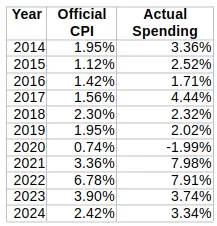
By contrast, the official CPI over those years rose only 31.03 percent. That’s quite the difference. Here’s how the year-over-year changes in CPI inflation vs actual spending inflation compare:

As you can see, with the exception of 2020 (when COVID left us with nothing to buy), the official inflation number was consistently and significantly lower than actual spending. And, in the case of 2021, it was more than double.

Since 2013, the items with the largest price growth were university education (57.46 percent), major household appliances (52.67 percent), and housing, water, electricity, gas, and other fuels (50.79).

« Newer PostsOlder Posts »

Powered by WordPress