
Ginny probably had agreed to the change because she had taken up a new political cause, and the spasms of pain that came on at night interfered with her fund-raising activities for the Barry Goldwater presidential campaign. Heinlein approved of Goldwater, both personally and politically — a New Deal liberal who had evolved in a sensible way, responding to the actual political realities the country had found itself in after World War II.
Ginny was setting up a “Gold for Goldwater” fund-raising campaign with five other field workers — a grassroots organization, outside the somewhat hidebound local Republican hierarchy. “Spend what you think we can afford,” he told Ginny. He had been disillusioned with party politics for nearly a decade, but this was a campaign worth fighting.
William H. Patterson Jr., Robert A. Heinlein, In Dialogue with His Century Volume 2: The Man Who Learned Better, 2014.
July 22, 2015
July 21, 2015
Dave Chappelle’s re-launch
At sp!ked, Tom Slater looks at Dave Chapelle’s new comedy routines:
In his own words, Dave Chappelle is the Bigfoot of comedy; a rarely seen legend whose long absence from the stage has only secured his status. The stand-up, actor and writer, who found global success in the mid-2000s for his Comedy Central hit Chappelle’s Show, walked away from a $50 million deal for a third season in 2006, after fame and showbiz politics began to weigh heavy on his shoulders. For the past nine years, he’s been a borderline recluse – living on a farm in Ohio, raising his children and doing the odd, unannounced stand-up gig in mobbed comedy clubs.
Now, he’s making his comeback. Touring across America and, this past week, doing a sold-out seven-night run at the Hammersmith Apollo in London, it’s as if he was never gone. And yet, he has returned to a circuit that is not what it was.
‘Are you a Muslim?’, an affable doorman asked my mate, as we handed over our tickets for Monday night’s Apollo show. He wasn’t on counterterror duty. There’d been a few incidents, you see, during the run so far, as Chappelle’s caustic jibes had ruffled some feathers. ‘He’s got a joke in there about transgenders, and one guy the other night just got up, started shouting and then ran out.’ It seemed our doorman had taken it upon himself to trigger-warn any potential targets of Chappelle’s punchlines.
It was a strange question. Not least because Chappelle is a Muslim, and anyone who comes to one of his shows should know what they’re getting. Like his hero Richard Pryor before him, Chappelle has a unique ability to craft edgy, racially charged and often scatological humour and serve it up to a mainstream audience. Chappelle’s Show, which broke all records at the time for DVD sales, ended its first episode with an extended skit about a blind white-supremacist author who is unaware he is black. It was one hell of a mission statement.
QotD: The feminist movement
As entertaining as these little vignettes may be, they’re also indicative of a more dispiriting and concerning philosophy that has overtaken a great many young people, both men and women, at the beginning of the 21st century. The early Western feminist movements generally possessed a nobility and righteousness that rendered the ideology both powerful and admirable. It is no small feat, after all, to reverse several millennia’s worth of systematic oppression and discrimination, and the women’s rights campaigns of the 19th and 20th centuries are some of the crown jewels of Western civilization. Emmeline Pankhurst may have been a bit radical here and there, but at least she was right. Nowadays among the ranks of feminism you’re less likely to find a principled zealot like Pankhurst and more likely to find a repellant, theory-drenched curmudgeon like Andrea Dworkin.
There is a word that embodies the kind of single-minded fanaticism of modern feminism: a cult. […]
It’s fashionable these days for feminists to try and convince others of their own latent feminism; “You’re a feminist,” they claim, “if you believe in equality between the sexes.” Political and social equality between the sexes is one of the most worthwhile and noble goals to which a society can aspire, but as we’ve seen, modern feminism is about so much more than that: it’s a neurotic, insular, self-aggrandizing, and paranoid ideology that aims to spread fear, small-mindedness and agonistic self-criticism and self-doubt over even an uncomplicated and enjoyable idea such as the bouquet toss. Is it any surprise that many prominent young women are rejecting the label altogether?
Daniel Payne, “The Many Fabricated Enemies of Feminists”, The Federalist, 2014-07-22.
July 19, 2015
It’s the right answer to so many intrusive questions!
Sippican Cottage relates the tale of how the answer to life, the universe, and everything came to be discovered:
Excuse me, did you say “42”? Because 42 is so last week. I have discovered the answer to life, the universe, and everything, and it’s a lot more useful and comprehensible than 42.
My wife was accosted in the supermarket parking lot by some ill-mannered brigands, otherwise known as female high school students. Don’t get me wrong; people are more mannerly and friendly in Maine than in other places I have known. But there are many interactions between persons that have been bent by circumstance.
[…]
My wife is very quiet and reserved. She smiles a lot, but she doesn’t talk very much. I have always depended on her steadiness, because I am mercurial. I wonder if there is anyone in this world who has anything bad to say about her, other than she chooses husbands in lighting not suitable for buying off-brand bales of hay. Anyway, she was caught somewhat unawares, and didn’t have a moment to parse what she said carefully for its effect. She just asked, more or less politely, “Why would I want to do that?”
They backed up like people who had opened a mummy’s tomb and heard Egyptian being spoken. It was as unanswerable as a tax bill.
Don’t you see? Can’t you see it? It’s the answer to everything. It’s the Swiss army knife of life, with the little can-opener dongle on it, except instead of opening cans it opens universes. If everyone would answer 99 percent of the questions put to them every day with, “Why would I want to do that?”, the world would be a better place. Not just for the questioner. All manner of mischief would fold up and die and I wouldn’t get messages from Nigerian princelings anymore because every offer to send a million dollars tax-free would be met with, “Why would I want to do that?”
I recognized it like a lost friend. It’s the phrase I’ve been thinking but not saying, morning, noon and night, for years on end, whenever anyone asks me anything about anything. It is my default position for everything, I’ve just never uttered it.
Why would I want to do that?
But (and there’s always a “but”) … it fails the test of one critical question.
July 17, 2015
QotD: Feminism’s uneasy attitudes to motherhood
Last week a person named Amy Glass wrote a breathtakingly honest — and breathless — rejection of traditional motherhood:
I hear women talk about how “hard” it is to raise kids and manage a household all the time. I never hear men talk about this. It’s because women secretly like to talk about how hard managing a household is so they don’t have to explain their lack of real accomplishments. Men don’t care to “manage a household.” They aren’t conditioned to think stupid things like that are “important.”
Women will be equal with men when we stop demanding that it be considered equally important to do housework and real work. They are not equal. Doing laundry will never be as important as being a doctor or an engineer or building a business. This word play is holding us back.
First, a few small points.
I hear men talk about how hard it is to manage a household and raise kids all the time. (We may not talk about it in terms Glass can recognize, but as a subscriber to the Happy Wife, Happy Life school of marriage, it’s my experience that husbands who don’t recognize and appreciate how hard it is to run a home soon become ex-husbands or miserable husbands.) Glass also may only be hearing what she wants to hear. Or, she may know only asinine men. Who knows? Frankly I don’t care which one is right because I don’t put a lot of stock in what Glass has to say.
Second, this is truly shabby work:
Doing laundry will never be as important as being a doctor or an engineer or building a business. This word play is holding us back.
Talk about word play! You see the sleight of hand, right? “Doing laundry” is a single, discrete task, a subset of a vast realm of responsibilities that often come with running a household and being a mother. Being a doctor, engineer, or business-builder are total careers or vocations. In other words, it’s a false analogy. Like saying being a chef isn’t as worthwhile as being a truck driver because chefs “cut vegetables.” Every career or calling involves unpleasant or tedious tasks.
Just in case you still don’t get it, another illustration. Raising kids involves taking the barbarian clay of a baby and through the alchemy of love and the application of intellect turning it into an emotionally, spiritually, and physically healthy human being and citizen. Meanwhile, doctors put their fingers in old men’s butts. So, to sum up: “Putting fingers in old men’s butts will never be as important as raising children. The word play is holding us back.”
Third (as a reader flagged for me), Glass is not exactly a rigorous thinker. On January 15 she writes:
Every time I hear someone say that feminism is about validating every choice a woman makes I have to fight back vomit.
On January 17 she writes:
The great thing about Feminism is that it means that women can do anything. You can be a working woman or a stay at home mother and both choices are equally valid. There is no “wrong way” to do feminism.
This means that as good feminists, we never judge the choices of other women.
Assuming there isn’t a technical explanation for what’s going on here (a false byline, a prank, or maybe an angry capuchin monkey loose in the IT department) this is the kind of inconsistency that doesn’t invite refutation so much as medication.
Jonah Goldberg, “It’s Still Only Two Cheers for Capitalism”, The Goldberg File, 2014-01-31
July 15, 2015
The onrushing infantilization of the West
Kit Wilson examines the state of western thought and belief:
Consider the main philosophical movements of the 20th century. The majority followed the fearsome footsteps of Friedrich Nietzsche — the man who killed God and buried good and evil at His side. And though they grappled with his legacy in a variety of ways, they shared, more or less, the same key assumption: that the traditional pursuits of thought — truth, beauty, meaning — were fundamentally misguided. Philosophy, unable to comment on the world, turned instead to — and on — itself. “Having broken its pledge to be at one with reality,” Theodor Adorno wrote, “philosophy is obliged to ruthlessly criticise itself.”
At the same time, positivism — the belief that only empirical or logically deduced data have any real meaning — took hold among many of the West’s intellectual circles. A.J. Ayer and Bertrand Russell declared that, if we were ever to understand ourselves, it would be by scientific means alone. Cultural memory, which could not be reduced to testable propositions, was made entirely superfluous.
Wherever one looked, the West seemed to be in the midst of a curious experiment: can a civilisation survive on nothing but the impulse to debunk its own presuppositions?
Adorno and his co-author Max Horkheimer tried to tackle this question in Dialectic of Enlightenment. A bleak assessment of Western culture, it argued that modernism, nihilism and reductionism were symptoms of the same fundamental malady — the suicide of Enlightenment thinking. Our insatiable appetite for self-criticism, the monstrous alter ego of philosophical scepticism, was finally gnawing at the very foundations on which we stood.
Adorno and Horkheimer thought it unlikely we would survive, and predicted three historical steps that would see us collapse altogether. High culture — including art — would exhaust itself, taking with it any sense of a shared inheritance. Second, we would lapse into infantile solipsism, duped by the immediate gratifications of capitalism — in particular, cinema and popular music. Finally, society — stupefied by such pleasures — would topple at the first serious test of its walls. Adorno and Horkheimer saw a host of surrogate mythologies — most notably, Nazism — poised to flood into the vacuum left behind.
This final point seemed borne out by the events of the 1930s and 1940s. But then, as the war receded into the past, much of the West suddenly found itself reclining into an unprecedented period of peace and prosperity. To the baby boomers, Adorno and Horkheimer’s stuffy pessimism seemed laughably outmoded. And today, we assume — having never known any different — that this good fortune is simply here to stay. At a time of such global instability — with Putin and Islamism openly challenging our values — we urgently need to reconsider our confidence. Were the last 70 years really the final disproof of Adorno and Horkheimer’s pessimism, or did history merely postpone its judgment?
Let us begin with the charge of Western infantilism. Here, at least, Adorno and Horkheimer seem to have been rather prescient. The West is — for all its wealth today — far more childish than even they anticipated. This can be traced — I believe — to the reductionist narratives we adopted as our mantras during the last century.
July 12, 2015
Of more than just “academic” concern…
Jay Currie rounds up the current issues for your university faculty:
Notes Re Coming Academic Year
From: Dean of Arts
To: Faculty
Dear Colleagues,I hope you are enjoying your well earned summer vacation. I know I am. However, a number of issues have arisen which I feel I must bring to your attention.
1. Marking: Many of you are still clinging to the outmoded idea that marks are designed to measure absolute progress in a subject. You are insisting upon received grammar and spelling in essays. You are setting exams and papers which, in themselves, are triggering events causing significant anxiety. Worse, you are not taking into account the often heart rending oppression narratives which many of your students bring to class. Stop it.
2. Subject matter: It is not enough to include writers and topics from outside the tragically exclusionary Western Cannon. The fact is that even a reference to Shakespeare will trigger feelings of anxiety, worthlessness, racial othering, religious persecution and, of course, sexual confusion. Just stop it. The same with references to the Bible, Plato, Milton, any so called Saint, Mark Twain or that Moby D*** fellow with the harpoon obsession. Each of these references will only serve to underscore the possible ignorance of your students which, rather obviously, will make them feel anxious, disrespected and unsafe. Best not to mention any of it.
[…]
6. Race: Pretty much the live hand grenade of the Arts Faculty. Say anything and it explodes with unknowable consequences. Even a supportive statement such as “slavery is wrong” can lead to disastrous conversations about Black African complicity in the trade and the continuing Islamic acceptance of slavery. Plus, and this is an acute problem, Chinese and South Asian students, dealing with our university’s current admission policies, may take strong exception to remarks vis a vis affirmative action or diversity. Just don’t go there.
7. Logic/Argument/Reason: Mansplaining at its heteronormative worst. It is pretty clear that argument, both verbal and written privileges middle class, usually white, usually male, left brain dominant, testosterone charged, individuals. By prioritizing thinking over feeling, requiring reason means an instructor risks making women, minorities and queer students feel unsafe with the feelings they often use in discourse rather than accepting the oppressor’s terms of exchange. Stay away.
July 11, 2015
“They sought to be ‘hypersexual’ or ‘pansexual’ because they never quite understood what it meant to be ‘sexual'”
George Fields wonders why “progressives” have such an adversarial relationship with ordinary life:
Many months ago, as I was wandering about the state of Indiana, a certain woman from Wisconsin advised me that “if one had nothing nice to say, he ought say nothing at all.” Being an introspective type, I took this to heart and determined to never write another article again.
However, I have decided to write at least one more time, provoked by a conversation with my kid sister. Having recently entered a public high school, she has come to enjoy informing me about some of her more eccentric peers. Near the end of the school year, she told me fewer and fewer of her friends were merely normal boys who liked normal girls, or normal girls who liked normal boys. Rather, they identify as a slew of peculiarly novel “sexual orientations.”
Some were, of course, the usual “gay” or “lesbian,” but in addition to these were “demisexuals,” “androsexuals,” and “therians” (which, she explained, are people who are only attracted to individuals who commune with the same spirit animal). One identified as a “panromantic polyamorous asexual non-binary space god.” Upon hearing this, I knew I had something to say, although it is unlikely to be nice. Having heard, however, several episodes of “The Prairie Home Companion,” I am convinced women from Wisconsin are famously kind, so I am sure my friend will forgive me.
I suspect the “space god” is nothing of the sort, but likely the kind of child who did not want to go to the caverns because she was much too busy trying to beat her high score on “Candy Crush Legend.” Meaning, she is likely longing to be “the extraordinary” because she has entirely failed to appreciate the ordinary. This, to any ordinary person of sensible wit, is extraordinary.
To the sane individual, the world is a wonderful thing. At no point in my life have I ever felt compelled to invent novel sexualities, mainly because I am so enthralled with the traditional two. Their complexity and magic never ceases to engage my imagination and bring me pleasure. Indeed, I can not imagine why anyone would critique the symmetrical beauty of “the two sexes.” Yet wherever I look, adversaries are about, seeking to destroy my source of wonderment.
July 10, 2015
July 8, 2015
Minnesota students face new rules under which “everyone accused of sexual assault will very likely be technically guilty”
Reason‘s Robby Soave on the introduction of new “affirmative consent” rules at the University of Minnesota:
The proposed policy is currently under review for another 30 days before it becomes official. Its language is fairly standard, which leads me to believe that it will suffer from the same problems as other “Yes Means Yes” policies:
- It is the responsibility of each person who wishes to engage in the sexual activity to obtain consent.
- A lack of protest, the absence of resistance and silence do not indicate consent.
- The existence of a present or past dating or romantic relationship does not imply consent to future sexual activity.
- Consent must be present throughout the sexual activity and may be initially given, but withdrawn at any time.
- When consent is withdrawn all sexual activity must stop. Likewise, where there is confusion about the state of consent, sexual activity must stop until both parties consent again.
- Consent to one form of sexual activity does not imply consent to other forms of sexual activity.
“It is the responsibility of each person who wishes to engage in the sexual activity to obtain consent.” But isn’t that redundant? All parties to a sexual activity must be willing participants in the first place, or else they are victims of rape under any standard. That’s what consent is: agreement to engage in sex. I presume the policy’s authors mean to say that it is the responsibility of each person who wishes to initiate the sexual activity to obtain consent. But such a requirement is at odds with the reality of human sexual activity — the initiating party is not always so clearly defined, especially when alcohol is involved (as it often is).
Equally troubling is the mandate that each and every sexual act be hammered out beforehand. May I touch your hand? What about your wrist? May I touch your shoulder? May I kiss this spot on your neck? May I kiss this other spot on your neck? May I kiss the first spot again while I touch your hand? Nobody is going to do this. Does that mean everyone is a rapist?
July 5, 2015
The real lessons of The Good Life
While I don’t think I ever saw an episode of the British sitcom The Good Life, I’ve read a fair bit about it in passing, as it is one of the mass media touchstones used by Dominic Sandbrook in his series of hefty tomes about British life from the 60s onwards. In short, a middle-aged couple bail on their middle-class lives and try to set up a self-sufficient lifestyle on their (fully paid-off) house in the suburbs. The interaction between the couple and their still-living-the-middle-class-life next-door neighbours provides much of the humour for the show. Based on that, I must heartily agree with David Thompson’s explanation of the show:
… Tom and Barbara’s experiment in “self-sufficiency” wasn’t particularly self-sufficient. They don’t prevail in the end, not on their own terms or in accord with their stated principles, and their inability to do so is the primary source of story lines. Practically every week the couple’s survival is dependent on the neighbours’ car, the neighbours’ chequebook, the neighbours’ unpaid labour, a convoluted favour of some kind. And of course they’re dependent on the “petty” bourgeois social infrastructure maintained by all those people who haven’t adopted a similarly perilous ‘ecological’ lifestyle. The Goods’ “non-greedy alternative” to bourgeois life is only remotely possible because of their own previous bourgeois habits — a paid-off mortgage, a comfortable low-crime neighbourhood with lots of nearby greenery, and well-heeled neighbours who are forever on tap when crises loom, i.e., weekly.
To seize on The Good Life as an affirmation of eco-noodling and a “non-greedy alternative” to modern life is therefore unconvincing, to say the least. The Goods only survive, and then just barely, because of their genuinely self-supporting neighbours — the use of Jerry’s car and chequebook being a running gag throughout. And insofar as the series has a feel-good tone, it has little to do with championing ‘green’ lifestyles or “self-sufficiency.” It’s much more about the fact that, despite Tom and Barbara’s dramas, bad choices and continual mooching, and despite Margo’s imperious snobbery, on which so much of the comedy hinges, the neighbours remain friends. If anything, the terribly bourgeois Margo and Jerry are the more plausible moral heroes, given all that they have to put up with and how often they, not Tom’s principles, save the day.
July 4, 2015
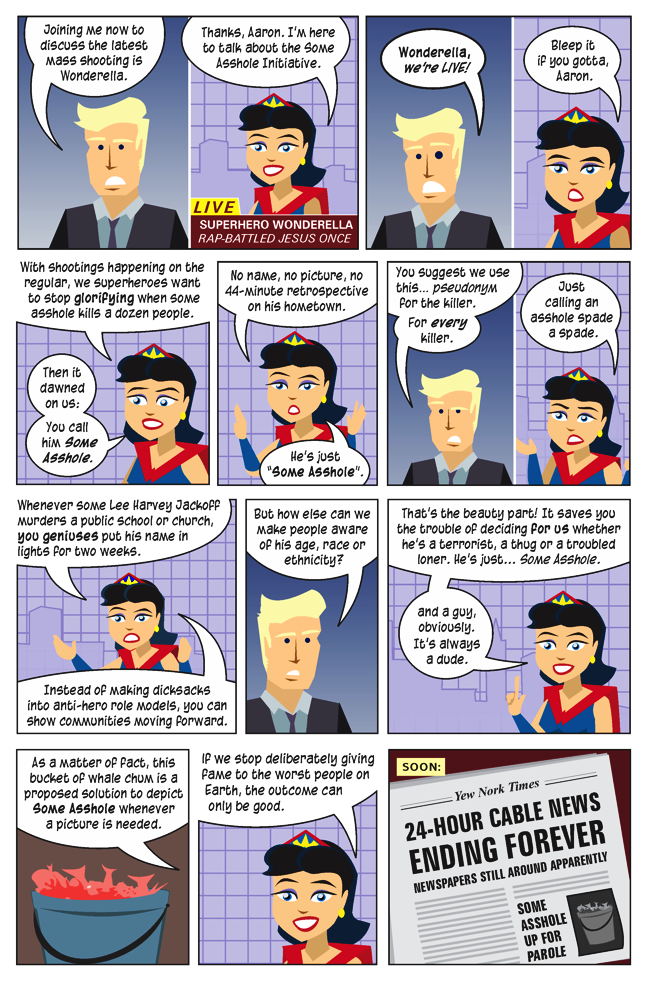
Please support the “Some Asshole” initiative!
By way of American Digest, let’s all get behind the “some asshole” initiative:
July 3, 2015
The unintended consequences of a bottled water ban
Mark J. Perry talks about the outcome of a well-intended ban of bottled water at the University of Vermont:
Here’s the abstract of the research article “The Unintended Consequences of Changes in Beverage Options and the Removal of Bottled Water on a University Campus,” which was just published in the July 2015 issue of the American Journal of Public Health (emphasis added):
Objectives. We investigated how the removal of bottled water along with a minimum healthy beverage requirement affected the purchasing behavior, healthiness of beverage choices, and consumption of calories and added sugars of university campus consumers.
Methods. With shipment data as a proxy, we estimated bottled beverage consumption over 3 consecutive semesters: baseline (spring 2012), when a 30% healthy beverage ratio was enacted (fall 2012), and when bottled water was removed (spring 2013) at the University of Vermont. We assessed changes in number and type of beverages and per capita calories, total sugars, and added sugars shipped.
Results. Per capita shipments of bottles, calories, sugars, and added sugars increased significantly when bottled water was removed. Shipments of healthy beverages declined significantly, whereas shipments of less healthy beverages increased significantly. As bottled water sales dropped to zero, sales of sugar-free beverages and sugar-sweetened beverages increased.
Conclusions. The bottled water ban did not reduce the number of bottles entering the waste stream from the university campus, the ultimate goal of the ban. With the removal of bottled water, consumers increased their consumption of less healthy bottled beverages.
[…]
Wow, nothing worked out as expected by the college administrators at the University of Vermont: a) the per capita number of bottles shipped to the University of Vermont increased significantly following the bottled water ban, and b) students, faculty and staff increased their consumption of less healthy bottled beverages following the bottled water ban. Another great example of the Law of Unintended Consequences. And the bottled water ban was not costless – the university paid to modify 68 drinking fountains, they paid for a publicity campaign, and they paid for lots of “free” reusable water bottles; and what they got was more plastic bottles on campus of less healthy beverages!
July 2, 2015
“These women should be able to milk their boobs for whatever purpose they want”
Shikha Dalmia on the schizophrenic demands of the “Free the Nipple” movement:
The Free the Nipple movement (which has already become the subject of a 90-minute, yawn-inducing documentary) tries to cure such attitudes, but in such a ham-handed and shock-jocky way that few real women outside of college campuses can relate to it, other than publicity-hungry celebrities. Thanks to the movement, 100 students—men and women—at UC San Diego took off their shirts last month to fight for the equal right of both sexes to go topless. Likewise, Scout Willis, the daughter of Demi Moore and Bruce Willis, earned her two minutes of fame some years ago when she went strolling topless in Manhattan to protest Instagram’s nudity policies barring pictures of topless women. Not to be outdone, Miley Cyrus, who has never encountered a publicity stunt involving her body parts that is too over-the-top, tweeted a picture of her bare breasts with red stars on the nipples to express her solidarity.
These women should be able to milk their boobs for whatever purpose they want, free from state censorship and violence, to be sure. But does that mean that freeing the nipple is the “civil rights issue” of our time — as some feminists claim — that requires busting all social taboos against female toplessness?
Not really.
For starters, it’s not like this kind of thing hasn’t been tried before. The “burn the bra” movement was all the rage among feminists in the 1960s. But it didn’t go beyond a few symbolic bonfires because going braless is simply too physically uncomfortable for most women with modern lifestyles.
Free the Nipple activists accuse society of a double standard for allowing men to show their breasts but not women. “Why are we more offended and outraged by female nipples than male nipples?” one demands to know.
But the fact is that their movement itself is based on a double standard. Indeed, if they were interested in genuine sexual equality, they wouldn’t just fight for the right to go topless, but all laws against indecent exposure. So why don’t they? Maybe because they realize that allowing strange men to swing their schlongs in streets would be neither comfortable nor safe for women.


