
I believe, and I have alluded to this several times, that we must anchor all our policies in North America. We are, I have said, again more than once, bound by what some wag called TINA²: we are Trapped In North America and There Is No Alternative. (TINA X TINA = TINA²) That’s the crux of it … no matter what some romantics might wish we are and must remain for generations anchored in North America. We are not big enough and rich enough to be powerful enough to face the world on our own, treating the USA as just another great power ~ as, arguably, Australia does. Geography, economics, personal issues ~ we are kith and kin ~ and the power imbalance make us dependent upon America to a degree that some, including me, find unhealthy.
But, until we can grow our population to 100 million, until we can grow up and appreciate that we need substantial hard (military) power in order to promote and protect our vital interests around the globe, until we can become a global free trader, and until America’s decline is more marked then There Is No Alternative … we are Trapped In North America ~ trapped in Donald Trump’s America, for now, anyway.
Ted Campbell, “Anchor, cornerstone or stumbling block?”, Ted Campbell’s Point of View, 2018-07-17.
August 17, 2018
QotD: TINA
August 16, 2018
August 15, 2018
Robert Heinlein – Highs and Lows – #2
Extra Credits
Published on 14 Aug 2018Heinlein’s novels made science fiction mainstream and even contributed to modern libertarianism. His novels vary widely in the philosophies they explore, but ultimately they all reflect how Heinlein saw himself: as the self-reliant “competent man” protagonist of his stories, despite glaring inconsistencies.
Maxime Bernier on sensible limits to “unlimited” diversity
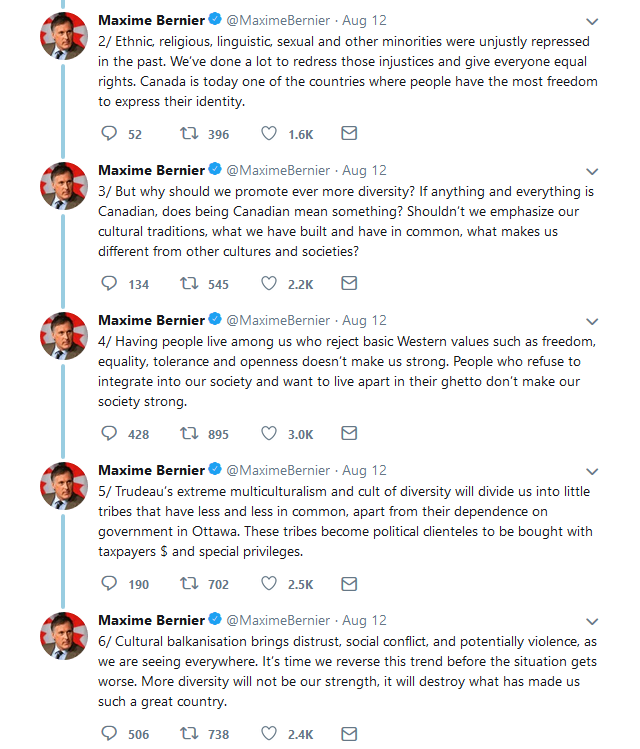
Maxime Bernier responds to Prime Minister Trudeau’s apparently unlimited desire for more and more diversity in Canada:
1/ Trudeau keeps pushing his “diversity is our strength” slogan. Yes, Canada is a huge and diverse country. This diversity is part of us and should be celebrated. But where do we draw the line?
Diversity is what makes Canada strong: Trudeau https://t.co/dZmCffRBFY
— Maxime Bernier (@MaximeBernier) August 13, 2018
The following tweets as a screencap, to avoid slowing down the whole page loading (as often happens with multiple tweet embeds):
August 12, 2018
Misunderstanding what the trade deficit represents
In a post from last week, Tim Worstall explains why Donald Trump is wrong about the economic impact of a trade deficit:
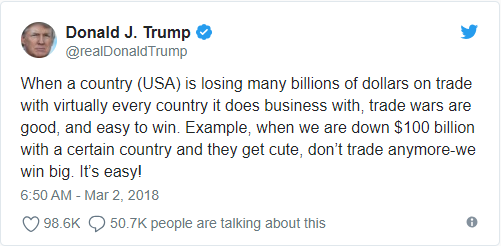
I should note here that I didn’t, because as a foreigner I can’t, support The Donald at the last election. But I didn’t support Hillary even more. So this is more about really, actually, insisting that Trump is wrong on trade issues rather than just the more general he’s wrong about everything common in the US press.
[…]
What Trump, DiMicco and Navarro are getting wrong is this, the GDP equation.
Y = C+I+G+(X-M)GDP is consumption plus investment plus government spending plus the trade balance – and minus it if there’s a trade deficit. So people look at this and think yep, if there’s a trade deficit than that makes Y, GDP, smaller!
But this is a mistake, an error. For, as the textbook immediately goes on to explain, what is it that we do with imports? Well, we either consume them, use them in investments or government buys them. So all imports are already in C and I and G. Meaning that if we don’t deduct them we’ll be double counting them. So, to avoid double counting we subtract them.
Trump and his advisers are simply wrong on this. The trade deficit doesn’t reduce the size of the economy. They’re getting it wrong simply because they’re not reading the second page of the explanation of the GDP equation.
Public statuary … can we just get rid of the politicians?
In the wake of Victoria’s city council deciding to remove a statue of Sir John A. Macdonald, Colby Cosh suggests that we apply a broader brush to what is acceptable for public display and get rid of the rest of the politicians, too:
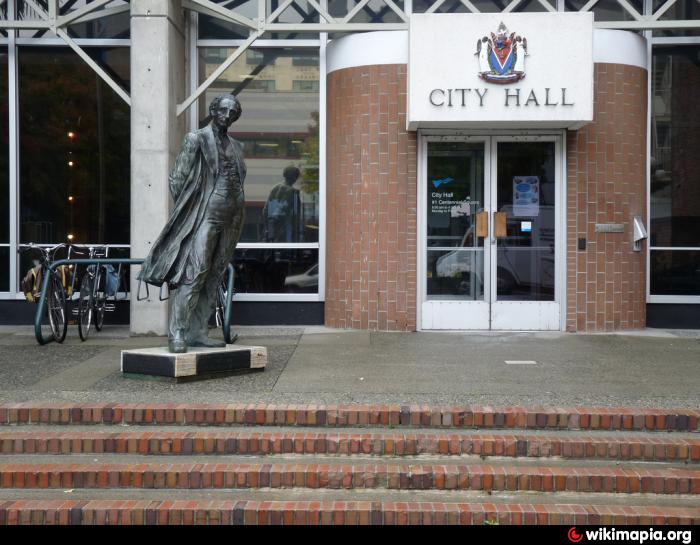
The mayor of Victoria, Lisa Helps, emphasized that the removal of the statue is “temporary,” promising to “find a way to recontextualize Macdonald in an appropriate way.” This suggests that the statue will find a home somewhere, perhaps even in its accustomed place, but will have to be accompanied by a sanitizing “This was a bad, racist guy despite having led the creation of our federation” text inscribed nearby.
All of this gives me a chance to rehearse my inconveniently unclassifiable views on the subject of revisionist iconoclasm in public settings. Part of me is sympathetic to the anti-revisionist case. Even if Victoria took a year with this decision, a year is not a long time to reconsider an act of commemoration that was intended to be permanent in the first place. Any one generation, let alone a small group within it, ought to be hesitant in removing public statuary — doubly so, perhaps, if you are doing it “temporarily” but without a deadline for its return. Putting objects of built heritage in storage is the easiest way for a government to demolish them, through neglect, on the sly.
With that said, I could be convinced to pick up a hammer if there is to be a general smashing of statues of politicians. No city or country really has a shortage of people to honour whose contribution to humanity is unambiguously and uncontentiously positive. Those who exercise political power, even in a democracy, rarely fall into this category. If we were building a country from scratch, I would suggest we start building statues to those who excel in the realm of pure thought — physics, math, music, scholarship — and work “down” through artisans, philanthropists, innovators and entrepreneurs.
Once we’re past the tradesmen who did good work and mentored the young, and we have made modest busts or reliefs of everyone who just worked to make a neighbourhood nicer or cleaner or safer, and we have put a few people on postage stamps just for contributing their own earnings or effort to any of the Corporal Works of Mercy, we can start with politicians of an especially noble and humane character who executed great necessary enterprises by means of law.
Politicians get big-ass statues because it is politicians who build statues: that’s all. The problem is that this encourages the dangerous habit of reverence for politicians, who, despite endless complaining about the thanklessness of their vocation, hardly go without social privileges or deference or celebration within their own lifetimes. In the case of statues or images of Sir John A. Macdonald, the veneration is all but explicit. The Old Chieftain represents the juvenile desire to have a George Washington-like national paterfamilias, to have a single founder to serve as the incarnation of our glorious state.
I am not a politician and I endorse this message. I’d be even more on board if we also chiselled off the names of politicians from schools, community centres, streets, and any other edifice built with taxpayer money.
August 11, 2018
QotD: Reductio ad Hitlerum
The poverty of peoples’ collective memory and imagination is such that the first minute any politician strays from the path of universalism, commentators reach for the most shocking (and only) historical comparison they can think of.
Ed West, “It’s absurd to compare Amber Rudd’s immigration speech to Mein Kampf”, The Spectator, 2016-11-07.
August 9, 2018
Scottish schools’ proposed gender initiative will encourage gender uncertainty in 5-year-olds
Joanna Williams explains why authority figures actively undermining one of the few certainties in a young child’s world is bound to cause much more harm to many children:
Education Scotland, regional NHS boards and the Scottish government jointly came up with this new gender initiative’s daft – sorry, draft – guidelines, which are set to come into effect from 2019. The plan is to tell children: ‘Your sex is what you are told by a doctor when you are born. Most people are told they are a male child (a boy) or a female child (a girl).’ But this ridiculous statement contradicts everything children will later learn in biology lessons. Babies are not ‘told’ they are a particular sex in some odd conversation between parents and midwives on the labour ward. The overwhelming majority of babies actually are male or female, boys or girls. Sex is not a lottery. It doesn’t depend on how the doctor happens to be feeling at a certain point in time. It is there in the child’s genitals and in their chromosomes. Telling children that sex is simply something that is arbitrarily announced by a doctor is a lie.
But propagating this lie and encouraging children to believe that sex is a random declaration allows teachers to go on to tell children: ‘Your gender is what you decide.’ In other words, children will be told to ignore the evidence they see before them every time they go to the toilet or get undressed. Ignore what the nasty doctor said. And ignore what family members have wickedly led them to believe. Not only does this undermine parents, it also heaps a lot of pressure on to the shoulders of five-year-olds. Most find it difficult enough to decide what to have for breakfast. Their brains are full of Minecraft, superheroes or Friendship Fairies. They worry about dinosaurs coming back to life and unicorns not being real. It is hard to see how telling children this age that one of the few things they know for certain isn’t certain after all can do anything other than cause distress.
But the problematising continues. ‘People might think they know your gender because of the clothes you wear or the things you like to do’, children will be told. But, of course, these people are wrong: ‘You are a unique person, you know who you are.’ This confuses two separate issues – gender stereotypes and actually being a boy or a girl. It also seriously underestimates children. The youngest children distinguish between boy stuff and girl stuff; they know whether they are a boy or a girl and which clothes and toys they are supposed to like. But while some children might police gender stereotypes with enthusiasm, others do not. They know, better than the Scottish government it seems, that you can play football and still be a girl or dress up as a princess and still be a boy. Even those keen to enforce gender conformity at age five may well rebel by the time they are 15. And so what if they don’t? If a boy enjoys being a boy and wants to grow up into a man, is that really so bad?
August 7, 2018
“[Trudeau’s] ideology is jeopardizing 20% of the Canadian economy”
Brandon Kirby on Prime Minister Justin Trudeau’s failing efforts to negotiate with the United States on trade:
Trade with Canada constitutes 2% of America’s GDP and trade with America constitutes a whopping 20% of Canada’s GDP. My home province of New Brunswick finds 50% of its private sector exporting to the U.S. – NAFTA is of vital importance to our economy.
The dwindling efforts of Trudeau’s cabinet to negotiate a deal with the Americans could become his government’s greatest failure. With tariffs already being imposed on steel and aluminum, NAFTA is potentially unraveling before our eyes and along with it, the Canadian economy.
Trudeau’s American counterpart isn’t known for his vocal support of trade and yet he handed Canada everything on a silver platter at the recent G7 summit. He offered to remove all tariffs and subsidies on imports and exports, provided Canada did the same. This is about as fair an offer as one could expect. Trudeau retaliated by insisting Canada had been insulted.
The trouble with Trudeau is precisely that. He was given a talking point. He developed rhetoric rather than substance. Akin to Marco Rubio’s disaster of a debate performance, who refused to go off script even when he was being called out for scripted answers, Trudeau had a talking point. It was a good one, Canadians and Americans died together in the mountains of Afghanistan to bring justice for Americans who died on September 11th. Trump alluded to our tariffs on their dairy farmers as a national security threat. But when Trump acquiesced, Trudeau kept to his talking points and refused to go off script, even when his talking points no longer made sense.
The initial renegotiation began with Trudeau’s government attempting to include a chapter on gender. The Americans weren’t enthusiastic about devoting a significant portion of their time at the negotiations to discussing an unenforceable chapter of the deal, but Trudeau pressed on.
The liberal rationale in the briefing notes was leaked, “Think back 20 years and remember the early discussions of labour and environment in the context of trade agreements.”
Environmental and labour standards were included in the negotiations of decades past because a country that has humane labour standards is at a trade disadvantage to countries that neglect their workers and their environment. Gender doesn’t have any bearing on trade. His ideology is jeopardizing 20% of the Canadian economy.
August 6, 2018
QotD: Voting
Most people vote in elections for the candidate they dislike the least, and perhaps this is as it should be: positive enthusiasm for candidates and politicians in general is likely to give them an inflated idea of their own importance and thereby promote the politicization of life.
Theodore Dalrymple, “Self-Anointed v. Resentful: A view from across the Atlantic”, City Journal, 2016-11-08.
August 4, 2018
Violence against women
Joanna Williams on the problem that well-established, well-paid, financially secure women — at least the professional feminists fitting those criteria — are having to work very hard to maintain their air of victimhood:
Being a feminist must be hard work. Perhaps you’ve got a newspaper column to fill with your hot take on the latest sexist outrage. Or perhaps you have a university sexual-harassment policy to write. Or a government minister to consult about a proposed new law. Or a hefty budget to administer. You’ve got the salary, a platform for your views, and the capacity to influence what happens in almost every institution in the country. And yet the entire basis for you being in this fortunate position, for walking the corridors of power, is your powerlessness. The bind for today’s professional feminist is the more power and influence she gains, the harder she needs to work to show that women are still oppressed.
[…]
As feminists increasingly take positions of power, tackling violence against women drives their agenda. The World Health Organisation tells us that violence against women ‘is a major public-health problem’. The United Nations tells us it is ‘a grave violation of human rights’. The British government describes violence ‘against women and girls’ as a serious crime that has ‘a huge impact on our economy, health services, and the criminal-justice system’.
Of course, violence against women and girls deserves to be taken seriously and perpetrators should be severely punished. But the lives of women in poverty-stricken and wartorn countries are very different to those of women in England. Likewise, adult women have far more agency and control over their lives than girls. Conflating the experiences of women all around the world, and of adult women with children, allows professional feminists to claim suffering by proxy.
At the same time, the definition of violence seems to broaden by the day. The internationally agreed definition of violence against women and girls is: ‘Any act of gender-based violence that results in, or is likely to result in, physical, sexual or psychological harm or suffering to women [or girls], including threats of such acts.’ In the UK and the US, violence encompasses sexual harassment – which includes winking, whistling and looking at someone for too long. Amnesty International describes women’s experiences of ‘violence and abuse on Twitter’. In 2017, the organisers of a women’s strike against President Trump described ‘the violence of the market, of debt, of capitalist property relations, and of the state; the violence of discriminatory policies against lesbian, trans and queer women’.
This is not violence as a physical act, but violence as metaphor. No wonder it is experienced everywhere. The World Health Organisation describes violence against women as an ‘epidemic’. We are told that over a third of girls have been sexually harassed at school and that more than a third of women have experienced sexual harassment at work. But then we also learn that two women are killed each week by a current or former partner. And here, immediately, is the problem with violence as metaphor. Real violence becomes relativised. When winking and nasty tweets are described as acts of violence, the word is no longer enough to describe acts of physical brutality and murder. Violence has become nothing more than a badge permitting membership of an inclusive feminist club, and this does little to support women who really are in need of help.
August 2, 2018
The role of the gatekeepers for Trans youth
This is a debate that has been bullrushed by the sudden political success of Trans activists, but there are genuine medical and ethical issues that need to be taken into account:

I’m a transsexual woman in my thirties who transitioned in my early twenties, and I wish I could have done so earlier. Even so, I am wary of today’s Brave New World of transgender activism in which important safeguards of transition are under attack and any counter opinion, even if made by a trans woman such as myself, are labelled as an attack on trans rights. At first it was easier for me to not ruffle the trans activists’ feathers, but my conscience got the better of me, and now I am continuing to speak up in order to help those who deserve better in their own journey of transition.
Through talking to other trans people in my life, it has become apparent to me that transition surgeries are an answer but not the answer to the long-term health and well-being of gender dysphoria patients. Unfortunately, many trans people get so fixated on surgery for so long, that they may forget that there is more to life and transitioning than just surgery and other medical intervention. The fixation is often driven by the fantasy that surgery, and transition in general, will transform them into a new person, and that all the problems in life will go away.
I haven’t known a lot of trans people over the years, but of the few that I know, there did seem to be a powerful belief that if they could fix just this one thing — their gender — then their lives would be perfect forever. In at least two cases, having transitioned, they then discovered that they were just as miserable as they had been before despite having changed to their preferred gender. All the surgery in the world won’t fix mental problems, and the disappointment and anger seemed to be that much greater when the situation finally came home. I’m not claiming this is in any way universal, but of the small number of trans people I’ve known, it was true for half of them.
During my gender transition, I didn’t fixate on surgery even though I was highly dysphoric back then. I’ve had my ups and downs, but I’ve always done okay. To be honest, thinking about sex and gender a lot is unhealthy, particularly during high-conflict public debates on what it means to be transgender and what rights we have to get the help we need. As the debate grows more divisive, the media valorization and glamorization of trans people, especially trans children, is not helping but rather, it is pulling us away from the honest conversations we need to have.
Forty-one percent of transgender people [PDF] have experienced suicidal ideation or self-harm, though this statistic does not indicate to what extent the attempts were before or after transition, or at what stage of transition. Nevertheless, studies have shown high rates of suicide among (alleged) trans people post-medical transition. Why is this the case and can the quality of transition be a factor?
As I understand it, the overall success rate of transgender surgery is higher the earlier it is conducted … within reason. This is where the ethical issues are the most pressing:
The move away from the medical gatekeeping model for treating gender dysphoria is not only unfortunate, it is irresponsible. Over the past few decades, the strictness of the standards of healthcare used to determine suitability for hormone replacement therapy (HRT) and related surgeries have been relaxed significantly. In 2008, the Endocrine Society endorsed puberty blockers as a treatment for trans teenagers. Then in 2011, the World Professional Association for Transgender Health (WPATH) issued new Standards of Care internationally for treating such patients via puberty suppression, while formalizing the ‘informed consent’ model. But it didn’t end there.
Last month here in Australia, new guidelines published in the Medical Journal of Australia gave the green light for potentially more trans children to go on HRT as young as 13, defying international guidelines. Specifically, “decisions about affirming a young person’s gender identity should be driven primarily by the child or adolescent, in conjunction with their family and health care providers.” While this experiment was hailed as world-leading, the minimum legal age for smoking, drinking and voting in Australia remains at 18, and it’s still 16 for consensual sex. So in Australia, a 15-year-old teen cannot consent to sexual activity but they can consent to life-altering medical treatments that they almost certainly cannot fully grasp at that age.
August 1, 2018
British Labour Party continues to sideline pro-Brexit MPs
Fraser Myers on the most recent pro-Brexit Labour MP deselected by local party activists:
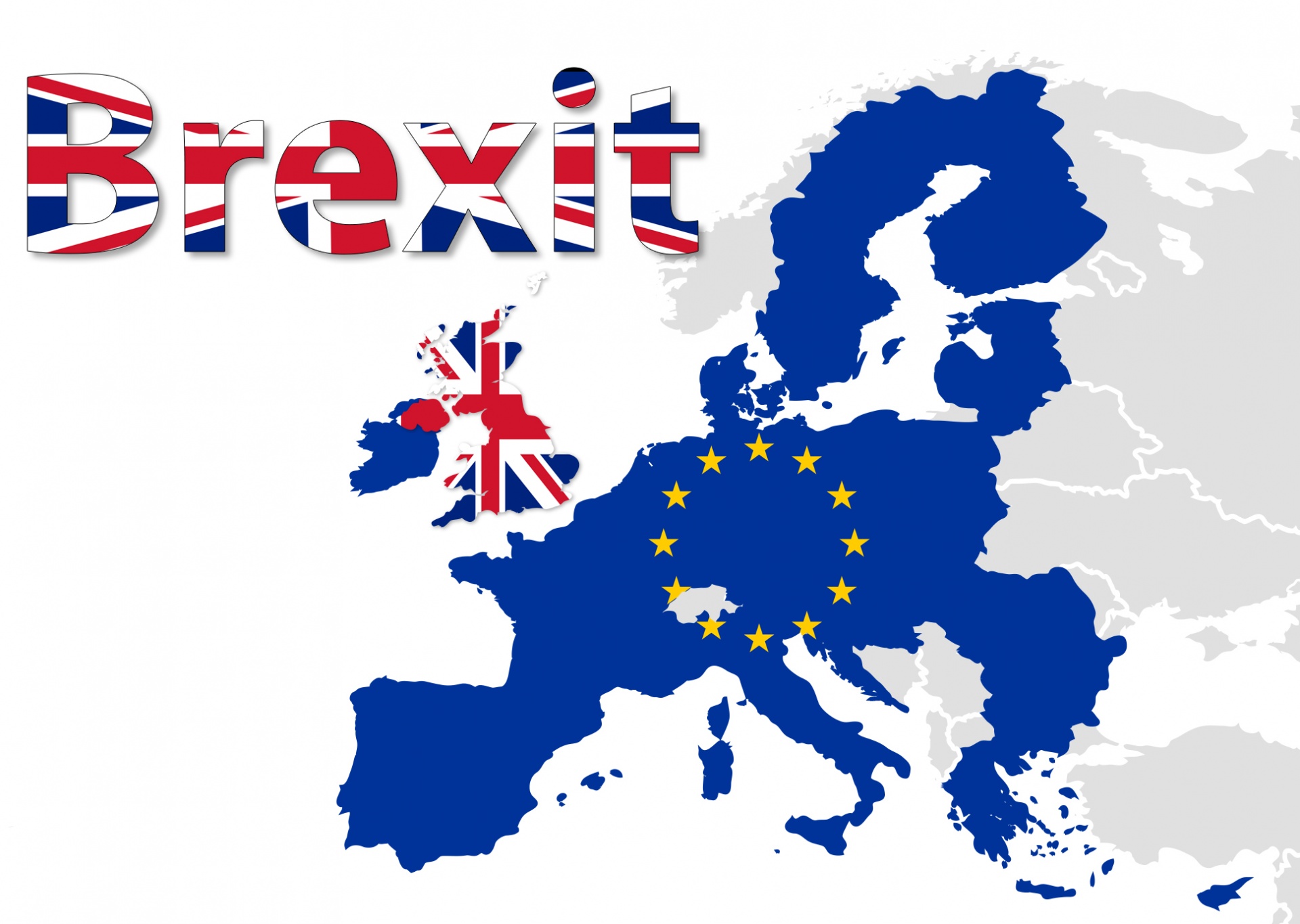
Labour Party activists have passed votes of no confidence in two of Labour’s Brexit-backing MPs, and called for their deselection. Frank Field and Kate Hoey were censured by their local parties for voting with the government against an amendment that would have kept the UK in a customs union with the EU after Brexit. If passed, it would have killed off any prospect of Britain having an independent trade policy after Brexit, and would have kept us under the jurisdiction of the European Court of Justice. Recognising this as a betrayal of the Leave vote, Labour Brexiteers had no other choice but to vote with the government to defeat the amendment. Now, for defending the democratic choice of 17.4million voters, Field and Hoey stand accused of ‘betraying’ the Labour movement and ‘siding with the reactionary Tory establishment’.
This sends a disastrous message to voters and pits Labour against the Leave vote, the largest democratic mandate in British history. Labour’s better-than-expected result at the 2017 General Election depended on retaining Brexit-voting seats. Two thirds of Labour MPs represent Leave-backing constituencies, with some of the largest Leave votes in Labour-held seats. Labour needs to win 64 seats at the next election to form a majority government, 42 of which are dotted around blue-collar, Leave-voting England. To attack the few Labour MPs who are on the side of the Leave majority is an astonishing act of self-harm for a party that claims to represent ordinary people.
While some Blairite MPs have long feared the prospect of deselection campaigns launched by the Corbyn-backing Momentum, the no-confidence motion against Kate Hoey was initiated by members of the Blairite pressure group, Progress. And rather than stand up for Hoey, a defender of Corbyn’s leadership, Momentum sided with its erstwhile rivals against the Brexiteer MP. As Owen Jones revealingly writes in the Guardian: ‘Self-professed Blairites, soft lefties and Corbynites were united in this vote.’ While the Blairite and Corbynite wings of the party claim to agree on very little, they appear to be united in their contempt for the electorate and for democracy.
These activists seem to forget that Labour has a long history of Euroscepticism. Labour’s much-celebrated postwar prime minister, Clement Attlee, and the architect of the NHS, Nye Bevan, were against Britain joining the EU’s predecessor, the European Economic Community (EEC). When the left-winger Michael Foot led Labour into the 1983 General Election, the party’s manifesto pledged to withdraw Britain from the EEC. Tony Benn – Corbyn’s hero – opposed the anti-democratic tendencies of the EU all his life. Would Benn, Foot and Bevan face a similar fate to Hoey and Field in Labour today?
July 31, 2018
The anti-Brexit propaganda machine of “Project Fear”
Brendan O’Neill on the never-ending whinge by the Remoaners emphasizing the potential negatives of Brexit:
I can’t remember a time when the elitist politics of fear has been as cynically wielded as it has been over the past week. It wasn’t even this bad when schoolkids of my generation were made to watch The Day After, a nuclear-disaster movie in which a wholesome American family slowly die from radiation after the Soviets go mental and bomb the US. Also, at least that dread-laden propaganda was only designed to make us fear the Ruskies – the even more unhinged Project Fear of elitist Remoaners is an attempt to make us fear ourselves and our friends and family and our collective electoral stupidity that has allegedly propelled Britain to the brink of ‘self-immolation’, in the words of the increasingly bizarre figure of David Lammy, the Member of Parliament for Brussels.
Every day the fearful propaganda intensifies. One wakes wondering what unearthly horror our vote against the EU 25 months ago might now have unleashed. Gonorrhoea is the latest. If we leave the EU with No Deal, Britain will apparently become a 15th-century-style hotbed of such sexual malaise. ‘Brexit could lead to spread of infectious diseases such as super-gonorrhoea’, says a headline in the London Evening Standard, which was once a newspaper but is now a score-settling sheet for its current editor: arch Remainer and former chancellor George Osborne, who we turfed out of office with our vote for Brexit. Medical officials fear that a shortage of medicine in the event of No Deal will mean we won’t be able to treat knob rot. It’s almost Biblical. ‘Defy me and your genitals shall wither.’ Up next: plagues of locusts? Floods?
Yes, floods. Brexit could ‘water down [the UK’s] environment laws’, says a piece in the Guardian, complete with a photo of a flooded English village. We could see more ‘severe flash floods’ if we leave the EU without boosting eco-laws. Perhaps we should build arks, get some animals on board? If you don’t drown, you might be poisoned. If there’s No Deal, Britain will become a ‘dumping ground for chemicals’, claim green groups. There won’t be much food, either. Remoaners are stoking up fears of food shortages if we change our trade arrangements with the EU. Because we will struggle to import ingredients and therefore won’t be able to make bread and other essentials. Why won’t be able to do this? They never say. They just know starvation is on the cards.
In the words of chief Remoaner Alastair Campbell, ‘No deal Brexit means no food Brexit and no medicines Brexit…’. Imagine being Alastair Campbell. Imagine giving the green light to the destruction of a foreign country and the deaths of tens of thousands of people in the name of delivering democracy, only to decide 15 years later that you don’t believe in democracy after all and so you devote your entire life to overthrowing the largest democratic vote in British history. Scientists should study Mr Campbell to discover how such a human being manages to sleep at night. Also, no one is saying there will be ‘no food’ after Brexit. Campbell is lying now as surely as he was when he said Saddam could bomb Britain in 45 minutes.
July 30, 2018
Auditor General to look at the RCAF’s “capability gap” claim
Ted Campbell reports on the news that the Auditor General will investigate the Trudeau government’s claim that the RCAF would be unable to meet its obligations due to a newly discovered lack of airframes:

I see in a Canadian Press report published in the Globe and Mail that “Canada’s auditor general has started to dig into one of the Trudeau government’s most contentious claims, upon which rests the fate of hundreds of millions of taxpayer dollars: that the country is facing an urgent shortage of fighter jets … [and] … The claim was first made in November, 2016, when the Liberals announced that Canada didn’t have enough fighter jets to defend North America and simultaneously meet the country’s NATO commitments, and that a stopgap was urgently needed until the entire CF-18 fleet could be replaced.“
You’ll remember, I hope, that back in 1997 Canada’s government (Jean Chrétien was our Liberal prime minister) decided to join the US (but soon multi-national) F-35 Lightening II programme with the implicit intention of buying the aircraft and the explicit goal of sharing in the work, profits and jobs that the project might create. In 2010 the Government of Canada (Stephen Harper was the Conservative prime minister) committed to buying the aircraft for the Royal Canadian Air Force. There ensued an almighty public row over costs ~ partially because some generals and some DND officials tried to ‘low ball‘ the actual costs, partially because almost no one in government can agree on how to define ‘life cycle costs,‘ partially because most Canadian journalists are nearly innumerate and partially because the Liberal ‘war room‘ launched a disinformation campaign ~ and that rocked the Harper government back on its heels and made it a campaign issue. In 2015 the Liberal Party promised that Canada would not buy the F-35 but would, instead, hold “an open and transparent competition to replace the CF-18 fighter aircraft.”
Then, when in power the Liberal “government originally planned to buy 18 interim Super Hornets from Boeing for $6.4-billion before the deal was scuttled late last year in favour of buying 25 used jets from Australia for $500-million … [but] … critics, including opposition parties and former air force commanders, accuse the government of fabricating an urgent “capability gap” – as the shortfall is known – by changing the military’s requirements to avoid having to buy the F-35 stealth fighter.” The rumour ~ and that’s all it ever amounted to, as far as i know ~ floating around Ottawa was that the Liberals saw the Boeing Super Hornet fighter as a “cheap and dirty,” readily available solution and they felt confident that they could, easily back away from the promise to hold a competition, thus avoiding the dilemma of having an “open and transparent competition” while already having decided that the F-35 could not win.


