
Everywhere one turns one sees a tendency toward mimesis — we tend to copy rather than invent — qualified by intellectual emptiness. In other words, it may be that the vacancy of the Canadian mind reflects the vacancy of the Canadian landscape. Of course, much of the land is variegated — lakes, rivers, forests, the impressive mountain ranges running down the length of “beautiful British Columbia” — in the same way, metaphorically speaking, that we can boast a number of resonating exceptions to the staple of tepid cultural and intellectual sameness.
One thinks of novelist Mordecai Richler, poet Irving Layton, critical minds Harold Innis, Marshall McLuhan and Northrop Frye, musicians Leonard Cohen and Gordon Lightfoot. Our founding father, Sir John A. Macdonald, was the ne plus ultra of our political class; there has been none like him since, which may explain why he is now on posthumous trial for war crimes and a hue and cry has gone up to remove his statues and rename eponymous schools.
The constitutive factor, however, exceptions aside, is the “howling emptiness” of a vast landmass that may partially account for the emptiness of our intellectual topography — if, as Jared Diamond had argued in Guns, Germs and Steel, geography governs the development of culture and spirit.
Any nation the preponderance of whose citizens regularly elects left-wing political parties; accepts single-payer healthcare; believes in the efficacy of the welfare state; endorses the hoax of global warming; accommodates swarms of third-world immigrants and refugees who have no love for or understanding of a country becoming an open-to-all multicultural tombola with the highest proportionate rate of immigrants in the Western world; has allowed its educational industry, from pre-school to graduate school, to be corrupted possibly beyond retrieval by lockstep Leftism, “diversity and inclusion,” and “social justice” claptrap; has caved to the feminist and campus-rape fable; dutifully takes CBC Leftist propaganda as gospel; has fallen for the 16th Century meme of the “Noble Savage” in its dealings with the aboriginal peoples; extravagantly celebrates a second-rate rock band like The Tragically Hip and names a street after it; reads (when it does read) tedious scribblers like the acclaimed Joseph Boyden and Ann-Marie MacDonald; and gives a complete ignoramus like Justin Trudeau a majority government on the strength of name and coiffure, cannot be regarded as informed, well-educated or in any way distinguished. Unlike the U.S., there are no cracks, to quote Leonard Cohen, where the light gets in. The Canadian political, cultural and academic spectrum has gone dark from end to end.
David Solway, “The Canadian Mind: A Culture So Open, Its ‘Brains Fall Out'”, PJ Media, 2018-10-10.
March 9, 2021
March 8, 2021
Despite the rhetoric, judging by their actions the Democrats really hate the “gig economy”
Along with all the giveaways to favoured groups in the US government’s huge “relief” bill, there was a late change that will take the gig economy into a back alley and rough it up to the tune of about $1 billion in new taxes:

UBER 4U by afagen is licensed under CC BY-NC-SA 2.0


When the economy is struggling to recover from a pandemic and crushing government lockdowns, that’s probably the worst time to impose $1 billion in new annual taxes on the working class. But that’s exactly what a new provision quietly slipped into the Democrats’ sweeping $1.9 trillion COVID legislation would do.
“A last-minute insert by Democrats looking to offset the cost of their coronavirus aid package would send tax collectors into the gig economy, eventually costing Uber and DoorDash drivers, Airbnb hosts and others about $1 billion annually,” Roll Call reports.
Under current tax law, earnings data for gig economy workers only needs to be reported to the IRS once it reaches $20,000. This means that small earners pursuing gig work to supplement their income aren’t hit by crushing federal taxes. However, the Democrats’ provision would nearly eliminate this benchmark, and instead require all income above $600 to be reported to the IRS.
“The stiffer tax burden would be imposed while 10 million Americans are unemployed and more and more have turned to freelance and gig economy work to make ends meet,” Roll Call notes.
Indeed it would, and this would be disastrous for both workers and the economy.
This tax hike “adds a significant burden to gig economy and small business workers at the worst possible time,” according to TechNet spokesman Steve Kidera. One tax expert warned Roll Call that many struggling gig economy workers won’t be able to pay the higher taxes, and that IRS penalties “can destroy a person’s life.”
March 5, 2021
Schools told they need to “identify and challenge the ways that math is used to uphold capitalist, imperialist, and racist views”
No wonder I had trouble with math back in grade school: Math is a racist tool of White Supremacists!
“Math Class” by attercop311 is licensed under CC BY 2.0
Mandatory teaching standards that focus on critical theory and identity politics to the detriment of liberalism and individualism are already working their way through state legislatures.
Now, math education itself has been deemed “racist.” A group of educators just released a document calling for a transformation of math education that focuses on “dismantling white supremacy in math classrooms by visibilizing the toxic characteristics of white supremacy culture with respect to math.”
Among the educators’ recommendations, which officials in some states are promoting, are calls to “identify and challenge the ways that math is used to uphold capitalist, imperialist, and racist views,” “provide learning opportunities that use math as resistance,” and “encourage them to disrupt the disproportionate push-out of people of color in [STEM] fields.”
Beyond activism, these recommendations also argue that traditional approaches to math education promote racism and white supremacy, such as requiring students to show their work or prioritizing correct answers to math problems. The document claims that current math teaching is problematic because it focuses on “reinforcing objectivity and the idea that there is only one right way” while it “also reinforces paternalism.”
March 1, 2021
In the 2020 US federal election, “Each side felt that the stakes were existential”
Michael Anton discusses what he calls the “Continuing Crisis” in the Claremont Review of Books:
“Polling Place Vote Here” by Scott Beale is licensed under CC BY-NC-ND 2.0

A full understanding of what happened that Wednesday would begin with the ruling class’s decades-long betrayal and despoliation of what would eventually come to be called Red or Deplorable or Flyover America. But the more proximate cause was the 2020 election — easily the highest intensity such contest of my lifetime. Each side felt that the stakes were existential. The accuracy of those feelings doesn’t matter; their existence was enough to drive events.
As an incumbent seeking a second term, President Trump — even after the COVID lockdowns had tanked America’s previously supercharged economy — seemed to have a lot of things going for him: near-unanimous support from the base, high primary turnout even though he faced no opposition, a seemingly unified party, approval ratings not far from Barack Obama’s in 2012. According to Gallup, in September 2020 56% of Americans reported doing better than they had four years prior — a level that, in ordinary times, would all but guarantee an incumbent’s re-election.
But these were not ordinary times. It was also easy to see — and many friends and supporters of the president did see, and warned about — shoals ahead. The Democrats used the pandemic as an excuse to accelerate and intensify their decades-long effort to loosen and change American election practices in ways that favor their party. In the spring, they began openly talking about staging a coup: literally using the military to yank Trump from power. It’s one thing to hold a “war game” and plot in secret about a president’s ouster, but why leak the result? Only if you want the public prepared for what otherwise would look like outrageous interference in “our democracy.” Democrats and their media allies also, and for the same reason, assiduously pushed the so-called “Red Mirage” narrative: the story that, while you are likely to see Trump way ahead on election night, he will certainly lose as all the votes are counted. This was less a prediction than preemptive explanation: what you see might look funny, but let us assure you in advance that it’s all on the up-and-up.
In response (or lack thereof) to the other side’s assiduous preparations, the president, his staff, his campaign, and his party committed four serious errors of omission. First, they made hardly any attempt to work with Republican state officials — governors, legislatures, and secretaries of state — to oppose and amend rule changes that would disadvantage them and favor their opponents. As far back as the 2016 election, Trump had complained that Hillary Clinton’s popular vote total had been padded by several million votes by illegal immigrants. Yet he and the GOP did very little to tighten state election procedures. Second, after having failed adequately to oppose those changes, they mounted far too few legal challenges to get them overturned or modified. Third, having declined to challenge the changes, they barely even tried to ramp up their own mail-in voting operation to rival the Democrats’. Fourth, despite numerous loud predictions — both as boasts and warnings — that the election outcome would be unclear and disputed in several states, no team was assembled in advance to investigate and, if necessary, litigate the results. Florida 2000 came as a surprise to candidates Al Gore and George W. Bush. Nonetheless the Bush campaign was able to field almost immediately an army of lawyers, including experts on election law, headed by a former secretary of state, the wily James Baker. The Trump team had at least six months’ warning and, as far as I can see, did nothing to prepare.
H/T to “currencylad” at Catallaxy Files for the link.
February 28, 2021
Should the Republicans embrace “class warfare”?
Scott Alexander proffers some advice to the US Republican Party in its post-Trump doldrums, even though he admits that “I hate you and you hate me. But maybe I would hate you less if you didn’t suck. Also, the more confused you are, the more you flail around sabotaging everything.”
So here’s my recommendation: use the word “class”. Pivot from mindless populist rage to a thoughtful campaign to fight classism.
Yeah, yeah, “class” sounds Marxist, class warfare and all that, you’re supposed to be against that kind of thing, right? Wrong. Economic class warfare is Marxist, but here in the US class isn’t a purely economic concept. Class is also about culture. You’re already doing class warfare, you’re just doing it blindly and confusedly. Instead, do it openly, while using the words “class” and “classism”.
Trump didn’t win on a platform of capitalism and liberty and whatever. He won on a platform of being anti-establishment. But which establishment? Not rich people. Trump is rich, lots of his Cabinet picks were rich, practically the first thing he did was cut taxes on the rich. Some people thought that contradicted his anti-establishment message, but those people were wrong. Powerful people? Getting warmer, but Mike Pence is a powerful person and Trump wasn’t against Mike Pence. Smart people? Now you’re burning hot.
Trump stood against the upper class. He might define them as: people who live in nice apartments in Manhattan or SF or DC and laugh under their breath if anybody comes from Akron or Tampa. Who eat Thai food and Ethiopian food and anything fusion, think they would gain 200 lbs if they ever stepped in a McDonalds, and won’t even speak the name Chick-Fil-A. Who usually go to Ivy League colleges, though Amherst or Berkeley is acceptable if absolutely necessary. Who conspicuously love Broadway (especially Hamilton), LGBT, education, “expertise”, mass transit, and foreign anything. They conspicuously hate NASCAR, wrestling, football, “fast food”, SUVs, FOX, guns, the South, evangelicals, and reality TV. Who would never get married before age 25 and have cutesy pins about how cats are better than children. Who get jobs in journalism, academia, government, consulting, or anything else with no time-card where you never have to use your hands. Who all have exactly the same political and aesthetic opinions on everything, and think the noblest and most important task imaginable is to gatekeep information in ways that force everyone else to share those opinions too.
(full disclosure: I fit like 2/3 of these descriptors)
Aren’t I just describing well-off people? No. Teachers, social workers, grad students, and starving artists may be poor, but can still be upper-class. Pilots, plumbers, and lumber barons are well-off, but not upper-class. Donald Trump is a billionaire, but still recognizably not upper class. The upper class is a cultural phenomenon.
Aren’t I just describing Democrats? No. The Democrats are a coalition of the upper class, various poor minorities, union labor, and lots of other groups. It’s an easy mistake to make, because you Republicans absolutely loathe the upper class, and whenever you’re talking about Democrats you focus on this group and how much you hate them. But you make the mistake of saying you hate Democrats, and then it looks like boring old partisanship. Or saying you hate the elites, and then it looks like boring old populism. Or saying you hate rootless cosmopolitans, and then it looks like boring old anti-Semitism. Or saying you hate the government, and then it looks like boring old libertarianism.
Instead, just use the words “class” and “classism”. Say “Hey, we Republicans want to be the party of the working class. We are concerned about the rising power of the upper class, and we are dedicated to stamping out classism.”
This is what happens when nobody uses the word “class”!
QotD: The essential role of writers like Twain and Mencken
A nation needs its Twains and Menckens. (We could have got by without Molly Ivins.) The excrement and sentimentality piles up high and thick in a democratic society, and it’s sometimes easier to burn it away rather than try to shovel it. But they are only counterpoints: They cannot be the leading voice, or the dominant spirit of the age. That is because this is a republic, and in a republic, a politics based on one half of the population hating the other half is a politics that loses even if it wins. The same holds true for one that relies on half of us seeing the other half as useless, wicked, moronic, deluded, or “prehensile morons.” (I know, I know, and you can save your keystrokes: I myself am not running for office.) If you happen to be Mark Twain, that sort of thing is good for a laugh, and maybe for more than a laugh. But it isn’t enough. “We must not be enemies,” President Lincoln declared, and he saw the republic through a good deal worse than weak GDP growth and the sack of a Libyan consulate.
Kevin D. Williamson, “Bitter Laughter: Humor and the politics of hate”, National Review, 2016-08-11.
February 27, 2021
Profiles in Cowardice — Justin Trudeau
Matt Gurney on how Prime Minister Justin Trudeau’s latest act of moral cowardice probably won’t hurt him at all in the polls:
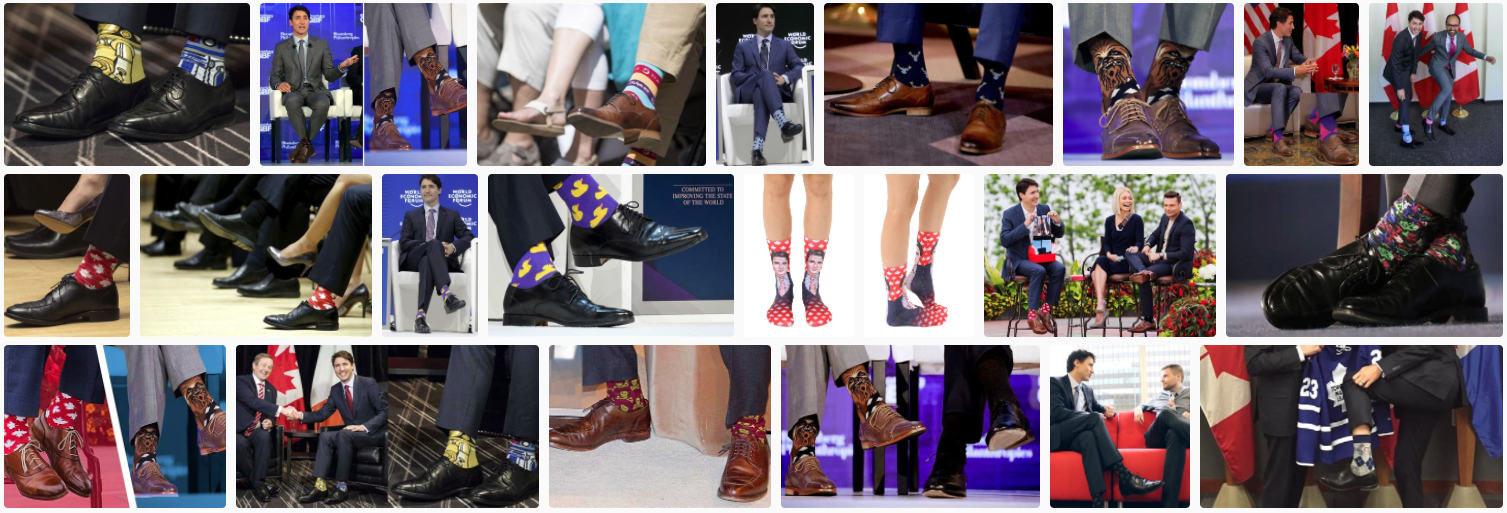
Typical image search results for “Justin Trudeau socks”
It has been fascinating to watch the reaction to Prime Minister Justin Trudeau’s profile in non-courage this week, after he and most of his cabinet skipped a vote on a Tory motion seeking to declare China’s brutal campaign against the Uyghur people a genocide. (Marc Garneau, who was probably desperately wishing he was back in low-Earth orbit, showed up to abstain … because that’s a good use of an astronaut.) If there is anything close to a consensus on the matter, it’s that the PM was in a difficult spot and found a way to slither out of it at the cost of some dignity, but no other real loss.
Kaveh Shahrooz, in a piece here at The Line on Thursday, made that case well. He savaged Trudeau for his hypocrisy — “when the chips were down, the [gender-based analysis], the intersectional lens and the feminist foreign policy were tossed aside in favour of appeasing China,” he wrote — but he also noted that the entire affair won’t really hurt the PM. “Sadly, the worst that will happen to Trudeau because of the hypocrisy and incompetence displayed is some angry tweets and a few articles like this one,” said Shahrooz.
Maybe. But maybe not. Shahrooz and others are certainly right that the prime minister won’t pay an electoral price, and probably won’t see his polling waver. But history makes its own judgments. And I suspect this prime minister is more aware of that than most.
It seems a long time ago now, but in his first term, Trudeau made a habit of apologizing. Only rarely for stuff that he was actually himself responsible for — he’s kinda averse to doing that. But formal and public apologies for past failures? He was all over those. In 2018, the BBC even ran a piece noting the PM’s habit, and asked in the headline, “Does Justin Trudeau apologize too much?”
It’s not that there weren’t things worth apologizing for. In 2016, he apologized for Canada turning back the Komagata Maru, a ship carrying mostly Sikhs that was then forced to return to India, where 20 of them were killed in a riot. The next year, he apologized to survivors of residential schools in Newfoundland and Labrador, and to LGBT Canadians for discrimination they faced at the hands of the federal government. The next year, Jews and members of the Tsilhqot’in Nation received apologies for historical wrongs inflicted on them. And so on. It was a thing.
A man who so clearly adores taking a stage to shed a few tears while acknowledging wrongs committed by someone else, long ago, probably can’t avoid wondering who, in a hundred years, will be apologizing to Uyghurs for his refusal to clearly state that what is happening to them is a genocide.
February 24, 2021
Solzhenitsyn was far from the first to warn about the evils of Soviet rule
Theodore Dalrymple had a discussion recently with a Marxist professor:
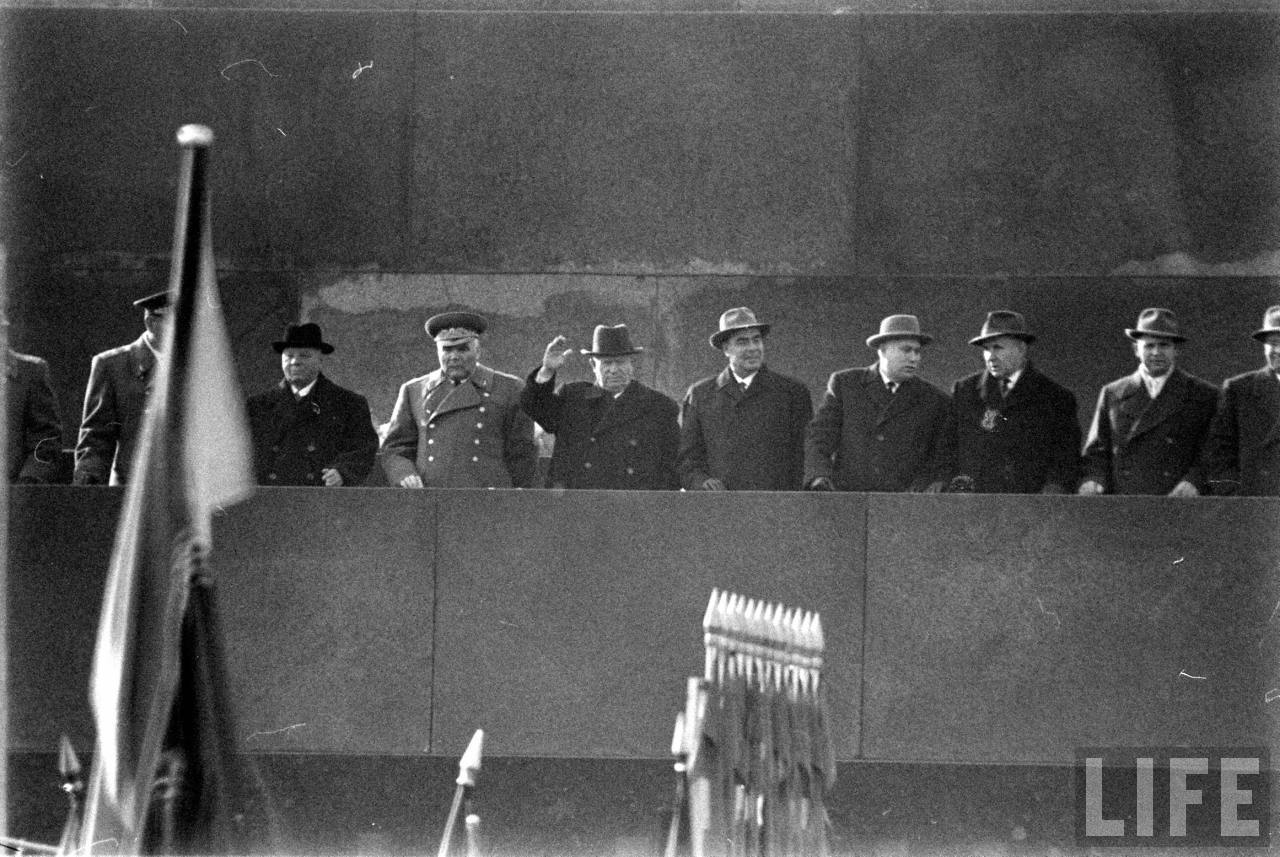
Krushchev, Brezhnev and other Soviet leaders review the Revolution parade in Red Square, 1962.
LIFE magazine photo by Stan Wayman.
The professor was an intelligent man, and probably cultivated too. How was it possible, in the Year of Our Lord 2021, for such a person still to believe that, until the advent of Stalin, the Russian revolution was a good thing, to be emulated or repeated elsewhere?
How could anyone of his intelligence fail to realise that, though as ever there was much wrong with the world, attempts to put everything right at once by the implementation of petty intellectual schemes are fraught with danger, and have a history of mass slaughter behind them?
I think the answer must lie in the psychology of religion: when religious faith is replaced by a philosophy that prides itself on its rationality, it soon turns religious in the worst possible sense. it becomes an atheist theocracy.
Everything was known about the Soviet Union from the first. It is simply not true that Solzhenitsyn revealed anything to the West that, in essence, was not, or could not have been, known before.
I have, in desultory fashion for a number of decades, been collecting books about Russia and the Soviet Union from just before the Revolution until the Second World War, and while it is true that many of them are laudatory, with titles that now seem hilarious to us such as The Soviet Union Fights Neurosis, a very large number books of various genres, from essays to histories to memoirs to novels and short stories, were published that exposed the viciousness of Bolshevism from the very first — a viciousness that anyone with any imagination could have anticipated from Lenin’s literary style alone.
Leninist viciousness was viciousness of a new and more thoroughgoing type that acted on the mind as a virus acts on a computer (viciousness, both actual and potential, is, alas, a constant of human history because of our flawed nature).
Solzhenitsyn was right about the difference between Macbeth, who from personal ambition killed people, but only a few, and the ideologically-motivated mass-killings of the Soviet Union and elsewhere — the difference being precisely in the effect of ideology.
But what was really different about Solzhenitsyn, apart from his literary talent, was that Western intellectuals were now prepared to believe what he said, whereas shortly before they had rejected as mere propaganda evidence of a very similar nature produced by others.It was so startling to meet someone who still believed that a “pure” revolution could take place, and that such a person was teaching history of all things, in a reputable, or at any rate reputed, university, that, like Karl Kraus confronted by Hitler, I could think of nothing to say.
I had no idea whether he still taught undergraduates, or whether in doing so he suppressed at least some of his views (as a judge is supposed to suppress his own private opinions): but I confess that the charge against Socrates, that of corrupting youth, came into my mind.
Disney’s Best Propaganda Cartoon
J.J. McCullough
Published 21 Nov 2020A review of Education for Death, a WW2 propaganda film. This video was sponsored by the Great Courses Plus! Start your free trial today by clicking here: http://ow.ly/az9m30rkCKF
Check out Three Arrows here: https://www.youtube.com/channel/UCCT8…
During the World War II, Disney made a number of cartoons to boost public support for the Allies and denounce Germany. This one, about Little Hans, has always been my favorite.
FOLLOW ME:
🇨🇦Support me on Patreon! https://www.patreon.com/jjmccullough
🤖Join my Discord! https://discord.gg/3X64ww7
🇺🇸Follow me on Instagram! https://www.instagram.com/jjmccullough/
🇨🇦Read my latest Washington Post columns: https://www.washingtonpost.com/people…
🇨🇦Visit my Canada Website http://thecanadaguide.comHASHTAGS: #propaganda #history #germany
QotD: Margaret Thatcher
But here’s the thing: I don’t hate Thatcher. It’s not that I’m a huge fan of her legacy or anything (although anyone who thinks that industrial relations were doing fine before her or that the Falklands were some kind of unjustified expedition is clearly a fantasist), it simply doesn’t matter whether I like her or not because she is just too interesting.
Thatcher wasn’t the first woman to lead a country, but unlike her predecessors, Indira Gandhi in India or Isabel Martínez de Perón in Argentina, she didn’t arrive sanctified by a political dynasty. She was, as Prince Phillip snobbily points out to the Queen in The Crown, a grocer’s daughter. In real life, such condescension came strongly from the Left. The Blow Monkeys, one of the bands involved in the Red Wedge tour to support Labour, released an album called She was only a Grocer’s Daughter in 1987; and even though several pop songs fantasised about her death, that never seemed quite as ugly as supposed defenders of the working class announcing that Thatcher was just too common to rule.
Sarah Ditum, “How Thatcher rejected feminism”, UnHerd, 2020-11-15.
February 23, 2021
The danger period is when “the coherence of the news breaks” … and it appears to be breaking before our eyes
In the latest Libertarian Enterprise, Sarah Hoyt remembers the breakdown of the Soviet Union and the disturbing parallels we can see today:
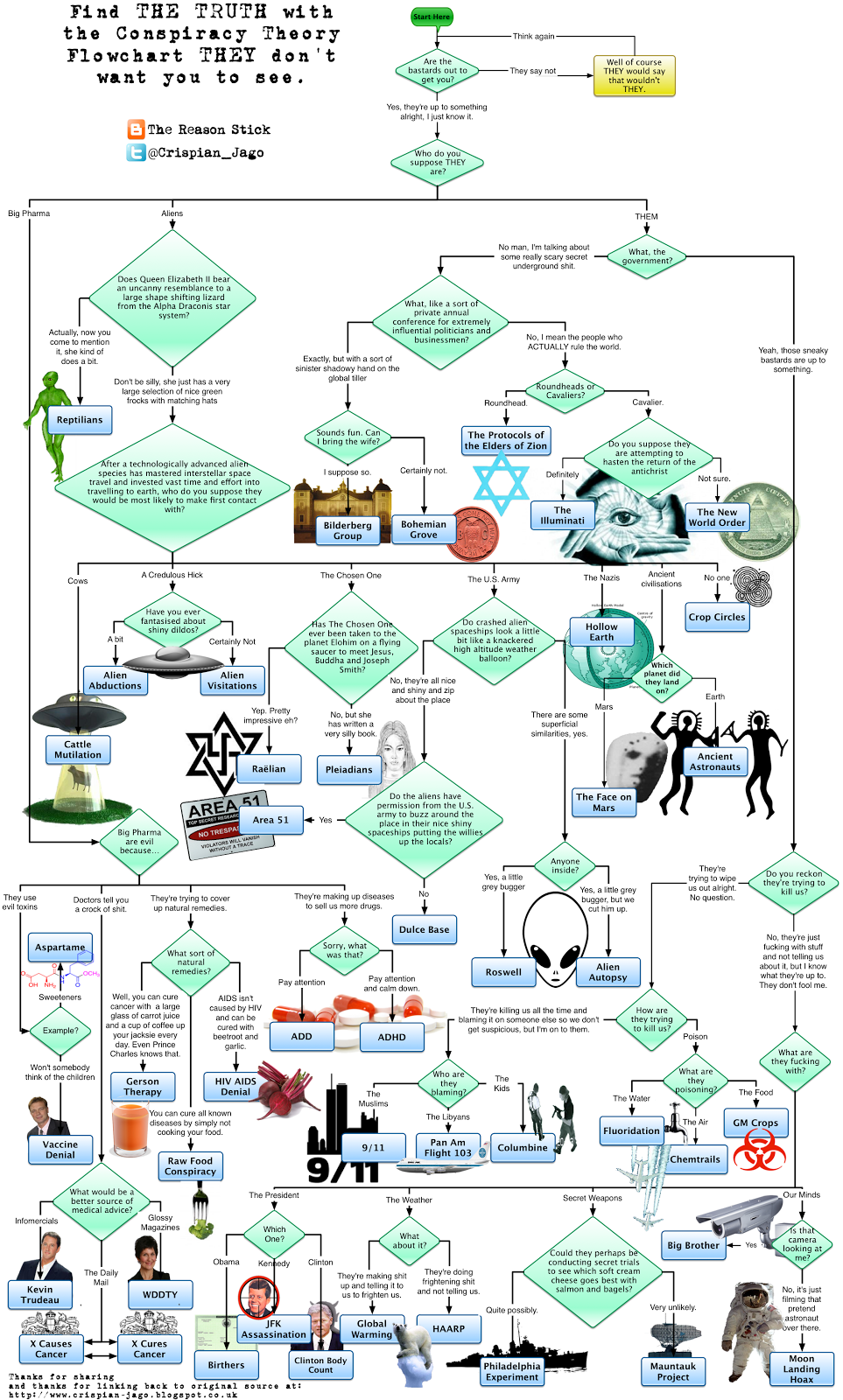
[Click to see full-size flowchart]
Our likelihood of coming out of this a constitutional republic is still high. Why? Well, because societies under stress become more themselves.
I remember when the USSR fell. And out of the ashes Tzar Putin emerged, who is despicable, but not particularly out of keeping with Russian monarchy.
So, yeah, the pull of our culture will be towards the reestablishment of who and what we are and were: a constitutional republic.
But on the way …
Look, I remember when the USSR fell.
The people in the USSR knew they were being treated like mushrooms: kept in the dark and fed on crap. They knew there was truth in Pravda. But they were used to having certain information, and interpreting it.
And there is something worse than reading the news in totalitarianism. You can get used to interpreting the news, and knowing the shape of the hole of what they’re not reporting.
But once you realize it’s all nonsense, once the coherence of the news breaks — and it’s doing so now, earlier than I expected, with the Times article, with the New York Times admitting the protesters at the capitol didn’t kill the police officer — once there are holes, but they’re not consistent, or they’re consistent, but then contradicted; once the narrative changes almost by the week, to the point it can’t be ignored, that’s the dangerous period.
I know I joke that by the end of this year I’ll have to apologize to the lizard-people conspiracy theorists. But the problem is that the lizard people conspiracy theorists can acquire respectability and a strange new respect. Or something even crazier. Heck, a lot of crazier things.
To an extent the 9/11 troofer conspiracies, which yes, are crazy and also anti-scientific were our warning shot. That they flourished and that to this day a lot of people believe them means that there was already a sense that the news made no sense, that there were other things going on behind the scenes that we weren’t aware of.
It’s going to get far, far worse than that, as the actual elites, the top of various fields fall like struck trees in a thunder storm. There is a good chance that authorities you rely on for your profession, or just for your knowledge have been compromised. A lot of our research is tainted by China paying to get the results it wants, for instance. And there’s probably worse. You already know most research can’t be reproduced, and that’s not even recent.
As all this stuff comes out, the problem is that people won’t stop believing. Instead they’ll believe in all and everything.
I don’t know how much was reported here, as the USSR collapsed. but I remember what I read in European magazines and journals. All of a sudden it was all new age mysticism and spoon bending and only the good Lord knew what else.
And that’s what we’re going to head into. So, when you find yourself in the middle of an elaborate explanation that someone constructed, well …
First find the facts. Pace Heinlein: Again, and again what are the facts. Never mind if your ideology demands they be something else. Establish the facts to the extent you can. Facts and math don’t lie. (Statistics do. So be aware you can lie with them. And any metrics that involve intangibles, like intelligence or performance much less sociability or micro anything? forget about it.)
From the facts, deploy Occam’s razor. What is the simplest explanation?
Then remember that humans run at the mouth, and the more humans in the conspiracy, the more facts are likely to leak out somewhere.
And while we’ve seen a lot of Omerta among leftists, note that they’re all afflicted by evil villain syndrome. Sooner or later, they brag about how clever they were in deceiving us. So, if your conspiracy theory requires perfect silence forever, it’s probably not true.
February 22, 2021
Australia experiments with social distancing from social media
Arthur Chrenkoff is mildly surprised to find that the Leviathan of social media — Facebook — considers his personal account to be a publisher for Australian ban purposes:
As of this morning, Australian media outlets – as well as government agencies – are not able to post anything on Facebook, and their articles and stories cannot be shared by anyone in the world using Mark Zuckerberg’s now somewhat anti-social network. This is Facebook’s retaliation for a law being introduced by the Australian government that would have companies like Facebook and Google pay Australian media outlets for having their content on their sites. Google has in fact just reached a global agreement with News Corp regarding content use, but Facebook is opting for a much more of a FU negotiating approach.
As much as I dislike Big Tech, I have so far been unable to see a good rationale for the new law. While the media keeps complaining that Facebook and Google (in particular) are monopolising the online advertising revenue, links to media stories are to my mind advertisements that drive online users to the source – and to the source’s advertisers. Perhaps it’s the media who should be paying the socials for this publicity. In the end, the war between the Big Tech and the Mainstream Media is one, to borrow from Henry Kissinger, it’s a pity that both sides can’t lose.
Apart from the fact that various health authorities around Australia are now unable to share COVID information on Facebook, the other ironic casualty of the Aust-Zuck spat is yours truly, whom Facebook has kindly deemed to be an Australian publisher, even though The Daily Chrenk media empire consists of a single ageing desktop in an inner Brisbane suburb utilised (all too rarely and irregularly) by yours truly for the love of it with no commercial element whatsoever. And so, the main avenue of promoting my new posts by sharing their links with the 1000-plus good people around the world who follow TDC page on Facebook has been (I hope only temporarily) lost to me. While it’s flattering to stand shoulder-to-shoulder with The Australian, I’m now somewhat confused: should Facebook be paying me when I voluntarily use their site to try to get eyeballs for my work? Thank you, Australian government, for thinking that should be the model.
I think the whole notion of taxing social media sites like Facebook is cracked … which might explain why the Canadian government has legislation in the works to do something similar … and earlier European attempts to extract money from the “tech giants” have always backfired. That said, I think Facebook’s retaliation is ill-advised, being both disproportional and very likely to induce other governments to look into ways to exercise more control over Facebook and other social media platforms. There are likely no winners in this dispute or the future confrontations that this will likely inform.
February 20, 2021
Confessed genocidal nation refuses to accuse China of genocide
Jen Gerson considers the moral smallness of Canadian government wiggling out of labelling China’s treatment of their Uyghur minority as the genocide it certainly is:
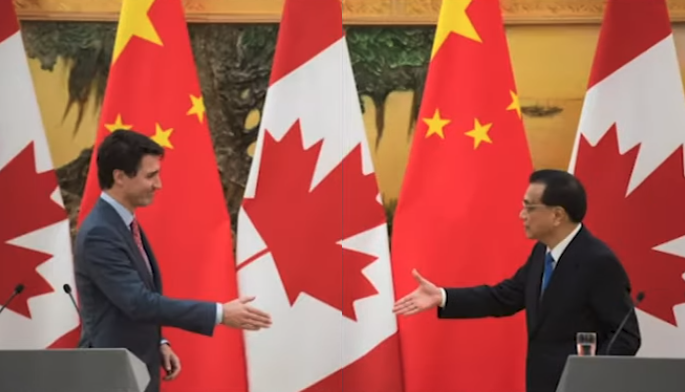
This week, the Prime Minister of an admittedly genocidal G7 state refused to condemn China for its treatment of its minority Uyghur population. A treatment that has included family separation, forced sterilization, and warehousing thousands of people in what can only be described as modern concentration camps.
Justin Trudeau failed to condemn China, noting, quite rightly, that genocide is an “extremely loaded” term. One not to be bandied about lightly. It demonstrates some moral cowardice on his part, certainly, but also a degree of pragmatism. Canada’s squeaky and lonely objection would do little good. We’re already in a vulnerable position, what with the ongoing captivity of two Canadians who remain in Chinese detention as an act of retaliation for our arrest of Huawei executive Meng Wanzhou. A declaration of genocide in this case is probably better handled by a collection of nations. As long as we can live with the shame of the smallness that such an argument implies.
(Although perhaps it was unwise to pin so many of our early hopes of an early vaccine rollout on a doomed collaboration with a Chinese manufacturer with a vaccine backed by China’s Institute of Biotechnology and its Academy of Military Medical Sciences. Who could have predicted we would run into problems with such a notoriously reliable and honourable global partner that occasionally engages in hostage diplomacy? But I digress.)
The real issue with Trudeau’s grovelling little deflection on the question of Chinese genocide is that it made his own position on the subject not two years ago impossible to ignore in comparison. The final report of the Missing and Murdered Indigenous Women and Girls inquiry stated that the truths it uncovered in the process of its years-long investigations:
… tell the story — or, more accurately, thousands of stories — of acts of genocide against First Nations, Inuit and Métis women, girls, and 2SLGBTQQIA people. This violence amounts to a race-based genocide of Indigenous Peoples … This genocide has been empowered by colonial structures, evidenced notably by the Indian Act, the Sixties Scoop, residential schools, and breaches of human and Inuit, Métis and First Nations rights, leading directly to the current increased rates of violence, death, and suicide in Indigenous populations.
Several pundits at the time noted at the time that this stretched the definition of “genocide” beyond ordinary recognition. “Genocide” is not the result of a set of compounding government failures over time: it’s a word that we reserve to describe a discreet set of acts motivated by the deliberate intent to decimate or totally exterminate an ethnic population. But after a day or so of hemming and hawing on the issue after the report was released, our prime minister noted: “The issue that we have is that people are getting wrapped up in debates over a very important and powerful term … We accept the finding that this was genocide, and we will move forward to end this ongoing national tragedy.”
There was some careful phrasing in this response. Note, Trudeau agreed that this was genocide, not that it is genocide. The prime minister dodged the implication that Canada is engaged in deliberate ethnic cleansing. But it’s worth peeling back the skin of the onion, past the obvious and easy allegation of hypocrisy, and instead ask ourselves why?
Why can we get away with calling ourselves a genocidal state, but not China?
February 17, 2021
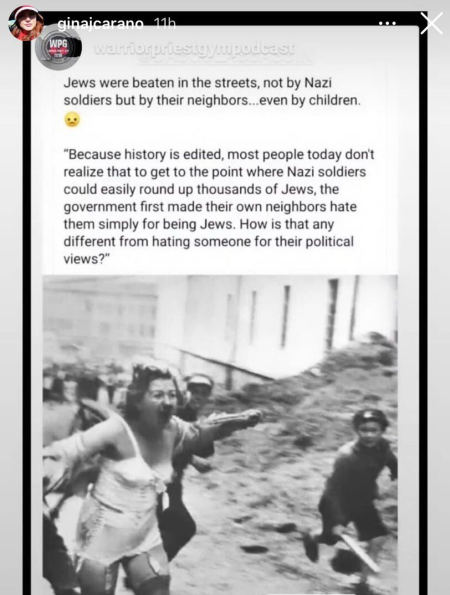
Sarah Hoyt on why Progressives think Gina Carano’s tweet was antisemitic
I’m a few days behind, so I didn’t see this post by Sarah Hoyt until Tuesday morning:
My first reaction was “Oh. Actress said something, and … they cancelled her.” Which is not only “day ending in y” right now, but also has been for a long time. Part of the reason I came out of the political closet is because I’d gotten tired of watching every word I said, and every expression I made in public. Because even a slight slip would have caused my career to be completely dead. […] So, I was going “Yeah, only innocents who don’t realize what life is like in a completely taken-over industry would think this is surprising. All power to the lady, but I’m sure she knew what would hit her for stepping out of line.”
And then I came across a screen capture of what she said. And someone asking “how is this anti-semitic.”
Which is when I panicked.
[…]
The only way, remotely, no matter how much you stretch it, that what she said can be considered “anti-semitic” is this:
The left believes the Jews were innocent. (This is correct, btw.) That what happened to them was shameful and terrible, and a dishonor on those who attacked them.
BUT they also believe it’s an insult to compare them to the people the left hates FOR THEIR POLITICAL VIEWS.
Because they think the people they hate for their political views — us — are really that bad, and really deserve everything the left intends to do to them. Which is more or less—in rough outlines — what the Nazis did to the Jews.
I mean, they have already talked of reeducating us, taking our children away, and they do in fact do think of us as not fully human.
Mind you, they have absolutely no idea who we are and what we believe, but they know we don’t agree with them, and since their hearts are pure, and utopia is their objective, we must be the very devil, and terrible on principle.
They’ve been exquisitely propagandized to the point they think the only American president with Jewish grandchildren was “anti-semitic.” They think that black people who don’t want to careen into ruinous and deadly socialism are “white supremacists” (the poor things swallowed Gramsci without chewing); they think other races aren’t hetero-normative; they think America is the most racissss, sexissss, homophobic nation on Earth … and they will not listen to corrections of their appalling and atrocious ignorance of true history or foreign anthropology or … really anything. Because anything opposing the indoctrination has been trained into them is an attack on their psyche.
So, they’re ignorant. They live in a political/social universe where if you oppose the completely insane leftist version of the world, you must be evil and “a nazi” which is to say the devil. They are so completely saturated in utter inanity that they call Israel “fascist.”
BUT one thing they know, and they know it at gut level: everyone to the right of Lenin — or perhaps Mao — are untermensch who will have to be utterly destroyed, so that the final promised utopia that they were promised since elementary school will come to be.
So, in their eyes comparing innocent Jews to their political opponents is experienced as an insult to the Jews.
Because in leftist eyes, we are evil, cockroaches and sub-humans whom they have to eradicate from society.
And they will not look in the mirror, or admit that what they’re engaging in is exactly what the nazis did, only with political beliefs instead of race. And it’s complicated. These idiots have simply decided that the real master race are black people. And that all evil comes from white males. But to be fair, it shades to people like me who have “internalized oppression” and are therefore “male.”
QotD: Protectionists, left and right
“Progressives” who embrace protectionism share conservatives’ low opinion of their country’s businesses, entrepreneurs, and workers, but also mistakenly believe that protectionism “sticks it to” corporate oligarchs when, in fact, it creates corporate oligarchs.
Don Boudreaux, “Quotation of the Day…”, Café Hayek, 2018-09-10.


