Quotulatiousness

April 14, 2021

Schrödinger’s photo ID requirements

Mark Steyn notes the odd inconsistency of US authorities insisting on or ignoring the need for photo ID for different demographics. So much for equal treatment in the United States.

“TSA Checkpoint” by phidauex is licensed under CC BY-NC-SA 2.0

Whenever you fly anywhere in America, you require picture ID — so that, when you get to the head of the great endless security line, the TSA agent can get out his jeweler’s loupe and examine how the ink lies on the paper. And, when he’s finished doing that, he can fish out his UV light to study the watermark on your ID.

Which is all bollocks even by the standards of American security-state bureaucracy. Why bother going to all the tedious trouble of fake ID when real ID is so easy to acquire? On September 11th 2001, four of the terrorists boarded the flight with genuine, valid picture ID issued by the state of Virginia and obtained through the illegal-immigrant day-workers’ network run out of the parking lot of the 7-Eleven in Falls Church.

If that didn’t get Americans mad about the cosseting of the undocumented, I doubt they’ll care a fig about this latest privilege. But I thought it worth mentioning anyway: While you’re stuck with the Loupe & Light guy poring over your ID, the federal government announced last week that migrants crossing the southern border will be permitted to fly within the United States without any valid ID. You’re on orange alert now and forever, they’re in the express check-in.

This is where selective enforcement of the laws always leads — to a broader contempt for all law, and an end to equality before the law. In 2021 no developed nation needs mass unskilled immigration. Some have it for historical reasons — a hangover of empire, as in Britain and France; some have it for sentimentalist pseudo-humanitarian reasons, as in Sweden and Norway. But neither of these rationales account for what the laughably misnamed Department of Homeland Security is doing at America’s southern border.

QotD: Emmanuel Goldstein, the Enemy of the People

Filed under: Books, Politics, Quotations — Tags: , , , — Nicholas @ 01:00

The programmes of the Two Minutes Hate varied from day to day, but there was none in which Goldstein was not the principal figure … Somewhere or other he was still alive and hatching his conspiracies: perhaps somewhere beyond the sea, under the protection of his foreign paymasters, perhaps even — so it was occasionally rumoured — in some hiding-place in Oceania itself …

Goldstein was delivering his usual venomous attack upon the doctrines of the Party — an attack so exaggerated and perverse that a child should have been able to see through it, and yet just plausible enough to fill one with an alarmed feeling that other people, less level-headed than oneself, might be taken in by it …

The sight or even the thought of Goldstein produced fear and anger automatically … But what was strange was that although Goldstein was hated and despised by everybody, although every day and a thousand times a day, on platforms, on the telescreen, in newspapers, in books, his theories were refuted, smashed, ridiculed, held up to the general gaze for the pitiful rubbish that they were — in spite of all this, his influence never seemed to grow less. Always there were fresh dupes waiting to be seduced by him. A day never passed when spies and saboteurs acting under his directions were not unmasked by the Thought Police.

George Orwell, Nineteen Eighty-Four, 1949.

April 11, 2021

QotD: Canada’s “Natural Governing Party”

Filed under: Cancon, Politics, Quotations — Tags: — Nicholas @ 01:00

Need I bring to your attention the utter gall of a leading member of “Canada’s natural governing party” accusing the Bush Republicans of running a one party state. Didn’t the Yanks just have a bruising knock ’em down, electoral race that had all the thrills and spills of Northern Dancer winning the Queen’s Plate.

Checks and balances? Canada? Third parties can’t even participate fully in electoral campaigns here. Checks and balances are very few in this centralized, caucus whipped, PMO-run federal government. Let us pass on quickly lest the good doctor/statesman becomes completely embarrassed by his own rhetoric.

John the Mad, “Lloyd’s Unworthy Letter”, John the Mad, 2005-03-05.

April 8, 2021

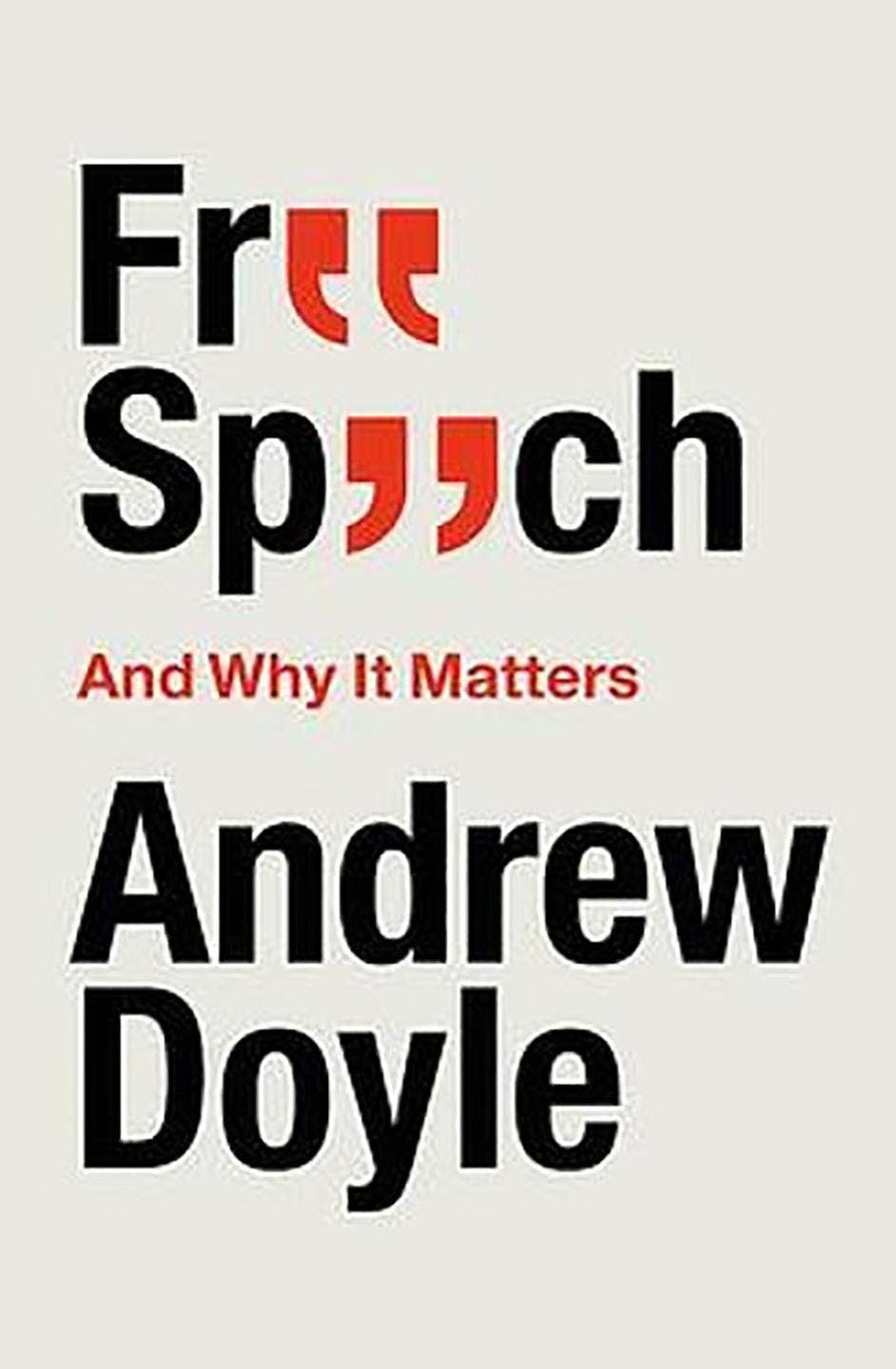
Andrew Doyle defends freedom of speech in his new book

In The Critic, Simon Evans reviews Free Speech And Why It Matters by Andrew Doyle (who is perhaps best known on this side of the pond for his ultrawoke Twitter persona “Titania McGrath”):

    When I am weaker than you, I ask you for Freedom, because that is according to your principles; when I am Stronger than you, I take away your freedom because that is according to my principles.
    Frank Herbert, Children of Dune

It is most peculiar. If the counter-culture had a dominant theme, it was the right to criticise the establishment and to question orthodoxy of all kinds. Back in the Sixties, it was central to its mission to Expand your Consciousness, man. And it worked. Walls came tumbling down. Yet now, everywhere you look, it seems the elements of society — students, academics, comedians — that one would most naturally associate with that freedom of expression, are introducing caveats and qualifiers to that principle faster than you can cry “Stop Little Pol-Pot, Stop!” They are turning, before our very eyes, into actual scolds.

It must be supposed that what was once the siege army, camped outside the moat like Occupy Wall Street, has captured the castle, for they are demanding that the walls be re-erected. That “hate” speech be distinguished from free speech and dealt with accordingly. That freedom of speech need not mean freedom from consequences. And a general suspicion is at large, among the young, that free speech is some sort of artefact of complacent boomer self-indulgence, like Steely Dan and second homes. No longer counter-culture, but decidedly counter-revolutionary.

I’m a comedian, and these have been strange times for our trade. Brexit saw comedians side with the mirthless neo-liberal consensus, against the humorous, sceptical grumble of the common rabble. The same thing happened in America, with bar-room stand-ups horrified by the vulgarity of Trump. And now the latest revision sees many of my fellow jesters and fools unsure whether people can really be trusted with free speech.One might have thought this issue had been settled long ago, in this country, and in liberty’s favour. But no, it seems we need to sharpen our tools once again, and Andrew Doyle’s new book is an excellent place to start.

Making the case for the defence, Doyle’s book is terse, restrained and as carefully argued as a QC’s summing-up in a top-drawer courtroom drama. Whether his command of the material comes from his doctorate in Renaissance literature or his experience of defending the comedy character Titania McGrath from infuriated wokerati, who knows? It is a beautifully balanced and comprehensive overview that will of course be read by no one who needs to hear it.

It is admirably historically literate. Doyle takes a quote from Milton’s Areopagitica as his epigram, with the old poet, declaiming over the din of the Civil War, as defiant as Satan himself, “Give me liberty to know, to utter, and to argue freely according to conscience, above all liberties.”

This sets the tone for the whole book, but Doyle also presents arguments intended to appeal to those who insist that we live in a society. With the compromises that entails. This was most famously recognised by notorious cis-hetero white man and free speech absolutist John Stuart Mill, who was surveying the world from the heights of Victorian Exceptionalism when he published the still unsurpassed On Liberty.

April 7, 2021

QotD: The G-[pick-a-number] meetings

There are far too many of these “summits,” far too undistinguishedly attended, expensive to organize, and conducted in public in ways that attract swarms of hooligans who vandalize shops, beat up bystanders, and provoke the police. Canada spent $400 million on three days of photo-ops at La Malbaie, to achieve practically nothing. For the first nearly 30 years of summiting, there were only nine such meetings; Roosevelt, Churchill and Stalin at Tehran and Yalta (1943 and 1945), Stalin, Truman and Attlee at Potsdam (1945), Eisenhower and the divided Russians and Anthony Eden and Edgar Faure at Geneva (1955), Eisenhower, Khrushchev, Macmillan and de Gaulle at Paris (1960), Kennedy and Khrushchev at Vienna (1961), Lyndon Johnson and Alexei Kosygin at Glassboro (1967), and Richard Nixon and Leonid Brezhnev at Moscow and San Clemente, Calif. (1972, 1973).

The first three were essential to plan for victory and peace, though many of their key provisions, especially for the liberation of Eastern Europe, were ignored by Stalin. The first Nixon-Brezhnev meeting was substantive and a couple of the later Reagan-Gorbachev meetings were very productive. These were intense business meetings between people who really were at the summit of world power and influence. The only matter agreed to in meetings between Soviet and American leaders between 1945 and 1972 was in the “kitchen debate” between then vice-president Nixon and Khrushchev in Moscow in 1959, when (forgive my coarseness in the interests of historical accuracy), Khrushchev accused Nixon of uttering “Horse shit, no, it is cow shit, and nothing is fouler than that” to which Nixon replied, “You don’t recognize the truth, and incidentally, pig shit is fouler than cow shit.” Khrushchev conceded the second point.

Conrad Black, “Take heed Canada: the U.S. would win a true trade war”, Conrad Black, 2018-06-16.

April 5, 2021

The Ahuman obsession

Filed under: Books, Politics — Tags: , , , — Nicholas @ 03:00

Theodore Dalrymple considers the work of an English professor who advocates for the extinction of the human race:

Professor MacCormack’s main idea seems to be that the only way to save the planet from destruction is for humanity not to reproduce itself and thereby to die out within a generation or two. She wants to make the world safe for the worms and the wasps, though her scheme would be hard luck on those species that parasitize only Man. They would have to die out too. But, as the Reverend Charles Caleb Colton put it in 1821, “Let no man presume to think that he can devise any plan of extensive good, unalloyed with evil.” If Man dies out, so too will Wuchereria bancrofti, one of the filarial parasites that cause elephantiasis, along with other such species, but I suppose that this is but a small price to pay for the immense benefit overall wrought by the extinction of Mankind.

Naturally, I sent for her latest book, The Ahuman Manifesto: Activism for the End of the Anthropocene. Thanks to the epidemic all the libraries were shut, though in other respects the virus’ efforts to end the Anthropocene were, from the professor’s rather special point of view, feeble or pathetic, with only 2,000,000 deaths so far and 6,998,000,000 to go. If I wanted to read the book, I would have to buy it.

I am an obsessional reader; that is to say, when I start a book I feel obliged to read it through from cover to cover. Moreover, I would rather read anything than nothing at all. Once in Los Angeles I was stuck in a hotel bedroom with nothing to read but the yellow pages (there were still telephone directories in those days), from which I learned a humiliating lesson. Books have long been at the center of my life, but I discovered how unimportant they are in the lives of most people. There was about half a page devoted in the yellow pages to bookshops, but scores to private detectives. No wonder Philip Marlowe chose Los Angeles as his place of work.

But Professor MacCormack’s book defeated me, not only sapping my will to read further but inducing a state almost of catatonia. It certainly cured me, at least temporarily, of my obsessional desire to finish any book that I have started. Her style made The Critique of Pure Reason seem as light and witty as The Importance of Being Earnest. She appears to think that the English plural of manifesto is manifesti rather than manifestos; I admit that it conjured up in my mind a new Italian dish, gnocchi manifesti.

Open the book at any page and you will find passages that startle by their polysyllabic meaninglessness combined with the utmost crudity. By chance, I opened the book to page 144 and my eye fell on the following:

    The multiplicity of becoming-cunt as an assemblage reassembles the tensors upon which it expresses force and by which force is expressed upon its various planes and dimensions.

I have known deteriorated schizophrenic patients to speak more sensibly and coherently than this.

The 1919 Red Scare – the craziest year in American history

The Cynical Historian
Published 19 May 2016

Many people have heard of the first Red Scare, but we should look at the year of 1919 more thoroughly. It’s probably the craziest one in American history.

Ann Hagedorn, Savage Peace: Hope and Fear in America, 1919 (New York: Simon & Schuster Paperbacks, 2007). https://amzn.to/2NHIcaT
————————————————————
contribute to my Patreon:
https://www.patreon.com/CynicalHistorian

LET’S CONNECT:
https://twitter.com/Cynical_History
————————————————————
wiki:
The First Red Scare was a period during the early 20th-century history of the United States marked by a widespread fear of Bolshevism and anarchism, due to real and imagined events; real events included those such as the Russian Revolution. At its height in 1919–1920, concerns over the effects of radical political agitation in American society and the alleged spread of communism and anarchism in the American labor movement fueled a general sense of paranoia.

The Scare had its origins in the hyper-nationalism of World War I as well as the Russian Revolution. At the war’s end, following the October Revolution, American authorities saw the threat of Communist revolution in the actions of organized labor, including such disparate cases as the Seattle General Strike and the Boston Police Strike and then in the bombing campaign directed by anarchist groups at political and business leaders. Fueled by labor unrest and the anarchist bombings, and then spurred on by United States Attorney General A. Mitchell Palmer’s attempt to suppress radical organizations, it was characterized by exaggerated rhetoric, illegal search and seizures, unwarranted arrests and detentions, and the deportation of several hundred suspected radicals and anarchists. In addition, the growing anti-immigration nativism movement among Americans viewed increasing immigration from Southern Europe and Eastern Europe as a threat to American political and social stability.

Bolshevism and the threat of a Communist-inspired revolution in the U.S. became the overriding explanation for challenges to the social order, even such largely unrelated events as incidents of interracial violence. Fear of radicalism was used to explain the suppression of freedom of expression in form of display of certain flags and banners. The First Red Scare effectively ended in mid-1920, after Attorney General Palmer forecast a massive radical uprising on May Day and the day passed without incident.
————————————————————
Hashtags: #History #1919 #RedScare #SpanishFlu #Bolshevism #BlackSox #strikes #WoodrowWilson #LeagueOfNations #prohibition #suffrage

[Note: this was filmed in 2016 … I think 2020 has now taken the mantle of “craziest year”. Unless 2021 doubles down all the weirdness of 2020.]

March 29, 2021

QotD: Modern conservatism is merely progressive policies on a ten-year delay

Filed under: Politics, Quotations, USA — Tags: , — Nicholas @ 01:00

In 2000, when the Vermont Supreme Court mandated same-sex “civil unions”, American conservatives were outraged. By 2010, when the left had moved on to gay marriage, conservatives were supportive of civil unions but insisted marriage was an ancient institution between a man and a woman. Now, the left having won that one and moved on to transgenderism, conservatives profess to be a bit queasy about transitioning grade-schoolers.

So you can take it to the bank that by 2030 rock-ribbed Republicans will be on board with penises in the girls’ changing rooms, but determined to hold the line against whatever the left’s next cause du jour is: human cloning, mandatory transitioning for delinquent boys, voting rights for animals.

There really isn’t much point to conservatism that’s just leftism ten years late, is there? It’s like that ITV+1 satellite service they have in Britain that offers you the ITV schedule but an hour later, in case you were caught in traffic heading home. If you’re considering on which side to bestow your tribal loyalty, the left is right quicker; the right is left behind — but only for a few years until they throw in the towel. If you’re all headed to the same destination, why not ride first class on the TGV instead of the creaking, jerking stopping service? Justin Trudeau’s vapid modishness was perfectly distilled by his campaign catchphrase of four years ago: “Because it’s 2015.” But that beats waiting till 2025 to say “Because it’s 2015”.

Mark Steyn, “Catch-Up Conservatism”, SteynOnline, 2020-12-17.

March 28, 2021

“Canadians are largely full of shit on climate change”

Filed under: Cancon, Environment, Politics — Tags: , , , — Nicholas @ 03:00

The Line wraps up the week with, among other things, an explanation of why they didn’t cover anything to do with the “Conservative” Party’s virtual convention:

We said in last week’s dispatch that we were monitoring the Conservative Party of Canada’s virtual convention, and that we’d bring you any commentary that it warranted. We brought you no such commentary this week. Draw your own conclusions.

We will say, this, though. We think the kerfuffle about the party delegates’ vote to not affirm their belief in climate change is overblown, for two big reasons. The first is that Canadians are largely full of shit on climate change. Yes, it’s true that polls indicate we are concerned about the issue — Very Concerned, even. But polls also show how much we’re actually willing to do about it, and the answer is, not a fuck of a lot.

The second point we’d make is that every Conservative convention comes with warnings of deep splits within the party, with long features by Toronto- or Ottawa-based writers explaining how out of touch Tories are with “mainstream Canadians” like them, how unelectable they are outside their western base, and so on and so on. We agree that the Tories have problems, and it’s clear that not everybody is happy inside that big blue tent (or any big tent). But the Conservatives won the popular vote last time, and though Brownface Trudeau did a lot of the heavy lifting don’t forget: Andrew Scheer was the CPC leader. Can we suggest that one comes out a wash?

Don’t read too much into the doom and gloom that surrounds every CPC convention. There are always stories just like the climate change one, and if you don’t believe us, just recall that long-ago era of, ahem, one week ago, when all the coverage was warning that pro-life insurgents in the party were going to hijack the agenda and cause a meltdown by chanting about abortion all weekend.

Didn’t happen. Went nowhere. We suspect the coverage of the climate change issue, though unhelpful and awkward, will vanish just as quickly now that the chattering classes, ourselves included, have filed the obligatory quota of “convention stories” and moved on to something more interesting (which is almost anything).

March 26, 2021

When the science becomes problematic to the narrative

Filed under: Health, Media, Politics, Science, USA — Tags: , , , , — Nicholas @ 03:00

Alexander Riley looks at a few of those awkward points where actual “scientific” science conficts with the deeply held beliefs of the “I heart SCIENCE!” community:

… human and nature cannot so easily be pried apart. The evidence of the biological reality of the sex difference — not just in gonads and sex cells, but in personality characteristics and behavioral profiles, on average — is overwhelming, and science is daily producing more. Male and female brains are structurally different in ways that map on to the emerging neuroscientific knowledge on how brain structure affects behavior and capabilities. The feminist claim that these differences are wholly a product of socialization becomes more implausible the more we know. In societies where egalitarian gender ideology is arguably most widespread, such as in Northern Europe, there has been no disappearance of traditional sex differences in choices concerning careers. Men are still overrepresented in fields that focus on systems and objects, and women are still the overwhelming majority in fields dedicated to extensive human interaction and social services.

The radical spirit of ’90s feminism represented by [author Judith Butler’s] Gender Trouble did not stop at “deconstructing” gender in the effort to move toward a world in which gender roles are divorced from biological sex. Sex too had to be subjected to such “problematization.” Radicals used the writing of Anne Fausto-Sterling, a biologist who admitted her work was fundamentally shaped by her “1960s street-activist heart,” to suggest that the sex binary was also an oversimplified social construction. Fausto-Sterling insisted there are at least five sexes: males, females, “true hermaphrodites” with one testis and one ovary, male pseudohermaphrodites with testes and “some aspects of female genitalia” but no ovaries, and female pseudohermaphrodites with ovaries and “some aspects of male genitalia” but no testes. Perhaps, she asserted, several of every hundred people might be in one of the three intersex categories, with — the clincher — an “infinitely malleable continuum” between them.

It was quickly pointed out that Fausto-Sterling had been deceptive in her estimate of the frequency of intersexuality. Leonard Sax, in the Journal of Sex Research, noted that she had counted phenomena such as Klinefelter’s Syndrome (biological males with an extra X chromosome), Turner’s Syndrome (biological females with only one X chromosome), and several other conditions typically not recognized as intersex. One of these alone — late-onset congenital adrenal hyperplasia (LOCAH), which involves the overproduction of adrenal androgens — accounts for 90 percent of Fausto-Sterling’s claimed figure of 1.7 percent of the population that is intersex. But LOCAH is not an intersex phenomenon. Many individuals who have it are never diagnosed because the symptoms are so mild, and all who have it are born with typical male or female genitalia that correspond to the male and female genotypes. Nearly all such individuals go through puberty with the typical sexual development for their genotype, as the condition generally does not manifest in women until the early 20s and in men much later. The true estimate of intersex individuals, Sax argued, is roughly 0.018%, about 100 times lower than Fausto-Sterling’s estimate. That is, more than 99.98% of humans are clearly either male or female in terms of biological sex.

But the attack on “standard sex difference science” was undeterred by this decimation of Fausto-Sterling’s case. In Gender Trouble, Butler criticized the work of an MIT group that had just discovered the region on the Y chromosome responsible for sex differentiation, claiming these scientists ultimately had to invoke cultural symbols of patriarchy to legitimate their explanations. In her view, this betrayed the very notion of an objective science of sex difference. We are always trapped in culture, she wrote, which means we are always trapped in patriarchy. A science of sex is impossible. Radical sex/gender ideology attacked science as male knowledge and elevated female knowledge as superior on the basis that women as a class were treated as inferior. Like blacks and other powerless groups, women — at least, women with a feminist outlook — could critically understand the point of view of men and supplement its lacunae with the fuller vision of the female perspective. Marx made similar claims about the superiority of working-class consciousness, though he did not attempt to cast the very notion of science as a tool of oppression.

The MIT group’s finding that what we now know as the SRY gene determines sex is universally accepted science today, and Butler’s ideological criticism has aged poorly in scientifically literate circles. So has her wild overestimation that perhaps one in ten people is outside the normal sex binary.

March 24, 2021

“By now it has dawned on even the most glossy-eyed internationalists that we are well into another sides-picking era of global geopolitics”

Like it or not, we’re already a few years into a new Cold War, this time with the Chinese Communist Party. The Canadian government seems to be among the last in the world to recognize this change in the geopolitical situation. In The Line, Andrew Potter shows why Justin Trudeau must stop trying to cuddle up to Xi:

The outrageous secret trials in China of Michael Spavor last Friday and Michael Kovrig this Monday are nothing more than punctuation marks on a storyline that has been obvious for some time now.

Which is why it was enormously gratifying to see more than two dozen diplomats show up to seek admittance to Kovrig’s trial. The fact that none was admitted is unfortunate but largely beside the point — what matters is the public display of solidarity. Even more gratifying perhaps is the announcement (by Canadian officials) that the U.S. has promised to treat the two Canadians as if they were American citizens. After all, it was our acquiescence to a U.S. request to arrest Huawei executive Meng Wanzhou at Vancouver International Airport in 2018 that prompted Beijing to nab Spavor and Kovrig in retaliation. While Chinese officials have denied that what this amounts to is hostage diplomacy, they’ve also made it clear that the fate of the Michaels is tied to that of Meng.

What makes the public support from all of these countries so remarkable is that a lot of them — the Czechs, the Finns, the Romanians — have very little to gain from sticking their neck out for Canada. More to the point, every one of these countries has good reason to wonder just how committed Canada itself is to this show of collective strength. After all, it was only five years ago that senior members of the Liberal party were freely — privately, but freely — saying that as far as the Liberal government was concerned, the U.S. was yesterday’s news and China was the horse Canada was going to ride into the future.

And while a lot has changed over the last five years (not least of which is the fact that Donald Trump has come and gone as president of the United States), it remains incomprehensible that it was just last year the Canadian National Research Council placed its disastrous COVID-19 vaccine bet with CanSino Biologics, a Chinese company with close ties to the Chinese military. What are our allies to make of the fact that only last month, the federal granting agency NSERC partnered with Huawei to sponsor computer engineering at Canadian universities. Or that Canada’s visa office in Beijing is owned and staffed by a Chinese police force?

Whether it is a matter of naïveté, bad faith, or outright cravenness, Canada continues to give every indication that it is a country that is still hedging its bets.

QotD: Politicians

Filed under: Politics, Quotations — Tags: , — Nicholas @ 01:00

The fact that so many successful politicians are such shameless liars is not only a reflection on them, it is also a reflection on us. When the people want the impossible, only liars can satisfy.

Thomas Sowell, “Big Lies in Politics” (syndicated column), 2012-05-22. (via Terry Teachout)

March 19, 2021

Cancel culture victims on the left

Filed under: Media, Politics, USA — Tags: , , , — Nicholas @ 03:00

In Quillette, Jonathan Kay looks at the attempt to cancel Jesse Singal who has repeatedly failed to follow the “party line” on Trans issues for several years:

One of the odd-seeming aspects of progressive cancel culture is that many of the figures targeted by mobs aren’t especially conservative in their views. Rather, the victims tend to be heterodox liberals who simply offer a dissenting opinion on one or more compartmentalized issues — since these liberal targets tend to operate in left-leaning professional and social milieus through which a mob can exercise leverage and demand concessions. There are numerous popular writers and broadcasters who promote deeply conservative themes without attracting any notice from cancel mobs — even as lifelong leftists within such niche genres as Young Adult fiction, LGBT theatre, and knitting-trade journalism are excommunicated on the basis of minor verbal infractions.

In some notable mobbings chronicled by Quillette, in fact, the targeted dissenter wasn’t even offering an opinion per se, but merely highlighting facts we’re all expected to ignore. James Damore wasn’t fired by Google because he gratuitously insulted women, but because he pointed out real differences between the sexes. In Canadian literary circles, Margaret Atwood became reviled among a progressive fringe when she argued (correctly, as it turns out) that falsely accused novelist Steven Galloway should have received due process before being tarred as a rapist. If you grovel enough, woke mobs might eventually forgive you for being wrong — but never for being right.

On the issue of gender, a particularly interesting case study centres on Jesse Singal, a mild-mannered and amiable (I’ve met him) New York-based journalist, book author, and podcaster whom Quillette readers may remember from his 2019 appearance on our own show. As early as 2016, well before the culture war over trans rights reached its crescendo, Singal authored a ground-breaking New York magazine exposé on the cynical takedown of eminent Toronto psychologist Dr. Kenneth Zucker (who was subsequently paid more than half a million dollars by his former employer, the Centre for Addiction and Mental Health, as part of a legal settlement relating to its part in that smear campaign). Two years later, Singal wrote an impeccably researched cover story for the Atlantic titled “When Children Say They’re Trans” — one of the most widely discussed features in the magazine’s recent history. In these articles, and on social media, Singal has dealt with the issue of gender dysphoria with care and sensitivity, documenting the challenges faced by those experiencing the condition. And while he is the furthest thing from an actual transphobe, he acknowledges the plain fact that some children who present as trans later “desist” to an identity that accords with their biological sex.

As anyone who follows this issue closely can guess, Singal’s measured approach doesn’t always sit well with progressive activist and journalistic subcultures, wherein the approved view is that any child’s expression of trans identity must summarily be “affirmed” by parents, educators, and therapists. Within these circles, Singal himself has written, “desistance isn’t viewed as a phenomenon we’ve yet to fully understand and quantify but rather as a myth to be dispelled. Those who raise the subject of desistance are often believed to have nefarious motives — the liberal outlet ThinkProgress, for example, referred to desistance research as ‘the pernicious junk science stalking trans kids’ … But the evidence that desistance occurs is overwhelming.”

We know from experienced psychotherapists in this area that children can present as trans for all sorts of reasons, sometimes related to trauma, sexual anxieties, or comorbid mental-health conditions. In some cases, the dysphoria is permanent, but in other cases, it isn’t (which is why the analogy with sexual orientation is misleading). Certainly, the idea that desistance is some kind of transphobic “myth” has now itself been shown to be a myth: In late 2020, British jurists upheld desister Keira Bell’s claim that the country’s Gender Identity Development Service had improperly rushed her through a medical reassignment process, at age 16, without proper safeguards. At the age of 23, Bell now is recovering from the after-effects of these treatments — including a needless double mastectomy — and confronts a lifetime of possible medical complications.

As we wrote in a recent Quillette editorial about Bell, it won’t just be doctors and politicians whose actions will be judged in relation to the excesses surrounding the transition of young people, but also those many journalists who’ve chosen to prioritize political fashion over journalistic integrity. Singal stands out as one of the few honourable exceptions. Indeed, Bell’s case is exactly the sort of tragedy that he’s consistently warned about over the past five years. To a certain kind of ideologue, such prescience is unforgiveable.

March 18, 2021

What’s the German phrase for “waiting for the other shoe to drop”?

Filed under: Media, Politics, USA — Tags: , , , , , — Nicholas @ 03:00

Sarah Hoyt on the current situation in American politics:

As we sit here, waiting for the other shoe to drop, almost weekly, if not daily, I field the question “Why isn’t anyone doing anything yet?” This is usually followed by wails that we’ll do nothing that we’ll just sit here and take it.

There are two things to take into account. The first is that most people aren’t us. Most people aren’t political junkies who know every stupid, unjust and just plain suicidal executive order coming from on high, from the office of the vice-roi of the middle kingdom installed over us.

The second is the shock part of shocked disbelief. Which tends to delay reactions quite a bit.

On the first one “but how can they not know?” Well, because most of our media is and has been devoted to lying to the people. They are the propaganda arm of international socialism, drumming madly for their billionaire owners, who somehow have failed to read a single word of history and think they’ll end up on top.

No, forgive me. It’s not that. It’s that they don’t think at all. They want to be accepted with the “best” people, who at their level are the old aristocratic families of Europe, who of course are all on the spectrum of socialism/communism.

What our idiot nouveau riche have failed to absorb is that these more inbred and pedigreed mental midgets might not know why they support the bullshit anymore, but it all started in the early 20th century with their being convinced communism was inevitable and putting on wolf suits before they were eaten by the wolves.

So we get back to the idiot millionaires and billionaires (hi Bernie!) are stupid and have never read history. After all they made lots of money in various ways that have nothing to do with learning history, so why should they bother.

And below them are the scrambling multitudes of the upper middle class who ape what they view as the beliefs of their betters and — when they attended college — the “smart people” who in turn were taught by the fossils of the 20th century that communism was inevitable and that all smart people are communist.

All of which amounts to: most of the people have not yet found out what Zhou Bai den has been signing at warp speed, or what it saddles us with. Fear not. These people are very very stupid, bordering on mentally slow, and they will make sure everyone knows, soon enough. Why, they’re proud of it.

People are already finding out retail, anyway. Very retail. As in, they are finding out every price is going up, and what was their very nice lifestyle is now evaporating before their eyes, as is any hope of getting better.

QotD: Leftists are generally rebelling against the man … even when they’re in charge

Filed under: History, Politics, Quotations, Religion — Tags: , , , , , — Nicholas @ 01:00

Leftism is, and always has been, an oppositional identity. “Rebelling” against “the Man” isn’t a bug, it’s a feature, and despite a half-century of practice, Liberals haven’t figured out how to handle the situation when they, themselves, are The Man. It doesn’t compute. Hence the strange spectacle of modern life, where Lefty controls everything but carries on like he’s a tiny, persecuted minority …

That’s where religion really comes in handy, and it’s no surprise that Leftism has so rapidly curdled into a chiliastic suicide cult. Not to tell guys like Max Müller their jobs, but it’s wrong to call Christianity an “Abrahamic” faith. Yes, it sprang from Judaism in its externals, but its orientation is totally inward. Judiasm, and Islam (which IS an “Abrahamic” faith) are outwardly oriented, communitarian. They’re ideally suited for small, tight-knit communities. So are Taoism, Confucianism, Shinto, Hinduism, and so forth. All of these are best described as ethnic religions — one doesn’t convert to Judaism or Hinduism; one must be adopted into the group.

Christianity and Buddhism, by contrast, are renunciant religions. From the very beginning they were urban faiths. Their ideal figure is the hermit or stylite, but in practice these men are supported by a small, tight-knit community … as opposed, as ostentatiously as possible, to the hustle and bustle of the big city. (That Europe in the “Christian centuries” was overwhelmingly rural is incidental. Christianity took root in the only place it could — the teeming metropolises of the Roman Empire. It spread out from its urban core, such that it was well established in the hinterland by the time the Empire fell). Christians are specifically commanded to be IN the world, but not OF the world, while the whole point of Buddhism is to escape the world while still somehow being physically in it.

It should come as no surprise, then, that what I call Lifestyle Leftists — those groovy folks who aren’t really political, who only mouth the slogans because they’re still trying to live like college kids well into middle age — all adopted some vague Buddhist-flavored “spirituality” back when. They want to make a big show of being against the dominant culture, but they lack the discipline for any real religious commitment, so they, you know, meditate on their, like, auras, man. Lots of nominally Christian denominations got in on the act, too, and hey, look at that

Despite the professional musicians and the light shows, people couldn’t be arsed to go to church, because why would they? Better to, you know, just kinda, like, do your own thing, man, I’m spiritual but not religious.

Alas for them, they forgot the basic thing we noted, above — renunciant doesn’t mean “doing your own individual thing;” it means “retreating into a monastic community.” The sangha is one of the pillars of Buddhism, and the only reason anyone has heard of the Desert Fathers is because those supposed hermits had large communities built up around them. You simply can’t be a solitary Christian or Buddhist, pursuing your own individual enlightenment without reference to the wider world. It doesn’t work like that.

Severian, “Alienation II”, Rotten Chestnuts, 2020-10-30.

« Newer PostsOlder Posts »

Powered by WordPress