
Tom Scott
Published 9 Dec 2019We still shouldn’t be using electronic voting. Here’s why.
(more…)
September 22, 2022
Why Electronic Voting Is Still A Bad Idea
Comments Off on Why Electronic Voting Is Still A Bad Idea
September 21, 2022
Jonathan Kay on cultural appropriation
In Quillette, Jonathan Kay put together “a somewhat lengthy manifesto” on the topic of cultural appropriation in response to a request from Robert Jago who wanted to do an interview with Kay on this issue:
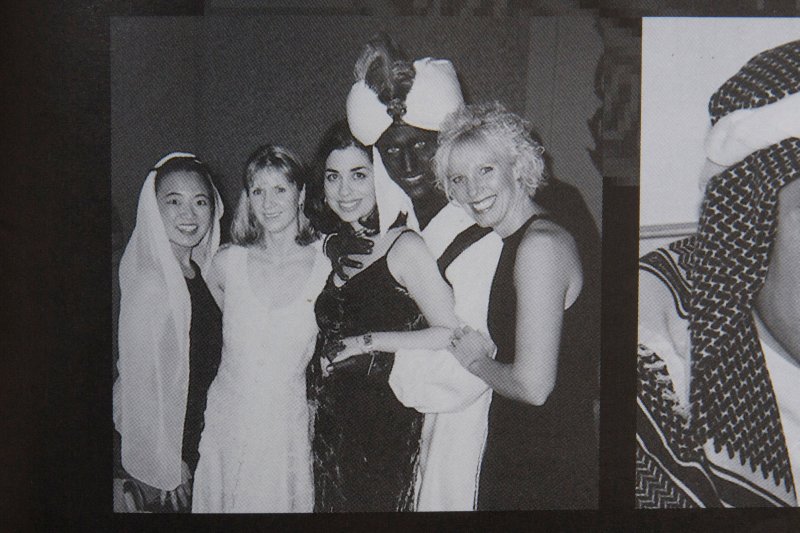
Justin Trudeau (Canada’s most prolific cultural appropriator) with dark makeup on his face, neck and hands at a 2001 “Arabian Nights”-themed party at the West Point Grey Academy, the private school where he taught.
Photo from the West Point Grey Academy yearbook, via Time
“Cultural appropriation” typically gets defined in a way that depends on whether one is defending it or denouncing it. If you’re defending it, you prefer to look at the big picture: Every new kind of art form, literary genre, style of dress, or cuisine typically represents a mix of inherited and borrowed elements. Shakespeare’s sonnets were written in an Iambic pentameter that Chaucer had “appropriated” from the French and Italians. So if Indigenous or African poets want to appropriate it from the English, no one has any basis for complaint. If you define cultural appropriation in this big-picture way, the concept isn’t just permissible. It’s artistically necessary, and indeed inevitable.
But if you’re denouncing cultural appropriation, on the other hand, the argument is more persuasive when your frame of reference is small, local, and community-rooted. I’m thinking of the (white) novelist or film director who passes through a region, and hears some garbled version of folklore that relates to a nearby Indigenous community. The guy thinks, “Oh wow, that’ll make a great novel” (or TV show, movie, etc.), and then makes a mint without consulting (let alone cashing in) the Indigenous community.
So the debate over cultural appropriation is like a lot of debates: It’s really easy to win if you get to define the terms. And since both sides pick definitions that suit them, it can become a dialogue of the deaf.
Indeed, there’s often no dialogue at all. Rather, both sides are apt to retreat into apocalyptic language about, respectively, (a) totalitarian censorship, and (b) white supremacist (cultural) genocide. This is absolutist language that leaves no room for nuance or discussion.
The cultural-universalism side of this dialogue is represented by people like me. I write about every topic under the sun, and so I get my back up when someone tells me that I’ve got to “stay in my lane”. My whole career is built around hopscotching from one idea to the next without worrying (much) about who gets offended. For me, the imposition of rules on what people are allowed to write about isn’t just an annoyance. It’s an existential threat to the creative faculties.
But if you’re on the other end of this — say, you’re a member of a small Indigenous community whose history and folklore have yet to be recorded or celebrated in any definitive form — you don’t care about some white guy in Toronto whining about how he can’t do the equivalent of wearing a sombrero on Cinco de Mayo. A small First Nations community might get only one real shot at telling its story to the world. If that shot gets used up by an outsider who strip-mines the locals’ oral history for a bestseller, that can no doubt feel like existential threat to one’s cultural autonomy. It’s like: “So you took our land, punished us for using our own language, sent our kids to residential schools, and now all we really have left is our culture, and you want to steal that, too?”
There’s this trite expression that often gets trotted out these days: Intent doesn’t matter, only the harm you cause. But of course, intent does matter. And if an author, director, or artist intends to respectfully and accurately include a community’s story in his or her work, then, for me, that’s very much a mark in their favour. That said, I absolutely do not think that this means there is an obligation to “honour” or “uplift” the community in question — let alone express “solidarity” or “allyship” with them. Doing so means you’re writing activist propaganda. What I mean, rather, is that you shouldn’t be intending to mock or belittle whole swathes of humanity.
The problem is that, in Canadian cultural circles at least, this isn’t really the standard that’s applied. I’ve spoken to a number of Canadian writers who, out of the best of intentions, invest their own funds in “sensitivity readers” — a process that can be not only expensive and time-consuming, but also creatively ruinous, since these consultants often are bursting with ideas about how to turn your novel or movie into a specimen of the above-referenced activist propaganda. I know one woman, in particular — a novelist — who appeared before a First Nations tribal council, and got its official permission to include a character in her book whose identity related to their community. But then a community member, someone not even involved with the band leadership, went after the woman and tried to smear her as racist. This is after she’d dotted every I and crossed every T of the sensitivity-reader process.
Comments Off on Jonathan Kay on cultural appropriation
Pierre Poilievre’s (very modern) modern family
In The Line, Rahim Mohamed discusses how the Poilievre family makes it difficult for Liberal propagandists to portray Poilievre as some sort of ultra-nationalist white supremacist (as they clearly would if they could):

Pierre and Ana Poilievre at a Conservative leadership rally, 21 April, 2022.
Photo by Wikipageedittor099 via Wikimedia Commons.
This is a critical moment for any new party leader. Poilievre need only look at his most immediate predecessor, Erin O’Toole, for an example of how quickly it can go wrong. After tacking to the right of rival Peter MacKay to win the party’s 2020 leadership race, O’Toole pivoted sharply to the centre once Conservative party leader, courting labour unions, calling himself a “progressive conservative” and backtracking on a promise to protect the conscience rights of pro-life doctors and nurses. O’Toole’s “authenticity problem” remained a storyline throughout his rocky tenure at the helm of the Conservative party.
Poilievre executed, successfully, an uncommonly combative and partisan frontrunner campaign, making any notion of a centrist pivot a total non-starter. He has tacked even further to the right than O’Toole did as a leadership candidate: branding moderate rival Jean Charest “a Liberal”, sparring with Leslyn Lewis over who supported this winter’s convoy protests first, leading “defund the CBC” chants at his rallies; and, perhaps most brazenly, promising to bar federal ministers from attending the World Economic Forum (a bête noire of far-right conspiracy theorists).
So how will Poilievre (re-)introduce himself to Canadian voters? If his first week as Conservative party leader is any indication, his telegenic, multicultural and decidedly “modern” family will be central to his efforts to cast himself in a softer, more prime ministerial light.
After the results of the leadership vote were announced, the first person to address Conservative party members was not the party’s new leader himself, but his Venezuelan-born wife Ana. Ana Poilievre (née Anaida Galindo) delivered a confident and well-received set of introductory remarks, cycling effortlessly between English, French and Spanish throughout the five-minute-long address.
The most effective moments of Ana Poilievre’s speech centred on her family’s hardscrabble journey from a comfortable middle-class existence in pre-Chavez Venezuela to precariously living paycheque-to-paycheque in the East End of Montreal. “My father went from wearing business suits and managing a bank to jumping on the back of a truck to collect fruits and vegetables,” she reminisced with her family in attendance; adding, “there is no greater dignity than to provide for your own family” to one of the loudest rounds of applause of the evening. These words captured the Galindo family’s distinct immigrant story, yet undoubtedly resonated with thousands of immigrants and first-generation Canadians across the country. (My own parents, for what it’s worth, were forced to start from scratch after being exiled from their birth country of Uganda as young adults.)
Pierre Poilievre returned to this theme in the victory speech that followed: “my wife’s family not only raised this incredible woman, but they came to this country … with almost nothing; and they have since started businesses, raised kids, served in the military, and like so many immigrant families, built our country.” He went on to thank members of his own family, including his (adoptive) father’s same-sex partner Ross and his biological mother Jackie (who gave Poilievre up for adoption after having him as a teenager). “We’re a complicated and mixed-up bunch … like our country,” he later joked.
All kidding aside, no major federal party leader has ever had a family that looks more like Canada. Members of Poilievre’s extended family span multiple nationalities and speak English, French and Spanish as first languages. He has a South American wife, an adoptive father who is in a relationship with another man, and a biological mother who’s young enough to be his sister — Pierre Poilievre is basically a character from the hit sitcom Modern Family. The governing Liberals, who have made identity politics central to their party brand and spent the past seven months trying to connect Poilievre to white supremacism, should be worried.
Comments Off on Pierre Poilievre’s (very modern) modern family
September 18, 2022
Forget #GamerGate already, here’s #NAFO!
At Samizdata, Perry de Havilland briefly recaps the story of #gamergate and the incomprehension of the “official” gaming press and PR departments of gaming companies that their actions to ridicule and shutdown the “racist/sexist/homophobe” #gamergate activists not only failed but drew more attention to the #gamergate issue, and compares it to a new instance of the same phenomenon:
Fast forward to 2022 and behold #NAFO: the North Atlantic Fellas Organisation.
And who are “the fellas”? A large and growing online pack of attack dogs countering, dare I say smothering, official Russian troll factory output, as well as other pro-Kremlin talking heads online. And their mascots are daft cartoon dogs (variations of a Shiba Inu to be precise). If journalistic collusion was a constant target of #GamerGate, the Russian troll farms are the modern analogy to that, constantly targeted and smothered by NAFO posting either pro-Ukrainian counter-narratives or just ridiculing or flagging up pro-Russian ones.
Many people, particularly those operating within institutions, don’t understand #NAFO for same reason PR departments of various video games companies & press outlets didn’t (and still don’t) understand #GamerGate.
Is #NAFO engaged in “information warfare”? Absolutely. They even get a shout out from the Ukrainian Ministry of Defence. But they are not managed out of an office in Langley, Virginia nor by some adjunct of the Ukrainian intelligence services. #NAFO is a hashtag, a phenomena, it isn’t “run” by anyone, because it doesn’t need to be. Like GamerGate, NAFO is a confluence of the motivated willing in every timezone on the planet.
And just as GamerGate had a single original trigger, which was then largely forgotten as the “movement” grew and started attacking larger more juicy prey, NAFO started as a fund raising effort for the Georgian Legion (a now battalion sized unit of about 600 within the Ukrainian army made up mostly of Georgian volunteers). At blinding speed, NAFO rapidly morphed into a wider distributed online effort supporting Ukraine in the “information space”.

Comments Off on Forget #GamerGate already, here’s #NAFO!
QotD: Late night TV’s negative impact on US national culture (aka “Clown nose on, clown nose off”)
I truly believe that Tim Pool is absolutely right about where the political poisoning of our National culture comes from.
Shows like Saturday Night Live, the Daily Show, late night television …
They take the news, spin it through a comedy filter, and present it to the masses. This presents an easily digestible, and thus easily believable, simplified and polarized view of events, that their viewers are then encouraged to apply to the news that is coming from real news sources. Anyone who objects to this is “overreacting, or doesn’t have a sense of humor” and thus is dismissed as irrelevant.
And thus the culture of lies continues, and gets ramped up as it spreads.
It’s sickening.
James Resoldier, posting to MeWe‘s “Hoyt’s Huns” group, 2022-06-16. (private group, so no public URL available)
Comments Off on QotD: Late night TV’s negative impact on US national culture (aka “Clown nose on, clown nose off”)
September 17, 2022
Is it still a conspiracy theory if more than 50% of Canadians believe it?
Chris Selley posted a link to this rather eye-opening Abacus Data poll summary by Bruce Anderson and David Coletto:
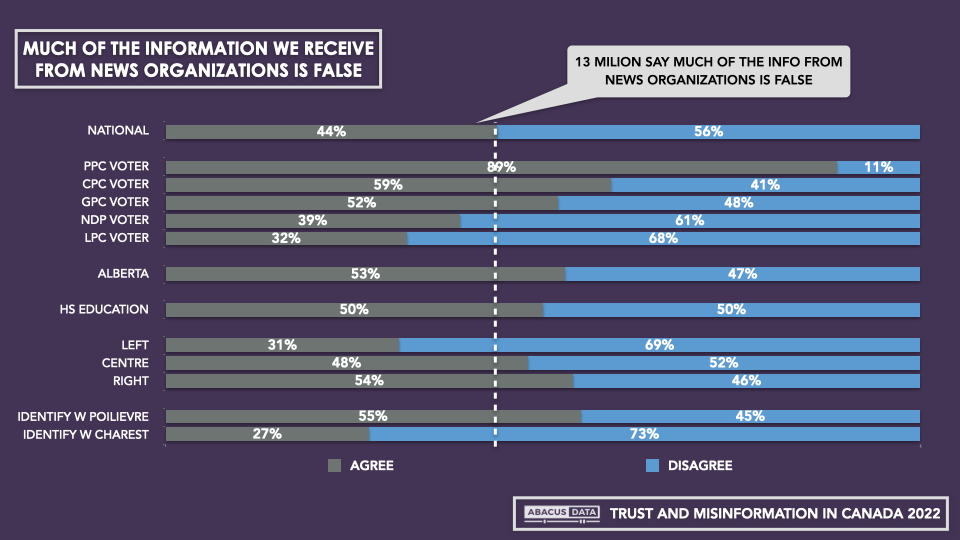
We recently completed nationwide surveying among 1500 Canadians. The focus was on the levels of trust people have in institutional sources of information, and belief in conspiracy theories. This is the first in a series called “Trust & Facts: What Canadians Believe”
44% THINK MUCH OF THE INFORMATION FROM NEWS ORGANIZATIONS IS FALSE
Almost half of those interviewed found themselves agreeing with the statement “much of the information we receive from news organizations is false”.
While this means a majority of Canadians have some trust in news organizations, more than 13 million adults (extrapolating 44% to an adult population of 29.5 million) don’t.
Those with no post-secondary education, Alberta residents and those on the right show greater mistrust. But by far the biggest differences are visible when we look at party affinity. The vast majority of People’s Party supporters don’t trust news organizations and a (smaller) majority – 59% – of Conservative voters feel the same way.
Among those who think Pierre Poilievre is the Conservative leadership candidate who best reflects their views, 55% don’t trust media information, while among those who identify with Jean Charest the proportion is much lower, at 27%.
52% THINK OFFICIAL GOVERNMENT ACCOUNTS OF EVENTS CAN’T BE TRUSTED
More than half of those interviewed found themselves agreeing with the statement “official government accounts of events can’t be trusted”
As with trust in news organizations, those with no post-secondary education, Alberta residents and those on the right showed markedly higher levels of mistrust in government.
Majorities of People’s Party, Conservative and Green Party voters indicate mistrust. Those on the left and Liberal voters show higher levels of trust.

Comments Off on Is it still a conspiracy theory if more than 50% of Canadians believe it?
A royal assault on free speech | The spiked podcast
spiked
Published 16 Sep 2022Tom, Fraser and Ella discuss the clampdown on republican protesters. Plus: the Ukrainian counteroffensive and the madness of Mermaids.
(more…)
Comments Off on A royal assault on free speech | The spiked podcast
September 16, 2022
How “misgendering” shattered the Green Party of Canada
Canada’s Green Party has never been noted for their tight party cohesion, so my use of the word “shattered” in the headline is a bit over-the-top, I must confess. Jonathan Kay provides a quick outline of the party’s history through the leadership of Elizabeth May, Annamie Paul, and most recently, interim leader Amita Kuttner:

Many grumbled that May was too slow to give up her leadership perch. Yet when she finally did step aside in 2019, the party learned that she’d been the only thing holding the outfit together. By the time the 2021 federal election rolled around, the Greens’ leader was a black Jewish woman named Annamie Paul, who got absolutely trounced in her own riding, winning fewer than 4,000 votes. Paul was then quickly run out of the party leadership during a complicated (and often farcical) internecine battle that involved public accusations of bigotry hurled in all directions, and which (predictably) repelled many of the party’s financial supporters.
On Sept. 27 I began the process of stepping down as Green Party of Canada Leader. Today I sent formal notice of my resignation to the GPC. I will also be ending my membership in the GPC.
It was an honour to work for the people of Canada and I look forward to serving in new ways.— Annamie Paul (@AnnamiePaul) November 10, 2021
One might think things couldn’t get any worse for the Greens. But, thanks to the installation of a 30-year-old interim leader named Amita Kuttner, they very much did.
Kuttner self-describes as non-binary, transgender, and pansexual. When asked, “What are your preferred pronouns?” in a 2019 interview, the one-time astrophysicist replied, “they/them”, but then elaborated as follows:
When I write my pronouns, I sometimes write all of them: they/them, she/her, he/him, because I don’t care. There will be days where I’m not always even aware of what my gender is, and I will notice it based on how someone addresses me and whether I respond. I was in choir for many years, and they’d say, “women sing now”, “men sing now”. And I would find myself starting with one or the other group, even though I was obviously supposed to sing soprano. I’d be like, “Oh, I guess I’m feeling that today.”
And yet, despite the fact Kuttner apparently can’t always figure out “what my gender is”, and claims not to “care” in any case, the interim leader felt the need to issue a lengthy statement on September 6th detailing the allegedly devastating emotional effects that ensued when the pronoun descriptor “she/elle” appeared in the electronic caption that sat alongside Kuttner’s name during a Green Party of Canada Zoom call, instead of the Kuttner-approved “they/he/ille”. Indeed, Kuttner described the ordeal as evidence that the Greens were infected by a “system of oppression”:
What happened here impacted me much more than a slip of the tongue. It made me feel hurt and isolated at a moment that should have been filled with inspiration and anticipation … This incident is reflective of a larger pattern of behaviours that a few in the party are perpetuating. Over the years, the party has documented reports which indicate a systemic issue disproportionately affecting Black, Indigenous, and racialized people and 2SLGBTQIA+ people, and I hope many more stories will be able to be shared so that this incident can be a catalyst for change … When things like this happen, people need to see those in leadership positions take some accountability, acknowledge how they have added to this system of oppression and what they must do to break the cycle.
Kuttner’s attempt to weaponize this (apparently very oppressive) instance of miscaptioning forms part of an ongoing civil war that’s been playing out for weeks within the Green leadership. That battle goes to the question of whether the party should proceed with its ongoing party leadership race, or pause it so that Green functionaries can investigate all of the (vaguely expressed) accusations of antisemitism, racism, and transphobia that were flung in every direction during the tumultuous last days of the Annamie Paul era back in 2021.
Comments Off on How “misgendering” shattered the Green Party of Canada
September 15, 2022
“Presentism is … a disease, a contagion here in America as infectious as the Wuhan flu”
Jeff Minick on the mental attitude that animates so many progressives:
My online dictionary defines presentism as “uncritical adherence to present-day attitudes, especially the tendency to interpret past events in terms of modern values and concepts”. To my surprise, the 40-year-old dictionary on my shelf also contains this eyesore of a word and definition.
To be present, of course, is a generally considered a virtue. It can mean everything from giving ourselves to the job at hand — no one wants a surgeon dreaming of his upcoming vacation to St. Croix while he’s cracking open your chest — to consoling a grieving friend.
But presentism is altogether different. It’s a disease, a contagion here in America as infectious as the Wuhan flu. The latter spreads by way of a virus, the former through ignorance and puffed-up pride.
Presentism is what inspires the afflicted to tear down the statues of such Americans as Washington, Jefferson, and Robert E. Lee for owning slaves without ever once asking why this was so or seeking to discover what these men thought of slavery. Presentism is why the “Little House Books” and some of the early stories by Dr. Seuss are attacked or banned entirely.
Presentism is the reason so many young people can name the Kardashians but can’t tell you the importance of Abraham Lincoln or why we fought in World War II.
Presentism accounts in large measure for our Mount Everest of debt and inflation. Those overseeing our nation’s finances have refused to listen to warnings from the past, even the recent past, about the clear dangers of a government creating trillions of dollars out of the air.
Presentism has led America into overseas adventures that have invariably come to a bad end. Afghanistan, for example, has long been known as the graveyard of empires, a cemetery which includes the tombstones of British and Russian ambitions. By our refusal to heed the lessons of that history and our botched withdrawal from Kabul, we dug our own grave alongside them.
H/T to Kim du Toit for the link.
Comments Off on “Presentism is … a disease, a contagion here in America as infectious as the Wuhan flu”
September 13, 2022
Society would be happier if we all paid even less attention to “the tossers of Tinsel Town”
Ian O’Doherty on the malign influence pretty people who mouth other people’s words for the cameras still exude in our popular culture:
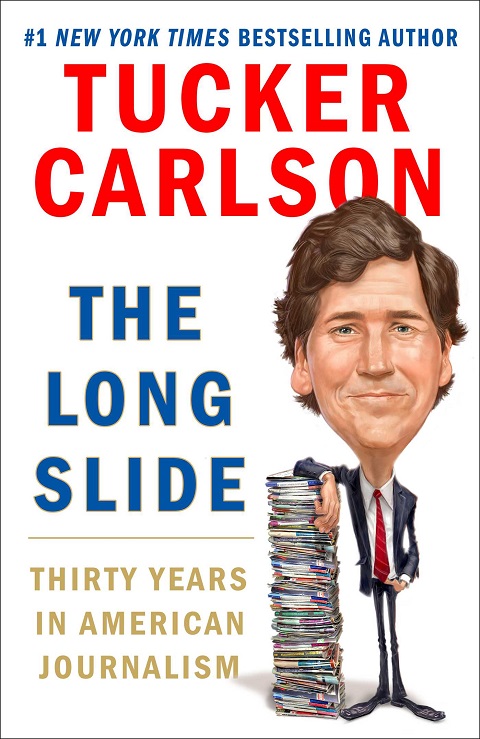
Tucker Carlson … the man from Jennifer Lawrence’s nightmares, apparently.
They never learn, do they? If the tumultuous events we have all watched with growing horror over the past few years taught us one thing, it is this – people don’t care what the pampered starlets of Hollywood have to say about politics. If we did, then Hillary Clinton would be comfortably enjoying her second term as the pantsuit POTUS, Jeremy Corbyn would be prime minister of the UK and we would all be driving electric cars.
But regular people are smarter than actors, which seems to drive the luvvies wild with fury. Rather than accepting that maybe, just maybe, there is another side to the argument, the tossers of Tinsel Town insist that anyone who doesn’t fully embrace the so-called progressive agenda is simply a monster.
We saw this recently when Jennifer Lawrence, who used to be quite refreshingly down to Earth, proudly admitted that she had to “work so hard … to forgive my dad and my family” for voting Republican. She also, quite wonderfully, spoke about having “recurring nightmares” about Fox News anchor Tucker Carlson.
In the course of her interview for the cover issue of Vogue magazine – that renowned bastion of proletarian agitation – the Hunger Games actress claimed that she was born a Kentucky Republican, was raised as a Kentucky Republican and had considered herself to be a Kentucky Republican, until she watched an episode of 30 Rock. And then her worldview completely changed.
Now most of us would agree that 30 Rock was a brilliant sitcom. After all, it was so ingenious in its construction that it even managed to make Alec Baldwin look likeable. But would anyone think that Liz Lemon’s line, “I’m not a crazy liberal – I just think people should drive hybrid cars”, would be enough to utterly transform someone’s political beliefs?
Apparently, this is what changed everything for Lawrence. She even seemed proud of the fact that a throwaway line in a sitcom triggered some sort of Damascene conversion to what is now so tediously known as “the right side of history”.
Predictably, following the Vogue interview, Lawrence was hailed as a modern-day Joan of Arc – for refusing to be “passive about politics”. But there is no real bravery involved in simply having the courage of other people’s convictions – she knows which way the political wind is blowing and is bending to it. That’s not all that brave, is it?
Comments Off on Society would be happier if we all paid even less attention to “the tossers of Tinsel Town”
The Boise Pride Festival’s “Drag Kids on Stage”
I’m not sure I could accurately place Boise on a map, but the city’s relative obscurity doesn’t mean it can’t have a really progressive LGBT scene, including a special “Drag Kids” event planned for their Pride Festival:
Remember that California has just passed a new law, SB 1100, to protect local legislative bodies against “bullying” from people who do hateful things like disagreeing with them, and that the recent failure of another (spectacularly offensive) bill in the state legislature was the product of “harassment”, by which the author of the bill meant that the peasantry forcefully and persistently criticized it. And you should definitely read this two–part essay from Bat Cattitude on the technocratic presumption that disagreement with technocrats can only be dangerous extremism.
With that background in mind, consider a modest victory in the most dismal battlefield of the culture war, and then watch the response to it.
This one happens in Boise, a purple town in a red state. This year’s Boise Pride Festival was all set to feature an event called Drag Kids:
“Now it is time to see the kids”, sexy eleven year-olds shaking that dirty little moneymaker on the stage. So hot. So empowering!
[…]
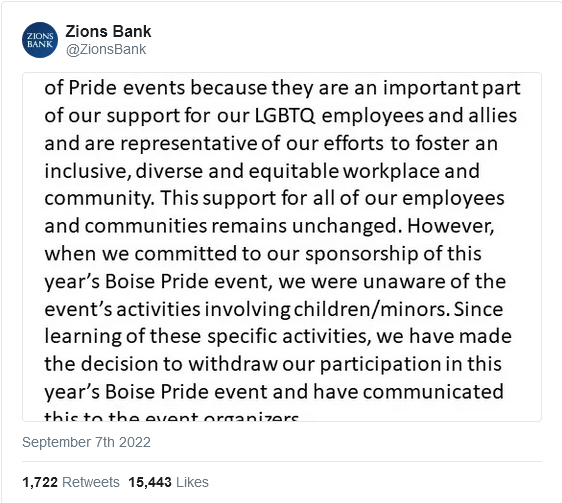
Now, the Big Pivot: Boise Pride pays its bills by soliciting the support of corporate sponsors, so a bunch of corporations suddenly found themselves sponsoring the sexuality-incorporating performances of some hot little eleven year-olds. They quickly began to jump clear of the thing:
Because bigotry still prevails in Amerikkka, see, corporations aren’t brave enough to stand up and support the sexy eleven year-olds in their extremely hot sexiness. Atavists! Prudes!
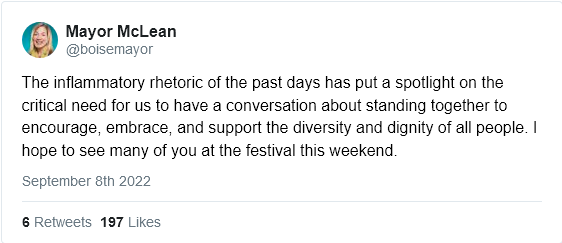
Now, here come the politicians. The mayor of Boise, Lauren McLean, is Very Disappointed In You All™:
Slogan slogan slogan, slogan slogan, slogan slogan slogan. A spotlight on the critical need for a conversation about standing together!
If you challenged Mayor NPC to publicly identify specific pieces of inflammatory rhetoric that were important and central to the controversy, she couldn’t; she just knows that the “inflammatory rhetoric” box has to be checked, because Mean Republicans objected to something involving an LGBT event, specifics not important. Nor could she explain how sexy children represent the dignity of all people, or respond coherently to a discussion about sexual commodification and the erasure of childhood. She has a list of slogans. She deploys them.

Comments Off on The Boise Pride Festival’s “Drag Kids on Stage”
September 12, 2022
As of Saturday night, Pierre Poilievre is now “Hitler” to most of Canada’s legacy media
Of course, he was already well on the way to being “Hitler” even before the landslide voting results were announced:

New Conservative Party of Canada leader Pierre Poilievre at a Manning Centre event, 1 March 2014.
Manning Centre photo via Wikimedia Commons.
First, this was a completely lopsided blowout victory for the Poilievre team. The Jean Charest people, God bless them, had been telling anyone who would listen these last few weeks that their campaign had a strategy to win on points, thanks to their strong support in Quebec. So yeah, that didn’t happen. Poilievre won on the first ballot with almost 70 per cent of the vote; Charest came in second with … not quite 17 per cent. (Leslyn Lewis came in a distant third with less than 10 per cent, which she’ll probably attribute to the WEF controlling the process using mind-controlling nano-bots hidden COVID-19 vaccines or something similarly totally normal and reasonable.)
But yeah. Sixty eight point one five per cent on the first ballot. That’s a pretty clear signal.
To be honest, we at The Line saw that signal being sent pretty clearly many months ago. As Line editor Matt Gurney wrote almost exactly a year ago here, the only thing that was going to stop the Conservatives taking a real turn to the right was going to be a good showing by former leader Erin O’Toole in the 2021 federal election. He failed to deliver, and discredited the notion of success-via-moderation in the process. Conservatives now want the real thing: a big hunk of conservative red meat on their plate. And we never had any doubt that Poilievre was going to be the guy to serve that up for them.
Poilievre now has something that neither of his last two predecessors had. He has the support of the party behind him. Andrew Scheer needed 13 ballots to win in 2017, and even then only barely edged out Maxime Bernier. O’Toole won a more decisive victory against Peter MacKay, but as soon as he tacked back toward the centre, much of the party became palpably angry and uncomfortable with his leadership. Poilievre will not have these problems. The Conservative Party of Canada is his now.
In terms of our federal politics generally, we repeat a point we have been making here and in other places for many months. We think many Canadians, particularly those of the Liberal persuasion, may be shocked by how well Poilieivre will come across to Canadians. We believe there are a lot of people out there, who don’t have blue checkmarks and don’t spend all their time microblogging angrily at each other, who will like a lot of what Poilievre has to say and won’t find him nearly as scary as those who #StandWithTrudeau.
Poilievre has a nasty streak, and a temper, and we’re not sure that he will be able to control either. He could easily destroy himself. He has baggage too, and maybe get too close to the fringe. But if he doesn’t, we think he has a real shot.
And we think he will be helped by the weakness of the Liberals. This government seems exhausted and increasingly overtaken by events. It is also overly reliant on a few tricks. We suspect Canadians are growing tired of a Justin Trudeau smile and vague non-answer. Some Liberal baggage is just the inevitable consequence of a government aging in office. Some of it seems to be more specific to modern Canadian Liberalism, its leader and their unique, uh, quirks. Too many Liberals are blind to these problems, or least pretend to be — probably because they’re not great at admitting they have any problems at all, least not any posed by someone they find as repugnant as Pierre Poilievre. To them, we say this: Hillary thought she’d beat Trump.
It’s been fixed opinion among “mainstream” “conservatives” in Canada that the only way to get elected is to be more like Justin Trudeau. The obvious problem with this notion is that it’s going to be difficult to persuade Canadians to vote for a blue-suited Trudeau — or even an orange-tie-wearing Trudeau — if the original item is still on offer. I personally think Trudeau is a terrible PM, but a lot of people in downtown Toronto, Montreal, and Vancouver clearly disagree with me, and thanks to the Liberals’ hyper-efficient voting pattern, that’s been enough to keep Trudeau in power.
September 10, 2022
Magical Monetary Theory (MMT) – You’re soaking in it
At the Foundation for Economic Education, Kellen McGovern Jones outlines the rapid rise of MMT as “the answer to everyone’s problems” in the last few years and all the predictable problems it has sown in its wake:

“Inflation & Gold” by Paolo Camera is licensed under CC BY 2.0 
 .
.
Modern Monetary Theory (MMT) was the “Mumble Rap” of politics and economics in the late 2010s. The theory was incoherent, unsubstantial, and — before the pandemic, you could not avoid it if you wanted to.
People across the country celebrated MMT. Alexandria Ocasio-Cortez, the Democrat Congresswoman from New York heralded MMT by proclaiming it “absolutely [must be] … a larger part of our conversation [on government spending].” The New York Times and other old-guard news sources authored countless articles raising the profile of MMT, while universities scrambled to hold guest lectures with prominent MMT economists like Dr. L. Randall Wray. Senator Bernie Sanders went as far as to hire MMT economists to his economic advisory team.
The most fundamental principle of MMT is that our government does not have to watch its wallet like everyday Joes. MMT contends that the government can spend as much as it wants on various projects because it can always print more money to pay for its agenda.
Soon after MMT became fashionable in the media, the once dissident economic theory leapt from being the obscure fascination of tweedy professors smoking pipes in universities to the seemingly deliberate policy of the United States government. When the Pandemic Hit, many argued that MMT was the solution to the pandemics problems. Books like The Deficit Myth by Dr. Stephanie Kelton became New York Times bestsellers, and the United States embarked on a massive spending spree without raising taxes or interest rates.
Attempting to stop the spread of Covid, state and federal governments coordinated to shut down nearly every business in the United States. Then, following the model of MMT, the federal government decided to spend, and spend, and spend, to combat the shutdown it had just imposed. Both Republican and Democrat-controlled administrations and congresses enacted trillions of dollars in Covid spending.
It is not hard to see that this spray and pray mentality of shooting bundles of cash into the economy and hoping it does not have any negative consequences was ripe for massive inflation from the beginning. Despite what MMT proponents may want you to believe, there is no way to abolish the laws of supply and demand. When there is a lot of something, it is less valuable. Massively increasing the supply of money in the economy will decrease the value of said money.
MMT economists seemed woefully unaware of this reality prior to the pandemic. Lecturing at Stoney Brook University, Kelton attempted to soothe worries about inflation by explaining that (in the modern economy) the government simply instructs banks to increase the number of dollars in someone’s bank account rather than physically printing the US Dollar and putting it into circulation. Somehow — through means that were never entirely clear — this fact was supposed to make people feel better.
In reality, there is no difference between changing the number in someone’s bank account or printing money. In both cases, the result is the same, the supply of money has increased. Evidence of MMTs inflationary effects are now everywhere.
Comments Off on Magical Monetary Theory (MMT) – You’re soaking in it
September 9, 2022
“Far from fighting against the establishment, the woke are the establishment”
In Spiked, Andrew Doyle discusses the reactions to his announcement that he was writing a book about the ongoing culture wars:

“Titania McGrath” and Andrew Doyle
My new book is about intolerance. I am fascinated by those who prefer only to associate with people who share their own identical worldview, and who interpret the slightest point of political disagreement as evidence of evil. The new religion of group identity and “social justice” has driven once rational people into a state of frenzied bigotry. I want to understand why.
So, back in May, when I announced I was working on a book called The New Puritans, I wasn’t all that surprised to see so many self-proclaimed advocates of “social justice” rush to demonstrate the very phenomenon that I was attempting to explore. Some suggested that they would acquire copies only to burn them. One said that he intended to kick it under the bookshop shelf “so that it could rot in darkness”. Another simply declared that I was “pure scum”. Were any of these people aware that they were proving my point?
Byline Times even claimed that I was waging “a perpetual battle against social justice – fighting against a contrived present world of aggressive ‘woke snowflakes’ in order to return to an imagined past”. This was news to me, given that my book is a defence of progressive and liberal values, and it explicitly criticises those who resort to the “snowflake” slur. I particularly enjoyed the suggestion that my book was an example of someone imagining enemies into existence in order to fight them. It takes some chutzpah to make such a claim of a book you haven’t actually read.
It would seem that the title alone – The New Puritans: How the Religion of Social Justice Captured the Western World – was enough to stir the ire of these culture warriors. In a sense, this is unsurprising. One of the key aspects of this ideological movement is that its adherents treat all challenges as a form of heresy that must be quashed. For all that they like to smear their detractors as “bigots”, they forget that the main definition of the word – “a person who is utterly intolerant of any differing creed, belief or opinion” – applies most accurately to themselves.
Why is it, for instance, that JK Rowling can be so routinely monstered as “hateful” and “transphobic” despite having never said anything hateful or transphobic? Only this week, the Harry Potter author found herself in an exasperating Twitter exchange with someone claiming she had been “outwardly hateful of an entire community”. Rowling quite rightly asked for evidence, to which her detractor replied: “I don’t know where you said it, but I bet you do.” For those taking part in the witch-hunt, the total lack of evidence is simply an inconvenience to be brushed aside.
This is why my book draws comparisons between the hysteria of the “woke” movement and the witch hunts of Salem in the late 17th century. In a burst of collective madness that lasted a little over a year (from February 1692 to May 1693), 20 people were executed for witchcraft on the basis of the testimony of local girls. All of the prosecutions were secured on the basis of “spectral evidence” – what today we might call “lived experience”. The girls simply declared that they had seen these innocent people sign the devil’s book, or that they had been “sending out their spirits” to torment people. This was their “truth”, and so it had to be believed.
Comments Off on “Far from fighting against the establishment, the woke are the establishment”
Britain’s “Lord of Misrule” at the end of the “Borisarchy”
In Quillette, John Lloyd considers the parts of Boris Johnson’s personality that allowed him to achieve the premiership but not to retain it:

The respectable consensus on Boris Johnson’s resignation is that the Lord of Misrule was an opportunist who rose to power amid the mayhem of Brexit that he’d helped to create, but that his fecklessness finally caught up with him. There’s something in that, but more in what’s not. Although his critics will refuse to admit it, what’s mostly missing is the laughter, which is now a more important factor in British public life than before.
Much of public and media life in the UK — and it isn’t unique in this — is a search for laugh lines, and Johnson — instinctively but also with calculation — played heartily into this. He always had. In a largely affectionate biography, Andrew Gimson, Johnson’s former colleague at the Spectator and the Daily Telegraph, writes that, “To make people enjoy being led by him was an aspect of leadership which Boris mastered at a very young age. He made people helpless with laughter, and so great was their enjoyment that they scarcely cared what he did with their support, as long as he kept on amusing them.”
With the laughter came Johnson’s inchoate libertarianism — a strong aversion to condemning activities in which others like to indulge, especially those in which he likes to indulge himself, such as adultery. He is fond of telling the story of when Churchill, Johnson’s lodestar as a public figure, was taken aside during his second administration (1951–55) by his chief whip and told that a cabinet minister had been discovered having sex with a guardsman in Hyde Park at 3am on a freezing morning in February. The press had found out, which the whip advised, meant the minister would have to resign. “Caught with a guardsman?” Churchill asked. “Yes Prime Minister.” “In Hyde Park?” “Yes Prime Minister.” “On a park bench?” “That’s right, Prime Minister.” “At three o’clock in the morning?” “That’s correct, Prime Minister.” “In this weather! Good God man, it makes you proud to be British!”
To Johnson, this is evidence of Churchill’s goodhearted tolerance and defiance of narrow prejudice (this was a time when homosexual acts were quite severely punished), which are matched only by his own in generosity and wit. To be generous and broadminded in his speech (he is said to be quite mean with his money) is attractive to the many sinners among us. We see in the Prime Minister a person with the moral outlook of Casanova and yet (or, and so) finds attractive women willing to dally with him — a cheering thought. As one of these, Allegra Mostyn-Owen, who became his first wife, later admitted, “at least he made me laugh.”
[…]
Accustomed to lying to wriggle out of embarrassments like the discovery of an adultery, he continued to mislead when he joined aides for impromptu parties at No. 10, when the strictest lockdowns and prohibitions on the public were in force. How could a man of such intelligence fail to realise that his bluster would unravel almost as soon as they were uttered? He had, it seemed, an inbuilt arrogance — a conviction that he was able to avoid consequences that brought others down, but which only made him stronger.
In the end, he ran out of that road. Ironically, what finished him was denying that he knew that a government whip, Chris Pincher, had a history of groping other men. Johnson refused to take the scandal seriously enough to fire Pincher, as his senior colleagues pressed him to do — an echo of the Churchill joke he liked to tell, and a reaction which accorded with his libertarian instincts. However, his colleagues finally wearied of delivering statements to the media that made them look ridiculous within days or even hours. It was the last straw.
When Lord Dannatt, a former head of the British Army, was confronted with the (admittedly faint) possibility that Johnson would be considered for the post of NATO Secretary General, he was quoted as saying: “There is no doubt that [Johnson] has done a lot of good, and our full support for Ukraine is just fantastic. But I am afraid that these are personal things, a lack of integrity, a lack of trust. Frankly, we do not want to put Boris Johnson on the international stage for further ridicule. He is a disgrace to the nation.”
Comments Off on Britain’s “Lord of Misrule” at the end of the “Borisarchy”


