
Forgotten Weapons
Published May 6, 2024The MG08 was the German Army standard Maxim gun in World War One. The Germany Navy adopted the Maxim first in 1894, followed by the Army in 1899, then a new pattern in 1901, and finally the MG08 in 1908. This was actually a somewhat old-fashioned pattern of Maxim when it was adopted, as the Germans chose to use the 1889-style lock, which was neither headspace-adjustable nor field-strippable. Their decision was based on the idea that they could produce locked to perfect interchangeable headspace, and field stripping was not really necessary — and they were not wrong in these assumptions. MG08 guns were issued with two spare locks in each sled mount, and that handled any broken parts that might occasionally happen. During the war, about 106,000 MG08s were built by two main factories, the Spandau Arsenal and the DWM company. This remained the standard German Army heavy machine gun until the adoption of the MG34.
(more…)
August 21, 2024
MG08: The Devil’s Paintbrush
August 19, 2024
Bret Devereaux on Nathan Rosenstein’s Rome at War (2004)
Although Dr. Devereaux is taking a bit of time away from the more typical blogging topics he usually covers on A Collection of Unmitigated Pedantry, he still discusses books related to his area of specialty:
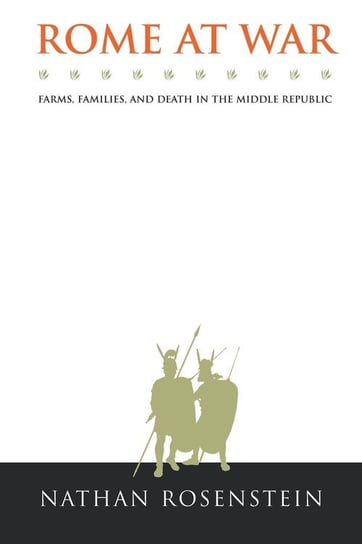
For this week’s book recommendation, I want to recommend N. Rosenstein, Rome at War: Farms, Families and Death in the Middle Republic (2004). This is something of a variation from my normal recommendations, so I want to lead with a necessary caveat: this book is not a light or easy read. It was written for specialists and expects the reader to do some work to fully understand its arguments. That said, it isn’t written in impenetrable “academese” – indeed, the ideas here are very concrete, dealing with food production, family formation, mortality and military service. But they’re also fairly technical and Rosenstein doesn’t always stop to recap what he has said and draw fully the conclusions he has reached and so a bit of that work is left to the reader.
That said, this is probably in the top ten or so books that have shaped me as a scholar and influenced my own thinking – as attentive readers can no doubt recall seeing this book show up a lot in my footnotes and citations. And much like another book I’ve recommended, Landers, The Field and the Forge: Population, Production and Power in the Pre-Industrial West (2003), this is the sort of book that moves you beyond the generalizations about ancient societies you might get in a more general treatment (“low productivity, high mortality, youth-shifted age profile, etc.”) down to the actual evidence and methods we have to estimate and understand that.
Fundamentally, Rome at War is an exercise in “modeling” – creating (fairly simple) statistical models to simulate things for which we do not have vast amounts of hard data, but for which we can more or less estimate. For instance, we do not have the complete financial records for a statistically significant sample of Roman small farmers; indeed, we do not have such for any Roman small farmers. So instead, Rosenstein begins with some evidence-informed estimates about typical family size and construction and combines them with some equally evidence-informed estimates about the productivity of ancient farms and their size and then “simulates” that household. That sort of approach informs the entire book.
Fundamentally, Rosenstein is seeking to examine the causes of a key Roman political event: the agrarian land-reform program of Tiberius Gracchus in 133, but the road he takes getting there is equally interesting. He begins by demonstrating that based on what we know the issue with the structure of agriculture in Roman Italy was not, strictly speaking “low productivity” so much as inefficient labor allocation (a note you will have seen me come back to a lot): farms too small for the families – as units of labor – which farmed them. That is a very interesting observation generally, but his point in reaching it is to show that this is why Roman can conscript these fellows so aggressively: this is mostly surplus labor so pulling it out of the countryside does not undermine these households (usually). But that pulls a major pillar – that heavy Roman conscription undermined small freeholders in Italy in the Second Century – out of the traditional reading of the land reforms.
Instead, Rosenstein then moves on to modeling Roman military mortality, arguing that, based on what we know, the real problem is that Rome spends the second century winning a lot. As a result, lots of young men who normally might have died in war – certainly in the massive wars of the third century (Pyrrhic and Punic) – survived their military service, but remained surplus to the labor needs of the countryside and thus a strain on their small households. These fellows then started to accumulate. Meanwhile, the nature of the Roman census (self-reported on the honor system) and late second century Roman military service (often unprofitable and dangerous in Spain, but not with the sort of massive armies of the previous centuries which might cause demographically significant losses) meant that more Romans might have been dodging the draft by under-reporting in the census. Which leads to his conclusion: when Tiberius Gracchus looks out, he sees both large numbers of landless Romans accumulating in Rome (and angry) and also falling census rolls for the Roman smallholder class and assumes that the Roman peasantry is being economically devastated by expanding slave estates and his solution is land reform. But what is actually happening is population growth combined with falling census registration, which in turn explains why the land reform program doesn’t produce nearly as much change as you’d expect, despite being more or less implemented.
Those conclusions remain both important and contested. What I think will be more valuable for most readers is instead the path Rosenstein takes to reach them, which walks through so much of the nuts-and-bolts of Roman life: marriage patterns, childbearing patterns, agricultural productivity, military service rates, mortality rates and so on. These are, invariably, estimates built on estimates of estimates and so exist with fairly large “error bars” and uncertainty, but they are, for the most part, the best the evidence will support and serve to put meat on the bones of those standard generalizing descriptions of ancient society.
The US Navy’s mis-managed decline continues
Niccolo Soldo from his weekend wrap-up of various news articles that caught his eye:
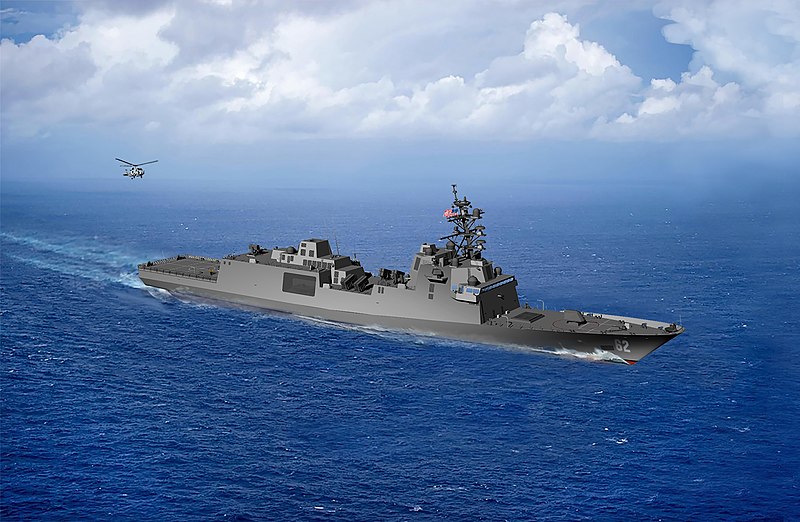
Artist’s rendering of the US Navy’s FFG(X) Constellation-class guided missile frigate. Initial contract awarded 30 April, 2020, but delivery of the first ship is not expected until 2029 due to design changes and other issues.
US Navy image via Wikimedia Commons.
One data point that works in favour of American Declinism is the US Navy’s inability to not just keep up with the Chinese in terms of the production of ships, but to also maintain its own production output. Many lightly-armed littoral combat ships have been retired, for example, with nothing to replace them.
These production setbacks have been pointed out to me, with one mutual on Twitter/X reiterating the point so that I get it (I do!). This is an actual problem that requires solving, and fast. It is partially to blame for the Americans effectively ceding the Red Sea to the Houthis (for now).
AP has done a partial deep-dive (horrible language here, I apologize) on this issue:
The labor shortage is one of myriad challenges that have led to backlogs in ship production and maintenance at a time when the Navy faces expanding global threats. Combined with shifting defense priorities, last-minute design changes and cost overruns, it has put the U.S. behind China in the number of ships at its disposal — and the gap is widening.
Navy shipbuilding is currently in “a terrible state” — the worst in a quarter century, says Eric Labs, a longtime naval analyst at the Congressional Budget Office. “I feel alarmed,” he said. “I don’t see a fast, easy way to get out of this problem. It’s taken us a long time to get into it.”
Marinette Marine is under contract to build six guided-missile frigates — the Navy’s newest surface warships — with options to build four more. But it only has enough workers to produce one frigate a year, according to Labs.
A lot of the guys who know how to do this work are retiring or have already retired. Sound familiar?
One of the industry’s chief problems is the struggle to hire and retain laborers for the challenging work of building new ships as graying veterans retire, taking decades of experience with them.
Shipyards across the country have created training academies and partnered with technical colleges to provide workers with the skills they need to construct high-tech warships. Submarine builders and the Navy formed an alliance to promote manufacturing careers, and shipyards are offering perks to retain workers once they’re hired.
Andreini trained for his job at Marinette through a program at Northeast Wisconsin Technical College. Prior to that, he spent several years as a production line welder, making components for garbage trucks. He said some of his buddies are held back by the stigma that shipbuilding is a “crappy work environment, and it’s unsafe.”
The problem:
Much of the blame for U.S. shipbuilding’s current woes lies with the Navy, which frequently changes requirements, requests upgrades and tweaks designs after shipbuilders have begun construction.
That’s seen in cost overruns, technological challenges and delays in the Navy’s newest aircraft carrier, the USS Ford; the spiking of a gun system for a stealth destroyer program after its rocket-assisted projectiles became too costly; and the early retirement of some of the Navy’s lightly armored littoral combat ships, which were prone to breaking down.
The Navy vowed to learn from those past lessons with the new frigates they are building at Marinette Marine. The frigates are prized because they’re less costly to produce than larger destroyers but have similar weapon systems.
Now check this out:
The Navy chose a ship design already in use by navies in France and Italy instead of starting from scratch. The idea was that 15% of the vessel would be updated to meet U.S. Navy specifications, while 85% would remain unchanged, reducing costs and speeding construction.
Instead, the opposite happened: The Navy redesigned 85% of the ship, resulting in cost increases and construction delays, said Bryan Clark, an analyst at the Washington-based think tank Hudson Institute. Construction of the first-in-class Constellation warship, which began in August 2022, is now three years behind schedule, with delivery pushed back to 2029.
The final design still isn’t completed.
Shifting threats:
Throughout its history, the Navy has had to adapt to varying perils, whether it be the Cold War of past decades or current threats including war in the Middle East, growing competition from Chinese and Russian navies, piracy off the coast of Somalia and persistent attacks on commercial ships by Houthi rebels in Yemen.
And that’s not all. The consolidation of shipyards and funding uncertainties have disrupted the cadence of ship construction and stymied long-term investments and planning, says Matthew Paxton of the Shipbuilders Council of America, a national trade association.
“We’ve been dealing with inconsistent shipbuilding plans for years,” Paxton said. “When we finally start ramping up, the Navy is shocked that we lost members of our workforce.”
How is the US Navy supposed to protect Taiwan from a potential Chinese invasion?
Evolution of WW2 German Tank Destroyers
The Tank Museum
Published May 3, 2024 19 productsUsed extensively by the German army of World War Two, the “tank destroyer” was developed to counter the increasing dominance of the tank on the battlefield.
Germany would field a massive 18 different types of tank destroyer in World War Two – compared with the 7 or 8 different types used by US, British and Commonwealth forces. One of these in particular, Sturmgeschütz III, would destroy more tanks than any other AFV in the entire conflict.
In this video we look at the development, strengths and weaknesses of German tank destroyers: from the 17 tonne Hetzer to the massive 70 tonne Jagdtiger — the heaviest tracked vehicle of the War.
00:00 | Introduction
00:59 | The First Tank Destroyers
04:14 | Avoiding Close Combat
06:59 | Jagdpanther
12:05 | Jagdtiger
15:31 | Hetzer
18:01 | Stug III
22:51 | ConclusionThis video features archive footage courtesy of British Pathé.
#tankmuseum #jagdpanther #stugiii #hetzer #jagdtiger
August 18, 2024
Hirohito Announces Surrender – War Continues – WW2 – Week 312 – August 17, 1945
World War Two
Published 17 Aug 2024Hirohito broadcasts Japan’s surrender to the world- despite an attempted to coup to prevent it from happening, and much of the world celebrates, but the war isn’t really over. The Soviets are busy invading Manchuria, and there’s revolution in Vietnam and Indonesia.
00:00 Intro
00:22 Recap
00:49 Attempted Coup In Japan
04:12 Hirohito Surrenders
08:54 Japanese Surrender In China
12:05 Soviets In Manchuria
17:52 Revolution In Vietnam
20:33 Summary
21:07 Conclusion
(more…)
.30-06 M1918 American Chauchat – Doughboys Go to France
Forgotten Weapons
Published May 4, 2024When the US entered World War One, the country had a grand total of 1,453 machine guns, split between four different models. This was not a useful inventory to equip even a single division headed for France, and so the US had to look to France for automatic weapons. In June 1917 Springfield Armory tested a French CSRG Chauchat automatic rifle, and found it good enough to inquire about making an American version chambered for the .30-06 cartridge. This happened quickly, and after testing in August 1917, a batch of 25,000 was ordered. Of these, 18,000 were delivered and they were used to arm several divisions of American troops on the Continent.
Unfortunately, the American Chauchat was beset by extraction problems. These have today be traced to incorrectly cut chambers, which were slightly too short and caused stuck cases when the guns got hot. It is unclear exactly what caused the problem, but the result was that most of the guns were restricted to training use (as best we can tell today), and exchanged for French 8mm Chauchats when units deployed to the front. Today, American Chauchats are extremely rare, but also very much underappreciated for their role as significant American WWI small arms.
(more…)
August 17, 2024
Forgotten War Ep1 – Witness the Rising Sun
HardThrasher
Published Aug 14, 2024In January 1942 the Japanese Army poured over the border with Burma, and pushed back the Indian and British Armies to the border with Burma. Today we look at how that disaster came about, why and the first phase of the campaign
(more…)
“The notion of a pre-existing Palestinian state is a modern fabrication that ignores the region’s actual history”
Debunking some of the common talking points about the Arab-Israeli conflicts down to the present day:
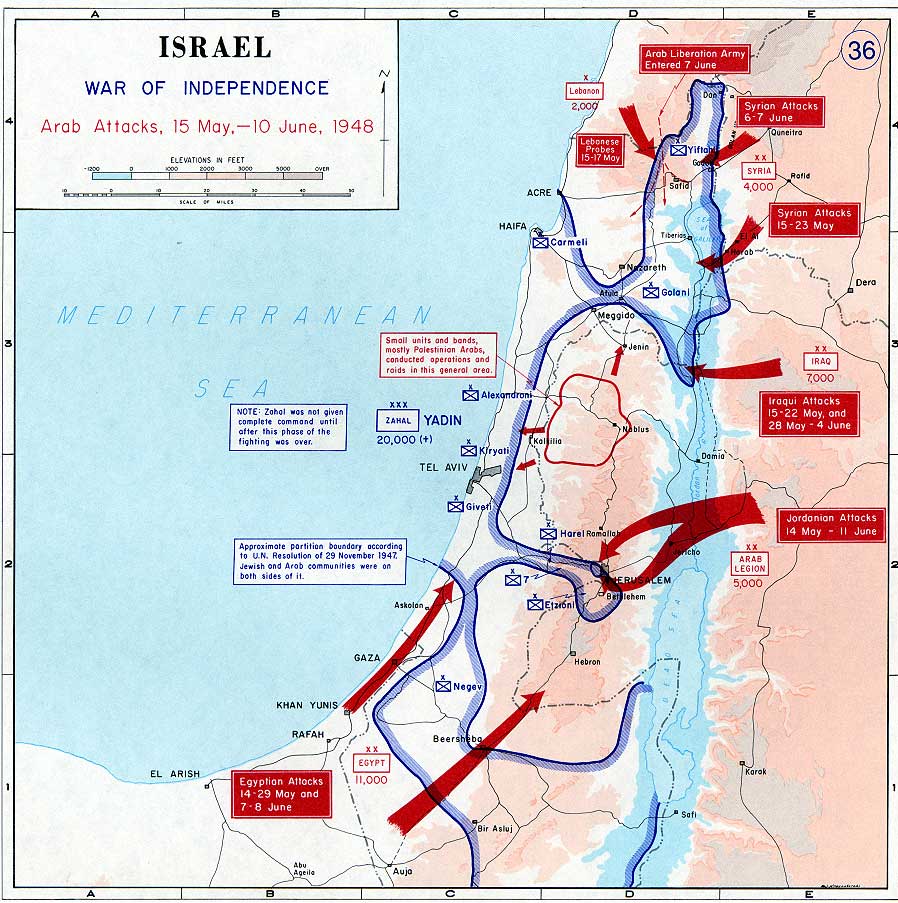
Arab attacks in May and June 1948.
United States Military Academy Atlas, Link.
Before Israel declared independence in 1948, the region now known as Israel, the West Bank and the Gaza Strip was part of the British Mandate for Palestine, which was established by the League of Nations after the fall of the Ottoman Empire in the First World War.
Under Ottoman rule, the area was divided into various administrative districts, with no distinct political entity known as “Palestine”. The concept of a Palestinian national identity emerged in the 20th century, largely in response to the Zionist movement and increased Jewish immigration in the area.
However, there was never a Palestinian state, flag or anthem. The notion of a pre-existing Palestinian state is a modern fabrication that ignores the region’s actual history.
The modern State of Israel’s legitimacy is rooted in international law and global recognition. On Nov. 29, 1947, the United Nations General Assembly passed Resolution 181, known as the “Partition Plan”, proposing two states — one Jewish and one Arab.
The Jewish community accepted the plan, demonstrating a willingness to compromise for peace. However, the Arab states rejected it, refusing to recognize any Jewish state, and instead launched a military assault on Israel following its declaration of independence on May 14, 1948.
Another pervasive myth is the “Nakba” or “catastrophe”, narrative, which claims that Palestinians were forcibly expelled by Israel in 1948. This version omits the critical context that it was the Arab nations that invaded Israel, causing many Arabs to be expelled or flee their homes.
Rather than absorbing the displaced population, the surrounding Arab countries kept them in refugee camps, using them as pawns to pressure Israel. Organizations like UNRWA perpetuated this situation, keeping Palestinians in limbo rather than encouraging their integration into their host countries. This contrasts sharply with how other refugee populations have been handled, where integration and resettlement are the norm.
The land referred to as “Palestine” has always been inherently Jewish. The Jewish people have maintained a continuous presence there for thousands of years, long before Islam or the Arab conquests.
Caesar Marches on Rome – Historia Civilis Reaction
Vlogging Through History
Published Apr 23, 2024See the original here –
• Caesar Marches on Rome (49 B.C.E.)
See “Caesar Crosses the Rubicon” here –
• Caesar Crosses the Rubicon – Historia…#history #reaction
August 16, 2024
“Operation Dragoon … was described by Adolf Hitler as the worst day of his life”
The “other” D-Day landing in France that few people know much about: Operation Dragoon.

Southern France, 15-28 August 1944.
West Point Military Atlas.
Often referred to as “the other D-Day”, Op Dragoon ran until 14 September 1944 and was a pivotal turning point in the Second World War.
Op Dragoon was a huge and complex operation by land, sea and air that liberated nearly two-thirds of France by linking up with troops from the Normandy invasion on 11 September and pushing the German forces right back to their frontier.
It also secured the ports of Marseilles and Toulon so Allied troops could flood into France.
This was a bitter blow for Hitler, who during conversations with his generals that were discovered in records written in shorthand, said: “The 15th of August was the worst day of my life”.
Dr Peter Caddick-Adams, a military historian and defence analyst, spoke to BFBS Forces News about Operation Dragoon, a largely French/American operation with support from countries including the UK and Canada.
He said: “It set the victory over Germany firmly on its way — and the end of the Second World War couldn’t really have been achieved without Operation Dragoon.
“This is the D-Day that you’ve never heard of.
“Originally there was planned to be two invasions of France on the same day — in Normandy and on the south coast of France along the Riviera.
“It was found that we didn’t have enough landing craft to do both at the same time simultaneously.”
It also didn’t help that Winston Churchill was against the idea and tried to cancel the operation.
The Prime Minister wanted the Italian campaign to remain dominant and was worried Dragoon would take troops and other resources away from Italy.
However, despite his best efforts, the Americans and French prevailed and Operation Dragoon went ahead.
Initially, the operation was given the codename Anvil, because Operation Overlord, the invasion of Normandy, was originally going to be called Sledgehammer.
The plan was for Germany’s armed forces to be smashed between the hammer and the anvil.
Churchill never changed his opinion about the operation despite its eventual success, as Dr Caddick-Adams explained: “At the last minute Churchill had the name changed to Dragoon and, legend has it, because he felt he was being dragooned into an operation that he didn’t want to undertake”.
August 15, 2024
Yet another revisionist history of World War II
In the latest anonymous review at Astral Codex Ten, the book to be considered is How the War Was Won by Phillips Payson O’Brien:
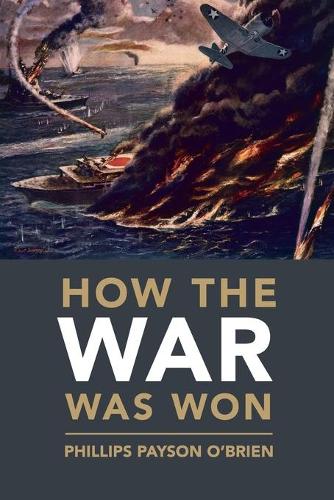
To a first approximation, there are a million books about World War II. Why should you care about How the War Was Won (hereinafter “HtWWW”) by Phillips Payson O’Brien?
- It provides a new, transformative view of the conflict by focusing on production of key goods and what affected that production instead of the ups and downs of battles at the front.
- That particular lens used can (and should) be applied outside of just World War II, and you can get a feel for how that might be done by reading HtWWW.
- I have lectured about World War II and read many, many books about it. I have never texted friends more excerpts of a book than this one.
I have some criticisms of HtWWW, but if the criticisms dissuade you from reading the book, I will have failed. These complaints are like tut-tutting Einstein’s penmanship.
The Wikipedia-Level Story of World War II (and O’Brien’s Counterargument)
To understand why O’Brien’s argument is so novel, you need to know the modern-day conventional understanding of the story of World War II. Here is my summary of the conventional narrative of World War II:
- Germany conquered Poland and France. It tried to bomb the UK into submission/maybe enable an invasion. That effort failed when Germany was defeated in the Battle of Britain, thanks largely to the plucky efforts of British airmen (memorably summarized by Winston Churchill: “Never in the field of human conflict was so much owed by so many to so few”.)
- Stymied in the West, Germany invaded the Soviet Union, won a bunch of crushing victories, but then got turned back at the gates of Moscow. The Soviets moved all of their factories east of the Ural Mountains and produced a vast tide of T-34 tanks that overpowered the Germans.
- The Germans suffered a catastrophic defeat at Stalingrad and a bloody strategic defeat at Kursk, after which the Soviets relentlessly pounded Germany to defeat.
- The US and the UK sent a lot of material help and eventually fought the Germans too, most notably in the D-Day invasion and the Battle of the Bulge. However, most of the fighting was done by the Soviets.
- It is very difficult to say how important the aerial bombing campaigns of the Western Allies were in defeating Germany. The Germans moved much of their production underground, insulating them from truly disastrous effects.
- The U.S. mostly fought alone against Japan, which won a series of impressive early victories (e.g., Pearl Harbor, the conquest of Singapore) until the decisive Battle of Midway, after which the vastly larger US industrial base outproduced Japan into oblivion.
- The US bombed the Japanese into submission by destroying Japanese cities, ultimately by dropping atom bombs on Hiroshima and Nagasaki.
By examining where the Axis focused their productive capacities and how the Allies disrupted those capacities, O’Brien challenges virtually every part of that narrative:
- The Battle of Britain was not a close-run thing. The fact that British fighter planes were flying over their own territory meant their attrition rate of pilots and aircraft were far lower than the Germans’.
- American and British bombing mattered far more to the war’s outcome than the battles of the Eastern Front, which consumed a much smaller portion of German expenditures.
- American and British airpower made German battlefield victories on the Western Front virtually impossible and dramatically limited the force Germany could bring to bear in the East.
- Japan (really, Japan plus the giant empire it conquered at the beginning of the war) was an industrial behemoth to rival the Soviet Union. However, the destruction of the Japanese merchant fleet by American air and sea forces wrecked Japan’s economy.
- The firebombing of Japanese cities and the atomic bombings of Hiroshima and Nagasaki had an ambiguous strategic effect. American air power played a much more important role in severing Japan from the natural resources it had conquered in the early part of the war.
August 14, 2024
The Korean War Week 008 – The First UN Counterattack – August 13, 1950
The Korean War by Indy Neidell
Published 13 Aug 2024The first UN large scale counterattack goes off this week; this by the American Task Force Kean. It has both successes and failures, and it runs right into a new North Korean offensive. The fighting happens just about everywhere on the Pusan Perimeter this week, though. That’s the area into which the UN forces have been compressed, and it is particularly threatening at the Naktong Bulge. It is, plain and simple, a week of desperate and bloody fighting and that’s about it.
Chapters
00:47 Recap
01:27 The Pusan Perimeter
04:31 Task Force Kean
07:44 The Naktong Bulge
10:09 The Fight Around Daegu
13:45 Summary
(more…)
Madsen M50: From the Korean War to Star Trek
Forgotten Weapons
Published May 1, 2024During World War Two, Madsen (DISA) manufactured a licensed copy of the Finnish Suomi (see: Danish M1941 Suomi SMG). When the war ended, they wanted to replace this with a more modern, inexpensive design of their own. The result was the Model 1946 Madsen, a creative clamshell design of stamped parts. It is a very simple blowback, open-bolt 9x19mm SMG that perfectly fit the post-war era. The M46 version was sold to a few countries, and after some continued development and refinement the M50 version was demonstrated to a public audience in November 1950. This pattern was even simpler than before, and proved a popular gun for many unaligned countries in Central and South America and Southeast Asia — so much so that it remained in production until the 1980s. A bunch were imported into the US in the 1950s and 1960s, and they found a home in the movie industry, where they were often used in fantasy/sci-fi films to avoid having guns that would be recognized by American movie audiences.
(more…)
August 11, 2024
The US drops two atomic bombs on Japan – WW2 – Week 311 – August 10, 1945
World War Two
Published 10 Aug 2024This week atomic bombs are for the first time in history dropped on cities — Hiroshima and Nagasaki in Japan. The bombs kill over 100,000 people and flatten large parts of the urban area. The Japanese government is actually meeting while the second bomb is dropped to consider their response to the first and to the demands for unconditional surrender. The response is not just to that first bomb, though, for on the 8th the Soviets tell the Japanese not only that they will not help them negotiate some sort of settled peace with the other Allies, they too are declaring war on Japan, and indeed invade Manchuria. With two atomic bombs and an invasion instead of mediating help, Japanese Emperor Hirohito cuts off any debate and says that Japan will surrender. This could happen next week.
00:00 Intro
00:17 Recap
00:44 Hiroshima Bombing
02:35 The Bombing Mission
04:19 Descriptions Of The Blast
06:38 The Nagasaki Bomb
07:37 The Tactics
08:31 The Japanese Response
12:55 Soviets Invade Manchuria
16:18 Splitting Korea
18:07 Operation Zipper
19:31 End Notes
20:08 Summary
20:30 Conclusion
(more…)
Canada’s long-standing issues with national defence won’t be fixed by merely spending more money
In The Line, Greg Quinn explains why meeting the 2% of GDP NATO target for military spending isn’t going to solve Canada’s problems with the military:
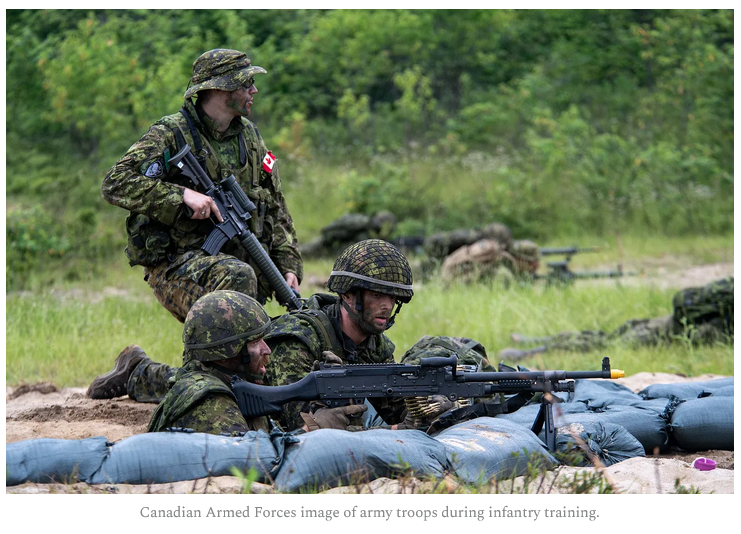
Canada isn’t pulling its weight on defence. Is that what Canadians want? Because it isn’t what its allies want. And the allies are more and more willing to say so.
Canada, and Prime Minister Justin Trudeau, likes to talk about how the country punches above its weight in NATO and global affairs more generally. It’s a cliché many countries have resorted to when put under pressure on one issue or another. (And I’ll confess that this includes my own United Kingdom, which I served as a diplomat for decades before my recent retirement.)
It’s also smoke and mirrors, which in Canada’s case on defence, hides an unhappy truth — Canada doesn’t pay its way.
Trudeau says Canada will meet the target of spending two per cent of GDP on defence in 2032. Some 18 years after NATO committed to it. At the moment Canada spends a paltry 1.37 per cent, or some $33.8 billion a year, on defence, damn near the bottom among the allies, in percentage terms. Ottawa claims this will increase to 1.76 per cent, or $49.5 billion, by 2030. If so, that will move Canada up a whopping two places to 25th.
Mind you, the Parliamentary Budget Office disputes even this, stating that Canada’s defence spending will peak at 1.49 per cent of GDP in 2025-26 before dropping (yes, dropping) to 1.42 per cent in 2029-30. Somebody is being economical with the truth.
[…]
The bottom line is simple — what does Canada (and the Canadian people) want its role in the world to be? Words are easy but they need to be backed by action. One of the most obvious demonstrations of action is spending on a defence force that is capable of deploying and acting on the global stage. More bluntly, of fighting and defeating a near-peer enemy as part of a coalition of allies.
If Canada doesn’t want to do that and prefers a defence force that is essentially a glorified local militia that focuses on domestic issues, well, fine. But let’s not pretend it is anything else. Let’s not talk about how much of a force for good Canada is in the world and let’s not try and fool Canada’s allies. They’re not as stupid as Canadian politicians want them to be.
And let’s not expect those allies to happily accept the situation and continue on as if nothing has changed. Canada already complains about being left out of AUKUS. Is it any wonder? More of that should be expected. If you don’t play the game and don’t pull your weight, then sadly, you don’t get the benefits of being in the grown-ups’ club.
Canadians owe themselves, and frankly owe their allies, an honest discussion about kind of role Canada actually wants to play in the world … and whether they’re willing to actually pay the bills required to play that role. Only after such an honest chat can Canadians, and their allies, calibrate their expectations accordingly.


